Maple Trees

Most gardeners and arborists recommend that Japanese maples be planted in what is often referred to as “dappled sunlight” or partial shade. Some recommendations even give different sunlight guidelines for parts of the country, such as full sun in some states and shade in others.  

Japanese maple trees thrive best in partial shade – but some can tolerate more sun. Bloodgood, coral bark, crimson queen, orangeola, and Shishigashira Japanese maple trees are varieties with a higher sun tolerance. If your Japanese maple is already in full sun, make sure it has plenty of water.

While you cannot plant your Japanese maple tree and walk away if it is in full sun (as you might be able to do if it is planted in dappled light), you can put forth some extra effort to grow a Japanese maple in full sunlight.

What Is A Japanese Maple Tree?

Japanese maple trees come in multiple varieties, but, overall, they are smaller, ornamental versions of the standard, large maple trees found predominantly in the northeastern United States.

Japanese maple trees originated in, as their name indicates, Japan, and they are also native to China, parts of Russia, and Korea.

Despite being native to lands far away from the United States, Japanese maple trees generally grow very well here and have become a favorite of gardeners for their ability to bring some shade, beautiful and interesting colors, and varying shapes to gardens and yards of all sizes.

Because they are much smaller than most other varieties of maple tree, Japanese maples are able to be placed in small yards, small gardens, and even containers.

Planting these trees is a great way to bring those characteristic maple leaves and fall colors into a smaller space without having to plant a large red or silver maple that could reach a height of 80 feet or more. 

While Japanese maple trees do not like very hot climates, they can appear to die in the winter months if the temperatures are very cold, according to Goodlettsville Parks and Recreation. But they are not gone, and they will grow back in the spring! 

According to the Portland Urban Forestry, there are over 120 different types of Japanese maple trees.

That means there are different kinds for different purposes, and different kinds for different environments. Some trees are better suited to sunlight than others, making it easier for you to plant a Japanese maple tree even if you have a varying amount of sunlight in different parts of your yard or garden. 

Most recommendations will state that Japanese maples are easily scorched and burned by direct sunlight and high temperatures, which is true. But if you are determined to plant a Japanese maple tree in a very sunny spot, there are some measures you can take to set yourself up as best as possible for a thriving tree. 

Some of the basic things you can do include:

  • Choose a type of Japanese maple tree that is already predisposed to grow better in full sun.
  • Prep your soil so it will keep your Japanese maple well-watered at all times.
  • Have equipment on hand to allow you to protect your Japanese maple from the sun.
  • Adjust your tree’s environment when possible.
  • Understand the coloration of your particular Japanese maple tree so you will know at any given point in the year whether its leaves look healthy or whether they might be showing signs of distress that could mean that you need to change something about the way the tree is being shaded or watered.

Next, we will examine a few different varieties of Japanese maple that are better suited for full sun than many other types of Japanese maple. This is your first step in planting a Japanese maple that can thrive in full sun!
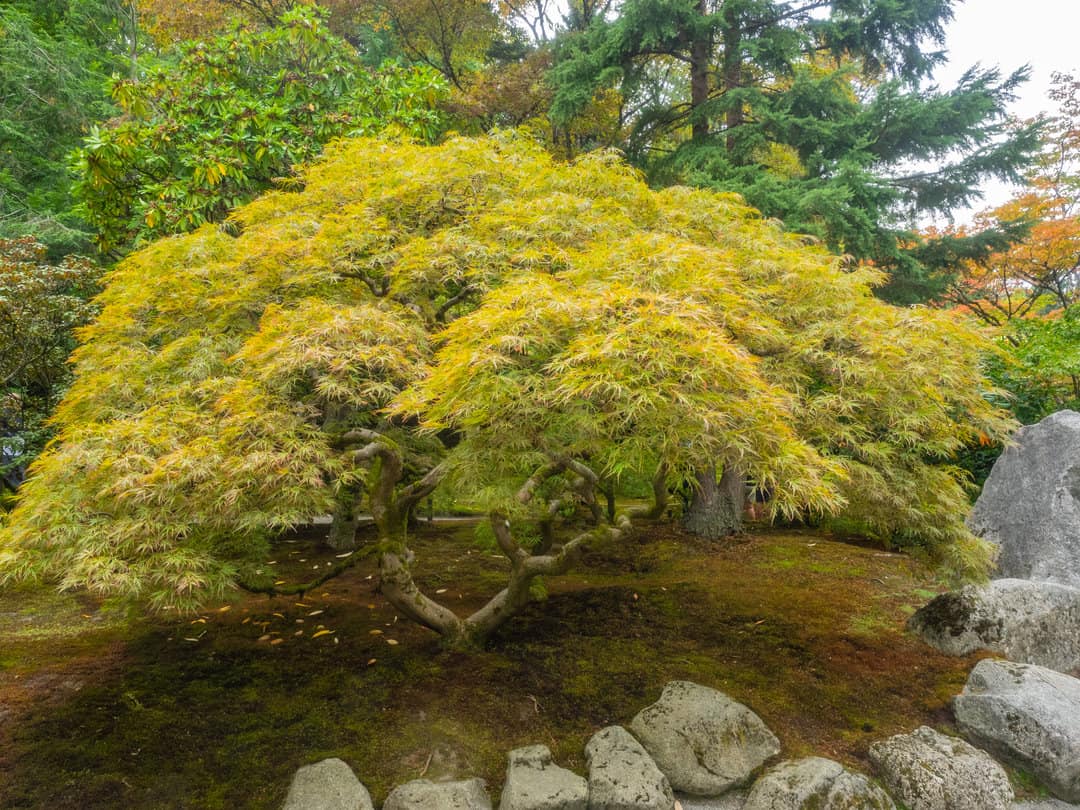
Japanese maple (Acer palmatum)

Choosing The Best Variety Of Japanese Maple Tree For Full Sun

Perhaps the easiest way to make sure your Japanese maple tree can thrive in full sun is to choose a variety that is one of the more sun-tolerant species.

Some Japanese maples do better in full sun than others, so you can get a head start on growing your Japanese maple tree in full sun just by picking the right tree from the start. 

According to the University of Washington Botanic Gardens, there are actually a number of species of Japanese maple that can survive in full sun, provided the right steps are taken regarding watering, irrigation, and planting.

In general, Japanese maple trees with green leaves are those that will do better in full sun, whereas the red-leafed varieties are more likely to burn in direct sunlight.

Varieties Of Japanese Maple That Can Tolerate Full Sun

These are some specific varieties of Japanese maple trees that are most likely to thrive in full sun. We are also including information about the leaves and colorings of these trees, as knowing what their typical year-long leaf cycle looks like can help you identify problems as soon as they occur.

If your tree’s leaves change color too soon, change the wrong color, or start to fall off early, those can all be signs of distress. Distress can mean that the tree needs more water, the mulch is wrong in some way, or the tree needs some shade for a while.

Keep an eye on any Japanese maple you are growing in full sun, as the extreme conditions make this tree more vulnerable to problems than one grown in dappled light or partial shade. 

Here are some types of Japanese maple tree that are good choices for growing in full sun:

The Bloodgood Japanese Maple Tree
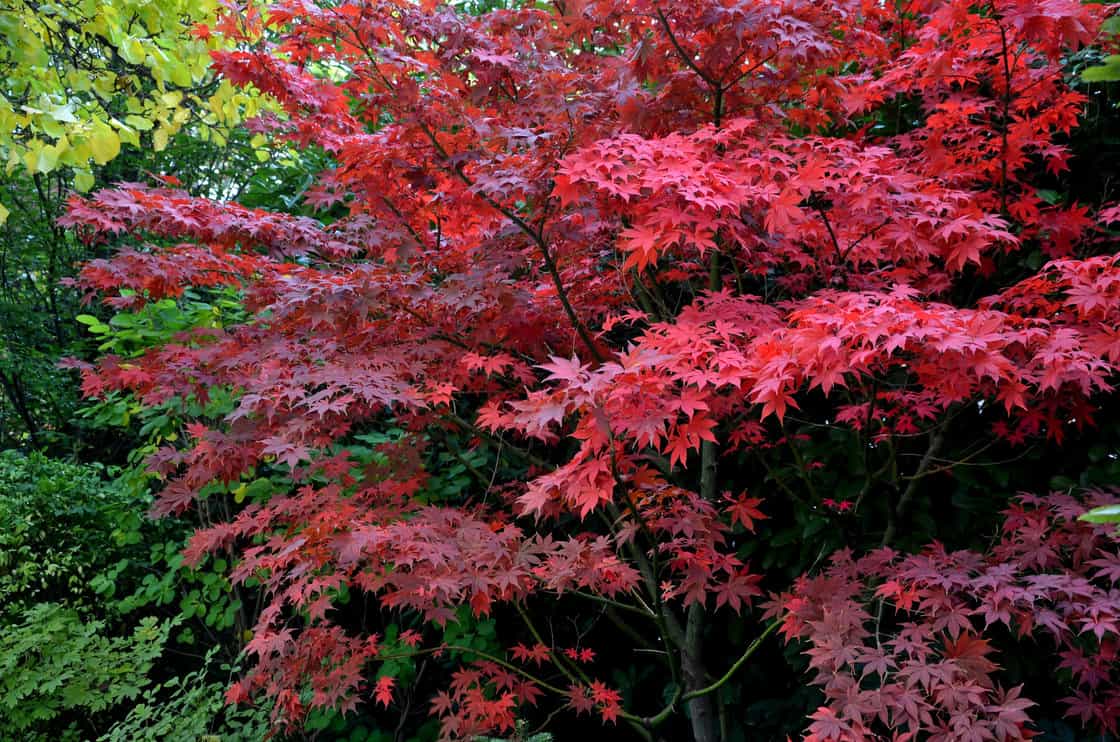
Bloodgood Japanese Maple Tree

The bloodgood is a variety of Japanese maple tree that, according to Bellarmine University, actually needs some direct sunlight part of the day.

Unfortunately, it also needs some afternoon shade, but if you are able to provide a location where it can be at least partially shaded, this tree is likely to survive the bright light of direct sun.

Bloodgood Japanese maples are one of the larger varieties of Japanese maple. While they are nowhere near as big as standard maple trees, this variety of Japanese maple can grow as tall as 15 to 25 feet.

Like many trees, the bloodgood gets its name from the color of its leaves. Though the green leaf varieties of Japanese maple are often the ones that thrive most in full sun, the bloodgood is an exception. Its leaves are red all year round, with deep, dark colors in the spring and summer and bright red colors in the fall.

If you like red leaves, this might be the perfect tree for you!

The Coral Bark Japanese Maple Tree

The coral bark Japanese maple is the common name for the Sango-kaku Japanese maple. It is one of the green-leaved varieties of Japanese maple that is most able to tolerate full sun, so this is one to put at the top of your list. 

This tree is able to be planted in full sun, as long as it is kept in moist soil, according to the North Carolina State University Extension. If you are willing and able to be very diligent about keeping the soil around your Japanese maple tree well-watered at all times, this might be a good variety to try for full sun. 

The coral bark Japanese maple gets its name from the color of its bark in fall and winter, which literally appears to be the reddish color of coral. The trees are, like most Japanese maples, slow-growing and rather small.

The coral bark is particularly well-suited to gardens or yards that you want to add some color to in winter, as the bark is most colorful during the cold seasons after the leaves have fallen off the tree. 

Coral bark Japanese maples have light green and yellow leaves in the spring and summer; in the fall, their foliage changes to a bright yellow color followed by an almost pink color in winter before the leaves finally fall to reveal that characteristic bark. 

This tree can lend an unusual and very interesting aesthetic to your yard or garden. 

The Crimson Queen Japanese Maple

According to Washington State University’s Clark County Extension, the Crimson Queen Japanese maple tree can grow in full sun, though, like most Japanese maple trees, it prefers to be in the shade on hot afternoons.

If it is exposed to direct sunlight in the hot summer afternoon sun, the leaves can be scorched, as is a common problem with Japanese maple trees. 

The Crimson Queen variety of Japanese maple is yet another variety that gets its name from the colors of its leaves. Its leaves are dark red in the summertime and then lighten to a brighter red in the fall. 

This variety of Japanese maple is on the smaller side, so it is ideal for small gardens or containers. The Crimson Queen usually only grows to a height of about 6 to 10 feet.

This small tree might be a perfect addition to your garden, and its small size makes it easier to water and protect from too much sun. 

The Orangeola Japanese Maple Tree
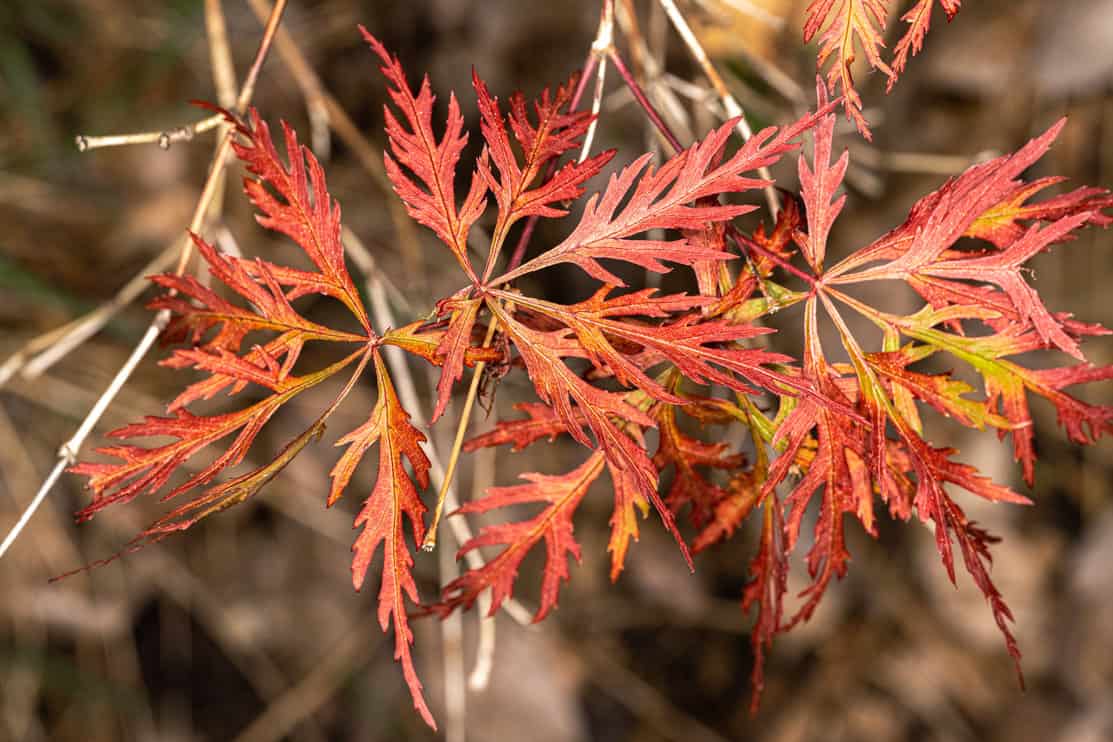
Acer palmatum var. dissectum, ‘Orangeola’

The orangeola is a variety of Japanese maple tree that is very tolerant of high temperatures and hot climates. This makes it a great tree to plant in a spot that receives full sun.

Once again, the tree in question was given its name because of the colors of its leaves. Orangeola Japanese maples have a mix of orange and green leaves in springtime that turn dark purple before turning green again in the summer, then orange and purple again. The fall foliage of these trees is a striking bright orange, lending the tree its name.

The foliage of this tree is very interesting and changes a lot throughout the year, making this tree a favorite. It is also one of the fastest growing varieties of Japanese maple, so it might work well if you are looking to plant a tree that will reach maturity quickly. 

Orangeola Japanese maples grow to be about 3 to 5 feet tall but they are very wide trees, reaching a width of up to 8 feet. You can therefore plant this variety of Japanese maple in a small corner of a garden or in a container.

If you are looking for a small tree with stunning foliage that can survive heat better than most other types of Japanese maple, look no further than the orangeola.

The Shishigashira Japanese Maple Tree (Lion’s Head Japanese Maple Tree)

Acer palmatum 'Shishigashira'
Acer palmatum ‘Shishigashira’

Also known as the Lion’s Head Japanese maple, the Shishigashira is a variety of Japanese maple that is more sun-tolerant than most.

According to the Washington State University Clark County Extension, the Lion’s Head maple, as it is commonly called, does well in full sun. It will be easiest to grow with some dappled light or shade, but the full sun helps its leaves produce the most vibrant colors in the fall. 

The Lion’s Head Japanese maple is a medium-sized Japanese maple, growing to about 10 to 15 feet tall. Its leaves are green in spring and summer, then they turn orange and dark orange in the fall. The tree earned its nickname of “Lion’s Head” because the leaves are often so vibrant that they appear like a golden lion mane. 

If you want to choose a Japanese maple that does not need as much protection in the shade as other varieties, the Lion’s Head is a great choice. 

Some General Guidelines For Planting Japanese Maple Trees In Sunny Locations

No matter what variety of Japanese maple you have chosen, planting one in full sun means that you will have to take some extra steps to help your tree thrive in these difficult conditions. Missouri State University recommends that Japanese maples are planted in full sun only if the soil is kept moist and is also mulched. 

Keep in mind that leaves can be scorched and sunburned no matter how much water you give your tree, so taking care during the summertime to protect your tree can be quite the task.
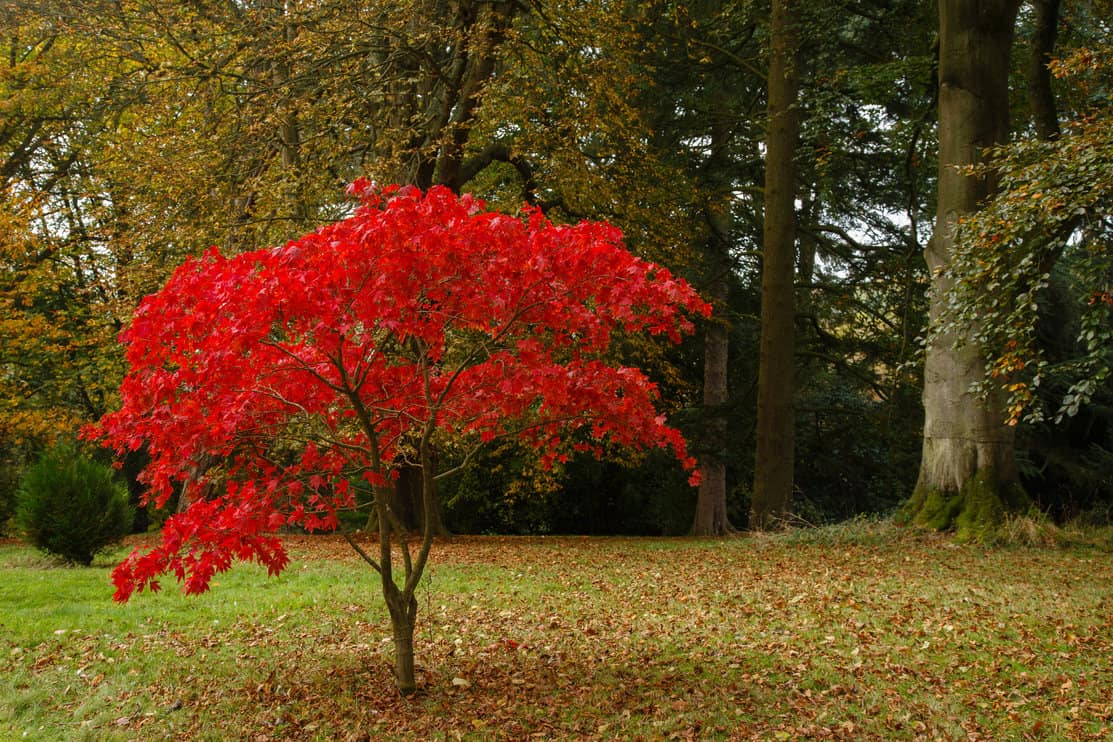
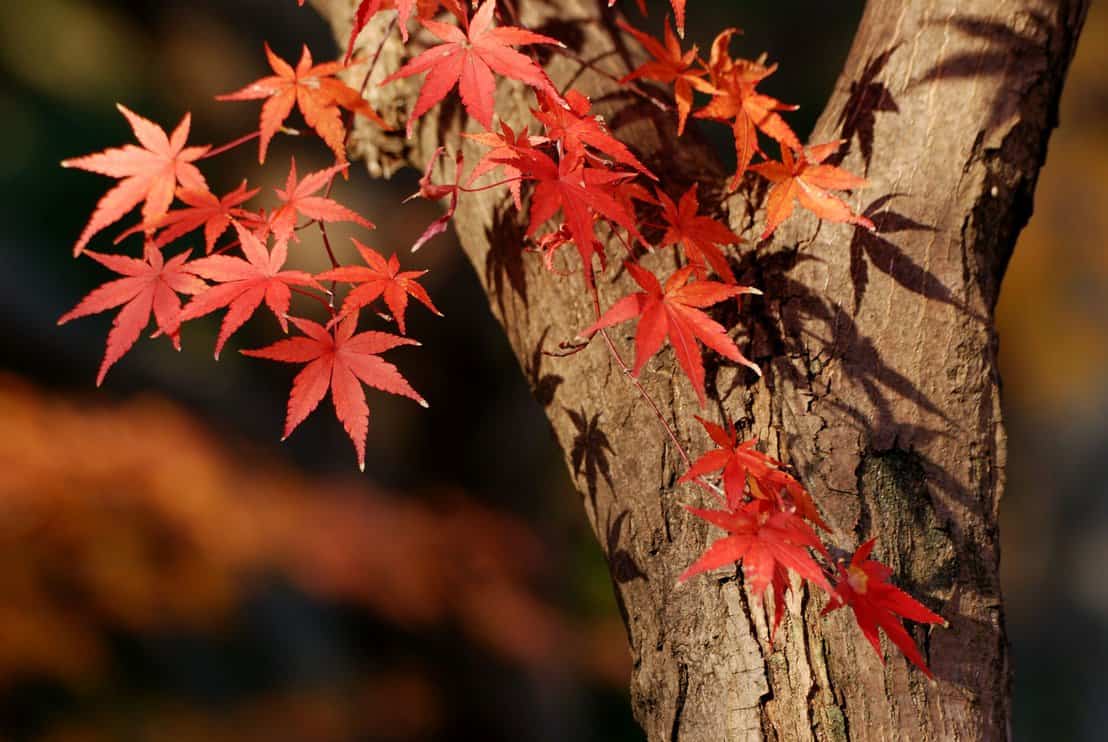
Acer in Autumn

Providing The Right Amount Of Water For Your Japanese Maple Tree’s Soil 

One of the most important things you can do for a Japanese maple tree that is planted in full sun is make sure it is adequately watered and that the soil it is planted in is kept moist but also drained.

Using Mulch To Retain Moisture In The Soil

It’s good to use mulch to keep the soil moist and keep the roots of your tree from overheating.

Follow these guidelines to help keep your Japanese maple tree’s soil hydrated and healthy:

  1. Choose an organic mulch, like this Rio Hamza Trading Pine Bark Mulch.
  2. The best time to apply mulch is springtime while making sure that your maple tree is well mulched during the hottest days.
  3. Mulch as wide in diameter as the thick of the tree’s canopy.
  4. Mulch your Japanese maple no thicker than 4 inches. Doing so can actually prevent oxygen from getting to your tree’s roots! It can also make the tree too hot, which is the opposite of what you are trying to achieve by providing the mulch in the first place.
  5. Don’t pile up mulch on the tree trunk. Create a buffer zone between the tree trunk and where the mulch starts, making sure that the root flare is completely free of mulch materials.

Remember that you will need to check on the mulch periodically, as it can get moved or disrupted by weather and wildlife. You will also need to replace or reapply mulch every so often, at least once a year. It is recommended to make this annual chore a springtime task. 

Placing mulch around the base of your Japanese maple tree can go a long way in preventing some of the drying problems that occur due to exposure to direct sunlight. If you plan to put your Japanese maple tree in full sun, mulching is a very important step in helping your tree thrive.

Setting Up A Regular Watering System

Another crucial step in helping your Japanese maple tree thrive in full sun is to provide adequate water for it, particularly during the hot summer months.

You should water your tree either in the early morning or in the evening. There are a number of ways to water your tree, but you should choose whichever method is most likely to result in regular watering of your tree.

You can use an installed sprinkler system, a garden hose with a sprinkler attachment, a soaker hose, or even an automated timer on your soaker hose or garden hose sprinkler.

Whichever method you choose, try to make it as foolproof as possible so your Japanese maple is never without adequate water. This is key to helping it thrive as it grows in full sun.

You should also make sure to water deeply as well, so that the water hits the bottom of the tree’s roots.

Giving Your Japanese Maple Tree A Break From The Sun

While many of these techniques can help you grow a Japanese maple tree in full sun, it might be a good idea to give your tree a break from all that direct sunlight every now and then.

One way to do this is to cover your tree during some of the hottest, sunniest hours of summer with a tree cover normally used to protect trees from frost, like this Sunpro Plant Cover.

You can cover your tree just as if you were preparing it for winter, but you can leave this cover on for just an afternoon or even give your Japanese maple tree a break in the shade for a few days. 

Another creative solution is to use shade netting, like this Garden Expert Black Sun Plant Mesh, to create a sort of awning over your Japanese maple tree in the afternoons.

You probably shouldn’t just drape the mesh directly on top of your tree, as this has the potential to harm the leaves and twigs, but you can use sticks or stakes to prop it up over the tree and provide some relief from the sun. 

These methods would be particularly useful in the summer, when bright, direct sunlight can combine with heat to both dry out your Japanese maple and also scorch it, damaging the leaves irreparably. 
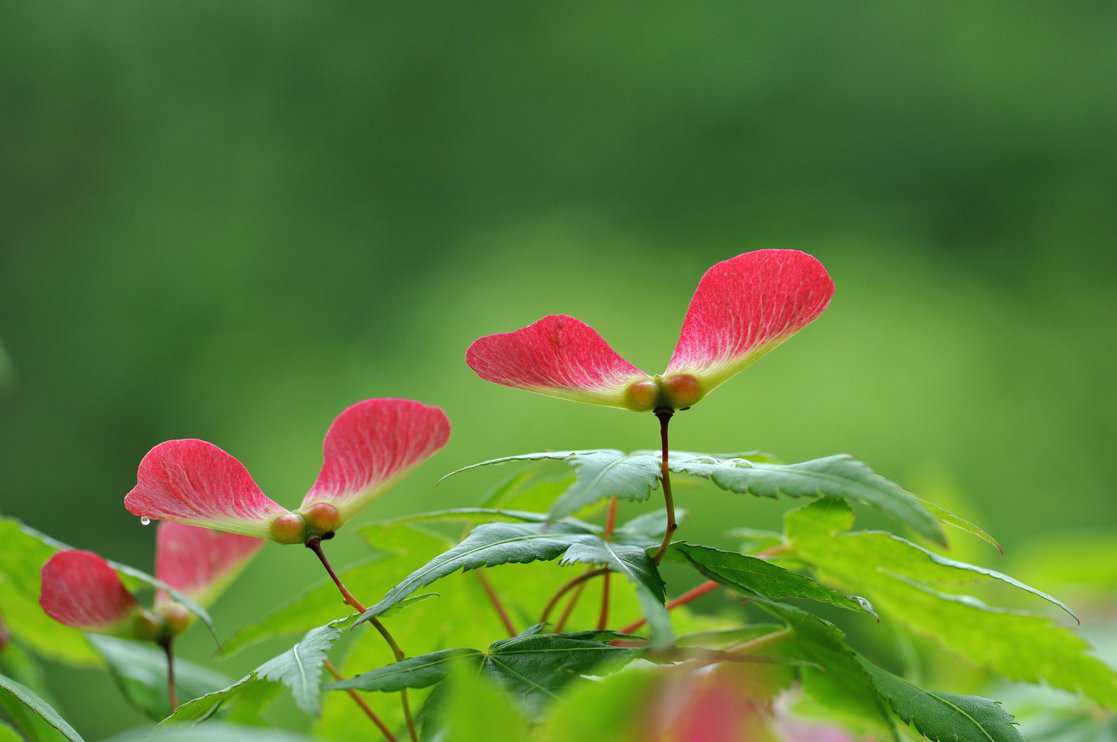
japanese maple seedlings

That’s A Wrap!

Now you are ready to choose a type of Japanese maple tree and plant it in your garden or yard, even if the chosen location is in full sun.

Make sure you are prepared with the proper equipment for mulching, watering, and perhaps even providing some shade for your tree. As long as you are diligent about keeping your tree hydrated, keeping the soil around it moist, and make sure the leaves are not experiencing too much scorching or sunburn, your Japanese maple tree can thrive in full sun. 

If you’re still not sure if your Japanese maple needs sun or shade, here’s how to tell!

Enjoy your Japanese maple tree!

References

Shaughnessy, D., & Polomski, B. (2006). “Maple.”

Triolo, V. “The Japanese Maple: A Deciduous Tree Graft.”

Julie, A. (2022). Bloodgood Japanese Maple Tree. Findings from the Field5(1), 63.

Planting anything under a maple tree can present unique challenges. Many people who have tried their hand at landscaping under the thick, dry, dark canopy of big maple trees have only thrown their hands up in resignation. Maple trees have expansive roots that greedily seek any moisture and nutrients in the soil, leaving you wondering what you can under them.

You need smaller plants with shallow roots, are drought tolerant, and love shade when planting under maple trees. The best companion plants to pair with maple trees include hellebore, vinca minor, sedum, ferns, daffodils, lilly of the valley, daylilies, tulips, crocus, and Canadian wild ginger.

The list is relatively small when it comes to plants that can survive underneath a maple tree because of their roots and the thick canopy that keeps the ground shaded. Some plants can thrive under a maple tree and below are 11 of the best plants you can plant under your maple trees – let’s get to it!

Why Most Plants Fail Under Maple Trees

Grass is difficult to grow underneath maple trees because of the dry, shady conditions. Most turf grass requires plenty of sunlight and moisture, but under the canopy of maple trees, these commodities are rare.

Some grasses can grow in shade, but then you could end up with a lawn that’s not uniform in color and texture. Not to mention the difficulty in mowing around the exposed roots of maple trees because they are so shallow and often stick up above the ground.

The maple trees themselves need quite a bit of sun to thrive, which is why shade-tolerant plants are important for the ground cover below them.

Maple Tree Roots Steal Most Of The Nutrients

There are a lot of plants, shrubs, and flowers that grow quite well in shady conditions, the problems come when you disturb a maple tree’s roots or you start to water the plants. The roots of maple trees are greedy feeders that can choke out other plants when they are introduced into the area.

When you plant something, you have to dig a hole, of course. However, when you plant under a maple tree, no matter how careful you are, you will end up cutting through some roots. The next step is to water and possibly fertilize the new plant. That’s when the maple tree sends its roots out to collect all the water and nutrients.

When maple tree roots are disturbed or cut, they will regrow feeder roots. These can grow fast and thick, and they often will become so thick they choke out the roots of any other plants to absorb as much water as possible.

One way that can circumvent this problem is to lay a few inches of soil over the shallow maple roots, but there are risks associated with this too. If you drop too much soil over the roots, the tree could decline, or you’ll shorten its lifespan.

Too Many Plants And Soil Can Cut Off Tree Root Circulation

Tree roots need some air circulation, that’s why they pop up at the surface. When the soil is too compact, or they are covered in a thick layer of mulch or soil, then the roots can suffocate. You may not notice it at first, but this will eventually reduce the years left on the tree and weaken it.

When covering tree roots with soil or mulch, the fresh nutrients will cause the maple to send roots into this area to feed. This behavior can lead to the new plants getting choked out.

Maple varieties like the fast-growing silver maple and the invasive Norway maple species are the most difficult maples to grow anything under. Many owners report any plants positioned under these species end up being taken over in a year or two because of the aggressive root system.

Look For Native Plants To Thrive Under Maples

Native plants in your area are more able to withstand the summers and winters and will need less care than hybrids and species from other climates.

According to BoulderColorado.gov, native plants have evolved to grow well in their local environment. They can easily bounce back from early frost, drought, and spring snow and, once established, need very little care.

What’s A Maple Tree Owner To Do?

Colorful autumn maple tree

While it may seem like there’s nothing to do but just accept that the area underneath a maple tree is going to look sparse and dry, there are things that can make this area look better.

Search For Plants In Containers No Bigger Than A Gallon

The larger the container, the larger the hole that needs to be dug, and the more roots you’ll end up disturbing.

So, just stick to smaller containers and you’ll be much better off. If you have a proper garden cover, it’ll help cover the holes.

Water The Entire Area Around Your Plants

When watering your new plants, if you only water the plants, this will invite more maple roots to move in and start crowding out the new plant.

To avoid this problem, you’ll have to water the entire area around the tree. When the whole tree gets watered, it will be happy and it won’t need to invade the wet “pockets.”

The same goes for fertilizer. Just adding fertilizer to your landscaped plants will tell the maple tree to send out feeders to snatch up the new nutrients. Either use a broadcast spreader to fertilize a larger area, or forego the supplement altogether.

There are certain fertilizers maple trees enjoy most, especially those high in nitrogen. You can learn more about that in our full list of the best maple tree fertilizers.

Be Careful Around The Maple Tree’s Roots

While it’s inevitable that you will end up cutting through some maple tree roots when you’re planting under it, be careful around the woody roots. These are the thicker roots that have a bark-like coating around them.

When these are damaged, the tree can suffer because they store additional sugars and nutrients for the tree.

When you come across these roots while digging, cover the hole back up and move a few inches over. The softer, feeder roots won’t damage the tree as much when they are cut or broken.

Of course, you could always cut down your maple tree if you want your plants to take priority, but that’s a whole other study.

Best Plants For Underneath Your Maple Tree

Now that we have those caveats covered, here are the 11 best plants you can plant under maple trees. Get your glasses on, it’s a doozy!

Columbine Performs Well Under Maple Trees

USDA Hardiness Zone3 – 9
Flowering SeasonMid-spring to summer
Additional InfoProlific re-seeders

Columbines have distinctive five-petaled flowers that have points, or spurs, behind them. They also have pleasing foliage, and attract all matter of nectar feeders. They do well in shady areas and will look good for most of the growing season.

Columbines prefer moist, but not soggy soil. Though they are perennials, columbines are short-lived flowers that only live for about three to four years max before they stop coming back.

The good news is they reseed themselves easily, so once you get a few in your garden, you shouldn’t have to purchase them over and over.

With the easy reseeding habit, even if maple tree roots crowd out the columbines, they will continue to come back as long as you don’t have a thick bed of mulch to prevent the seeds from taking.

These flowers come in many shapes and colors, so you can have a garden area under your maple tree that has a variety of shapes and colors with these flowers alone.

Find a variety of columbine bulbs here—5 Sweet Caroline Columbine Perennial Flower Bulb Collection.

Hellebore Will Grow Under Your Maple Tree

USDA Hardiness Zone3 – 9
Flowering SeasonLate fall to early spring depending on the variety
Additional InfoEvergreen, winter flowers

One of the few plants that flower in late fall and into the winter, hellebores offer sprigs of bright color when most other plants are laying dormant, waiting for spring. Hellebores are also evergreen, so you will have color all year long.

They often look weak and spindly during hot summer days. Once the temperatures break and the season cools, hellebores come to life.

Since they like shade in the summer and plenty of sunlight in the winter, these flowers are perfect for areas under big maple trees.

Some varieties of these flowers bloom in November and stop in mid-winter around December and January, while others, like the Lenten Rose, bloom later in the season and last until spring when other flowers shine.

Once established, hellebores are not thirsty plants and can usually survive normal rains. Though in times of drought, they will require some supplemental watering. To keep them flowering, you’ll need to cut out any dead foliage and add a light layer of compost every other year.

You can propagate them by splitting them when they get crowded. They can reseed themselves, but they grow slowly, and may not flower for a year or two when they grow from seeds.

Here are a few live hellebore plants if these flowers have caught your interest—Lenten Rose Live Plants, 3 Hellebore Plants in 2 Inch Pots.

Vinca Minor Thrives Under Maple Trees

Vinca minor lesser periwinkle ornamental flowers in bloom, common periwinkle flowering plant, creeping ground flowers
USDA Hardiness Zone4 – 9
Flowering SeasonSpring to summer
Additional InfoEvergreen groundcover

This is a low-growing groundcover that has small, shallow roots that can withstand the delicate but aggressive maple roots. Vinca, also called periwinkle, sprouts small flowers either blue, purple, or white in the spring and keeps deep green evergreen foliage.

They spread by sending out thin vines that root when they touch the ground. Sometimes they will try to grow up the trees, but I have yet to see vinca that grows more than about a foot tall.

Periwinkle works great with bulbs such as daffodils, crocus, and tulips. These bulbs will poke through the vinca vines, bloom, and then recede while the vinca continues to spread out. This way you have a flourish of spring color when the flowers bloom, and a green carpet the rest of the year.

Once established, vinca minor needs very little care, it’s drought tolerant, does well without fertilizer, and will stay within a border with regular trimming. You can add a light layer of compost occasionally to keep it green and strong if the soil is lacking, otherwise, just let some of the maple leaves decompose to add nutrients to the soil.

Here are enough periwinkle plants to cover a large area—Greenwood Nursery / Live Ground Cover Plants – Vinca Minor.

Sedum Is Great Ground Cover For Under Maples

USDA Hardiness Zone4 – 9
Flowering SeasonSummer into fall
Additional InfoOver 400 different varieties

If you’re looking for a plant that virtually thrives on neglect, then creeping sedum, or stonecrop, is the “crop” for you. These plants seem to grow where all other plants fear to tread. They can grow in dry soil, between cracks in stones, and in soil that seems devoid of nutrition.

The only places some variety of sedum can’t thrive are wet, soggy lands. Sedum can take a drought like no one’s business, but too much water will have them vanishing like a magician’s assistant.

Creeping sedum is a ground cover that can coexist with even the most aggressive of maple tree roots. It will spread quickly, covering the ground with a succulent carpet of beauty that changes color in the fall.

While some varieties will shrivel up and come back next year, there are also evergreen varieties. In fact, there are over 400 varieties of sedum for you to choose from. Some grow tall and produce clusters of flowers, while others remain a colorful blanket of ground cover.

When looking for sedum, strike up a conversation with your local nursery expert to find out the best kind that will work for you and in your area. You might be able to plant several varieties in the same area for some striking visual impact.

If creeping sedum is your thing and you want to get started now, find them here—Sedum spurium Dragon’s Blood, Ground Cover.

Ferns Happily Grow Under Maple Trees

USDA Hardiness Zone3 – 10
Flowering SeasonFoliage plant
Additional InfoReproduce via spores instead of flowers

Ferns have been around since before dinosaurs and are still thriving today. Most ferns live in tropical areas, but there are still plenty of varieties that survive in North America. Ferns typically like shady, moist soil, so if you plant these under your maple trees, you’ll have to water the area regularly.

Two species of ferns that have found happiness growing underneath maple trees are the maidenhair fern, and Japanese painted fern. The maidenhair fern looks slightly different from typical ferns such as the Boston fern. It has small, fan-shaped leaflets that grow off the thin stems.

They are considered slow-growing ferns, taking up to three years to reach maturity. When fully grown, they reach about one to two feet tall and wide. These will need more water than most plants, so if you don’t want to water them constantly, you will do better getting something a little less thirsty.

Japanese painted ferns are visually stunning plants. They have bluish-silver fronds, with darker ribs for contrast and grow about 18 inches tall and wide.

These ferns naturalize relatively easily because they can spread through rhizomes. They also love the shade, as the strong, southern sun will scorch the delicate leaves. They are more tolerant of the dryer, poorer soil than maidenhair ferns, but they still need moist soil to keep them happy.

The gorgeous color of these ferns might make up for their tendency to be picky.

Daffodils Can Live Under Maple Trees

USDA Hardiness Zone3 – 9
Flowering SeasonSpring
Additional InfoMake great cut flowers

These bulbs are great for naturalizing and often seem to spring up in yards across America as if my magic. They are hardy bulbs that come up in early spring, produce a flourish of yellow, orange, or white flowers, then recede into the ground when it’s time to mow.

They are easy to grow under maple trees because they have a mounding, clumping habit, and will shrivel back when the tree’s canopy reaches full bloom. Since daffodils clump together and the bulbs propagate easily, you’ll have to separate clumps occasionally to keep them healthy.

Bulbs are great options to plant around maple trees because all you have to do is dig a small circular hole in the ground, drop the bulb in and cover it. When planting daffodils, put them in the ground in the fall, and they will flower in the spring. Use this Edward Tools Bulb Planter to make planting bulbs easy.

You can find plenty of daffodil bulbs here—Yellow Daffodils 25 Healthy Heirloom Bulbs.

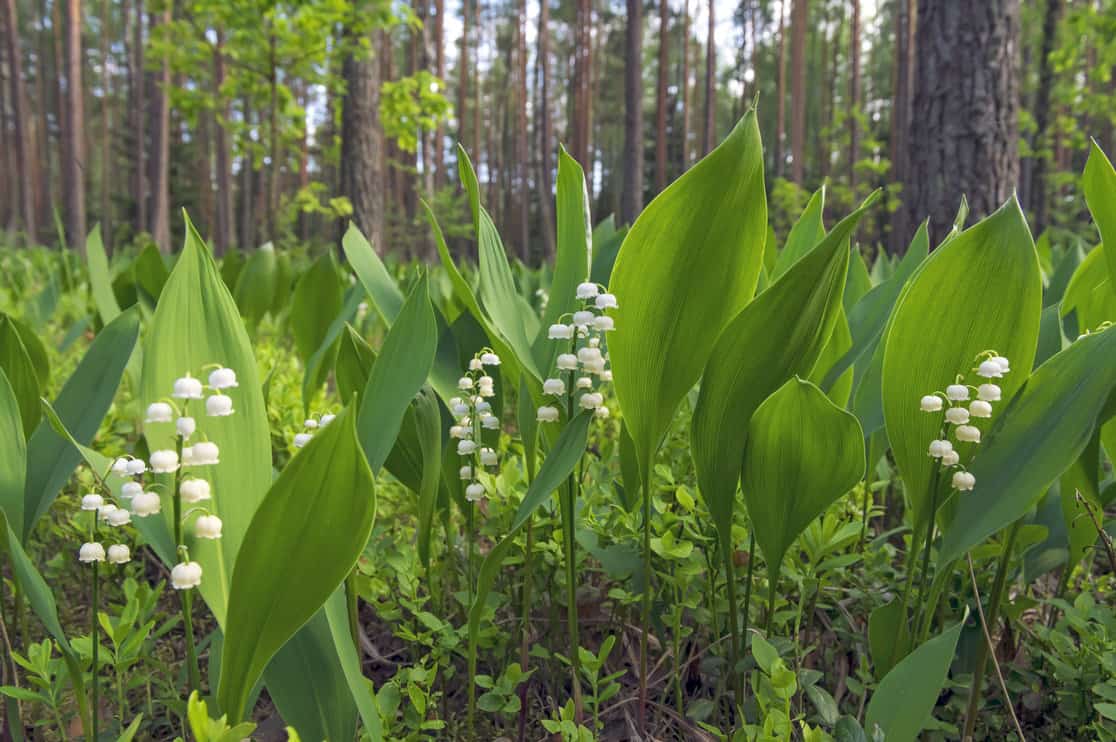
Lily Of The Valley Flourishes Under Maple Trees

Blooming lilies of the valley in sunny pine forest
USDA Hardiness Zone3 – 8
Flowering SeasonSpring
Additional InfoConsidered invasive in some areas

These little plants with their bell-shaped delicate flowers and thick, rich, green foliage are next to the dictionary under “set it and forget it.” They grow well in shady areas, like under trees where most other plants dare to grow.

Lily of the valley spread through rhizomes that can be separated and replanted when they get too crowded. They will quickly spread out and cover an area where adequate shade protects them from too much sun. 

There aren’t many pests that will damage your lily of the valley plants. Occasionally aphids or spider mites can become a nuisance, but ladybugs will often keep them in check. When these lilies go dormant, the pests have no choice but to move on.

These little beauties with their fragrant flowers grow so well in some areas they are considered invasive species, so check your local nursery experts to find out if certain plants are invasive.

You can get a start on lily of the valley here—White Lily of the Valley 10 Pips.

Daylilies Prosper Under Maple Trees

USDA Hardiness Zone4 – 9
Flowering SeasonSpring to fall
Additional InfoEvery part is edible

Daylilies are prolific and all-purpose flowers that are used in landscapes all over. They grow in full sun to partial shade, can tolerate droughts, and attract butterflies and hummingbirds.

These plants spread through tubers and seeds and are easily separated and propagated. The flowers come in many colors, as well as styles. You can have double daylilies, ruffled edges, small flowers, or some nearly as large as dinner plates.

Their leaves show in early spring, then they put out thin, round stems where the flowers grow and last sometimes until the fall, but the mounding foliage sticks around until fall. All you have to do is cut them back when they are dried out and they will come back bigger and lusher.

For planting daylilies under maple trees, plant them closer to the outer edge as they need some sun to produce more flowers. A nice contrast would be to plant some ground cover plants in the inner area of the tree and use daylilies as a border at the outer edge.

When the daylilies are cut back, you still have some cover, and when everything is growing you have a nice, contained area of green under the tree.

There are many colors and varieties of daylilies. These are quite natural looking for areas under maple trees and are quite inexpensive—50 WILD DAY LILY BULBS.

Tulips Will Bloom Year After Year Under Maples

USDA Hardiness Zone3 – 8
Flowering SeasonEarly spring
Additional InfoPerennials, but some have annual habits

Tulips share a lot of similarities with daffodils. They are both harbingers of spring, but tulips can poke through the ground when there’s still a threat of snow and freezes. This is okay because they are cold tolerant plants.

Tulips are essentially perennial bulbs, but after centuries of hybridizing, some of these bulbs have lost their ability to return year after year. Unfortunately, some tulip bulbs may only come up one time, but you get to change them out and alter the colors every year.

If you want your tulips to come back every year, search out words like naturalizing, perennial, and certain species of tulips when you’re looking to purchase. Smaller tulips like dwarf varieties are also recurring bulbs that will come back each year.

The smaller versions rarely make great cut flowers because they are usually too small to put in vases, but they will make a return instead of being a once-and-done flower.

These tulips are perennials, so you won’t have to replant every year—Perennial Tulip Bulbs.

Crocus Spreads Under Maple Trees

USDA Hardiness Zone3 – 8
Flowering SeasonEarly spring
Additional InfoCrocus means cheerful

When it seems the groundhog was right and winter is sticking around longer than it needs to, the crocuses will poke through the ground to offer the dreary landscape some much-needed color. These little flowers can be naturalized for some early, sometimes needed brightness.

These dainty flowers grow from corms. In the late days of winter, you might see the thin leaves poking through the barren landscape, and soon the little colorful flowers will show you that spring is coming.

Most crocuses are quite small, but the Dutch giant varieties grow up to four inches tall. Yeah, not very big for a giant, but they are great for early bees who need a spring snack.

Crocuses will spread like most flowers that grow from bulbs, so once they clump together, you can spread them out to have more clumps of these early spring flowers. As long as you plant them in the fall, they will flower in spring. They need a period of cold weather to make them flower.

Once you have planted them, there’s nothing much you need to do to keep them healthy. As long as the dormant corms get a dose of water between dry spells, they will be fine. Just add them to the landscape with some later blooming flowers or ground covers for visual interest throughout most of the year.

Get an early start on spring with these—Perennial Crocus Bulbs.

Canadian Wild Ginger Sprouts Under Maple Trees

USDA Hardiness Zone3 – 7
Flowering SeasonSpring to summer
Additional InfoCan attract the endangered Pipevine Swallowtail Butterfly

Canadian wild ginger is a low-growing ground cover that has spade, or heart-shaped leaves that grow about six inches tall. Their flowers are often found underneath the foliage and are mostly hidden, but they can attract the pipevine swallowtail butterfly. This butterfly is considered endangered in Maine.

Wild ginger can propagate from seeds or by splitting the rhizomes. Propagation by seeds is often difficult, so it’s easier to split groups of wild ginger through the rhizomes.

It’s a shade-loving ground cover that tolerates dry conditions. It may need some supplemental composting if the soil is lacking in nutrients.

Wild ginger is also evergreen, so if you plant this around your maple trees, it will keep a pleasing color all year long.  

Use Container Plants Under Your Maple If All Else Fails

Now you have several options for planting under your maple trees, but if none of these work, or they just aren’t what you’re looking for, you can always use containers. Adding a light layer of mulch—two to three inches max—and various containers can offer an acceptable alternative.

When it comes to container gardening you also don’t have to weed, till, or rake these plants. Much easier!

This way you can plant nearly an endless option of plants, shrubs, and flowers under your maple tree. As long as they are shade plants that do well in containers, plant away. Using varying types of containers in both height and width will lead to a more appealing contrast.

To keep from compacting the soil too much, use lighter containers and ones that aren’t too deep. Compacted soil can damage tree roots, so we try not to pack it down too much.

You can also fill the bottoms of containers with lightweight materials like used water bottles to keep them from getting too heavy.

Let’s Conclude This Session

While it can certainly be difficult to find plants that will tolerate the hungry, thirsty, and downright pushy maple roots, you now know you have a few options.

Whether you go with spring bulbs for a pop of early color, ground cover, or a mixture, you don’t have to suffer with a brown “dirt scape” under your maples.

It may be a bit of extra work in the beginning, but most of the plants in this article will grow with minimal care once they are established. Soon you will have a vibrant, lush landscape where once nothing would take.

If you’re interested in planting a new maple tree, take a look at our top picks for the best maple trees to plant here!

References:

Pregitzer, Kurt S., et al. “Variation in sugar maple root respiration with root diameter and soil depth.” Tree physiology 18.10 (1998): 665-670.

Xia, Mengxue, Alan F. Talhelm, and Kurt S. Pregitzer. “Fine roots are the dominant source of recalcitrant plant litter in sugar maple‐dominated northern hardwood forests.” New Phytologist 208.3 (2015): 715-726.

Martin, Patrick H. “Norway maple (Acer platanoides) invasion of a natural forest stand: understory consequence and regeneration pattern.” Biological invasions 1.2 (1999): 215-222.

Pegram, Kimberly V., et al. “Warning color changes in response to food deprivation in the pipevine swallowtail butterfly, Battus philenor.” Journal of Insect Science 13.1 (2013). https://academic.oup.com/jinsectscience/article/13/1/110/1751849  

If you’re lucky enough to have a big maple on your property, you know the joy it can bring – hearing the wind blow through the leaves, enjoying the cool shade in summer, watching the leaves turn vibrant autumn colors. Maybe you are also struggling with a bare patch beneath it where nothing seems to survive. What plants can you grow under a maple tree… and what plants aren’t even worth a try?

Maple trees have a shallow root system where plants underneath will compete for nutrients and water. Avoid planting goldenrod, aster, English ivy, oriental bittersweet, wisteria, field bindweed, bishops weed, honeysuckle, clover, and hostas directly below your maple tree.

With proper landscaping, a mature maple can be a gorgeous centerpiece to your yard. So whether you’re fixing patchy areas beneath your big trees, or whether you’re planting young maples and want to give them a good start in life, read on to learn how to keep your marvelous maples healthy and looking good!

What Are Maple Trees – And Where Do They Grow?

Maples are attractive, easy-to-grow trees found in cultivated gardens and wild forests across the Northern Hemisphere. Some have colorful leaves, others interesting bark, and a few, like the valuable sugar maple (Acer saccharum), provide sap that can be boiled down into tasty maple syrup! There’s over triple digit species of maples in the world, so there’s plenty of trees to go around.

According to Oregon State University, thirteen species of maple tree are native to North America.

In the West, expect to see bigleaf (A. macrophyllum) and vine maple (A. circinatum). Midwestern forests are home to the boxelder (A. negundo), which has the largest range of any North American maple. The red maple (A. rubrum) dominates the East, although the fast-growing silver maple (A. saccharinum) is nearly as common.

In yards and urban areas, you are more likely to encounter one of the many varieties of Japanese maple (A. palmatum), a smaller species that can sometimes be no larger than a shrub, or the Norway maple (A. platanoides), a non-native that spreads so aggressively it has been classified as an invasive species by the USDA

Learning about the growth stages and patterns of your maple tree is important as well. For more information, check out our full timeline of maple tree growth!

The Challenge To Growing Plants Under Maple Trees

The needs of maple trees vary widely between seasons – however, all seasons typically lead to something not allowing plants to grow well under your maple tree.

Maple Leaves Can Block Sunlight To Plants

In the summer, their dense foliage creates a wall of leaves that completely blocks the sunlight from any plants directly beneath them. 

When their lower branches no longer get sunlight, either from their own shade or from a neighboring plant, they will shed those branches and redirect energy into overtopping the surrounding plants. (You can read more about the reasons trees lose their branches here.)

In the fall, the blanket of leaves dropped by maples can smother anything growing beneath them, creating an environment that invites fungus, slugs, and other pests if left to rot in place.

Decomposing leaf litter can also make the pH of soil more acidic over time, further inhibiting competition from other nearby plants.

So, won’t grow well when this happens, but typically that’s in fall. More acidic soil will limit the types of plants that can potentially thrive under your maple.

Maple Tree Roots Stay Close To The Surface

The root system of maples is dense and shallow, with larger roots often breaking the surface while smaller, hairlike ones form a dense mat just underneath the soil. In most species, root growth is not aggressive enough to harm other plants and buildings.

The exceptions are Norway and silver maples, as noted by the USDA, both of which can cause damage to pavement and plumbing.

Since maple trees have dense roots, they tend to suck up all the moisture in the surrounding area during their growing season.

This makes it so that these roots more actively compete with plants, regardless of how deep those plants roots go. In small numbers, it’s OK. However when you get a high maintenance plant, it can become an issue.

Maples Require A Lot Of Water

At the height of summer, a maple tree requires about 10 gallons of water, weekly, for every inch of caliper (the diameter of the trunk measured above ground).

However, in the winter, dormant maples take up little water, leading to muddy, soggy soil in areas with heavy rainfall and poor drainage.

Maple trees also require a large quantity of sunlight, with their canopy blocking the sun from anything under them. Learn more about your maple tree’s need for sun here!

Now, since they need all that water AND have shallow roots, that means that your maple tree really need any water that comes down naturally. So, the only way to make sure that plants can actually grow under your tree are to choose low maintenance ones that you actively water, along with your maple tree.

Plants That You Shouldn’t Grow Under Maple Trees

Some plants that might thrive close to your maple come with other complications. Now, this list isn’t to say you CAN’T plant these plants under your maple tree, but just know that it really could impact your maple tree’s longevity in a negative way.

Think of the area around the maple tree like a nice, big ol’ blackberry pie. If you have the pie all to yourself, you get ALL THE PIE. If you bring it to a multi-family gathering, then you have to share the pie and thus, have some competition on getting a slice.

So, let your maple tree have it’s pie and DON’T grow these plants under your maple tree in order to avoid competition.

Also – I think that’s my favorite maple tree to pie analogy ever 🙂

Beech Trees

Beech are beautiful, long-lived trees beloved for their wide canopies and useful wood products, nuts, and syrup. Since beech and maple trees often grow together in the wild, you might suppose a beech would make a good companion plant for your tree. 

However, beech trees naturally replace maple trees in forest succession, as shown by this USDA study. Beech trees will eventually crowd your maples out, although that might be a problem you pass down to your grandkids!

Now, when we say “under” your tree, you obviously won’t plant a tree under another tree, but I’m speaking a bit more about planting beech trees (and black walnut which I’ll discuss in a second) relatively close to each other.

Black Walnut Trees

Black walnut trees are allelopathic plants, meaning that they secrete chemicals that inhibit the growth of other nearby plants.

Many maples are tolerant of black walnut’s chemical secretion, also called juglone, making them one of the few trees that can grow nearby, but if your maples are facing other stressors like drought or insufficient sunlight, you’ll want to separate them as much as you can from walnuts. Silver maples are especially susceptible to damage from black walnut trees.

Read more about walnut allelopathy in our guide: 20 Plants Not To Grow Under A Black Walnut Tree.

Goldenrod And Aster


The beautiful perennials are both part of the aster family and grow well together, creating a rich environment for honeybees and other pollinators.

However, research published in Canadian Journal of Forest Research has shown that these flowers, like walnut trees, release allelopathic chemicals in the soil that can inhibit the growth of maples, especially if you are trying to introduce young trees.

Unless your maple is already well-established, you should keep your goldenrods and asters well away from its root system.

Grapes

During their growing season, grape vines will reach across gaps and begin growing in the branches of your maple tree. The dead wood that accumulates on a grapevine can weigh down and weaken your maple, causing more of its branches to break off during winter storms.

Over time, a grapevine can even cover a maple tree enough to block it from getting sufficient sunlight.

Virginia Creeper

According to the University of Wisconsin, Virginia creeper, native to much of North America, can grow up to 20 feet in a single year. Like grape, it can grow into the branches of your maple, shading the tree and eventually leading to it’s end.

Unlike grape, the berries of Virginia creeper are not for human consumption and the vine itself contains a sap that causes more issues to boot. Don’t plant it.

English Ivy, Oriental Bittersweet, And Chinese/Japanese Wisteria

Attractive and hardy, these invasive ornamentals have become a plague across many forests in North America, covering and eliminating native plants that wildlife rely on for food and shelter.

You might be tempted to green up the bare patch beneath your maple tree with English ivy, bittersweet, or wisteria. Don’t. All three of these aggressive plants will grow up into the branches of your tree, cutting off sunlight and ending your maple section by section.

Field Bindweed

Close up of convolvulus arvensis or field bindweed flower blooming on meadow

Sometimes confused with morning glory, field bindweed (Convolvulus arvensis) is one of the more difficult invasive weeds to control once established.

Field bindweed can get into the branches of your maple and strangle it just like other aggressive vines.

In addition, the roots of bindweed can go as deep as 20 feet, according to the University of California, intertwining with the roots of your maple tree. Once this happens, your options for using herbicide are limited, and you’ll have to pull it by hand wherever it comes up to keep it from spreading.

Bishop’s Weed

Also called goutweed, this groundcover is sometimes advertised as “Snow on the Mountain” or “ground elder.” Sounds innocent, but Bishop’s weed is a noxious invasive that spreads so aggressively it’s illegal to sell in several states.

Your maples will struggle to get the water and nutrients they need in the summer when their root zone is covered by dense patches of Bishop’s weed, and to make matters worse, bishop’s weed irritates the skin if you try to pull it by hand. Look for the scientific name–Aegopodium podagraria–and avoid it.

Japanese/Amur Honeysuckle

Japanese Honeysuckle

Although many species of honeysuckle native to North America are great sources of food to pollinators like honeybees and hummingbirds, two invasive varieties, the Japanese and Amur, are aggressive enough to slow down the growth of your maples.

Both have extensive root systems that can reduce the availability of nutrients in the soil for other plants, and once established, both are difficult to eradicate. In addition, Japanese honeysuckle can send vines into your maple that can gird its trunk and branches, strangling it.

Hosts Of The Ambrosia Beetle

If you have Japanese maples, you’ll need to be on the watch for tiny “toothpicks” of sawdust sticking out of the trunk, a sign that your tree has been infested by granulated ambrosia beetles. First introduced in North America in the 1970s, these pests are a serious problem, difficult to treat, and fatal to young Japanese maples.

One way you can protect your maples is by steering clear of other species frequented by the ambrosia beetle: pecans, plums, peaches, apples, persimmons, figs, ornamental cherries, dogwoods, magnolias, azaleas, rhododendrons, Shumard oaks, Chinese elms, sweetgums, golden rain trees, redbud, crapemyrtle, and plants from the genus Syrax.

If you bring any of these plants back from the nursery, including any new Japanese maples, be aware that the ambrosia beetle might hitch a ride into your yard. Since the beetles can travel several miles a year, planting away from your maple won’t stop the spread. 

Fortunately, ambrosia beetles are less likely to attack a healthy tree, another reason you should avoid planting beneath your maple in a way that weakens its health.

Plants That Don’t Stand A Chance Under Maple Trees

Don’t waste money buying plants that will parish beneath your maples. Anything that requires full sunlight won’t stand a chance, and plants that have specific moisture needs, especially ones with shallow root systems, will be in constant competition with the dense surface roots of your maples

(Hint… the maples usually win!)

You should remove the leaves that accumulate around the base of your maples each autumn to prevent pests and rot in your trees. This means you’ll also want to avoid plants that can’t take a little rough handling from rakes and leaf blowers.

Here are some types to avoid:

Grass

Most types of lawn grasses won’t be able to tolerate the shade beneath your maple to grow properly. If the area around your tree is clear enough to let morning and evening sun reach beneath it, you may be able to grow some of the more shade-resistant varieties like creeping red fescue and supine bluegrass.

Even if you can find a variety that tolerates what little sun reaches under your maple, your grass will be constantly deprived of water and nutrients in the summer when your maple is at its greediest.

Grasses that continue to grow throughout the winter face a different problem, as the area beneath a dormant maple tree can easily become over-saturated with rainwater without the maple roots to absorb it.

Be aware that grasses growing in the shade, even shade-resistant varieties, develop shallow root systems. If you are successful in establishing a lawn beneath your maple tree, consider using a leaf blower in the fall instead of a rake to keep from accidentally pulling up the more-fragile grass.

Clover

Clover is not only great for pollinators like bees, but with its ability to capture and return nitrogen to the soil, it plays an important role for other plants in your yard. Clover that grows near your maple will help it.

However, almost all varieties of clover have high water demands. Unless you can provide extra irrigation during the driest months, clover will have a hard time getting established.

Hostas

Although hostas can survive the harsh growing conditions underneath maple trees for a while, after a few years, maple roots will invade the root ball of the hosta and slowly choke it out.

A hosta beneath a maple tree will decline in health gradually, even if the first year or two looks like a success!

So What Can I Plant Under My Maple Tree?

Maples are successful at inhibiting growth beneath them, but don’t give up! There are several plants that will survive in the shade of a maple tree:

Spring-Flowering Bulbs

Plants from bulbs that emerge in the spring can get enough light to bloom before a maple leafs out for the summer.

These types of plants, called spring ephemerals, include: bluebells, daffodils, snowdrops, crocuses, anemones, and hyacinth.

Ferns

Green growing fern leaves in nature. Sun light

Ferns unfurl new growth in the spring while maple trees are still dormant, and many can survive both heavy summer shade and damp winter soil. Try varieties like maidenhair fern, lady fern, wood fern, or cinnamon fern.

Sword ferns can also thrive beneath a maple, although competition from the tree often dwarfs their height to only a few feet tall.

Mondo Grass

If you are determined to grow something similar to a lawn beneath your maple, mondo grass might be your solution. Certain varieties, like dwarf mondo and black mondo, can tolerate the varying conditions beneath a maple tree.

Mondo grass spreads slowly over time to fill in gaps, and because it stops growing after it reaches a certain height, you don’t have to mow it. Mondo isn’t a true grass but is more closely related to lilies.

Shade-Loving Plants

There are a wide variety of other groundcovers and low-growing plants that may succeed in the shade of your maple depending on your climate and the specific conditions beneath your tree.

Plants that do well with maple trees include creeping phlox, rose champion, epimedium, lily of the valley, periwinkle, and Solomon’s seal.

Drought-tolerant moss can flourish over an undisturbed area beneath your tree, although because moss clings to soil with fragile rhizoids instead of roots, it can be difficult to establish.

Whatever you plant, you’ll have better luck if you enrich the soil under your maple with a few inches of compost and plan to provide extra water to the area in the summer months, especially as your new plants are getting started. You can also prune up some of the lower branches of your maple tree, or some of the upper ones to introduce more light to the ground below.

If you want an even more detailed look at what you can plant under your maple tree, check out our list!

Alternative Solutions To Plants Under Your Maple Tree

Maple tree in autumn colors on Mount-Royal in Montreal, Canada.

Let’s face it, your maple wants to dominate the soil beneath it. You’ll have to cut through its roots to plant anything, and anything you plant will be in direct competition with your tree for moisture and nutrients.

Don’t want to fight that battle? Here are some other solutions you might consider:

Mulch

Encircling the base of your maple with wood chips or another type of mulch can be an attractive alternative to a groundcover. When you mulch around your maple, be careful not to put down too much.

Maple roots need to be close to the surface to exchange oxygen, so you should never apply more than a few inches over the root zone to at least the dripline (the edge of the tree’s canopy). Don’t pile up mulch against the tree, which can encourage disease and rot, but leave a mulch-free area about 12 to 18 inches around the trunk.

Maple roots need to have good airflow with the surface, so avoid using large rocks or pavers to cover the area beneath a tree.

Smaller stones like pea gravel can work as a mulch alternative, but this can cause problems when you need to clean the seeds, blooms, and leaves your tree will drop throughout the year. It can be difficult to rake or blow maple leaves without mixing in whatever you have laid around the base of the tree.

You may also need a good fertilizer, which you can take a look at our list of best maple tree fertilizers here.

Create A Charming Place to Rest

If you’re dealing with a big, mature maple, why not enjoy its cool summer shade for yourself? 

Beneath a tree is a brilliant spot for a standalone hammock or reading chair. Incorporate your maple into the space by using something like this circular tree garden bench by Design Toscano.

You can brighten your seating area even more with container plants. Hang containers from sturdy branches or elevate them with plant stands.

Just make sure you don’t affect the roots of your maple too much—no heavy pots that rest directly on the ground—and choose plants that can tolerate the shade.

Feed The Birds

Not all wild birds appreciate a hanging bird feeder.

Some, like juncos and towhees, prefer to feed on the ground, while others, like blackbirds, will purposely knock seed down from feeders for the rest of the flock below. Some, like flickers and doves, struggle to find a perch on small feeders.

Ground-feeding birds do a good job tearing up any plants trying to grow where birdseed falls. If you have a large maple, use this to your advantage!

If nothing seems to grow beneath your maple, designate the area as a feeding spot. Hang feeders in the branches and scatter seed for ground feeders.

The activity of birds will weed out almost everything that tries to grow while also providing bonus nutrients for your tree. 

That’s A Wrap!

Maple trees are wonderful for their summer shade and vibrant fall colors. No matter what kind you have, you’ll want to take care of it so it can continue to color your yard for many years to come.

But to care for your maple, you need to think about what’s happening beneath the surface of the soil. Your maple wants to create a dense, shallow root system to absorb every last bit of water and nutrients, and so anything you try planting beneath it will be in direct competition with your tree.

Now, for a quick recap.

You should avoid planting the following under your maple tree:

  • Other trees that will outcompete your maple, like beech and black walnut
  • Plants with allelopathic chemicals, like goldenrod and aster
  • Vines that can choke your tree, like grape, Virginia creeper, English ivy, oriental bittersweet, Chinese/Japanese wisteria, and field bindweed
  • Aggressive invasive plants, like bishop’s weed, Japanese honeysuckle, and Amur honeysuckle
  • Plants that introduce ambrosia beetles
  • Plants that your maple will outcompete, like grass, clover, and hostas

Hopefully this article will help you avoid choosing something you’ll regret down the road while giving you some excellent alternatives. If you’re interested in planting a maple tree, check out our guide on the best maple trees to plant!

Just remember, respect the root zone of your tree, use good companion plants or non-plant alternatives, and you’ll have a happy maple!

Thanks for reading!

References

Carl H. Tubbs, Allelopathic Relationship between Yellow Birch and Sugar Maple Seedlings, Forest Science, Volume 19, Issue 2, June 1973, Pages 139–145.

Elizabeth Anne France, Dan Binkley, and David Valentine. Soil chemistry changes after 27 years under four tree species in southern Ontario. Canadian Journal of Forest Research. 19(12): 1648-1650.

Galbraith-Kent, S.L. and S.N. Handel. 2008. Invasive Acer platanoides inhibits native sapling growth in forest understorey communities. Journal of Ecology 96:293-302 R. F. Fisher, R. A. Woods, and M. R. Glavicic. Allelopathic effects of goldenrod and aster on young sugar maple. Canadian Journal of Forest Research. 8(1): 1-9.

Veselkin, D.V., Rafikova, O.S. Effects of Water Extracts from the Leaves of Boxelder Maple Acer negundo and Native Tree Species on the Early Development of Plants. Russ J Ecol 53, 59–67 (2022).

Maple trees come in several varieties and multiple sizes. They can grow quickly, or take a while to mature, but once they are grown, they can provide shade, shelter from the wind, and attract wildlife. Let’s explore how long it will take for a maple tree to grow.

Some maple trees can take between 20 to 30 years to mature, while other species will reach maturity in half that time. Japanese maples are the turtles of this tree genus, growing only a few inches in a year, while silver maples can add over 7ft of growth in a single year.

We’ll go over the steps on how to grow your own maple trees from seeds and saplings, and how long it takes for these trees to reach maturity. Hopefully, this will help you decide what kind of maple tree you want on your property, and what to expect during each stage of its life.

What Type Of Maple Tree Is Right For You?

Picking the right maple tree largely depends on what attributes you are looking for, as well as what size yard you have.

Some maple trees stay small and shrub-like, others stop growing when they reach 20 to 30 feet tall, while others can be towering giants that require a lot of space. 

Best Maple Trees For Small Yards

If you have a smaller yard, then a huge sugar maple, black maple, or sycamore would not be a brilliant choice. They all can grow to over 100 feet tall and grow nearly as wide. For smaller, more compact yards you’d be better off with Japanese, Korean, Norway, or paperbark maple trees.

Japanese and Korean maple trees can grow up to 35 feet tall, or be dwarf varieties, which grow slowly and only achieve a height of 5 to 7 feet. Paperbark and Norway maple trees will grow to heights of 25 to 60 feet, respectively.

Keep in mind when you decide to plant a tree that it needs to have space to expand. Trees that will grow higher than a one-story house need to be at least 20 feet away. Even small trees that topple can cause a lot of damage if they fall onto your house.

Tree roots have to be considered as well. Some trees can grow under, and into foundations causing major problems, so give them space to grow freely without becoming a problem.

Maple Trees For Big Yards

For those of you who have large expanses of turf, you have more options when it comes to maple trees. Silver maples, sugar, sycamore, and red maples, as well as the previously mentioned trees, can be incorporated into your landscaping. 

Some maple varieties can grow to 70 to over 100 feet tall. These include the big-leaf maple, sugar, black, red maple, and sycamore.

These trees will need to be planted quite a distance away from any structures or power lines. Thirty feet would be the bare minimum, but I’d personally put a few more feet of distance between them and my house. 

While maple trees are considered hardwood trees, some fast growers like the silver maple have softer limbs and trunks that can break or fall in high winds and during heavy storms.

You definitely don’t want any of these limbs falling on your roof, so keep them a fair distance away. 

How Long Does It Take For A Maple Tree To Grow?

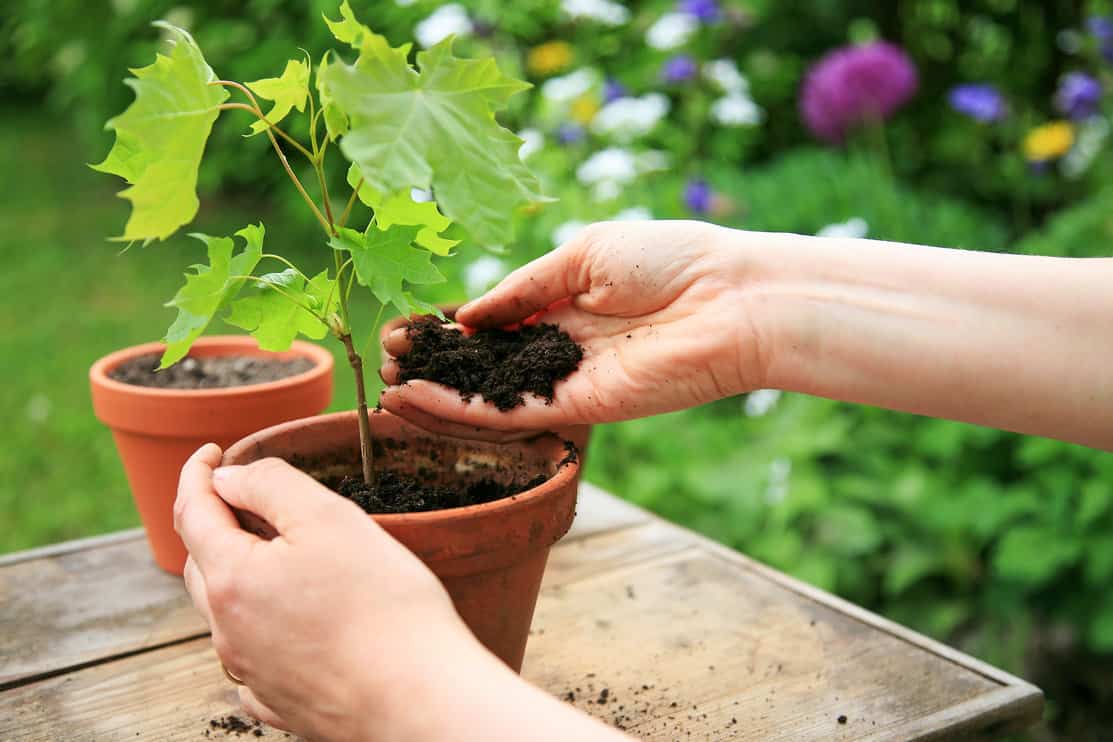
Hands planting a maple tree seedling in a flower pot

Maple trees can take a few decades to reach maturity. This depends on if you are starting your maple tree from seed, seedling or you have a sapling you purchased from a local nursery. 

Growing A Maple Tree From Seed

Did you find some maple seeds on the ground while you were walking in your neighborhood, the park, or out hiking? You should be able to get these seeds to sprout into seedlings with the proper steps.

If you found seeds that started falling in the fall, then these will most likely need a period of stratification before they will germinate. Stratification is a period of cooler weather required for some seeds to grow.

Seeds that have fallen in spring do not require this chilling period and will probably not stay viable in storage for long. Red and silver maple seeds fall into this category and can be started without stratification.

According to the USDAsilver maple seeds start growing in April, take about three weeks to mature, and then will disperse from the tree. They require no stratification, and germination is usually successful in moist, organic soil.

When searching for seeds, only take the ones that have fallen to the ground. If you pluck them straight from the tree, they may not be mature enough to grow into a tree. Look for seeds that are firm, dense, and don’t have any holes in them.

How To Mimic Stratification For Your Maple Tree

Put your maple seeds in a sealable plastic bag with a moist soil medium. You want something like peat or a seed starting soil you then dampen. You don’t want it dripping wet or swimming in water. 

Put the bag with the seeds in the refrigerator. Make sure they don’t freeze, as this could ruin the seeds. Anywhere between 34℉ to 41℉ is a good range to strive for.

It’s important to keep the bag partially opened. Even through this cold process, the seeds need to “breathe.”

Now leave them for about 40 to 120 days, but check them every two weeks. Add a few drops of moisture to the soil if it’s drying out. Tap off any moisture droplets that have condensed inside and flip the bag over.

If you see any moldy or mushy seeds, remove them. Once they sprout during this time, remove them and put them in a seed starting tray or small pot. 

If the seeds haven’t started sprouting after 120 days, take them out and begin planting them. Keep in mind that most times, not all the seeds will sprout, so you will want to stratify at least 10 to 15 to make sure you get a few viable seedlings.

As the seedlings grow, you can cull the ones that aren’t growing so well. 

You can plant seeds outside and let nature take care of the stratification for you, but this process could take up to two years. That’s if squirrels, deer, or other animals haven’t eaten the seeds or seedlings. 

Now Plant The Maple Seeds

Whether they have been stratified, or they’re from a species that doesn’t require a cold snap to get them to grow, it’s time to plant them. Cover the seeds with a thin layer of soil—less than an inch is plenty—then place them in a warm area of the house, preferably near or on a windowsill.

Keep the soil moist while you are working on germinating the seeds, but don’t drown them. Now is not the time to get impatient, because some seeds can still take 40 to 90 days for the seeds to sprout.

Once you have a few maple tree seedlings growing, reduce the frequency of water just a bit. You don’t want to keep the soil moist all the time, as root rot can set in. Instead, let the soil get dry to the touch before misting it again.

You’ll also want to start setting them outside in a partially shaded area, so the new seedlings can harden. As they reach around six inches tall, you can plant them in their new home, or transplant the maple trees to another, larger pot until they get larger and stronger. 

It’s around this time that you will want to give your maple tree seedlings more sunlight. Most maple trees are sun-loving trees. While they can survive in shady environments, maple treesl do much better when they get between 4 and 8 hours of sunlight. 

Deer, rabbits, and sometimes squirrels often eat maple seedlings. You may want to take steps to protect them by either wrapping them in chicken wire or leaving them in pots until they are a few feet tall. 

This may take a year or up to five years, depending on variety, for the seedlings to grow into sapling size. This means the main trunk is about two inches in diameter. 

When And How To Plant Maple Saplings

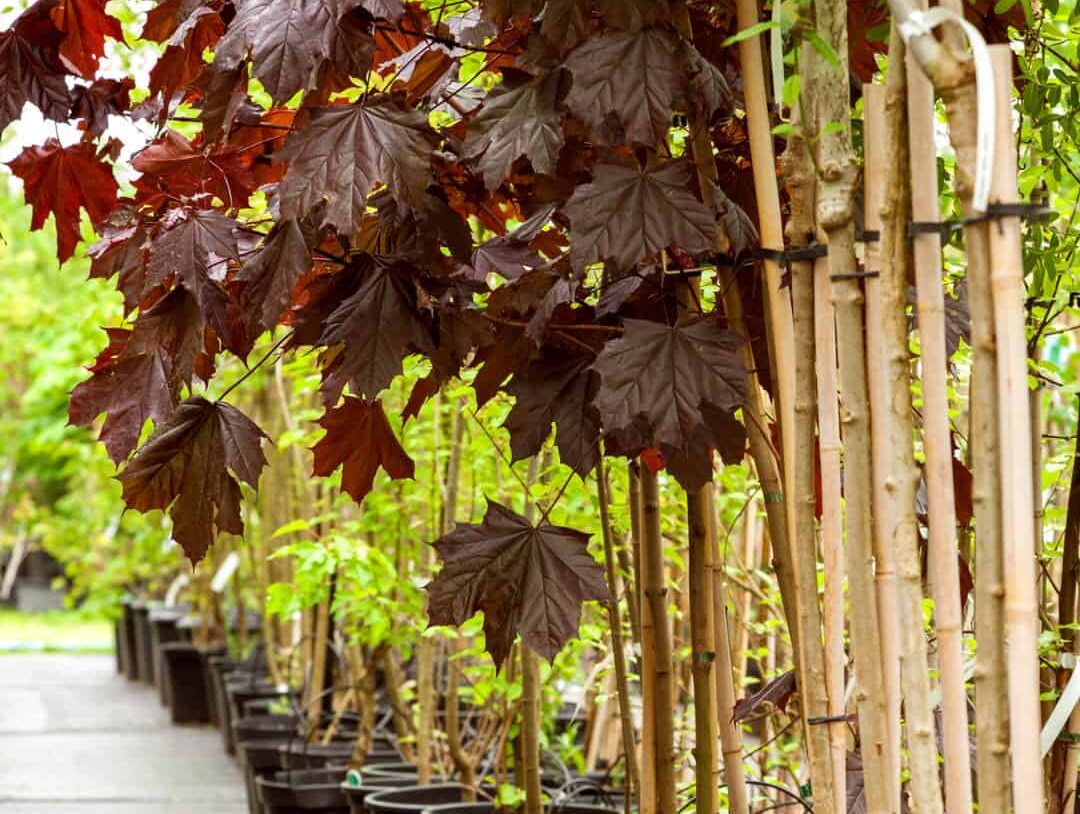
Row of young maple trees in plastic pots. Alley of seedling tree

Fall is the best season for planting, and maple trees are no exception to the rule. While you can plant them at any time, fall is the best season because it gives the trees a chance to establish their roots in new soil. 

It’s important for the roots to get acclimated so that when spring comes around, the tree can send moisture and nutrients up to grow new branches, leaves, and flowers.

Choose Your Planting Spot

Choose a site that gets plenty of sun and is far enough away from structures, sidewalks, pathways, or any kind of water pipes. Remember, maple trees LOVE sun!

Maple roots are often shallow and can raise or crack cement and asphalt. Some maple roots also will disrupt drain pipes in their search for water, so be mindful of supply lines and septic fields.

Dig The Hole!

Next, dig your hole. Dig as deep as the container and about two to three times as wide. Loosen up the root ball so the roots can spread out and mix the existing soil with a good garden or potting soil so there are plenty of nutrients for the new tree. 

Set The Maple Sapling Inside

Set the sapling in the hole, but don’t bury the trunk deeper than the original soil level in the container. Before you fill in the remainder of the soil, water the hole and root ball very well. This makes sure the water reaches the roots.

Fill The Hole And Wait

Now fill in the hole, compact the dirt, and add a layer of mulch. Spread the mulch in the shape of a donut while keeping it away from the trunk a few inches. 

Once your maple sapling is in the ground, it can take 10 to 30 years for the tree to mature. During this time, you may need to prune the tree occasionally for health, but the main thing you can do to make sure it remains healthy is to make sure it gets enough water.

Fertilizer isn’t really necessary for maple trees unless you can tell it’s NOT growing well. Their roots spread out far enough to find the nutrients they need. With regular leaf mulching, mowing, and keeping a layer of mulch around the tree, it finds enough nutrients to stay full!

Keeping Your Maple Strong From Sapling To Young Tree

Maple saplings are still susceptible to damage from foraging animals that like to snack on tender tree bark and the soft tissue underneath. Deer, mice, squirrels, porcupines, and beavers all will seek new saplings, especially when other food sources are scarce. 

According to the USDA, when deer feed on saplings, they increase potential frost damage, weaken the tree and insect infestation. These can increase the mortality of the saplings.

Place A Wire Mesh Around The Maple Tree

To keep them protected, you should erect a wire mesh frame around them. You can use metal fence posts, wood stakes like these Bond Manufacturing Hardwood Stakes, or anything else rigid enough to hold hardware cloth. 

Pound them into the ground around the tree, then take some hardware cloth and attach it to the posts to enclose the tree in a tight cage. Nueve Deer Hardware Cloth has ½” holes that will keep animals out and away from the tree.

Use Chicken Wire

Chicken wire will help against deer and some larger animals, but mice and squirrels can get through the openings. 

Next, drape some netting or mesh over the top of the tree and secure it with bread ties or zip ties to keep small climbing critters like squirrels out. Feitore Deer Fence Netting will help to deter them.

Keep Your Maple Tree Watered

Saplings need to be watered more often than big, established, mature trees. You’ll probably have to water them on a regular schedule, especially during periods of sparse rain for the first two years of growth. 

Maple trees need a good, drenching watering every couple of days to keep them healthy.

The biggest concerns here are to make sure the water soaks in and reaches the roots, but also to keep from watering them too much. Root rot is hard to fix and can be fatal, especially in newer trees. 

Let the top of the soil dry out before watering again so the tree’s roots can “breathe,” instead of drowning the roots in water. When watering your maple sapling, give it a few gallons at a time. Proper watering is the best way to prevent sunscald and leaf scorch.

Properly Mulch Your Maple Tree

A good three to four-inch layer of mulch around the tree helps to keep moisture in, and as the mulch decomposes, adds organic nutrients to the soil. 

Once the tree is about five years old, you can remove the protective mesh and start letting nature water your tree. In times of drought, you can water your tree to keep it healthy, but during normal conditions, the tree should be able to fend for itself. 

Congratulations, you have a strong growing maple tree! It should give you and your family a lifetime of beauty, shade, and enjoyment. Aside from the occasional pruning and watering during droughts, you shouldn’t have to do much else to keep your maple tree healthy. 

How Fast Do Maple Trees Grow?

Maple tree turning yellow in autumn in a public park.

Again, this is species specific. Some maple trees grow very slow while some will reach maturity quickly, for a tree that is. 

Some of the slower-growing maple trees include most species of Japanese maples, sugar maples, field, and Shantung maple.

Many of these trees will grow no more than a foot per year. For trees that can reach over 100 feet tall, this means it could take a lifetime for them to attain their full height.

Common Maple Tree Growth Rates 

Sugar maples will take about 30 to 40 years to reach a tall, mature age. Dwarf Japanese maples are some of the slowest growing maple trees. They only reach five to seven feet tall, and it may take them ten years to attain that height. 

Maple trees with a slightly faster growth rate will grow up to two feet per year. Medium growth maple trees include trident maples, Norway, red, and some bigger varieties of Japanese maples, such as Acer palmatum, or Bloodgood. 

Red maples may reach a mature height of 40 to 60 feet tall in 20 to 30 years, while a Bloodgood Japanese maple will reach a max height of 35 feet tall in 15 to 20 years. 

Fastest Growing Maple Trees

The fastest-growing maple trophy goes to the silver maple. This tree can shoot up almost as fast as bamboo (but they aren’t nearly as invasive).

The speedy silver maple can grow up to five or six feet in a single year. These trees can reach maturity in less than 10 years.

If you are looking for a super fast-growing tree, look no farther than the silver maple. But with that quick growth brings a soft, easily broken wood, so keep that in mind. 

Other fast-growing maple trees include the autumn blaze and freeman maple. These are hybrids of the red or, in the case of freeman maple, a red and silver maple mix.

While they don’t grow as fast as the silver maple, they are still considered fast-growing maple trees. 

Can You Grow A Maple Tree In Your Zone?

Some maple trees can grow from Maine to Florida, while others can’t deal with extreme heat. Most maple trees are fairly hardy from U.S. grow zones 4 down to 8, but again it depends on the species. 

Maple trees can be found all across the United States and Canada. While sugar maples favor the eastern side, they can grow in the west.

The bigleaf maple is native to the western states and can be found in Washington, Oregon, California, and even up in Alaska.

You should be able to find maple trees that are native to or will grow well in your zone, no matter where you are.

Establish a relationship with your local nurseries and ask them what maple trees will work for you. They’ll be able to provide you with all the information you need to grow your own maple trees. 

That’s A Wrap!

Trees can provide benefits for people, wildlife, and the environment, so go ahead and take up this hobby. The trees you plant can provide several generations with beauty, shade, and happiness. 

Whether you’re planting sugar maples, sycamores, or Japanese maple trees, these iconic trees are fun and exciting to care for and watch grow up into strong healthy trees. Get out there and start planting.

References:

Ostfeld, Richard S., Robert H. Manson, and Charles D. Canham. “Effects of rodents on survival of tree seeds and seedlings invading old fields.” Ecology 78.5 (1997): 1531-1542.

Carl, Clayton M., and Albert Granville Snow. Maturation of sugar maple seed. Vol. 217. Northeastern Forest Experiment Station, Forest Service, US Department of Agriculture, 1971. https://books.google.com/books?hl=en&lr=&id=jK2cxrI_AycC&oi=fnd&pg=PA1&dq=maple+tree+seeds&ots=Nvh34JltBC&sig=IWTAlHe0addJNsuJd-uCWIYR-P8#v=onepage&q=maple%20tree%20seeds&f=false 

Farmer, Robert E., and Maureen Cunningham. “Seed dormancy of red maple in east Tennessee.” Forest Science 27.3 (1981): 446-448.

Tremblay, M-F., Yves Mauffette, and Yves Bergeron. “Germination responses of northern red maple (Acer rubrum) populations.” Forest Science 42.2 (1996): 154-159.

While looking out your window you admire the beautiful maple trees out there and feel life is good. But then you take a closer look and realize you can’t trust those trees…they’re looking mighty shady. Jokes aside, sometimes you have to cut down maple trees, for one reason or another!

You should cut down your maple tree if it is too close to your house, attracting significant pests and insects, has received major storm damage, or it’s roots have become invasive. Maple tree roots can span up to 25ft wide, which can cause issues with underground wires and drainage systems.

Though it may be hard to think about because many trees have sentimental value, there are valid reasons to cut down your maple trees. Read on to find out why you should have your maple tree cut down, and when would be the best time.

Your Maple Tree Is Too Close To Your House

Large trees like maples need a minimum of 20 feet away from your house or structures. That doesn’t mean everyone follows this recommendation. Many people plant a tree based on how tall it is at that moment, failing to realize many trees will soon tower over the house, and be too close.

They could have been thinking more about how the shade is going to help with cooling bills in the summer, or how they will be having picnics underneath their tree in a few years instead of wondering if it’s too close to the house. 

Chances are you bought your house with that maple tree already fully established, but sitting a little too close for comfort. If you have a maple tree that’s sitting closer than 20 feet away from your house it could be sitting in the “danger zone.” 

According to the University of Missouri Extension, smaller trees can be placed about 15 feet away, but large trees need to be planted 20 feet or more away from the house. 

Trees sometimes fall on their own for several reasons. They also can drop large branches without the courtesy of giving a decent notice. To prevent major tree damage to your house or other structure, you might want to have that maple tree cut down. 

You Have A Maple Tree With Invasive Roots

Beautiful mighty maple tree trunk with great fleeced with moss roots on a cloudy day. Beautiful nature scene at fall season

Not all maple trees are considered to have invasive roots, but the silver maple and Norway maple do fall into that category. Maple trees in general tend to have shallow roots, so depending on what kind of landscaping you have, any tree can present root problems.

Shallow roots can lift sidewalks, driveways, and paving stones in your garden path, or make it a nightmare to mow. Anyone who has accidentally run over a tall, thick, tree root with a lawnmower knows what I’m talking about. It’s a jarring experience, to say the least.

Norway and silver maples are fast-growing trees that can have extensive root systems. They will get everywhere in their insatiable quest for water. These roots can dig into fine cracks in foundations, basements, and water lines.

Once they find a water source, more roots quickly crowd into that area causing more damage. Whether they increase foundation damage or get inside pipes causing them to clog and back up, there’s not much that can be done to mitigate this damage aside from removing the tree.

When a maple tree starts to ruin your hardscapes, driveway, or even your brick retaining wall, you’ll probably have to get it cut down. You can try cutting the roots back, but often the maple will just grow those damaged roots back.

Maples are known to have invasive and damaging roots. Our article on 9 trees that can damage your foundation can help you choose a tree that is good to plant near your home!

Your Maple Tree Is Ruining Your Grass

Grass can be difficult to grow underneath trees. You could have patches of weeds, weak grass, or a big brown patch that looks like a scar on your lawn.

Most grass varieties require full sun and plenty of water to keep them healthy. The broad expanse of a large maple tree’s canopy can deter both of those requirements. This leaves large patches that can be an eyesore.

In the spring and summer, a maple’s canopy can restrict rainwater from falling through. A large quantity of rainwater will run off the leaves and fall around the edge, leaving the soil directly underneath too dry for grass.

Along with providing shade for most of the day, typical grass can’t cope.

You can cover the ground with mulch, but if the dead grass patch is 20 feet or more in diameter, a huge mulch bed will simply look awkward.

Along with the grass problems, you could be dealing with raised roots that cause trip hazards. Or maybe you’ve had to replace a lawnmower blade for the X-teenth time because of shallow, protruding roots. When enough is enough, it’s time to cut your maple tree down.

Oh, and maple trees often leave helicopter seeds on your lawn, which can be quite annoying and another reason to get rid of them since they drop them in large amounts.

A Big Storm Broke Your Maple Tree

Trees grow and develop ways to withstand fierce storms, but occasionally Mother Nature brews up a special kind of storm. When this happens even the strongest trees can succumb.

Whether the ground has been soaking in a constant barrage of torrential rain and the tree topples, roots and all, or there was a lightning strike, you might have to get rid of the tree.

It doesn’t have to be summer storms that ruin trees to the point where they have to be removed for safety. Heavy snowstorms or especially freezing rain can cause tree limbs to break off, or topple trees.

Most ice storms that result in a quarter or half an inch of ice will break off smaller limbs. Hardwood trees like maples can often withstand this much ice, but if the storm continues to dump freezing rain, large limbs or even the tree itself can fall.

Ice storms start getting problematic when accumulation surpasses ½” of ice. When severe storms damage your trees you’ll need to get an arborist to check on them. Sometimes the damage is so bad, that the entire tree will have to be cut down.

Most trees can survive moderate storm damage. If the tree sustained damage but is still standing, you might want to have it checked out before cutting it down completely. It might be able to heal itself. 

Your Maple Tree Has Extreme Fungi Or Insect Damage

Rhytisma acerinum fungus on Acer platanoides leaf.

Healthy trees are often able to fight off mild insect or fungal damage. But if a tree is getting very old—some maples can live for hundreds of years—or it is going through the wringer it can be more difficult to fight off invaders. 

Maple trees can be infected with fungal afflictions like anthracnose, cottony scale, tar spot, verticillium wilt, and various types of insects. They can become beset with leaf-eating caterpillars, beetles, or boring insects that weaken them.

While some of these problems can be overcome by the tree itself, or be treated with fungicides or pesticides, there are times when you should go ahead and have the tree cut down. Some fungal infections can’t be treated and will lead to the tree’s end.

You’ll need to contact a professional arborist who can let you know if the tree can be treated effectively. The problem with fungal afflictions and insect invasion in trees is they can often be spread to others. If it’s not cost-effective to treat it, or it seems to be sick all the time, then you’ll need to get rid of it.

Your Maple Tree Is Leaning, Lopsided, And Needs To Go

A leaning tree can be similar to a ticking time bomb. It’s not going to blow up everywhere, but it could fall over without warning. Often we don’t notice leaning trees until it’s too late, or it has an odd pronounced lean that catches our eyes.

Many things can cause a tree to grow lopsided, and when the canopy gets heavy and uneven, it can make the tree slowly lean until it falls completely over.

Too much shade on one side can cause this problem. Maple trees are sun-loving trees. If other trees are growing around them, casting shade on one side, they can end up growing more on the sunny side to compensate.

Branches can fall off making them lopsided, or possibly the roots are starting to give way. Whatever the reason, a tree that has developed a prominent lean will need pruning to correct it.

When that doesn’t work, the only other option is to “defuse” the situation by having the maple tree cut down

Go ahead and get the tree before it gets you.

The Maple Tree Is Simply Too Expensive To Keep

There may come a time when the tree has reached the end and will need to be put out of its (and your) misery. Do you have to treat it yearly or more often to keep it healthy? Are you maxing out credit cards to keep it from coming down? 

We hope this isn’t the case, but when you have to constantly pay to keep a tree going, it’s probably best to go ahead and get it out of there.

Maybe the tree is finally reaching its end. Some maple trees have been known to live for 300 or even 400 years; then some varieties will never see ages such as those. The silver maple for example is a variety that grows fast and may only live a few decades in suburban settings.

When a tree is constantly dipping its branches into your wallet, it’s time to turn it into firewood. If you have a firepit you can at least enjoy the tree one last time with a bonfire.

in-fact, maple is one of the hottest burning firewoods!

Your Maple Tree Is Close To Power, Phone, Or Internet Lines

Trees and power lines have never been a good mix, and it stands to reason they never will be. Whether the tree was there first or not, power lines end up getting the right of way.

Maybe the tree grew too close to the lines and now it needs to be removed. New utility lines could have been put in and now the tree is the one that needs to move.

Trees can damage power lines by rubbing against them all the time. The branches can fall and break the lines, or even grow into them if given enough time. Unfortunately for the tree, when they get tangled up around these lines, it’s the tree that loses.

Your Maple Tree Was Topped

Topping a tree is, unfortunately, a common practice, but also an almost always a game ender for large trees. When a tree gets “topped,” all the upper branches get cut back drastically, and most lateral, or side branches, get chopped off. What’s left is a tree without any leaves or small branches.

Trees get topped because they are too close to the house, and they think drastically cutting them back will keep them from causing problems. They want to prevent storm damage so they cut large limbs off, or the tree is too close to utility lines.

These reasons have their merit, but topping a tree stresses the tree out and leaves too many large wounds that can allow an insect invasion or infection that it will no longer be able to fight off. Topping a tree also prevents it from creating food for itself because all the leaves are cut away.

The tree will respond by quickly growing a cluster of new limbs and leaves to heal itself, but these limbs are often weaker than the branches that were cut off. Besides, the tree will often end up growing as tall as it was before, only with weaker limbs.

The Illinois Forestry Conservation gives three reasons not to top a tree:

  • The fast-growing new limbs are weaker, making them more susceptible to storm damage.
  • A topped tree is exposed to decay, insects, and afflictions, and weakens the entire tree. Meaning the tree will probably require more upkeep and it will end up significantly reducing the lifespan of the tree.
  • A topped tree is often a liability, can cause property damage, and possibly reduce property values.

Topping trees may have seemed like a good idea some time ago, but the practice is quite detrimental to tree health and should be avoided if possible.

Contact a tree professional to come up with good alternatives to topping your tree. If you have a tree that was topped, then you may have to get it removed and replace it with a new, healthier tree.

After dealing with the troubles of such a large tree, you may want to consider smaller trees like these Japanese maples. They won’t get nearly as big as red or sugar maples, and they provide beautiful colors all season long.

Maybe you would rather go even smaller. If that’s the case, why not get into a bonsai hobby starting with a Live Juniper Bonsai Tree. With these, you won’t have to worry about property damage from falling limbs, power lines, or having large patches of grassless yard.

What You Need Before Cutting Down A Maple Tree

Big maple trees with orange and yellow leaves

While the tree may be on your property, there may still be ordinances or other obstacles to overcome before having the tree removed. An HOA may have restrictions on tree removal, the tree may be located on an easement or other hindrances.

Don’t be nervous if this is your first time cutting down a tree; many people cut down trees for a bunch of reasons. If you are interested to learn more about this, check out our article on 6 reasons why people cut down trees!  

Are You Part Of An HOA?

When you have a Homeowner’s Association, there may be rules in the community guidelines that prevent you from cutting trees down.

Before having your tree removed, go over the rules to make sure you won’t be getting a nasty letter or any fines. If you’re unsure, reach out to an HOA official to make certain you’re in the clear. 

Is The Maple Tree On An Easement?

An easement is a part of the property that you can use but don’t own. It can be a driveway that goes through a neighbor’s property that allows you access to your property, an alleyway, or another section of land. 

Since you don’t own that section of land, you can’t cut trees off it without permission, even if they are posing a hazard to the property. 

The Maple Tree Straddles A Property Line

Sometimes it happens, that a tree ends up sitting on a property line between you and your neighbor and it needs to be cut down. How do you handle that?

In this case, you’ll have to reach an agreement with your neighbor. You both will have to agree upon if the tree can be safely removed, and how that will happen, and you may have to figure out how to split the cost.

We just hope you have reasonable neighbors and at least have a friendly repertoire with them.

Is The Tree On Or Near A Culvert?

Maple trees during autumn in a public park

The drainage area near the road is technically an easement but it may be owned by the city or county where you live. You are responsible for the upkeep but you’re not supposed to build, landscape, or fill this area in.

Trees usually aren’t allowed to grow here, but there’s always that exception. If you happen to have a maple tree, or any tree for that matter, growing along this area and it needs to be removed, you should reach out to your officials to find out the proper procedure.

You may be able to find information on your town, city or county website about this subject.

If you can’t find the proper information you may have to call or email someone to find out for sure. Since the tree is on town or city property, you may be able to get it removed by them.

The Best Time To Cut Down A Maple Tree

When it comes to cutting trees down, leave it to the professionals. Unless of course, it’s a little sapling. The minor cost savings compared to the potential damage that can occur aren’t worth the risk.

That being said, when is the actual BEST time to cut down your maple tree?

Simply put, if your maple tree is presenting an immediate issue such as insect damage, extreme rot, storm damage, branches hanging etc., then you should call a professional ASAP to remove the tree.

If it’s something where the maple tree is just messy, then you may be able to wait and put it off until the Fall when prices from local arborists may be a bit cheaper as it’s usually not as busy for them. You could also wait to save up for the expense as well!

So go ahead and call the professional arborist, they have the equipment, the trucks, and the manpower to handle any job with the utmost safety. Peace of mind can be priceless.

Wrapping Up!

While it might hurt your heart to have your favorite maple tree cut down, sometimes it simply can’t be avoided. When the tree starts to lean, it’s just too close to the house, or the roots are causing you endless headaches, it’s time to get it “outta there!”

If you want to start new with a small maple sapling, you should read out article on the 9 best maple trees to plant!

Once that tree is gone, maybe it’s time to replace it with something a little smaller. A nice dogwood possibly, a Japanese maple, or if you prefer evergreens, you can’t go wrong with a dwarf cypress or small blue spruce. 

References

Lusk, Anne C., Demóstenes Ferreira da Silva Filho, and Lea Dobbert. “Pedestrian and cyclist preferences for tree locations by sidewalks and cycle tracks and associated benefits: Worldwide implications from a study in Boston, MA.” Cities 106 (2020): 102111.

Morgenroth, Justin, Jarlath O’Neil-Dunne, and Luis A. Apiolaza. “Redevelopment and the urban forest: A study of tree removal and retention during demolition activities.” Applied Geography 82 (2017): 1-10.

Campanella, Bruno, André Toussaint, and Roger Paul. “Mid-term economical consequences of roadside tree topping.” Urban Forestry & Urban Greening 8.1 (2009): 49-53. https://www.sciencedirect.com/science/article/abs/pii/S1618866708000587 

McKenzie, Rita, and Urban Forester. What’s Wrong with Topping Trees?. Purdue University, Forestry and Natural Resources, 2000.

When looking to accent your landscape with trees, maples are often one of the top choices for homeowners. They come in many sizes, and their foliage can be stunning. Maple trees can create beautiful focal points, provide shade, and even increase property value, but what are the best maple trees to plant?

Maple trees thrive in yards that get a steady amount of sun and have little to no obstructions underground. Some of the best maple trees to plant in your yard include sugar, Japanese, red, black, paperbark, crimson king, or silver maple trees.

Whether you have a small yard or an expansive sea of grass, you can find the right maple tree for your area. We’ll include trees hardy to many growth zones, small trees, and large trees, and we’ll include any pros and cons that go along with these trees. Let’s get to it!

About The Mighty Maple Tree

There are over 125 different species of maple trees across the world, but only 12 varieties are native to North America. Most maple trees can be recognized by their distinctive five or seven lobed leaves—think of the Canadian flag—but there are others that have completely different leaf shapes.

Some maple varieties can grow to well over 100 feet tall, while others won’t surpass five feet in height. Maple trees are deciduous, meaning they lose their leaves in cold weather, though in some places along the Mediterranean region, they never lose their leaves.

Some maple trees have shallow roots that will seek water sources, such as drain pipes, irrigation lines, or septic tanks. These roots can squeeze themselves into the tiniest of spaces and bust open or clog these lines, so caution needs to be exercised with certain species.

Most maple trees can be tapped in order to collect sap for syrup production, the sugar maple—which is native to Eastern Canada and the Eastern United States—is the most commercially tapped variety.

What Maple Trees Are Best For Your Yard?

This can be a tough question to answer without getting a good bit of information first. Consider the size of your yard, how many buildings you have on your property, and what you are looking to accomplish with the maple tree to start with.

Do you want some shade? Are you looking for a striking focal point for your flower garden? Do you want beautiful colors for a particular season? Or maybe a combination of all these reasons?

Your particular grow zone and soil type will also need to be considered because, while some maples are very tolerant, others require specific conditions for optimal growth.

Japanese Maple Tree

Red foliage of the weeping laceleaf japanese maple tree, acer palmatum in garden

The Japanese maple is popular among many gardeners and homeowners alike. They typically have bold colors that last throughout most of the growing season or show up in early fall.

They can grow upright or droop down in showy cascading patterns and have distinctive leaf shapes.

While there are many subspecies of Japanese maples, we will focus on the two most popular varieties; the Bloodgood maple, and the dwarf Japanese maple—of which there are many cultivars.

You can get your own Japanese Red Maple Tree right here. These will grow well in zones 5 to 8!

Bloodgood Japanese Maple Tree

NameAcer palmatum Bloodgood 
Average size15’ to 20’
Hardiness zones5 – 8
ConditionsFull sun. Slightly acidic, well-draining soil.

Bloodgood Japanese maple trees are the most common Japanese maple tree that comes to mind when you think of the species. They’re truly a beautiful addition to any yard and they’re an accent tree to boot!

Dwarf Japanese Maples Tree

NameAcer palmatum (various)
Average size6’to 8’
Hardiness zone5 – 9
ConditionsFull to partial sun. Soft, well-drained soils. 

Most dwarf Japanese maple trees are very slow-growing, and often mounding shrub-like trees. They often have layers of thin, wispy branches with bright showy, or lacy leaves which make them perfect focal specimens.

They are perfect for small yards that won’t allow full-sized, towering trees.

Pros:

Overall, Japanese maples work great in smaller yards because they don’t get exceptionally tall or wide. They are easy to trim because of their smaller stature and they show off deep, crimson leaves throughout the growing season.

Since these trees don’t grow very tall or get thick and hefty, you won’t have to worry about them falling down onto your house or garage.

Their roots are not terribly invasive like other varieties of maple trees, meaning these roots won’t be lifting your sidewalk or digging into water pipes.

They can be a great focal point around a flower garden, or help to break up a bare yard with some striking color.

Cons:

Overall, problems for Japanese maples include relatively weak branches and trunks and the price tag. Heavy snow, extreme winds, or thick ice will break branches.

Japanese maples can be quite expensive depending on the species and how old they are. Often even smaller trees only a few years old will be upwards of $100-$200.

While Japanese maples rarely suffer from serious insect infestation or other maladies, they can get cankers, root rot, and pests like aphids and mites.

Sugar Maple Tree

NameAcer saccharum 
Average size50’ to 75’ tall
Hardiness zone4 – 8 
ConditionsFull sun to partial shade. Well-drained, moist soil. 

Pros:

These giants are the trees that produce the sap which can be boiled down into scrumptious maple syrup (sugar maple trees are actually one of the best maple syrup trees!)

They also create show-stopping colors in the fall. Their deep emerald leaves will glow yellow as the temps drop, then they transform to orange, and finally deep red.

If you are looking for a tree that will wow friends, family, and neighbors with rich autumn colors, the sugar maple is a superb choice.

Just make sure you have plenty of yard for this big tree or it could cause some major headaches. They need to be planted at least 30 feet away from your house or other structures.

Sugar maple roots are not considered to be invasive, but you should still map out plenty of space for them when you plant the small sapling. Just because these roots aren’t considered invasive doesn’t mean they won’t dig into your underground pool if the tree is planted close by.

This maple tree is probably one of the most cold-tolerant of the species found in North America. If you are worried about harsh winters and planting trees, this variety will probably be able to handle it.

The wood of sugar maple trees also has commercial uses and makes great smelling, hot burning firewood, but you’re probably not planting it hoping to make furniture or heat your house.

Cons:

When planting saplings, especially in hotter climates, you’ll have to watch out for sun scald. What happens is the bark can create small cracks during the winter when the sap freezes. During the summer months, the heat damages the soft growing tissue underneath the bark, causing severe damage to the trunk.

Severe sun scald can be a game ender to trees, especially newer sugar maple tree saplings.

Once sugar maple trees are established, they can create a dense upper canopy that makes it hard for other vegetation to grow beneath these trees. The leaves create a near-constant blanket of shade, and rainwater drops around the drip edge. Think of a sugar maple as nature’s umbrella.

Some plants can tolerate shade well enough (maple trees generally need more sun than shade), but few can survive long periods of drought.

You’ll have to water underneath large maple trees constantly or have a big bed of mulch to keep from having a barren wasteland underneath them.

You’ll also need a lot of space to plant sugar maples. Small or medium-sized yards will have a hard time accommodating all the space these trees take up. They also don’t do well in busy urban areas, as pollution and emissions can shorten their lives.

Some maple varieties can be susceptible to fungal afflictions and insect pests. Sugar maples could get anthracnose fungus or leaf spots as well as defoliating insects such as tent caterpillars and gypsy moths.

For zones 4 through 8, especially on the eastern side of North America, you can have your own Sugar Maple Shade Tree shipped to your door. They are 2’ to 3’ saplings.

Paperbark Maple Tree

NameAcer griseum
Average size20’ to 30’
Hardiness zone5 – 7
ConditionsFull sun to partial sun. Needs watering in times of drought, will tolerate acidic soil.

Pros:

The paperbark maple is another smaller specimen of maple that can work well in small or medium-sized yards. This tree resembles birch trees with the peeling habit of the bark, but it still grows the iconic “winged” seed pods that some affectionately call “helicopter seeds.”

Most of these seeds end up being sterile, so you won’t have to cut down, or pull up a ton of paperbark seedlings every year.

The paperbark maple’s tolerance of shade means you can plant them underneath larger trees or areas the sun barely touches.

They also work great as focal points in any garden. Their birch-like bark peels away to reveal cinnamon-colored bark underneath that is stunning in the bleak, colorless winter.

The paperbark maple is a slow-growing tree that will eventually reach heights of 25 to 30 feet tall. The green leaves will darken to a beautiful scarlet red in the fall, making it an excellent showpiece.

Cons:

This variety of maple has very few cons. One is that it can be a messy tree. Smaller branches fall off during storms, and the peeling bark can be a minor nuisance.

Leafminers can inhabit the paperbark causing extra leaf drop, but other than that, these trees are about as easy to grow as they come.

Silver Maple Tree

NameAcer saccharinum
Average size60’ to 80’
Hardiness zone3 – 9
ConditionsFull sun. Moist, acidic soil.

Pros:

This maple tree is aptly named because of the silvery undersides of the leaves and the similarly colored bark. In some communities, people believe they can tell a storm is coming when the leaves all turn silver. Strong winds flip the leaves over and around, revealing the silver color.

Silver maples have recently become more popular in home landscapes because they grow so rapidly, and produce a lot of shade in a relatively short time.

These trees can grow large, up to 80’ tall, and have massive trunks. This is also one of the most striking features of the silver maple. In the winter, the trunk and limbs are a sight to behold.

Silver maples were prized in the pioneering days, according to The Arbor Day Foundation. They say settlers of the Ohio Valley loved silver maples for their willingness to grow in a variety of soils and their fast growth. These settlers also preferred to make syrup from silver maple sap, though they didn’t produce as quickly as sugar maples.

Cons:

With the exceptionally fast growth, comes weaker wood. This maple variety has a problem with dropping limbs easily, so be careful where you plant them. You’ll want to make sure they are a suitable distance away from any buildings.

The roots of silver maples are notoriously invasive. They will stretch out and clog up septic drain lines, or dig their way into any small, leaking supply line. They will also push up sidewalks and paving stones.

These fast-growing trees need a lot of space, so you’ll have to have a good-sized yard to let these trees free.

Red Maple Tree

NameAcer rubrum
Average size40’ to 60’
Hardiness zone3 – 9
ConditionsFull sun to partial shade. Tolerates most soil types.

Pros:

The red maple is aptly named because it likes to show off something red during every season.

In spring, there are small red flowers. During summer, the leaf stalks turn red, while in autumn the leaves themselves glow a deep crimson red, and in winter, the tree has pops of red buds all over.

The red maple is very similar to the sugar maple. The fundamental difference—which isn’t that big—are the leaves. Red maple leaves have a V-shaped groove between the lobes, while the sugar maple has a more U-shaped groove.

This tree grows faster than sugar maple trees, but not as fast as silver maples. These trees are also very cold hardy, but they can withstand hot temperatures as well, so they do well in most U.S. grow zones.

Cons:

Red maples easily get fungal infections that cause leaves to drop and weaken them. Limbs and trunks can sustain damage fairly easily, which can allow rot to set in. To combat these issues, keep the trees as healthy as possible.

Their roots, though not as invasive as silver maple, are still shallow. This makes mowing difficult. Sidewalks and driveways near red maples will inevitably get cracked and raised by the shallow root structure.

Check out these to start your own Red Maple Shade Tree!. They are live trees and shipped when they are between 2’ and 3’ tall.

Korean Maple Tree

Acer pseudoplatanus atropurpureum branch with fruit
NameAcer pseudosieboldiana
Average size15’ to 25’
Hardiness zone4 – 8
ConditionsFull sun to partial shade. Moist well-drained soil. Doesn’t tolerate drought. 

Pros:

These trees are similar to Japanese maples as they are similarly sized, but they can withstand cooler temperatures. If you have tried Japanese maples but the winter devastated them, a Korean maple might be what you’re looking for.

They can grow in shady areas, don’t get very tall, and take well to containers. In the spring these maple trees sprout little purple flowers, then continue the color show in autumn when the leaves turn rich, deep red.

Korean maple trees don’t get very large, so you can plant them in smaller yards, or group several of them together in larger plots.

Cons:

These trees are quite cold hardy, and they don’t have many major problems. They are susceptible to leaf fungus, and some insects, but a healthy Korean maple will easily survive most afflictions.

Tatarian Maple Tree

NameAcer tataricum
Average size15’ to 20’
Hardiness zone3 – 8
ConditionsFull sun to partial shade. Any well-draining soil

Pros:

The best thing about these maple trees is they will grow in nearly any soil type as long as they don’t sit in water. They will even grow in loam and clay soil if it drains well.

Tatarian maple trees are also fast-growing, shorter trees that will reach their max height soon. Once they are finished with the adolescent growth spurt, they take on the “dad-bod” and start growing as wide as they are tall.

While these maples will grow in shady areas, they do best in full sun conditions. Like most other maple trees on our list, they put on a beautiful colored leaf show in the fall.

Since they stay relatively small and wide, they work well in smaller landscapes where massive trees just can’t grow.

Cons:

Tatarian maple trees originated in Korea and China, so they are an introduced species to other countries like North America.

Since they can tolerate several temperature extremes and most soil conditions, they are considered invasive in many areas.

Black Maple Tree

NameAcer saccharum nigrum
Average size50’ to 75’
Hardiness zone4 – 8
ConditionsFull sun. 

Pros:

Black maples are very similar to sugar maples. In fact, they are considered a close cousin. They can still be tapped to make maple syrup and grow to a similar height.

Mature black maples fill out into a pleasing, rounded shape and will glow with yellows, oranges, and reds in fall like sugar maples. Since they get quite large and can live for well over 100 years, plant these trees where they have plenty of space to grow.

If you are looking for a great shade tree, then a black maple might fit the bill. Their canopies stretch out up to 50 in diameter, giving you plenty of cooling area in a wide open yard.

Cons:

These trees don’t have major issues to worry about. Minor problems include leaf scorch, fungus, and boring insects. They also don’t do well around coastal areas, the salt will hamper growth.

They are also not very tolerant of air pollution. These trees prefer clean, country air.

The Best Time To Plant Maple Trees

Maple tree during planting sequence in house garden

Technically, trees can be planted nearly any time the ground isn’t frozen, but to give them the best chance, fall is the optimal time.

When a tree’s roots are disturbed, they need time to establish themselves before the trees should start spending nutrients and energy on leaf growth. The best time for undisturbed root stimulation is the fall.

The tree goes through its dormant phase and can get the roots settled before winter sets in.

Summer isn’t a good time to plant trees because the heat and typically dry conditions can stress the plant. Trees pl›anted in summer don’t get the water, or the time needed to establish themselves. Weakened and stressed trees have a hard time fighting off insects and other afflictions.

If you’ve decided that you need to move your maple tree, you can take a look at our piece on transporting your maple tree here!

Why Not Plant Maple Trees In The Spring?

Spring tree planting may seem like the best time for them because that’s when they wake up from their dormancy. Leaves grow, April showers and all that, so it would theoretically seem like the perfect planting time.

While this may be true for flowers and some other species of trees, for maples, spring planting isn’t the perfect season for them. Maple trees produce a lot of sap that they have to push through the trunk and up to the leaf buds to make them expand and grow.

If the trees are trying to establish a strong root system—the roots are like the heart of the plant—then they can’t afford to expend more energy on growing leaves and new branches. Trees will work on roots first and foremost, while everything else comes in second.

Planting in fall will give the tree time to get a strong, healthy root system developed, then it will be ready for spring and the seasons beyond.

Don’t Prune Maple Trees In Spring Either

Again, pruning is often a spring or early winter activity. However, for maple trees, spring pruning can be harmful to them. This again has to do with sap production.

While trees can afford to lose some sap—thank goodness or maple syrup might not be a thing—it’s required to prepare them for leaf production. Maple trees produce a lot of sap, and the bigger they are, the more sap is needed for bushing out the wide leaf canopy.

Cutting the limbs around this heavy sap production and movement time will cause the trees to “bleed” more profusely and could result in a weakened tree. Just like humans, when trees aren’t feeling their best, infections have an easier time setting in.

When you prune or have your maple trees pruned, try to schedule it for fall. The tree won’t lose so much sap, the wounds will heal better, and it will be healthier overall.

How Long Do Maple Trees Live?

A properly cared for maple tree, depending on the species, can live between 80 to 300 years. Sugar maples tend to be the longest-lived of them, as some have been reported to live for 400 years.

Red maples often can grow for over 300 years, while the fast-growing silver maples live hard and fast. They typically last about a century before giving up the ghost.

The slow-growing Japanese maple will often live to the ripe old age of 100. Depending on the variety, you could have a tree that will last for several generations.

If you want to expand the longevity of your maple tree, take a look at our piece on the best maple tree fertilizers!

That’s All We’ve Got!

Maples, like all trees, have plenty of pros and cons, and quite a variety to choose from for all your landscaping needs. If you want a long-lived, giant shade tree, silver, red, or sugar maple might be your pick.

If instead, you want something a bit easier to manage that won’t engulf your smaller yard, then Japanese, Korean, or a paper bark maple might be just what you need.

All the maple varieties in this list will give you plenty of beautiful fall color, while some will even continue providing a colorful show throughout the winter. Whatever you are looking for, maple trees can probably check off the boxes!

References:

Wada, Naoya, and Eric Ribbens. “Japanese maple (Acer palmatum var. matsumurae, Aceraceae) recruitment patterns: seeds, seedlings, and saplings in relation to conspecific adult neighbors.” American Journal of Botany 84.9 (1997): 1294-1300.

Godman, Richard M., Harry W. Yawney, and Carl H. Tubbs. “Acer saccharum Marsh. sugar maple.” Silvics of North America 2.654 (1990): 78.

Saeki, Ikuyo, et al. “Comparative phylogeography of red maple (Acer rubrum L.) and silver maple (Acer saccharinum L.): impacts of habitat specialization, hybridization and glacial history.” Journal of Biogeography 38.5 (2011): 992-1005.

The maple tree. Home of the best syrup on the planet! Of course, an opinion, but one held worldwide by many. There are 128 species and they can live up to 400. Here, we’ll answer an important question; do maple trees need sun or shade?

Maple trees generally grow between hardiness zones 3-9 in the United States. In colder climates of zones 3-6 (north), maple trees need more sun than shade to thrive during the colder months. In zones 7-9 (south), maple trees benefit from both partial sun and partial shade to prevent overheating.

Maple trees are an asset to any property, but because it is a tree, you cannot easily pick up and move it if you need to! Read on to find out more specifics about how much sun (or shade) maple trees actually need.

Maple Tree Sun Or Shade Using Hardiness Zones

Ok, so you are here because you want to know whether the maple tree you are about to plant, move or buy should have sun or shade. Excellent job in taking a proactive approach to your tree planning. 

Trees are a lifelong commitment, whether on commercial or private property. Knowing the best place to root down is essential to the life of the tree. Hardiness zones determined by the USDA are important, so let’s investigate this first.

Once you discover that your particular maple tree species needs 6-8 hours of direct sunlight per day, the next step is looking up the hardiness zone you’re in. 

You can go right to the hardiness zone map at Arbor Day Foundation for the United States. It’s better than the USDA Forestry Map in this situation because you have to search a lot to find the specifics of what you need. 

Best Practices For Maple Planting According To Hardiness Zone

So, let’s say you are interested in a Japanese maple. Before you attempt to buy and plant one, find out what hardiness zone it should be in. The same amount of sunlight or shade is not the same between two extreme climates. 

A good example is if your maple tree of interest belongs in Arizona because it is hardy enough to take the extreme heat, yet you put it in New Jersey. The tree may not take it very well. 

Even if you put it out in the direct sunlight in upstate New Jersey, the cloud cover and temperature dips and extremes will deteriorate that tree. So, if your maple takes a lot of heat, do not put it in an area with frequent cold weather. 

So, this relationship is complicated. Going by the hardiness map and matching it with the specific species is best. 

Now, let’s look at some of the most popular maples in North America, along with the facts you need to know. 

Take into account the number of seeds you will be cleaning up in the future as well. You can read our full list of the maple trees that produce the most helicopter seeds, so you know what to expect from your maple tree!

How Much Sun Or Shade Does My Maple Tree Need?

The Sugar Maple Tree

Hardiness Zones: 3-5 | Ideally in Full Sun

The primary role of this maple is syrups, which make them aptly named. It grows well in a nice cold winter, so great for those climates with snow and ice. This type will yield the most beautiful fall show of color over any other species. 

Native Geography: Eastern Canada; Central North America; Northeastern America.

Best Soil: Acidic, drained sufficiently, and low salt content. Must have a lot of space to sprawl out and grow. 

If you are interested in learning about sugar maple trees and their syrup production, check out our article on the most common trees that make maple syrup!

Red Maple Tree

Hardiness Zones: 3-9 | Ideally 10 hours of sunlight per day

The red maple is an all-around maple. It can live in all conditions such as wet, wind, severe heat, dry, and excessive cold. A great maple for those who have never planted a tree and are nervous about failing. 

You may also know this maple as the soft maple or swamp maple. It will grow up to 24 inches per year. 

Native Geography: You can find them most often in the Northeastern United States. 

Best Soil: You can plant this tree in nearly anything such as clay, sand, acidic, drained, and moist. Give it ten hours of sunlight per day.

Silver Maple Tree

Acer saccharinum fresh foliage

Hardiness Zones: 3-9

The sugar maple has an interesting character as it grows in the shape of a vase and it has the largest seeds of all the maples! Similar to the red maple tree, the silver maple is quite versatile and can thrive in the majority of hardiness zones. 

Native Geography: East Central United States and Southeastern Canada.

Best Soil: Deep and moist acidic soil.

Paperbark Maple Tree

Hardiness Zone: 5

You may know this tree as blood bark as well from its red, peeling bark. This is one of the slowest growing maples.

Native Geography: China 

Best Soil: Acidic, but not too much, and well-drained soil.

Amur Maple Tree

Hardiness Zone: 3

This is a shorter tree and is quite invasive. Do not put this maple anywhere the seeds can travel too much. It should be planted in a place with low humidity and cold weather a majority of the time. 

Native Geography: Northeast Asia, Southeast Russia, but can be found in North America and Europe. 

Best Soil: Acidic or Neutral 

Striped Maple Tree

Hardiness Zone: 4 | Full shade or partial sun

You may also know the striped maple as moose or goosefoot maple. You can tell it’s a striped maple when it’s young before the bark turns brown. It will have white and green stripes.

Native Geography: Found in Northern America.

Best Soil: Moist and need full shade or partial sun most of the time. 

Korean Maple Tree

Hardiness Zone: 4

The Korean maple tree is also known as the purple bloom maple and can grow to 25 feet with purple and white flower blooms.

Native Geography: Russia, China, and Korea 

Best Soil: Well-watered, moist soil. Protect from droughts, and very high winds 

Japanese Maple Tree

Hardiness Zone: 6 (tolerant in zones 5-8)

This maple is a shrub, is short, and grown mostly in containers out of the ground. You can grow it in the ground, but be sure to follow the soil and watering appropriate for it.

It’s one of the least hearty of the maples. Any prolonged drought or being planted in poorly drained soil can kill the tree. 

Native Geography: Japan, Mongolia, China, Russia, and Korea

Best Soil: Well-watered, moist soil. 

Norway Maple Tree

Hardiness Zones: 4-7

In North America, it isn’t planted much because of its invasive quality. The roots grow close to the surface of the soil so it robs nutrients from neighboring plants and trees. 

However, it can live through some drought. 

Native Geography: Western Europe, Central, and Eastern Europe. 

Best Soil: Moist and well-drained soil

Freeman Maple Tree

Hardiness Zone: 4

Freeman maple trees do well in cities and urban conditions. The soil can be Alkaline and yhey produce bright red colors and a fantastic fall show! 

Native Geography: American Eastern Region

Best Soil: Alkaline 

How Long Does A Newly Planted Red Maple Tree Take To Grow? 

Rainy autumn afternoon with maple trees

The red maple tree grows between 1-2ft per year and will stop new growth at about 25-30 years. It will grow plenty of leaves before it halts its growth and provides a good amount of shade to a small circumference around it. 

To understand the growth of the red maple, we must know the facts about the maple tree as a whole.

The key is to know the species you have, the hardiness zone you are in, and how to care for it from birth to maturity and beyond. A maple tree could take between 10-15 years or 20-30 years to mature. 

Once the red maple matures completely, it will end up in the neighborhood of 40 to 60 feet tall and up to 45 feet in circumference. You’ll enjoy the red color each year as it gets stronger and bolder.

The red maple gets its name from the red flower blooms that will soon turn into stems that will then turn into the red leaves we commonly know. Most people don’t know they bloom flowers, but they do. 

The flowers are the way the tree spreads its seeds and flourishes. If you notice red flowers getting caught up in the breeze and falling to the ground, you can do something great to encourage the growth of new maples. Take them and plant the seeds within them.

If you are not interested in having more maples, then rake up the flowers and dispose of them so you do not have unwanted sprouts on the property. They are hearty and easy bloomers! 

What Is The Best Place To Plant Maple Trees For Full Sun Or Shade?

Young maple sprout fenced with a painted tire in the spring sun. Glowing leaves in the ambient light.

The most common type of maple is the Red maple. This maple tree has a root system that will push up your pavement. So, make sure that you don’t have it near any structure or sidewalk.

So, the best place to plant your maple tree is somewhere with no underground structures in a clear, open field. If your maple tree needs shade, plant it in a way that when the sun hits a nearby building or structure, the maple tree will be covered by the shade for part of the day.

What’s The Best Time To Plant A Maple Tree?

As long as the ground you have chosen is not frozen, you can plant them anytime. However, you may want to plant in the fall for the most optimal time. The ground is not frozen, the weather is cooler, and you can still manage the soil. 

New grower? Try this Red Maple Tree Seed Grow Kit. It includes everything you need to care for your tree from the seed. You get the seeds, growing medium, a mini-greenhouse, and detailed instructions… fancy!

Make sure you plant them in either full sun or no more than partial shade. We must take advantage of the nutrients from our big gas giant. The soil should also be well-drained. 

Now, before you sink the tree into the ground, the hole should be as deep as the container the tree came in if you are planting a sapling. It should also be about 3 feet wide. 

Check the soil line left on the stem of the sapling. Make sure the soil is NOT deeper than that to prevent root rot. 

Now you should fill the hole, starting with the soil the sapling came with. If you need more, make sure you do NOT get soil with any fertilizer or any other component in it. 

Remove the air pockets by filling them with dirt and packing it. Not too tight, just enough to make it firm. You can use your hands to pack the soil in.

Once you have filled the hole, water it deeply. You can add 3-4 inches of mulch to keep it moist. 

Most Important Tip For Planting Maple Trees

Never force a maple tree to grow too fast; this can be fatal to the tree. You may not notice it until it’s too late. Never fertilize the maple tree until the second spring after planting.

If there is nothing wrong with how it’s growing–then just do not fertilize–period. 

Although, if you do decide your tree requires fertilizer, read 5 Best Maple Tree Fertilizers (And How To Use Them) to choose which one to use!

There’s a way to try your hand at growing a tree for the first time. Or, you can have your kids learn with a Brussel’s Bonsai Live Trident Maple Outdoor Bonsai Tree. These trees have been taken care of for 5 years already, and are ready for you to enjoy their beauty.

That’s A Wrap! 

Well, that’s all we have! We hope you have much maple planting success! Take this information and pick the perfect tree for you.

See you in the next piece and thanks for stopping by! 

Resources

Westermann, C. M., Leeuwen, R., Raamsdonk, L. W. D., & Mol, H. G. J. (2016). Hypoglycin A Concentrations in Maple Tree Species in the Netherlands and the Occurrence of Atypical Myopathy in Horses. Journal of Veterinary Internal Medicine30(3), 880–884.

Bauce, E., & Allen, D. C. (1991). Etiology of a sugar maple decline. Canadian Journal of Forest Research21(5), 686–693.

Bauce, E., & Allen, D. C. (1992). Role of Armillaria calvescens and Glycobius speciosus in a sugar maple decline. Canadian Journal of Forest Research22(4), 549–552.

At some point in life, you may have to transport a tree, either to transplant it or to move it from the nursery to your home. Sounds like quite the undertaking, no? The good news is there are several things you can do to easily transport your maple tree. 

In general, the best way to transport a maple tree is to make sure to protect the root ball and bark by lifting from the pot into your vehicle. Wrap the maple tree foliage lightly to protect it from the wind while driving and when you are stopped, make sure to provide air circulation.

Most of the procedures and considerations are the same for transporting any tree, though there are differences when it comes to the height and some types of trees. Read on to find out more about how to transport your maple tree!

Equipment Needed For Transporting Maple Trees

If you have a maple tree that is coming from the nursery then you’ll need to see how they deal with the storage of the tree. Are they root balled or burlapped? If so, for both they’ll be quite heavy. 

The one thing to remember is to never pull, drag or lift a maple tree from the bark. This may not only hurt you–but hurt the tree in a way that will start it dying early. The way to understand this is to look at the bark like the skin. 

According to a study by the American Society for Horticultural Science, tree health can suffer due to rough contact with the bark and or foliage. If you rupture the skin, you’ll let in bugs and disease. The best way to give your maple tree regardless of age or size a great chance at a healthy life is to protect that bark! 

So, use a hand truck or dolly and get help to lift it into the truck without engaging the bark by pulling or lifting. 

You can find a tree cart like this Mac Sports Collapsible Outdoor Utility Wagon to make transportation easier!

Additionally, since you’re most likely trying to transport a younger maple tree – take a look at Fiskars 46 Inch Steel D-handle Transplanting Spade if you’re going to be digging up the maple tree yourself. It’s ideal for penetrating the ground around tree routes in order to make translating go quite easily.

Make sure to wear proper gardening clothing, such as long sleeved gloves, shirts and pants along with protective glasses.

1. How To Transport A Container Grown Maple Tree

Young maple seedlings in pots waiting to be planted outdoors

Using the same considerations for the bark as you would for any tree, lift, preferably with two people if it’s a heavy tree, into a wheelbarrow and place it into a flatbed truck or an enclosed moving-style truck.

Do not put the maple tree lopsided inside a small car or a place that will crush the foliage, tender small branches, or hurt the bark of your maple tree. We will hit that point home! 

Maple trees in the pot also need to be watered and provided protection to the root ball while the tree awaits replanting.

2. How To Transport A Maple Tree On A Roof Rack

Most people who are transporting only one maple tree will end up putting the poor thing on the roof rack of the car. This typically happens because folks are unaware of the care of the tree in transport. 

Once you understand the care of the bark and the foliage you can make the roof rack thing work. All you need to do is wrap the maple tree from root to top. 

The age and size of the tree should dictate what you would use to wrap it. Especially when it comes to the branches and bark. You also don’t want to knock the dirt off the root ball if you’ve dug it up. 

Let’s address that first. If you’ve dug up the maple tree and plan on transporting it on your roof rack then take a burlap or just some old blankets and carefully wrap and knot them around the root ball being careful not to damage the roots. 

If it’s pot-bound then make sure you pack some plastic down in the soil to keep it from spilling out and then wrap it with the blankets. The dirt in the pot or any dirt around an exposed root ball is important and it is recommended not to remove it. It serves as nutrients and protection. 

Now, let’s address the branches and trunk. A tarp may be the best bet for covering the tree foliage and tender branches. If you will be driving in wind or at speed on the freeway or anything over 35 MPH we suggest using a tarp with twine or rope

We do not recommend wrapping bungee cord around the maple tree body. Bungee is too tight and will tear and break the branches. It may also rip off the foliage. The tree will be in shock, to begin with, and we don’t want to push it into a nervous breakdown! 

So, we suggest that you only use a bungee cord to put through the loops in the tarp to attach it to the inside of the roof of the vehicle. Use twine or rope to firmly, but not too tightly wrap the tarp around the tree. 

High quality bungee cords can be found online like these Rhino USA Bungee Cords Outdoor with Hooks.

You’ll have to experiment with it. If it’s too much, you may want to find another way to transport your maple. The roof rack is the most common other than a flatbed which is better, but not the most ideal.

If your maple tree comes in a netting already, then leave it on. If you pick one up from a nursery, it may be pre-netted. Don’t remove it. Make sure you’ve measured the car and the tree to ensure it is not falling off or smacking on the car. 

3. How To Transport Your Maple Tree In A Flatbed Truck

Flatbed truck ready for tree transport

Transporting your maple in a flatbed truck is simple and the same precautions should be taken to protect the tree as you would transporting it on the roof rack. 

Be sure to measure the flatbed against the maple tree you want. You want a foot all the way around the tree. You do not want to bump the tree around but you also don’t want to squash it. 

The best practice for transporting your maple tree in an open flatbed truck, meaning no cab is enclosing the bed, is to use old blankets and pillows. 

Line the bottom of the flatbed first. Then, place it in the middle and surround it gently with pillows and blankets. Place one blanket over the top loosely and place a tarp over the blanket. 

If there is more than one maple tree, they will be young trees with fragile foliage and branches. You would not be able to fit more than one more mature maple in the flatbed. 

Then, using the eyelet holes that should be on the insides of the truck, attach bungee cord crossways over the tree and the top blankets. Make sure they are not crushing the tree branches.

Finally, make sure you are not allowing the root ball or pot (if it is pot bound) hang out of the back of the flatbed more than a foot and not without being wrapped. The trees should be short enough to fit entirely into the back. Make sure that tree is snug as a bug in a rug! As they say. 

4. How To Protect Your Maple Tree From Weather During Transport

The one threat that your maple tree has in transport apart from getting injured is the weather. Heat and extreme cold can be enemies of trees. However, the cold, most can withstand for some time. 

Heat, on the other hand, can be deadly, even for a short time. Make sure that you climate control your vehicle if it’s enclosed and it’s cooler than the outside by at least a degree or two. 

You don’t need a refrigeration truck, but it must not be hot. The foliage will wilt and it can damage the root ball. 

If you are moving the maple tree via a flatbed truck, you can’t climate control it. However, you need to get to the destination in a timely manner. We would suggest traveling after sundown if you are going a distance. Any exposure to direct sun for any part of the maple tree in transport is not good at all. 

5. Cost Of Getting A Professional To Transport Your Maple Tree

Tree with root ball intended for transplanting

If all else fails, you may need to get someone to transport the tree for you. The nursery may have someone or you may have to go to a larger DIY chain with a nursery. Hiring someone on an app where people offer their services may be an outlet. 

In general, transporting a maple tree should cost around $200 to $400 to get it out of the ground if it’s a maple tree that needs to be uprooted. With transportation, the whole project could run over $600 plus.

You have to figure out what’s worth it for you. You may not want to pay to transport one maple tree or pay more than the tree was acquired for.

6. How To Transport Your Maple In A Car Or Utility Trailer

This is not recommended for trees larger than a sapling level. The maple tree must be inside the car all the way and can’t be forced for fear of crushing it or drying it out. Getting a maple into your Mini is simply not going to work!

If you absolutely can’t avoid it, here’s how to transport your maple tree in your car. 

Follow the same instructions consistent throughout this article. If you can’t – and you most likely won’t – fit the whole maple tree inside the car all the way and at the same time not squash it, then tarp or net the foliage and wrap the root ball.

A utility trailer that is hooked to your car is the better choice as you will have markedly more room to maneuver. Just understand as we stated before that for long distances or more than under an hour, in the heat, is not good. 

Get the maple tree to the planting site ASAP and plant the same day. This is the recommendation you should follow for all methods of transporting a maple tree. 

7. How To Properly Load And Unload Maple Trees During Transport

For large maple trees, the use of a root sling and hook can be used. You will have to learn how to use this or hire a company with one. The first way is to place a specialized band around the root ball and attach it to a hook and further attach it to another band around the trunk.

You would have to wrap jute or burlap around the trunk to protect it and the lifting is through the root ball. 

The second method is for multi-stemmed maple trees and maple trees with root balls at 80 plus centimeters. The hook and strap go from the root ball to the back limbs. This is to protect the small limbs from snapping during the lifting process which is common. 

8. How To Transport Your Maple Across The Landscape

Using or investing in a tree cart is the smartest way. Especially if you are moving it alone and can’t lift it. You will still have to have it lifted off the truck. Once that happens, you’ll place the tree root ball first and place the tree trunk carefully over your shoulder.

Of course not with a mature and very heavy tree. Also, watch your eyes and face from the small limbs that could cause injury. If it’s a small tree in the way of the limbs, but the root ball is kinda big, you’ll want to use a tree cart. The way it works is by using leverage so that you aren’t using your strength to push it.

If the utility cart mentioned earlier in the article doesn’t suit your needs, take a look at this heavier duty option, MacSports Heavy Duty Collapsible Wagon Cart.

How To Transplant Your Maple Tree

The one thing you must remember about completing the transition for your tree is to get it in the ground the same day you transport it. You want to make sure that it’s well-irrigated if you need to keep it on the planting site for a day. 

Do not leave it for more than a day. Only if you have no other choice. The root ball can’t dry out and the dirt around the root ball must not detach from the root ball.

Understand that you must follow the planting, climate, and watering instructions for your species of maple. 

Here are 12 steps to transplanting a maple tree:

  1. Be sure to clear the ground on the planting spot of any vegetation.
  2. Dig the planting hole 18 inches into the ground.
  3. Mix in organic compost.
  4. Continue to dig the hole as deep and wide as the root ball.
  5. Pour several gallons of water into the soil and give it a few minutes to seep into the earth.
  6. Go and mark the north side of the maple tree by tying a ribbon or something to demarcate it without marring or injuring the bark.
  7. Move the maple tree to the hole ensuring the root ball is shielded from the direct sunlight.
  8. Lower the maple tree into the hole. The marked side facing north. 
  9. Fill the hole with the soil that you extracted from the hole.
  10. Meet the soil at the soil line on the trunk that was left on it from the prior location.
  11. Water thoroughly and deeply after planting. When water is left on top of the soil and no longer seeping in.
  12. The watering schedule should be as follows: Water deeply like this twice in the same week. Water normally when the Earth is dry 3-4 inches deep. If there is little to no rain then water twice a month deeply near the roots. 

Check out this article on the 5 Best Maple Tree Fertilizers (And How To Use Them) to learn more about taking care of your maple tree!

Below, we’re going to go over several variations for what you’ll need to do, depending on your equipment and situation, for transplanting a maple tree. Let’s get to it!

That’s A Wrap! 

We hope that you’ve gotten enough out of this to make an educated choice as to how you’d like to handle your maple transportation. It’s very simple when you break it down!

Here are 5 simple steps for transplanting a maple tree:

  1. Make sure you measure the maple tree against your vehicle or method of transportation.
  2. Keep the maple tree inside the vehicle. If you can’t be sure to cover the foliage and root ball.
  3. Keep it out of direct sunlight. 
  4. Do not drag, pull or lift from the bark so as not to injure or strip it.
  5. Do not break the root ball or allow the dirt to detach from a root ball. 

References:

Gen, M., Li, Y., & Ida, K. (1999). Solving multi-objective transportation problem by spanning tree-based genetic algorithm. IEICE TRANSACTIONS on Fundamentals of Electronics, Communications and Computer Sciences82(12), 2802-2810.

Xiao, Z., Wang, Y., Fu, K., & Wu, F. (2017). Identifying different transportation modes from trajectory data using tree-based ensemble classifiers. ISPRS International Journal of Geo-Information6(2), 57.

You may have heard of whirlybirds, or maybe whirlygigs. Perhaps you know them as samaras, but helicopter seeds might just be the most common name for the fruit that falls from a maple tree. These flying seeds whirl to the ground in a beautiful spectacle, but how many maple trees produce them, you might ask?

Red maples trees, silver maple trees, Norway maple trees and Japanese maple trees produce the most “helicopter” seeds, also called samara fruit. Helicopter seeds grow throughout late spring to early summer. Once they’re mature, the helicopter seeds are usually blown off by the wind similar to leaves.

Below, we are going to give you insight into which maple trees produce the most helicopter seeds, as well as how to care for your maple trees as they reproduce, grow, and bloom all over again. Well, what are you waiting for? Let’s get into it!

What Are Helicopter Seeds?

Two winged maple seeds attached to the stem

Officially known as samaras, other popular names include ‘helicopter seeds’, ‘whirly birds’, and ‘whirlygigs.’ Really, the easiest way to think about them is just: ‘a maple seed.’

Now, just for clarity, maples are not the only trees that produce samaras. 

In general, samara fruit is found on maple trees, box elder trees, elm trees, and ash trees. Essentially this ‘fruit’ is a seed shrouded in a little wing-like casing that is designed by nature to blow through the wind and spread far and wide. 

This spread gives the tree releasing a samara, or helicopter seed, the chance to reproduce at a further distance than a tree that produces fruit like acorns, apples, or citrus might.

‘Samara’ is the term for each piece of the conjoined two sides, which combine to display two casings, two seeds, and a structure that looks like a little pair of wings floating down to the sky. 

Often, you may instead see them as individuals who have been broken apart by winds, animals, or other forces of nature that separated the whole into a half. 

Other trees only produce one-sided wings. Maples are special in this way, that they are the true ‘helicopter’ seeds both by structure and the way they fall from the canopies. 

Having the fortune to be produced by so many types of trees means that samaras are quite common, and most people are probably familiar- even if they are more familiar with the one-sided samara pieces that wind up in their yards.

Speaking of samara production, different trees produce different amounts, as well as different types of seeds. 

After all, we are talking about maple trees here, so let’s digress. 

Which Kinds Of Maple Trees Produce the Most Helicopter Seeds?

There are so many kinds of maple trees out there. Most are known for the type of sap they produce which, in turn, leads to the type of syrup they help create. 

A lesser-discussed qualifier of maple trees is their ability to produce a whole host of helicopter seeds. These maple seeds, or whatever other name you prefer to refer to them by, are also an edible part of the tree that can be utilized right alongside the syrup that has its roots deep inside the maple itself.

Red Maples A tree that is commonly known for producing sap that is not as sweet as other trees’, the red maple makes up for it by producing the most helicopter seeds!

Silver Maples. The silver maple holds its own- producing sweeter sap and plenty of whirlybirds itself. You can rely on a silver maple for looks, taste, and a little bit of a show when the wind blows and the helicopter seeds go flying.

Norway Maples. Now, this European native may not be nearly as popular of a topic as its two preceding relatives, but it has plenty to show for between its seeds, size, and ability to spread like, well . . . wild helicopters?

Japanese Maples. One of the most diverse maples out there, this tree stands its ground pretty well as one of the most versatile trees in general. Add in the fact that it produces a ton of maple seeds, and we’re on to something.

Red Maple Trees Produce Many Helicopter Seeds

Autumn. Fall nature scene. Beautiful autumnal park

The red maple tree is a great way to add color to your space. No matter the time of year, you’ll be sure to appreciate the state tree of Rhode Island.

Even as the leaves fall in the winter and the tree loses its bright red vibrance, its branches make up for the loss of one colorful element by adding another. Green stems that are still young will turn red in the winter, and thus goes the cycle of bright red to bright green throughout the different seasons.

Even the samaras on this tree represent their tree’s name with pride. While other maple seeds tend to be some shade of green during the spring and summer months, the red maple seeds sport a vibrant red tone.

This makes it even easier to distinguish this species of maple as if we’d need any extra help!

Silver Maple Trees Can Produce Lots Of Helicopter Seeds

Another popular one! Silver maples are known for their color tones, as well. 

Their attributes are so much more than just a silvery underside of a leaf or even the fact that, as a species, it is one of the most common trees in America.

The first crowning feature of silver maple, besides its distinguishable nature and sheer population size in North America, is the sap it yields.

While other maples, yes, even the red maple, produce a sap that is pretty bitter until processed thoroughly and correctly, the silver maple does not face that issue.

Its byproducts are noted to have a butterscotch undertone, making the syrup a sweet, light, treat to add to a variety of breakfast, pastries, and even savory dishes.

Norway Maple Trees Produce Many Helicopter Seeds

Autumnal foliage of Norway maple against blue sky

Norway maples are not one that you hear about quite as often as their relatives, namely the maples with a color listed in front of their name. 

However, these trees are medium to large and propagate very frequently, thanks to their abundance of seeds and the distance those seeds can spread.

Norway maples have samaras, helicopter seeds, that are each about 2 inches long with two papery wings, as described by Iowa State University’s Natural Resource Stewardship. 

Japanese Maple Trees Make Many Helicopter Seeds

A perk of being one of the most versatile trees is that, while Japanese maples pop up pretty frequently each tree tends to not look quite the same as its surrounding trees. 

So, even if your helicopter seeds stick and a few new Japanese maples begin to grow, you have the gift of knowing you will be watching completely individual trees grow at different rates and in different styles. 

Even leaf shape and size vary, on top of the growth patterns and styles themselves. 

With a Japanese maple, you’ll find yourself constantly excited by what new changes arise and how your tree develops over time. Not to mention that they are absolutely beautiful pieces of flora that can enhance any outdoor environment. 

When Do Helicopter Seeds Usually Grow?

Helicopter seeds, also called “samaras” grow and fall once per year. The seeds begin to fully mature in the late spring to early summer where they begin to fall off maple trees, similar to leaves in the fall.

How To Maximize Helicopter Seed Growth On Your Maple Tree

There are plenty of easy, natural, and quick ways to give your maple tree a little boost. 

If you find yourself wondering what you can do to best support your maple tree, this part is for you!

Using The Right Soil To Maintain Your Maples

Clean soil for cultivation.

Maple trees, according to the Clemson Home and Garden Information Center, prefer rich, porous, and well-drained soil. While these trees are pretty flexible in the pH range of soil they can use to thrive, slightly acid soil seems to be the way to go. 

You’ll want to stay within the 5.0-7.0 pH range, avoiding any soils over a pH of 7.3 to ensure that your maple tree has the right conditions it needs to flourish.

Talking about the fact that red and silver maples are two of the biggest producers of helicopter seeds, they also thrive in soil that is pretty wet. This extra hydration they receive may just contribute to the production rates of whirlybirds.

One example of a great maple soil is this Happy Frog Japanese Maple Organic Tree Fertilizer!

Use Fertilizer To Help Maintain Your Maple Trees

It is great, and so important, to know what kind of soil is going to be most beneficial. However, sometimes soil alone is not quite enough to do the trick, especially if your tree seems to have fallen from its former glory.

If that is not the case, and your tree is thriving with the soil it is in, why not do the pre-emptive work of making sure it stays that way?

By using mulch, compost, or other types of fertilizers, you will ensure that your tree is getting the proper access to nutrients that it needs to really thrive and not just survive. 

If you are looking for specific additives to help your maple grow, check out this article on the 5 Best Maple Tree Fertilizers!

Using soil with a higher level of acidity along with fertilizer can help make sure that your tree is absorbing all the necessary nutrients. Add in that 5-12 gallons of water weekly, and Bam!, a healthy maple tree free to produce all the helicopter seeds you could imagine.

Water Your Maple Trees Correctly To Help Maintain Them

Depending on age and location, maple trees need anywhere from about 5 to 12 gallons of water a week to stay hydrated, healthy, and happy!

This is something that all trees need, though amounts of water will vary by size of the tree, location and how much rain there is, the amount of sunlight the tree gets, and more. 

Just be mindful that, while you’re watering your other plants like flowers and garden vegetables, you should not forget about watering your maple tree once in a while, too.

Maintain Your Maples By Selectively Pruning Them

You should hesitate to prune too much of your maple tree. 

Simple upkeep is great, even recommended, but be sure not to overdo it.

Prune in a way that keeps your tree looking nice, and perhaps out of the neighbors’ yard, but don’t think that you should prune just for the sake of pruning. 

Most experts will tell you that you should not be trimming away more than 15% of your tree’s branches in a calendar year. 

We recommend that you trim enough to suit your needs and goals for your maple tree, but then let it do its thing as nature intended. 

While picking a pruning tool depends on you and your tree, one great universal pruner set is this Topbooc 5 Pack Garden Pruning Shears Kit!

Of course, if you have a pest or disease problem, this rule might change. In such a situation, we recommended that you do specific research into symptoms and reach out to your local nursery or a trained professional for advice. 

Wrapping It Up!

Maple seeds, samaras, helicopter seeds, whirlygigs, whirlybirds, whatever you’ve decided to call them along the way, these seeds are here to stay. 

From a fun snack or addition to a meal to a seed that spreads like crazy and helps keep maple trees in abundance, these little flying bundles have so many purposes. 

Even watching them swirl and twist in the air, falling from high branches into the grass is an activity that can be fun for people of all ages. 

So take a moment to appreciate the simple joys today, like eating a nice snack or watching nature in action, and thank helicopter seeds for being such a fun yet useful part of it all.

For now, thanks for taking some time to learn!

References

Green, D. S. (1980). The aerodynamics and dispersal of ash, tuliptree, and maple samaras. Princeton University.

Varshney, K., Chang, S., & Wang, Z. J. (2011). The kinematics of falling maple seeds and the initial transition to a helical motion. Nonlinearity25(1), C1.

Jones, H. A. (1920). Physiological study of maple seeds. Botanical Gazette69(2), 127-152.

Wada, N., & Ribbens, E. (1997). Japanese maple (Acer palmatum var. matsumurae, Aceraceae) recruitment patterns: seeds, seedlings, and saplings in relation to conspecific adult neighbors. American Journal of Botany84(9), 1294-1300.

There’s nothing better than a stack of warm fluffy pancakes drizzled with delicious maple syrup. But as you’re savoring the flavor you may be wondering where maple syrup comes from? Maple trees, sure, but does maple syrup just flow out of it and get collected?

Maple syrup comes from the sap of maple trees. What comes directly from the tree is not syrup, but rather the sap of the tree. It’s always best to boil sap, but you can eat sap straight from the tree including directly from the tap, in carbonated sap, in your hot chocolate, and in fruit drinks.

Read on to find out how you can utilize your maple trees to produce sap, and what you can do with it once it starts flowing. We’ll also talk about the best times to collect sap!

Is Pure Maple Syrup Straight From The Tree?

So, what the heck is maple syrup? Where does it come from and why is it so delicious? 

Pure maple syrup does not come straight from the tree. It goes through a process of boiling before it becomes syrup. The syrup you see on the shelves of your grocery store goes through further processing and preserving to keep it from spoiling.

What comes straight from the maple tree is called sap. This sap is collected from maple trees via taps that are installed directly on the tree trunk. Tapping season only happens in the spring when temperatures are below freezing at night and above freezing during the day.

This temperature variation creates a vacuum inside the tree, sucking in and releasing out the sap as it cools and warms. When temperatures cool down, the sap is sucked back into the tree to be used as nutrients. 

As the roots suck in water, a process happens to replenish the supply of sap. According to a 2015 study, even when stressed from drought or pests, trees have a backlog of carbon that they use to keep producing sap.

Once the temperature warms back up the next day, the sap flows through the taps again. This process can happen for up to six weeks, as long as the temperatures continue to fluctuate. 

In fact, the bigger the fluctuation in temperature, the more sap produced according to Indiana Dunes National Park Service.

How Is Maple Syrup Made?

Pail used to collect sap of maple trees to produce maple syrup.

With all that being said, how in the world do you make maple syrup from tree sap? It’s actually pretty simple, which is why a lot of people make it a hobby to collect sap and make homemade syrup.

But, to make syrup it takes A LOT of sap. According to the University of Vermont, to make a single gallon of maple syrup you need over 40 gallons of maple sap! 

Once you collect the sap, it needs to be boiled to reduce the amount of water and concentrate the sugar content. Because there is so much evaporation, many people do this outside over a campfire or outdoor stove.

The boiling process should continue until the sugar content is around 66%, which can be measured with a hydrometer like Homebrew Guys Triple Scale Hydrometer. That’s when you know you have your syrup! The color should be light to medium for optimal flavor.

Can You Eat Raw Maple Syrup (Sap)?

When we say ‘raw maple syrup’ what we really mean is the sap that’s used to make maple syrup. So, can you eat raw sap straight from the tree?

Absolutely! But, take caution. It’s always best to boil sap and make syrup first.

You can eat raw maple syrup (sap) as it is sterile inside the tree and does not come in contact with any bacteria or harmful substances. The only time it has a chance to come in contact with harmful agents is when it exits the tree via a tap.

There are tons of different types of taps, each with its own unique design, and you can sterilize them all you want before putting them in the tree. But the fact of the matter is, if you want enough sap to actually use, you’ll have to leave the tap in for at least a few days if not weeks.

While the tap is in, it has the potential to collect some unwanted bacteria. This is rare, but it does happen if a bird or insect lands on the tap or in the sap – hey, they like sweet foods too!

To prevent this, you can install a filter on your collection system. The Maple Tapper 3pc Maple Syrup Filter Set is an excellent choice. It comes with 3 filters – 2 for filtering the sap during collection and 1 for the boiling process if you plan to make your sap into syrup.

If you’re wondering how in the world the sap won’t just sit on the filter, you’re thinking of the heavy, sticky quality of syrup. When sap comes from the tree it’s very watery, so it can flow right through the filter.

Another option is to place a lid over your collection bucket or container that covers both the tap and the collection container. This is considered best practice in the maple tapping biz, and the taps you purchase will typically come with both a lid and a hanging system for your collection container.

Is Maple Syrup Sweet Right From The Tree?

Before we get into all the ways you can eat maple syrup (sap) straight from the tree, let’s discuss if it tastes good or not. We all know maple syrup is deliciously sweet, but what about maple sap?

Sap straight from a sugar maple tree typically contains about 2-2.5% sugar. This sugar comes from the process of photosynthesis, which converts water and CO2 into glucose: a sugar!

According to Michigan State University, the sugar is stored in the tree’s wood during wintertime. Once spring rolls around, the sugar is converted into sucrose (sound familiar? That’s table sugar!) which dissolves into sap.

Here’s what all that science jargon boils down to: The sugar content of maple syrup is around 66%, while the sugar content of sap is 2.5%. That’s the difference in sweetness between syrup and sap. In truth, sap isn’t all that sweet.

Is it sweet straight from the tree? Not really. Not in comparison to finished maple syrup. But fresh sap does contain a lot of nutritional benefits, is unrefined, and there is anecdotal evidence that certain local saps can even help with allergies, similar to local honey.

Different Ways To Eat Maple Syrup Straight From The Tree

Maple Sap Dripping into a Bucket

Now that you’ve devoured a couple of knowledge nuggets about syrup, sap, and the sap production process, let’s get to the meat of this post: how can you eat maple sap straight from the tree?

Get Maple Sap Fresh From The Tap

If it works for beer, why not sap? You can drink sap straight from the tap of your maple tree. If you’ve ever been to a maple festival, you may have already experienced this!

Place your cup right below the tap and fill it up. The contents will look like regular water, which it mostly is. Sugar content is not uniform and will vary from tree to tree. Trees that are more active use more energy (sugar) and therefore produce less sugar in the sap.

Your cup of sap will not be as sweet as syrup, but it does contain a little bit of sugar. It’s a nice change from plain water and enjoyable on a crisp spring day.

The best time to drink sap straight from the tap is on the first day. This will minimize the chance of it containing any bacteria. If the sap looks cloudy, it’s not a good idea to drink it as this indicates contamination.

Drink Maple Sap In A Carbonated Drink

If you’re a fan of things like seltzer water, club soda, or sparkling water, then you’ll enjoy this unique way to eat sap straight from the tree.

If you don’t have your own carbonator machine, you won’t be able to enjoy this option. But if you love sparkling water, it might be time to get one!

The AirSoda Carbonator is a great choice, modestly priced, and will definitely work to make carbonated sap.

To make carbonated sap, simply substitute your maple sap for water. Carbonate it up and drink it just like sparkling water. It’ll be a little sweeter than plain water, which isn’t a bad thing especially when the sweetness comes from good old mother nature!

Boil Sap To Enhance The Sweetness

This isn’t necessarily straight from the tree, but it’s close enough! Boiling your sap is what makes it into syrup, but you don’t have to go through that entire process of collecting 40-some-gallons before you enjoy maple sap!

Use your collection bucket or a cup to gather some sap, however much you want, and boil it for about 20-30 minutes. This will reduce the water content and concentrate the sugar content to give you a slightly sweeter taste than what comes straight from the tap.

This method is far simpler and takes less time to do than completing the entire maple syrup process. It won’t be as sweet as syrup, but it will be a much tastier drink than straight from the tap. 

Boiling also has the benefit of purifying the sap, just in case there’s something in there that isn’t supposed to be.

Make A Fruity Sap Drink

There are plenty of things out there that are used to flavor water – lemon juice, flavor drops, flavor packets, energy boosts, vitamin packets. Pretty much everything!

You can do the same to your sap right from the tap. Consider adding pure fruit juice to the sap to give it a delicious fruity flavor. You can use your favorite flavors – blueberry, pineapple, cranberry, strawberry. Whatever you’d like!

Another option is to make lemonade. Use the same recipe on your lemonade packets as you would for plain water.

Make Maple Sap Hot Chocolate

Forest of Maple Sap buckets on trees in spring

Move over, fall! Spring is taking over the hot chocolate season. There’s nothing wrong with a delicious cup of hot chocolate on those cold spring mornings and nights.

And you can use your maple sap to make it!

If you’re using hot chocolate packets like Swiss Miss Hot Cocoa Mix, simply substitute your sap for water. 

If you’re noticing a trend here it’s because there is one: You can pretty much substitute maple sap for anything that would otherwise be water. Use it in your morning cup of joe, in your recipes, for baking, and, well, you get the point. The possibilities are pretty endless!

What Trees Can You Tap For Sap?

The industry standard for maple sap is to tap a sugar maple or black maple. They both have about the same sugar content in the sap.

Other trees that can be tapped for sap include red maple, silver maple, and boxelder. Birch, walnut, and hickory trees can also be tapped to make syrup, but the sugar content will not be as high as maple trees, and the process to make syrup is different.

Each tree can produce about ten gallons of sap, which might sound like a lot, but when it boils down to it (pun intended) it only makes about a quart of maple syrup.

If you were wondering if an oak tree can be tapped, it can’t. You can read more about the major differences between oak and maple trees here.

When Is The Best Time To Tap A Tree?

If you’re looking to tap your own maple trees for sap, knowing the best time can be essential to gathering enough sap for your delicious syrup.

The time to tap into a maple tree will vary depending on region and elevation. The biggest indicator is the temperature. You’ll want to start tapping your tree when temperatures consistently get above freezing during the day and below freezing at night.

The temperature fluctuations typically start mid- to late-February and last until April. You’ll know when the tapping season is over if the trees begin to bud. This process of budding takes up a lot of energy, so the tree will not produce excess sap. Instead, they’ll use the nutrients to create new shoots and leaves.

That’s All For Now!

That’s all we have for now on how to eat maple syrup (sap) straight from the tree! To recap, here are all the ways you can eat sap straight from the tree:

  • From the tap
  • In a carbonated drink
  • Boiled
  • Add fruit juice or flavoring
  • Make hot chocolate
  • Use it in your coffee
  • Baking
  • Cooking

When in doubt, you can always boil your sap for a little bit to make sure it’s completely safe to drink, but for the most part sap straight from the tree is perfectly fine to eat.

References

Ball, D. W. (2007). The Chemical Composition of Maple Syrup. Journal of Chemical Education, 84(10), 1647. https://pubs.acs.org/doi/abs/10.1021/ed084p1647#

Muhr, J., Messier, C., Delagrange, S., Trumbore, S., Xu, X., & Hartmann, H. (2015, December 07). How fresh is maple syrup? Sugar maple trees mobilize carbon stored several years previously during early springtime sap-ascent. New Phytologist, 209(4), 1410-1416. https://nph.onlinelibrary.wiley.com/doi/full/10.1111/nph.13782

Perkins, T. D., & Van Den Berg, A. K. (2009, April 21). Chapter 4 Maple Syrup – Production, Composition, Chemistry, and Sensory Characteristics. Advances in Food and Nutrition Research, 56, 101-143. https://www.sciencedirect.com/science/article/abs/pii/S1043452608006049

Your Competitors Are Already Running Ads. Are You?

This is for landscaping business owners who are: