Oak Trees

Sitting by a fire is always one of the best places to be. It’s relaxing, it’s warm, and it’s the time to wind down and call it a day. Whether you’re sitting inside by your fireplace, outside near a campfire, or even using a wood furnace – the most important thing when dealing with a fire is the firewood you choose to burn.

White and Red Oak Trees produce the best firewood as they both produce a high heat value, long-lasting fire, and clean burn. The best oak trees to burn are the Shumard Oak, Black Oak, Willow Oak, Pin Oak, Cherrybark Oak, Oregon White Oak, Post Oak, Bur Oak, Chestnut Oak, and Swamp White Oak.

Although you can’t go wrong with oak trees for firewood, we still have the top 10 oak trees for firewood that we want to share with you! But first – let’s talk about why oak is such an amazing firewood option.

Why Are Oak Trees Good for Firewood?

Oak is simply the best when it comes to firewood because of two things: the density of the wood and the water content. The more dense and drier the wood is – the better the burn. But that’s just the start of all the wonderful things that oak has to offer for firewood.

Since Oak Trees provide such dense and dry wood, it checks off some of the most important factors when enjoying a fire. Oak lasts long, oak burns clean, and oak produces little smoke.

Since Oak Trees provide hardwood, it automatically sets them at the top because hardwood firewood is the best wood to consider burning.

Hardwood is the best for firewood because it is denser than softwood, takes longer to burn through, has less moisture, and is more economical – since you will need less of it.

Oak Tree Firewood Gets Very Hot

Whether you are choosing a White Oak Tree or Red Oak Tree for firewood doesn’t matter. Although White Oak Trees do produce hotter fires per cord, Red Oak Trees produce fairly hot fires as well.

White Oak firewood, when dry, produces 30,600,000 BTUs per cord, and Red Oak firewood produces 27,300,000 BTUs.

Having a hot fire is so important for many reasons – the hotter the fire, the better the burn.

A hot fire will help warm your homes faster and longer. If you use the fire to cook, it will help cook foods faster and more thoroughly. If the fire is hot, there is also less of a chance of getting the bad stuff that can occur from a fire – like the black soot called creosote, build-up in your chimneys, and a lot of smoke.

Oak Trees Are Very Dense

Another determining factor in why oak trees make amazing firewood is how dense they are. With Janka hardness levels of 1290 for Red Oak, and 1360 for White Oak, on the Janka scale – oak is very dense and strong.

The denser firewood is, the longer it burns. Imagine burning through a thin piece of wood, compared to a thick – it will take absolutely longer to get through the thick wood!

The actual wood from an oak tree is very dense, to begin with, as oak trees grow for long periods of time and to very tall heights, creating time for the wood to get thick, the grains to be straight and long, and in turn, a denser piece of wood.

Since grains are straight and long on oak tree firewood, it will provide less smoke and burn cleaner. There won’t be so much popping and sizzling when your fire is burning through the wood, and along with the patterns of the wood.

Oak Trees Provide Dry Firewood

Although a Red Oak Tree is porous, and a White Oak Tree is non-porous, on paper, yes – White Oak Trees are better for firewood – but that’s only when compared to one another. When both types of oak trees are compared to other trees out there, Red Oak and White Oak are the best firewoods.

Both White and Red Oak Trees will provide dry firewood, which is ideal for fire burning.

But – oak trees are definitely not in ideal conditions when it’s cut down right away. When an oak tree is cut down, for the ultimate fire experience, oak tree firewood should be seasoned for 2-3 years until it reaches less than 20% of moisture.

You can check the moisture in your firewood by using a Moisture Meter – like with the General Tools Digital Moisture Meter. You use the pins to pierce through the wood, and it will give you the moisture percentage.

So you may be wondering – What’s the Best Oak Tree Firewood to use? Without further adieu – here is our rank!

10 Best Oak Trees for Firewood Ranked from Good to Best!

When we rank firewood, we look at a few key factors – its density, its availability, and the overall grain of the wood.

#10 – Shumard Oak Tree

A Red Oak firewood, Shumard Oak, is found in the South Eastern Part of the United States and is commonly available for purchase.

Shumard Oak is dense and has a hardness level of 1290 lbf. Shumard Oak is abundant, comes in many sizes, and is typically less expensive than other types of oaks, making it good firewood.

The downfall with Shumard Oak is that it has very large pores. Although straightly grained, the texture is uneven, and the pores are big enough for someone to blow through and get to the other side.

In terms of firewood, it does have a lot of pros – however, the large pores will make it burn faster and may create more smoke.

#9 – Black Oak Tree

Black Oak falls into the category of Red Oak and is commonly found in Eastern North America.
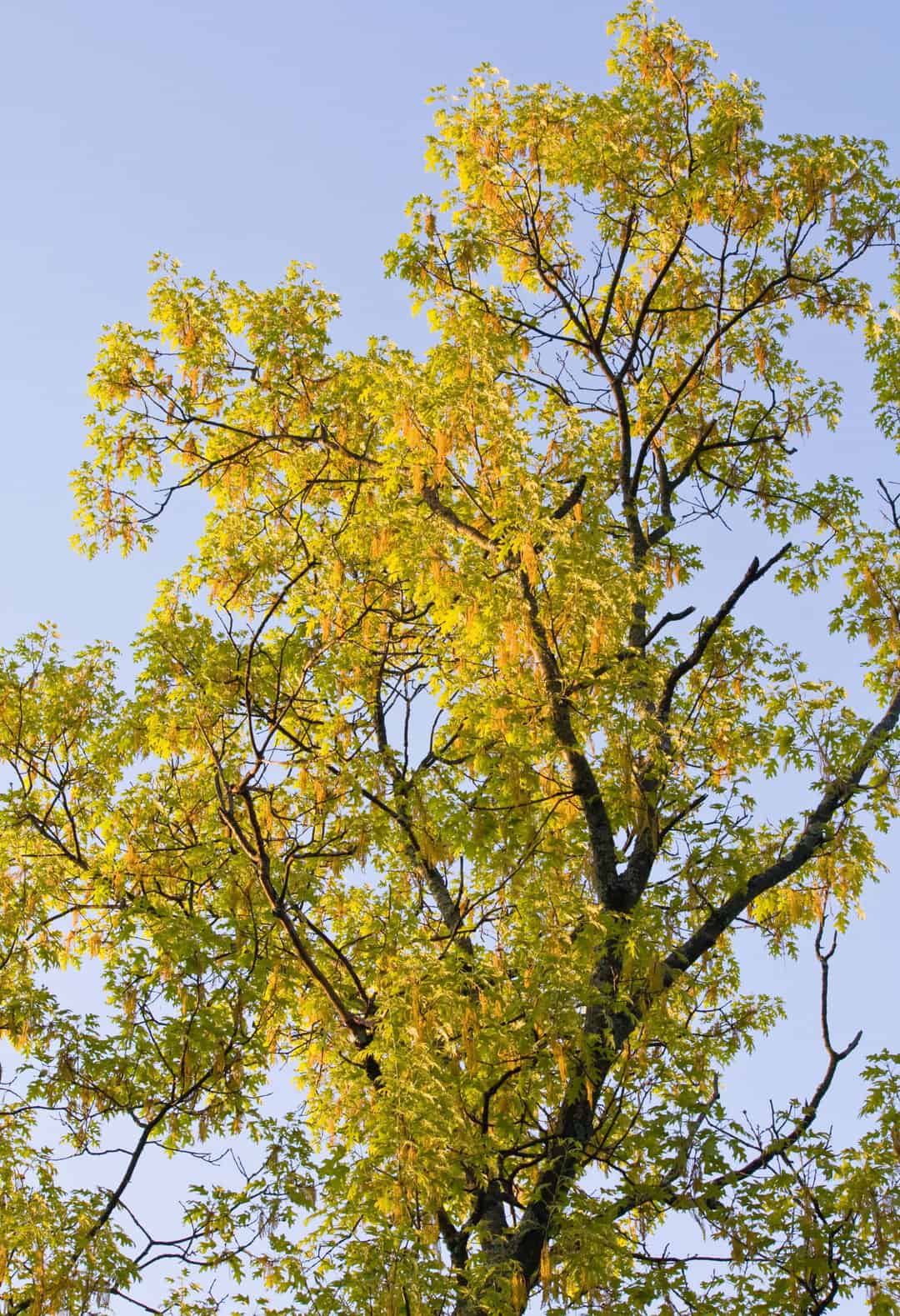
Flowering Black Oak (Quercus velutina) in early spring.

Black Oak is relatively dense. Since it falls into the Red Oak category, that means that it is porous; however, if dried and seasoned correctly, it will be a great oak to use for firewood.

Black Oak is also an oak that won’t produce a lot of ash or smoke because its bark is relatively smooth. With grains that are typically straight, this yellow-colored oak wood will be a perfect addition to your firewood.

#8 – Willow Oak Tree

Another Red Oak, Willow Oak, is a good option for firewood. Found in the Eastern United States, Willow Oak is abundant.
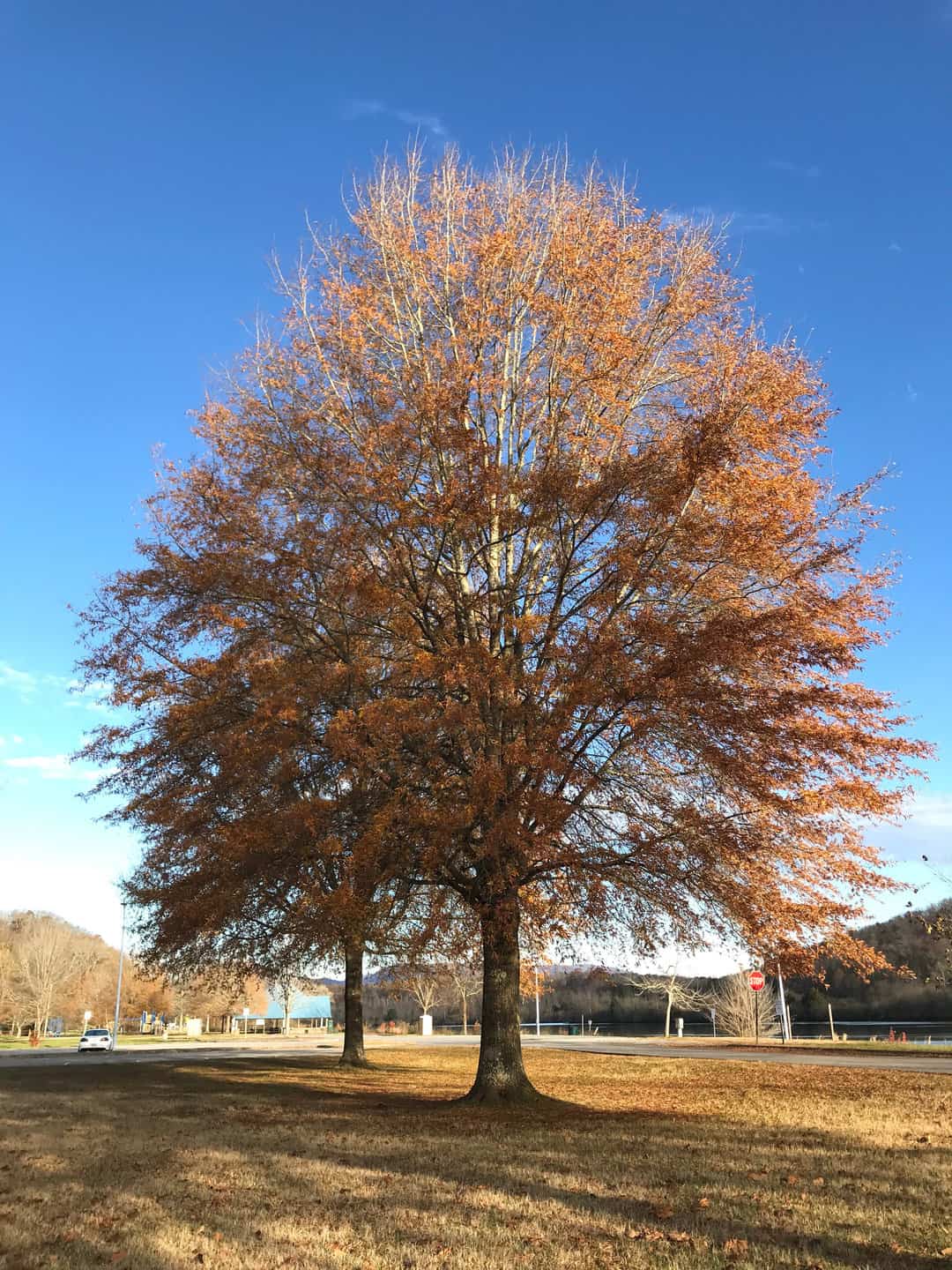
A fall foliage willow oak (Quercus phellos)
A fall foliage willow oak (Quercus phellos.)

Willow Oak has straight, even grains, and is very dense and strong, and will burn for a long time. Its Janka Hardness Level is 1460 lbf, making it one of the harder Red Oaks.

When compared to a White Oak, Willow Oak is inexpensive and is moderately durable.

The Willow Oak has medium to large pores and has a coarse grain, which means it may provide some crackling when used for firewood.

#7 – Pin Oak Tree

Pink Oak is a Red Oak Tree and is a great option for firewood – and not really a great option for anything else.
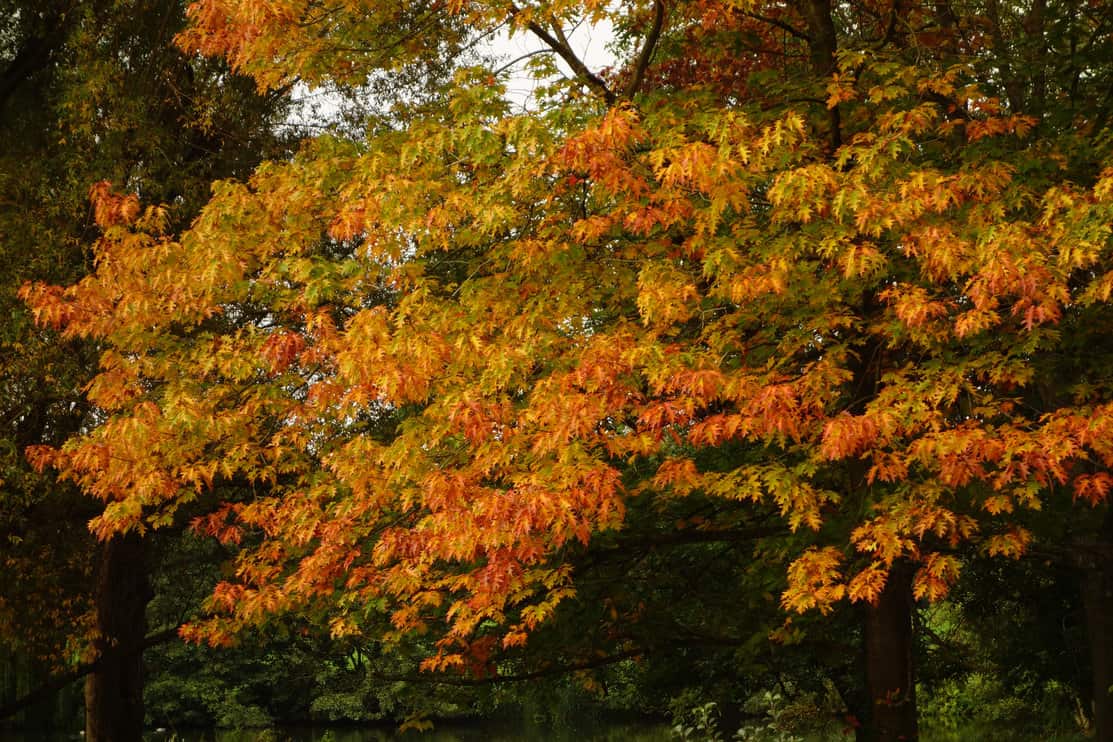
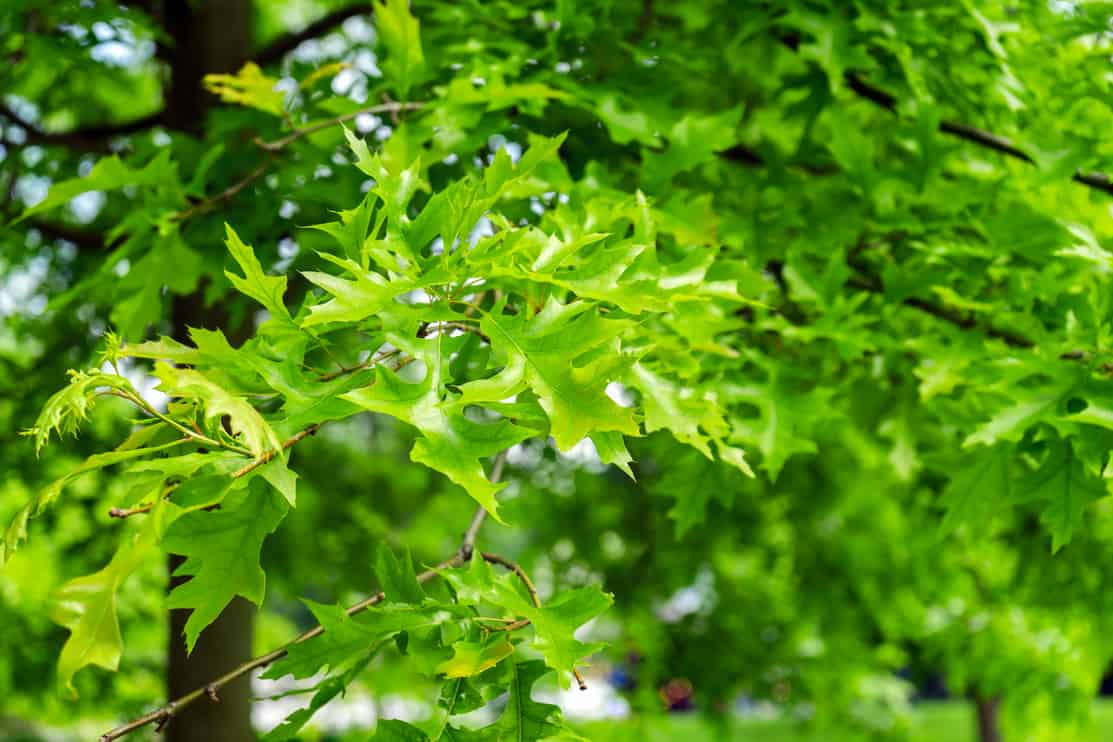
Pin Oak Tree Leaves in Autumn.

Pin Oak is found in the Eastern United States and is very hard with a Janka Hardness Rating of 1500 lbf; however, it does not have straight grains and cannot be used in furniture because of its warping abilities.

Although Pin Oak warps and may not be good for other things, the warping isn’t too much of an issue for firewood, as it will move along with the fire. It is a great firewood option; it is very abundant and inexpensive.

#6 – Cherrybark Oak Tree

The last Red Oak Tree on the list – Cherrybark Oak, is one of the highest quality Red Oak firewoods available and amongst the strongest.

The Cherrybark Oak Tree is very hard and dense and has relatively straight to curved grains. It is a dense wood that will burn for long periods of time.

Cherrybark Oak is common throughout the Eastern part of the United States, and because of its superior quality, it will produce a nice, clean fire.

If you’re interested, you can read our piece on 29 incredible facts about Red Oak Trees here.

#5 – Oregon White Oak Tree

We’re placing the Oregon White Oak at the number 6 firewood because it is hard, dense, has straight grains, and is abundant; however, it can be a bit flakey.

An Oregon White Oak (Quercus garryana) on a foggy Fall morning.

Oregon White Oak firewood will burn for long periods of time and has one of the hotter heat values in the category of White Oak.

The downfall to Oregon White Oak is that the bark is generally flakey – and can produce a lot of ash, and can be very messy.

#4 – Post Oak Tree

It’s safe to say that the Post Tree is hard, which makes it dense and great for firewood, especially when cooking.
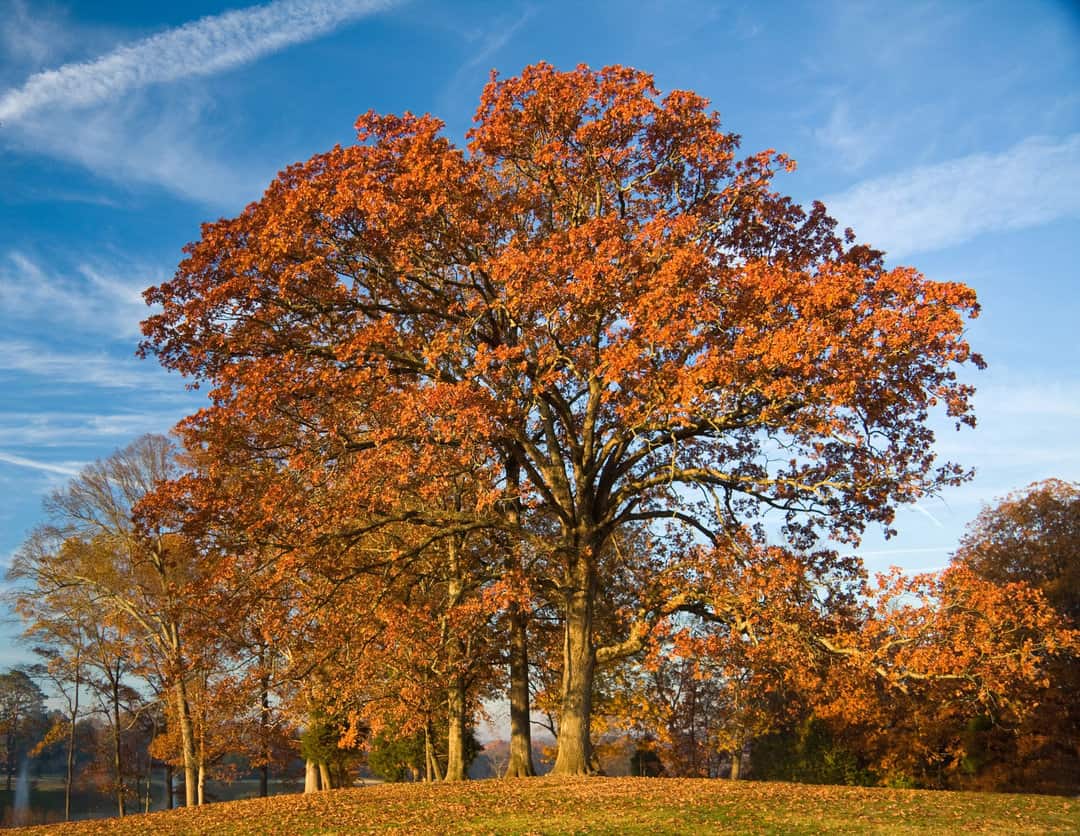
Autumn Post Oak (Quercus stellata) with blue sky.
Autumn Post Oak (Quercus stellata.)

Live Oak Trees, such as Post Oak, are commonly seen in the Eastern United States, and they are abundant. They are part of the White Oak family, and although they grow straight, they do have some diagonally shaped grains that can create smoke.

However, usually smoke is not the best when considering firewood, but if you’re looking for a cooking fire, then the Post Oak Tree may be the firewood to choose. Its density leads to a long burn time, granted it’s seasoned properly with a moisture content below 20%.

But don’t count it out as firewood – because Post Oak is abundant, it is dense, it will create a long burning fire and produce a lot of heat!

Fun fact – Live Oak Trees are one of the longest living oak trees. You can read more about how long oak trees live here.

#3 – Bur Oak Tree

Bur Oak is placed at number 3 because it is dense, can be found in most parts of the United States. It has a BTU of up to 29 Million and has a fantastic burn time while producing low smoke.
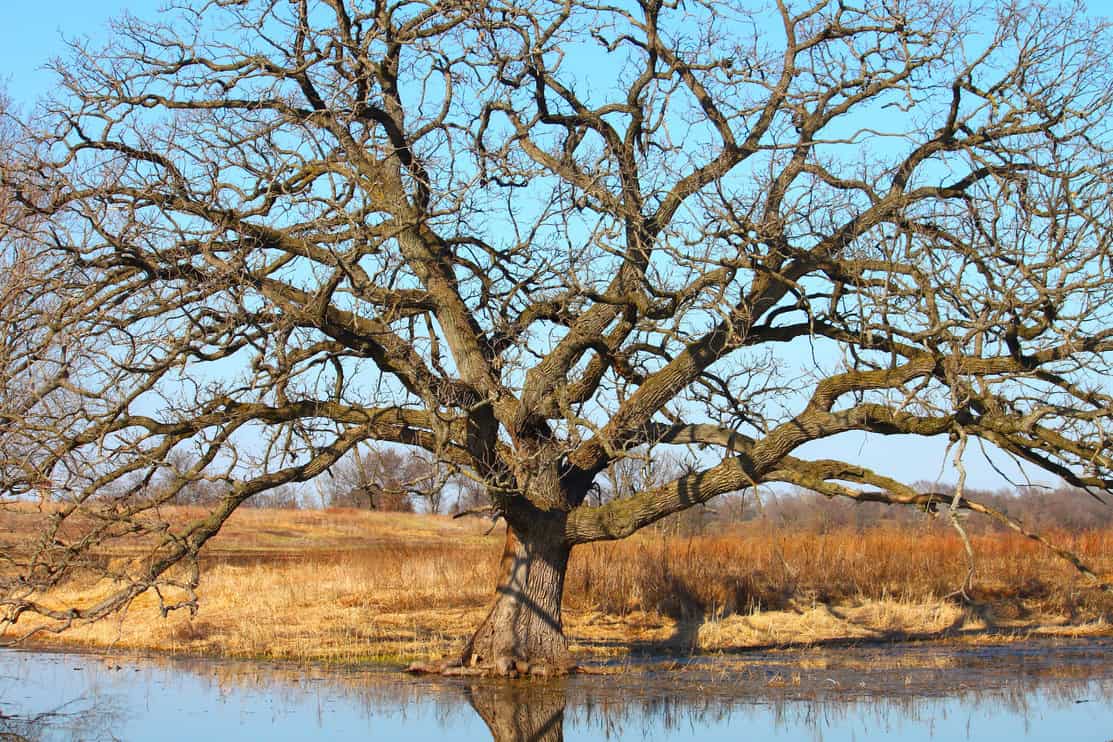
Old Bur Oak (Quercus macrocarpa) grows along a wetland of northern Illinois.
Old Bur Oak (Quercus macrocarpa.)

Bur Oak is a White Oak, which makes it non-porous, meaning it is less susceptible to moisture – when dried seasoned correctly (.5 – 2 years), Bur Oak can be an amazing firewood option.

Found in the Eastern to Mid-Eastern part of the United States of America, Bur Oak is abundant and is moderately priced.

The only downfall to Bur Oak is that it has medium to large pores, which means it may crackle and pop when it is burning. The more cracking and the more popping, the more smoke it may produce.

If you’re finding your firewood is crackling and burning, it either has a high moisture content or is a tree with larger pores. You can either get a moisture reading device or look into a fireplace chain curtain (like this chain curtain from Midwest Hearth Store) to stop access sparks leaking from your fireplace.

#2 – Chestnut Oak Tree

Commonly found in the Eastern part of the United States – Chestnut Oak is another great option for firewood.

Chestnut Oak Trees have very straight grains, and although not the hardest White Oak, it has enough hardness to be dense and long-lasting. Chestnut Oak doesn’t have as many tyloses as other White Oaks, which is good – because it will dry faster for use.

Additionally, Chestnut Oak firewood isn’t very porous, leading to less crackling and popping than, say, a Bur Oak Tree.

#1 – Swamp White Oak Tree

The Swamp White Oak tree has been determined, by us, to be the best firewood.

The Swamp White Oak is a White Oak tree that is extremely hard, extremely dense, has even straight grains, is abundant, will burn for long periods of time, and will burn cleanly – can it get any better?

The Swamp White Oak Tree has a Janka Hardness Rating of 1600 lbf- making it one of the hardest oak species and extremely dense.

The Swamp White Oak Tree is seen in the Eastern to the Mid-Eastern United States. It primarily grows in well, swampy and damp areas. However, it can survive quite well in residential areas as well.

You should wait at least 18 months to allow Swamp White Oak to season before using it as firewood. Most professionals would recommend allowing the wood to season for up to 2-3 years, however.

Is White Oak or Red Oak Better for Firewood?

Now that we have our Top 10 – you may notice that the White Oak Trees are considered the best when comparing firewood! Although this is like comparing Red Autumn Leaves to Orange Autumn Leaves, we love them both; equally, there are some benefits to choosing White Oak to Red Oak for Firewood.

White Oak is better firewood because it burns at higher heat values, is non-porous, and is denser than Red Oak.

Here are some reasons why you may want to consider White Oak for your next burn.

You can also read our full guide on why white oak is better than red oak for firewood here.

White Oak Produces More Heat

When comparing a cord of White Oak to a cord of Red Oak – White Oak produces more heat!

Like we mentioned earlier – White Oak, when dry, produces 30,600,000 BTUs per cord, and Red Oak produces 27,300,000 BTUs, making white oak the hotter choice.

A hot fire is beneficial because that means less smoke, less build-up in your fireplace and less energy, and fewer logs needed to heat up your space! You’re saving a lot here.

If you ask us, the amount of heat a fire produces is important – especially if you are heating up your home or cooking with it.

If you’re interested, you can learn more about the key differences between Red and White Oak Trees here.

White Oak Dries Faster

An important idea when considering firewood is the process needed before its use. Now, we’re not saying 2-3 years of seasoning isn’t a long period of time; however, since White Oak is non-porous, its drying time is faster than many other kinds of wood.

All firewood should be dried before it is used. Of course, we’ve all found some twigs on the floor or chopped down our own tree and couldn’t wait to use it in our fire pit – and okay, if you’re not a firewood enthusiast, maybe that’s not the worst thing – but, if you want to actually reap the benefits from firewood, you need it to be dried and seasoned correctly.

Dried firewood means less smoke, longer burns, less wood needed, and less popping, cracking, and smoking. When wood holds moisture, it’s only going to start putting itself out as it burns, creating a ton of smoke in the middle of the burn.

But if you just can’t wait, and you don’t have any seasoned firewood available, the best tip we can give you is to only burn clean wood.

If you’d like to check it out, here are 32 incredible facts about White Oak Trees.

Avoid Burning Scrap Wood

No matter which firewood you choose, White Oak, Red Oak, or something else – do not burn wood that has been used for other purposes.

Scrap wood and lumbar were often used to build things. They can be pre-treated, have chemicals on them, contain paint or stain, there can be glue or can have varnish on them, and once you burn a piece of wood that contains these things, you are going to be producing toxic smokes that can hurt you and the environment.

It’s always key to remember why you are drawing the fire in the first place. If you are using it for your indoor space and heat, you want to make sure your wood is clean to protect you and your house.

If you are using it for leisure in an outdoor setting, there’s a good chance you are going to be close to it – and an even better chance that you’re going to roast some marshmallows, and that being said, if it produces any smoke at all – it needs to be free of chemicals and any of the bad stuff.

And because we are believers in clean fires – this is why we think oak trees are a superior option!

That’s a Wrap!

When choosing firewood, it’s important to remember why you need this wood in the first place. Firewood needs to be as clean as possible, but picking a dense, long-lasting, and evenly grained firewood can make all the difference.

With firewood, it’s like a domino effect. When it is dense, that means it will burn longer. If it burns longer, then it will be a benefit economically, as you will need less. If you need less, you are helping the environment.

Firewood, having very personal preferences attached, should always be seen as something that will be beneficial for you and the environment.

References

Dow, B. D., & Ashley, M. V. (1996). Microsatellite analysis of seed dispersal and parentage of saplings in bur oak, Quercus macrocarpa. Molecular ecology5(5), 615-627.

Gardiner, E. S., & Hodges, J. D. (1998). Growth and biomass distribution of cherrybark oak (Quercus pagoda Raf.) seedlings as influenced by light availability. Forest Ecology and Management108(1-2), 127-134.

Kabrick, J. M., Dey, D. C., Van Sambeek, J. W., Wallendorf, M., & Gold, M. A. (2005). Soil properties and growth of swamp white oak and pin oak on bedded soils in the lower Missouri River floodplain. Forest Ecology and Management204(2-3), 315-327.

King, W. W., & Schnell, R. L. (1972). Biomass estimates of black-oak-tree components (No. TVA-2902217). Tennessee Valley Authority, Norris (USA). Div. of Forestry, Fisheries and Wildlife Development.

A tall and stately tree, silver oaks can grow over 100 feet tall with a 30-foot spread of nice cool shade. They thrive in moderately dry, tropical climates such as Florida and California. But silver oak trees have more uses than just a pretty shade tree.

Silver oak trees, also called silk, silky, and southern silky oak, have many uses. Along with providing shade, silver oak trees can be used as windbreaks, fuelwood, veneer, to make musical instruments, cabinets, and for reforestation. They also provide nectar to pollinating birds and insects.

This multi-use tree is more than just something pretty to look at in your backyard. Silver oaks have some amazing uses you can take advantage of!

What Are Silver Oak Trees?

Despite their name, silver oak trees are not part of the oak tree family. They belong to a family of trees known as Proteaceae. Don’t ask us how to pronounce that! Macadamia nut trees belong to the same family.

There are thousands of species under this large family umbrella, ranging from herbs and shrubs to large trees. 

Silver oak trees are the largest tree in their genus, Grevillea. You may know this genus by another name: spider flowers. Species in this genus commonly produce nectar for bees, ants, and birds. However, you will not see any animals eating the flowers or fruits as they contain cyanide. 

Where Do Silver Oak Trees Live?

The silver oak goes by many names: southern silky oak, Australian silver oak, silk oak, and silky oak. 

These trees are picky about where they live. In the United States, their range is the southern tips of Florida and Texas, Southern Arizona, and Southern California. They’re also present in Hawaii.

Silver oaks are native to Australia according to the US Forest Service. Specifically, they are from the east coast of Queensland, down to New South Wales. In New South Wales, they consider these pesky trees weeds because they pop up so quickly.

What Climates Do Silver Oak Trees Grow In?

Judging by where these trees grow, you can tell they like warm climates. If they have to, silver oaks can survive down to 18℉ and up to 95℉. However, they prefer temperatures between 50℉ and 80℉. Who wouldn’t?

Speaking of picky climates, silver oaks are also fastidious about moisture. They cannot grow in wet, soggy, swampy soils. Instead, they need well-drained soils and prefer slightly acidic conditions. 

Talk about a picky tree!

The pH of your soil can affect the growth of any plant. For more information on what certain trees prefer and how to amend your soil to their liking, What pH Level Do Trees Actually Like For Best Growth? is a great place to start!

Most folks living in the U.S. will never see a silver oak tree because they prefer tropical, warm climates. Even those living in southern New Mexico do not see silver oak trees. However, for those living in Hawaii, you will see silver oaks on most of the islands.

Under ideal conditions, silver oak trees will reach an average height of 75-100 feet with a single, straight trunk at full maturity. They are fast growers, growing at a minimum of 3 feet per year, sometimes 10 feet!

Now that we know where silver oaks live and what their favorite growing conditions are, let’s check out all the uses for your silver oak tree and what you can do with yours.

10 Silver Oak Tree Uses (And What To Do With Yours)

Beautiful silk or silver oak tree with yellow flowers in spring time

If you have a silver oak tree in your yard or are thinking about planting one, you may wonder what it’s good for. What can you do with a silver oak tree?

The number one use for residential silver oak trees is for shade and ornamentation, but don’t worry, we’ll also talk about some other uses such as the timber industry and even the rock n’ roll industry!

Let’s get to it!

Silver Oak Trees Are Used As Ornamental Trees

Their massive size puts silver oak trees in the ‘skyline’ tree category. They dominate the landscapes they are growing in and like to be the center of attention.

Now, if you have a small yard in the city, silver oak trees are not recommended. According to the University of Florida, you should not plant them near a house because of their size and spread.

The large spread of silver oak trees is not the only problem with planting them near a house. Silver oaks are brittle and shed their leaves, despite being evergreens. In high winds, the tops of the trees can even snap off!

So, why in the world would you want to plant a silver oak in your yard?

Well, if you have the land, they are an excellent choice for a centerpiece or statement tree in your landscape. When the flowers bloom in the spring, they are a brilliant yellow-orange. Coupled with long, fern-like leaves, the silver oak is a beautiful tree to see.

It is also an evergreen tree, so you do not have to worry about it losing its leaves and growing bare in the winter months. Although, the silver oak loses a lot of its leaves throughout the year due to wind and inclement weather.

Silver oak trees have been used industrially as ornamental street trees. When planted along roads and trimmed properly, these trees can be pleasant to look at and their roots have minimal impact on sidewalks and streets.

Silver Oak Trees Are Used For Shade

With a mature height sometimes reaching over 100 feet, silver oak trees are the perfect choice for shade. It has a large spread, providing up to 30 feet of shade in all directions.

These are magnificent trees to plant in large fields for farm animals to rest under on hot summer days. They are also nice in large yards, providing shade for family picnics and outings as long as the wind isn’t too high!

It’s not recommended to hang a tire swing from these trees because of brittle branches.

Silver oaks provide shade for agricultural plants too. Tea bushes and coffee plants need protection from extreme sun, rain, wind, and cold. Silver oaks make for a great umbrella over these economically important crops.

Using silver oaks in this manner is popular in India and Sri Lanka, according to the US Forest Service. Protecting coffee with silver oaks is a common practice in Hawaii, India, and Brazil.

Silver Oak Trees Are Used As Windbreaks

Another great use for silver oak trees is to use them as windbreaks. After all, they’re massive, right? Might as well!

So, what exactly is a windbreak? Windbreaks are used to, well, break the wind and slow it down. Slowing the wind means less erosion, less damage, and better conditions for crops.

You can buy artificial windbreakers like the Royal Shade Windscreen. This is a good option if you need protection against the wind right now, instead of 10 years later when a silver oak may grow tall enough to provide wind protection.

Windbreaks create a better environment for soil, livestock, and wildlife. Silver oaks are not a great windbreaker. They may be super tall, but as the tree ages their branches grow brittle and easily break off.

In Florida, silver oak trees serve an important role in preventing Citrus canker according to the Natural Resources Conservation Service. Citrus cankers result from a bacterium that infects citrus trees, causing brown spots and lesions on the fruit.

Silver oak trees are not very cold tolerant, so they are mainly used in the southern coastal areas. The bacteria responsible for citrus cankers travels in windy rain, where it gets deposited into the stomates of vulnerable citrus trees.

When using silver oaks, the number of lesions observed on vulnerable trees was lower and the spread of the disease was reduced to only a few plants instead of an entire nursery.

Silver Oaks Provide Nectar For Wildlife

Flowering silky oak tree

Trees not only provide us with oxygen and shade, but they also provide food and homes to a lot of wildlife. Squirrels, birds, beetles, deer, raccoons, and tons of other wildlife benefit from trees and their fallen fruits and nuts.

The silver oak provides a special sort of reward for visiting wildlife: nectar! According to a study published in Austrul Ecology, honeybees and ants take advantage of this trait the most, but birds also get in on the action.

During the study, they observed birds were better pollinators for silver oaks than bees or ants, but that bees and ants often hogged the nectar so that cross-pollination happened far less often than it should have.

If you want to give the birds a better chance at the nectar, consider hanging a bee habitat like SunVara Wild Pollinator Mason Bee Habitat from a nearby tree. Bees will cruise on over to this setup, giving the birds some breathing room.

Silver oak trees are important honey trees in India, where the nectar is converted and sold as honey.

Silver Oaks Are Used For Fuelwood

There’s nothing better than sitting around a fire on a warm summer night, watching the flames rise and disappear into the night.

Ready to have a bonfire yet? Silver oak wood makes fantastic firewood! 

Silver oak trees are easy to grow in warm climates, and they do not compete too much with their neighboring plants and trees. For this reason, silver oaks are often planted in plantations where they are harvested for specific purposes. Like fuelwood, for example.

Another commodity silver oaks are used for is timber. These trees grow fast and straight, so they are perfect for the timber industry.

You can read more about using oak trees for firewood here!

Silver Oak Trees Are Used As Veneer 

For those of us out there unfamiliar with woodworking, you are not alone! The word ‘veneer’ is probably known but not well defined in the average person’s mind.

The veneer is the ‘face’ of a wood product. It can make a TV stand appear like solid oak or a chest look like dark cherry. Underneath most wood products is simple particleboard.

Since people often dislike having particle board as a style in their home, a veneer is an important commodity in the wood industry. Silver oaks have a unique appearance referred to as ‘lacewood.’ It ranges from a silvery gray to brown with vertical striations. 

In recent years, silver oak veneer has caused allergic reactions in some folks who are sensitive to the wood.

Silver Oaks Are Used To Make Doors, Windows, and Cabinets

Not only are silver oak trees used for the face of wood products, but they’re also used to build stuff! The wood of silver oaks resembles that of an actual oak tree according to California Polytechnic State University, making it an attractive wood in the industry.

Remember how we said silver oak trees grow pretty fast? This quality makes the silver oak one of the better trees to use for wood products because they are more sustainable. 

In just two years, silver oaks can reach a height of 10 feet!

Silver oak trees are used to make cabinets, doors, windows, and furniture. The reason they used the wood for these purposes is silver oak tree wood is resistant to rot. 

This makes it an excellent candidate for wood products exposed to the elements, like doors and windows.

Silver Oak Trees Are Used To Make Musical Instruments

Because silver oak trees resemble the wood of an oak tree, it’s commonly used to make beautiful musical instruments.

Silver oaks are considered ‘soft’ hardwoods. The wood is easily worked without splintering or breaking, making it an ideal choice for instruments. Normally, softwood trees are chosen for musical instruments, but hardwoods are used occasionally.

The popular belief about hardwoods and softwoods is that hardwood is hard, and softwood is soft, right? While this is true for a lot of hardwood and softwood trees, it’s not true for all.

According to Penn State University, back in the days of two-man saws and whittling wood into tools, the hardest trees to whittle and cut were called hardwoods. The trees easiest to work with and cut, they considered softwoods.

When scientists came around with their calipers and notepads, they were not convinced this is how they should categorize hardwood and softwood. Instead, they noticed the trees labeled ‘hardwood’ were all deciduous trees that shed their leaves in the fall. All the softwoods were evergreen.

At last, they found a labeling system for hardwoods and softwoods!… right?

Well, as they moved west and south, it became a lot more confusing as some fall-shedders turned out to be softwoods, and some evergreens turned out to be hardwoods. 

Nowadays, they use a method called the Janka-ball hardiness test to categorize trees into hardwoods and softwoods. The test is as bizarre as it sounds, involving a hard metal ball shot into the wood.

Nonetheless, silver oaks, silky oaks, whatever you may call them, are used to make musical instruments like guitars and violins. They can also be used as veneer wood on instruments.

Silver Oaks Are Used As Reforestation Trees

Reforestation is an important response to the continually rising population in the United States. For many years, the rate of forest growth to forest cutdowns has been relatively stable, but with population growth comes forest decline.

But reforestation isn’t as simple as throwing a few seeds down and waiting for the trees to grow. Scientists have gotten reforestation down to, well, an exact science! 

According to the Virginia Department of Forestry, when a forest is first establishing itself, it is just an open field of grasses and shrubs. Lightweight seeds get carried on the wind and deposited in the field. These first trees are called ‘pioneer’ trees and grow fast in a full-sun environment.

Despite establishing and growing quickly, pioneer trees do not live as long as other trees established later on. As the pioneer trees grow, other trees that are long-lived and do not require full sun creep up. 

As the pioneer trees die off, the later trees establish themselves, and the forest is considered established.

Silver oak trees typically live around 100 years. They are sun-loving and fast-growing, making them excellent candidates for pioneer trees in the reforestation process. 

Reforestation activities using silver oak trees are limited to the environments they can survive in. Silver oaks are not a good choice for reforesting areas in northern Montana, for example, as the cold-intolerant trees would not survive.

Instead, silver oaks stick to warm climates like the southern regions of Florida, Texas, and California. 

Silver Oak Trees Provide Nesting Areas For Native Birds

Trees are an important part of most ecosystems. They provide food, shade, shelter, and homes to many animals, big and small.

Beetles, ants, bees, birds, squirrels, and bears all rely on trees, which are always giving to nature! Silver oak trees are no different. If you have one in your yard, you can expect tons of wildlife to be attracted to them:

  • Birds: Native birds will make nests in silver oak trees, using leaf litter and twigs to make a comfy home. Since silver oak trees are large and evergreen, they provide the perfect amount of shade and protection for nesting birds.

    These trees also attract birds because of their nectar. The bright yellow-orange flowers that bloom in the spring will bring plenty of beautiful birds around.
  • Insects: Just like birds, pollinating insects will be attracted to the colorful flowers blooming in the spring. The colorful flowers of the silver oak tree attract bees and ants.
  • Mammals: Some trees attract animals because of the fruit it drops, such as the acorns dropped from an oak tree. Silver oaks do not attract animals with their fruit, but they are attractive to animals like squirrels and raccoons who may nest in any hollow cavities of the tree.

You can learn more about how oak tree leaves attract these types of creatures as well here: 5 Animals & Insects That Eat Oak Tree Leaves.

Problems With Silver Oak Trees

Grevillea robusta, Silky oak, Australian silver oak, Evergreen tree with dark green bipinnatifid fern like leaves and gloden-orange bottlebrush like flowers and leathery about 2 cm long fruits

Silver oak trees are pretty useful, not only for nature and animals but for people too! However, before you plant silver oak trees in your yard, let’s check out some drawbacks.

Silver Oak Trees Are Susceptible To Lightning & Wind Damage

Your tall and stately silver oak tree may grow fast and far, but it may not last. Because silver oaks are so tall, they are often hit by lightning according to the. This is one more reason not to plant these trees close to your home.

If your oak tree has been struck by lightning, you can read Oak Tree Struck By Lightning? What Happens & How To Save It to learn more about the upcoming necessary processes.

Another weather-related problem with silver oak trees is wind damage. The branches and tips of the tree are rather brittle as the tree gets older. A powerful gust of wind in a storm can cause branches to fall off and even the tips of the tree to break.

Silver Oaks Cause Extensive Leaf Litter

As we just mentioned, silver oak trees are susceptible to inclement weather. They truly are picky trees! Too much wind, rain, lightning, and silver oaks get upset…

Unfortunately, branches are not the only brittle part of the tree in a windstorm. Although silver oaks are evergreen, their leaves are often shed on windy days, creating large amounts of leaf litter. 

Not cool for the homeowner obsessed with a clean landscape…

Wrapping Things Up

Silver oak trees prefer full sun, warm temperatures, and aren’t big on cold, windy, or wet conditions. These trees serve many purposes in the extreme southern regions of the United States, like Florida, Texas, and California.

To recap, here are 10 silver oak tree uses:

  • Ornamental landscape tree
  • Shade tree
  • Windbreak
  • Honey tree/nectar for animals
  • Fuelwood
  • Veneer wood
  • Doors, windows, & cabinets
  • Musical instruments
  • Reforestation
  • Nesting for native birds & mammals

In terms of the average homeowner, the qualities most important on this list would be using silver oaks as an ornamental tree, shade tree, fuelwood, and for wildlife viewing.

Silver oak trees are also important in the timber industry and for reforestation projects. However, declines in the native population of silver oak trees have made them less available for commercial production.

So, if you have a silver oak tree in your yard, cherish it. It might be the only one around for many, many miles!

If you are interested in learning more about the trees around your yard, check out our homepage for more information on oaks, maples, apples, and all kinds of different trees. You will not ‘be-leaf’ all the information we have!

If you’d like to learn more about oak trees in general, check out our guide on the most popular fallen oak tree uses here!

References

Afzal, M., Farman, M., Rasib, K. Z., & Qureshi, N. A. (2019, April). Biocidal action of silver oak (Grevillea robusta) leaf extract on the termite Heterotermes indicola Wasmann (Blattodea: Rhinotermitidae). International Biodeterioration & Biodegredation, 139, 1-10.

Besley, J. (2009, July). This noble species: Grevillea robusta. Australian Garden History, 21(1), 4-8.

Kalinganire, A., Harwood, C. E., Slee, M. U., & Simons, A. J. (2002, January 15). Pollination and fruit-set of Grevillea robusta in western Kenya. Austral Ecology, 26(6), 637-648.

Owate, O. A., Mware, M. J., & Kinyanjui, M. J. (2018). Allometric Equations for Estimating Silk Oak (Grevillea robusta) Biomass in Agricultural Landscapes of Maragua Subcounty, Kenya. International Journal of Forestry Research, 2018, 14.

Oak and elm trees are both picturesque and can be found in landscapes all across the United States. If you’re choosing between an oak and an elm tree for landscaping or building material, it is important to know their distinctions so you can pick between the everlasting elm vs. oak differences.

Elm trees grow taller, but oak trees are wider than elm trees. Elms have non-invasive root systems and are more tolerant than oaks against poor quality soils. Oak trees are harder and more durable than elm trees, making oaks a more popular for construction like flooring and cabinetry. 

You may automatically think that you should choose oak because it’s harder and more durable, but that’s not always the case! By the time you’ve finished this blog post, you’ll know the key differences between oaks and elms as well as which type of wood to choose when building a specific item. Let’s jump in!

Is Oak Or Elm Wood Harder? 

Oak Tree Logs

In terms of hardness, oak trees have harder wood than elm trees, especially red oaks. It’s not as hard as hickory or American walnut, but it is considered one of the strongest in the North American market. 

Since oak is also more durable than elm, it is often chosen over elm for projects. However, because it’s harder, oak wood is prone to cracking and splintering when cut into. It also needs care and maintenance to keep it from shrinking and cracking once it’s been turned into furniture or flooring. 

As for elms, the wood tends getting out of shape easily and is more vulnerable to insect attacks than oak. It’s still a durable and hard wood, but these cons make it slightly less valuable than oak wood and ultimately a less popular choice. 

What Determines Wood Hardness? 

Oregon State University explains that trees’ wood is made up of cellulose that is bound together by lignin, and its hardness is determined by how dense that is. The wood’s cells are shaped like whiskers and the way they lay determines whether or not it’s hardwood or softwood. 

Hardwoods have more hollow whisker cells, and oak trees in particular have resin in the hardwood that fills the cells and makes them even harder.

The Janka scale is the official test for the hardness and stability of wood. This is done by measuring how much force it takes to push a .444-inch steel ball .222 inches into the wood, which is measured by pounds force. 

The red oak tree has a score of 1290, which means it is particularly hard. It’s even used as the standard that other wood types are tested against. Elm trees have a hardness rating of 830, which means it’s considered “soft hardwood”. 

3 Differences Between Oaks And Elms

Oak tree park

Now, onto the good stuff. Here are 3 differences between elm and oak trees to watch out for. 

1. Elm Trees Are Taller Than Oak Trees

Both of these trees grow in different sizes and shapes. You can expect an elm tree to grow to about 60 to 80 feet and an oak tree to be about 60 to 100 feet tall. 

2. Oak Trees Are Wider Than Elm Trees

As far as the wideness of the canopy, oak trees reach out further than elms to a shocking 100 feet wide. More often than not, oaks are wider than they are tall.

Elms, on the other hand, can stretch to about 60 feet wide. As with any living thing, the size dimensions are only averages and can of course have exceptions with especially old and healthy trees. 

3. Oak Trees Are More Expensive Than Elm Trees

Sometimes cost is a factor if you’re purchasing a live oak or elm to put in your yard. Tall oak tree seedlings cost up to $35 and elm seedlings cost a little less at around $20. 

Oaks range in price from $200 to $400 for a 10-foot tree. You can expect to pay less for an elm at about $120 for a tree between 6 and 7 feet. Matured trees above a certain height will cost hundreds and even thousands of dollars. 

White oaks are the most valuable tree you can have out of the two species and because of that cost more, especially when they are mature.

Elm And Oak Tree Shared Qualities 

Elm and Oak tress have a lot of similarities and differences, but are ultimately low-maintenance trees and common choices for a lot of homeowners and builders. One of the similarities between oaks and elms is their lifespan. Oaks can live up to 150 to 400 years, while elms live around 150 to 300 years. 

Oaks and elms also require virtually the same care. Both trees enjoy full sun and moist, well-draining soil. Elm trees can handle partial shade but do very well with a lot of sun. Experts recommend fertilizing each tree once or twice a year. As far as pruning, they both do well with a trim once every 3 years. 

As for prices, the two types of wood these trees produce cost about the same per board. Typically, elm costs about $3.50 to $6.50 per square foot, and oak costs slightly more, around $4.50 to $10.50 per square foot. Although they have their special uses, both of these woods are used for making furniture and flooring. 

The Elm Tree 

Elm tree field

You will recognize the umbrella-shaped elm tree by its light to dark green leaves that are oval-shaped with a pointy tip and small saw-toothed edges. When they turn yellow in the fall, they showcase the full beauty that makes them great additions to yards and city streets across the United States. 

Elm trees have the kind of bark that you’d picture if I told you to imagine a basic tree. It’s dark brownish-gray, has deep ridges, and looks kind of scaly. It’s also super useful, which I’ll talk about later on! 

Although they’re not as popular as oaks, elm trees are great choices for yards because they provide a lot of shade and are generally very easy to take care of. Elm trees were very popular in urban areas until Dutch Elm Disease wiped a lot of them out. The ones that are still used in these areas were chosen because they give excellent shade for roads. Sometimes their canopies connect and provide an even bigger area of shade. 

Despite many of them being wiped out by Dutch Elm Disease, scientists have created hybrid species that are resistant to it, so they’ve been making a comeback! We’re rooting for you Elms!

The Mighty Oak Tree

Mighty Oak Tree in Green Field under blue skies with clouds, Spring Landscape under Blue Sky

Oaks are known for their strength and elegant height; they’re even referred to as trees’ king of kings! An oak tree is easily recognized by its unique leaves, also called broadleaves, that are flat with multiple rounded lobes as the edges. They are green in color but turn red or brown in the fall. 

As oak trees age, their bark changes from silvery brown to light gray or very dark brown. The bark has deep ridges all over its surface. Like the elm, the oak trees’ bark is very useful. 

Because of how beautiful and stately they are, oak trees are used as landscaping trees all over American yards. They are rich in foliage and have wide canopies that can stretch to other nearby trees. And besides giving plenty of shade, oak trees are hardy and can handle all sorts of weather changes.  

That’s All You Need to Know! 

Now that you’re informed, you’ll know exactly which tree you want to use either as a landscaping addition or as timber. 

To recap—oaks are harder, more durable, and grow bigger than elm trees. However, elms are hardier in rougher soils and are less likely to cause major root problems to structures as oaks do. 

As for similarities, both trees require the same care and are used to add beauty and shade to yards. Both of the trees’ wood cost pretty much the same although oak tends to be slightly more expensive. And lastly, you’ll see both of these trees used for flooring and furniture.

All in all, you really can’t go wrong with either of these trees. It all depends on you! Whether you’re shading a corner of the yard or building a desk, the oak and the elm will both provide pleasant results. 

References 

Scheffer, T. C., & Morrell, J. J. (1998). Natural durability of wood: A worldwide checklist of species. 

Vörös, Á., & Németh, R. (2020, July). The history of wood hardness tests. In IOP Conference Series: Earth and Environmental Science (Vol. 505, No. 1, p. 012020). IOP Publishing. 

Unfortunately, trees can become severely damaged or sick and require removal. Sometimes you have to get rid of your tree, as sad as that may be. Thankfully, there are many methods you can use if you need to remove an oak tree. 

When you have to get rid of an oak tree, your best bet is to cut it down. You can also get rid of your oak tree by using:

  1. Rock Salt
  2. Vinegar
  3. Girdling
  4. Copper Nails
  5. Herbicides

When your oak tree gets damaged beyond repair, do not fret about what to do! I’ve got you covered with a list of the top five methods to get rid of oak trees. Let’s dive in.

Using Natural Methods To Get Rid Of Your Oak Tree

Now, if you’re like me you probably like using chemicals as little as possible and prefer natural methods. After all, your oak tree has had a great lifespan and probably done some good for you over the years.

Thankfully, you can definitely use at home herbicides to get rid of your oak tree. They may not be as effective as man-made chemical solutions, but they still get the job done if used liberally. 

1. Rock Salt 

a handful of rock salt on the table

Salt is a natural way to get rid of an oak tree because it absorbs the moisture from the ground your tree would usually use and it prevents potassium and magnesium from entering the oak tree. You can use Epsom or rock salt. 

Keep in mind that salt will stay in your soil until enough water has leached it out. This process can take years if the only water comes from rain. You can speed up the soil’s regeneration by soaking the soil every day with water. 

Oak trees can also pull it up into their roots and reach toxic levels, as well as speed up the process of a stump’s decay. However, it takes longer for an oak to be get rid ofed by salt than it does by chemical herbicides. 

Side note, if roots have overtaken your pipes, you can pour a little dissolved rock salt down drains to get rid of them.

Smaller oaks will die much quicker and with a lot less salt than larger trees. Therefore, I recommend only using this method to get rid of small oak trees, but you can still use it for larger oaks. 

For smaller oaks, pour a solution of 2 cups water to 1 cup salt around the area liberally. Keep in mind this will get rid of off any grass or vegetation next to the tree.

For larger oaks, drill holes into exposed roots and cover with the salt mixture. Pour the salt mixture over the area as well. 

After salting the area around the tree, put some mulch over the soil and water it deeply every few days. Exposed roots should have at least 6 inches of mulch above it. This will speed up the process of get rid ofing your oak.

2. Vinegar 

You can also use vinegar to get rid of your oak tree. Spraying undiluted white vinegar on the leaves of the oak will prevent them from photosynthesizing and eventually get rid of them. Get rid ofing the leaves is not enough to get rid of the whole tree, but it speeds up the process. 

Vinegar works because it alters the pH level of the soil, which makes it unsuitable for oak trees. It is a contact herbicide that will get rid of any plant that it saturates. 

To destroy the oak tree’s roots, drill holes into them and pour the vinegar into the holes. You can also soak the area where roots are exposed. 

It will require a lot to get rid of a large tree, but you can do it. 

Remember to mulch your tree after treating it with salt or vinegar so the roots do not get enough air, get rid ofing the oak tree quicker.

You can read more about using vinegar to get rid of tree roots here.

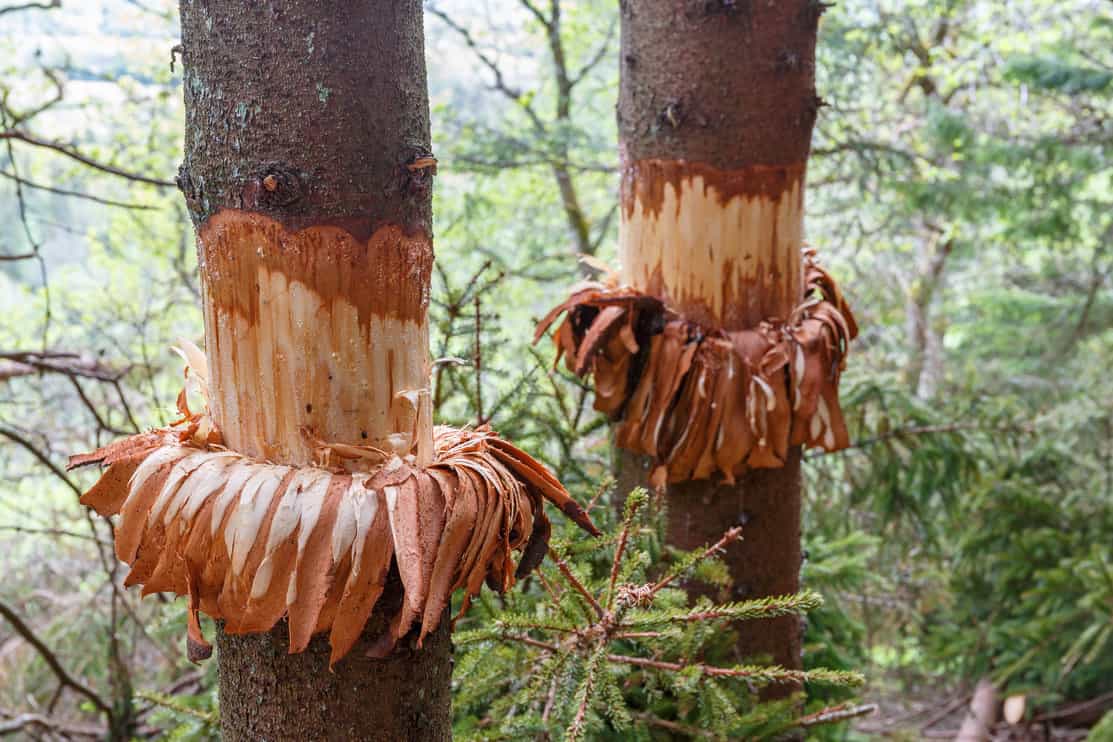
3. Girdling Or Ring Barking Gets Rid Of Oak Trees

Girdling trees in the forest

Girdling has long been the traditional way of felling a tree without actually cutting it down. It is very effective, low-cost, and much less work than felling the tree with a chainsaw. 

To girdle your oak tree, cut a ring around the trunk of the tree down to the cambium layer. This keeps the conducting cells from producing branches and leaves above the cut. It is important to cut the ring below any branches so you can get rid of every piece of the tree. 

You can do this using a chainsaw, scorp, axe, chisel, flat pry-bar, or a special girdling tool with a knife on the end of it to strip a tree down to the cambium layer in a single rotation. A scorp is a wood-carving tool you can use to cut into the tree as well.  

A girdling tool like the Zenport GK03 Girdling Knife is a perfect example of the proper tool. It has a stainless steel blade for ease of use and a polished wooden handle for comfort.

When using a chainsaw, make two cuts into the tree about three inches across from each other and then peel off the layers with a chisel or other similar tool.  

You can do the same thing with an axe. Make two cuts several inches apart from each other, and then swing the axe in downward strokes to shed the layers off the tree. 

The best time of the year to girdle your oak tree is in the spring and summer. This is because the tree is most vulnerable after they have used their springtime growing energy up.  

It will take a couple of years for girdling to get rid of the tree, but you can speed up the process by applying herbicide to the wound you created in the tree. 

This option is best for trees in the woods of your yard and far away from any structures or clearings. You do not want a ticking time bomb on your hands waiting for the tree to fall if it is too close to your house.

4. Copper Nails Can Rid You Of Your Oak Tree

Another easy way to get rid of an oak tree is to use copper nails. If you just nail one into the tree, it will not get rid of it unless it is a sapling. When you overwhelm a larger tree with multiple nails, then you will see results.

When copper oxidizes, it becomes toxic for trees and makes sure the growing process of your tree stops and then destroys growth cells. Start by nailing copper nails in a ring around the lower part of the trunk. They should be half an inch apart.

Point the nails downward when you nail them in. The deeper the copper is into the trunk, the faster your tree will die.  

When your oak tree dies, make sure to remove the copper nails.

5. Cut Your Oak Tree Down

A lot of trees, including oak trees, do not grow back after they are cut down to a stump. Their root systems do not regenerate after such a blow! 

If you decide to cut it down, wear the proper safety gear, including safety glasses, gloves, helmet, Kevlar chaps, face shield, and earmuffs. These things will make your felling process much safer. 

Many recommend using a felling wedge to begin the felling of the oak tree, which keeps your chainsaw from being pinched. You can place it in a tree by cutting a notch pointing toward the direction you want your tree to fall. 

If you need a felling wedge, take a look at the Oregon 23565 Felling Wedge which comes highly regarded.

Begin the cut until it will fit the wedge, then insert it. Cut another notch 4-6 inches away from the first notch and hammer in another wedge. 

Alternate between felling the tree with your chainsaw and pounding in wedges. Sometimes you should use more than one wedge on top of the other to make it thick enough to be inserted into the tree. 

Continue this process until your tree has fallen. Success! At this point, you will have just the stump of the tree. The oak will eventually die. 

Because this process is time-consuming and potentially dangerous, I highly suggest contacting a professional to cut down your tree for you. 

Using Herbicides To Get Rid Of Your Oak Tree

There are several herbicides you can use to jumpstart the dying process of your oak tree. We will look at six different ways you can apply herbicides to your tree and our most recommended product soon. 

Herbicides use chemicals like dicamba, imazapyr, picloram, glyphosphate, and triclopyr to get rid of trees (and other foliage). Always use proper safety equipment when handling them and read all product information.

The most popular type of herbicide professionals use for get rid ofing a tree is Tordon. The active ingredient in Tordon is picloram, and it is non-toxic to humans and animals like honeybees, mammals, and birds.

The Dow AgroSciences RTU548 Tordon RTU Herbicide is a highly regarded choice for personal use. It includes a blue dye to make use easier to visualize and control. It is also a no-freeze formula, so you can use it any time of year.

Keep in mind these chemicals are damaging to the surrounding area, so the application must be very precise. Make sure there are no water sources nearby because rain runoff could contaminate them. Check the area around you and make yourself aware of your state’s regulations for using herbicides.

We recommend using a professional tree company to apply herbicide and help you with the process of get rid ofing your oak tree because they will do the most effective job! 

Ways To Apply Herbicide To Get Rid Of Oak Trees

Now, the tordon method above is used in different fashions and in some cases, used on the actual wood of the tree underneath the exposed bark. This is essentially the skin of the tree. For other herbicides, they can generally applied in the different methods we’ll describe below.

It’s important to note that no matter what we say here, you should ALWAYS follow whatever herbicide product you have and their directions for use.

By the way, if you’d like more justification for why you should remove your oak tree, take a look at our guide on how oak trees cause damage here.

1. Soil Application 

When you apply herbicide to the soil, your tree will begin to die. This happens when the chemicals get absorbed into the tree’s roots and end up within the tree itself. This will get rid of your tree quickly. 

Remember to water your tree thoroughly when you apply herbicide to the soil because it speeds up the process. Otherwise, you will have to wait until it rains for the roots to drink up the herbicide.  

If you decide to use this method, make sure there are few or no trees around your oak. Roots will intertwine if close enough, so damaging the roots of the oak will ultimately damage the roots of any trees near it. 

2. Foliar Application 

With this method, spray the herbicide onto the leaves of your tree. This method is more effective on smaller trees, which is something to keep in mind when deciding what herbicide application method is best for get rid ofing your oak. 

Foliar application will work best for speeding up the process of dying instead of get rid ofing the tree from the inside, which works much faster.

If you are using this application, you may need equipment to reach the tallest leaves of your tree. This method is easier if you are using a sprayer backpack. Therefore, we suggest contacting a professional to apply herbicide to your tree, especially when using foliar application. 

You will get the best results if you use certain chemicals at certain times of the year. For auxin-type herbicide, apply it during the spring when leaves first appear. Enzyme-inhibiting and popular herbicides like Roundup are best used in late summer or fall, right before the leaves change colors.  

3. Basal Bark 

Basal bark application is generally used with a low-pressure backpack sprayer aimed at the lower 12-15 inches of the tree stem. 

Wet the stem completely, or else it will not be as effective. You should also spray any root collars or exposed roots. Finally, soak the bark, beginning at the bottom and going up one foot. 

The best time to apply the herbicide is when the trees are dormant and there are no leaves, as it will make it much easier for you to spray the stems and bark directly. Applying it to leaves is not very effective, so avoid it to save more product. 

4. Tree Injection 

You can inject herbicide into the oak tree to make the process go much faster than the foliar method. It applies the chemical directly into the tree’s living tissue, in either liquid or pellet form. Tree injectors are 4–5-foot tubes with a pump and a 1.5 to 2-inch knife on the other end. 

Liquid injectors are applied by cutting a slit into the tree and pumping it into the slit. However, pellet injectors are shoved into the tree by a head on the tube. 

Avoid using tree injectors during spring because this is when there is a heavy amount of sap flowing upwards in the tree. The sap will slow down the herbicide’s absorption.   

How Do I Get Rid Of An Oak Tree Stump? 

A stump among autumn leaves and grass. Top view of the rings and the cracks on it

There are multiple methods to get rid of or speed up the decaying process of oak tree stumps that range from using chemicals to stump grinders. Let’s look at them below!

1. Use Chemicals 

The best way is to use chemicals, like the VPG Fertilome Stump Killer. This is a simple process, and it only takes a few steps. Drill multiple holes in the stump and then pour the liquid into the holes.  

You should pour the chemical into every hole and along the sides of the stump. After this, seal the stump with a tarp to lock in moisture. This will speed up the decaying power of the get rid ofing solution. 

2. Burn It 

Another way to get rid of the stump is to burn it! Place firewood on top of the stump and light it. Keep close watch over the fire as it burns the stump. Break up any remaining pieces or roots that are exposed.

It may help to drill 6-8 holes into the stump and pour some diesel fuel into the stump to speed up the process and make sure that the stump catches fire.

3. Hire A Professional 

You can also hire an arborist to grind down the stump for you. They will use one of two methods: stump grinding or stump removal. You can do these methods yourself, but they are very hard and time-consuming, so leave it to the experts. 

When they grind down the stump, they use a rotating blade that rips into the tree stump and cuts it up into little pieces, which is the fastest way to remove it. One downside of this method is it does not provide a very good growing area.

After they have ground it down, it does not leave a lot of room for soil. However, the stump will be completely removed.

Stump removal is a very hard process that requires you to pull out the entire stump and remove the roots. It is extremely time-consuming, but it comes with an upside. Once the tree is gone, you have free space to do whatever you want with the area.

A professional can also help you decide on what to do with the rest of your fallen oak tree.

How Do I Know If My Oak Tree Is Dying? 

If one of the methods discussed above works for you and the tree is dying, you can tell by the following symptoms your oak tree will exhibit:

  • If you use a method other than herbicides, salt, or vinegar, then you will see fungi around the base of your tree, indicating decay. 
  • Bark has begun to shed off of the tree and sap has oozed out of it. This is a sure sign that your oak is dying.
  • Dieback has occurred. This is when the upper branches of the tree have died off and are now sticking above the crown of the tree. It’s a definite sign that the root system is in trouble.
  • The branches easily fall off and have begun to scatter on the ground in great numbers.
  • Leaves have turned brown out of season and fall off. Very few of them are healthy.
  • The cambium layer is now brown instead of green. You can check this by removing a small strip of bark to reveal the cambium layer. 

If one or more of these things happens, you succeeded! Your next step is getting rid of the stump if you cut down your oak tree. If you are using another method, you can expect your tree to die in one year or more.

You can also read our guide that goes more in-depth on what’s wrong with your oak tree here.

That’s All We’ve Got!

If you are thinking about planting an oak in your yard, head on over to our article Should You Plant An Oak Tree in Your Backyard? Pros & Cons to figure out if it is the best choice for your property!

I hope this article has helped you learn more about the various methods of get rid ofing an oak tree and which one of them works best for you. 

Even though there are many ways to get rid of an oak on your own, I highly suggest contacting a professional arborist. They will consult with you about the ways you should get rid of your oak tree without the risk of damaging plants surrounding the tree or structures nearby the tree’s felling zone.

That’s all for now! 

References 

De Schepper, Veerle, et al. “Detailed analysis of double girdling effects on stem diameter variations and sap flow in young oak trees.” Environmental and Experimental Botany 68.2 (2010): 149-156.

Feucht, James R. “Herbicide injuries to trees-symptoms and solutions.” Journal of Arboriculture 14.9 (1988): 215-219. 

Szczepkowski, Andrzej, and Danuta Nicewicz. “The content of heavy metals in the wood of healthy and dying oak trees (Quercus robur L., Q. petraea (Matt.) Liebl.).” Acta Sci. Pol. Silv., Colendar. Rat. Ind. Lignar 7.4 (2008): 55-65. 

Pin oaks are an incredibly common type of tree that is used in multiple places because of their adaptability and aesthetic. Chances are high that you have probably stumbled upon one of these trees in your life if you live in the United States, no matter which state.

Pin oak trees are a member of the red oak family and are known for their odd shape when matured. Pin oaks can grow up to 12-15ft tall within 5 years. That’s as tall as 2 NBA players stacked on top of one another. Pin oak trees generally live up to 120 years and reach a full height of 60-70ft.

Pin oaks are great trees. They are seen in parks, golf courses, along streets, and multiple yards. Some may argue that they are overused, but being as they are such a solid choice, I would argue that the point is up for debate!

What Does A Pin Oak Look Like?

Pin oaks have some very distinct and unique features about them that make them so sought after. The University of Kentucky states that pin oaks are about 60-70 inches tall when they are mature but can be over 100 feet tall if they are given the right conditions (so, like the woods and not a residential area).

The width that pin oaks can spread their branches out can reach up to 40 feet but it’s more common to see them at about 25 to 30 feet.

Pin oaks, when they are fully mature, have an odd shape where their lower branches hang down (and a lot of times they will even touch the ground), their middle branches stick straight out kind of like a pair of arms and their upper branches face the sun.

They are a very well-rounded tree if you can picture it. When they are young though, they have a standard pyramid shape.

The leaves on a pin oak are glossy. In the spring and summer months, the leaves are a nice green color but when fall rolls around, they turn a red or bronze color before turning brown for the harsher, wintery months. Pin oaks actually will keep their leaves (some of them at least) throughout winter.  

The leaves are also about 4 to 6 inches long, so to picture it, they are about as long as your hand. They have anywhere from 5 to 7 lobes on them. The pin tree also produces a flower, but it shows up about the same time the leaves flourish so they are really hard to see, but an acorn is produced from the tree as a fruit.  

If you are still confused, or are simply interested in being able to identify more native trees, consider getting a book like the National Wildlife federation’s Guide To Trees Of North America.

The acorns on a pin oak are about one-half of an inch around and they are your classic acorn shape, rounded with a slight point on the end and wearing a little hat! They are reddish-brown as well.

Where Did The Pin Oak Come From?

According to the United States Department of Agriculture, the pin oak is Native to North America. You can find pin oaks just about anywhere in the United States today. These trees were first introduced in the 1770s and it was found that they are very easily transplanted, so they took off without a hitch and started showing up all over the country.

Characteristics Of The Pin Oak

Quercus palustris, pine oak or Spanish swamp oak. Autumn time in October. Red oak leaves close up. Autumn Park.  Quercus palustris pin oak tree typical autumnal colorful deciduous foliage

The pin oak, as mentioned previously, is a very unique-looking plant but it has some other unique features about it as well.

For starters, the University of Kentucky says that the pin oak loves acidic soil, especially if it is well-drained also. However, it is a hardy tree when it comes to soil conditions and it will also accommodate to tolerate wet soil.

The pin oak loves full sun exposure, so you don’t have to worry about putting it in a place that needs partial shade or full shade, it can just hang out in the sun all day long and thrive. It tolerates these conditions so well because it has a very shallow root system with one central root that burrows into the ground.

Pin oaks are in zone 4 for hardiness which means it is a pretty hardy plant, it can survive in places that are warm and hot during the day but where the temperatures dip down at night and it can also tolerate places where there are winter months that can get pretty intense in their cold weather.  

It is one of the fastest-growing oak trees in the world because it can grow an amazing 12 to 15 feet in just 5 years. That is 2 NBA players stacked on top of each other in just 5 years, how insane is that?

The SRS explains that the pin oak is monoecious, meaning that it has both male and female reproductive organs on the same tree. While many trees rely on bees for pollination, not the pin oak. This tree relies on the wind to move the pollen for it to other trees.  

Furthermore, the United States Department of Agriculture explains that the pin oak doesn’t have many predators or pests to bother it, just your typical bugs but nothing too serious. They are also seen as very useful plants.

They are useful because they are good for not only decoration and residential areas, but they are a strong and heavy cut of wood that is fantastic for things like fuel for wood stoves and furnaces as well as (fun fact) railroad ties because they are super strong and can warp as well, conforming to their job at hand.  

Young deer like to munch on the acorns from pin oaks, so many times hunters will use them in their food plots to help lure deer into their property before hunting season. Deer also really enjoy eating them when they are young saplings.  

Full Tree Lifespan: A Timeline Of The Pin Oak

Since the pin oak is a tree that grows up so fast, there are not too many steps in the growing timeline. Essentially, once it is planted and takes off growing, it just needs to mature to have fruit that can reproduce and make other trees.

The Beginning Of A Pin Oak’s Growth

Oak sapling in hands. The leaves of rays of sunlight.

The SRS gives a great snapshot of the growing timeline. First, a tree has to be old enough and mature enough to have a fertile acorn that is capable of growing a tree. A pin oak can have a good acorn for growth at about 15 years old, but it is more common to see it closer to 20 years old.

Acorns start to form on the mature, adult trees in the springtime, month-wise, it is about late April to early May. They fall more towards the end of May and the way that the seeds are spread around (other than just dropping to the ground) is actually by those super cool little scavengers, our friends the squirrel.

The squirrel will usually move these acorns to their final resting place to grow between September and December. Once they are buried in the ground and ready to grow, they have a growing phase, or a stratification phase, of about a month, give or take (the statistic is 30-45 days under the soil to sprout).

These little acorns like it when the temperature they are working with during that stratification phase is about 32 degrees Fahrenheit to 41 degrees Fahrenheit. Considering the time they drop, this isn’t an unreasonable request for them to their new homes.  

The pin oak goes through hypogeal germination which is a fancy term meaning that the cotyledon (a fancy name for a part of the stem) stays under the ground when the seed germinates.

For more information on how to grow a pin oak of your very own, check out this article on How to Grow An Oak Tree From An Acorn (6 Easy Steps).

This doesn’t sound too important, but it’s an odd fun fact for the pin oak because usually if a plant has hypogeal germination, it grows slowly when this tree does the opposite. 

If you wish to have a pin oak tree of your very own, consider getting something like these Pin Oak Tree Seeds, or even this Medium-Sized Pin Oak Tree Seedling.

Early Growing Stages Of Pin Oak Trees

Now, on average, these pin oak trees will have about 8,650 new seedling trees per every 3,500 acres of land but that does not mean that they all grow and survive. Just like any species, they are subject to a lot when they are brand new to the world.

Actually, a lot of the time more than one pin oak sprout will pop up in the same place and the dominant sprout will grow while the others grow more slowly on their stump and if the more dominant (or parent) sprout doesn’t make it, they jump right in and take its place.

So realistically, let’s say that 5 or 6 of these plants all grow in the same place and only one makes it, that can cut down your numbers.

In the early stages, first-year seedlings are prone to get flooded out. They have such shallow roots, so it does not take much to flood them out. However, since it is such a common problem for them to have, there is also a common solution that they use to get through it.

Their little, shallow roots will just cease to exist almost when they get flooded out. They do not grow, but they also do not stop living there. They will hold on for up to 84 days. Eighty. Four. Days. I don’t know about you, but I think that is incredible. They will wait 84 days for the flooding to go away to continue to grow.

Maturation And Aging Of Pin Oaks

Green leaves of landscaping tree, Quercus palustris, the pin or swamp Spanish oak in park.

Like it was said previously, these bad boys grow so fast. By their second year of thriving and chilling as saplings, they now have a pretty established and strong root system, and that one grounding root has sunk into the earth and claimed its territory.

They grow, again, about 12 to 15 feet in the first 5 years. That’s an average of 2 to 3 feet per year. This makes me think of a child and how fast they grow, and think if your child were to grow 2 to 3 feet in a year. It is incredible how fast these trees can grow!

Although they can sprout up in height, they, unfortunately, do not mature as quickly as they grow. It takes about 15 years for them to be fully matured and ready to disperse acorns that will plant more trees.  

Once these pin oaks get to about as tall as they can grow, you will start to see their unique shape starting to form. They will start to sag in their lower branches and their middle branches will scratch out and fan. The pin oak doesn’t get big thick branches like other oaks, they are pretty delicate and thin. 

If you have a fallen oak you don’t know what to do with, consider reading this article on the 9 Best Fallen Oak Tree Uses.

Blooming, Fruiting, Maturity Of A Pin Oak Tree

The pin oak has a lot of time to fully mature and because of that, it also has a lot of time to figure out the seasons and when it is supposed to bloom, drop acorns, all of the things it needs to do to survive.

The Wisconsin Department of Natural Resources discusses that the blooming season for pin oaks occurs in mid-spring, closer to May than any other month. They bloom and then fruit a few months later in the heat of the summer, in about July and even into early September. 

They are the easiest to identify and pick out during May to September because that is when the tree is doing all of the big tasks it needs to get done for the year. This is also when the leaves will start to change (into September more so than the summer season) when the autumn weather starts to make its way into town.

These pin oaks are perennials, which is a term meaning that they last for a long time and that they will bloom again in the next blooming season. Usually, for plants, it means they will be dormant or just be a bulb under the ground but will bloom again come the spring.  

For a tree, specifically the pin oak in question, it means they will lose their leaves (pin oaks keep most of them in the winter months though) and then bloom again when the conditions are right in the spring season to show off their beautiful glossy, green leaves again.  

Wrapping Up

In closing, the pin oak is a great tree to have around. It does not attract too many pests, although some animals do find their acorns to be a tasty treat. It provides a great spot for shade through the grueling summer months and it doesn’t mind at all if it suffers in the sunshine, it prefers that over the shade you’ll be sitting in underneath of it.

It is aesthetically pleasing, scattered all over residential areas for just that reason. Pin oak trees grow well in almost any soil and it is a hardy tree that can survive the elements. They can survive the heat, the cold and even flooding for an incredible period of 84 days.

While they do grow tall quickly, maturing takes a bit longer but it is worth it to have such a great tree nearby. Take a look around your local park next time you are there and the chances are pretty high that you will see a pin oak there. 

If you’d like to learn more about the timeline for growing other oak trees, make sure to take a look at our guide: How Long Does It Take to Grow an Oak Tree? Full Timeline.

References

Dale M. Maronek, James W. Hendrix, Cathy D. Stevens. (1981). Fertility-mycorrhizal-isolate interactions in the production of containerized pin oak seedlings. Scientia Horticulturae. Volume 15, Issue 3. Pages 283-289. ISSN 0304-4238.

Henderson, D.E.; Botch, P.; Cussimanio, J.; Ryan, D.; Kabrick, J.; Dey, D. 2009. Growth and mortality of pin oak and pecan reforestation in a constructed wetland: analysis with management implications. Science and Management Technical Series: Number 1. Missouri Department of Conservation, Jefferson City, MO. Pg 19. 

Himelick, E. Watson, G. (2004). Effects of soil pH, root density, and tree growth regulator treatments on pin oak chlorosis. Journal of Arboriculture. 30 (3). Pgs. 172-178.

M. Boyer, J. Miller, M. Belanger, E. Hare, Jiyou Wu. (2008). Senescence and spectral reflectance in leaves of northern pin oak. (Quercus palustris Muenchh.). Remote Sensing of Environment, Volume 25, Issue 1. Pages 71-87. ISSN 0034-4257.

For some homeowners, ball moss on an oak tree is a mark of character; for others, it’s an eyesore. A common plant that grows on the branches of oaks, it can quickly overwhelm its host tree. But, is ball moss helpful or harmful to an oak tree?

Ball moss is helpful because it converts nitrogen into a nutrient, adding it to the soil. Contrarily, it’s harmful because it potentially weakens an oak tree. Ball moss is removed through picking, pruning, and spraying. Using all three techniques is best for removing and prevention.

Keep reading to discover more about what ball moss is, the different ways in which it harms and helps oak trees as well as how to manage it on the oak trees in your yard.

What Is Ball Moss?

Ball moss is a flowering plant from the Bromeliaceae family that often grows on the branches of oak trees. It can even grow on power lines, fences, or rocks. Ball moss is sometimes mistaken for a jumble of Spanish moss, which hangs from tree limbs like a long, wispy beard. 

If you are having trouble figuring out what moss is growing on your oak tree, you should check out one of our popular articles, Moss On Your Oak Tree: Identification And Removal Guide.

Ball Moss Is An Epiphyte: A Non-Parasitic Air Plant

Neither ball moss nor Spanish moss is actual moss, though. They’re epiphytes, which are also known as air plants. They grow on structures and other vegetation with pseudo-roots. 

These pseudo-roots don’t take in nutrients or water as tree roots do. Instead, they provide an anchor that attaches the plant to the surface. This fact leads some homeowners to think that ball moss is a parasite.

Here’s the truth: ball moss isn’t a parasite. When a parasite attaches itself to a living organism, it collects food from that organism – usually at the host’s expense. Since ball moss can thrive on non-living structures such as power lines, it’s clear that it doesn’t receive nourishment from its physical supporters.

With its leaves, ball moss absorbs water from rainfall in addition to water vapor from the air. This acquisition allows ball moss to quickly grow from its fastened perch. This epiphyte also grabs most of its nutrients from the debris or dust that aggregates on the host plant or structure. Some minerals are absorbed from rainfall, too.

Ball Moss Needs A High Humidity Environment

Green valley surrounded by mountains is covered in fog and clouds. Heavy fog in green misty mountains on a cloudy day. Achishkho ridge - the wettest place in Russia. Krasnaya Polyana, Sochi, Russia

Most air plants thrive in tropical regions with plenty of sunlight and high humidity. Living among shaded tropical vegetation, air plants seize nutrients from the organic detritus that gathers in a tree canopy. Many of these air plants are flowering plants or angiosperms, which include orchids and other plants in the pineapple family.

Air plants such as mosses, liverworts, and ferns thrive in both mild and tropical areas. Interestingly, ball moss is the only air plant that is found to also live in arid regions. This includes the deserts along Mexico’s western coast where ball moss absorbs water from the oceanic fog.

Specifically, ball moss grows in regions with high humidity, little airflow, and reduced light intensity. These conditions often match the canopy underside of numerous shade trees like oaks. Since trees typically grow leaves and other vegetation toward the end of their branches, their central limbs are often empty; this interior area leaves a perfect place for ball moss to attach itself and flourish.

If you wish to keep ball moss alive in a more controlled area such as a greenhouse, you can try a handheld mister such as this Ebristar Glass Plant Mister.

Air plants like ball moss require the wind to disperse their feather-like seeds. Animals can disperse these seeds as well. The dispersal range of it’s seeds is vast. Currently, ball moss extends from the Southern United States to Chile and Argentina. 

Ball moss is often seen in Florida, Georgia, Louisiana, Arizona, Texas as well as Mexico, and most of Central and South America. This air plant is a staple on many southern live oak trees, even ones that are declining or expired. This causes a few homeowners to assume that ball moss is responsible for the deterioration of these oaks.

Is Ball Moss Helpful Or Harmful To Oak Trees?

Small ballmoss, ball moss or bunch moss  which is commonly provided by southern shade trees.

Ball moss grows in the central canopy of healthy oaks as well as sickly ones. The air plant is easier to spot in the oaks that are ill, leading to a common misperception that ball moss is harmful to the trees. Examining the misperceptions, benefits, and disadvantages of this moss can help you decide whether this air plant is good for your yard’s oak trees.

Misperceptions About Ball Moss

These are four common misperceptions about ball moss:

  1. Ball moss is a parasite. As a reminder, ball moss isn’t parasitic. It’s not actively harming an oak tree by stealing its nutrients (as a parasite does). Ball moss absorbs its nutrients from the atmosphere.
  2. Ball moss is responsible for a thinning tree canopy. It isn’t responsible for thinning an oak tree canopy. Insufficient drainage, disease, and compacted soil are much more likely suspects for a thinning tree canopy.
  3. Ball moss deteriorates an oak tree’s health by blocking the leaves’ access to sunlight. There’s no direct evidence that this is the case. Especially since ball moss populates in the interior part of the canopy (where the oak tree’s limbs are bare), it isn’t competing with the oak’s leaves that are growing at the end of the tree’s branches.
  4. Ball moss causes an oak tree’s limbs to break. Branches infested with ball moss can indeed break off from the tree due to the additional weight, especially if it’s rainy or windy. These branches, however, are typically dead or dying before the ball moss was on the tree. Interior limbs usually die because of little sunlight, regardless of the presence of ball moss.

Benefits Of Ball Moss

Ball moss offers some benefits to your yard’s oak trees. Birds can use a big cluster of ball moss as shelter. (This tends to happen if the cluster is near their nest.) Ball moss can also attract insects to the oak tree, and birds can enjoy these critters for their meals.

In addition, ball moss takes in nitrogen from the atmosphere and converts it into a nutrient. The nutrient is added to the soil at the tree’s base. This benefits the oak and all surrounding vegetation. 

Cosmetically, some homeowners even like the look of ball moss on an oak tree. These individuals say that it adds character to the tree. For them, ball moss provides an august quality to a mature oak tree.

Disadvantages Of Ball Moss

There are several disadvantages to ball mass growing in your yard’s oak trees. Some homeowners say that ball moss can weaken oak trees, which could lead to the trees’ premature decline. This might be caused by the tendrils on ball moss: they envelop the branches and stems of the tree to successfully affix the air plant to a branch. 

As the ball moss grows, these tendrils can intensify their grip. This can decrease circulation in the tree. Also, it’s conceivable that severe infestations can slow down the development of new buds and shoots on a tree.

Another disadvantage is that once ball moss attaches itself to a tree, it can spread to other trees in the locale. Since ball moss requires wind for seed distribution, it’s not too hard for the plant to get around. This can quickly lead to an overabundance in one small area.

Also, on a cosmetic level, some homeowners dislike the look of ball moss on a tree. They think that the air plant detracts from the natural allure of the tree. Some of them might even call it an eyesore.

What Is The Removal Process For Ball Moss?

Tillandsia recurvata aerial Plant growing.

If you decide that the disadvantages of this air plant outweigh its benefits, or that ball moss in your yard’s oak trees is too unsightly, then it’s time to learn about the removal process. Traditionally, there are three ways that you can remove ball mass from your oak tree. These techniques include picking, pruning, and spraying. 

On its own, each technique isn’t enough to entirely remove ball moss from your tree nor prevent its return. The best approach is to incorporate the three techniques in your removal process. Each technique – as well as an integrated approach – is detailed below.

Picking And Pruning Ball Moss

Picking requires pulling off each ball moss from the tree, usually one by one. Undoubtedly, this is laborious and time-consuming. This technique could be hazardous if you’re not using an aerial work platform or cherry picker; however, it can be effective in removing the ball moss from your oak tree.

Pruning is another technique that involves cutting away the dead or dying interior limbs from the oak tree and completely removing them. Since ball moss mostly grows on these dead branches, you’ll remove nearly all of the moss from your oak tree this way. This takes time, and you might want to hire a professional tree trimmer to do it.

Furthermore, ball moss thrives in conditions with reduced light intensity. If you choose to lightly thin the canopy of the oak tree while pruning, more sunlight will hit the central area of the tree, which will deter another infestation of ball moss. After pruning, make sure to use a pruning seal on the cuts because this prevents the spread of oak wilt.

For picking moss that is especially high up on the tree you could use a product like this RMS 34 Inch Extra Long Grabber.

Oak wilt is caused by beetles that bore into wood. They’re drawn to oak trees’ sap, and fresh cuts on oak trees attract their attention. The beetles’ bodies carry a fungus that generates oak wilt; so, wherever the beetles go, oak wilt will also spread. 

This is why it’s crucial to use a pruning seal on any cuts made while pruning your oak tree. The timing of pruning your oak tree also matters regarding to preventing the spread of oak wilt disease. The beetles are most active in moderate weather, so it’s recommended to prune your oak during the middle of summer or winter.

Removing Ball Moss By Spraying

Spraying includes lightly showering a chemical to your oak tree using a foliar spray. A copper-based fungicide is one chemical option. Copper-based fungicide is designed to eliminate ball moss on oak trees. 

You’ll apply the spray in the spring when the ball moss is readily growing. Avoid using more than the recommended amount because too much of this chemical could damage your oak tree. In five to seven days, the ball moss will no longer grow. 

It’s important to note that copper-based fungicide may drift during use. This can cause damage to vegetation that’s near the sprayed oak tree. Furthermore, it can also cause damage to metal surfaces, such as outdoor furniture. 

On the other hand, if you are looking to use homemade or dilutable sprays, you could easily disperse them with this CHAPIN Garden Sprayer!

Additionally, copper-based fungicides mark surfaces they touch with a blue stain. Take extra precautions if you’re spraying close to buildings and other outdoor objects. Given all of these considerations, while using a copper-based fungicide, you might want to hire a landscape professional to take on the job.

After the fungicide is applied, the ball moss will not promptly fall from the oak tree. Rather, it will slowly fall away as the year progresses. It may need the force from a rainstorm or a wind gust to push it out.

If you don’t want to wait for the ball moss to naturally fall from the tree, you can remove the air plant with a hose. You’ll simply attach a high-pressure nozzle to your water hose, turn on the water and direct the water stream at the ball moss. As you do so, be careful to not shoot off the tree’s bark or break any branches. Also, avoid using hot water because it can harm the tree.

For more natural treatment of ball moss, you can also use baking soda and water. You’ll add half of a pound of baking soda per every one gallon of water. For example, if you plan to use four gallons of water, then you’ll need two pounds of baking soda. Add this mixture to your sprayer, and directly spray all of the areas where the ball moss is growing on the tree.

The Best Approach To Removal: Pick, Prune, And Spray Ball Moss

Big oak tree with fresh green leaves and green spring meadow

Incorporating the three removal techniques for ball moss – pricking, pruning, and spraying – is the best approach to eliminating the air plant from your oak tree. This integrated method will also prevent ball moss from coming back. Starting to pick the moss is effective in removing it from the tree, but it won’t prevent the air plant from returning to the tree.

This is why pruning, in addition to picking, is essential. Removing the deadwood from your oak tree eliminates the opportunity for ball moss to attach itself to the interior branches. It also provides overall health maintenance for the tree.

Spraying ball moss can be done after pruning your oak tree. Using either a copper-based fungicide or baking soda and water, spraying stops ball moss from growing. Spraying can also curb the likelihood of a future infestation.

That’s A Wrap!

Ball moss is either a beauty mark or a nuisance for oak trees depending on a homeowner’s aesthetic and preference. Ball moss is helpful because it converts nitrogen into a nutrient, adding it to the soil underneath an oak tree. Yet, it’s also harmful because it potentially weakens the oak in which it resides. 

If you are dealing with other types of moss, you should look our other poplar moss article: Spanish Moss On Your Oak Tree: Here’s What To Do.

Removing ball moss through picking, pruning and spraying are effective in removing it and preventing its return. The best results include using all three of these techniques. The finest management of ball moss ultimately rests in your opinion about the non-parasitic air plant.

References:

Arny, Nancy P. Spanish moss and ball moss. University of Florida Cooperative Extension Service, Institute of Food and Agriculture Sciences, EDIS, 1996.

Birge, Willie Isabella. The Anatomy and Some Biological Aspects of the” Ball Moss,”: Tillandsia recurvata L. No. 20. University of Texas, 1911.

Harvey, Celia A. “Patterns of seed colonization and seedling establishment of ball moss (Tillandsia recurvata) on sand live oak trees (Quercus geminata) in Central Florida.” Florida Scientist (1996): 76-81.

When oaks trees are fully covered in leaves, you may wonder just how many leaves they have. They grow quite old, sometimes over 100 years easily and, some species over 1000. Let’s answer the question of how many leaves are on a full grown oak tree and more amazing facts.  

A full grown oak tree can have anywhere from thousands of leaves up to even 1 million leaves. Oak trees are considered fully grown at 30-40 years. To get the approximate number of leaves on your tree, measure the width of the oak under the crown. For every 25 feet, oak trees have approximately 30,000 leaves.

Read on to find out facts you will want to know about your full-grown oak tree, including tree/leaf maintenance and identifying oak trees!

How Do I Measure My Oak Tree To Know How Many Leaves Are On It?

So, to actually measure your oak tree and understand just how many leaves that you may have to rake up when they all fall, you’ll first need to actually MEASURE your oak tree.

To do this, you’ll ideally want a soft measuring tape as opposed to a hard one so it will wrap accurately and tightly around your oak tree. A good soft measuring tape option is LAND’s Open Reel Fiberglass Tape Measure which will give you more than enough room to measure your tree.

Next, you’ll want to take the measuring tape and wrap it around the thickest part of the trunk near the base of the tree. You won’t want to measure all the way at the bottom of the trunk near the ground, but somewhere near chest level for you.

You can also get a ladder and measure directly in the middle of the tree but, this isn’t really worth it unless you need the most accurate measurement possible.

To measure your oak tree to see how many leaves it has, wrap your soft measuring tape around the tree to get it’s total circumference. Divide the total feet by 25ft, and multiply that number by 30,000. This will give you a rough estimate of how many leaves you have on your tree.

For example, if your oak tree is approximately 26ft around the trunk of the tree, your oak tree may have around 31,200 leaves.

You could additionally do this will ALL the oak tree on your property, and learn just how many rakes you’ll need to get this year!

With that being said, now is a great time to mention our guide on oak tree leaves called: How Big Do Oak Tree Leaves Get? Leaf Identification

What Is Special About An Oak Tree?

The grand oak tree is a symbol of great strength and wisdom. A member of the Quercus genus, there are up to 800 different species native to the Northern hemisphere. 

The oak tree is important for both humans and beasts all over the planet. Natural medical practitioners have used its bark in specialized ways for many years.

It yields acorns which is a food source for animals. They find them in large groups, which then provide shelter to many species of animals.

Next time you look at art involving trees–the oak is showcased many times over. A brush on canvas complements the lines and twists of oak trees.

Why Should I Plant An Oak Tree?

The Oak Tree Is A Generational Tree

If you have a property you want to make a garden, something generations to come can enjoy, then any appropriate species of oak fits well. So this is the first reason to plant an oak tree specifically. 

You can buy seeds like the White Oak Tree Seeds for Planting by The CZ Grain Company. It comes with 10 large acorns, which should be stratified for 30-60 days after you receive them. They include a video link and paper instructions with each order as well!

This article, How To Grow An Oak Tree From An Acorn (6 Easy Steps), would also be a fantastic guide throughout your journey. If you decide to plant an oak tree, give it a read!

The reason we are referring to the oak tree as generational is it’s still at the beginning of its lifespan at 30-40 years of age; when humans are middle-aged–the oak tree is just getting started!

This means if you plant it when you are in your 20s or younger, your grandchildren and their kids can enjoy the full-grown oak tree! 

Regardless of when you plant, you may still want to plant them all over the property properly, which we will get into next. Then you can enjoy a full fall color show from the bold and beautiful seasonal leaf turning. 

You Will Enjoy The Fall Leaf Colors

From the very first year, the oak trees show off their colors! Some are more muted and others are brilliant and bright! 

Kids love the memories of playing in the oak leaves!

Oak Trees Can Typically Live 200 Years

oak tree branch, copy-space background

Around the globe, they have found species as old as 1000 years old. Like this article about the British oak. So you are not only creating history for your family but creating oxygen for the planet and helping the ecosystem greatly. 

They do not have many issues as they grow, but you must take care of them properly. This is especially true if you are planting them from the acorn, which we will get into later. 

They grow healthy and vibrant from the start and even in their last days–a century or more–they stay gorgeous. Yes, identifying a dying tree without a professional can be difficult. 

Oak Trees Provide A Habitat For Many Creatures

If you want to draw creatures to your yard, then for sure, plant some oak trees! Squirrel and deer and the most common of the acorn marauders.

Oak trees attract over 100 vertebrate species of animals in the US.

Some creatures that live in oak trees are:

  • Squirrels- especially flying squirrels and grey or red squirrels.
  • Chipmunks
  • Wood Ducks
  • Blue Jays
  • Crows. 
  • Quails
  • Wild Turkeys
  • Rabbits
  • Raccoons
  • Possums

You can read more about what creatures live in trees in our article: 9 Different Animals And Insects That Live In Trees

Oak Trees Are Fairly Low Maintenance

All you need to do is read up on how to take care of the Oak, and let them grow! There is not a lot you need to do with this practically self-maintaining tree. Infestations or diseases are not something you have to worry much about with oak trees.

Oak tree diseases are not unheard of though. You can learn more about the most common issues here in our article: What’s Wrong With My Oak Tree? 10 Most Common Oak Diseases

How To Maintain An Oak Tree

As we mentioned in the last point, the oak tree does not need a lot of maintenance, but there are some very important things you should do. It is still possible to stunt the growth of your oak tree or harm it in other ways.

  • The Root Zone: The root zone is the area 6 feet from the trunk. If possible, maintain an additional ⅓ of the distance from the edge of the foliage. This area is commonly called the drip line. 

Make sure you keep things off of those areas and do not dig or interrupt them. This is the root zone, which is where food, water, and airflow must be free to feed the tree.

  • Low Pruning Your Oak Tree: The full-grown oak only needs to be pruned in the dry season and to get rid of dead or weak branches. You do not want one of those big heavy things dropping on you or someone else–it’s a lawsuit or worse.
  • Irrigation of your Oak Tree: Go to the outer edge ⅔ the way from the root zone and water the area deeply. To keep the weeds from drawing nutrients and water away from the tree root system–put down organic mulch. 
  • Fertilization: If you have a new tree, you can use fertilization to establish it quicker. Hire a professional to do it properly to make sure the tree stays healthy. 

On the mature oak tree, you will not have to fertilize unless there is unusually poor growth or disease. This TreeHelp Annual Care Kit for Oak is a great place to start with a new tree though. It is a complete care package for all your tree’s needs.

  • Planting around the Oak: Use drought-tolerant plants only. Never plant around the root system or up against the tree. Remember to leave the 6-foot radius around the tree. 

7 Amazing Facts About Oak Trees

Dawn, the young leaves of oak trees covered the first rays of the sun.
  1. Oak trees have two categories.

Oak trees can be considered trees or shrubs. Yup, you heard right. 

This is because they can reach a towering height of 148 feet, which accounts for the tree title. Besides, they look a lot more like a tree than a shrub. 

However, their branches also sprawl out quite far and can have branches from near the ground to touching the sky! 

  1. Oak trees have lived on the planet for 65 million years. 

Their leaves and acorns, which are the hard shell the seed comes in, are coated with tannic acid.

No fungi or any other creepy business lives through it, so they slime on out of there! 

  1. They can live 7-10 centuries! Which is 700 to 1000 years. Could you imagine? On one hand, this is not a long time and on another–it seems like forever compared to the time humans have on the planet.
  1. Oak trees produce 10 million acorns, the hard-shelled nut-like thing that falls from an oak tree. It contains one seed, which becomes a tree in the right conditions. However, the wildlife who enjoy them eat a majority of the acorns.

These acorns can have many amazing uses, which you can read about here: 9 Amazing Fallen Acorn Uses (And What to Do With Them).

Dogs, horses, and other large animals cannot eat them. They can be deadly. 

  1. Oak trees have over 600 species. The Americas, including Mexico, have a good number of these species. Mexico has 160 endemic species, and in North America, there are 90.
  1. Mandeville Louisiana houses the largest oak tree still alive. Professionals have also estimated it to be approximately 1500 years old. So, if it is true, then it knocks out the record for 1000 years.
  1. Wine barrels are made from oak wood because it is the best wood to age wine in. The wood can give a coconut, vanilla, and smoky tinge to the wine. This is a tradition people have carried on throughout centuries.  
  1. Like Truffles with your wine? You have oak trees to thank for them. 

How Do You Identify An Oak Tree?

Autumn. Fall. Autumnal Park. Autumn Tree.

There are tons of big and amazing-looking trees around. However, many species fall into the oak tree category. If you think you have one or are walking through nature and want to identify one, then do read on! 

You can find oak trees in North America, Mexico, Europe, and Asia, to name a few. Some are deciduous, while others are evergreen or semi-evergreen. Some are trees and some are classed as shrubs. 

They can survive very well in hot tropical or cold climates. They are by far one of the heartiest, if not the absolute hardiest, of all the trees in the tree kingdom. Sort of the green king of the jungle. 

Red And White Oaks

The first step is to identify which oak trees are growing in your region. Let’s use North America as an example here. 

Here, you would look for two types of oak trees. The red and the white oak tree. 

For the red oak, you would look for darker bark like a tanner color and lobed leaves, which come to a point sort of like a maple leaf. Though oak leaves are skinnier than maple. 

The white oak has a lighter bark with more rounded lobes. Between the lobes lie sinuses. They can be deep or shallow and will give the lobes their character. 

For a more detailed look at these two types of oak tree, consider reading Red Oak vs. White Oak Tree Growth Rate & Key Differences!

Using Leaves To Identify Oak Trees

Some evergreen species are smoother without sinuses and have a more fluid look with little shape.

The branches on an oak will grow from one central location and branch out. The leaves are more spiral from the stem and will never appear flat. 

The geographic region and the appearance of acorns are also important to identify oak trees.

The leaf color should also correspond to the season. The green leaves appear in summer–the red leaves appear in the fall and the brown in winter. This is a great telltale sign you have an oak. 

Of course, match the leaves up with the two possible shapes we mentioned along with the other facts we provided to decide if you have an oak tree.

If it’s in the early spring and you spot pinkish leaves, wait to see if they turn green shortly. This is another way to be sure. 

Oaks love their leaves and hate to part with them. Though you would not know it by the amount of them you may have to rake and bag. However, a young tree will hold its leaf stock well into spring and older trees will still wait until the new tender baby leaves come out.

Oak leaves decay at a much slower rate than other species of tree. They are great for self-fertilization. The oak needs no fertilizer unless something unusual like disease and poor growth happens. By understanding these facts, you will see how incredible this tree is. 

Oak leaves can also vary in size, among other things, and are actually generally targeted by insects of all types. To learn more about what happens, check out our guide: 5 Animals & Insects That Eat Oak Tree Leaves

Why Is There A Decline In Oak Trees?

Oak trees are in decline mostly because of our climate changes causing prolonged droughts. This can cause fires, and soil issues caused by humans moving in on vast territories are the cause for some other factors. 

Typically, apart from a direct hit from fire, oak trees can withstand some of these things, but fungi, infestations, and disease follow. That is just too much for an oak tree. 

We have no affiliation with them, but if you are a tree lover and want to help, you could join a charity of your choice like Save The Oaks who, according to their website, save saplings.

That’s A Wrap!

Well, that’s all we’ve got! We hope you have as much fun identifying and learning about Oak trees as we have teaching you. They are a majestic creation that deserves our reverence and protection. 

References

Reyes-French, G., & Cohen, T. J. (1991). A Mitigation Process for Impacts of the All American Pipeline on Oak Woodlands in Santa Barbara County. In: Standiford, Richard B., Tech. Coord. 1991. Proceedings of the Symposium on Oak Woodlands and Hardwood Rangeland Management; October 31 – November 2, 1990; Davis, California. Gen. Tech. Rep. PSW-GTR-126. Berkeley, CA: Pacific Southwest Research Station, Forest Service, U.S. Department of Agriculture; P. 255-261126.

Dagit, R., Carlberg, C., Cuba, C., & Scott, T. (2015). Economic incentives for oak woodland preservation and conservation. Gen. Tech. Rep. PSW-GTR-251. Berkeley, CA: U.S. Department of Agriculture, Forest Service, Pacific Southwest Research Station: 457-469251, 457–469.

Light, R. H., & Pedroni, L. E. (2002). When oak ordinances fail: unaddressed issues of oak conservation. In: Standiford, Richard B., et Al, Tech. Editor. Proceedings of the Fifth Symposium on Oak Woodlands: Oaks in California’s Challenging Landscape. Gen. Tech. Rep. PSW-GTR-184, Albany, CA: Pacific Southwest Research Station, Forest Service, U.S. Department of Agriculture: 483-500184.

One of the most popular trees out there, oaks are a fixture throughout the many wooded areas of the world. It’s no wonder that these trees pop up so often, whether you see them as young trees beginning to grow in a developing neighborhood or as ancient beings with hundreds of years of life experiences behind them.

Oak trees typically fall due to old age, wind, or lightning strikes. Typically, you can still use most fallen oak tree wood on your property! The best fallen oak tree uses include cutting the wood for firewood, turning the oak wood into mulch, and using the wood for creative landscaping.

So, without further adieu, let’s discuss what to do with a fallen oak tree if it so happens to fall in your area. Are you ready? We are! Let’s get into the 9 BEST fallen oak tree uses and what to do with them. 

What Is An Oak Tree? 

The massive and old Angel Oak Tree in South Carolina

Oak trees have around 500 subspecies of trees and shrubs that are distributed throughout the world. 

These trees contain both female and male flowers, which reproduce to create an acorn, the ‘oak nut’ which acts as the seed of the tree. 

There are so many types of oaks, each of which is good for different things. Both red and white oaks (the two main categories that subspecies fall into) are commonly used for lumber when cut down, producing furniture and flooring while also being used in millwork, construction, and more. 

If you wish to grow your own oak tree for aesthetic or practical purposes, something like these Red Oak Tree Seeds from CZ Grain could help get you started!

What happens when the oak tree is not intentionally cut down for use but falls for whatever external reason? 

We’ve got you covered! Let’s dive into what you should do when a tree first falls on your property. 

What Do You Do With A Fallen Tree In Your Yard?

One of the first things you’ll want to do when dealing with a fallen tree is inspected the wood of the tree. It’s important to know that you cannot necessarily repurpose every tree. Some factors might render the wood unusable, unfortunately. 

For example, if a fallen tree ends up having been infested by insects or disease, the wood will likely be rotten, brittle, or both. This weak wood will be poor to use, especially if you were hoping to create furniture or any other weight-bearing pieces from it. 

If you are creating nicknacks, you may be able to recover some sections of wood to use for more craft-based purposes. This should be done at your discretion, and with the understanding that the wood may not be as easily worked with as you might hope. 

It can be disheartening to have to completely lose a tree and not be able to repurpose its wood, but sometimes it is worth the loss to avoid further issues or injury down the road with wood that is not reliable.

If you believe that your tree may have fallen due to pest or fungus damage, you could do a little research by reading similar articles from us such as 5 Animals & Insects That Eat Oak Leaves, or 6 Simple Tips To Prevent And Remove Oak Tree Fungus to learn more!

9 Amazing Fallen Oak Tree Uses

From furniture to home decor, functionality to aesthetics, reusing wood from fallen oak trees can serve as an environmentally conscious, cost-effective way to spruce up any area. 

If you have a fallen tree, it’s time to spring into action and make use of the wood while it’s still relatively fresh. After a while, you may not have a choice between leaving the tree to nature and using it for yourself- animals move quickly, too!

Here are 9 of the best ways that you can use the wood of fallen oak trees.

Cut Fallen Oak Into Firewood

A stack of beautiful wood. firewood chopped and ready for the kindling of the fireplace lie beautifully. natural energy

Looking for a simple, not super time-consuming, way to get a fallen tree taken care of while still reaping the benefits of all your newly gained access to completely free oak wood? 

Chop the wood up and get yourself tons of firewood. Depending on the size of the tree, the temperature of your location, and the frequency that you have fires- this firewood has the potential to last you for quite a long time. 

Also dependent upon the type of equipment and experience you have, you might hire someone to help you break the tree up into pieces that have a firewood-sized width or length. Use an ax (or a woodcutter, this is easier if you have access to one) to break those pieces up into little logs that will fit into a bonfire or a fireplace and burn evenly. 

If you want to invest in a great tool for cutting up wood, you could get something like this INTERTOOL 35-Inch Splitting Maul.

One thing to consider, that the University of Kentucky reminds us of, is that your firewood will need to dry out. You can’t just chop up a fallen tree and throw it into the fire- this will create smoke and your fire is likely to fizzle out in a hazy plume. 

If you have access to a kiln, you could very quickly speed up the drying process. Most likely, you will just need to practice some patience and plan on using this firewood next year.

Fresh firewood pieces will take anywhere from 6 months to a year to dry out. Hey- we said that chopping the firewood wouldn’t take super long, this is a whole different part of the process!

Store your firewood until it can be used, mindful of the fact that a tarp can be placed over the stacks of wood to ensure that no more moisture gets into it. 

Finally, enjoy nice nights outside roasting marshmallows, or a cozy evening in front of the fireplace with some movies. Either way, this is a relatively simple method to handle a fallen oak tree that is practical and fun- all in one!

If you’re interested, take a look at our guide: 10 Best Oak Trees for Firewood Ranked to learn more about the best oak firewood!

Create Furniture That Is Eco-Friendly And Unique From Fallen Trees

You don’t have to burn the wood that you cut down. 

If you have any experience or are committed to learning how to woodwork- this could be the perfect opportunity for you!

You could build a set of patio chairs that reflect the transformation of your tree while allowing it to stay in your backyard, or on your property somewhere. 

If your home has more of a rustic feel, or you’re hoping to incorporate your fallen oak tree into the interior where it can remain well-preserved, perhaps a rocking chair or lounging chair in the corner would be a better fit. 

While there are many factors, from sanding to staining, that take place as the furniture itself is being built- you can be sure that you will have a piece that not only looks great but is also a fun conversation topic. 

Maybe you prefer to keep it simpler (and less weight-bearing) and build a little slanted shelf that could hold a few books or some blankets in your living room. 

Whatever furniture you pick will be unique, and authentically yours, bringing nature and your old tree and turning them into something that you can continue to use and appreciate.

You get to know where your wood was sourced from while making all other decisions about everything from design to comfort and where you want to display your newest furniture piece (or pieces, if you’re feeling ambitious.)

Create Other Unique Household Items With Fallen Oak Trees

Did you think it was just furniture you could make out of your fallen oak tree? No way!

So, what else could you make, in that case?

Let’s talk about a few of the unique household items you’d be able to create using your fallen oak tree’s wood.

Oak Coasters

You could create some really beautiful yet functional pieces by cutting some branches into little cylinders that are ½ inch to an inch in height.

Sand them and treat them however you see fit, and voila! You’ve got yourself some coasters that are great for a coffee table, or wherever else in your home drinks tend to get placed on bare surfaces. 

These coasters will go together, of course, but will each vary in a way that makes them fun and unique. No cookie-cutter pieces here!

Oak Tree Cutting Boards

Speaking of ‘cutting’, you could make some wonderful cutting boards out of this wood. 

Perhaps you just want one, or maybe you’ll decide to create a 5-piece set of different-sized cutting boards that can be used on all occasions. Say goodbye to plastic cutting boards and hello to durable yet-replaceable ones that should last you quite some time.

Oak Picture Frames

Looking for something that can be a bit more purely decorative? We’ve got you!

What could be better than a photo of you and a loved one, or some beautiful landscape, or a degree, surrounded by natural oak wood that frames it? The oak wood frames you use on a photo fall in your entryway may be what draws your guests’ eyes at first, but your photos will quickly become the stars of the show- as they should be. 

This is a fun way to add an extra touch to the already-personal elements of your home. 

Oak Candleholders

Are you a candle lover but tired of the same old wax warmers or little glass jars that candles come in? Add some oak wood!

Whether you opt to cut a small piece of wood (from an oak branch that is about the width of a standard drinking glass) and hollow it out far down enough to fit your favorite candle, or you simply want to sit a tea-light or candle atop a piece of oak, you will soon forget about your boredom with the old candle holders you’ve been using.

These are all great ways to add some decor to your home all while maintaining a common look and theme. Oakwood is beautiful and can be used in so many ways, including some that we haven’t yet mentioned. 

That being said, let’s continue- shall we?

Make Hanging Wall (Or Mantel Piece) Decor With Fallen Oak

If little things sitting around your house stress you out, you can opt for decor that is a little more eye-level. 

Beyond picture frames hanging on walls, you could also hang an interesting-looking piece of oak wood as a centerpiece above the focal point of a room. (Extra points if the wood looks at all like driftwood or is curved uniquely.) 

Not only would this draw the eye of anyone you invite over, but it can also be a special way to commemorate a tree that has fallen but was once important to you for any reason. 

Maybe your kids climbed the tree every day after school, or it was planted after a wedding, or you just really loved reading in the shade of its branches on hot summer days. 

No matter what the backstory may be, you can keep a piece of any special tree with you even after it has fallen.

Turn Fallen Oak Wood Into Woodchips Or Mulch

Mulch Background

Take a note from the University of Florida and go ahead and turn some of your leftover oak tree pieces into mulch!

Spreading this organic mulch around your other plants- from trees to flowers to the garden vegetables you’re growing- will help to support them. While your oak tree may be gone, it is far from finished with its work in your landscaping. Now, it just helps you out in a different way.

Instead of paying all that money to buy bags of mulch each year, you could rent a wood chipper and call it a day! 

If you see yourself doing this task more often in the future, you may want to invest in something like this Sun Joe Electric Silent Wood Chipper.

Any machinery and equipment should be mindfully operated and carefully used, of course.

Fallen Oak Can Make Great Outdoor Chairs And Tables

If you are not keen to use fallen oak wood to build chairs that go indoors, we get it! That doesn’t mean, however, that you cannot still repurpose this wood into furniture that gets used in the great outdoors. 

Just think of hosting a backyard party and getting to tell your friends or relatives that the chair they are sitting in, or the piece of wood acting as a side table, or the little outdoor coffee table, was made from that tree that blew over in the storm a while back. 

Not only is this environmentally conscious and a great way to repurpose a free and available resource, but it is also cool!

Use Oak Pieces As Decorations

Whether this looks like planning for a rustic-themed event or simply adding some character into the design of your home, pieces of wood in any shape or size are great additions to areas where you have already decorated. 

Fallen Oak Pieces At Events 

For example, if you are planning an anniversary dinner, you might gather some pinecones, needles, and other leaves to put in clear vases while sitting candles on top of little wooden coasters. These can be cut directly from branches and you can vary the size so that the look is cohesive without looking like you bought matching wood cylinders from your local craft store. 

Add an old book or some dried flowers and boom, you’ve got yourself a creative and fun centerpiece that has real thought put into it. 

Another great way to use elements that tie in an oak tree is to decorate your centerpieces with acorns and use them as additional decorations!

Fallen Oak Pieces At Home

Trying to figure out what you can do to freshen up your entry table or the alcove near your dining area? 

You can take a similar idea from the event options, and shift it into something fitting for a home decor scenario. Maybe a little less ‘centerpiece-focused’ and a little more ‘spread out throughout your home’, for example.

Do you have a bowl where your keys go once you walk in the door? Sit that on a thin but wide cylinder of wood, and place a taller but thinner (from further down the branch) piece of oak wood next to that centerpiece. 

If you want to get fancy, carve a little circular section from the top of that taller wood piece and sit a tealight into it. You can use an electric one, in the name of fire safety!

Feeling extra bold? Maybe you take a piece of the trunk or one of the largest branches (if the tree was quite mature) and turn it into a bedside table, an end table by a couch, or a statement piece by the front door where you throw your mail from time-to-time. 

The possibilities for incorporating wood as decor in your home are endless, and we know that you will do something super cool!

Use Fallen Oak For Creative Landscaping

Growing herbs and vegetables, including tomatoes, in a small Victorian kitchen garden

Keeping with the theme from a few ideas up about using some of the oak wood to create mulch, you could also always use parts of your tree as a landscaping element that is a bit more obvious. 

Line a flower bed with evenly-sized pieces of wood (cut from a medium-sized branch, for example.) Who needs rocks, anyway? These wood pieces can help prevent erosion of the soil and mulch in your flower bed while also creating a unique, fun, visual effect.

To protect yourself while moving around these pieces in your yard, you may want to put on something like these Ironclad General Utility Work Gloves.

Let Critters Live In Fallen Trees

The bird spots the owl in a tree hole.

Fallen trees can be the perfect habitat for many little creatures, from chipmunks and squirrels to raccoons and red foxes. If you have a large property and feel comfortable leaving your tree to the land you’ll create less work for yourself while providing a potential new habitat to some woodland critters. It’s a win-win if your area is appropriate for this.

Especially if you are someone that would love to be creative but just does not have the time, or if you have no interest in using the wood for anything personal. These ideas are all great, but they aren’t for everyone. 

Leaving a tree to go back to the earth is the most natural way to do it and, as long as disease or infestation is not a factor, this can be so deeply beneficial for the area around where your tree once stood.

Naturally, of course, this is just one of the amazing ways how oak trees help the environment. You can read more in our piece: 7 Amazing Ways Oak Trees Help The Environment.

That’s A Wrap!

Now that we have shared some amazing ways that you can make use of your fallen oak tree, it’s time for you to put them to the test!

So, get your saw, your ax, your hammer and nails, your wood stain, and anything else that you could need to create all of the best pieces for inside your house and out.

Remember, these are only some of the amazing uses for fallen oak trees. Get creative, and let us know if you come up with any more. This is all a new part of your tree journey, and we just hope that these ideas spark something in you- whether it be creative, functional, or both. 

The fact that a tree falls is never ideal, but the loss of your tree does not have to mean the loss of all that it has to offer. 

Like nature itself, trees can provide some pretty unexpected gifts if you take the time and effort to search for them. Plus, all that free wood should get some use out of it- do you know how much all that firewood, or a new chair, or some end tables, would cost at the store?!

Thanks for reading! If you’d like to learn more about oak trees, check out our fun article: 32 Incredible Facts About White Oak Trees.

References:

Bugalho, M. N., Caldeira, M. C., Pereira, J. S., Aronson, J., & Pausas, J. G. (2011). Mediterranean cork oak savannas require human use to sustain biodiversity and ecosystem services. Frontiers in Ecology and the Environment9(5), 278-286. 

Julyus, P. (2019, November). inland waterways transportation interior decor laminated wood layout LEAN. In Nautical and Maritime Culture, from the Past to the Future: Proceedings of the 3rd International Conference on Nautical and Maritime Culture (Vol. 3, p. 219). IOS Press.

Robinson, S. C., Tudor, D., MacDonald, G., Mansourian, Y., & Cooper, P. A. (2013). Repurposing mountain pine beetle blue wood for art through additional fungal colonization. International Biodeterioration & Biodegradation85, 372-374.

That extra green, drapey stuff hanging all over your oak trees, well, that’s moss. Although, based on personal preference, by something you like the look of or don’t, moss on your oak tree indeed doesn’t mean too much and usually doesn’t do much harm to your tree. 

Moss is a nonvascular flowering plant, an epiphyte that grows on oak trees. In most cases, moss does not need to be removed from a healthy oak tree. Unless moss is abundant on your oak tree, moss is rarely the cause of significant oak tree damage and can be monitored and left alone.

Moss is commonly seen on oak trees, especially mature ones, and moss will use the oak tree as its host for as long as possible. However, you may be wondering – how did moss get on my oak tree in the first place? Keep on reading to learn a bit about moss and what it means for your oak trees. 

Tree Moss: What is It?

Moss is part of the Bromeliad family of plants, and believe it or not – the Bromeliad family consists of moss, pineapples, and succulents! What an interesting mix, right? 

Moss, pineapples, and succulents are epiphytes – meaning, they are plants that are not parasitic and will grow on other host plants without taking nutrients from them. 

Moss is a nonvascular plant, which means it doesn’t have any vessels or roots. Because of its nonvascular makeup – moss isn’t able to collect nutrients from its nearby plants, and instead, moss collects water and nutrients from the air! 

Instead of roots, moss has rhizoids, which are small hair-like structures, which keep the moss in place. The best way to describe it would be like small, little suction cups clinging to their surroundings. 

Dating back to 450 million years ago, there are so many different variations of moss, and moss can be seen in almost all and every climate – all moss needs to survive is moisture. 

How Does Moss Grow on Oak Trees?

bark covered with moss on the trunk of a tree close up

Moss grows because the environment is perfect – that’s really all it takes to grow moss. 

Moss is self-disciplined and doesn’t need help from other plants or us for it to grow successfully. However, the one thing it does need is moisture, and that comes from the air! 

Growing rapidly, moss will grow on almost any surface – plants, pavements, buildings – wherever the conditions see fit, moss will suddenly appear. 

And it’s true – it’s almost as if they suddenly appear. Like fungi, moss grows from spores – however, moss is not fungi at all. When dust particles mix with moisture and nutrients in the air – moss suddenly begins to form. 

Moss can grow to prosperous ranks within 6 weeks! This fast-growing plant can take over gardens, lawns, trees, and other landscaping, and although some people love the look of it – others cannot stand it! 

But have no fear – moss almost never causes harm directly to your oak tree. And if you feel your oak tree is being harmed, there is a good chance that it has an underlying issue going on. 

But you may be wondering – why are oak trees susceptible to moss in the first place? Well, we’re going to tell you right now!

If you’re interested in planting an oak tree and worried about moss growing on it, you should read our guide on planting an oak tree in your backyard here.

Moss Needs Dark and Humid Conditions to Grow on Oak Trees

Have you ever noticed when walking through a forest that there is a lot of moss? Well, the reason why moss is typically seen in forests is because of how much shade is in forests from all the tree’s canopies!

Moss needs shade and moisture to grow – making a forest an ideal climate. 

Even without rain, a forest has so much moisture because of all the trees that are around, and because of that, the air itself has more moisture in it, and then the mix of the two creates the perfect foundation for moss to form! 

Because of how fond it is with shade and moisture, there are certain trees that are perfection in moss’ eyes – one being the oak tree!

Moss Prefers Oak Trees 

Do oak trees love moss, or do moss love oak trees? The question of the year, right here. But the fact is – moss loves oak trees. Oak trees provide the perfect home for moss to grow, and the reason has to directly do with the makeup of the tree itself. 

Oak trees are wide and tall and provide an abundance of shade because of their wide canopies. They have a plethora of branches to provide areas for moss to grow.

In truth, many oak variations, especially white oak trees, have deep ridges in their barks that hold moisture and are typically damp and provides a dark area for moss to breed. 

If you’re interested in the difference between white and red oak trees, you can read more about their major differences here.

All around, oak trees provide the perfect conditions for moss because moss needs a dark, humid space to grow. Once those conditions are met, moss grows out of control and will hold on to its host for as long as it can – and it will mingle with its host to stay afloat.

Moss Needs Branches if it’s Growing on Oak Trees

You wouldn’t think that moss needs branches to survive, but indirectly, it does if it’s growing on a tree. 

Because moss is nonvascular – it doesn’t have any roots and doesn’t adhere to anything on its own; therefore, it needs other ways to support itself and to keep it in place, and that’s where branches come in handy. 

When moss starts to grow on trees, it naturally will spread upwards and out and will start to hang over branches and limbs – this is what keeps it in place and growing. 

Without branches, moss would merely be hanging on to the small ridges that come from the bark, and that would not be enough for moss to support itself.

But are all moss the same? When thinking of hanging on branches, the go-to moss image that comes to mind is – really hangy moss – but there are a few types of moss that hang out on oak trees.

Types of Moss that Grow on Oak Trees

There are three common types of moss that grow on oaks trees – Spanish moss, mall moss, and common haircap moss. All the moss are generally similar in nature but vary in appearance. 

Spanish Moss

A huge old oak tree draped with Spanish moss.

Native to Mexico, Spanish moss is seen in the more Southern parts of the United States and in tropical environments. With its chandelierlike stature, Spanish Moss resembles light pendants hanging from a ceiling, providing trees with a very fairy-like ethereal appearance.

Wherever Spanish Moss grows, you typically see a lot of it throughout the location. Spanish moss is usually in the lower canopies of trees, and because of its non-parasitic nature, causes no harm to a tree. 

However, it is important to understand that moss also can grow in sunlight, and if you happen to see a lot of moss on your oak tree – the canopy may be thinning and letting the sun in, and if so, the more humidity arises, and the more likely moss will grow. 

We write a little bit more on Spanish moss on your trees in our piece on tree moss in Florida here.

Ball Moss

Tillandsia recurvata (ball moss) aerial Plant in Baja California Sur Mexico.

Much like Spanish moss, ball moss grows on trees; however, it’s truly shaped in a ball-like cluster shape. 

Ball moss has pseudo-roots; it appears to be gripping onto something. However, since Ball moss intertwines and encircles whatever it is on, the reason it sticks to oak trees is because of its wrapping nature, and it doesn’t have roots at all.

However, unlike Spanish moss – ball moss can cause a bit more problems for your oak tree. Because of how tightly wound ball moss can get, it can stop a tree from developing buds, especially if it’s wrapped around branches, which over time will stop the oak tree growth, and the tree will get damaged. 

Common Haircap Moss

Polytrichastrum formosum commonly called haircap moss or hair moss.

Common haircap moss is seen throughout heavily humid areas, with a lot of rainfall – and is the most common type of moss throughout the United States of America. 

Common haircap moss is one of the tallest growing moss and can grow as tall as 30 cm. Haircap moss has piney stems, and leaves can range from 6-12 mm. Common haircap can be seen on your oak trees, especially in Ohio and Illinois. 

Overall, common haircap moss looks like a little like a small, green fireworks display stemming up from its roots… wild!

Should You Remove Moss From Your Oak Tree?

The question that still remains is – if moss is on your oak tree, should you remove it? Well, it depends on a few things. 

If moss is on your oak tree and your tree looks to be in healthy condition, moss does not need to be removed. If moss is on your oak tree, and your tree is declining in health, it may be due to moss damage, but in most cases is due to a different oak tree affliction.

If you’re wondering if your tree damage is moss-related, you can read our piece on the most common oak tree afflictions here.

In fact, if it is moss-related, it most likely has to do with a scenario that is often seen with ball moss – that it is so intertwined on the branches of the tree that it may be stopping the tree’s buds from growing. 

Another reason as to whether you should remove moss or not is merely based on personal preference – it’s just what you like! 

Moss draping from branches like Spanish moss is said to provide a very regal and, yet, historical look to your oak tree. But to some, it can look like a webby mess or dirty! It’s truly a matter of preference. 

However, if you do choose to remove it, there are certain ways to remove moss! 

How to Remove Moss from an Oak Tree 

Removing moss from an oak tree can be relatively easy if you have the right tools and catch it quick enough – however, it is way easier when moss is just appearing on your trees than when it’s been there for 6 weeks or more. 

Remember, it takes moss 6 weeks for moss to truly prosper – and once it starts, it’s never going back! When moss is lively and green, it’s living its best life – however, this can be the hardest time to remove it, especially if been there for more than that 6-week period. 

On the contrary, if moss is ashy and white, it may be one of the easiest times to remove moss – but either way, there are some steps to take to remove it! 

However, it is always best to check in with a professional before you start removing moss on your own. 

Option 1: Use a Soft Brush to Remove Moss 

Using a soft brush, scrub brush, or broom with soft bristles – is a great place to start the moss-removal experience. By taking the brush and scrubbing the moss, adding extra pressure to bigger clumps of moss and less pressure to smaller, thinner clumps, you may be able to loosen up the moss or fully remove some of its pieces. 

A great brush to try out, especially if there are a lot of crevices where the moss is lying, is Moss Removal Deck Crevice Tool, specifically made for decks; this can be a good brush to add to your toolbox for hard to reach moss removal. 

If using a soft brush isn’t doing the full job, the next step to take would be to pick at it with your hands! 

Option 2: Use Your Hands to Remove Moss

Taking full precaution, as moss can have bugs in it and it can be prickly, wearing elbow-length, thornproof gloves, use your hands to move the moss around and to lightly tug at it. Do not grab the moss tightly, as you can hurt yourself. 

If you are in need of some thorn-proof gloves that are perfect for all types of gardening, you may want to check out Acdyion Gardening Gloves for Women/Men!

If you don’t want to touch moss, grab a nearby stick or twig, or use a tool like a rake, and see if you can get underneath the moss a little bit and loosen it from the tree. 

If you feel this step is appropriate action to take, but you are unsure how, please check in with a professional before doing so. 

Option 3: Use a Pole Saw or Pruning Tool For Hard-to-Reach Moss 

One last way that can help with the moss removal and can be done as the last step when the moss is dead is to use a pole saw or pruning tool to actually cut any remaining moss that is hanging high on the branches. 

Since moss, like Spanish moss, drapes over branches, sometimes for it to let go, it needs to be cut away because with its wrapping nature – moss can be tightly wound and impossible to loosen up! 

However, do not stand directly underneath falling moss – as it contains bugs and can be prickly and irritate you. 

If you want to try this method, check out this easy-to-use pole saw Greenworks 40V 8-Inch Cordless Pole Saw, it’s cordless, so it’s perfect for those hard-to-reach places!

Where Else Does Moss Grow?

Moss will grow on almost any hard surface. The most common spots are barks, pavements, on rocks, on the ground, on lawns, and even on houses, roofs, and other man-made structures. 

Polytrichum formosum (Common haircap moss)

Moss doesn’t discriminate when it comes to its choice of the host location; however, all that matters is that for moss to grow, the environment needs to be right. 

You will find moss in any location where moisture is abundant. Have you ever noticed the plants around a small creek or river? When there is water present, and especially in forests where shade is everywhere, moss will grow alongside the creeks and water supply and create a truly ethereal landscape.

The greener the moss, the more alive it is, and the more it will flourish. And in our opinion, that blanket-like appearance of the plant, especially when growing on rocks and close-to-the-ground plants, is something out of a fairytale – it’s an unbelievable, breath-taking sight to see. 

That’s a Wrap!

Moss can either be something out of a fairytale – or a big mess on your oak trees! Completely up to personal preference, moss can be an asset or a disadvantage to your oak trees and landscape. 

When dealing with moss, more times than not, it is harmless; however, if it’s not to your liking, you have every right to remove it from your trees and property!

However, always take precautions when you start to remove moss and check in with a professional before doing so.

If you’re interested in learning more about planting oak trees, check out our guide on the best oak trees to plant here!

References

Birge, W. I. (1911). The Anatomy and Some Biological Aspects of the” Ball Moss,”: Tillandsia recurvata L (No. 20). University of Texas.

Drda, G. S., & Wyatt, R. (1990). Genetic variation in the common hair-cap moss, Polytrichum commune. Systematic Botany, 592-605.

Garth, R. E. (1964). The ecology of Spanish moss (Tillandsia usneoides): its growth and distribution. Ecology45(3), 470-481.

There are a lot of things to love about oak trees. They are tall, beautiful, and very hardy. They can even house hundreds of different species of birds, insects, and other critters. Unfortunately, oak trees can also house many harmful or destructive varieties of fungi. 

To prevent fungus from affecting your oak tree, apply mulch, prune your oak during the dormant season, and avoid any injury to the tree that exposes the inner layers. For active oak tree fungus, prune affected branches and apply fungicide.

Reading on further will give you the information to identify, treat, and prevent some of the most common fungi you may see on your oak tree. Some oak tree species are resistant to certain fungus, while others are very vulnerable.  

What Does Oak Tree Fungus Look Like? 

There are three different ways you can tell if there is a fungus on your tree. The most obvious is seeing mushrooms growing out of the tree or around its base. Fungi may also look like a dusting over the bark

Other signs of fungus invading your tree are unusual growth, discoloration, and wilting of the leaves. The bark may have cankers, scabs, or discoloration as well. 

If you notice any of these things, your best bet is to call in a professional. A professional arborist will be able to diagnose and treat the tree properly without all the guessing work on your part. 

Fungi is not the only issue your tree may encounter. To educate yourself on the most likely culprits, check out our article: What’s Wrong With My Oak Tree?

How Did My Oak Tree Get Fungus On It? 

Your oak tree has fungus on it for a variety of reasons. For starters, fungi is EVERYWHERE. There will always be fungus near your tree. It is a part of the ecosystem.  

Fungal spores travel to your tree by wind, rain, improperly cleaned tools, and animal and human movement. Fungus can attach to the bottom of your shoes and travel all over your yard and oak trees as you walk around. The possibilities for spreading fungi are endless.  

So instead of wondering how to prevent fungus from coming near your oak tree, since that is impossible, your best bet is to keep the oak tree’s “immune system” as healthy as possible.

Next up is a list of some of the most common types of fungus and what to do about it if your oak tree has it. 

Types Of Oak Tree Fungus And How To Prevent And Remove Them

There are a variety of fungi that affect oak trees that mimic each other. This means it is very important to identify which type it is before treating it because there are different treatments for different fungus.

I’ve written some information for you below about the species, identification, ways to cure oak fungus (when possible), and ways to prevent fungus from coming back. You will be more prepared once you are done reading! 

Oak Anthracnose  

Oak anthracnose, or apiognomonia errabunda, is known as a type of leaf spot or leaf blight disease. They love the cool and wet weather of spring.

The effects of the fungus look awful, but luckily the damage never fully eliminates the tree. However, repeated attacks by this fungus will leave your tree vulnerable to other problems. 

The fungus begins on the leaves and is dormant during the winter months. Once it warms up a little, the spores release and travel to other leaves.

The fungus will then produce more spores and spread to other leaves until the weather heats up and becomes dry. This will usually slow down or stop the fungus.

Light rain will also increase the spread of the fungus by carrying spores through the droplets that splash up when they hit the ground.  

According to the University of Minnesota, you can tell if your oak tree has this fungus through the leaves. The leaf veins will become brown or black and look like they have been scorched. 

You will see the leaves of the lower branches of the tree become discolored first. Then it will spread upwards. Young leaves may be distorted or fall off depending on the severity of the anthracnose.

Anthracnose spreading among oak trees is just one of the ways oak trees can cause damage.

How Do I Fix Anthracnose On My Oak Tree?

To stop the fungus from spreading to other parts of the tree, you should properly prune off the affected branches or twigs. Fungicide is not necessary unless it is a long-term probelm. It will do nothing once the leaves have become discolored. 

You can prevent oak anthracnose from coming back next year by raking up all the leaves from your yard. The fungus will live and produce spores on the fallen leaves if they are still there come spring. 

Artist’s Conk 

Ganoderma applanatum on the roots.

Ganoderma applanatum or artist’s conk is a decaying fungus affecting any size oak that rots the heartwood of the tree. The heartwood is the most inner part of the tree trunk. As it decays the lowest part of the trunk, the tree becomes a hazard for falling over or being uprooted. 

You will know your tree has this fungus if the leaves are yellow, wilted, or smaller than usual. You will also see the mushroom, or conk, grow around tree limbs, the base of the tree, and any exposed roots. The conks grow in shelves that are brown with white or gray edges. 

Unfortunately, if you see these mushrooms or cankers appear on your tree, then the death of the tree is coming in 3-5 years. There is no way to cure artist’s conk. The best thing to do is to remove the tree, its roots, and the soil from the area.  

How Do I Prevent Artist’s Conk On My Oak Tree? 

You can prevent artist’s conk or Ganoderma root rot from making your oak tree its home in three ways:

  • Maintain the amount of water your tree gets
  • Line the tree with mulch
  • Use soil care products to improve the health of the tree will all help protect your tree

Avoid injuring the oak tree as the wound will leave it vulnerable to the fungus. 

Armillaria Root Rot  

Group of yellow armillaria on forest ground

Armillaria root rot is also known as shoestring root rot, mushroom root rot, or toadstool. Armillaria mellea loves wet summers and moist soil and grows quickly when plants are over-watered. 

It is parasitic to other plants as well, including lilac and daffodils. It spreads and damages oak trees by the roots. The fungus reaches across to affect neighboring roots. Once it touches the root, it decays the wood and destroys the oak bark by dissolving it. 

The first sign of armillaria root rot is when the shoots are stunted, oak leaves become discolored, and an unusual number of leaves fall. Honey-colored mushrooms pop up around the base of the tree during late summer and fall. 

If the tree’s root system has been taken over by armillaria fungus, then you should remove the oak tree and its stump immediately, or else you will spread it to other plants. 

How Do I Prevent Armillaria Root Rot On My Oak Tree? 

To prevent this from taking over your oak trees and landscape, you should first make sure you are not over-watering them. Check your oak trees often for signs of ailments. 

Do not plant one of the host plants in your yard either. You create a breeding ground for the fungus to grow and spread that way. 

Fungi will grow easier on stressed-out trees. Reduce oak tree stress by mulching around the tree (only 2-3 inches high), taking care not to wound the tree with lawn tools, avoiding over-watering, and pruning in the dormant season. This is the best way to keep this fungus at bay! 

Check out our piece Best Time To Trim Oak Trees + Trimming Calendar And Tips to learn more about proper pruning! It is a very important step to keeping your tree healthy.

Sudden Oak Death 

This type of fungus is known as Phytophthora ramorum formed by a water mold. It is known for the mass damage it has caused to oaks along the West coast.  

It even affects other plants like rhododendron and around one hundred other species. According to the Ohio State University, it was introduced to the country through rhododendrons sold in retail stores. Crazy! 

Any plant hosting this oak tree fungus planted six feet or less from an oak tree may be affected. There is not a lot of evidence explaining how the fungus spreads, but scientists guess it is spread through rain, wind, and humans or animals as they travel through forests. 

If you have white oaks, have no fear! Only red and intermediate oaks can be affected by this fungus. 

How Do I Know My Oak Tree Has Sudden Oak Death? 

It is a little difficult to identify sudden oak death because it mimics a lot of other oak tree afflictions.

You should keep an eye out for trunk cankers, which look like red-brown or black wounds oozing red or amber sap. You will see these cankers anywhere from 4 to 6 feet above the soil line. 

Some other signs of sudden oak death are leaf loss over time or sudden browning and falling of leaves. It can take 2 years or less for the oak to perish.

Unfortunately, there is no cure for sudden oak death. You can use a fungicide to lighten the symptoms, but it will just delay the inevitable.  

If you think your tree has this, call a local arborist as soon as possible to diagnose and prevent spread.  

What Do I Do If My Oak Tree Has Sudden Oak Death? 

Redwood mulch around the base of Oak trees to help hold in moisture with shallow dept of field

If your tree has sudden oak death, you can either delay it from happening or remove the tree altogether. 

If you are delaying it and want to enjoy your oak longer, immediately prune any affected branches. Spray the cankers and other affected areas with fungicide. 

When you prune, sanitize the pruning tools you used with bleach to prevent the spread.

I recommend using the Reliant Systemic Fungicide (Agri-Fos/Garden Phos) on your tree to extend its life because it has phosphonate, which is very effective against this specific fungus. Some experts suggest using a fungicide injection to put into the trunk. 

You should also put mulch around the tree (2 to 3 inches high) and fertilize it. Do not let the area get too wet, there should be good drainage. 

However, the best choice for dealing with an affected tree is to cut it down. Eventually, it will become a falling risk.  

Then, check the plants in the area for symptoms. Spray the phosphonate fungicide around host plants and trees, but only if the affliction is present already. Paying attention to your oak is key to stopping the spread of the fungus to other trees.

Oak Leaf Blister  

Oak leaf blister, also known as taphrina caerulescens, commonly affects many oak tree species. Red oaks are notorious for this fungus! You’ll see oak leaf blister in the spring during cool, wet weather.  

Oak leaf blister spreads by wind and rain onto buds and twigs of the tree. It will lay dormant in the winter and grow when the spring hits and new leaves have sprouted.  

You will notice this fungus on the leaves of oak trees in early summer as raised greenish-yellow spots on the top and gray depressions underneath. The leaf will then turn red or brow

Luckily, this fungus does not full eliminate injured oak trees. Instead, it deforms the appearance of the oak tree with discolored leaves. 

How Do I Prevent Oak Leaf Blister On My Oak Tree? 

Preventing oak leaf blister is quite easy. Apply a pesticide to the buds of the tree in early spring and it will keep it at bay. Fungicides do not work on this affliction if you use it after the buds have broken open.

Only use this method if you are dealing with a small tree. I strongly recommend hiring a professional if you are applying pesticide to a large tree. It is a very laborious and dangerous job, so consider your safety when deciding how to treat your tree. 

Oak Wilt 

Oak wilt, scientifically known as ceratocystis fagacearum, is a oak tree fungal affliction that was discovered in red oak trees 77 years ago and affects trees in over twenty states. It can affect every species of oak tree, but white oaks are more resistant to oak wilt than red oaks. 

The fungus spreads through the roots of the oak tree and by sap beetles that feed on it. 

Wilted, dull green, or brown oak leaves are the first sign of oak wilt, which is similar to drought-affected trees. Every color of leaves will have fallen at the tips of the branches. In some oaks, you will see brown streaks underneath the bark. 

Once affected, red oak trees can parish as little as weeks later, while white oaks can last one to a few years after the fungus. 

The most important thing you should do to stop oak wilt in its tracks is remove the affected tree from your yard. Do this before the beetles or roots can spread it to other trees. 

How Do I Prevent Oak Wilt On My Oak Tree? 

The most effective way to prevent oak wilt is to avoid pruning the tree once the spring temperatures reach 50 degrees. Sap beetles become active when it gets warm and fungi create fruiting structures, so the oak affliction spreads quickly when it is warmer. 

Once you wound the tree by pruning, paint over the exposed areas with tree-wound paint so the beetles can’t get to the sap as easily. 

Finishing Up 

You can do a lot of the steps above on your own, but the best option for inspecting, treating, and preventing fungi from invading your oak trees is to call a professional. They will take out any hassle or confusion when figuring out what is wrong with your tree. 

Make sure your yard is free of fallen leaves and branches and affected, tree stumps. Many fungi will survive year after year if left unchecked, so follow the tips above to keep the annoying fungus from invading your oak trees.

If you’re interested, take a look at our guide: 10 Early Symptoms of a Dying Oak Tree: Prevention Guide to learn more about saving your oak tree!

Go forth and good luck! 

References 

Ambourn, Angie K., Jennifer Juzwik, and Roger D. Moon. “Seasonal dispersal of the oak wilt fungus by Colopterus truncatus and Carpophilus sayi in Minnesota.” Plant Disease 89.10 (2005): 1067-1076. 

Koetter, Rebecca, and Michelle Grabowski. “Anthracnose of Shade Trees.” Lawn and Garden, UMN Extension, 2018. 

Frankel, Susan J. “Sudden oak death and Phytophthora ramorum in the USA: a management challenge.” Australasian Plant Pathology 37.1 (2008): 19-25.

Popenoe, Juanita, et al. “Key Plant, Key Pests: Oak (Quercus spp.): ENH1332/EP596, 12/2020.” EDIS 2020.6 (2020). 

Smith. “Rhododendron Plants, Walmart, Rural King and Sudden Oak Death!” Fairfield County Master Gardeners, The Ohio State University, 18 July 2019. 

Southworth, Darlene. “Oaks and mycorrhizal fungi.” Oak: Ecology, types and management (2013): 207-218. 

Your Competitors Are Already Running Ads. Are You?

This is for landscaping business owners who are: