Grow Your Business with Tree Journey

Our TradeWorks Revenue System™ builds a detailed advertising funnel that attracts, nurtures, and converts the right clients – so you can finally stop chasing leads and start scaling your business.

Oak trees are long-lived, slow-growing trees that can provide shade for yourself and shelter to wildlife. If you’re thinking about planting a tree in your yard, an oak tree is a great choice, but how long will it take to grow?

It takes oak trees 5 to 6 years to become completely self-sustainable. Even the fastest-growing oak trees will only grow about 3 feet per year. It takes decades before an oak tree is fully grown. Oak trees need 20 to 30 years to begin producing acorns of their own, depending on the type of oak tree.

We’ll walk you through the full timeline of an oak tree’s life so you’ll know exactly how long it takes to grow an oak tree. Plus, we’ll cover some tips to help your oak tree grow faster, and how to keep any pesky critters from eating your tree before it has a chance to grow!

Which Oak Tree Should You Plant?

Whether you’re looking to plant a single oak tree, or looking to fill acres of land with these stately trees, you’ll need to decide what type of oak tree to plant.

The two broad categories of oak trees include red oaks and white oaks. Within these two categories are over 90 different types in North America.

So, how in the world do you decide which oak tree to plant?

The best oak tree to plant is going to be the same oak trees that live near you. Take a stroll around your yard or neighborhood and figure out what kind of oaks grow near you.

If you’re not sure, your local arborist or gardening center will know exactly which oak trees will be best to plant in your area. This will be based on what zone you live in, how cold it gets in the winter, how hot it gets in the summer, and how much rainfall your area gets.

Certain trees thrive in drier climates while others need higher rates of rainfall. Each oak tree will be uniquely adapted to certain conditions, so make sure you pick an oak tree that’s local to your area. Otherwise, it may not survive or it will have stunted growth.

How Quickly Does An Oak Tree Grow?

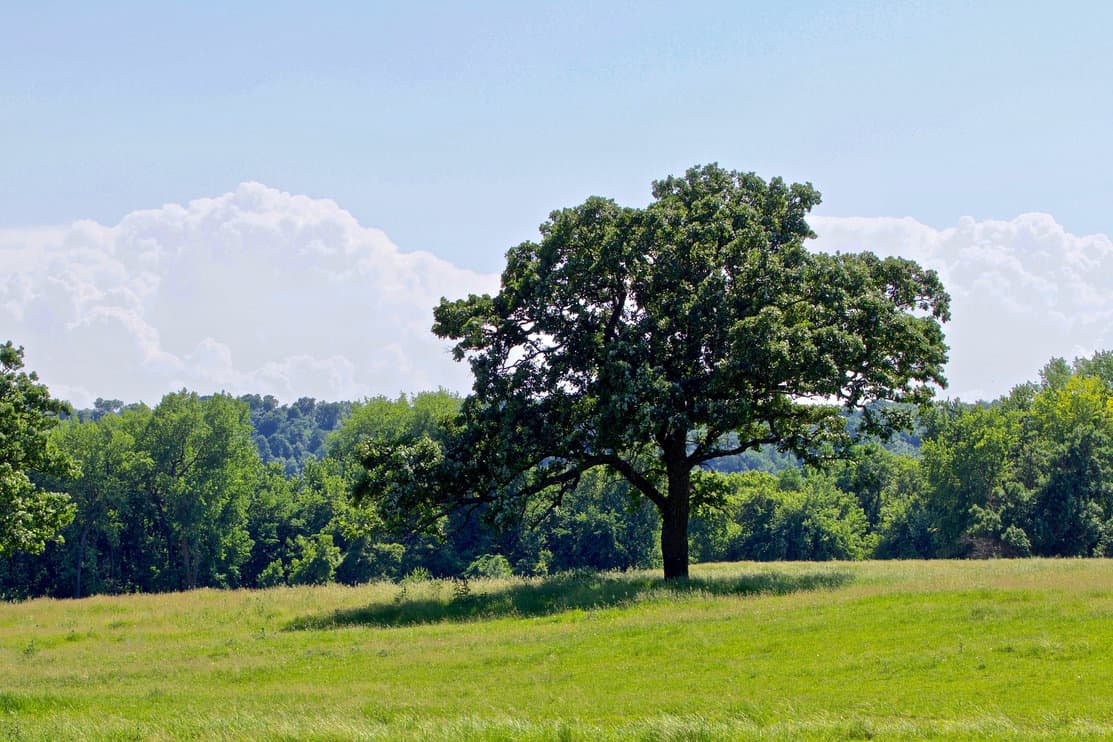
A grassy meadow with oak trees.

Because there are tons of different types of oak trees, there are tons of different growth rates, too!

Some oak trees can grow as much as three feet per year, such as the Nuttall Oak. Others, like the Post Oak, only grow about two inches. It all depends on what type of oak tree it is.

Weather conditions also play a small part in a tree’s growth rate. If the oak tree is grown in full sun, it’s likely to grow faster than one that’s in partial shade. Most oak trees cannot grow in full shade.

Proper soil conditions including PH and drainage will also affect how fast a tree grows. An oak that loves water will have a tough time growing in a dry climate, and vice versa.

Some oak trees live much longer and grow much faster than others. You can read our growth chart on the fastest growing oak trees here.

How Long Does It Take To Grow An Oak Tree? Full Timeline

So, you’ve found a local oak tree and you’re ready to grow one yourself. What can you expect? How long will you have to care for it?

Oak trees aren’t too hard to grow. They don’t require a ton of attention, so if you don’t have a green thumb you should still be safe to plant these majestic trees! 

Let’s start at the beginning and work our way through the timeline of growing an oak tree.

Live oak trees, specifically, grow at a different rate. You can view our guide to how long live oak trees live here.

Day 1: Finding The Right Oak Tree Acorn

Oak tree acorn

The first day of our oak tree timeline includes finding a seed to plant! This is as easy as identifying your local oak trees and waiting for the right moment. 

The beginning of fall is the perfect time to go looking for acorns. According to Mississippi State University, picking acorns directly from the tree may not be the best idea as these can be immature.

Instead, wait until acorns begin falling from the tree. You’ll want to pick them up within 3 to 4 days of dropping. Otherwise, they could dry out and the seeds will no longer be viable. Even if you only want to plant a single oak tree, it’s best to pick up more acorns than you intend to plant.

Some of them will not be viable, so pick up as many as you like! You can discard the unusable ones back outside.

Here’s what to look for in your acorns:

  • Color: Acorns should be mostly brown with a slight tinge of green.
  • Cap scar: This is the widest part of the acorn and should be bright and firm when pressed with your fingers. If the cap is still on the acorn, you can gently discard it. If the cap does not come off easily, try a different acorn or find one without the cap.
  • Make sure there are no holes in the acorns: This is a sign that a weevil or other pest has already burrowed in and made a meal of the seed.
  • Check for mold or dark, mushy spots: You may be able to wash the mold off if there are no other acorns available, but it’s better to find acorns that are mold-free.

Once you’ve collected enough decent-looking acorns, it’s time to test if they’ll grow or not! Don’t worry, the test is a pass/fail with only one question: does it float or sink in water?

Acorns that float when placed in a bucket or bowl of water are not viable and can be discarded back outside. All the acorns that sink are the ones you can use to plant!

Day 1 – Day 30: Planting an Oak Acorn in The Fall

Now that we have viable acorns, it’s time to plant those puppies and watch them sprout! The only problem is that white oaks and red oaks require different handling when in the acorn stage.

Acorns from white oaks can be planted immediately after harvesting, but red oaks require a dormancy period. With that being said, you can plant both white oaks and red oaks immediately. The only difference is red oaks will not sprout until spring, while white oaks will sprout within 1 to 2 weeks of planting.

You can plant your acorn either in the place you want the tree permanently or somewhere more convenient. You can transplant the tree within the first year without any problems.

To prepare the area, till the soil. A good rule of thumb is to place the acorns one inch deep. You can plant up to five acorns per square foot. This will allow you to choose the healthiest sapling to transplant. Make sure wherever you plant the acorn, it will have plenty of sunlight.

If the acorn has already started sprouting, put the root-side down. If it hasn’t, simply plant the acorn sideways in the soil. 

Over the next two weeks, you’ll start to see stems and leaves emerging from the soil if you planted a white oak acorn. During this time, you’ll want to remove the smaller seedlings to give the better-growing seedlings a shot at becoming the tree you’ll plant permanently.

Be sure to remove any grass or weeds that emerge, as this can stunt the growth of your seedlings.

This is a particularly vulnerable time for the acorn because squirrels and other digging critters LOVE to dig up acorns, especially in late fall and winter. There are a few ways you can prevent this.

  • Lay chicken wire fence down: this is an especially good deterrent for red oak acorns as they will take a while to germinate and sprout. Be sure to remove the fencing once the stems begin peaking out from the soil.
  • Use hardware cloth: You can use this in the same fashion as chicken wire fence. Be sure to remove it when the seeds are ready to germinate (early spring for red oaks, about 5 days after planting for white oaks).

For white oaks, after about a month you should have a good idea of which seedling is the fastest-growing and tallest. You’ll want to use this one for your tree. Be sure to remove the other seedlings or transplant them to a different location to allow your prized seedling to gobble up all the sun and nutrients.

If you’re worried about which oak tree you grabbed an acorn from, you can read our full guide on the best oak trees to plant here.

Month 1 – Year 1: Oak Sowing In The Fall

The next year will be a very vulnerable time for your seedling. It will need protection from browsing animals like deer. 

You can use something like the Voglund Nursery Mesh Tree Bark Protector. The nice thing about this product is it comes in 4 different sizes, so you can continue to scale up the size as your seedling grows. It also comes with zip ties included for easy installation.

If you’d rather use something less bulky, you can try a product like ANPHSIN Tree Protector Wraps. These will help repel pests but can also help your seedlings and saplings through cold weather. 

Some claim that heavy critter browsing may not be deterred by this type of wrap, but it is inexpensive, so if the browsing pressure isn’t too high in your area it may be worth it!

Once your tree reaches a height of 3 feet, it is considered a sapling. Woohoo! This can take anywhere from 6 months to a few years, depending on the type of oak tree. So if you make it this far, congratulations!

Before we move forward, let’s get back to those dormant red oak acorns, and how else you might grow them.

Month 6 – Day 1: Sowing Oaks In The Spring

If you’d rather wait until spring to plant your acorns, you can store them in the fridge or plant them indoors in pots until you’re ready. This goes for both red oak and white oak acorns.

For red oak acorns, they will not begin to sprout until spring. After you collect them in the fall, store them in a plastic bag left partially open in the fridge for two months. 

Be sure to check them every few weeks for signs of mold growth. If you see any, simply wash it off and place them in new bags.

For white oak acorns, you can store them in moist sand in the refrigerator for up to four months. After this time you will either need to plant them outside or move them to a pot to start germinating.

If you have red oak acorns, their dormancy period should be over after about two months. At this point, you can move them to a pot or plant them outside. Due to outdoor winter conditions, it’s usually easier to move them to an indoor pot.

If you’re a bit unsure of the difference between red and white oak trees, you can read the key differences to each here.

Be sure your pot is at least 1 foot deep. You’ll want to use a mixture of potting soil and local topsoil. Just like with planting outside, you’ll want to plant a few acorns per pot so you can pick the largest one to move outside.

Plant the acorns sideways about one inch into the soil. The acorns only need watering once a week and should begin sprouting within two weeks.

Pro Tip For Planting Your Acorn

  • Use a slow-release fertilizer in your pot to promote fast and healthy growth. EasyGo Product Milorganite Slow-Release Nitrogen Fertilizer is a great option. It’s simple to use and contains no salt, so it can be used in drought areas.
  • Pots can sometimes promote root spiraling due to their shape. To combat this, prune or straighten the roots before transplanting.

Continue to monitor your seedlings as they grow, removing smaller seedlings where necessary to promote faster growth for your dominant seedling. It’s not until around April that you can safely move your seedlings outside.

Month 6 – Year 1: Sowing Oaks In The Spring

As soon as April rolls around and the birds start chirping, you can move your potted seedlings outside. It’s okay if temperatures dip below freezing again, oak trees can survive the frost.

Place your potted seedling in an area that gets partial shade. We don’t want to shock the tree with full sun just yet. For the next month or so, let your seedling get acclimated to outdoor life. If it hasn’t rained in over a week, be sure to water it.

After a month, you can move your seedling to full sun! Use our previous tips to protect your vulnerable seedling from browsing animals. For the next few months to few years, your seedling should grow substantially. Just like before, once it reaches a height of 3 feet it’s officially a sapling!

Year 1 – Year 5: Growing Oak Tree Saplings

Depending on the type of oak tree you planted, you may have to wait several years for it to reach its sapling stage. Others take less than a year.

But the awesome thing about saplings is they take WAY less work than our little acorns did. The big issue during this time is browsing, pests, and disease. Because our oak saplings are still young and small, they’re more susceptible to these things than a full-grown oak tree..

Another big issue: transplanting. If your small but mighty oak isn’t in its permanent location by now, it’s time to think about where you want to plant it. Find an area that will sit in full sun and make sure you visualize how big your oak will get and give it enough space to grow.

Transplanting within the first year should not be an issue with oak trees. The earlier you transplant the better. The longer you wait, the longer it will take for your oak tree to acclimatize to its new location, which could stunt its growth.

How To Transplant Your Oak Tree Sapling

  • Dig an appropriate-sized hole
  • Straighten or prune any spiraling roots
  • Place sapling in hole and cover with removed dirt
  • (optional) throw some mulch around your sapling to help retain moisture and deter digging critters like mice, moles, and voles.

For the next five years, you’ll need to be vigilant about browsing. Use tree guards or wraps to deter deer. You can also use scents and smells that deer or squirrels dislike to discourage them from coming near your sapling. 

Unfortunately, oak saplings can be susceptible to certain tree diseases. You can read our piece on the most common oak tree diseases here.

Year 5 – Year 50: Grown Adult Oak Tree

Oak tree on the green spring meadow

Once your oak tree hits the five-year mark, it’s generally good to go. You can breathe deep, relax, and watch from afar as this amazing tree continues to grow.

An oak tree reaches maturity around 30 years old, but this can vary depending on the type of oak tree. You know your oak tree is mature when it begins producing its own acorns that you can spot in the summer.

At this point, your oak tree may be fully grown. However, some oak trees will continue to grow for decades more, if not centuries!

Wrapping Things Up

Hopefully this timeline gives you a good idea of how long it takes to grow an oak tree. It can be fun to plant an acorn, care for it, and watch it grow. 

Although you may not be around when your mighty oak tree has reached full maturity and height, generations to come will be able to enjoy its shade and the wildlife that call it home. Not a bad legacy to leave behind!

Happy planting!

References

Cufar, K., Grabner, M., Morgos, A., Castillo, E., Merela, M., & Luis, M. (2014). Common climatic signals affecting oak tree-ring growth in SE Central Europe. Trees, 28, 1267-1277.

Pilcher, J. R., & Gray, B. (1982, March). The Relationships between Oak Tree Growth and Climate in Britain. Journal of Ecology, 70(1), 297-304.

Willaume, M. (2006, March). How periodic growth pattern and source/sink relations affect root growth in oak tree seedlings. Journal of Experimental Botany, 57(4), 815-826.

There is nothing more beautiful than a healthy oak tree that’s standing tall and full. With its beautiful green foliage, and branches stretching far and wide into the sky, an oak tree is a true symbol of strength. However, sometimes our oaks aren’t doing so great – and there are some key symptoms of a dying oak tree that you can look out for!

Symptoms of a dying oak tree can include yellowing leaves, loss of foliage, decaying bark, root rot, and more. For oak trees seriously affected, the trees will need to be removed from the property, while those only slightly affected can be monitored and nourished.

Today we’re going to talk about some early symptoms to look out for and what to do if you notice these signs! But first – keep on reading to learn a little bit more about oaks! 

What Are Oak Trees?

Oak trees are those beautiful grand and wide trees that have lobed leaves and a ton of acorns! Known as a staple tree in American agriculture, oak trees are a symbol of great strength, wisdom, and resilience and can be found in almost every state across the United States of America. 

Oak trees are part of the Quercus family, with variations of up to five hundred plus types of oaks. All considered medium to tall, and with each type having a different growth rate, oak trees can get up to 100 feet at their tallest and are typically considered mature anywhere from 60-100 feet. 

Oak trees can be categorized into two main groups: White Oak or Red Oak. 

Oaks trees truly embody strength. They can withstand extremely strong winds and can even survive a drought. Oak trees live hundreds and hundreds of years, and one reason for that is because they are generally not susceptible to fungus or disease. 

However, disease does happen on occasion, and when they are dying, there are signs that we can look out for, but first – what is a healthy tree even supposed to look like?

How to Tell That an Oak Tree is Healthy

Before identifying what an unhealthy oak tree looks like, it’s important to know what a healthy tree is supposed to look like.

This way, you have a general rule of thumb before deeming a tree unhealthy.

There are three key visual ways you can identify a healthy oak tree: full branches, strong bark, and green leaves. 

To identify a healthy oak, think full, strong, and green! Using these three ideas as a basis for a healthy tree can help you quickly identify if anything is going on with your trees that would otherwise make them unhealthy. 

Full Branches 

Big old oak tree on a meadow with forest behind.

In the image above, take note of the fullness of the majority of the bottom branches. However, notice at the top where the branches lack leaves? This is a sign where this tree may be reaching it’s end.

One of the tale-tell signs of a healthy tree is its branches! If the branches are full, you most likely have a healthy tree. 

A great way to double-check the strength of an oak tree branch is to take a branch and bend it. If it bends and feels flexible, it’s a living branch; a dead branch will snap immediately. Oak trees, in general, have a plethora of branches stemming from the center of the tree.

Strong Bark 

A strong bark is another great visual identification of a healthy tree. Strong oak tree bark has no peeling or decay and will remain its natural color. If the bark on your oak tree is changing color or starting to lose bark, the tree could be in trouble.

Green Leaves

Often, discoloration is the first sign of an unhealthy oak tree.

An oak tree has lobed leaves, and the leaves will vary between the type of oaks in leaves shade of green. A healthy oak tree will have an abundance of green leaves and will not show discoloration. Commonly, oak trees can contract Fusiform Rust.

But it’s time to dive into it – what are some early symptoms of a dying oak tree?

Early Symptoms of a Dying Oak Tree 

There are many symptoms to look out for, for a dying oak tree, and luckily, if caught early enough, there are solutions you can try to save your oak.

Check out this table below with some symptoms, causes, and solutions to help save your oak tree.

DYING OAK TREE SYMPTOMCAUSESOLUTION

Spots on Early Leaves (Anthracnose)

Caused by Anthracnose – spotting, or lesions, on early leaves is a sign that the tree may not do so well – however, it’s not a game-ender quite yet. 

On an oak tree, Anthracnose can be noticed by looking at the leaf. You may see some yellowing or brown spots going along the veins of the leaf. The leaf itself may start to turn into a cup shape and feel papery. 

The solution to Anthracnose on an oak tree is to watch, monitor and truly, – see what happens. However, to get ahead, start by raking up the fallen leaves, and pruning branches that are lower to the ground. This keeps affected leaves away from others. 

Pruning branches can help air circulation. Increasing the air circulation can lead to proper irrigation and fertility of the tree.

If you’re interested, you can read our piece on the lifespan for common oak trees here.

Blotches on Leaves (Tubakia Leaf Spot)

Next time you’re out for a walk, take a close look at your oak tree. You may notice blotches on your oak’s leaves.

Blotches, also known as sprawling spots, are called the Tubakia Leaf Spot. These blotches usually appear brown to brown/orange and, on young trees, are well-defined and truly give a blotchy appearance. 

On older trees, the blotches may be larger. If these blotches are along the veins of the oak tree leaf, it could lead to a premature falling of leaves and also restrict water movement.

Much like the spotting on leaves, the best thing for Tubakia Leaf Spot here is to watch and monitor your oak, but also rake up fallen leaves, and prune branches for better air circulation and irrigation. 

Yellow, Brown, or Dull Green Perimeter on Leaves (Oak Wilt)

Ever see a leaf and notice it has a few different colors around its edge? Well, that is actually Oak Wilt.

Due to Oak Wilt, yellow, brown, or dull green perimeters on leaves can be an early sign of a distressed tree. This becomes a problem for oak trees because the leaves will drop too early, and in turn, will cause the tree to reach its end significantly faster as the leaves channel photosynthesis for the tree.

Oak Wilt is much more serious for Red Oaks. White Oaks are less susceptible to Oak Wilt, whereas Red Oaks often reach their end within four weeks of Oak Wilt first being spotted.

Oak Wilt is often caused by oak bark beetles in warmer temperatures. These beetles feed on their host tree and can introduce decay fungi which can create the wilt. 

The solutions to oak wilt vary depending on how intense the wilt is. Trenching is a solution that is used so that root grafting can be prevented. Sometimes, a trunk injection with a fungicide is used to stop the spread – however, this should be done and looked at by a professional.

Puckered Areas on Leaves (Oak Leaf Blister)

Oak Leaf Blister looks like the shape that any blister would look like, except it’s on a leaf! At the first sign of blistering, there may not be much of a color variation. The texture, however, will definitely feel bumpy – like many blisters on a surface. 

The longer the Oak Leaf Blisters are there, the browner they get, and the leaves can eventually curl and fall. Leaves are vital for the tree as they channel the process for photosynthesis.

However, this can be fixed.

The solution to Oak Leaf Blister’s puckered areas on the leaves is to simply watch and monitor and to keep the surrounding area of the tree clean. Continuously raking the fallen leaves and debris and throw the leaves out to prevent spread. 

Swollen Branches or Trunk (Crown Gall)

One of the most obvious symptoms of a dying tree is caused by Crown Gall. Crown Gall causes the roots, stems, branches, and trunk to look swollen and round. It almost looks like a big bulge on your tree. The Gall becomes the most troublesome when it is near the root crown, and at first, may seem spongey, but gets very hard the longer it’s present. 

The solution to Crown Gall on an oak tree is prevention and maintenance. Crown Gall is a bacterium in and of itself, and by making sure there are no open wounds on the tree and also by controlling insects, the bacteria will not be able to get in. Insects can carry Crown Gall and spread it to the tree. 

White Textured Spotting (Armillaria Root Rot)

White textured spotting, caused by Armillaria Root Rot, appears as a white, yeasty substance on the tree bark and branches. Caused by fungi, if your tree experiences this is can reduce its growth, have a premature leaf drop, and in turn, can cause the tree to reach its end significantly early.

Armillaria Root Rot can be hard to detect, as it usually is present under the bark of an oak tree. However, a sign that this is occurring in the presence of red to brown clusters of mushrooms growing at the base of the tree. 

The solution to Armillaria Root Rot is to try to increase the tree’s vigor and making sure the tree doesn’t experience any flooding. Proper irrigation and fertility (improving soil composition and nutrients) are key in doing so.

Peeling Bark (Phytophthora Root Rot)

Peeling bark, or simply put as Phytophthora Root Rot, should be managed quickly on an oak tree. If Phytophthora Root Rot is present, the tree will reduce in strength, and the leaves may start to turn yellow. Depending on how intense the rot is, trees can hold out for a few years but will have a significantly shorter span.

Phytophthora Root Rot is difficult to detect in oak trees as the roots are the main problem, and they are underground. The roots will turn a different red-brown color if they do have it. You may notice Phytophthora Root Rot near the stem of the tree underneath the bark as well.

The solution to Root Rot on oak is irrigation and maintaining a good soil drainage system. From the get-go, avoid planting trees too deep, as that can be one of the factors that attribute to Root Rot.

Of course, you can’t do much to change how deep your tree is currently planted. Just make SURE the tree has proper irrigation.

Mushrooms at The Collar (Heart Rot) 

Also known as Heart Rot, mushrooms at the collar of the tree are a no, no, and should be managed as soon as possible! 

When first spotting Heart Rot, you may see some white rot on the wood of the oak tree as it starts to become spongey as it decays. On the bark itself and collar of the tree, you will start to see mushrooms that can get quite large and will almost appear like it’s wrapping around the bark. 

A tree with Heart Roots can decline quite rapidly, as the branches will wilt away, the tree will lose its leaves, and when leaves are supposed to be green, they will appear yellow and brown. The mushrooms, however, will fall off within a few weeks once this happens.

The solution to Heart Rot is to time pruning when spores are not present. When the mushrooms fall off, or the spores are no longer present – usually in the colder months, it’s the perfect time to prune. 

Vertical Stripes (Hypoxylon Canker)

Vertical stripes seen on the bark and on the branches of your tree are a sign of Hypoxylon Canker.

The stripes on your oak tree will develop over silver-gray, tan patches and eventually will turn black with yellowing and wilting leaves also accompany this. 

The solution to these vertical stripes (Hypoxylon Canker) on your tree is prevention. Keeping a tree strong by ensuring proper irrigation is key. Making sure there are no wounds on the tree or insects, such as beetles. If you do see a wounded limb, removing it right away will help to refrain exposure of the disease to the rest of the tree.

Tiny Yellow Spotting (Fusiform Rust)

Tiny yellow spotting on the leaves and trunk of an oak tree occurs because of Fusiform Rust. The yellow spots almost mimic the idea of hair follicles and will have a hair-like appearance with a yellow to orange color. The spots are tiny, like pin-points, and are in clusters. 

Fusiform Rust may not be so noticeable in already planted and growing oaks – however, it is very common in a tree nursery. In order to prevent it, fungicides should be used in young oaks.

Initial Steps to Take to Prevent an Oak Tree from Dying

It’s important to understand what you CAN do to keep your trees full of life. The thing is, there are actual steps that you can take from the beginning that can prevent your trees from reaching an early end. If you know, you know, but if you don’t – we are here to explain! 

Additionally, you’ll want to plant your oak tree at the right time as well. This is quite crucial. Here’s our piece on when the best time to plant an oak tree is.

Pick the Right Oak Tree

Old oaks in the fall by the pond.

Now, we know all trees are beautiful; that kind of goes without saying, but not all trees are meant to be in all climates. Although oaks generally do good in a mixed climate, there are specific oaks that you can choose for your area. 

If you need to pick the right oak tree, you can view our guide on the best oak trees to plant here.

Keep Grass Away From The Tree

Grass will actually fight the tree for air, water, and nutrients; thus, when planting a new tree, it’s a good idea to keep it away from a grassy area! In the early stages, a tree is at its most vulnerable, and it needs all the air, water, and nutrients it can get. Adding mulch around the tree is a much better alternative.

You can read our guide to planting oak trees in your backyard for more info.

Provide Plenty of Water to Your Oak

Depending on the soil drainage, your new tree will need water to grow to its highest potentials. It’s important to at least water your new tree every other day. For the first three years after planting, If the soil is dry, provide about 1-1/2 gallons of water per diameter inch of the trunk.

Remove Tree Stakes Early On 

This is the typical remove the training wheels idea. The only reason a tree should have stakes in the first place is if it’s too young to stand on its own. Once the tree has been planted for a bit and has the capabilities to stand on its own, the stakes should be removed. 

The trunk of the tree will grow much stronger if the tree has the ability to sway in the wind. 

Pruning Your Oak Tree Properly

New oak trees don’t need a ton of pruning. As the tree begins to grow, it’s important to look out for any low branches that may be growing, as if they get too close to the ground, pruning them would be a good option. 

Removing dead or damaged limbs or suckers that sprout from the trunk is always important in pruning a new tree.

Fertilize Only When Needed

With new trees, a lot of the time, you think fertilization is necessary – however, it can cause more damage than good if you fertilize when you don’t have to.

When the tree is first planted, it’s okay to add fertilizer, but after that, take a look at the tree and see how it’s looking. If it shows any signs that it’s unhealthy – then fertilizing is necessary. 

The Take-Away!

Trees are beautiful and are true sentiments to our outdoor scapes; however, like any plant, they need special care, especially at a young age, and can be prone to different diseases. 

The best way to stay ahead of the game is by prevention; however, if you ever do happen to notice an early symptom, don’t stress; there are ways to help your tree get rid of the disease and to live a long and full life.

References

Pearce, M., & Williams-Woodward, J. (2009). Key to diseases of oaks in the landscape.

Jung, T. H. O. M. A. S., & Blaschke, H. E. L. M. U. T. (1996). Phytophthora root rot in declining forest trees. PHYTON-HORN-36, 95-102.

“The Tree Owner’s Manual .” Northeastern Area State and Private Forestry, United States Department of Agriculture.

“Tree Planting.” National Association of Conservation District, nrcspad.sc.egov.usda.gov/DistributionCenter/pdf.aspx?productID=51.

Oak trees and maple trees. What comes to mind when you hear these words? Maybe it is the sticky syrup that pairs perfectly with a pancake, or the acorns that squirrels love to snatch up.

In general, oak and maple trees can be determined by their leaves. White oak tree leaves usually have a rounded tip, while red oak trees have tips that tend to be more pointed. Maple tree leaves have veins, are pinnate, and made up of three single leaves to create one large leaf.

So, is one tree better than the other? If you pick maples vs oak or vice versa, will you regret it? The truth is, either might be perfect for you. One might also end up being better than the other based on your needs and expectations. We are here to give you some insight that will help you come to a conclusion… so, come along!

What Are The Major Differences Between Oak and Maple Trees?

There’s no argument about it. All trees are different, depending on fruit, leaves, bark, or even just the potential for growth or ability to adapt to difficult environments.

Some trees do better around water, while some don’t need it nearly as much. There are so many factors that go into determining different species and their applicable offshoots.

Specifically, though, you may be wondering not about these finite details that could be discussed for hours, but the actual differences between the trees themselves. 

Whether you are looking for lumber, to plant a new shade tree in the family backyard, or to plant something that will make your business attractive to customers as they walk through the door, knowing about what you are buying matters. 

Trees are nature, but they are also a product and, when it comes to deciding which product to obtain for your space, we want you to have all the important details!

Well, here are a few things to know about the specific differences between maple and oak trees.

Is Maple Harder Than White Oak?

In a word, yes. 

With further explanation, yes… but.

Maple and oak are both hardwood trees, but maple is harder than oak. However, oak is more stable than maple, especially when working with flooring and products that require thinner, more finely-cut pieces of wood. 

If you are looking to buy a tree for your yard, this difference does not matter nearly as much as it would for someone looking to source the best kind of wood for a new home or business. 

To give you some quantitative information, maple ranks at 1450 while white oak is at a slightly lesser 1360 and, another species, red oak comes in at 1290 on the Janka hardness rating scale.

Are Oak Trees Bigger Than Maple?

Maple trees actually have a much greater range of sizes than oak trees. Most maples grow to a height of 10-45 meters, which translates to about 35-150 feet, more or less. Other times, these trees can end up being less than 10 meters tall and will appear more like shrubs due to the multiple small trunks stemming out at ground level.

Because some species of maple are actually shrubs, their mature heights may be as short as 8 feet tall. These smaller maples may also be able to grow in containers due to their small size, even if just for the beginning of their life span.

As for oak trees, the small ones may reach about 6-9 meters, or about 20-30 feet, whereas larger oak trees will reach 30 meters or 100 feet. Whereas maple trees may hold the title for the broadest range of growth, oaks are known for something else.

Oak trees show significant growth not only in their height but also in a horizontal manner. Everything from as low as the roots to as high as the tallest branch is likely to grow far from the middle of the tree. Maple trees of a similar size would not exhibit this same lateral sort of growth. Keep this in mind if you are looking to fit a tall tree into a small patch of property.

Major Oak Tree and Maple Tree Leaf and Bark Differences

To really, truly differentiate between oak and maple, there first needs to be a proper understanding of the trees.

There are 2 main categories of oak trees, red and white oak. Within these categories, in North America alone, there are dozens of different varieties. Altogether, when we account for new varieties, hybrids, and oaks that appear internationally, there are about 500 varieties of oak trees. 

Luckily, we can divide oak trees between red and white, while there are fewer (about 100) varieties of maple trees. This means that we can just call them all maple and keep the comparison coming. 

When it’s all said and done, there are really two major parts of a tree that we can compare- the leaves and bark.

Without further adieu, the 4 major differentiating factors between oaks (white and red) and maple trees.

Oak Leaves Vs. Maple Leaves Differences

So… leaves. Arguably one of the most important aspects of a tree. They are the blob that children learn to draw atop what would otherwise be a brown line. They give the tree character and change into a beautiful sea of color during the colder months of the year. 

The chemical composition of leaves themselves can actually be related to soil conditions. Remember how we mentioned trees that are more adaptable to less ideal conditions? These are often selected for afforestation, and studies have been done that show that there is a significant difference in those leaves of trees which have different soil conditions to nurture the growth.

How could one possibly know all of the intricacies, all of the differences between the leaves of an oak and a maple tree? We are here to help with just that question.

Oak vs. Maple Leaf Shape

White oak leaves usually have a rounded tip, while their red cousins have tips that tend to be more pointed. 

Similarly, the lobe of a white oak is also rounded without bristles coming up at the tip of the lobe. This means that the serrations along the outer edges of the white oak leaf are also rounded.

Red oak leaves have pointed lobes that do, in fact, sport some bristles at the lobe tips. This species of oak is a bit trickier than its counterpart because there is a greater variety of leaf shapes that might appear. The edges of red oak leaves may be round and more smoothly serrated, or they might sport harsher, more acute edges.

The leaves of a maple tree are pinnate and actually made up of three single leaves to create this one larger leaf that we see. The individual leaves are curved, but irregularly so, sort of like those of a white oak but not quite. 

These hard maple leaves have lobes that are compared to the spaces between the fingers of a human hand. They are rounded, a bit spaced out without being too far apart, and characteristic of a hard maple leaf.

If you happen to be dealing with a soft maple leaf, the lobes will be shaped more like a ‘V’ than a ‘U’ because of the sharper edges of the leaf as a whole.

Maple Leaf Veins (& Petioles)

The maple leaf petiole, which we see just before the veins start, is long and reddish. It also appears to be coarsely toothed throughout the leaf. One small downside is that this is subject to attack by a ‘maple petiole borer’, a wasp that will not cause major damage but will certainly act as a hindrance to the success of your maple tree.

The veins of both oaks and maples are thin and spread through the leaves themselves.

Oak Vs. Maple Tree Bark Differences

close up of maple tree trunk in park at summer
Close up of maple tree trunk in park at summer.

Aren’t trees classified by their leaves? How else can you tell apart an oak and a maple if not for the shape of the leaves as you walk past? 

What is one to do in the winter when trying to determine the species of tree at which they are looking? That’s easy!

Bark is a great, relatively easy, classifier of tree species during the winter months when trees (other than evergreens) have lost all of their pretty leaves that normally help us differentiate between them. 

So, that’s all well and good but… what are the differences in bark that might be useful to us?

Oak vs. Maple Tree Bark Shade

Hard Maple usually exhibits a color that is both lighter and more consistent throughout the trunk and branches. 

Soft maple, however, is typically a darker color, mixing in shades of brown, red, and even grey at times.

Young oak trees often have a silvery brown look, while mature oak trees will see a change in the color of their bark. Of course, it all depends on the species but the bark may become a light grey in some white oak varieties. On the contrary, red oak varieties may shift toward a very dark color, almost black looking at times.

This is one reason why it is difficult to classify comparisons in ‘this’ vs ‘that’ when trees have so many species and even more varieties within those. It really is ‘this entire category of plant life’ vs ‘a different, yet related whole category of plant life.’

Oak vs. Maple Tree Bark Texture

A young red maple may have smooth, unbroken bark that looks quite different from the cracked-looking, rougher bark of, say, a northern red oak.

Somewhere in the middle would fall the scarlet oak, which has some vertical cracks and seams in the bark that is otherwise smooth, more similar to the young red maple than the northern red oak, funny enough. 

Generally, the bark of young oak trees is smooth, though this may not be true of every single variety. Especially as these trees mature, the bark will become more cracked with deep ridges along the bark. 

What Defines An Oak Tree?

Let’s summarize some of the finer points of what it really means to talk about an oak tree.

To identify oak trees, first, you will want to look for the leaves, if there are any. You’ll expect to see deeply lobed leaves that may sport either pointed or rounded tips (we know, they just can’t make it easy on us, right?)

If you cannot get a good look at those leaves for whatever reason, winter, the height of the branches, or some other reason, look to the bark for some answers!

The bark should have a scaly look due to its ridges and the deep fissures running along the trunk. If the tree is visibly younger, with a thinner trunk and shorter overall height, the bark may appear smooth. This doesn’t mean it’s not an oak tree, just that it is not yet fully matured. 

The color of the bark may be whitish silver, but it could get as dark as black. So, knowing the color of the bark may not be as helpful in this scenario.

The fruit of an oak tree is more commonly referred to as a nut, the acorn in particular. If properly prepared, humans can eat these nuts just like any other! 

Keep these key factors in mind, and you’ll be able to distinguish oaks in no time!

What Defines A Maple Tree?

Maple tree turning yellow in autumn in a public park.

We’ve had the chance to talk about identifying an oak tree in summary, so now let’s go over maples!

To identify maple trees, the best indicator is the leaves. Maple tree leaves will have between 3 and 9 lobes, and some will have prominent veins (the petioles.) Many of these leaves will have serrated lobes. 

All of these factors together (amount of lobes, shape of the leaf as a whole, serration, and indentations on the leaf) will help to identify specific varieties within the maple category.

In the fall months, maple trees find their leaves changing color. You’ll be able to spot shades of red, yellow, burgundy, and orange. Sometimes a single tree will have a mixture of all of these colors!

In the summer months, and as they grow back in the spring, maple leaves are a dark green color. They have fruit in the form of winged seeds. These are sometimes known as helicopters.

A cool tip: humans can eat these nut-like fruits, samaras, too! Unlike acorns, these can be plucked right from the tree and are actually said to be tastier when picked this way, as opposed to being collected as the tree releases them naturally. The more you know!

Finally, we couldn’t forget about the fact that maple trees produce the sap which is the ever-important base of maple syrup. Yum! But also… sticky. More to consider, this sap could be a pro or a con. Maybe it’s both- you’ll have to decide this for yourself.

Lock these characteristics in your brain, so that the next time you try to distinguish a maple tree, you won’t be doing so in vain.

What Are The Most Valuable Hardwood Trees?

In temperate climates, both oak and maple trees are among the most valuable hardwood trees. They stand among ash, cherry, walnut, and tulipwood in this categorization.

Furniture is their main use, but joinery and interior decoration are other popular ways to incorporate these hardwood trees into one’s home, office, or other business space.

Is Oak Better Than Maple?

This question is commonly asked but does not have a satisfying answer. Unfortunately, there are just too many factors to compare and too many differences in what people hope to get out of a tree (or its lumber) to be able to classify one as ‘better’ than the other.

That’s All For Now!

Now that we’ve learned a little more about the differences between maple and oak trees, as well as what makes them unique, it’s clear that trees are complex organisms that deserve thorough research and understanding before you choose a specific kind.

Maple might be harder than oak but oak is more stable. Maple is better suited for smaller square footages, while oak will not produce a sticky sap. There are many more factors like these that go into the decision of which one is ‘the one.’

When one tree is eventually selected, whether you are planting the tree itself or looking to harvest its wood, we hope that you feel confident in your decision.

It’s not likely that you’ll run into huge issues or downsides with a maple or an oak tree, but keep these factors in mind as you continue to look into what you will eventually purchase. 

The fruit of each tree will likely attract some little critters, but can also act as the star of a fun foraging activity for those with kids (or anyone who wants to mindfully use all of their resources!) 

The leaves are all similar, but different. The bark tells you things that the leaves wouldn’t be able to and is a great substitute for those trying to distinguish species amid winter. 

Both maple and oak trees are sturdy, beneficial to own, produce great wood, and offer a source of shade when you are in need. 

But, don’t forget that each tree is individual. Expect a beautiful touch of the natural world in your backyard, in your home, or anywhere else that you are in the presence of these two great hardwood trees. 

References

James C. Finley and Sanford S. Smith. October 2009. From the Woods: Ten Important Hardwoods. PennState Extension.

Ovington, J. D. (1956). The composition of tree leaves. Forestry: An International Journal of Forest Research, 29(1), 22-28.

Koczan, G., Karwat, Z., & Kozakiewicz, P. (2021). An attempt to unify the Brinell, Janka and Monnin hardness of wood on the basis of Meyer law. Journal of Wood Science67(1), 1-16.

Oak trees (Quercus spp.) are a common feature in folk stories, poetry, and songs for their noble stature, strength, and long lifespan. Compared to other plants, and even other trees, oaks are fairly slow-growing. Most oak species average 12-24 inches of growth each year, but this rate of growth varies widely among species, growth zones, and changes as trees age.

Lifespan varies widely among oak species. While most oak trees live around 100-150 years, there are a few species that live for less than 70 years, such as the laurel oak. Rare species of live oak trees can even be over 2,000 years old, such as the Angel Oak Tree in South Carolina!

These long-lived plants aren’t just stately additions to a spacious property. They are soil stabilizers and improve soil fertility. They also protect groundwater and are a keystone species upon which many other species depend for food and shelter.

Facts About Oak Tree Lifespan

Oak trees are part of the beech family. They can grow as shrubs or as true trees, depending on the environment in which they are growing.

Oaks are hardy plants that can handle freezing winters and scorching summers. Native throughout the Northern Hemisphere, these important plants can be found throughout cool temperate and warm tropical climates.

North America is home to the largest number of oak species. 

Approximately 90 different species of oak trees can be found in the United States, while 160 species grow in Mexico. China is the second-largest center of oak growth, with approximately 100 species known to grow there.

Humans have discovered approximately 500 known species of oaks in total. 

Now, we aren’t going to get into the specifics of every species. We wouldn’t even want to read all of that! Instead, we are going to focus on some common species that you are likely to have on your own property.

TREELIFESPANANNUAL GROWTHFULL HEIGHTBEST HARDINESS ZONE

Most Common Oak Trees in the United States

A red oak stands in a grassy spring meadow beside the river.

Remember, there are at least 500 species of oak trees out there. 

Another important skill oak trees have is that they can naturally create hybrid species. That makes our task of extending the life of all oak trees a bit of a challenge. 

Oak trees break down into two varieties: red oaks and white oaks. 

The main difference between the two is their leaf shape. White oak tree leaves have rounded leaf tips, while red oak leaves tend to be pointed. Of the two, white oak tree acorns develop faster than the acorns of the red oaks. Our list includes trees from both groups.

For now, we’re going to stick with the most common species in North America. For most of our readers, these are the most common species you are likely to see at a nursery or have growing on your property already. 

We are also going to include some information that will hopefully help you ensure your tree reaches maturity and lives a long, fruitful life.

Black Oak

Lifespan: 100 years

This wide-spread species of oak belongs to the red oak group. It is native and widespread throughout eastern and central North America. If you live in any coastal state from Maine to Texas, or inland as far as Michigan, Ontario, Minnesota, Nebraska, Kansas, Oklahoma, or eastern Texas, then chances are good you have seen this common oak.

Black oaks grow best on well-drained, silty clay. This tree is generally considered a slow grower, only averaging 8-12 inches of growth until its roots are established. However, once it is settled in, if it has optimal growth conditions, these trees can grow two to three feet a year. 

If well taken care of, a black oak can provide shade and shelter to wildlife for about 100 years.

Bur Oak

Lifespan: 200-300 years

The Bur oak’s botanical name is Quercus macrocarpa, the Oak with the large fruit. We’re going to go out on a limb and call this a bit of an understatement. This oak can grow to over 80 feet in height, has leaves that are over 10 inches long, and produces acorns bigger than limes!

Bur Oak, also called the Mossycup Oak, gets its name from the shaggy acorn cap that tops its acorns. Once sprouted, these trees have a moderate growth rate and can grow more than 20 inches each year. 

Bur oaks are often found in parries, open woods and stream edges, preferably closer to the water. One of the oldest Bur Oaks, the Bicentennial Tree, is believed to be more than 400 years old. Most specimens are believed to live around 200-300 years.

Laurel Oak

Lifespan: 50-70 years

The Laurel Oak, Quercus laurifolia, is a fast-growing oak that can reach over 100 feet tall. This is a relatively short-lived species when compared to others on our list, often dying off after about 60 years.

It is a good oak for more humid and rain-heavy climates but is not very picky when it comes to temperatures. It can be found in just about any coastal region south of New York and grows on the west coast up through Washington state. It grows well from Florida to Southern California, and down into Mexico.

Water Oak

Lifespan: 60-80 years

Quercus nigra, the water oak, is native to the eastern and south-central United States. You can find this oak in all the coastal states from New Jersey to Texas, and inland as far as Oklahoma, Kentucky, and southern Missouri.

Compared to some of the other oaks on this list, the water oak is pretty picky when it comes to growing conditions.

As a wetland tree, it occurs naturally in lowlands and up to 1500 ft in altitude. It is adapted to wet, swampy areas and can tolerate well-draining soil. It grows well in sandy soils or red clays.

It does not do well on crowded plots and does not tolerate even light shade. 

This specialized oak will only last for several decades. The water oak is relatively short-lived, making it 60-80 years on average. 

However, it is a fast grower and reproduces quickly, making it an excellent candidate for restoring bottomland hardwood forests after agriculture or pine plantation usage. 

Pin Oak

Lifespan: 150 years

Quercus palustris, the pin oak, or swamp Spanish oak, is a species of red oak. The Pin Oak gets its name from the short branchlets that grow along the greater branches and limbs.

Here are another wet-tolerant species and is sometimes also called a Water Oak, though our two examples are quite different plants. Unlike the Water Oak Quercus nigra, the Pin Oak Quercus palustris is more commonly found in more northern, interior states and all the way up to Ontario, Canada.

Pin oaks grow primarily on poorly drained floodplain and river-bottom soils. Generally, pin oaks grow well near high clay content as well.

While they like wet soil, they do not grow in areas that have standing water throughout the majority of the growing season.

The Pin Oak is also much longer lived than the Water Oak, reaching about 150 years, or roughly double, that of our other water-tolerant oak.

Pin oak is one of the most commonly used landscaping oaks in its native growth zone because it is easy to transplant, grows very quickly, and is tolerant of pollution.

Live Oak

Lifespan: up to 1,000+ years

If you want to impress and have the acreage and southeast climate for it, then the live oak is the way to go. Quercus virginiana, also known as the southern live oak, is an evergreen oak tree native to the Southeastern United States.

Many oaks are loosely called “live oak,” but a true southern live oak is one of the most iconic trees in the United States, particularly in the Old South. 

Many of the oldest trees and largest trees on the eastern coast are live oak trees. Live oaks are believed to be capable of living up to 1,000 years in their native region. 

The most famous specimen, Angel Oak in Johns Island, South Carolina, is believed to be 400-500 years old. It’s raised 66.5 ft tall and measures 28 ft in circumference! Even more interesting, the longest branch on the Angel Oak is 187 feet and its shade covers 17,200 square feet.

Some folks contend that the tree could be as old as 1500 years, but many arborists suspect that its true age is closer to 500 years. Either way, that is nothing to shake a stick at.

Oak Tree Care

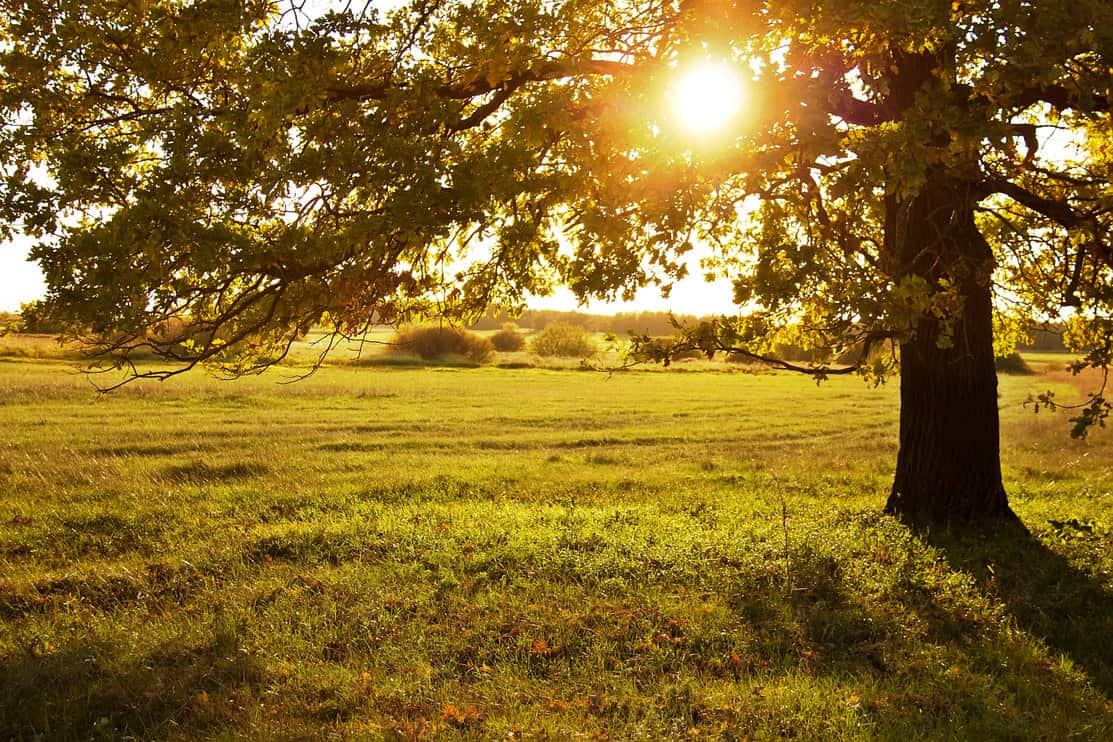
Big old oak in a autumn field. The sun shines through branches of the tree

Let’s start by stating that each species of oak tree has its own care requirements based on its natural habitat.

In general, oak trees prefer full sun and well-drained soil, unless you are dealing with a Pin Oak or Water Oak, of course. 

Typically, they are well suited to the natural change of seasons. Most oaks can handle hot, dry summers and cold, wet winters, especially once they are established. 

Oaks can handle a good soaking in winter if you are having a dry season, and it is also safe to water them a time or two during a dry summer. Be sure to water them gradually all day so that the surrounding soil becomes thoroughly moist but not waterlogged.

It is not recommended to water a mature oak more than once each month. However, you can lay mulch at the base of your tree to keep the surrounding soil from drying out while also preventing nutrient-sapping weeds.

Remember that oaks do not appreciate shade. They are shade providers, but they do not require it for themselves. Full sun is the way to go to make sure that your oak grows up happy and healthy.

Common Oak Diseases

A large, stately oak tree is the pride of any homeowner lucky enough to have one, or several, on their property. But the smallest of organisms can fell a 100+-year-old oak tree. If you have a prized oak, here are some signs to watch out for:

Oak Leaf Blister

A fungal leaf disease caused by Taphrina caerulescens. Watch out for raised circular bumps on leaves, especially if they are more than 2 inches in diameter. 

Most oak trees are vulnerable to this disease. While not deadly, it will result in your oak dropping a hefty amount of leaves.

Bur Oak Blight

This blight only affects bur oaks, as the name suggests. It is a slow-moving fungus that spreads on the leaves. Symptoms appear in late July or early August, though the fungus needs a long period of growth before your oak will begin showing symptoms. 

The leaves of an infected tree will have black veins and will probably stick to the tree trunk or other leaves when they fall, thus spreading the pathogen. 

While not directly deadly to the tree, this pathogen may weaken the tree enough that it becomes susceptible to pests and other diseases. If this occurs, the tree will weaken until it dies an untimely death, since these trees can live well over 200 years. 

Oak Wilt

This is the one to really watch out for, as it will cause your prize oak to die off. 

Oak Wilt is caused by a fungus that is carried by beetles that feed on oak sap. This fungus can affect all oak trees but is more likely to occur in red oak varieties.

You can spot this disease from sudden leaf wilt that starts from the top of the leaf and works its way down. You will also see sudden leaf drop. This condition can kill a mature oak within 3 weeks, so if you see the signs, be sure to consult your local arborist immediately.

Why Keep and Encourage Oak Tree Growth?

Aside from being a stately, shade-producing centerpiece to your property, oak trees are actually essential to the local environment. 

Oak trees are known as keystone species – they play an irreplaceable role in soil ecology, the carbon cycle, and wildlife lifecycles. 

The long-lived oak provides a stable, lasting home for a rich mix of shade-tolerant plants, insects, birds, squirrels, raccoons, and even deer.

So if you are harvesting wood for your next campfire or clearing land for a new house, consider keeping that old oak tree around. Chances are good that it will continue to provide shade for several decades, or even centuries, to come. 

References

Brunori, A. M. E., Sdringola, P., Dini, F., Ilarioni, L., Nasini, L., Regni, L., … & Pelleri, F. (2017). Carbon balance and Life Cycle Assessment in an oak plantation for mined area reclamation. Journal of cleaner production, 144, 69-78.

Drobyshev, I., Niklasson, M., Linderson, H., Sonesson, K., Karlsson, M., Nilsson, S. G., & Lanner, J. (2008). Lifespan and mortality of old oaks–combining empirical and modelling approaches to support their management in Southern Sweden. Annals of forest science, 65(4), 1.

Di Filippo, A., Pederson, N., Baliva, M., Brunetti, M., Dinella, A., Kitamura, K., … & Piovesan, G. (2015). The longevity of broadleaf deciduous trees in Northern Hemisphere temperate forests: insights from tree-ring series. Frontiers in Ecology and Evolution, 3, 46.

Garbelotto, M., Svihra, P., & Rizzo, D. (2001). New pests and diseases: Sudden oak death syndrome fells 3 oak species. California agriculture, 55(1), 9-19.

Davidson, J. M., Werres, S., Garbelotto, M., Hansen, E. M., & Rizzo, D. M. (2003). Sudden oak death and associated diseases caused by Phytophthora ramorum. Plant Health Progress, 4(1), 12.

Your Competitors Are Already Running Ads. Are You?

This is for service business owners who are ready to SCALE.