Grow Your Business with Tree Journey

Our TradeWorks Revenue System™ builds a detailed advertising funnel that attracts, nurtures, and converts the right clients – so you can finally stop chasing leads and start scaling your business.

As you are probably aware, you cannot find trees like palm trees in all locations. Just like how a coniferous evergreen tree will not grow successfully in the desert of Arizona, one will not have much luck finding a palm tree in the wilderness of Montana. 

New Orleans is a suitable environment for palm trees because of its low altitude, humid subtropical climate, coastal location, high sun exposure, and proximity to the equator. The most common palm trees in New Orleans and Louisiana are the Canary Island Date palm and Palmetto palm.

Before we can talk about which types of palm trees are well-suited to this sort of environment, let’s dive into whether Louisiana, as an entire region, has palm trees.

Does All Of Louisiana Have Palm Trees?

In a short answer, yes. Louisiana has many palm trees growing throughout the state. The major region may be NOLA, but that does not mean palm trees cannot thrive throughout the state of Louisiana.

Louisiana State University’s College of Agriculture states that the most common palm trees in Lousiana are the Canary Island Date palm tree (Phoenix canariensis) and Palmetto palm tree.

The sort of palm trees growing in Louisiana are going to be hardier trees, meaning there is a higher chance for a tree to survive (and thrive) as the temperatures get colder during the winter months.

Reasons Palm Trees Grow Well In Louisiana

Before we get into New Orleans specifically, here are a few reasons why palm trees can grow in Louisiana in the first place!

Proximity To The Gulf Of Mexico

This proximity affects not only New Orleans but the entire state of Louisiana. 

The Gulf of Mexico affects the land and creates a humid, subtropical climate in the middle of other, similarly defined land. 

New Orleans may feel this the most deeply, which we will discuss later, but Louisiana is a wonderful place for palm trees to flourish.

Louisiana Hardiness Zone Of 8a-10a Is Perfect For Palm Trees

Palm trees need a minimum hardiness level of 7a or higher to thrive. 

Louisiana falls into an even higher hardiness zone, which is a good thing! 

Palms are very unlikely to freeze, and there are great growing conditions for this general species in this part of the country

Wait, wait, wait… let’s back up. 

What In The World Is A Hardiness Zone?

The USDA has defined different hardiness zones across the United States to help categorize which trees will grow best in certain environments. 

Palm trees fall into the range of higher numbers on this scale, so they need warmer temperatures overall to thrive. 

You can find a map of the country and different regions’ respective hardiness zones provided by the USDA.

How Do Hardiness Zones Work?

Each zone represents a certain range of temperature in degrees Fahrenheit, with a threshold of 10 degrees. 

Those 10-degree zones get divided into smaller halves to represent the lower 5 degrees Fahrenheit and the higher 5 degrees Fahrenheit of each zone. 

Let’s look at the low end of the hardiness zones that palms can thrive in as an example. 

  • Palm trees start doing well in hardiness zone 7a. 
  • Zone 7 is 0-10 degrees Fahrenheit. 
  • Zone 7a is 0-5 degrees Fahrenheit. 

If palms could start doing well in zone 7b, instead, they could not do as well in that 0-5 degree Fahrenheit temperature range. 

Why Hardiness Zones Are Important For Louisiana Palm Trees

A hardiness zone represents what types of plants can survive in certain climate conditions. From the ability to survive in a minimum temperature range to their ability to thrive in an area with a higher minimum temperature range.

Hardiness is a great measure of the ability of a plant to survive in cold temperatures. The 0-10 degrees of zone 7 does not represent the average temperature of the region. It also does not represent the other factors in a region. 

Hardiness zones represent the minimum temperature a region can reach, not the typical temperature of an area.

It helps to remember other environmental factors can also play a part in the ability of a tree to do well in an area. 

Hardiness zones cannot account for precipitation, elevation, or freeze dates of a place.

That is where our other factors come in!

Let’s talk about NOLA specifically now. 

Why Does New Orleans Have Palm Trees?

Palm tree and green space in City Park, New Orleans

Alright, now the part you have been waiting for!

The factors, the reasons, the explanation… why New Orleans has palm trees!

Stick with us for the 5 main reasons New Orleans is such a magnificent home for palm trees to grow.

New Orleans’ Altitude Makes It Favorable For Palm Trees

The vast majority of palm trees live in low-lying areas, something that probably comes to mind when you think of New Orleans. 

NASA itself tells us NOLA is a perfect location for palm trees. Much of the city lies below sea level. It is thanks to levees and sea walls the various storm surges that come through the region have not yet completely decimated the city. 

The city was founded in marshy swamplands, and it took ages for settlers to figure out how to drain the swamp they had built so much on top of. Thanks to this delayed realization, the city of New Orleans sunk. 

There’s a reason NOLA has mausoleums instead of graves and a severe lack of basements. The water just underneath the surface is an enormous factor contributing to the overall setting of the city.

The altitude of the city is just one of the many factors that combine to make this such a great space for palms to stay.

Palm Trees Can Thrive In The Climate

Palm trees likely cannot survive winter weather. One frost and a palm tree may not bounce back. 

Did you know the city of New Orleans has a humid, subtropical climate similar to much of Florida?

Just like the rest of Louisiana, but a bit more extreme, New Orleans has quite the climate.

If you stop to consider the western coast of Florida meets the same gulf New Orleans itself is next to, it is not an immense surprise their climates may be similar.

Now, think about how many palm trees you see in Florida, right? Exactly. 

The climate of good ol’ NOLA is perfect for the subtropical palm species that call Southern Louisiana home.

While climate is important, don’t forget about those hardiness zones, the geography of New Orleans is another huge player in the city’s success with palms. 

Costal Locations Are Perfect For Palm Trees

If the overall climate of New Orleans and the fact the city rests at a low altitude is not enough for you, maybe the location is. 

Thanks to the coastal location of New Orleans, the weather is humid and pairs with other factors, which create a subtropical climate zone that is perfect for growing palm trees. Having water all around only enhances how low the city sits. 

The water table in New Orleans is very high thanks to the coastal location and the land that just isn’t high enough to avoid turning into a swamp a few feet below the surface. 

Not all palm trees love wet soil, but there are certainly many that thrive in this type of environment. New Orleans may just be the best place for these species!

Another reason this city is so great for palm trees? 

The sun.

New Orleans Provides Ample Sun For Palm Trees

Palm trees can grow with a bit of shade, but it is certainly not the ideal situation for these tropical trees. 

New Orleans provides a very warm, sunny location where a palm tree can soak up the water it needs, all while simultaneously soaking in the sun.

New Orleans averages 216 sunny days per year, beating the national average of 205 sunny days by over a week and a half. 

If it does not seem like a lot, consider the hours it likely translates to. This area gets approximately an extra 120 hours of sunlight a year. 

Take into consideration the amount of direct sunlight, and you will see why these trees do so well in the Crescent City.

The Geography Of New Orleans Lets Palm Trees Flourish

Okay, okay, back to the geography again. This time, we are talking less about proximity to the beach and more about the location of New Orleans on a global scale. 

We are getting serious now!

Palm trees grow most abundantly in tropical regions, between 30 degrees South and 30 degrees North on the globe. 

Funny enough, the coordinates of New Orleans see the city at just over 29 degrees North, making the city the best place in the entire state to flourish- geographically and otherwise. 

Now, as we mentioned, there are many types of palm trees. New Orleans is not suitable for all of them.

Lucky for you, we have compiled a list of how to grow some of the hardier trees that will do well on the Southeastern coast of the Bayou state.

Best Palm Trees To Grow In New Orleans

You should plant palm trees between May and August when the soil is warm and ready to help some little palm trees establish themselves as a fixture within the dirt. 

You’ll always want to inquire about… bum, bum, bum, the hardiness of your palm tree when you are buying it. 

We keep circling back to this factor, but it is potentially the most significant one.  

When temperatures drop in the winter months, you do not want to find out you selected the wrong variety of palm tree. Do this the easy way, not the hard way. 

Anywhere you purchase a palm tree from can tell you the approximate hardiness of the tree, and which zone you should plant it in. 

If your zone does not match up with a tree- do not force it. 

Simply buy a hardier tree. We promise it is easier than dealing with a tree dying during its first winter. 

Unless you can afford to move based on the type of palm tree you prefer, this is the best way to go about buying a palm.

You can learn about 825 different species of palm tree in The Encyclopedia of Cultivated Palms. This includes information about their hardiness zones, water and nutrient needs, and over 900 photos for identification.

Without further ado, some of the hardiest palm trees to plant in New Orleans:

Palmetto Palm Tree

Green Small Palm Tree: Little Palmetto in a Garden.

Also known as the ‘cabbage palm’ for its edible leaves that form a heart similar to an artichoke, this tree is pretty great.

The sabal palmetto tree is best suited for areas with the hardiness zone 8, which makes up much of the region’s ranking. Even in areas with a higher hardiness zone, this tree can thrive. 

This tree needs hot and humid temperatures to do well, so NOLA is just the spot to plant a palmetto.

Jelly Palm Tree

This tree does its best in hardiness zones 9-11, which is pretty perfect for the New Orleans region. 

You may wonder why it is called a jelly palm.

This tree is called the pindo palm but grows edible fruits with a large amount of pectin in them. 

Pectin is typically used as a thickener for jellies and jams, hence the ‘jelly palm’ name.

The more you know!

Low maintenance, slow-growing, and resilient- this tree does well enough in drained soil and can even survive droughts. While it will not be necessary along the coast, it is good to know the jelly palm (Butiá capitata) is versatile and well-adjusted.

Windmill Palm Tree

palm leaf of trachycarpus fortunei close up view

The windmill palm does well in hardiness zones 7-11. With an adaptable palm tree like this one, it’s no wonder it can do so well in the hot New Orleans summer and the cooler months of the year. 

Plant this palm in some porous, fertile, moist, and well-drained (if possible) soil. 

Perhaps this plant will do well a little way inland, in regions that have tendencies that are a little less, well… swampy.

Canary Island Date Palm Trees

Some of the most common palm trees in Louisiana overall, the Canary Island Date palm tree is a signature tree in New Orleans. These palm trees grow best in hardiness zones 9-11, and can reach heights of up to 60ft tall!

That’s A Wrap!

Well, that is pretty much all we’ve got for now!

As much as we would love to talk about the thousands of species of palms that could do well in the Crescent City, we should let you go. 

The main takeaway is palm trees not only survive but truly thrive in the sunny yet damp region of the Southeastern United States.

Remember the key reasons that New Orleans is so well-suited for palm trees to grow:

  • Low Altitude
  • Humid Subtropical Climate
  • A Coastal Location
  • Lots of Sun
  • Close (Enough) to the Equator

I hope this piece helps you appreciate the versatility of palm trees and the great growing environment of New Orleans all at the same time. 

As you continue along your tree journey, remember to check back in for new tips, tricks, and bits of information that may just change your life. 

A little dramatic? Maybe, maybe not. Anyway, see you next time!

References

Bomhard, M. L. (1950). Palm trees in the United States (No. 22). US Department of Agriculture, Forest Service.

Costa, I. D. J. S., Costa, B. N. S., Assis, F. A. D., Martins, A. D., Pio, L. A. S., & Pasqual, M. (2018). Growth and physiology of jelly palm (Butia capitata) grown under colored shade nets. Acta Scientiarum. Agronomy40.

Karubian, J., Sork, V. L., Roorda, T., Duraes, R., & Smith, T. B. (2010). Destination‐based seed dispersal homogenizes genetic structure of a tropical palm. Molecular Ecology, 19(8), 1745-1753.

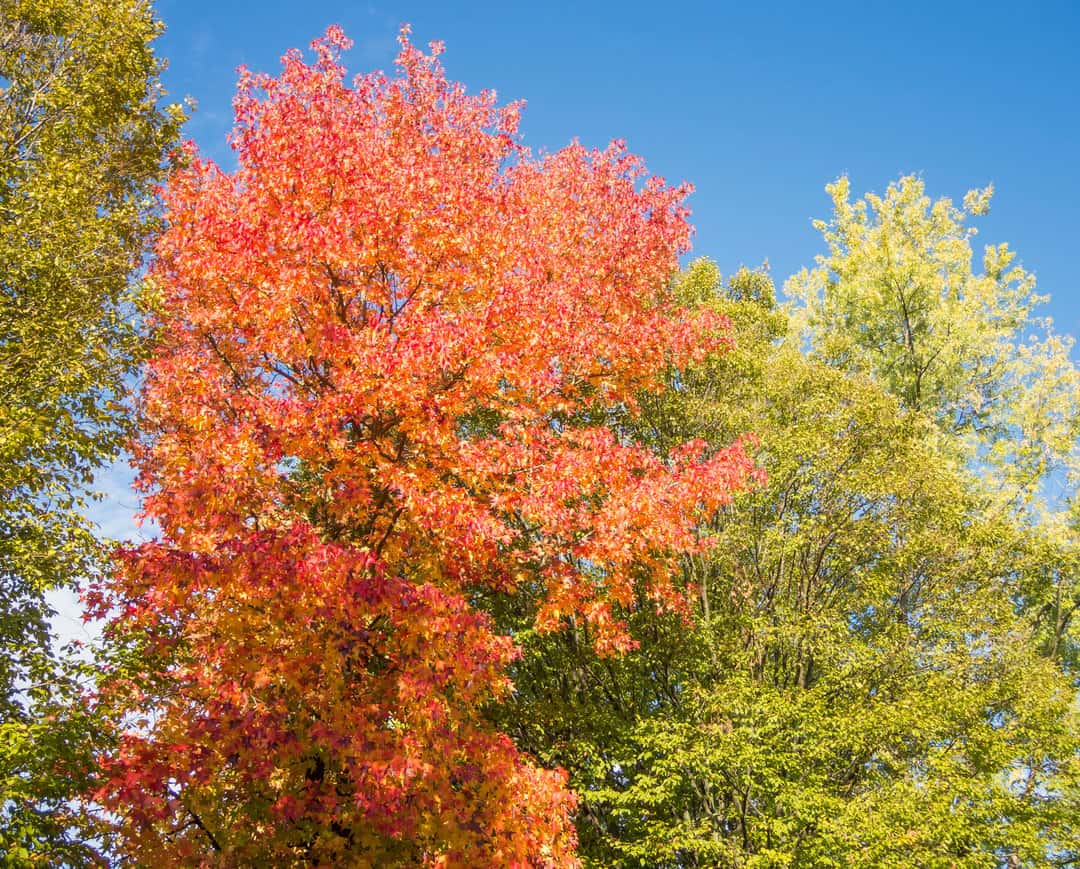
You’ve heard of chewing gum, but did you know that it once came from a tree? Not only that, but gum trees are quite a wide variety that contribute to many household products.

In truth, one of the most common products that come from gum trees is scent-based. Eucalyptus, a type of gum tree, is used to create air fresheners, essential oils, hygiene products, and more. Additionally, eucalyptus trees have many commercial for their wood and are used to create paper.

Below, you will learn about more of the incredible products that have a base in gum tree material, as well as how and why these products are used. So, what are you waiting for? Let’s get to it!

What Is A Gum Tree?

A gum tree is a name that refers to many types of trees in the myrtle family, from eucalyptus (the most well-known) to angophora and corymbia.

The American Sweetgum, to provide one example of the many versions of gum trees, was first mentioned in the diary of a Spanish conquistador, according to Yale University’s Yale Nature Walk

Additionally, the American Sweetgum’s scientific name is Liquidambar styraciflua which means “liquid amber.”

Almost all gum trees are native to Australia unless otherwise noted. In some locations around the world, these trees are considered an invasive species. 

Gum trees produce oils and sap that are very commonly used, along with the wood itself. 

Many times upon looking up gum trees, people come to the conclusion that this name is synonymous with the popular eucalyptus tree. As that is known to be an Australian species and favored by koala bears, this is not completely off-base. 

However, is a gum tree really the exact same thing as a eucalyptus tree?

Let’s talk about it.

Is A Gum Tree The Same As A Eucalyptus Tree?

American sweetgum tree.

A eucalyptus tree is a type of gum tree, but not all gum trees are eucalyptus. 

If that’s confusing, just think of the way that all squares are rectangles, but not all rectangles can be squares because there are more specific criteria that must be met in that case.

Essentially, ‘gum tree’ is the common name for a whole group of trees. The eucalyptus tree just so happens to be one of the species that fall into that category.

When we talk about the uses of a gum tree, many byproducts end up referring specifically to a eucalyptus tree and its relatives, thanks to the oils and sap produced by varieties like those.

What Is A Gum Tree Used For?

Gum trees are used to create a wide range of products, not limited to just that which stems from their sap.

While hardwood and other wood-based products come from a gum tree, the most common uses of this tree do happen to fall into the category of things that can be tasted or smelled. 

Here are what gum trees are mainly used for:

  • Chewing Gum. This popular sweet treat is among the least surprising byproducts of gum trees, since…well, the name includes the word gum. Created using the sap of a gum tree. Gum trees are actually not commonly used in commercial gum!
  • Air Fresheners. Another household product for many, air fresheners that smell like eucalyptus, typically include oils that come from the tree itself and add a relaxing, natural scent to an indoor space. Not only does this add some relaxation to a place, but it also smells great and can help increase the mental clarity of those near it.
  • Essential Oils. As with most other natural products, essential oils can be produced by gum trees. Uses range from relaxation to mental clarity, energy, and more. These oils have a plethora of benefits that can be felt by those who use them.
  • Medicinal Teas. While eucalyptus essential oils should not be ingested, the medicinal herbal teas that come from these trees are safe to drink. Benefits range from cold and flu remedies to aiding those with asthma to contain its effects.
  • Dental Products. Myriad dental products include eucalyptus in some way, shape, or form. Not only does this add to the flavor and scent of the products, but adds natural bacteria-fighting properties that help prevent gum disease and bad breath.
  • Wood Products. Like other trees, gum trees are also often harvested for the wood that they yield among all of the other parts of the tree that create more unique products.
  • Paper Products. Due to it’s fiber and durability, eucalyptus gum trees are quite commonly used for paper production!

Gum Trees Can Be Used For Chewing Gum

American sweetgum tree.
American sweet gum tree.

Chewing gum is perhaps the least surprising product to come from gum trees, thanks to the name and association.

While many companies now opt for synthetic material in place of turning gum tree sap into this popular product, the origin of chewing gum is not forgotten.

In fact, The University of Houston details the history of chewing gum by noting that our modern-day chewing gum originated in Mexico as ‘tstile,’ now known as chicle.

Chicle is the word for natural gum from trees that our chewing gum is made out of. It is also one of the words used in Spanish when talking about gum- chewing or otherwise. 

Air Fresheners Are Made From Gum Trees

Eucalyptus tends to be a popular scent for people to have in their homes.

Products like this Scent Fill 100% Natural Eucalyptus Plug-In Air Freshener are great examples of gum trees turning into products that we either 1. Use or are 2. Familiar with.

The great thing about products like this is that they can be completely natural. For example, the Scent Fill air freshener is made with eucalyptus essential oil, among other naturally-sourced ingredients. 

There’s nothing like a home that smells nice and being reassured that the products you use do not have unknown substances. 

Eucalyptus Essential Oils Are Made From Gum Trees

Row of eucalyptus trees.

Essential oils have seemed to be all the rage in the last decade, but aromatherapy has been around for millennia.

Penn State University details how, in ancient times, aromatherapy had roots in spiritual practices, which morphed over time into the understanding of herbalism as more of a medicinal, health-centric concept.

Products like this Ethereal Nature 100% Pure Oil utilizes the properties of eucalyptus in a way that can be used as a skin or hair care product, as well as something that can be safely diffused into the air. Don’t ingest eucalyptus oil.

Additional uses for this product range from massage oil to a supplement to baths. This oil is used to relieve tension and promote relaxation while simultaneously boosting energy and mental clarity. All around, this is a great way to practice simple aromatherapy at home. 

Another topical use has to do with blemishes on the skin. Eucalyptus oil can be mixed with water (about 3 or 4 times as much as the amount of oil you use) to place on any spots. 

Medicinal Teas From Gum Trees (Eucalyptus)

While eucalyptus essential oil should never be ingested, there are eucalyptus products that can be, when made by those who know how to properly and safely do so.

This Hanan Eucalyptus Tea, for example, is completely safe, healthy, and rather beneficial to drink. 

Not only is this herbal tea relaxing, but it can also help with respiratory comfort when it comes to helping contain the effects of asthma or other respiratory issues.

The same way that eucalyptus is used in medicinal teas, it can also be added to cough drops, decongestants, and other cold remedies. 

Tea like this helps to target bronchial symptoms of asthma or viral infections (such as colds and cases of flu.)

The benefits of using this kind of tea have been used in Peru for ages, as well as many other countries. 

Eucalyptus (Gum Tree) Dental Products

Eucalyptus tree leaves.

Toothpaste and mouthwashes, especially products focusing on natural bases, tend to include eucalyptus oil due to the natural bacteria-fighting properties of the oil.

Not only can eucalyptus oil help to create better-smelling breath in the short term, but it also works with you in a long-term capacity as it fights bacteria that cause bad breath in the first place.

Gum Trees (Eucalyptus) Are Made Into Wood Products

Gum trees, like many others, have wood that is used in cabinetry, furniture, doors, paneling, plywood, palettes, and more. 

The grain of this wood tends to be very consistent, so it is great for aesthetically-focused pieces where you want the grain to be real but also to look good! It’s functional too, though, in that it repels moisture well and is a very sturdy type of wood that can be trusted in projects.

Benefits Of Eucalyptus Wood

You can use any (or even all) of these wood products for renovating a space, redecorating, and more similar projects that require you to build something.

Some benefits of eucalyptus wood are that this type of wood tends to be resistant to rot and decay, and the wood is a beautiful color that darkens over time. So, you could say that this kind of wood ages very well!

Another benefit is that this is a very sustainable type of wood, especially when there are myriad other uses for every part of this tree, and not just the wood. 

When people think of cutting down trees, it is often the wood that gets the majority of users. In this case, it is actually the opposite.

All of the eucalyptus products (and those from other types of gum trees) that we hear about so often, including in this piece, ensure that these trees are completely appreciated and utilized.

Paper Is Made From Gum Trees (Eucalyptus)

A close up shot of Eucalyptus bark.
A close up shot of eucalyptus tree bark.

Yup, it’s true! Eucalyptus, a species of gum tree, is one of the most commonly used trees for paper production. Simply put, the quality of the wood in combination with its hardness and fiber makes it ideal for paper production.

In general, eucalyptus gum trees are native to South America, Australia, and the Philippines.

Wrapping It Up!

Gum trees can clearly be used to produce a range of goods, from edible products to furniture, hygiene products, and so much more. 

This versatile range of trees may see most of their popular byproducts yielded by the eucalyptus tree, but species such as the America Sugargum should not be overlooked. Each tree has something different to offer!

When we talk about gum trees, now you’ll know about their many benefits and uses. A truly incredible tree that can be utilized in so many ways deserves to be well-known. 

We hope that this piece helped to pique your interest in learning more about these wonderful organisms. 

That’s all we have for now, but we’re hoping to share more about gum trees with you soon. 

As always, thanks for reading and continuing to grow on your own tree journey!

References

Coppen, J. J. (Ed.). (2002). Eucalyptus: the genus eucalyptus. CrC Press.

Doughty, R. W. (2000). The eucalyptus: a natural and commercial history of the gum tree. Johns Hopkins University Press.

Farhadi, D., Karimi, A., Sadeghi, G., Sheikhahmadi, A., Habibian, M., Raei, A., & Sobhani, K. (2017). Effects of using eucalyptus (Eucalyptusglobulus L.) leaf powder and its essential oil on growth performance and immune response of broiler chickens. Iranian journal of veterinary research18(1), 60–62.

That extra green, drapey stuff hanging all over your oak trees, well, that’s moss. Although, based on personal preference, by something you like the look of or don’t, moss on your oak tree indeed doesn’t mean too much and usually doesn’t do much harm to your tree. 

Moss is a nonvascular flowering plant, an epiphyte that grows on oak trees. In most cases, moss does not need to be removed from a healthy oak tree. Unless moss is abundant on your oak tree, moss is rarely the cause of significant oak tree damage and can be monitored and left alone.

Moss is commonly seen on oak trees, especially mature ones, and moss will use the oak tree as its host for as long as possible. However, you may be wondering – how did moss get on my oak tree in the first place? Keep on reading to learn a bit about moss and what it means for your oak trees. 

Tree Moss: What is It?

Moss is part of the Bromeliad family of plants, and believe it or not – the Bromeliad family consists of moss, pineapples, and succulents! What an interesting mix, right? 

Moss, pineapples, and succulents are epiphytes – meaning, they are plants that are not parasitic and will grow on other host plants without taking nutrients from them. 

Moss is a nonvascular plant, which means it doesn’t have any vessels or roots. Because of its nonvascular makeup – moss isn’t able to collect nutrients from its nearby plants, and instead, moss collects water and nutrients from the air! 

Instead of roots, moss has rhizoids, which are small hair-like structures, which keep the moss in place. The best way to describe it would be like small, little suction cups clinging to their surroundings. 

Dating back to 450 million years ago, there are so many different variations of moss, and moss can be seen in almost all and every climate – all moss needs to survive is moisture. 

How Does Moss Grow on Oak Trees?

bark covered with moss on the trunk of a tree close up

Moss grows because the environment is perfect – that’s really all it takes to grow moss. 

Moss is self-disciplined and doesn’t need help from other plants or us for it to grow successfully. However, the one thing it does need is moisture, and that comes from the air! 

Growing rapidly, moss will grow on almost any surface – plants, pavements, buildings – wherever the conditions see fit, moss will suddenly appear. 

And it’s true – it’s almost as if they suddenly appear. Like fungi, moss grows from spores – however, moss is not fungi at all. When dust particles mix with moisture and nutrients in the air – moss suddenly begins to form. 

Moss can grow to prosperous ranks within 6 weeks! This fast-growing plant can take over gardens, lawns, trees, and other landscaping, and although some people love the look of it – others cannot stand it! 

But have no fear – moss almost never causes harm directly to your oak tree. And if you feel your oak tree is being harmed, there is a good chance that it has an underlying issue going on. 

But you may be wondering – why are oak trees susceptible to moss in the first place? Well, we’re going to tell you right now!

If you’re interested in planting an oak tree and worried about moss growing on it, you should read our guide on planting an oak tree in your backyard here.

Moss Needs Dark and Humid Conditions to Grow on Oak Trees

Have you ever noticed when walking through a forest that there is a lot of moss? Well, the reason why moss is typically seen in forests is because of how much shade is in forests from all the tree’s canopies!

Moss needs shade and moisture to grow – making a forest an ideal climate. 

Even without rain, a forest has so much moisture because of all the trees that are around, and because of that, the air itself has more moisture in it, and then the mix of the two creates the perfect foundation for moss to form! 

Because of how fond it is with shade and moisture, there are certain trees that are perfection in moss’ eyes – one being the oak tree!

Moss Prefers Oak Trees 

Do oak trees love moss, or do moss love oak trees? The question of the year, right here. But the fact is – moss loves oak trees. Oak trees provide the perfect home for moss to grow, and the reason has to directly do with the makeup of the tree itself. 

Oak trees are wide and tall and provide an abundance of shade because of their wide canopies. They have a plethora of branches to provide areas for moss to grow.

In truth, many oak variations, especially white oak trees, have deep ridges in their barks that hold moisture and are typically damp and provides a dark area for moss to breed. 

If you’re interested in the difference between white and red oak trees, you can read more about their major differences here.

All around, oak trees provide the perfect conditions for moss because moss needs a dark, humid space to grow. Once those conditions are met, moss grows out of control and will hold on to its host for as long as it can – and it will mingle with its host to stay afloat.

Moss Needs Branches if it’s Growing on Oak Trees

You wouldn’t think that moss needs branches to survive, but indirectly, it does if it’s growing on a tree. 

Because moss is nonvascular – it doesn’t have any roots and doesn’t adhere to anything on its own; therefore, it needs other ways to support itself and to keep it in place, and that’s where branches come in handy. 

When moss starts to grow on trees, it naturally will spread upwards and out and will start to hang over branches and limbs – this is what keeps it in place and growing. 

Without branches, moss would merely be hanging on to the small ridges that come from the bark, and that would not be enough for moss to support itself.

But are all moss the same? When thinking of hanging on branches, the go-to moss image that comes to mind is – really hangy moss – but there are a few types of moss that hang out on oak trees.

Types of Moss that Grow on Oak Trees

There are three common types of moss that grow on oaks trees – Spanish moss, mall moss, and common haircap moss. All the moss are generally similar in nature but vary in appearance. 

Spanish Moss

A huge old oak tree draped with Spanish moss.

Native to Mexico, Spanish moss is seen in the more Southern parts of the United States and in tropical environments. With its chandelierlike stature, Spanish Moss resembles light pendants hanging from a ceiling, providing trees with a very fairy-like ethereal appearance.

Wherever Spanish Moss grows, you typically see a lot of it throughout the location. Spanish moss is usually in the lower canopies of trees, and because of its non-parasitic nature, causes no harm to a tree. 

However, it is important to understand that moss also can grow in sunlight, and if you happen to see a lot of moss on your oak tree – the canopy may be thinning and letting the sun in, and if so, the more humidity arises, and the more likely moss will grow. 

We write a little bit more on Spanish moss on your trees in our piece on tree moss in Florida here.

Ball Moss

Tillandsia recurvata (ball moss) aerial Plant in Baja California Sur Mexico.

Much like Spanish moss, ball moss grows on trees; however, it’s truly shaped in a ball-like cluster shape. 

Ball moss has pseudo-roots; it appears to be gripping onto something. However, since Ball moss intertwines and encircles whatever it is on, the reason it sticks to oak trees is because of its wrapping nature, and it doesn’t have roots at all.

However, unlike Spanish moss – ball moss can cause a bit more problems for your oak tree. Because of how tightly wound ball moss can get, it can stop a tree from developing buds, especially if it’s wrapped around branches, which over time will stop the oak tree growth, and the tree will get damaged. 

Common Haircap Moss

Polytrichastrum formosum commonly called haircap moss or hair moss.

Common haircap moss is seen throughout heavily humid areas, with a lot of rainfall – and is the most common type of moss throughout the United States of America. 

Common haircap moss is one of the tallest growing moss and can grow as tall as 30 cm. Haircap moss has piney stems, and leaves can range from 6-12 mm. Common haircap can be seen on your oak trees, especially in Ohio and Illinois. 

Overall, common haircap moss looks like a little like a small, green fireworks display stemming up from its roots… wild!

Should You Remove Moss From Your Oak Tree?

The question that still remains is – if moss is on your oak tree, should you remove it? Well, it depends on a few things. 

If moss is on your oak tree and your tree looks to be in healthy condition, moss does not need to be removed. If moss is on your oak tree, and your tree is declining in health, it may be due to moss damage, but in most cases is due to a different oak tree affliction.

If you’re wondering if your tree damage is moss-related, you can read our piece on the most common oak tree afflictions here.

In fact, if it is moss-related, it most likely has to do with a scenario that is often seen with ball moss – that it is so intertwined on the branches of the tree that it may be stopping the tree’s buds from growing. 

Another reason as to whether you should remove moss or not is merely based on personal preference – it’s just what you like! 

Moss draping from branches like Spanish moss is said to provide a very regal and, yet, historical look to your oak tree. But to some, it can look like a webby mess or dirty! It’s truly a matter of preference. 

However, if you do choose to remove it, there are certain ways to remove moss! 

How to Remove Moss from an Oak Tree 

Removing moss from an oak tree can be relatively easy if you have the right tools and catch it quick enough – however, it is way easier when moss is just appearing on your trees than when it’s been there for 6 weeks or more. 

Remember, it takes moss 6 weeks for moss to truly prosper – and once it starts, it’s never going back! When moss is lively and green, it’s living its best life – however, this can be the hardest time to remove it, especially if been there for more than that 6-week period. 

On the contrary, if moss is ashy and white, it may be one of the easiest times to remove moss – but either way, there are some steps to take to remove it! 

However, it is always best to check in with a professional before you start removing moss on your own. 

Option 1: Use a Soft Brush to Remove Moss 

Using a soft brush, scrub brush, or broom with soft bristles – is a great place to start the moss-removal experience. By taking the brush and scrubbing the moss, adding extra pressure to bigger clumps of moss and less pressure to smaller, thinner clumps, you may be able to loosen up the moss or fully remove some of its pieces. 

A great brush to try out, especially if there are a lot of crevices where the moss is lying, is Moss Removal Deck Crevice Tool, specifically made for decks; this can be a good brush to add to your toolbox for hard to reach moss removal. 

If using a soft brush isn’t doing the full job, the next step to take would be to pick at it with your hands! 

Option 2: Use Your Hands to Remove Moss

Taking full precaution, as moss can have bugs in it and it can be prickly, wearing elbow-length, thornproof gloves, use your hands to move the moss around and to lightly tug at it. Do not grab the moss tightly, as you can hurt yourself. 

If you are in need of some thorn-proof gloves that are perfect for all types of gardening, you may want to check out Acdyion Gardening Gloves for Women/Men!

If you don’t want to touch moss, grab a nearby stick or twig, or use a tool like a rake, and see if you can get underneath the moss a little bit and loosen it from the tree. 

If you feel this step is appropriate action to take, but you are unsure how, please check in with a professional before doing so. 

Option 3: Use a Pole Saw or Pruning Tool For Hard-to-Reach Moss 

One last way that can help with the moss removal and can be done as the last step when the moss is dead is to use a pole saw or pruning tool to actually cut any remaining moss that is hanging high on the branches. 

Since moss, like Spanish moss, drapes over branches, sometimes for it to let go, it needs to be cut away because with its wrapping nature – moss can be tightly wound and impossible to loosen up! 

However, do not stand directly underneath falling moss – as it contains bugs and can be prickly and irritate you. 

If you want to try this method, check out this easy-to-use pole saw Greenworks 40V 8-Inch Cordless Pole Saw, it’s cordless, so it’s perfect for those hard-to-reach places!

Where Else Does Moss Grow?

Moss will grow on almost any hard surface. The most common spots are barks, pavements, on rocks, on the ground, on lawns, and even on houses, roofs, and other man-made structures. 

Polytrichum formosum (Common haircap moss)

Moss doesn’t discriminate when it comes to its choice of the host location; however, all that matters is that for moss to grow, the environment needs to be right. 

You will find moss in any location where moisture is abundant. Have you ever noticed the plants around a small creek or river? When there is water present, and especially in forests where shade is everywhere, moss will grow alongside the creeks and water supply and create a truly ethereal landscape.

The greener the moss, the more alive it is, and the more it will flourish. And in our opinion, that blanket-like appearance of the plant, especially when growing on rocks and close-to-the-ground plants, is something out of a fairytale – it’s an unbelievable, breath-taking sight to see. 

That’s a Wrap!

Moss can either be something out of a fairytale – or a big mess on your oak trees! Completely up to personal preference, moss can be an asset or a disadvantage to your oak trees and landscape. 

When dealing with moss, more times than not, it is harmless; however, if it’s not to your liking, you have every right to remove it from your trees and property!

However, always take precautions when you start to remove moss and check in with a professional before doing so.

If you’re interested in learning more about planting oak trees, check out our guide on the best oak trees to plant here!

References

Birge, W. I. (1911). The Anatomy and Some Biological Aspects of the” Ball Moss,”: Tillandsia recurvata L (No. 20). University of Texas.

Drda, G. S., & Wyatt, R. (1990). Genetic variation in the common hair-cap moss, Polytrichum commune. Systematic Botany, 592-605.

Garth, R. E. (1964). The ecology of Spanish moss (Tillandsia usneoides): its growth and distribution. Ecology45(3), 470-481.

For birch trees, naturally peeling bark is part of its growth cycle. As the tree grows and the trunk increases in width, the older bark pushes out from the more central parts of the tree, dries, and falls off.

Birch bark can be tempting to peel because it is beautiful. If you peel birch bark too early, you risk damaging the tree. You can safely peel off birch tree bark if the bark comes off with little resistance and is less than 1/4th inches thick. This is bark that the birch tree is already shedding.

Read on to learn the reasons birch bark can fall off naturally and why you should not peel it off yourself. We will also discuss what to look for to distinguish between natural bark peeling and an underlying issue affecting the tree’s health.

Why Do People Peel Off Tree Bark?

There are a few reasons people purposely peel away tree bark. Sometimes they use bark to make things, other times it is for the care or removal of the tree.

People have peeled bark to create things like baskets, boats, and parts of shelters in the past. Peeled birch bark, as well as the substance that holds the layers together, have also been used to make medicine.

A tree may also get damaged and need to be removed. People might peel away the bark on a tree they intend to get rid of. Peeling away the tree’s bark will cause the tree to die and dry out faster over a season, making the tree much lighter and easier to remove.

Why Does Birch Tree Bark Peel?

There are several reasons bark can peel from a tree. Bark may peel simply because the tree is shedding a layer of protection it no longer needs.

In other cases, bark may peel from many underlying conditions. Peeling bark can signal that a tree is suffering from some type of illness or disease. It may also be a sign of insect infestation that is damaging the tree and causing the bark to peel away.

Some tree bark peels because the moisture conditions or drainage are off for a tree. In any circumstance where you notice the bark of a tree peeling, you will want to investigate these potential causes.

Interesting to note that birch peel bark doesn’t just peel like typical tree bark but in-fact, according to the University of Vermont’s Department of Plant and Soil Science, birch tree bark actually peels in sheets.

Fungi Can Cause Birch Tree Bark To Peel

Bug infestation, frost, and water damage are not the only enemies of your birch tree’s health. There is one more we have yet to touch on.

Fungi can cause bark to peel before it should. Hypoxylon canker is one of the common fungi capable of causing bark peeling. Unfortunately, it is not a treatable disease.

If you are not sure whether your tree is naturally peeling or if it is being affected by an underlying cause, contact a professional arborist. They can inspect your tree and give you a more definitive answer.

Popular Uses For Birch Bark

Ancient ancient birch baskets. Products from birch bark

Though there are safe ways to collect birch bark, if you are looking for crafting materials, this Natural Birch Bark is a great find! It comes in three sizes for all of your craft making needs and is just as beautiful as what you can collect yourself, with less of the hassle.

Birch bark has had many uses throughout history. Traditionally, people have used it to construct useful items like baskets, shelters, boats, and weapons. It was used as paper before the invention of modern-day paper as well.

Items like canoes, dishes, cookware, and even art were made from birch bark by Native American tribes near the Great Lakes. Canoes made from birch bark are lightweight and naturally water-resistant, making them perfect for early construction.

The powdery substance in between the layers of birch bark has been used as a natural painkiller as well. People have used many parts of the birch tree for medicinal uses throughout the years. Always consult a doctor before treating yourself in any way.

A quick note, if you’re interested, check out the reasons why birch trees can’t grow in shade here.

Why You Should Not Peel Bark Off Of A Birch Tree

There are multiple reasons you should not peel the bark off of a birch tree. Several things can damage a birch tree if you peel away the bark.

If the bark on a tree is very loose, this is a signal that the tree no longer needs that piece of wood. This process is akin to a shedding of skin that is no longer needed as a protective layer.

However, if the bark is still attached, this can harm the tree in multiple ways.

Peeling Bark Can Harm The Inner Bark

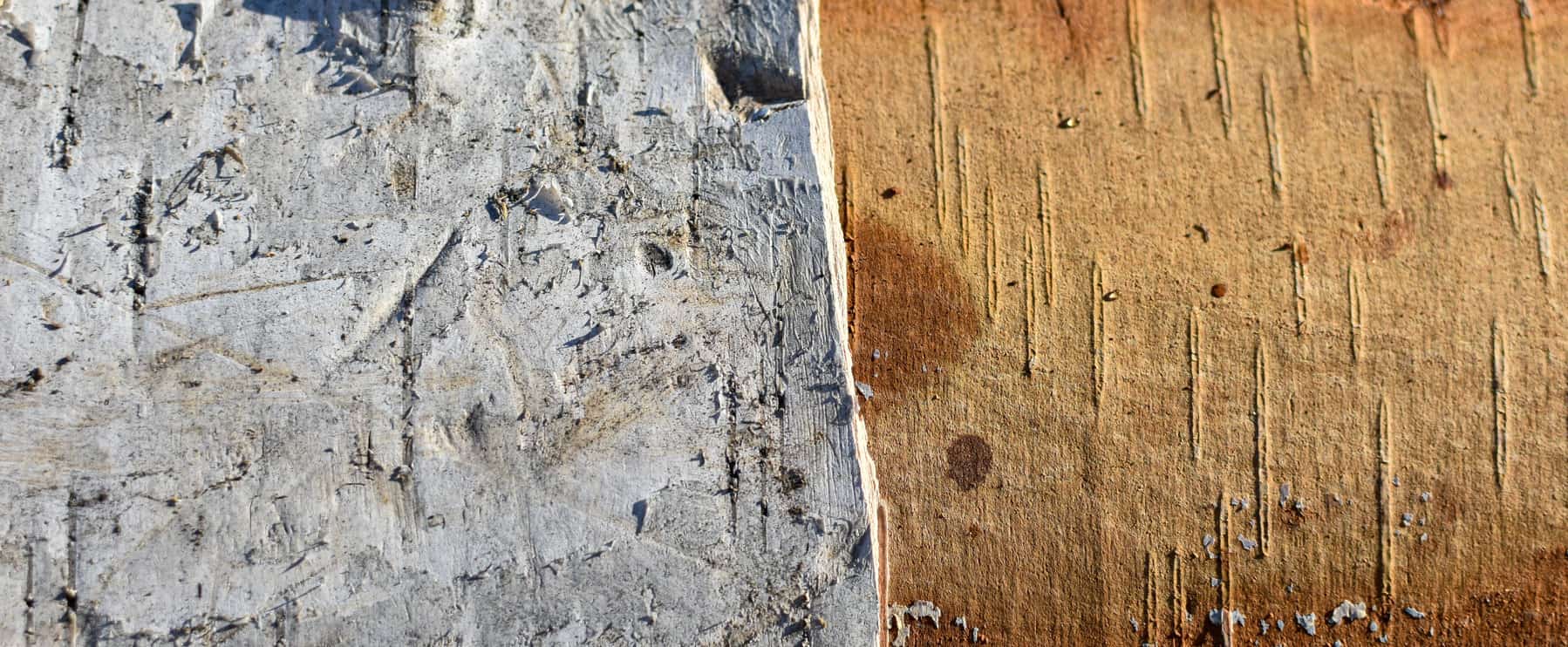
Texture of birch trunk, divided into two parts - with bark and without bark. Damage to trees. Firewood for stove. Close-up is part of tree with top layer of bark torn off, in sunlight. space for text

If a birch tree begins to peel in a natural shedding as a result of the tree growing, the old bark will usually fall off of the tree in its own time. It is not recommended to peel away tree bark. 

If you peel bark that is not yet ready, you might pull off more than the tree is ready to shed. Over peeling birch tree bark can harm the tree.

When tree bark is over peeled past the layers it is naturally shedding, the underlayers of the tree may not be fully ready to be exposed. Areas of a tree with prematurely peeled bark are vulnerable to weather, unfavorable moisture conditions, or bug infestations.

Birch Trees Can Get Sick From Exposed Bark

Birch trees can suffer from many illnesses. When bark is peeling unnaturally, this could be a sign that a tree is already suffering from an attack of boring bugs. It could also result from any other number of unfavorable conditions caused by weather or where the tree is growing. 

Peeling the bark of a birch tree leaves it more susceptible to disease. Without their natural defenses, trees will struggle to thrive.

In an article from Iowa State University, the authors note that peeling bark is typical of certain trees, including birch trees, and is a natural sign of tree growth. As the tree grows, it pushes the older bark from the center of the tree. The outer bark then dries and sheds.

Removing Bark From A Birch Tree Can Leave It Vulnerable

Tree bark acts like our skin acts for us. It is the first line of defense and protection for your tree. Any signs of distress can signal a deeper issue with the tree underneath.

A birch tree that has had its tree bark removed can be vulnerable to frost. It can also be susceptible to excess moisture that can become trapped under loosened bark layers and cause fungal issues.

Any area where the bark has been prematurely peeled is an area left open to potential damage.

Exposed Inner Bark Can Stop The Flow Of Nutrients 

If you peel bark from a birch tree, the tree may also suffer from a lack of nutrients.

A tree gets its nutrients in different ways, and one of the most important for the birch tree lies underneath the outer bark of the tree. There is a nutrient transport system under the outer layer of bark that helps nutrients travel where they need to go.

If you peel away birch tree bark, you can damage this nutrient transport system, called the phloem, and the tree can die. If the bark is removed in a ring around the entire tree, and this layer is damaged, it spells disaster for your tree. The tree roots will die and the tree will need to be removed.

Now if you actually need to remove tree roots, you can get rid of tree roots using vinegar.

Peeling Bark Can Leave A Birch Tree Open To Frost Damage

During the winter, trees can suffer from a few different types of damage. Some of this damage is referred to as load damage. This type of damage usually affects the branches or the trunk of the tree.

Heavy snowfalls and ice that remain for long periods of time on tree branches can cause significant damage. If this occurs, otherwise healthy branches may snap under the weight of heavy frosts, ice, and snow.

In other cases, the bark itself can be damaged by freezing temperatures. Sometimes, tree bark itself can suffer from freeze damage. This happens when bark that is already slightly peeling freezes and cracks.

These freeze cracks can happen as a result of sunscald as well. The outer layer of your tree loses some of its cold hardiness when temperatures warm up, which is referred to as sunscald. If the temperature drops again quickly, like from day to night, frost cracks can form.

The south-facing side of your tree is the most prone to damage. When this happens, the area underneath the tree bark can become susceptible to further frost damage.

Peeling Birch Tree Bark And Bug Infestations

The wood borer on a birch trunk

Keeping your trees free of bug infestation is most definitely important. Peeling the bark off of your birch tree will make this more difficult. Look out for signs of infestation before it is too late!

In an article from Oregon State University, the author discusses the damage caused by a pest called the bronzed birch borer. These pests had a pattern of infestations in birch trees around the Oregon area. 

It’s noted that tree damage from these types of insects, who specifically target birch trees, can be hard to spot until there is already significant damage done. They also write that it is important to consider how much of a tree has been damaged before attempting to treat it. 

If over 40% – 50% of a tree has suffered damage, it probably does not make sense to try to save it. At this point, tree removal is the best option.

When Is A Good Time To Peel Tree Bark?

In the article, Harvesting And Use Of Birch Bark by the Michigan Agency Forestry, the author notes that if you remove birch bark correctly, it does not harm the tree.

When attempting to remove birch tree bark, one should look for already loosened bark that comes off with very little resistance and is less than 1/4 inches thick.

They also note that birch bark can be harvested from pieces that have already fallen off of the trees. In fact, this is the preferred way to collect birch bark.

If you are ever building with logs, this is when it is important to peel away outer bark. If you leave loose bark on a tree log, it becomes a boat for moisture, rot, bugs, and other problems of deterioration. 

Wrapping Up

As birch trees grow, their bark will dry, peel, and fall off the tree on its own. Peeling birch bark is a natural occurrence for this type of tree. If you have a birch tree and you notice it is peeling, check the tree for any signs of damage. 

Look for frost damage, pest damage, or fungal damage when checking your tree’s health. If you do not see any other signs of damage, you probably have a healthy birch tree that is just going through its natural cycle of shedding old bark. 

In either case, avoid peeling the bark from your birch trees to avoid causing damage to the tree. If you are unsure whether your birch tree is healthy, contact a professional who can come out and check the health of your tree just to be on the safe side.

References

Katovich, Steven, et al. “How to grow and maintain a healthy birch tree.” NA-FR-02-97.[Radnor, PA]: US Dept. of Agriculture, Forest Service, Northern Area State & Private Forestry 297 (1997).

Lines, Roger. “Man’s use of birch—past and present.” Proceedings of the Royal Society of Edinburgh, Section B: Biological Sciences 85.1-2 (1984): 203-213.

Shorohova, Ekaterina, et al. `Tree species traits are the predominant control on the decomposition rate of tree log bark in a mesic old-growth boreal forest.” Forest Ecology and Management

Fletcher, Lucie, et al. “The use of birch bark.” Star Carr 2 (2018): 419e435.

There are a lot of things to love about oak trees. They are tall, beautiful, and very hardy. They can even house hundreds of different species of birds, insects, and other critters. Unfortunately, oak trees can also house many harmful or destructive varieties of fungi. 

To prevent fungus from affecting your oak tree, apply mulch, prune your oak during the dormant season, and avoid any injury to the tree that exposes the inner layers. For active oak tree fungus, prune affected branches and apply fungicide.

Reading on further will give you the information to identify, treat, and prevent some of the most common fungi you may see on your oak tree. Some oak tree species are resistant to certain fungus, while others are very vulnerable.  

What Does Oak Tree Fungus Look Like? 

There are three different ways you can tell if there is a fungus on your tree. The most obvious is seeing mushrooms growing out of the tree or around its base. Fungi may also look like a dusting over the bark

Other signs of fungus invading your tree are unusual growth, discoloration, and wilting of the leaves. The bark may have cankers, scabs, or discoloration as well. 

If you notice any of these things, your best bet is to call in a professional. A professional arborist will be able to diagnose and treat the tree properly without all the guessing work on your part. 

Fungi is not the only issue your tree may encounter. To educate yourself on the most likely culprits, check out our article: What’s Wrong With My Oak Tree?

How Did My Oak Tree Get Fungus On It? 

Your oak tree has fungus on it for a variety of reasons. For starters, fungi is EVERYWHERE. There will always be fungus near your tree. It is a part of the ecosystem.  

Fungal spores travel to your tree by wind, rain, improperly cleaned tools, and animal and human movement. Fungus can attach to the bottom of your shoes and travel all over your yard and oak trees as you walk around. The possibilities for spreading fungi are endless.  

So instead of wondering how to prevent fungus from coming near your oak tree, since that is impossible, your best bet is to keep the oak tree’s “immune system” as healthy as possible.

Next up is a list of some of the most common types of fungus and what to do about it if your oak tree has it. 

Types Of Oak Tree Fungus And How To Prevent And Remove Them

There are a variety of fungi that affect oak trees that mimic each other. This means it is very important to identify which type it is before treating it because there are different treatments for different fungus.

I’ve written some information for you below about the species, identification, ways to cure oak fungus (when possible), and ways to prevent fungus from coming back. You will be more prepared once you are done reading! 

Oak Anthracnose  

Oak anthracnose, or apiognomonia errabunda, is known as a type of leaf spot or leaf blight disease. They love the cool and wet weather of spring.

The effects of the fungus look awful, but luckily the damage never fully eliminates the tree. However, repeated attacks by this fungus will leave your tree vulnerable to other problems. 

The fungus begins on the leaves and is dormant during the winter months. Once it warms up a little, the spores release and travel to other leaves.

The fungus will then produce more spores and spread to other leaves until the weather heats up and becomes dry. This will usually slow down or stop the fungus.

Light rain will also increase the spread of the fungus by carrying spores through the droplets that splash up when they hit the ground.  

According to the University of Minnesota, you can tell if your oak tree has this fungus through the leaves. The leaf veins will become brown or black and look like they have been scorched. 

You will see the leaves of the lower branches of the tree become discolored first. Then it will spread upwards. Young leaves may be distorted or fall off depending on the severity of the anthracnose.

Anthracnose spreading among oak trees is just one of the ways oak trees can cause damage.

How Do I Fix Anthracnose On My Oak Tree?

To stop the fungus from spreading to other parts of the tree, you should properly prune off the affected branches or twigs. Fungicide is not necessary unless it is a long-term probelm. It will do nothing once the leaves have become discolored. 

You can prevent oak anthracnose from coming back next year by raking up all the leaves from your yard. The fungus will live and produce spores on the fallen leaves if they are still there come spring. 

Artist’s Conk 

Ganoderma applanatum on the roots.

Ganoderma applanatum or artist’s conk is a decaying fungus affecting any size oak that rots the heartwood of the tree. The heartwood is the most inner part of the tree trunk. As it decays the lowest part of the trunk, the tree becomes a hazard for falling over or being uprooted. 

You will know your tree has this fungus if the leaves are yellow, wilted, or smaller than usual. You will also see the mushroom, or conk, grow around tree limbs, the base of the tree, and any exposed roots. The conks grow in shelves that are brown with white or gray edges. 

Unfortunately, if you see these mushrooms or cankers appear on your tree, then the death of the tree is coming in 3-5 years. There is no way to cure artist’s conk. The best thing to do is to remove the tree, its roots, and the soil from the area.  

How Do I Prevent Artist’s Conk On My Oak Tree? 

You can prevent artist’s conk or Ganoderma root rot from making your oak tree its home in three ways:

  • Maintain the amount of water your tree gets
  • Line the tree with mulch
  • Use soil care products to improve the health of the tree will all help protect your tree

Avoid injuring the oak tree as the wound will leave it vulnerable to the fungus. 

Armillaria Root Rot  

Group of yellow armillaria on forest ground

Armillaria root rot is also known as shoestring root rot, mushroom root rot, or toadstool. Armillaria mellea loves wet summers and moist soil and grows quickly when plants are over-watered. 

It is parasitic to other plants as well, including lilac and daffodils. It spreads and damages oak trees by the roots. The fungus reaches across to affect neighboring roots. Once it touches the root, it decays the wood and destroys the oak bark by dissolving it. 

The first sign of armillaria root rot is when the shoots are stunted, oak leaves become discolored, and an unusual number of leaves fall. Honey-colored mushrooms pop up around the base of the tree during late summer and fall. 

If the tree’s root system has been taken over by armillaria fungus, then you should remove the oak tree and its stump immediately, or else you will spread it to other plants. 

How Do I Prevent Armillaria Root Rot On My Oak Tree? 

To prevent this from taking over your oak trees and landscape, you should first make sure you are not over-watering them. Check your oak trees often for signs of ailments. 

Do not plant one of the host plants in your yard either. You create a breeding ground for the fungus to grow and spread that way. 

Fungi will grow easier on stressed-out trees. Reduce oak tree stress by mulching around the tree (only 2-3 inches high), taking care not to wound the tree with lawn tools, avoiding over-watering, and pruning in the dormant season. This is the best way to keep this fungus at bay! 

Check out our piece Best Time To Trim Oak Trees + Trimming Calendar And Tips to learn more about proper pruning! It is a very important step to keeping your tree healthy.

Sudden Oak Death 

This type of fungus is known as Phytophthora ramorum formed by a water mold. It is known for the mass damage it has caused to oaks along the West coast.  

It even affects other plants like rhododendron and around one hundred other species. According to the Ohio State University, it was introduced to the country through rhododendrons sold in retail stores. Crazy! 

Any plant hosting this oak tree fungus planted six feet or less from an oak tree may be affected. There is not a lot of evidence explaining how the fungus spreads, but scientists guess it is spread through rain, wind, and humans or animals as they travel through forests. 

If you have white oaks, have no fear! Only red and intermediate oaks can be affected by this fungus. 

How Do I Know My Oak Tree Has Sudden Oak Death? 

It is a little difficult to identify sudden oak death because it mimics a lot of other oak tree afflictions.

You should keep an eye out for trunk cankers, which look like red-brown or black wounds oozing red or amber sap. You will see these cankers anywhere from 4 to 6 feet above the soil line. 

Some other signs of sudden oak death are leaf loss over time or sudden browning and falling of leaves. It can take 2 years or less for the oak to perish.

Unfortunately, there is no cure for sudden oak death. You can use a fungicide to lighten the symptoms, but it will just delay the inevitable.  

If you think your tree has this, call a local arborist as soon as possible to diagnose and prevent spread.  

What Do I Do If My Oak Tree Has Sudden Oak Death? 

Redwood mulch around the base of Oak trees to help hold in moisture with shallow dept of field

If your tree has sudden oak death, you can either delay it from happening or remove the tree altogether. 

If you are delaying it and want to enjoy your oak longer, immediately prune any affected branches. Spray the cankers and other affected areas with fungicide. 

When you prune, sanitize the pruning tools you used with bleach to prevent the spread.

I recommend using the Reliant Systemic Fungicide (Agri-Fos/Garden Phos) on your tree to extend its life because it has phosphonate, which is very effective against this specific fungus. Some experts suggest using a fungicide injection to put into the trunk. 

You should also put mulch around the tree (2 to 3 inches high) and fertilize it. Do not let the area get too wet, there should be good drainage. 

However, the best choice for dealing with an affected tree is to cut it down. Eventually, it will become a falling risk.  

Then, check the plants in the area for symptoms. Spray the phosphonate fungicide around host plants and trees, but only if the affliction is present already. Paying attention to your oak is key to stopping the spread of the fungus to other trees.

Oak Leaf Blister  

Oak leaf blister, also known as taphrina caerulescens, commonly affects many oak tree species. Red oaks are notorious for this fungus! You’ll see oak leaf blister in the spring during cool, wet weather.  

Oak leaf blister spreads by wind and rain onto buds and twigs of the tree. It will lay dormant in the winter and grow when the spring hits and new leaves have sprouted.  

You will notice this fungus on the leaves of oak trees in early summer as raised greenish-yellow spots on the top and gray depressions underneath. The leaf will then turn red or brow

Luckily, this fungus does not full eliminate injured oak trees. Instead, it deforms the appearance of the oak tree with discolored leaves. 

How Do I Prevent Oak Leaf Blister On My Oak Tree? 

Preventing oak leaf blister is quite easy. Apply a pesticide to the buds of the tree in early spring and it will keep it at bay. Fungicides do not work on this affliction if you use it after the buds have broken open.

Only use this method if you are dealing with a small tree. I strongly recommend hiring a professional if you are applying pesticide to a large tree. It is a very laborious and dangerous job, so consider your safety when deciding how to treat your tree. 

Oak Wilt 

Oak wilt, scientifically known as ceratocystis fagacearum, is a oak tree fungal affliction that was discovered in red oak trees 77 years ago and affects trees in over twenty states. It can affect every species of oak tree, but white oaks are more resistant to oak wilt than red oaks. 

The fungus spreads through the roots of the oak tree and by sap beetles that feed on it. 

Wilted, dull green, or brown oak leaves are the first sign of oak wilt, which is similar to drought-affected trees. Every color of leaves will have fallen at the tips of the branches. In some oaks, you will see brown streaks underneath the bark. 

Once affected, red oak trees can parish as little as weeks later, while white oaks can last one to a few years after the fungus. 

The most important thing you should do to stop oak wilt in its tracks is remove the affected tree from your yard. Do this before the beetles or roots can spread it to other trees. 

How Do I Prevent Oak Wilt On My Oak Tree? 

The most effective way to prevent oak wilt is to avoid pruning the tree once the spring temperatures reach 50 degrees. Sap beetles become active when it gets warm and fungi create fruiting structures, so the oak affliction spreads quickly when it is warmer. 

Once you wound the tree by pruning, paint over the exposed areas with tree-wound paint so the beetles can’t get to the sap as easily. 

Finishing Up 

You can do a lot of the steps above on your own, but the best option for inspecting, treating, and preventing fungi from invading your oak trees is to call a professional. They will take out any hassle or confusion when figuring out what is wrong with your tree. 

Make sure your yard is free of fallen leaves and branches and affected, tree stumps. Many fungi will survive year after year if left unchecked, so follow the tips above to keep the annoying fungus from invading your oak trees.

If you’re interested, take a look at our guide: 10 Early Symptoms of a Dying Oak Tree: Prevention Guide to learn more about saving your oak tree!

Go forth and good luck! 

References 

Ambourn, Angie K., Jennifer Juzwik, and Roger D. Moon. “Seasonal dispersal of the oak wilt fungus by Colopterus truncatus and Carpophilus sayi in Minnesota.” Plant Disease 89.10 (2005): 1067-1076. 

Koetter, Rebecca, and Michelle Grabowski. “Anthracnose of Shade Trees.” Lawn and Garden, UMN Extension, 2018. 

Frankel, Susan J. “Sudden oak death and Phytophthora ramorum in the USA: a management challenge.” Australasian Plant Pathology 37.1 (2008): 19-25.

Popenoe, Juanita, et al. “Key Plant, Key Pests: Oak (Quercus spp.): ENH1332/EP596, 12/2020.” EDIS 2020.6 (2020). 

Smith. “Rhododendron Plants, Walmart, Rural King and Sudden Oak Death!” Fairfield County Master Gardeners, The Ohio State University, 18 July 2019. 

Southworth, Darlene. “Oaks and mycorrhizal fungi.” Oak: Ecology, types and management (2013): 207-218. 

You have heard of the popular tongue-twister: how much wood could a woodchuck chuck if a woodchuck could chuck wood, but let’s change it to beavers and ask ‘why.’ If you are looking for some digestible, but true, reasons why and how beavers cut down trees, this is the piece for you! 

Beavers cut down trees to make food easier to access, prepare lodging, and store fat for the winter. The dams and lodges they build also act as protection from predators and the elements. In general, a beaver can cut through a mature tree in approximately 8 minutes.

Before we continue our discussion of why exactly beavers cut down trees (and how they do so), let’s dive into what a beaver is, exactly!

What Is A Beaver?

Beavers are large, semi-aquatic rodents with a broad tail to aid in swimming and large teeth to help them cut down trees successfully. 

These critters are part of the Castor genus and, within this classification, we most commonly see two different species of beaver: the Eurasian beaver and the North American beaver.

Smithsonian’s National Zoo and Conservation Biology Institute tells us a beaver has orange teeth due to its protective coating and those teeth continue to grow throughout a beaver’s life. This is likely because they chew through so much wood they would otherwise wear their teeth down completely.

Beavers are well-designed to thrive in water and on land, with front paws that are clawed and more easily used to get across terrestrial surfaces, whereas their back paws are webbed and much more akin to those of an aquatic animal.

While you might not expect it, beavers can swim pretty darn fast- up to 6mph, about 3 times as fast as an average human swimmer (though Olympians sometimes swim at a similar 5-6mph.) On land, these critters get a little less refined- walking awkwardly between their clawed front paws and webbed, larger back ones.

Not to worry though, the beaver’s speed (and amazing lung capacity) outweigh any awkwardness they may encounter on land. Beavers can swim for about a quarter of an hour underwater, which we would dare to say is longer than the vast majority of other rodents.

A beaver’s eyesight is not quite up-to-par, so they rely on their ears and whiskers to help them feel out (and ‘hear’ out) spaces. This comes in handy because the dams and lodges beavers build may be secure, but they are also incredibly dark.

Sunset and sunrise may be undetectable markers of time inside a beaver’s lodging because of how thick the wooden walls are. It is a good thing beavers do not need excellent sight, because they certainly would not have good visibility in their homes, regardless.

Also, unlike most other rodents, beavers’ tails are quite broad and can range from being shorter and wider to longer and slimmer, though the general design remains relatively similar across species.

Cool, so now we know a bit more about beavers, but what about different TYPES of beavers?

You can learn even more about beavers in At Home with the Beaver: The Story of a Keystone Species. It provides information about all the species beavers provide habitat to.

American Beaver 

The American beaver is the state mammal of New York- now we bet you did not know that one. (But if you did, props for knowing your stuff!)

This species has a longer and flatter tail, which can help to distinguish this species of beaver. It is also black instead of brown.

The National Wildlife Federation confirms the beaver is the largest rodent in all of the United States, clocking in at 2-3 feet long. Guess what? This length does not even factor in the tail!

These populations are stable, even after a history of being hunted in the Americas for their pelts. In the early 1600s we almost eradicated the animal from what is now New York state, but not to worry- beavers made a comeback and there are now plenty of them all over the continental U.S. 

Eurasian Beaver 

Eurasian beaver (Castor fiber).

As you might assume after seeing this species’ name, Eurasian beavers populate areas of Europe and Asia.

However, you might not know this once-widespread creature is now found primarily in certain regions of Europe, thanks to centuries of overhunting. 

Certain efforts have been made in recent decades to help beavers become once again populous, but these things take time. 

You can differentiate this species by their broader and more oval-shaped tail when compared to an American beaver.

In the wild, these animals can live between 10 and 20 years, though lifespans fall at the lower end of the range because of environmental factors and poaching.

4 Reasons Beavers Cut Down Trees

Alright, this is it… the moment you have been waiting for! The rhyme and reason of it all. The 4 main reasons beavers do what they do, which will eventually lead us to talk about how they do it.

When it comes down to it, these reasons have to do with survival over comfort. However, the lodges beavers build can be pretty cool and the way they harvest the wood they use is, too.

Here are a few reasons beavers spend so much time and energy working to cut down trees.

Beavers Cut Down Trees For Food

Beavers are herbivores. Haven’t heard the term in a while? It’s okay. 

It means beavers only eat plant products. 

Anything from aquatic plants to leaves off of trees and even the wood itself can make a meal for a beaver.

Funny enough, what they use to build is also their preferred type of food. It seems hard to believe building materials could combine as a meal, but hey, we don’t make the rules!

Beavers cut down trees because they cannot climb them. So, to reach those lush green leaves, they have to bring the top of the tree down to their level. 

At this stage, a beaver might decide to eat more or to break up the branches and twigs along with other tree bits to build a dam or a lodge. 

When you can’t eat, build… right??

You might wonder how there is any nutritional value in these tree bits, but they provide quite a bit of value to beavers. 

Like other plants, they need to be preserved to offer a significant amount of nutrition. This is where the cold water inside dams and lodges comes in handy- it acts as a sort of cooler or refrigerator system to keep these harvested parts of plants cold and full of their nutritional value. 

During the winter, beavers will eat the stems and branches they stored away at earlier times in the year, often as they worked to build their living structures. 

Did you know a beaver’s tail doubles as a place to store fat for the winter? They also use them to warn others of danger when they slap into the water in a certain way.

Beavers Cut Down Trees For Wood To Build Homes

This might be the most obvious of the reasons, the one you were expecting to see. It is true, beavers use a ton of wood for their lodging, but how much do you really know about that?

Beavers are commonly referred to as ecosystem engineers because, as we mentioned above, their lodges truly can affect the entire ecosystem around them.

These creatures are nocturnal and build these structures at night, which makes them appear to be sneaky creatures, while in reality, this is just their most productive period. 

Water levels have to be at least 2 feet deep, but ideally are higher, because they build lodges with hunkering down for the winter in mind. If beavers build a lodge in waters that are too shallow, the bottom half of their home (including those underwater entrances) might freeze during the cold season.

Though lower waters do not work with lodges, they are well-suited for dams that can be built in areas with faster-moving water like rivers, or lower levels of water like small ponds.

These structures are also often works in progress. Beavers may add bedding to the floor of sleeping chambers, create roofs and extra chambers, and make other additions as the need for space grows.

It is common for these creatures to first form a passageway before then digging out a living chamber (the central open space of a lodge) by pushing up on the pieces of wood or even gnawing their way through sections that need to be widened.

Okay, so now that we know a bit more about how lodging works- let’s discuss how beavers might use these spaces for general protection from predators.

Cutting Down Trees Provides Beavers With Protection

Those dams (and also the lodges) beavers build themselves often have many entrances, but they are almost all going to be found underwater. So, natural predators like coyotes, foxes, great-horned owls, and bobcats cannot get in. It can even block otters from entering these spaces.

Beavers design dams to be so much more functional than most people realize, combing style and safety into a secure and sound design. It also helps them stay social with other beavers. 

If danger arises, a beaver can swim quickly into their lodge using those powerful lungs and quick swimming skills. 

On a similar note, if anything occurs inside the lodge, a beaver can escape its home easily and rapidly. 

Dams and lodges are built for easy access by beavers and defense against any predators. 

Just as the beaver is famous for slapping its tail in the water to signal danger, dams are infamous for being the cherished homes and protectors of the species, and for good reason.

This protection extends far past predators and also helps beavers find refuge from the elements. 

When temperatures drop to freezing or below in the winter, beavers have a safe haven underneath the surface. The water may be cold, but beaver’s food storage throughout the summer and fall months has helped them to prepare deeply for a moment like this. 

Storms, ice, and other elements on the outside do not affect the inhabitants of the lodges nearly as much as they would if these animals had to live out in the open air.

Beavers Cut Down Trees To Provide Sustenance for Winter

Beavers do not hibernate, so they need all 3 of the above benefits to be made more accessible during the cold winter months when ground and water freeze over.

During the fall months, beavers will eat more bark than usual to help them fatten up for the cold and long months of winter. 

Even during periods when beavers are not looking to bulk up, tree material comprises the vast majority of their diet, only supplemented by water plants they might find as they swim around. 

During the winter, when resources are low, the natural refrigerator system we have discussed above provides easy and reliable access to food beavers can use to sustain their already-fattened bodies. This helps them to remain active and nourished throughout even the iciest of winter days.

Even if the stockpile runs out- all is not lost!

The University of North Texas describes it like this: if beavers ever run out of food in their naturally refrigerated underwater storage piles, it’s no big deal! Why? They just start eating pieces of their home- easy peasy.

On top of the access to food, let’s not forget the shelters beavers build are complex and protect against more than just predators. Weather-based dangers are also kept safely out of reach of beavers as they stay warm (enough) and safe in their thick wooden lodges and dams.

How Do Beavers Cut Down Trees?

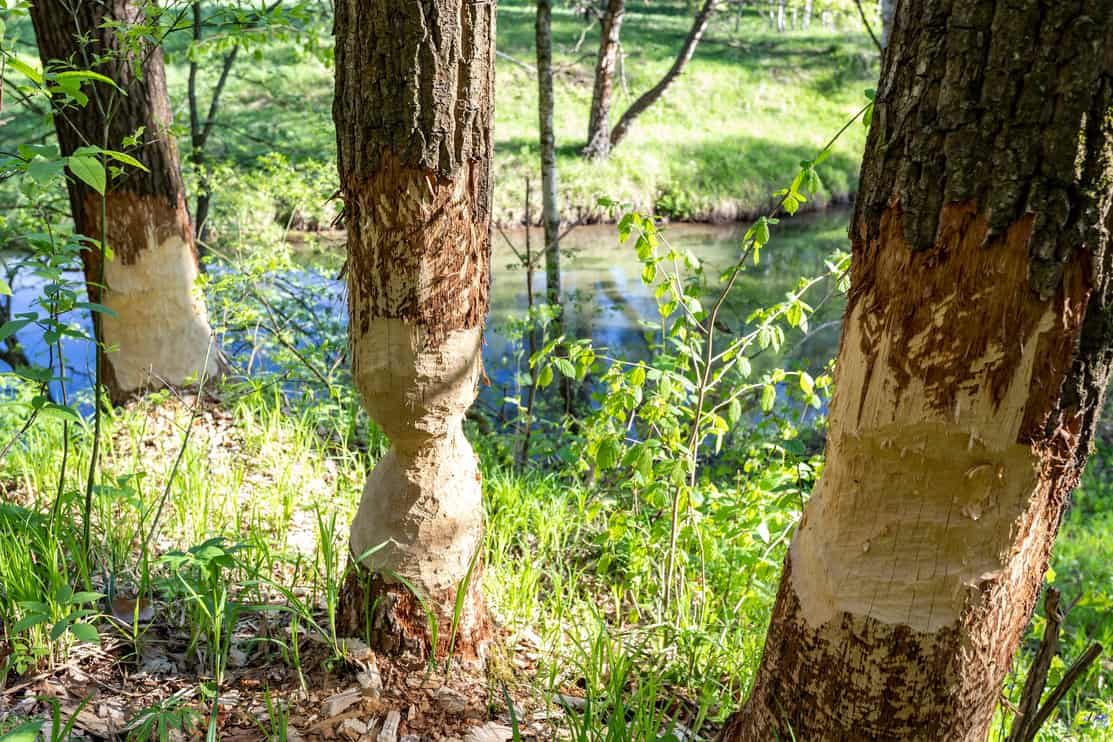
Beaver cut down tree partially

Okay, everything so far is all fine and dandy. Beavers eat, sleep, and live among the trees, but how on earth are those little animals able to cut down entire trees? 

They do not know how to work chainsaws… right? 

Beavers do not need power tools, because they have something naturally powerful on them at all times. 

Beaver’s teeth are no joke. 

Beavers will rapidly chew through the bark and the trunk of a tree, chipping away small pieces of wood at a quick rate, which causes the tree to come crashing down within minutes. 

First, they strip away the bark with this quick gnawing, giving way to the softer wood of the trees, the beaver’s target. 

The way they wear their teeth down while they keep growing makes the shape of their incisors perfectly suited to chomp and chew straight through as many trees as a beaver needs. 

Remember, the reason for this chewing could be a beaver needs to build a new lodge to sleep in, wants to store fat for the winter, needs to be protected from a predator by building a shelter, or simply wants a snack. 

Whatever the reason, it does not take a beaver long to achieve its goal of cutting down any tree- no matter the size.

How Long Does It Take A Beaver To Chew Through A Tree?

Beavers can cut down as many as 200 trees a year, but what does their rate of chewing seriously look like?

One beaver can remove nearly 150 chips of wood from a tree with a 5-inch diameter, which would topple the tree in mere moments. This means it would take about 8 minutes to cut down a relatively mature tree, depending on the species. 

These expert lumberjacks make other species, and machines, look silly.

Beavers prefer trees with a diameter of fewer than 6 inches because the bark of smaller trees is more nutritious. This way, they can reap the benefits of the bark and have a quicker chewing time to cut down the rest of the wood. They use this as food reserves or wood for building lodging. 

A beaver will typically work alone to fell a tree (cut it down), but the colony as a whole will often work to break up sections of the tree. They then divide these sections into food or building materials, and you get the picture!

What Kind Of Trees Do Beavers Prefer?

Beavers use whatever trees they find in their general environment- some popular species of which are poplar, maple, birch, aspen, and willow.

Softwood trees are the most commonly cut down by beavers. 

Since they eat parts of the same trees they use to build, they hold a special preference for those they enjoy munching on. Aspen, poplar, and cottonwood trees are some fan favorites. So, if you have any of these trees and live in a wooded area near any significant aquatic areas- pay extra attention to them. 

Where Are Beavers Found?

In North America, aside from some of the desert regions of the West, beavers can be found all over!

Ponds, lakes, rivers, marshes, wooded areas, streams, and wetland areas are just some environments beavers call home. 

You probably know beavers build dams, but did you know they can also build lodges nearly 7 feet tall, and sometimes even higher?

This is great for beavers because it means they can adapt their environments to fit their needs. Unlike many other animals, beavers can quite literally create new habitats of their own.

It is for this reason beavers need wood, but their motivations are more complex than this alone.

The dams beavers build are made primarily of sticks and reeds. Sometimes, they also add branches and saplings into these wood and mud-walled structures.

These structures can create new habitats because they result in ponds moving, although slowly. They can also support other aquatic life as well as food and water sources for other, larger animals. 

The other structure beavers create, lodges, sit both above and below the waterline, with multiple entrances underneath the surface. However, other parts of the lodge may be above water, such as the sleeping area. 

Beavers typically prepare for and construct these lodges during the summer and winter months to get ready for the winter, but more on this later!

That’s A Wrap!

Well, that’s all we have for you today. We hope you learned a lot of new information about why, how, and when beavers work to cut down trees. 

The primary goal is this piece is just like a beaver’s teeth- not dull!

Learning about the surrounding wildlife not only helps us to live more harmoniously with nature, but it also helps us to understand the reasons we should want to!

Also, knowing how and why beavers cut down trees is just one more piece of the puzzle as we work to grow on our personal and collective tree journeys.

Here are the 4 reasons why beavers cut down trees:

  • Beavers eat trees from leaves and twigs to large sticks.
  • Beavers build lodging materials from cut down wood.
  • Dams and lodges double as predator protection for beavers.
  • Trees help beavers store fat when eaten, but also protect them from the elements when lived in, during cold winter months.

Essentially, beavers cut down trees and get a snack, a place to sleep, defense, and shelter from the elements. Not a bad four-in-one deal if you ask us!!

Now, we’ll let you go- thanks for reading and learning with us.

I hope this piece helped you learn something new. As usual, good luck as you continue along your tree journey, and we hope to welcome you again soon!

References

Müller-Schwarze, D. (2011). The beaver. Cornell University Press.

Saunders, D. A. (1988.) Adirondack Mammals. State University of New York College of Environmental Science and Forestry. 216pp.

Greyhounds of the desert, perhaps better known as cheetahs, are large cats native to the African continent. These large cats are notably fast and physically unique.

When cheetahs are smaller, younger, and more agile, they use trees as a playground. They also use tree climbing for communication, as well as marking their territory. While marking their territory, cheetahs use the high ground to survey the land for potential prey.

Below, we’re going to discuss whether cheetahs are adept climbers and how they climb, along with discussing exactly what a cheetah is! Let’s get to it!

Can Cheetahs Climb Trees?

Male cheetah prepares to climb down tree

Funny enough, and unlike other big cats, cheetahs are not natural climbers. 

If you do a quick google search without looking into some research, or even digging through a few search results to compare, you might think cheetahs do not climb trees at all. 

While this is not true, there is some validity because cheetahs do not climb regularly. Their bodies are simply not built with climbing as a priority.

The leopard, for example, is much keener to climb trees. This is likely because it is a jungle cat, while cheetahs originate from the plains of the African continent with fewer trees to climb.

So, in what cases can you find a cheetah climbing a tree?

Why Do Cheetahs Climb Trees?

There are just a few reasons for cheetahs to be climbing in trees, and it is important to know they are not necessarily standard practice for all cheetahs. 

Remember, climbing trees is more of an exception to the rule for these furry felines.

Cheetah Cubs Use Trees As A Playground

When cheetahs are still cubs with smaller bodies and more agility to climb, trees can act as a great location to play. 

There are photographs of mothers and cubs up in trees, even if it may have taken a while to get up into the branches compared to their other big cat relatives. 

Think for a moment about how house cats like to play on ‘cat condos’ and things they can climb. It is the same sort of concept when you see cheetahs, especially young ones, slowly but surely scampering into the trees.

Cheetahs Use Trees For Communication

Information from the Cheetah Conservation Fund tells us this particular instance where it is more common to see cheetahs climbing in trees has some complex meaning behind it.

Trees are not solely a place for cheetahs to play, they also act as a medium for communication.

This is seen most commonly, and pretty recently, in Namibian cheetahs. It was discovered just a few decades ago these trees also seem to act as territorial markers for cheetahs.

The trees cheetahs can climb and use for communication are defined by some physical traits.

Trees with sloped trunks rather than trunks coming up at a 90-degree angle from the ground are better suited for cheetahs to climb. The limbs of these sorts of trees are large and horizontal, providing a great platform for cheetahs to climb around on. 

Let’s dig into how cheetahs specifically use trees to communicate, though, shall we?

Cheetahs Use Trees To Mark Territory

Communication has many forms, but marking one’s territory is a little less complex. 

Cheetahs climb trees to survey the land for prey, but in going into the trees, something else also happens. These big cats will go from play tree to play tree in a given area, leaving their mark as they go.

How do they leave their mark?

Think of other animals, even your pet dog, that mark their territory and you might come up with a few ideas.

Essentially, cheetahs will urinate on the trunk of a tree or leave scat on the branches to stake their claim to an area. 

This communicates with other cheetahs, and perhaps other species altogether, that an individual has already claimed a space.

The reason trees are the chosen location for this action has a lot to do with the environment of the area cheetahs often live in. 

In sandy areas like deserts, shrublands, and open plains, few areas will remain visibly marked up by an animal. 

Sand blows, grass can be stomped and ruffled by many species, and there are few other natural landmarks they can use to claim a place. 

Trees offer a surface softer than rock, higher than some mounds of sand, and they stand out more than some of the other nature surrounding them. 

They are the perfect place for cheetahs to mark their territory. 

How Do Cheetahs Climb Trees?

Two cheetah cubs climb tree on savannah

As we mentioned before, it is not the easiest thing in the world for cheetahs to climb trees.

The body of a cheetah is built specifically for speed, which is what makes it the fastest land animal on earth. They do not just get this superlative by chance, and it means some other abilities like having big teeth to chew and climbing trees, for example, are not the most important to this species. 

Their retractable claws and special pads used to create traction are not only good for running, though. 

While cheetahs may not be natural-born climbers, they can still do so when the conditions are right.

So, how do the smallest of the big cats do it?

Thanks to many physical attributes that make this cat the fastest, the cheetah can climb trees well enough. 

While cheetahs physically can climb trees, they do not do so often. That is why most searches of cheetahs climbing trees will give you pieces saying cheetahs cannot do this activity. 

Cheetahs are not the best climbers, this much is true, but they are certainly physically able.

They Use Their Paw Pads

You know cheetahs have paw pads capable of creating some serious traction but have you thought about all the ways this could benefit these animals?

Cheetahs need this extra traction while running at top speed, but these cats do more than just run. 

As a cheetah is attempting to climb a tree, what might come in handy?

You guessed it- paw pads with an extra bit of grip!

While cheetahs’ paws are not sticky or grippy in how other species’ might be, they have merit of their own. 

The paw pads on a cheetah can help keep some traction as they move their paws along the bark of a tree they are climbing. 

Similar to how humans wear special shoes to go rock climbing and bouldering, cheetahs’ paw pads help create some stability not only as they run but also as they climb trees to mark their territory.

Their Semi-Retractable Claws Help Them Climb

In a similar vein to the paw pads, the retractable claws cheetahs get to sport also offer some help when these big cats go climbing.

Let’s draw another parallel to human sports for a moment. 

Bear with us here.

When rock climbers hit sheets of ice, when mountaineers reach the snowy tops of mountains, when park rangers go on steep solo treks, they all wear shoes with some sort of spike. 

While the semi-retractable claws cheetahs have are uncommon in the overall cat family, this irregularity comes in quite handy- no pun intended.

First, what does semi-retractable mean?

When a cat retracts its claws, it is moving a tendon to contract the claw up and into its paw. This, in most cat species, works to help them keep their claws sharp while maintaining a level of surprise when hunting prey. 

Semi-retractable means the claws cannot go all the way into the paw of the cat. 

So, cheetahs are always walking around with at least a partial claw out ready to grip, tear, or whatever else a claw might do.

This is beneficial in more ways than one. For instance, cheetahs can use their claws at different lengths to grip onto the tree they are climbing. 

This may not be great for the tree if a cheetah digs too deep, but it will undoubtedly help it climb up there.

Now, aside from aspects of physique related to the paw, there is one more big factor that might just determine how successfully a cheetah can climb up a tree. 

This factor is age.

Young Cheetahs Are Better Climbers

For a moment, think of what it was like to be playing in a tree as a kid. You probably felt more limber, a little more courageous, and it was likely easier to wind through the branches than it would be as an adult. 

If you are still a kid- enjoy climbing those trees with ease!!

On a related note (we promise), young cheetahs have an easier time climbing up trees than their older relatives do. 

Thanks to their youthful bodies being small, lightweight, and not yet as strategically built to run ultra-fast, cheetah cubs have an advantage when it comes to climbing.

Little cheetahs can scamper up trees using those padded paws and semi-retractable claws because they have less bodyweight to pull up with them and can more freely move among the branches. 

This is, again, not to say that adult cheetahs don’t climb trees, but their youthful counterparts just do it in a breeze

What Is A Cheetah?

A cheetah is a carnivorous mammal that inhabits broad sections of Africa. 

Its status is vulnerable, which falls in between ‘near threatened’ and ‘endangered’ on a conservation scale. 

Smithsonian’s National Zoo and Conservation Biology Institute tell us cheetahs can accelerate from 0 to 45mph in just 2.5 seconds. This fun fact makes cheetahs the fastest land mammal on the planet.

Did you know cheetahs can reach a speed of 60 to 70mph?

Think about driving a car. Not just anywhere, though. Just imagine driving a car on the highway, looking over, and seeing a huge cat running right next to you. 

A cheetah could compete with the speed of a car any day, something we hope to leave up to the imagination for now.

If you are looking for more information on cheetahs and their current day plights, check out Remembering Cheetahs: Remembering Wildlife. It contains photographs from some of the top wildlife photographers in the world, and raises money for charity with each sale.

Identifying A Cheetah

Cheetah close up

Cheetahs have small heads and high set eyes, as well as a black tear mark from the inner corner of the eyes down to the mouth. 

You will see white sections of fur around the cheetah’s eyes and neck, as well as the underside of their belly, while the rest of their body is a yellow or tan color as the base. 

If you did not already know, cheetahs sport black spots all over their bodies, which act as camouflage within the grasses of the savannah and the shadows cast by this environmental feature.

The appearance of a cheetah is important, but the traits they physically use are even more significant when understanding how cheetahs live and survive in the wild.

Physical Traits Of A Cheetah

Cheetahs, as a species, have many highly beneficial physical traits, as well as some superlatives they hold, like the fastest land mammal.

With partially retractable claws and special paw pads, cheetahs have the gift of great traction even as they exponentially speed up from rest to their peak speed of 70mph.

Every part of a cheetah’s physique helps with its speed. From a tail made to help with turning and balancing to a slender body with long legs, speed is a part of this animal’s very nature.

Some traits hinder cheetahs more than help them.

Cheetahs have large lungs and nostrils meant to provide a ton of air to their lungs while running, which means they have much less space for their teeth. 

Since cheetahs have such relatively small teeth, they have to suffocate their prey.

While cheetahs are undoubtedly lethal to their prey, they cannot fight with other predators and are at a disadvantage because of their small teeth.

Where Do Cheetahs Live?

The areas of the African continent cheetahs inhabit include North, Eastern, and Southern Africa.

There is a species of the cheetah native to Iran, but is critically endangered, unfortunately. The Iranian cheetah is one of the most endangered felids in the world.

Countries like Kenya, Namibia, Botswana, and Tanzania are home to most cheetahs thanks to their dry environments with shrublands.

The spots cheetahs sport on their fur helps them blend into these grass and shrublands. The shadows from a direct and harsh amount of sunlight give off a similar black cast within the tan grass.

So, we know now where cheetahs live, but how long do they live?

Lifespan Of A Cheetah

If you have a house cat, you might be ready to predict the lifespan of a cheetah. They are all just cats, right?

Well, not quite. 

Cheetahs actually only live between 8 to 10 years in the wild. Territorial conflicts, a constant pressure to catch and keep prey, and other environmental factors, cause their lifespan to be about ⅔ of a common house cat’s.

In human care, however, cheetahs can live up to 15 years.

This is because captivity removes some of the environmental factors, though the lifespan of this creature is relatively short no matter what way you swing it. 

In this pretty brief life, what is a cheetah’s diet like?

What Do Cheetahs Eat?

Many big cats are nocturnal hunters, giving them the benefit of slinking around in the dark. 

Cheetahs have speed on their side and do not need this leg up. So, you can expect cheetahs to hunt in the early morning hours as well as late afternoon.

The primary food source for cheetahs is animals ranging from small to medium, such as antelope and the young of larger animals like warthogs. 

Game and birds also contribute to a cheetah’s diet, though they are not the majority of the food these animals use to sustain themselves.

Cheetahs have to be on the defensive during mealtimes, as other animals like lions and vultures create competition. 

Even though these big cats are fast, they are often bullied into losing their prey by other predators thanks to their lack of ability to fight. 

Remember the discussion about cheetahs having small teeth? Well, it comes into play here when we consider they are much less likely to win in a fight with a lion.

Cheetahs do not come back to prey once they leave them, so they must eat quickly and efficiently to avoid losing them altogether to a competitor.

That’s It!

Well, that’s pretty much all we have on cheetahs and trees. 

While the big cats can certainly climb trees contrary to other random internet searches you might find, the activity is not their forte. 

Unlike other big cats like lions, leopards, jaguars ,and more, cheetahs often stay on the ground. 

They can run laps around any of their cousins any time though. Cheetahs have their own set of rules to go by. 

Remember, there are 3 reasons a cheetah will climb up in a tree:

  • Play: Young cheetahs love to climb around and play wherever they can. After a while, it is all about the hunt, and these youngsters make use of their ‘free’ time in those early days. 
  • Communication: There are ways animals, including cheetahs, communicate that have nothing to do with sound. Cheetahs climb trees to see prey, to stake a claim, and to convey several other messages. 
  • To Mark Territory: Circling back to communication, cheetahs’ main purpose for climbing trees seems to be marking their territory. It is hard to leave a mark in the constantly blowing sand, and trees offer a great blank slate to stake a claim.

We hope this piece gave you some extra insight into the relationship between cheetahs and trees. 

Until next time, we hope you continue your tree journey and keep learning about all the crazy interactions that make our planet so interesting!

Oh, and (as always), thanks for sticking with us.

References

​​Farhadinia, M. (2004). The last stronghold: cheetah in Iran. Cat News, 40, 11-14.

Marker, L. L., & Dickman, A. J. (2003). Morphology, physical condition, and growth of the cheetah (Acinonyx jubatus jubatus). Journal of mammalogy, 84(3), 840-850.

As you are probably very aware, trees are a pretty common plant around the globe, no matter your location. Save for the arctic circle and the driest of deserts, you are likely to find trees somewhere in your proximity.

Trees grow at very different rates, which is to be expected. However, trees like the Eastern Hemlock, Canadian white cedar, Don Egolf Redbud, Bur Oak, Japanese Maple, Purple Lily Magnolia, and Serbian Spruce are among the slowest growing. These trees have slow yearly growth rates between 10″-24″.

To discover more about these trees and how you can affect their growth time, continue reading!

Do Slow-Growing Trees Live Longer?

There is a great deal of research on this subject, much of which deals with specific intricacies and nuances of how tree growth differs across species.

Research has shown examples of this in practice.

One situation shows slower radial growth rates of a tree correlates to the tree living much longer than another species who may grow much faster but will almost certainly live for less time. 

Does that make sense? 

If not, think of it like this:

The trunk of an eastern hemlock tree gets wider rather slowly, which is the radial growth rate. This tree is a good example of a tree that fills out pretty slowly while living for quite a long time. 

In fact, its lifespan can get up to 800 years and this tree does not even reach maturity until it has lived for nearly 300 years. 

Talk about slow-growing and long-living!!

An eastern white pine, however, has a trunk that fills out much more quickly. Unfortunately, as follows, this tree has a shorter overall lifespan.

Different Types Of Tree Growth

deforestation and forest valuation - man measuring the circumference of a tree with a ruler tape

As explained by the University of Tennessee Extension, tree growth occurs in two different ways. 

“What are these different ways?” you may ask. Let’s dive in!

Primary Tree Growth 

When growth happens in a way that makes the tree larger and taller, it is primary growth. This sort of primary growth manifests as increasing height and length and occurs in small areas individually. 

This growth stems from as deep down as the roots of the tree and high up as the shoot tips. 

So- primary growth means what? Increased height and length of the tree and its branches!

Secondary Tree Growth

Secondary growth is when growth increases the thickness of the stems and branches of a tree. 

Among the stems and branches, roots also increase in diameter as a result of secondary growth.

Secondary growth means… Increased thickness in the tree and its various appendages!

Now that we have a better understanding of what growth even looks like in trees, let’s get to the important part. 

What are some trees we can use as an example of this newfound understanding of tree growth?

8 Most Common Slowest Growing Trees

Alright, it’s here! The moment you have been oh so patiently waiting for: some of the slowest growing trees.

Here are eight of the slowest growing trees out there, their growth rate, and some other information that might come in handy if you have any of these species. 

Tree TypeYearly Growth Rate
Eastern Hemlock12-24”
Canadian White Cedar13-24”
Don Egolf Redbud12”-16”
Bur OakLess than 12”
Japanese Maple12”-24”
Purple Lily Magnolia6”-12”
Chinkapin Oak10”-24”
Serbian Spruce12”

Like anything, there may be some variability here. Some individual trees may grow a little faster, or even a little slower. Maybe a tree not on this list is growing just as slow, even though it is not technically a ‘slow-growing tree.’

What we will discuss here regarding the yearly growth rate of each tree is the primary growth, mainly focusing on the increase in the tree’s height. 

That being said, let’s finally turn the spotlight on the trees.

Eastern Hemlock Tree

The Eastern Hemlock is a great first tree to discuss. If you remember, it was such a wonderful example that we already discussed it above. 

It deserves a little more attention than we gave it, though, so let’s talk about the Eastern Hemlock, shall we?

The USDA’s Forest Service informs us that an Eastern Hemlock tree measuring 193 cm (76 in) in d.b.h. and 53.3 m (175 ft) tall is among the largest recorded. Imagine that – one of the slowest growing trees getting to be one of the tallest! 

Maybe there’s some merit to that old saying, “slow and steady wins the race,” after all. 

If you recall from above, this tree can sometimes take between 250 and 300 years just to reach maturity. If a few hundred years put a tree at the start of its adult life, just imagine how slow yet fortuitous this species is. 

Eastern Hemlocks can live up to 800 years on average, with a record age recorded as 988 years… which is pretty darn old!

Eastern Hemlock Tree Growth Rate

The growth rate of these slow yet steady trees is pretty unbelievable in and of itself. 

It can take an Eastern hemlock 100 years to get to 2.5 cm in d.b.h, or diameter at breast height. This common measurement of a tree might take other, faster-growing trees (like sugar maple, for example) about 10 years to reach that point. 

So, the Eastern Hemlock is about 10 times slower in its growth than many average North American trees.

The average growth rate in height per year does not exceed 12 to 24 inches. 

Canadian White Cedar Tree

Green Hedge of white cedar trees, nature, background Against the background of the blue sky.

This evergreen tree is in no rush to shoot into the sky. 

The Canadian White Cedar is a softwood tree and a very adaptable one at that!

Its wide root system allows for this cedar to grow in places that other trees may not find as hospitable, like rocky areas or other difficult spaces. 

The Canadian White Cedar grows in places other trees like maple and oak cannot, which goes to show it has merit.

If you have ever heard of ‘arborvitae,’ it’s the same tree! Funnily enough, arborvitae means ‘tree of life’ and that is very reminiscent of the adaptability and survival instincts of this species. 

Canadian White Cedar trees can live up to 700 years on average, not quite beating out the Eastern Hemlock but certainly giving it a run for its money.

Canadian White Cedar Tree Growth Rate

The average growth rate of the Canadian White Cedar is 13 to 24 inches per year if conditions are good.

There is a Canadian White Cedar that is 4 inches tall, but over 100 years old. Just another reminder individual growth rates and factors play a huge part in what we hear about certain species. 

Maybe you’d heard of that tree and figured the species must be the slowest growing. While it grows at a slow-moderate speed, it is important to do research into the entire species.

Don Egolf Redbud Tree

A tree suited for warmer climates, the Don Egolf Redbud tree (also known as the Chinese redbud) is both compact and beautiful. 

Its vibrant pink flowers are closely clustered and bloom into an unmistakable show of color in the spring months. 

Some might even mistake this tree for a bush because of its short height, even at full maturity. 

The Don Egolf Redbud tree goes against the commonly held statement that slower-growing trees live for longer. With a lifespan of only 50-70 years, this redbud species is pretty short-lived. 

Unfortunately, this species is also pretty susceptible to diseases, which can significantly decrease the lifespan even more.

Don Egolf Redbud Tree Growth Rate

It takes this tree 15 years to reach its initial mature height of about 10 ft tall. This means the Don Egolf Redbud grows between 12 to 16 inches per year.

Not the slowest rate out there, but certainly not the fastest, either.

You could always purchase this tree as a more mature plant in order to get the beauty of the redbud in bloom without the hardship of bringing the plant up from a sapling.

Bur Oak Tree

The bur oak is rather adaptable, even a magnificent tree to fit into an urban setting with a lack of other green space to utilize.

Wildlife love the acorns, and so do some people who know how to use them properly!

If you are interested in learning more, check out our piece on 4 Reasons Why Squirrels Eat Acorns (& Their Favorite Type).

Now, as we talk about slow-growing trees, this one is giving all the others a serious run for their money. 

With a lifespan of 200-300 years minimum, this oak tree has plenty of time to make its mark. When your life is that long, there is no need to rush!

Bur Oak Tree Growth Rate

The bur oak grows at an extremely slow rate of less than a foot per year. Though it grows at a slow rate, its lifespan also allows it to reach up to a soaring 80 feet tall. 

Yes, you read that right- the bur oak grows so slowly that it might be lucky to hit 12” of growth in a year.

It’s all about balance, right?

Japanese Maple Tree

There are so many variations of the Japanese Maple, almost all of which are very slow-growing.

The reddish-purple leaves add yet another spectacular pop of color during the spring and summer months.

The mature height of a Japanese Maple tree is about 30 feet tall, which can be reached in about 12 years, give or take.

With the Japanese red maple, since there are so many variants of the species, it is hard to nail down exactly how long it will take. The important thing to know is this is a slow-growing species overall.

Although these trees are very beautiful, be warned they make some of the most helicopter seeds! If you want to learn more about these trees and others similar to it, check out 4 Maple Trees That Produce The Most Helicopter Seeds.

Japanese Maple Tree Growth Rate

The Japanese Maple’s growth rate spans from less than a foot per year to just at the two feet mark. 

That’s right – another tree whose yearly growth has the potential to be less than 12”. With a yearly maximum growth of 24”, we can likely assume a Japanese Maple tree will grow around 16” per year.

Purple Lily Magnolia

Blooming lily magnolia magnolia (Magnolia liliiflora) in the botanical garden.

Similar to the Don Egolf Redbud, this tree adds a great level of color to any space. 

As another tree you might mistake for a bush. You could easily prune a Purple Lily Magnolia and maintain a certain shape or style. One more benefit of slow growth is the nature of this tree is pretty well set up for styling. 

Whether you are looking for a pretty shape in a sculpture garden or a well-manicured pop of color in your front yard, the Purple Lily Magnolia could be the tree for you.

Again, not the longest-lasting of trees, but this is certainly worth its ability to keep a shape.

The Purple Lily Magnolia tree should last around 100 years, so a few new generations will also benefit from your decision to plant a purple lily magnolia.

Purple Lily Magnolia Tree Growth Rate

Getting to a mature height of 10 feet takes the Purple Lily Magnolia 10-15 years, so it grows between 6 to 12 inches yearly.

Chinkapin Oak Tree

This tree is wonderful for wide-open spaces like large properties, parks, and even to add something to the empty lot around a business in need of some sprucing up.

A species that needs around 6 hours (at least) of direct sunlight a day, the Chinkapin Oak tree is most definitely well-suited for sunny regions.

Use the tree as a shade tree on a hot day, while allowing it to have everything that it needs to flourish. 

All critters will love this tree for the acorns it produces, but you can even use those acorns yourself.

​​You can take a look at our guide on 9 Amazing Fallen Acorn Uses here.

Really, this tree is good for so many purposes. Its slow growth only allows it to fully develop its assets for use by humans, animals, and more!

The Chinkapin Oak lives for well over 100 years on average.

Chinkapin Oak Tree Growth Rate

The Chinkapin Oak tree grows anywhere between 10 to 24 inches yearly, so you can expect this to be a pretty slow-growing addition to your backyard. 

Trees like this are pretty cool if they are planted when kids are little. They will get to grow up alongside the tree. Comparing growth between little humans and little trees will make this slow-growing species seem like it is just shooting into the air!

Already have this species on your property? Great! It’ll stick around for quite some time. 

Serbian Spruce Tree

Serbian spruce - Latin name - Picea omorika

Similar to the Japanese Maple, the Serbian Spruce tree grows slow, though this species lacks the variants that the Japanese maple so proudly boasts. 

Serbian Spruce trees are fantastic for backyards and other residential spaces, areas not quite urban but also in need of a bit of sprucing up. Just remember, when a tree grows, so do its roots. 

For this reason, planting a Serbian spruce in an area too compact could lead to property damage (even if that just means a sidewalk) a few years down the road.

Living around 60 years, it’s hard to imagine, but the Serbian Spruce tree gets up to 30-35 feet tall in some cases. 

While the growth rate of a Serbian Spruce ranges from less than a foot to just over two feet yearly, it is most common to see this species grow at the slow end of the spectrum.

Serbian Spruce Tree Growth Rate

This one is pretty simple because the standard growth rate of the Serbian Spruce is 12” per year.

Now, after learning about these trees, a foot does not seem so crazy anymore, right?

How To Help Trees Grow Faster

While all the trees we discussed here today have genetics to thank for their slow growth rates, there is always something you can do to support your tree, at the very least. 

While any of the following methods will not make your bur oak suddenly grow 2.5 feet per year, or your purple lily magnolia miraculously get taller, they will certainly promote healthy growth.

It all begins at the roots, and early in a tree’s lifespan. Next, you will want to maintain your tree throughout its life by trimming if needed, adding fertilizer to the soil, and making sure your tree has plenty of water to sustain it.

Do all of those things seem pretty basic to you? Great- you are probably already well on your way to growing a strong, healthy tree- no matter the species. 

If this is news to you, or you want to brush up on your general knowledge of tree maintenance- follow along for a little while longer

It never hurts to refresh your knowledge!

Water Your Tree Frequently To Promote Growth

One of the most important things when taking care of any plant is making sure it has enough water. Most trees should be able to obtain and retain the proper amount of water, but this is not always a case. 

Say, for example, the area you live in is facing a drought. You do not want to waste water, but in order to keep your tree from completely dying, try to add a little extra water.

You could also try something like the Greenscapes Tree Watering Bags. They hold up to 20 gallons of water and slowly release the liquid over 6 to 8 hours. This allows your tree to get proper hydration without wasting any extra!

Perhaps a better example is you notice the soil around your tree becoming dry, though nothing is particularly amiss in your environment. Take a moment and water your tree!

Heat of the summer? Water your tree!

Trees are adaptable and can survive many environmental hardships, but if you have the power to help them out along their journey- why not take it?

A happy tree is a healthy tree, and your yard will look all the better for it. 

Give your summer visitors a chance to comment on how well groomed your purple lily magnolia or how deep the green of your oak’s leaves are. (You can thank us for the reminder later!)

Fertilize The Soil To Aid Tree Growth

If you are a regular reader, you will be familiar with us talking about soil and fertilizer oh so often. Like, all the time. 

The simple truth of it is fertilizer is one of the most beneficial resources you can provide a plant with. 

Say it with us though… fertilizer is not plant food.

Fertilizer is… what?

When used with soil and water, fertilizer acts as a way to help plants use all aspects of the nutrients they are already receiving, while getting some supplementation to those main nutrient sources. 

In the same vein, trees need some vitamins and nutrients in their systems, too. 

Giving a tree that extra boost helps it focus on growing tall, wide, strong, and healthy above all else!

If you have an oak tree, check out our guide: How to Fertilize Your Oak Tree (7 Simple Tips)

That’s A Wrap!

Well, we hope this wasn’t as slow of a read as the growth of those trees.

For what it’s worth, if you’re looking for a fast-growing tree and stumbled here instead, you will know what not to look for as you begin your search. 

If you were here for this exact reason – to see which trees glow slow but live long, or which species may be more manageable to craft and shape, we hope this helps!

Remember, not every individual tree is going to be the same. One Japanese Maple may have a very wide truck while another is taller and thinner. 

Maybe your Don Egolf Redbud gets a little taller than expected, or not quite tall enough. 

Each tree is unique, and while it helps to know what to expect, part of the process is getting to learn as you grow.

Thanks for spending some time with us, and good luck as you continue along your own tree journey!

Conversely, if you’d like to check out some of the fastest growing oak trees, take a look at our article: 12 Fastest Growing Oak Trees: Growth Chart!

References

Bryan A. Black, Jim J. Colbert, Neil Pederson “Relationships between radial growth rates and 

lifespan within North American tree species,” Ecoscience, 15(3), 349-357, (1 September 2008) 

Coomes, D. A., & Allen, R. B. (2007). Effects of size, competition and altitude on tree growth. Journal of Ecology, 95(5), 1084-1097.

Growing a lemon tree is way easier than you think. The trees require very little to thrive as long as they are in the right environment. While getting them to produce lemons may take some time, the wait will easily be worth it.

It takes about 20 to 25 years for a lemon tree to reach its peak height, and could take anywhere from 4 to 6 years for the tree to produce lemons. Lemon trees need to develop fully before they produce fruit. The type of tree and variety of lemon will decide how fast your tree will grow.

Continue reading to learn more about how to help your lemon tree thrive, what to watch out for to keep it healthy, and some general lemon tree information!

Which Lemon Tree Should You Plant?

Not sure what kind of lemon tree you should plant? There are many varieties, and it can get a little overwhelming. Let’s look at the different varieties and what suits your needs and growing community. 

So, where do you even start when deciding what variety of lemon trees to buy?

The best way to figure this out is to see if your neighbors have figured it out first. Look around your neighborhood and see if you can spot any lemon trees. If you see some, you know you have the right growing conditions for a tree to thrive. 

If you cannot spot any trees, head to your local arborist or gardening center and ask for their advice. They know the area, climate, and plants well, so they can give you an informed answer. 

Different varieties of lemon trees need various elements to thrive. Most trees need full sunlight, well-drained soil, and a warm climate. You can also bring many varieties of lemon trees inside and plant them in pots.

Some varieties of lemon trees also have shallow roots, which is preferable in some situations. To learn more about this and other fruit trees, take a look at our piece 6 Best Fruit Trees That Have Shallow Roots: Identification Guide.

However, lemon trees grow very tall, so it is best to keep them outside if it is an option for you. 

How Quickly Will A Lemon Tree Grow Each Year?

Lemon tree

Each variety of lemon tree has a different rate of growth. With many varieties to choose from, you can also pick one that suits your timetable for growth. 

The majority of lemon trees grow around 6 to 12 inches each year. Over time they can reach up to 20 feet tall, or sometimes even higher depending on the variety. It all depends on what kind of lemon tree you are growing and the conditions they are living in. 

Having the proper conditions to grow a lemon tree lets it reach its full potential each season. If you plant the lemon tree in a spot with heavy sun and proper drainage, it will likely grow about 6 to 12 inches each season. If the lemon tree is in the shade or sitting near a puddle every day, it is less likely to thrive in those conditions, making it grow poorly and take longer to produce fruit. 

Some variety of lemons do well in warmer climates or better indoors in planters. You can read about the best variety of lemons to plant for your zone here. 

How Long Does It Take To Grow A Lemon Tree?

So, you’ve narrowed the search down and are ready to plant a lemon tree and enjoy fresh lemons right in your backyard. How long will it take to get fruit? What kind of care does it need?

Overall, lemon trees will take 20 to 25 years to reach their full height of approximately 20 feet.

Lemon trees are rather simple to grow if you give them the proper conditions. They do not require a lot of maintenance and can support themselves. If you are not great with plants but curious about a citrus tree, start with a basic variety of lemon and see how it goes. 

When Will Lemons Arrive On Your Lemon Tree Once Fully Grown?

Now that your tree is in the ground or a container, you must be curious when the lemons will start rolling in? Depending on the maturity, size, and type of tree you bought, you could wait some time for lemons. 

Fruits on a fully grown lemon tree typically take about a year to show up. A few tiny lemons may fall off the tree as well before any fruit makes an appearance. This is the natural cycle of the tree, so do not worry if the tiny fruits start to fall. 

The best thing that you could do is stay patient when waiting for your fruits to grow and ripe on the tree. Once the fruits appear on the tree, you may think you will have lemons soon. However, you may have to wait a bit longer. 

Lemons can take a long time to ripen and come to their full potential as fruit. It could take up to a year for the lemons to grow and then another 6 to 9 months for the lemons to be fully ripe and ready for consumption. It will be worth the wait, and the satisfaction will be excellent when you pick the first lemon. 

When Should I Pick Lemons Off My Tree?

Senior farmer harvesting lemons with garden pruner in hands on a lemon tree in a sunny day. Seasonal, summer, autumn, homegrown, hobby concept.

Okay, so you finally have a few lemons on your tree. After what seems like years of waiting, you are only a few steps away from adding the tangy citrus into your diet. But how do you know when to pick them off the tree?

It may surprise you to find out not all lemons are bright yellow when they are ready to be picked from a tree. In fact, many of them are slightly green, just like their cousin the lime.

According to the University of Florida, you typically pick lemons when they are green and 1 ½ to 2 inches in diameter. After picking them, you cure them, which involves placing the green fruit out at room temperature and allowing it to ripen. While they ripen, the peel smooths out, and the fruit becomes juicer.

When the fruits are ready, you can store them at room temperature or in polyethylene bags in the refrigerator, where they will last several weeks. 

What Kind Of Lemon Tree Should I Buy?

The first step in your journey is to decide what kind of lemon tree works in your zone and climate. If you live in an area where it is cold in the winter, look to buy a smaller variety you can transport indoors when it gets cold. 

According to the University of Vermont, citrus trees thrive in temperatures between 50 and 85 degrees Fahrenheit, but 65 is their ideal temperature. If your growing season cannot sustain those temperatures in the winter, look for a tree you can manage indoors. 

The best time to plant a lemon tree is in the early spring. Planting lemon trees from fruit seeds may not yield lemons, so you are better off buying one that has already begun growing. Plus, it could take years until the seed grows into a tree, so buying a tree already on its journey will yield fruit sooner. 

Look for a lemon tree with strong and healthy leaves. They should be a vibrant green and not wilted. Also, check out the roots on the lemon tree and make sure they look strong and not rotted. 

The next step is figuring out the right variety. Do you live in a warm climate where you can keep the tree outdoors all year long? Or do you live somewhere where it is not sustainable year-round? These will all be important factors when figuring out what variety of lemon trees to buy. 

Let’s look at a few examples of the different lemons you can grow. 

Eureka Lemon Trees

Eureka lemons are very common around the world and are rather simple to grow, especially for newbies. They do better outdoors and love a warm climate.

Meyer Lemon Trees

Raw Yellow Organic Meyer Lemons in a Bunch

Meyer lemons are very sweet for the lemon variety. The trees produce fruit all year round but do not do well in the cold weather. Luckily, they are prime trees for growing in containers and can come inside during the winter months to continue growth. 

Verna Lemon Trees

If you are looking to keep your lemon tree outside all year long, you might want to pick a Verna lemon tree. The variety, which is like the eureka, only produces fruit twice a year. Sometimes you will end up with a third crop, but with limited production.

The lemons are super juicy and have very thick skin. Do not underestimate the size of this tree, either. It can grow up to 12 feet when it has reached its full maturity!

Primofiori Lemon Trees

If you are looking for a lemon that will yield a lot of fruits, the primofiori lemon is for you. This tree produces fruit year-round.

It thrives in a raised garden bed, or a container for easy transport come the winter. If you are bringing it inside, you must make sure you trim the leaves back regularly. 

How To Plant A Lemon Tree 

If you plan to keep your lemon tree outdoors year-round, then look for a large spot it can live for years to come. If you plan to plant the lemon tree in a container, pick a large container with good drainage and place it in a very sunny spot. 

According to Clemson University, a custom soil mixture is best for your citrus tree. They claim it should contain 4 parts shredded aged pine bark and 1 part peat moss or coir. This combination provides proper drainage and organic matter, but you can substitute it with a well-draining potting mix.

If you are planting the lemon tree in a container, make sure your container is at least 2 inches bigger than the original container the tree came in. Over time, the tree will have to be repotted and moved into a bigger container as it continues to grow. 

Your lemon tree will have to come inside before the weather turns cold. Lemons do not hold up well in cold temperatures, so it is better to bring them inside a few weeks before the first frost of the season hits.

The same goes for putting it back outside in the warmer months. Wait until the last frost of the season has passed and the temperatures are warming up again. When the temperature is at a steady warmth, it is okay to put the lemon tree back outside. 

You might have to juggle the timeline depending on the weather and keep it inside longer than you want to. While this may sound annoying, it is better to keep the tree inside longer so it does not freeze over. This way, none of your hard work goes to waste!

Do Lemon Trees Need To Be Pollinated?

Now that you have picked out the variety of lemon trees to plant and you have it all ready to grow, you may wonder about lemon tree pollination. 

Lemon trees, like most citrus trees, are self-pollinators and do not need to be pollinated by another source to produce fruit. While it will be helpful to have many other citrus trees nearby, it will not stop your lemon tree from growing and start producing lemons. 

Another lemon tree or citrus tree will typically help increase the production of your tree. The timeline will not change, but you may yield more fruit in the long run. 

Keeping Your Lemon Tree Healthy

Just like any other plant, lemon trees are not strangers to pests and diseases. Especially if you keep them outside. 

If planted in the right conditions, you may avoid pests and ailments near your lemon tree. However, we cannot all be lucky. Here’s what you have to watch out for with your lemon tree. 

A common thing that citrus plants grown in containers experience is root rot. Root rot can occur when a plant is over-watered and does not have the proper draining in place to keep a solid flow for the roots at hand.

To avoid root rot, you will want to make sure you have a pot with a strong drainage system. Also, make sure you are not over-watering your plant. 

Another issue you may see on your lemon tree is citrus greening. The issue first came to light thanks to an insect called the Asian citrus psyllid. The bug is rather small, as it is similar to a gnat, but can cause a lot of damage. 

Aphids are probably one of the most common pests in a garden. While it seems like they will never go away, there are useful tools to help keep them out of your garden. A simple insecticidal soap treatment or a neem oil spray will help deter these tiny creatures. 

If soap is not removing the aphids, try out a product like Natria Neem Oil Spray for Plants. You can spray this oil directly on plants and it will help repel aphids and other pests. 

Caterpillars are also a big no for your lemon tree. They are fond of the leaves on the tree and can go through them rather quickly. The damage is usually minor, but it will be smart to keep a lookout for the crawling creatures. 

What Should I Do With My Lemons? 

Okay, so you finally have a lemon fruit. But now, what do you do with it? Sure, you have the lemon juice, but there are so many more ways you can use the lemon. Let’s look! 

Lemon Blossom

lemon tree flower

If you are super impatient while waiting for the lemon to fruit, pick a few lemon blossoms off your tree.

The super fragrant flowers make great decorations for food and dessert and give off an incredible scent. While they are not edible, they make an excellent decorative garnish while you are waiting for your lemons to fruit. 

Lemon Oil 

Lemon oil goes a long way. You can use it in cooking and baking to enhance flavor and increase the lemon scent. However, you can also use it outside of the kitchen, in beauty products, cleaning materials, and in certain furniture polishes. 

Lemon Rind 

The lemon rind may secretly be the best part of the lemon. The rind is so beautifully fragrant and adds an incredible flavor to whatever you are cooking with. It brings such a bright flavor to anything you are eating and instantly elevates any dish. 

Lemon Peel 

Do you love making lemon candies and jellies? Then you are going to want to keep the peel of the lemon around.

The lemon peel is the rind with the white pith attached. It contains a large amount of citric acid and pectin, which is one of the key ingredients for making jellies and marmalades. 

So When Can I Enjoy My Lemons?

So, as you probably noticed by now, there is not a specific answer to how long it takes to grow lemons on a lemon tree. It could take 1 year, or it could take 6 years! It all depends on many, many factors. 

If you are starting from seed, it may take around 4 to 6 years before you get any fruit on the tree. However, most people are starting with a plant that has already been around for a few years, so you will probably not have to wait as long. 

Remember to keep your plant in a fully sunny area with proper drainage. If you see any pests or issues near the plant, treat it with the proper material to help bring it back to its natural state. 

When your lemons finally appear on your tree, remember you are not done yet! The fruit will still take time to grow on the tree and will be ready when they are slightly green.

You can either pick them or let them ripen more on the vine. Whatever you do, the long wait is over, and you finally have lemons you can enjoy! 

References

Beridze, T. R. “The effect of organic fertilizers on lemon tree productivity.” Subtropicheskie Kul’tury 3 (1990): 83-86.

Domingo, R., et al. “Water relations, growth and yield of Fino lemon trees under regulated deficit irrigation.” Irrigation Science 16.3 (1996): 115-123.

Dubey, A. K., and R. M. Sharma. “Effect of rootstocks on tree growth, yield, quality and leaf mineral composition of lemon (Citrus limon (L.) Burm.).” Scientia horticulturae 200 (2016): 131-136.

Ortuno, M. Fernanda, et al. “Stem and leaf water potentials, gas exchange, sap flow, and trunk diameter fluctuations for detecting water stress in lemon trees.” Trees 20.1 (2006): 1-8.

Journals, notebooks for school, official documents, dictionaries, novels, handwritten notes; paper is everywhere in our lives. Even as technology becomes the norm, we see paper products everywhere we go.

One tree makes over 8,000 pieces of paper while approximately 1/500th of a tree is cut down for every piece of paper. Americans use over 850,000,000 pieces of paper per year, equalling over 106,000 trees. Most paper is produced from softwood trees such as pine trees, spruce trees and fir trees.

Keep reading to discover more about the paper industry. What you learn may surprise you!

How Is Paper Made From A Tree?

There’s no doubting most paper is made from wood pulp. Maybe you will remember an elementary school teacher telling you to write in pencil to erase your mistakes so it would sacrifice no more trees than necessary. Just us? Hmm, okay. 

Anyway, the process is quite simple, and it’s old. It is derived from one created in China back in the 100’s A.D. and has evolved into the paper, and the processes used today.

How Is Wood Pulp Made Into Paper?

Wood pulp texture

To start things off, raw wood gets processed into pulp. Then comes the combination of wood fibers and chemicals, which can happen in one of two ways.

Mechanical Pulping 

Literature from Princeton University tells us softwood trees lend themselves better to mechanical pulps. The process grinds down wood fibers more than the chemical method will. 

Therefore, the paper produced from mechanical pulping, the less common of the wood pulping methods, is a thinner, weaker paper. Think of newspapers or phone books (talk about something old), and you will get a sense of the thin type of paper created through this process. 

Chemical Pulping

A more common method, chemical pulping, uses both soft and hardwoods and creates most of the paper products we know and love today.

Much of the naturally glue-like substance found in pulp is eliminated through this process, which results in a much stronger paper.

Everything from fine printing paper to paperboard and writing paper, found in journals and notebooks, is a byproduct of the chemical pulping process. Since wood fibers are not simply being ground down, there is a wider range of paper types you can create using chemicals to break down the fibers.

What Comes Next In The Paper-Making Process?

Making mulberry paper, decorating with leaves and flower. Urban career in Thailand

The initial pulp is very wet and needs to be dried to create sheets of paper. 

Funny enough, this part of the process has changed little since the ancient Chinese practices that spearheaded the idea of turning wood into paper. 

Wood pulp is sprayed onto large screens, which then go through many rounds of drying processes. First, the pulp is squeezed until it is about halfway wet and appears to be more of a damp paper than a liquid pulp. 

Eventually, the pulp gets pressed to remove even more water, and the paper is truly coming into its final form.

To create different textures, thicknesses, and tones, the paper may go through different treatment processes to arrive at its desired state.

Finally, the paper product is rolled into huge reels of paper before being sent off to be cut and organized. Paper can turn into journals, envelopes in which we buy printer paper, and so many more things. Maybe the lined paper that was treated becomes spiral notebooks for children to practice their alphabet, and blank white paper is waiting for official statements and apostilles to be sent between governments. 

The opportunities are endless for this product made from a tree not so long ago.

Can Paper Be Made from Any Tree?

As we briefly mentioned above, while discussing the pulping processes, hardwood and softwood are turned into paper.

Most of the wood that gets turned into pulp comes from softwood trees. These trees are coniferous trees such as pine, spruce, and fir, among others.

Coniferous simply means ‘cone-producing’ and it is these types of seed-producing trees that earn their classification as softwood trees. 

Essentially, however, yes. Certain types of wood may have wood fibers that break down into a pulp better (hence softwood trees being the preference), but all wood can technically be turned into pulp to create paper.

Which Type of Trees Are Commonly Used To Create Paper?

The Forest Service, part of the U.S. Department of Agriculture, helps to provide a great snapshot into what types of trees are commonly used to create paper.

Softwoods like pines, spruces, hemlocks and firs stand among other conifers such as bald cypress, Douglas-fir, larches, red cedar, white cedars, and redwood to create the portfolio of trees most commonly turned into paper.

While softwoods are the majority, a good 85% or so of the trees selected for this process, it leaves us with a solid amount of hardwood trees also being utilized. 

Hardwood trees that turn into paper include poplar, birch, maple, beech, sweetgum, tupelo, and many others. Unlike paper made from softwood, we typically use wood produced by these trees for hardboards, materials inside shipping boxes, and other less ‘refined’ uses.

How Long Does It Take To Make Paper From Trees?

Well, if we start from the beginning…

Growing trees can take between 10 and 20 years just to have a reasonably sized organism that can produce enough pulp to create paper. 

Turning wood into pulp and pulp into paper, however, can take significantly less time. It is possible to re-create this process in short periods if you have the right materials.

How Much Paper Is Wasted Every Year?

paper waste for recycle

Middle Georgia State University tells us that the average American family throws away up to 13,000 separate pieces of paper per year. Mostly packaging, junk mail, old notebooks, and other undesired paper products, it is unbelievable how quickly that adds up.

According to the University of Southern Indiana, Americans use over 850,000,000 tons of paper per year. We just tried to convert it to pounds for you and got a number wider than the screen, but it is nearly 700 pounds of paper per person. Certainly, not all of that paper gets to stick around, right?

How Much Paper Can One Tree Produce?

One tree makes over 8,000 sheets of paper, which sounds like a lot but is less than you’d expect. 

Think about a copier case of paper, which normally has about 10 reams (packs of paper) at about 500 pieces each. You are already at 5,000 pages and over half of a tree was used to create that single box of paper. 

If you work in an administrative office, school, or any other facility heavily reliant on paper usage, the number of trees used to create the paper you are using could be much more than you expect. 

Suddenly, those elementary school teachers telling us not to waste paper don’t seem so off-base. 

Let’s circle back to the amount of paper an average American family throws away a year, just in junk and packaging materials. When it’s all said and done, over a tree and a half is wasted.

What Is Tree-Free Paper Made from?

Using tree-free paper is a great way to work toward the future and sustainable steps. 

Using fewer trees contributes to lessening deforestation, not to mention that some of these tree-free options are pretty darn cool!

CalRecycle informs us that woodless paper sources fall into two categories:

  1. Crops that are specifically intended to produce paper
  2. Residue from agricultural crops also repurposed into paper

If you have been searching for woodless paper options, alternatives to the norm, this section is just for you!

Kenaf 

Hibiscus cannabinus also known as Kenaf

This tropical plant was traditionally used for sacks, ropes, and other sorts of cords. Now, however, it is being used as a treeless way to create more paper. 

This plant is also used to create paper’s distant cousin- canvas. This is not surprising, as sacks and canvas have similarly textured patterns, and you can use the fibers in similar ways. 

Kenaf has become more sought after in recent years for its properties and uses beyond paper-making. Only time will tell if this becomes a staple in the paper world.

Hemp 

Hemp has become very popular in recent years for its versatility. 

Seen in everything from soaps and hair care products to being the primary material in backpacks and clothing items, this one does it all, including paper!

Hemp crops grow exponentially quicker than trees do, and they can produce a pulp that results in a similar paper all the same.

The infrastructure has not developed completely, meaning it is a bit more expensive to create paper using hemp. However, this process is so much better for the environment and all the trees involved.

Currently, hemp paper’s use falls under specialty use most often, as opposed to commercial production for things like notebook paper or printer paper. Hopefully, as this option advances, we see hemp paper more readily available.

Straw From Rice, Wheat, Or Rye

More agriculturally focused crops often discard some of the straw growing on parts of the plant. The part humans rarely eat. 

We often give this straw to animals, but there are so many other ways to use this part of the plant. 

The fiber in straw is comparable to that of wood fiber, and the pulp is used to hand-make paper in a unique, eco-friendly manner.

This is not a new concept, however, and is a standard practice already in many Asian countries that emphasize using all of their resources.

Essentially, instead of burning or plowing most of the straw from agricultural crops, it could instead replace a fair amount of the tree-based paper we so often use at this point.

Coconut

Coconut? Yes, coconut!

But coconut is not at all similar to the wood of a tree or the fibers in straw or kenaf!

This may be true, but the husk of a coconut has plenty of fibers you can use to create something useful. Instead of discarding the husk of a coconut, once the water and fruit have been removed, it can help to produce a very useful, thick textured paper.

Contrary to how newspaper paper works, as a flimsy product, coconut paper could prove quite strong for projects where you use markers or water-based writing utensils. 

You may have even seen this type of paper before and had no idea what was behind the final product. 

The hair between the fruit and husk of a coconut is the perfect texture to create paper. When pieces of the hair remain, they add dark spots to the paper, which can give it a worn, authentic feel. 

If the overall ‘vibe’ of the paper doesn’t matter to you, these little strands of fortitude highly reinforce your paper. 

Stone 

Yes, you read that right, too. Even crushed stone can turn into a sort of pulp-like substance. This substance can also create paper.

Stone paper notebooks and products like this Pictostone Executive Notebook are making a lot of headway in the journal space these days. 

The paper is smooth but somehow manages not to smudge. It is both strong but has a softer appearance, like if we combine the strength of coconut paper with the look of tree-based paper and the softness of hemp paper. It’s a 3-for-1 you can get behind!

We might go as far as to say this is the next big thing in the paper, at least for those who prefer handwritten notes jotted down in planners or the feeling of putting pen to paper as a way to create artistic works like poetry or short stories. 

Knowing your paper comes from one of the myriad origins, other than trees, is not only a good feeling but a cool one. It is amazing how many of our natural resources can create such a similar product, and in such different ways.

That’s A Wrap!

Now that you have learned a little more about what goes into the making of paper, how paper is made, and other ways to create tree-free paper, we hope you are intrigued. 

Try some tree paper alternatives, and see what you think! It’s a fun way to experiment with something we use oh so often in daily life, all while helping the planet, too!

We sincerely hope that you enjoyed this piece. As you continue along your tree journey of learning and exploring, take a moment to consider how you can help save some of those trees we all love so much.

For now, though, we will see you next time. Thanks for reading!

References

Fratzl, P. (2018). Wood made denser and stronger.

Gurav, S. P., Bereznitski, A., Heidweiller, A., & Kandachar, P. V. (2003). Mechanical properties of paper-pulp packaging. Composites Science and Technology, 63(9), 1325-1334.

M’hamdi, A. I., Kandri, N. I., Zerouale, A., Blumberga, D., & Gusca, J. (2017). Life cycle assessment of paper production from treated wood. Energy Procedia, 128, 461-468.

Fig trees can provide deliciously sweet fruit, but they require some tender loving care to get them established. There are over 750 species of fig trees, most of which are tropical and subtropical in distribution around the globe. It will surprise you to learn many backyard growers can grow fig trees, even if you do not live in the tropics!

Fig trees thrive in well-drained, fertile soil containing organic matter and moisture. They have shallow root systems, which makes them susceptible to damage from heat, cold, drought, and tillage. Fig trees grow best in warm, sunny spots and withstand temperatures as low as 15-20 degrees Fahrenheit.

Fig trees are often planted near buildings that may protect them from harsh winter winds and weather. If you are dreaming of the sweet taste of the tropics in your backyard, read on to learn some tips for planting and caring for a new fig tree.

Plant The Right Species Of Fig Tree For Your Area

This is a qualified question you need to get right! Since there are so many species of fig trees, it is really important to choose one that is suitable for your climate.

Always be on the lookout for any fig growers in your area, as they will be your best resource for learning what works best in your region. If you have a trusted nursery, or Master Gardeners Association to contact, that would also be a great place to ask for advice.

When growing unique food, such as figs, tapping into local wisdom can be priceless.

Most fig trees in the United States grow best in California, Texas & Florida but can be grown in any conditions that meet the requirements of the tree, including indoors! Fig trees can also grow in many southern states including Alabama, Mississippi, South Carolina and Oklahoma as well.

Plant A Fig Tree From A Cutting

Fig tree planted in the small pot. Pruning concept.

Fig trees are usually propagated from cuttings. The method is so simple and used so often, no special consideration of other methods is necessary.     

In fact, growing fig trees from seeds is quite unique unless you live in a native fig growing region where the fig wasps live to pollinate the flowers. The only way that pollen can reach the female flowers on the fig tree is through a narrow entrance hole. Female fig wasps can carry pollen through these entrances. 

If you know someone in your area growing a fig tree, consider asking them to take a cutting for you! Cuttings are taken during the dormant season from well-matured wood of the preceding season’s growth. Be sure to not use the long, slender, sappy shoots that sometimes sprout from the ground.  

Cuttings are usually 8-10 inches long pieces of solid wood (not pithy), which is usually found in the center of the branches. For cuttings made in the fall, pack with damp moss and moist sand. Keep them moist and cool so they will remain dormant until the weather is suitable for planting in late winter or early spring.

You can be assured any fig tree purchased from a tree nursery started as a cutting. They are then grown in a pot for at least a year to get their roots established before going to the nursery.

If you’re deciding to grow your fig tree in a pot, make sure to visit our article: 4 Best Soils For Potted Fig Trees

Plant Your Fig Tree During Late Winter or Early Spring

It is most often agreed you should plant your fig trees in the late winter or early spring while the tree is still dormant. Fig trees are deciduous, meaning that they lose their leaves at the end of each growing season. Plant your fig tree before new leaves are emerging for best results.

If you decide to plant your fig tree during the growing season, or after the tree has already ‘leafed out’, there is still a significant chance your tree will survive. It will be of most importance that you keep the roots well-watered, especially when planted later in the season. 

Alternatively, planting in the late fall is another option, since the tree has gone dormant and lost its leaves. Just be sure to give extra winter protection to the young roots by covering the roots with a heavy layer of mulch.

You will want to do this regardless of when you plant it, for the first 3-4 years. This is especially important if you need to protect your tree from cold weather.

The Best Types Of Soil For Your Fig Tree

Close up of researcher holding soil

Backyard fig trees and figs grown in an orchard thrive in well-drained, reasonably fertile soil. They also desire plenty of humus, and moisture, according to the book Fig Growing in the South Atlantic and Gulf States by H.P. Gould.  

Gould also states you can also successfully grow fig trees in clay-type soils, even though they are not as well-drained. As long as there is sufficient fertility and organic matter, heavy clay soils that are amended will still hold moisture better than light, sandy soils.

Soils that are light and sandy are often low in fertility since the drainage is so effective. Water will wash away all the nutrients as it drains through the larger sand particles. By adding a lot of organic matter, or humus, to sandy soils, you will increase your odds for success.

Fig trees that were planted on alluvial floodplains and river bottoms often have good moisture and sufficient nutrients, naturally. The agricultural community widely recognizes (and envies) these soil types as being ideal sites to grow a variety of crops. Figs are no different, as they often experience strong growth and dark foliage in these sites. 

No matter what the soil type, fig trees can suffer badly in times of drought without sufficient humus and moisture to protect their roots from heat. These hot, dry conditions are extremely favorable for nematodes, a type of parasite that may feed on the roots of fig trees.   

Use Soil pH Amendments To Help Your Fig Tree Thrive

When planting species that aren’t native to your region, I find it incredibly helpful to understand the natural habitats where these species may have thrived in. Such as, what do we know about tropical and subtropical climates?

These places have adequate moisture, a lot of vegetation (and humus!), which is a great place to start. Since a lot of rain also causes more acidic soils, we might assume that figs also prefer slightly acidic soil. However, growers of figs have remarked that when they increase their acidic soil’s pH with garden lime, their fig trees will thrive. 

A study conducted at the La Selva Biological Station in Costa Rica determined that neutral soil pH levels resulted in faster fig tree growth and higher survival rates of young seedlings. A neutral soil pH is 7, which is neither acidic nor alkaline.  

If you don’t know what your region’s natural soil type is, reach out to your local extension office or call a Soil and Water Conservation District for that information. Garden centers and Master Gardener Associations will sometimes offer free soil testing as well.

There are very easy-to-use pH meters available for purchase. The Sonkir pH 3 in 1 Soil Moisture/Light/pH tester is a great tool that provides very useful information for the home gardener. It doesn’t require any batteries, since instead, it uses a sensor design to test pH, soils moisture, and even light!

If your garden soil pH is less than 6, then your fig tree would likely benefit from adding garden lime to the soil. Lime is a garden soil additive that is usually added in the fall, so the winter moisture will help the lime break down and make the soil ‘sweeter’, or less acidic.  

Jobe’s Organics Garden Lime is a granular de-acidifier that will raise your soil’s pH. Follow instructions on the package for how much to apply. If you need results fast, choose a finer grind lime product, like the Calcium Carbonate Limestone Powder by the Seed Supply.

If you live in an area with naturally sweet, or alkaline soils, then you may need a different amendment to lower your soil’s pH to closer to 7. Clemson University recommends using aluminum sulfate and sulfur to lower soil pH. Aluminum sulfate will change the soil pH instantly due to how quickly it will dissolve into the soil, whereas the sulfur may take several months to change soil pH conditions.

Rich aluminum sulfate works in all types of soil, including sandy soil, loamy soil, and clay soil if you’re needing results fast. This Bonide Aluminium Sulfate is an easy to apply option. It also includes an application chart to help you determine how much of the product to add to your soil.

If you’re amending soil or planting in the fall, you could use True Organic Plant Foods Prilled Sulfur as a granular amendment. It is beneficial to your tree’s overall growth, and can even give your leaves a darker green color.

In summary, it is very helpful to know the natural pH of your soil so that you can add amendments, if necessary. Be prepared to add pH adjusting amendments each year if your soil is not naturally between 6.5-7.5 for the healthiest, luxuriant foliage and fruit.

How To Plant Your Fig Tree Outside

Dripping ripe fig on the tree, close up, soft focus

There is a common joke among the conservation community that the best time to plant a tree was 20 years ago. But alas, here we are, dreaming of a canopy of figs while likely looking at a short twig of a tree. Let’s get this right so that our dreams come true!

Choose Strong Fig Trees To Plant

A one-year-old nursery plant with sufficient roots should be strong enough to plant. Keep in mind that the more roots they have, the bigger hole you will have to dig!

If you have a stressed, root-bound tree that has been in a pot, you will need to spread the shallow fibrous roots out gently and possibly even trim them. If you remove many roots, then you should also trim back the tree to help provide balance for nutrient and water needs.  

Choose A Sunny Site With At Least 6 Hours Of Sun Each Day

To be considered ‘full sun’, a plant typically needs to be exposed to sunlight 6 hours a day during the growing season. The fig tree can take some shade throughout the day, but be sure to plan for that full 6 hours to get the maximum fruit production and healthiest tree.

Make observations about where other trees are growing and consider how big they will be in 20-40 years. Will your fig tree get shaded out and out-competed for light?

Plant At Least 20 Feet Away From Any Buildings

Fig trees can grow a canopy up to thirty feet wide. Their roots are shallow and will seek the most optimum growing conditions with adequate moisture and shade from the heat.  

Plant Near A Water Source Or Hose

Fig roots are naturally shallow-rooted, very fibrous, and sensitive to very hot and cold temperatures and disturbances. They prefer even moisture throughout the year, never drying out.

In nature, they are often found growing along larger river systems in the riparian area on the edge of a forest. On your property, consider how the water is draining and how high the water table is when choosing your planting location. Ideally, groundwater and rainfall will water it, saving you the trouble of irrigation once you establish your tree.

Add Extra Organic Matter To Your Planting Hole

Having well-decomposed organic matter mixed into the soil as you plant your fig is crucial.  This one step will protect your roots from the stresses of living outside in a non-native habitat while giving them the nutrients they need to get established in the first 3-4 years of their life. 

By adding humus, or organic matter, to the planting hole, and surrounding area, you will provide the best possible start to your fig tree. Just visit your local garden center and ask for the best planting mix full of organic matter, or make your own!  

To make your own humus, collect and mix organic matter from compost, a decomposing log, worm castings, rotted leaves, or old grass clippings, as examples. The humus you use cannot be in big clumps, as you’ll want to fill in between the fine, fibrous root system of the tree to eliminate any air pockets. If you make your own, sift it through a screen.

Decide On A Bush Or Fig Tree Form

Hopefully, you know approximately where on your property you’d like to plant your fig tree (s). You can grow figs as a taller tree form, or a shorter, bushier habit with the right pruning. 

If you decide on a tree form (single stem), be sure to plant your stem one to two inches deeper than their current soil level in the pot. This is not normal tree planting instructions, as trees often prefer to keep their trunk at ‘soil level’.  

If you desire a bush form, plant at least four inches deeper than the soil level in the pot. This deeper planting will induce branching from below the surface of the soil and send up additional stems.

Cover Fig Tree Roots With Mulch

Fig trees are often injured or killed to the ground by cold temperatures. The older the tree, the less prone they are to winter injury; such as by 3-4 years old, their roots have become hardier and their branches thicker.

Adding 3-4 inches of wood mulch, straw, or other local mulch is necessary if you live in colder climates with hard freezes. Think of it as adding a warm blanket to the roots to help protect those young roots at the surface from freezing.  

As a bonus, during the growing season, the mulch will decompose and add additional organic matter to the roots, helping to keep them moist and providing extra nutrients.

One last comment here about most mulches. They are often very carbon-rich, and to decompose, they will use up any nitrogen that may be in the soil from all of that amazing humus you provided. Be sure to read the last notes about fertilizers to learn how to stay proactive in the nutrient cycle!

Don’t Forget About Fig Tree Fertilizers!

Whew! That was a LOT of information! I hope you got through it ok and are feeling motivated and educated to plan for your fig paradise. On a final note, I wanted to be sure to include some well-balanced fertilizer recommendations to add each spring.

Be sure to add a well-balanced fertilizer to your fig tree each spring to keep it vibrant and growing up to be its best, fruity self!  

Options include a granular fertilizer, such as Jobe’s Organic Fruit and Nut Fertilizer that gets sprinkled around the base of the tree and the roots; or Jobe’s Fertilizer Spikes that get inserted around the tree’s drip-line, where active roots are growing.  

There are many others to choose from, but remember that when you choose a product that says it is for fruit trees, you’ll get a higher phosphorus number that is specifically for healthy roots and fruits.

Dreaming of a fig-alicous future for you (and me!)

References:

Gould, H.P., 1921. Fig growing in the South Atlantic and Gulf states (No. 1031). US Department of Agriculture.

Compton, S.G., Wiebes, J.T. and Berg, C.C., 1996. The biology of fig trees and their associated animals. Journal of Biogeography, 23(4), pp.405-407 

Banack, Sandra Anne, Michael H. Horn, and Anna Gawlicka. “Disperser‐vs. Establishment‐Limited Distribution of a Riparian Fig Tree (Ficus insipida) in a Costa Rican Tropical Rain Forest1.” Biotropica 34.2 (2002): 232-243.

You may have heard of whirlybirds, or maybe whirlygigs. Perhaps you know them as samaras, but helicopter seeds might just be the most common name for the fruit that falls from a maple tree. These flying seeds whirl to the ground in a beautiful spectacle, but how many maple trees produce them, you might ask?

Red maples trees, silver maple trees, Norway maple trees and Japanese maple trees produce the most “helicopter” seeds, also called samara fruit. Helicopter seeds grow throughout late spring to early summer. Once they’re mature, the helicopter seeds are usually blown off by the wind similar to leaves.

Below, we are going to give you insight into which maple trees produce the most helicopter seeds, as well as how to care for your maple trees as they reproduce, grow, and bloom all over again. Well, what are you waiting for? Let’s get into it!

What Are Helicopter Seeds?

Two winged maple seeds attached to the stem

Officially known as samaras, other popular names include ‘helicopter seeds’, ‘whirly birds’, and ‘whirlygigs.’ Really, the easiest way to think about them is just: ‘a maple seed.’

Now, just for clarity, maples are not the only trees that produce samaras. 

In general, samara fruit is found on maple trees, box elder trees, elm trees, and ash trees. Essentially this ‘fruit’ is a seed shrouded in a little wing-like casing that is designed by nature to blow through the wind and spread far and wide. 

This spread gives the tree releasing a samara, or helicopter seed, the chance to reproduce at a further distance than a tree that produces fruit like acorns, apples, or citrus might.

‘Samara’ is the term for each piece of the conjoined two sides, which combine to display two casings, two seeds, and a structure that looks like a little pair of wings floating down to the sky. 

Often, you may instead see them as individuals who have been broken apart by winds, animals, or other forces of nature that separated the whole into a half. 

Other trees only produce one-sided wings. Maples are special in this way, that they are the true ‘helicopter’ seeds both by structure and the way they fall from the canopies. 

Having the fortune to be produced by so many types of trees means that samaras are quite common, and most people are probably familiar- even if they are more familiar with the one-sided samara pieces that wind up in their yards.

Speaking of samara production, different trees produce different amounts, as well as different types of seeds. 

After all, we are talking about maple trees here, so let’s digress. 

Which Kinds Of Maple Trees Produce the Most Helicopter Seeds?

There are so many kinds of maple trees out there. Most are known for the type of sap they produce which, in turn, leads to the type of syrup they help create. 

A lesser-discussed qualifier of maple trees is their ability to produce a whole host of helicopter seeds. These maple seeds, or whatever other name you prefer to refer to them by, are also an edible part of the tree that can be utilized right alongside the syrup that has its roots deep inside the maple itself.

Red Maples A tree that is commonly known for producing sap that is not as sweet as other trees’, the red maple makes up for it by producing the most helicopter seeds!

Silver Maples. The silver maple holds its own- producing sweeter sap and plenty of whirlybirds itself. You can rely on a silver maple for looks, taste, and a little bit of a show when the wind blows and the helicopter seeds go flying.

Norway Maples. Now, this European native may not be nearly as popular of a topic as its two preceding relatives, but it has plenty to show for between its seeds, size, and ability to spread like, well . . . wild helicopters?

Japanese Maples. One of the most diverse maples out there, this tree stands its ground pretty well as one of the most versatile trees in general. Add in the fact that it produces a ton of maple seeds, and we’re on to something.

Red Maple Trees Produce Many Helicopter Seeds

Autumn. Fall nature scene. Beautiful autumnal park

The red maple tree is a great way to add color to your space. No matter the time of year, you’ll be sure to appreciate the state tree of Rhode Island.

Even as the leaves fall in the winter and the tree loses its bright red vibrance, its branches make up for the loss of one colorful element by adding another. Green stems that are still young will turn red in the winter, and thus goes the cycle of bright red to bright green throughout the different seasons.

Even the samaras on this tree represent their tree’s name with pride. While other maple seeds tend to be some shade of green during the spring and summer months, the red maple seeds sport a vibrant red tone.

This makes it even easier to distinguish this species of maple as if we’d need any extra help!

Silver Maple Trees Can Produce Lots Of Helicopter Seeds

Another popular one! Silver maples are known for their color tones, as well. 

Their attributes are so much more than just a silvery underside of a leaf or even the fact that, as a species, it is one of the most common trees in America.

The first crowning feature of silver maple, besides its distinguishable nature and sheer population size in North America, is the sap it yields.

While other maples, yes, even the red maple, produce a sap that is pretty bitter until processed thoroughly and correctly, the silver maple does not face that issue.

Its byproducts are noted to have a butterscotch undertone, making the syrup a sweet, light, treat to add to a variety of breakfast, pastries, and even savory dishes.

Norway Maple Trees Produce Many Helicopter Seeds

Autumnal foliage of Norway maple against blue sky

Norway maples are not one that you hear about quite as often as their relatives, namely the maples with a color listed in front of their name. 

However, these trees are medium to large and propagate very frequently, thanks to their abundance of seeds and the distance those seeds can spread.

Norway maples have samaras, helicopter seeds, that are each about 2 inches long with two papery wings, as described by Iowa State University’s Natural Resource Stewardship. 

Japanese Maple Trees Make Many Helicopter Seeds

A perk of being one of the most versatile trees is that, while Japanese maples pop up pretty frequently each tree tends to not look quite the same as its surrounding trees. 

So, even if your helicopter seeds stick and a few new Japanese maples begin to grow, you have the gift of knowing you will be watching completely individual trees grow at different rates and in different styles. 

Even leaf shape and size vary, on top of the growth patterns and styles themselves. 

With a Japanese maple, you’ll find yourself constantly excited by what new changes arise and how your tree develops over time. Not to mention that they are absolutely beautiful pieces of flora that can enhance any outdoor environment. 

When Do Helicopter Seeds Usually Grow?

Helicopter seeds, also called “samaras” grow and fall once per year. The seeds begin to fully mature in the late spring to early summer where they begin to fall off maple trees, similar to leaves in the fall.

How To Maximize Helicopter Seed Growth On Your Maple Tree

There are plenty of easy, natural, and quick ways to give your maple tree a little boost. 

If you find yourself wondering what you can do to best support your maple tree, this part is for you!

Using The Right Soil To Maintain Your Maples

Clean soil for cultivation.

Maple trees, according to the Clemson Home and Garden Information Center, prefer rich, porous, and well-drained soil. While these trees are pretty flexible in the pH range of soil they can use to thrive, slightly acid soil seems to be the way to go. 

You’ll want to stay within the 5.0-7.0 pH range, avoiding any soils over a pH of 7.3 to ensure that your maple tree has the right conditions it needs to flourish.

Talking about the fact that red and silver maples are two of the biggest producers of helicopter seeds, they also thrive in soil that is pretty wet. This extra hydration they receive may just contribute to the production rates of whirlybirds.

One example of a great maple soil is this Happy Frog Japanese Maple Organic Tree Fertilizer!

Use Fertilizer To Help Maintain Your Maple Trees

It is great, and so important, to know what kind of soil is going to be most beneficial. However, sometimes soil alone is not quite enough to do the trick, especially if your tree seems to have fallen from its former glory.

If that is not the case, and your tree is thriving with the soil it is in, why not do the pre-emptive work of making sure it stays that way?

By using mulch, compost, or other types of fertilizers, you will ensure that your tree is getting the proper access to nutrients that it needs to really thrive and not just survive. 

If you are looking for specific additives to help your maple grow, check out this article on the 5 Best Maple Tree Fertilizers!

Using soil with a higher level of acidity along with fertilizer can help make sure that your tree is absorbing all the necessary nutrients. Add in that 5-12 gallons of water weekly, and Bam!, a healthy maple tree free to produce all the helicopter seeds you could imagine.

Water Your Maple Trees Correctly To Help Maintain Them

Depending on age and location, maple trees need anywhere from about 5 to 12 gallons of water a week to stay hydrated, healthy, and happy!

This is something that all trees need, though amounts of water will vary by size of the tree, location and how much rain there is, the amount of sunlight the tree gets, and more. 

Just be mindful that, while you’re watering your other plants like flowers and garden vegetables, you should not forget about watering your maple tree once in a while, too.

Maintain Your Maples By Selectively Pruning Them

You should hesitate to prune too much of your maple tree. 

Simple upkeep is great, even recommended, but be sure not to overdo it.

Prune in a way that keeps your tree looking nice, and perhaps out of the neighbors’ yard, but don’t think that you should prune just for the sake of pruning. 

Most experts will tell you that you should not be trimming away more than 15% of your tree’s branches in a calendar year. 

We recommend that you trim enough to suit your needs and goals for your maple tree, but then let it do its thing as nature intended. 

While picking a pruning tool depends on you and your tree, one great universal pruner set is this Topbooc 5 Pack Garden Pruning Shears Kit!

Of course, if you have a pest or disease problem, this rule might change. In such a situation, we recommended that you do specific research into symptoms and reach out to your local nursery or a trained professional for advice. 

Wrapping It Up!

Maple seeds, samaras, helicopter seeds, whirlygigs, whirlybirds, whatever you’ve decided to call them along the way, these seeds are here to stay. 

From a fun snack or addition to a meal to a seed that spreads like crazy and helps keep maple trees in abundance, these little flying bundles have so many purposes. 

Even watching them swirl and twist in the air, falling from high branches into the grass is an activity that can be fun for people of all ages. 

So take a moment to appreciate the simple joys today, like eating a nice snack or watching nature in action, and thank helicopter seeds for being such a fun yet useful part of it all.

For now, thanks for taking some time to learn!

References

Green, D. S. (1980). The aerodynamics and dispersal of ash, tuliptree, and maple samaras. Princeton University.

Varshney, K., Chang, S., & Wang, Z. J. (2011). The kinematics of falling maple seeds and the initial transition to a helical motion. Nonlinearity25(1), C1.

Jones, H. A. (1920). Physiological study of maple seeds. Botanical Gazette69(2), 127-152.

Wada, N., & Ribbens, E. (1997). Japanese maple (Acer palmatum var. matsumurae, Aceraceae) recruitment patterns: seeds, seedlings, and saplings in relation to conspecific adult neighbors. American Journal of Botany84(9), 1294-1300.

Your Competitors Are Already Running Ads. Are You?

This is for service business owners who are ready to SCALE.