Grow Your Business with Tree Journey

Our TradeWorks Revenue System™ builds a detailed advertising funnel that attracts, nurtures, and converts the right clients – so you can finally stop chasing leads and start scaling your business.

There are plenty of trees around the world. You see them literally everywhere there is earth (for the most part, except for the plains). You may have wondered at some point (like right now) , just what trees grow near saltwater?

Some trees have adapted to tolerate salinity but many still prefer freshwater. The most common trees that can grow near saltwater are the pond apple, common horse chestnut, Canadian serviceberry, honey locust, white oak, and Japanese tree lilac. Mangroves grow directly in saltwater.

These trees have adapted to live in salty environments. Salty soil and salty water can be hard for a tree to survive in, but not these guys. Keep reading to learn more about these trees that grow near saltwater!

How Can Trees Tolerate Saltwater?

Trees that grow in salt water that prefer it

Some trees always thrived in saltwater, but the fact of the matter is that a lot of trees that thrive in salty water now have only adapted to those conditions. A lot of trees have actually adapted to the salty ocean waters because of rising ocean levels and seawater working its way into the soil further into the land.

The trees that have always thrived are trees that are reliant on things like alkalinity and acidity in the soil to survive. With these traits, they are more likely to be saltwater tolerant.

Some trees have always been primarily sustained by saltwater (like those that live butted right up to the water along the coasts) they are genetically made to live there. Just like you and I breathe air, we are genetically meant to. These trees that live on the coast are meant to subsist on saltwater. 

When the water from the ocean starts to work its way into the soil system and into the water reserves that were once freshwater, the vegetation (trees included) has very few options. They can either adapt or they can cease to exist. 

Some trees are hit with a double whammy where they are not only getting saltwater to their roots system, which is essentially their lifeline but they are also getting hit with salt spray from the ocean. 

Salt spray is that moist air that hits you at the beach and leaves you covered in a salty layer. Trees get hit by it and they are unable to rinse off like us, so they absorb the salt through their bark this way, too.

The University of Florida refers to this as salt stress, and some scientists are trying to reduce it. They use a bunch of different chemical processes like fertilizing with oxygen but they are only seen as short-term solutions, that’s why some scientists are working on finding ways for plants to adapt to salty conditions. 

The trees that adapt usually have some sort of gene that helps them to adapt to the salinity of the water. Scientists have actually started trying to convert plants that are likely to be affected by the influx of saltwater. 

Some plants are even hit by this up in the northern states, too. When they use large amounts of salt to get snow and ice up from the roads, they are noticing that vegetation along roadways has actually adapted to handle salty water and salty soil, too.

It’s crazy how trees and vegetation can adapt and how they can learn to survive in something that seems impossible!

Want to learn more about what trees need to survive? Check out our article: What pH Level Do Trees Actually Like For Best Growth?

7 Trees That Live In Saltwater Conditions

Now, onto the good stuff! Here are the most common trees that live in saltwater.

A quick note, many of these trees grow and thrive off of primarily freshwater BUT in certain circumstances, they’ve adapted to saltwater and are tolerable to it. These trees, except for mangroves, will most likely have a better life near a freshwater source.

Pond Apple
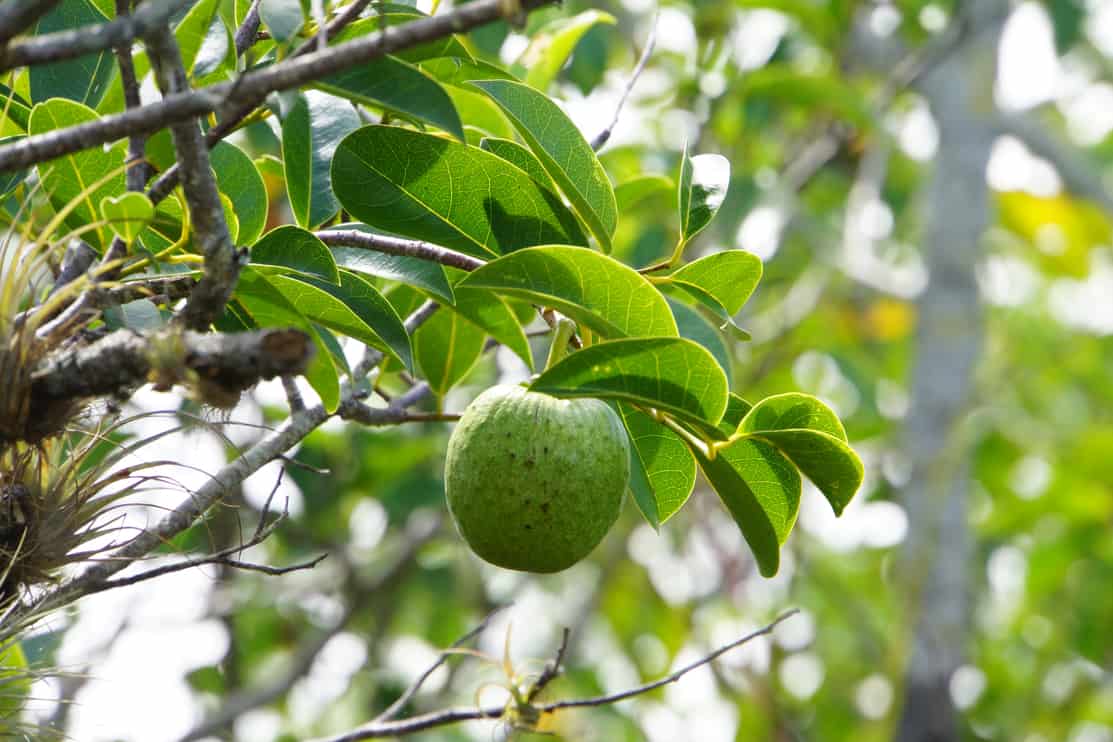
Wasserapfel (Annona glabra), Everglades Nationalpark, Florida, USA

Pond apple, Annona glabra, is known under many different aliases. It is called the pond apple, bobwood, corkwood, monkey apple, swamp apple, and alligator apple. According to the University of Florida, the name alligator apple is because it’s a common snack for alligators. Who would have thought?

The pond apple tree is semi-deciduous and is classified as woody. They grow to about 10 feet tall but are capable of growing taller than that if given the right conditions and space. They have alternating leaf patterns with leaves that are waxy and green.

While the pond apple does have flowers that are yellow and white with a bright red middle, they also bear a fruit that is edible in as little as two years. They love saltwater and even brackish water, which is a mixture of saltwater and freshwater.

Their fruit looks like a common apple, but it is green and much smaller than what you would buy at the grocery store. They are a bit more oval-shaped, too, but still hold a pretty close resemblance. 

Pond apples are found mostly in Florida, but they are also found in the Bahamas. A pond apple tree is a textbook example of salt stress and adaption in converting to a primarily saltwater tolerant tree.

Horse Chestnut
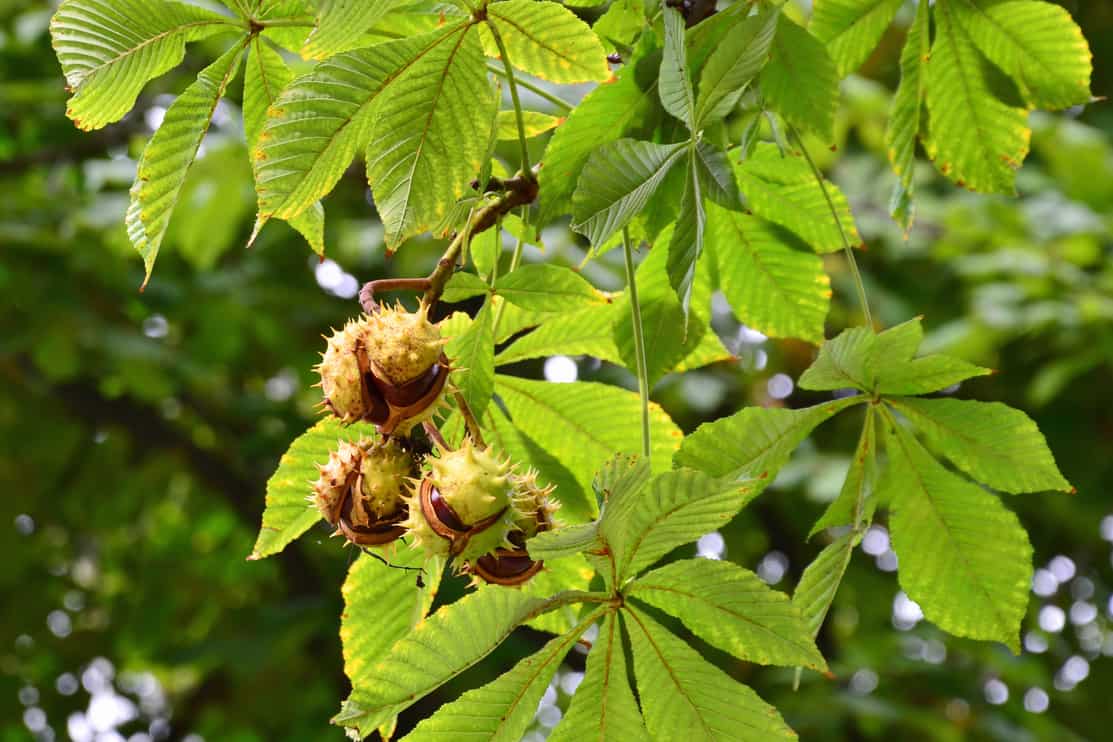
Horse-chestnuts on conker tree branch - Aesculus hippocastanum fruits.

The horse chestnut tree, Aesculus hippocastanum, is fully deciduous. According to the University of North Carolina, it usually gets about 50 feet tall but is known to grow to heights of about 75 feet as well. The horse chestnut has yellow leaves and when it fruits it has yellow and red flowers.

After the flower fruits, it produces a nut that is covered in spiky, green skin that looks sort of like a sea urchin. It’s probably one of the more interesting fruits of the trees listed here! When the skin is peeled back, the fruit is a dark brown nut that looks like an acorn without its lid.

This tree is native to Greece and Albania. It has been moved around quite a bit and is very adaptive.

Canadian Serviceberry
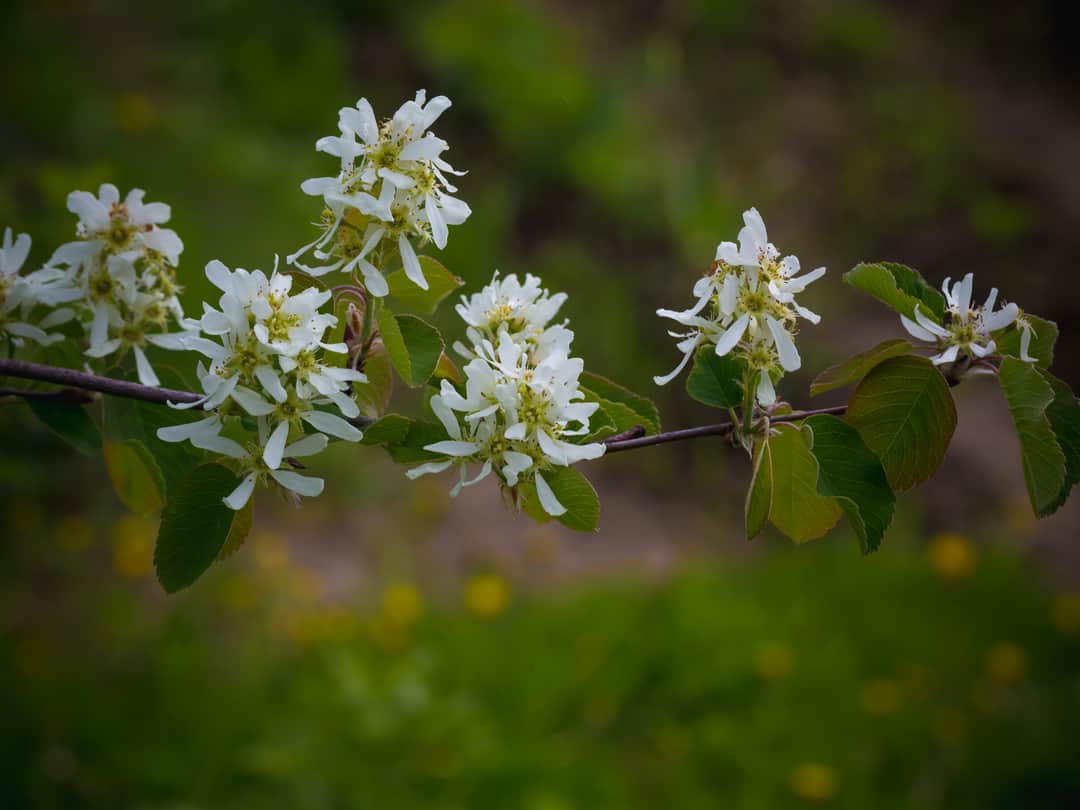
Amelanchier canadensis tree in bloom in the garden. Canadian serviceberry, juneberry

The Canadian serviceberry, otherwise known as Amelanchier canadensis, is another fully deciduous tree according to the United States Department of Agriculture. The Canadian serviceberry tree can also be known as a juneberry, which is what it is commonly known as.

This tree grows to be around 25 feet tall and unlike some of these other trees, it’s actually gray in color and is known for the dark stripes it has when it’s younger that run vertically along the length of the tree. 

The Canadian serviceberry tree can be found in the northern part of the eastern United States and into Canada (hence the name) and they have always grown in marshes, swamps, and bogs for the most part before anyone made them ornamental. Because of this, they prefer saltwater because it is part of their natural habitat. 

The Canadian serviceberry produces a sweet fruit that is actually purple. I think that’s pretty cool, if I’m being honest! But before it fruits, it gets white flowers all over the tree almost making it look like it’s covered in snow when in full bloom.

The berries are small and round, and they give off a rich and beautiful deep purple color. They grow in clusters but they almost resemble a blueberry that is a little bit off in color. 

The Canadian serviceberry is probably one of the more beautiful trees, in my opinion, that grows in saltwater.

Honey Locust

Large branched thorns on the Honey Locust tree (Gleditsia triacanthos) also known as Thorny Locust.

The honey locust, otherwise known as the Gleditsia triacanthos, is the first tree on this list to have thorns, surprisingly enough. This tree is a tall one, averaging at about 60 feet, but reaching heights of 80 feet as well. 

A honey locust tree is a darker gray (kind of like the Canadian serviceberry, but darker) or brown-colored tree. The thorns stem from the actual trunk of the tree and they are intimidating. They stick straight out and they are long, sharp, and usually, a few thorns are clustered to one spot.

The leaves are alternating but instead of being green, they are yellow and gray, how cool right? A honey locust’s fruit is just seed pods, so it doesn’t produce anything edible to humans. Before it makes fruit, it flowers into green flowers that grow in clusters. Not many people would notice them as flowers if they didn’t know what they were looking at.

Honey locusts can be found in the tropics and now, all over the globe. They love warm, humid weather. They also love acidic and alkaline climates and conditions, so the saltwater is right up their ally when it comes to how they survive. 

Cockspur Hawthorn
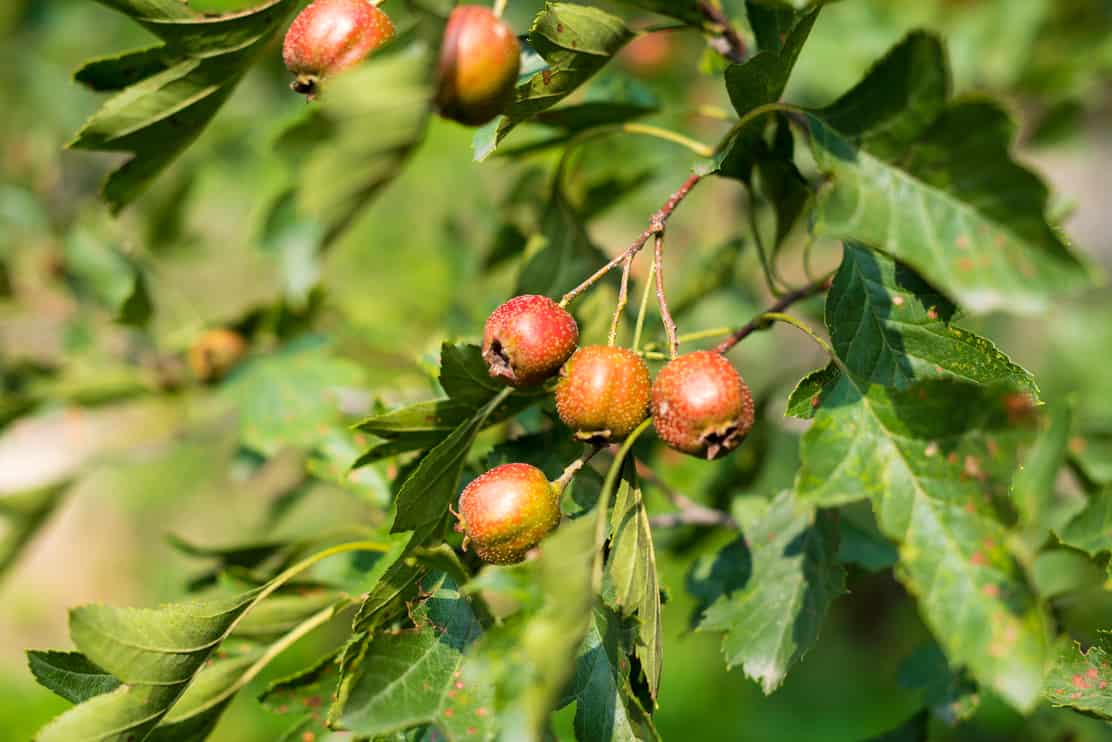
Ripe cockspur hawthorn in autumn

According to Franklin and Marshall College, the cockspur hawthorn tree (or the Crataegus crusgalli if you want to be fancy) is an interesting tree because while it is tolerant to wet, salty soil it is also tolerant to dry and hot conditions.

Cockspur hawthorn trees are also interesting because they are considered to be low branching trees, which means that all the branches droop toward the ground and you might even see the bottom branches on, or touching the ground. While the branches on this tree grow towards the sun, the bottoms of the branches sag downward.

The cockspur hawthorn itself isn’t the tallest one we’ve seen, sitting at about 25 feet tall. The leaves are dark green but they turn a purplish-red color in the fall and are oval-shaped. The flowers on this are white and they give off a really bad smell that is not exactly an attractive aspect that it has to offer.

While it is stinky, it is also pretty! It has bright red berries that blossom from the foul-smelling flowers. Where it lacks in smell, it exceeds in beauty! Don’t judge a book by its smelly flowers, am I right?

The cockspur hawthorn can be found along the coast in the eastern United States. It is a tree that has adapted to living in salty conditions due to the rise in sea level. 

White Oak
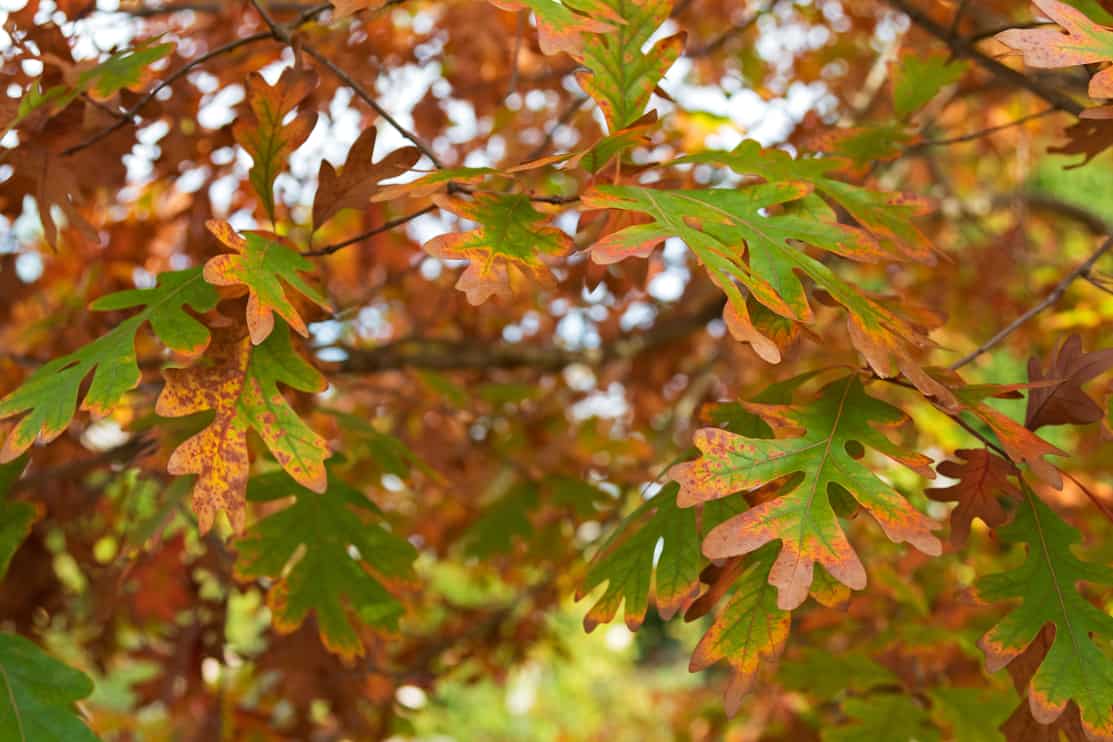
Closeup of White Oak trees leaves turning into Autumn yellow shade in Coonawarra during fall season in South Australia

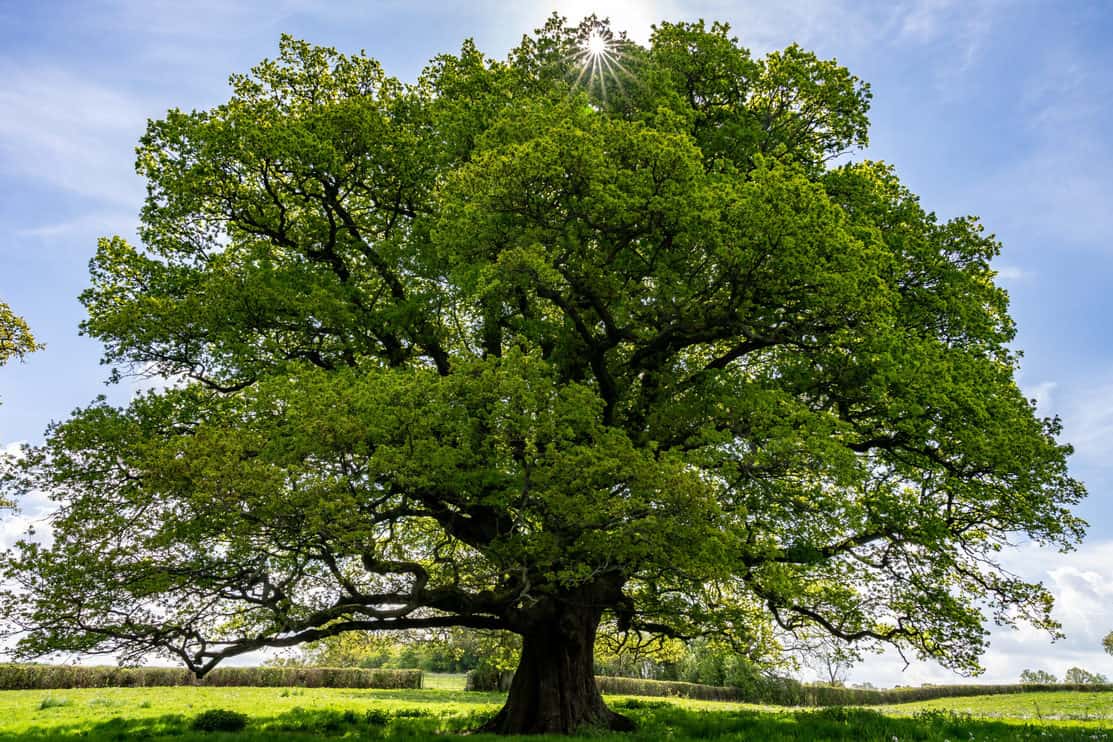
The white oak tree, Quercus alba, is honestly probably the most well-known tree that we have on this list. It is part of a very well-known family, the oaks, and some sort of variation of the tree is seen almost everywhere in the country.

White oaks live up north, mostly. They are absolutely a tree that adapted to salt life. They can be found mainly in places like the midwest and Canada, although they are found in places on the northern coast like New York, Delaware, Maine, and New Hampshire.

The more hardier species of white oak trees can withstand saltwater, but again they do thrive much better near freshwater.

White oak trees are very tall and fully deciduous. They grows to heights reaching 60 feet and their canopy can be as wide, too. They can be a pretty big tree if they have room to grow.

White oak is one of your more textbook trees. It has green, scalloped-edged leaves with flowers that are not showy. They are so not showy that you probably wouldn’t even notice them if you were walking by. They don’t have a smell either, so there is even less to notice.

The fruit this tree bears is a nut, which is more commonly known as an acorn. A little nut that is green when new, and turns brown and woody when it matures with a cute little hat on top. 

If you want to prune your white oak, the Fiskars 15 Inch Pruning Saw is perfect to maintain any low, dead, and dying branches on your tree!

Learn more about white oaks in our article 32 Incredible Facts About White Oak Trees!

Japanese Tree Lilac
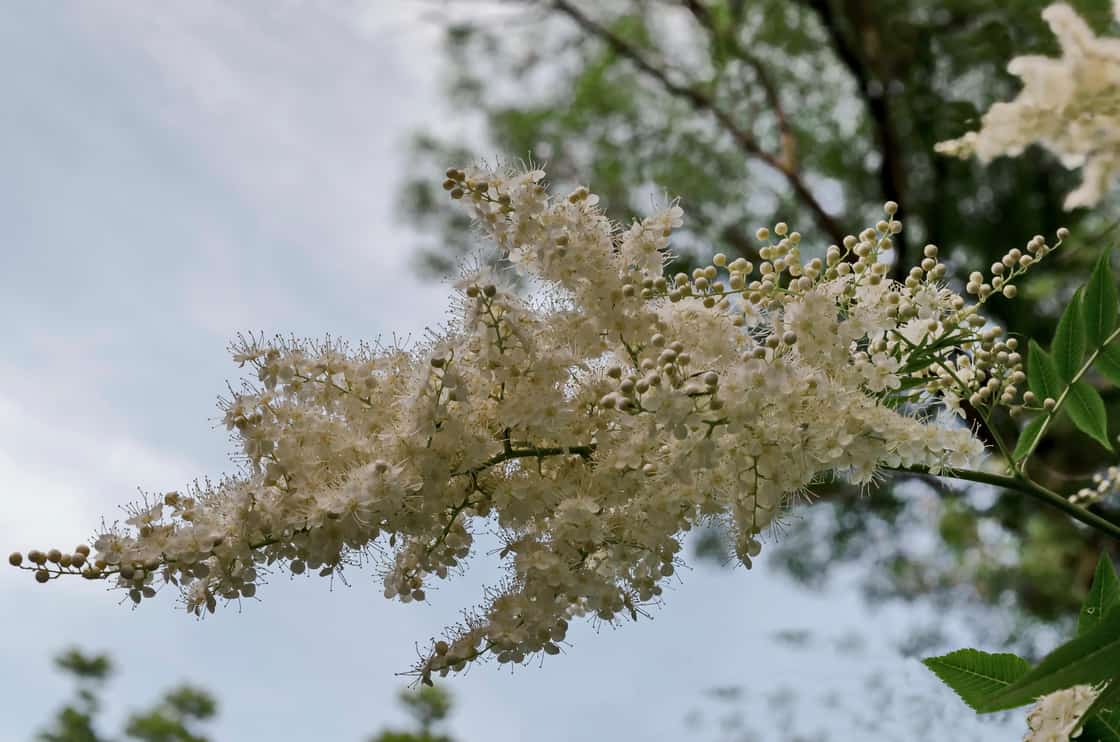
Branch of Japanese tree lilac or Syringa reticulata with white bloom close up in the springtime

The Japanese tree lilac, Syringa reticulata, if you’re referring to it scientifically. The Japanese tree lilac is on the shorter side as stated by the University of Minnesota, only reaching about 25 feet at its maximum height. 

This tree has reddish-brown bark that peels very easily and changes colors to more of a dull gray when it gets older. A lot of people compare this tree to a cherry bark tree in its appearance because the bark peels the same way.

The leaves are pretty easygoing, they are sort of a teardrop-shaped and green. They grow in opposite pairs off of the branch. The flowers on a Japanese tree lilac smell delightful and they are a pretty white color. They grow in large clusters and throw beautiful splashes of light throughout the tree when it is in full bloom. 

If you know what a lilac looks like, the flower clusters look like that, but instead of the traditional purple lilac, these flowers are white. It is a beautiful tree! The fruit, however, isn’t very exciting compared to the beautiful look and smell of the flowers. It’s a brown dry pod that holds the seeds. 

The Japanese tree lilac is native to Japan, as the name would suggest. They live along coastal areas of Japan, so they are used to salty conditions. The Japanese tree lilac has been transplanted and moved around for ornamental purposes and it can be very adaptive.

That’s All We’ve Got Today!
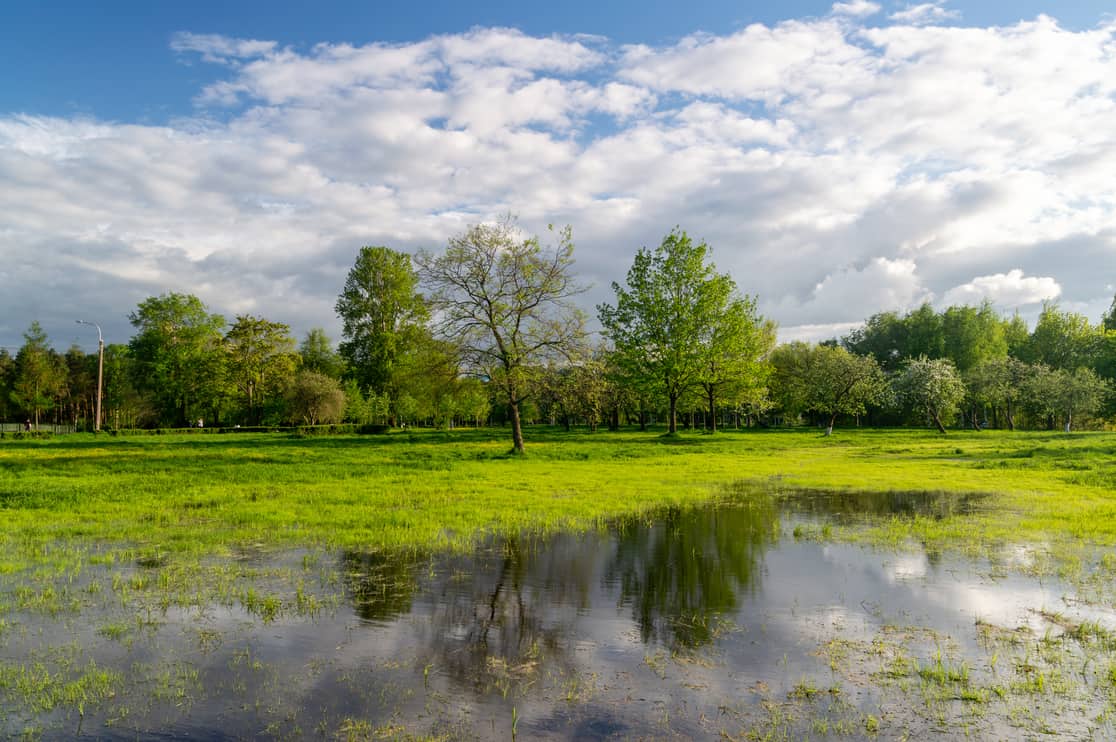
Trees that have adapted to salty conditions and prefer growing in saltwater

While a lot of trees can grow in these salty conditions, they didn’t always start off like that. A lot of trees on the coast have always had homes in salty conditions but as the sea level continues to rise, more and more trees are beginning to adapt to a new way of life.

All of the trees mentioned are great options if you are living along the coast and want to spruce up your yard with a new tree!

Thanks for sticking around and learning all about trees that grow in saltwater and why they prefer it!

References

Hanes, R. E., L. W. Zelazny, and R. E. Blaser. “Salt tolerance of trees and shrubs to de-icing salts.” Highway Research Record 335 (1970): 16-18.

James A. Allen, Jim L. Chambers, Michael Stine, Prospects for increasing the salt tolerance of forest trees: a review, Tree Physiology, Volume 14, Issue 7-8-9, July 1994, Pages 843–853, https://doi.org/10.1093/treephys/14.7-8-9.843

Singh, K., J. S. P. Yadav, and V. Singh. “Tolerance of trees to soil salinity.” Journal of the Indian Society of Soil Science 39.3 (1991): 549-556.

Zhang, M., Liu, Y., Han, G. et al. Salt tolerance mechanisms in trees: research progress. Trees 35, 717–730 (2021). https://doi.org/10.1007/s00468-020-02060-0

Zhu JK. Plant salt tolerance. Trends Plant Sci. 2001 Feb;6(2):66-71. doi: 10.1016/s1360-1385(00)01838-0. PMID: 11173290.
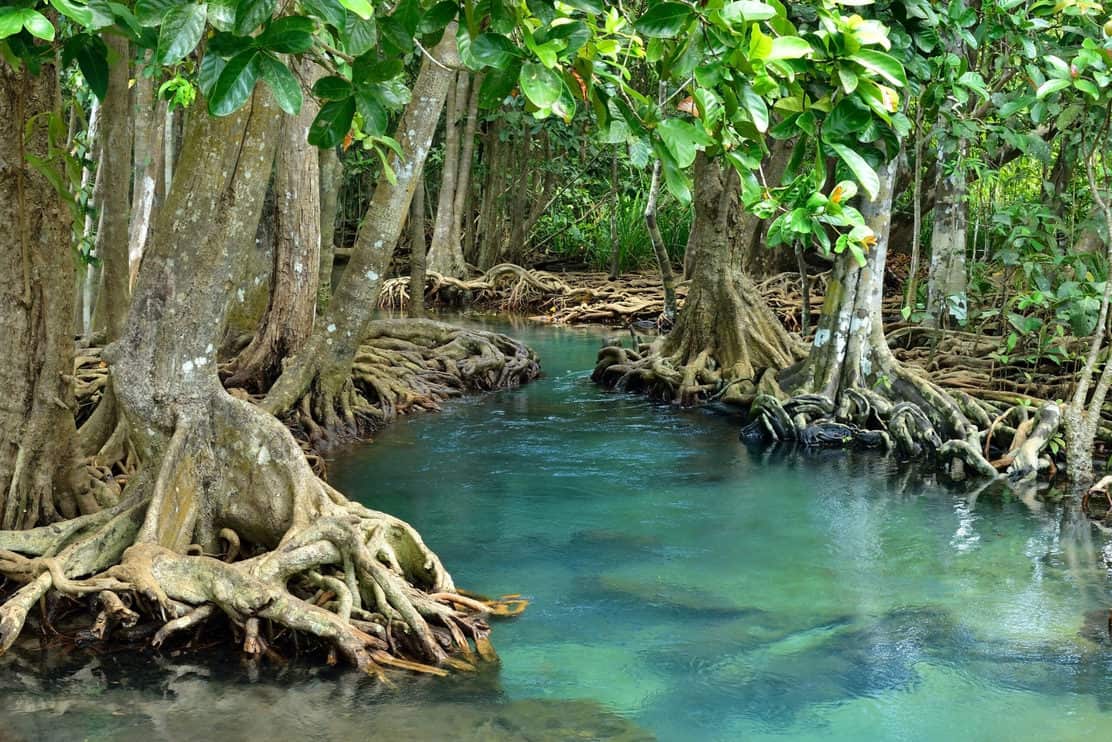
Mangroves grow along intertidal and coastal waterways as you may have seen them sticking out of the water along the coast. They look like thick-leaved trees on stilts as the tide rushes in around them. Living in the salty water as they do, you’ve probably wondered, do mangrove trees eat anything to stay nourished?

Mangrove trees don’t truly eat anything, but they do extract nutrients from the ground through their roots with the help of other organisms in the habitat mangrove trees help to create. Waterlogged soil provides nutrients from waste from organisms such as bacteria, fish, and mollusks.

Keep reading on to find out more about these fascinating trees, how they create such a diverse ecosystem among themselves, and find out how and what exactly mangrove trees eat!

What Are Mangroves?

Mangrove trees are specific trees that grow in tropical areas around or near the equator that have adapted to life in areas with low oxygen content soil. In total, there are 80 species of mangrove trees that can potentially make up mangrove forests.

These trees are often found along coastal sea waters or areas of brackish water. Mangrove forests are recognized by their intertwined roots that reach into the water and keep the trunks and leaves above the waterline.

These dense tangles of roots get flooded with the rising of the tide and help protect against erosion, slow the movement of the tides which helps sediments settle to the bottom, and can help buffer the coast from tsunamis, rising waters, and hurricanes!

Most typically, mangrove trees are known to grow in salt water in the most general gist!

Mangroves Are A Diverse Ecosystem

A mangrove forest creates a densely populated ecosystem on its own from the roots in the water to the branches above.

Fish, mollusks, manatees, algae, and more all rely on the roots of the mangrove trees for survival while several bird species, amphibians, and reptiles call the branches and canopy home.

Mangroves Offer Homes For Animals, Fish, And Insects

Mangrove roots are specialized to let tidal water submerge them without letting the tree drown. All trees need oxygen to live, and they need that oxygen in all parts of the tree; from the leaves to the trunk, and down to the roots. Most plants will eventually die if their roots are constantly submerged in water.

To get enough oxygen to survive in the water, mangrove trees grow what are called aerial roots. These roots stick out of the water and have specialized pores in them called lenticels that allow oxygen to enter but not water or salt.

The tangle of roots from a mangrove forest that reaches into the tidal basin creates shelter and attracts food for a host of marine animals.

Some of the creatures you would find living among mangrove roots include mudskippers, shellfish, sharks, fish, reptiles such as turtles, snakes, crocodilians, and even mammals such as dolphins, and manatees.

The roots of mangrove forests offer hiding places for small fish, snails, and other creatures at the bottom of the food chain, which in turn brings in those larger predators.

In fact, many fish species lay their eggs among the mangrove roots because the tangle of roots provides shelter from larger predators.

For instance, lemon sharks are known to birth live young among the mangrove roots!

These dense areas of mangrove trees offer shelter for their young and provide them with plenty of food. When these sharks are grown, they return to the place they were born to birth their own pups, so mangroves are very important for these sharks.

Mangrove Canopies House Birds, Insects And Animals

Amongst the branches and leaves of mangrove trees, you’ll find many different species as well.

Ferns, orchids, spiders, insects, tree-climbing crabs, birds, and monkeys call the mangrove trees home. When the mangrove trees flower, hummingbirds and bats come to feed off the nectar, which pollinates the flowers to drop seeds for new mangrove trees.

Mangrove trees are extremely important for many animal species for food and shelter. Without them, many species of animals would have a hard time surviving.

How Mangrove Trees Eat And Get Nutrients

Mangrove tree roots

Mangrove trees, like all trees, create their own food by photosynthesis in their leaves. But like most other plants and trees they need to draw some of their nutrients through their roots in the soil.

The muddy, sandy, coastal waters where mangrove trees grow are usually very nutrient-lacking areas. Mangrove trees live in oxygen-poor, and nutrient-poor conditions, so how do they make up for the lack of nutrients.

Fortunately for mangrove trees, there is usually a bacteria in the top layer of the soil that can convert fish waste, often in the form of ammonium deposits, into nitrates, which plants need.

The trees then help to feed the bacteria and other small invertebrates when the mangrove trees drop dead leaves. These leaves slowly decompose and provide more food for the bacteria, snails, and other small animals.

Fish come along to feed on the snails, plankton, and bacteria and drop their waste, which continues the cycle. Mangrove trees don’t actually eat anything in the sense that humans do, but they do absorb nutrients from the salty, muddy soil, thanks to bacteria.

How Mangrove Trees Grow In Saltwater

There aren’t many plants or trees that can live in harsh, salty regions. The rich salinity of seawater will kill most plants. In fact, mangroves are the only trees that can live submerged in saltwater. Some trees have adapted to live along coastal regions where salt spray is common, but if the roots get submerged by salt water, they won’t last for too long.

Mangrove trees still need plenty of fresh water to survive, so how do they get enough life-sustaining non-saline water? Mangrove trees have several unique adaptations that allow them to get enough water to not only survive but flourish.

You can learn more about where the most common places to find mangrove trees is here!

Dealing With Evaporation

The leaves of a mangrove tree are very similar to succulent plants. The leaves are thick and broad to be able to store a lot of water in them. Some also have a waxy coating that helps to keep the precious water inside and reduces evaporation when the sun is beating down.

Some species of mangrove trees have tiny hairs on them that deflect sunlight and wind, which would evaporate a lot of water when the leaves pass gasses during photosynthesis. Others have pores on the bottom of the leaves instead of the sides and the upper face of the leaves.

Mangrove tree leaves also utilize a type of sap or milky latex type substance that keeps insects and other leaf-eating animals away. This way the tree can keep more moisture inside it since freshwater is hard to come by when the roots are completely submerged in saltwater.

The Leaves Remove Salt

Another adaptation to harsh, salty environments is the ability of mangrove trees to extract salt from seawater. With their roots constantly submerged in saltwater, it would be difficult for mangrove trees to get freshwater, even when it rains, but these trees can filter out the salt.

According to the American Museum of Natural History, mangrove trees can filter up to 90% of salt out of seawater that is absorbed by its roots. Some mangrove trees use glands in their leaves to expel the salt, which can form crystals on the leaves.

Other trees store excess salt in leaves and bark that have outlived their usefulness. The old leaves and bark then fall off the tree, which gets rid of the excess salt and minerals. The tree not only renews itself but gets rid of salty waste at the same time.

Even Mangrove Seeds Are Adapted To Life In The Sea

Mangrove trees roots, Rhizophora mangle, above and below the water in the Caribbean sea, Panama, Central America

Mangrove seeds will germinate while still hanging on the tree. If they fall during low tide and hit the ground, the roots will spread very quickly and anchor themselves in the mud before the high tide returns. If the seeds fall when the tide is in, the seeds will float until they reach solid ground where they can start growing.

It has been thought that some mangrove seeds have floated on the currents for years before coming to rest on a distant shore, and growing into a tree. On the ground, the seeds need to grow fast or they could be washed away. In fact, some mangrove trees will grow more than two feet in their first year so they can get above the waterline.

Some species of mangrove seeds will form roots while still attached to the parent tree. After one to three years, the roots will detach from the parent tree and either start growing nearby or be carried to another shore.

The way mangrove trees propagate, in a matter of a decade, one solitary seed can become a new, small forest of mangrove trees.

While mangrove trees can grow in freshwater, they do prefer saltwater!

Benefits Of Mangroves

Mangrove forests are extremely important to the global environment. They provide a home for a vast, biodiverse array of animals from microscopic, single-celled organisms to top of the food chain predators, some of which are only found among the mangroves.

Coastal Stabilization

Groups of these trees help to stabilize coastlines from erosion caused by storms, waves, and incoming tides.

The roots hold together the soil while the dropped leaves help to provide nutrients to areas that are nearly empty in nutrients. The trunks and canopies help to reduce floods, and rising waters and slow down winds from big storms.

This natural barrier is more effective than artificially produced seawalls at protecting local, coastal communities. It’s also much less expensive to grow trees than it is to build walls.

Protect Water Quality

Mangrove forests filter pollutants from stormwater drainage before it reaches coral reefs.

These contaminants could damage and destroy coral reefs, but mangrove trees help to buffer these pollutants.

Important To Reducing Carbon

One of the most important factors of mangrove trees that directly affects us is the ability to store large amounts of carbon.

According to The Role of Mangroves Forests in Decarbonizing the Atmosphere, the forest of mangrove trees can store 3 to 4 times as much carbon dioxide as tropical rainforest can.

Mangrove trees also store that carbon in their leaves, trunks, and roots where they are simply an ultra-effective carbon filter!

So, mangroves are essential in the battle against climate change.

Mangroves Are Being Threatened

Whether it’s tourism, agriculture, coastal development, or shrimp farming, the mangrove forests are being threatened and wiped out. The most devastating of these are shrimp farming and coastal development.

Shrimp farmers come in, wipe out the trees, and place shallow ponds in their way for crowded shrimp hatcheries. Generally, many chemicals are used to keep the overcrowded shrimp healthy, which eventually affects everything around the area.

Pretty soon even the shrimp can’t live there, and the shrimp farmers move off to another area, leaving the destroyed landscape in their wake.

This isn’t to say ALL shrimp farmers, but thats the main idea.

With coastal development, the mangrove trees are cut down or damaged by all the pollutants that come along with building structures and roads. Eventually, these pollutants are too much for the mangrove forests to handle and they begin to fade away if they aren’t cut down and removed before development.

What You Can Do To Help The Mangroves

There are ways you can help the world’s mangrove forests. If you consume shrimp, look for sustainable alternatives to farmed shrimp that come from mangrove areas.

You can grow your own mangrove trees at home (near saltwater), and you can also donate to conservation sites, and help people who live in the coastal areas by purchasing directly from them.

Some people keep beehives along the mangroves and sell mangrove honey from these hives. These small farmers use sustainable means to provide a living for themselves and their families all while helping to protect the mangrove forests.

Grow Your Own Mangrove Tree

If you’d like to grow your own mangrove trees, you can start with these mangrove seedlings 8 Healthy Strong Red Mangrove Seedlings. You can grow these trees outdoors if you live in USDA Hardiness Zones 9-12. Mangroves will also grow in ponds, aquariums, or pots.

They will need a lot of heat and about 12 hours of full sun each day. If you want to grow them indoors in a pot, you will need a heating pad to keep the soil warm. Try out this highly rated heated grow mat, MET certified Seedling Heat Mat!

That’s A Wrap!

Mangrove Thailand

That’s all we’ve got for now!

Mangrove trees don’t really eat anything, they aren’t carnivorous plants like the Venus flytrap. But like all plants do require nutrients that they draw up through their roots and nutrients they make using photosynthesis.

Mangrove trees are fascinating, one-of-a-kind trees that provide a ton of benefits to the global environment, and positively affect each one of us. For these reasons and more, mangrove trees should be recognized for their usefulness and be protected.

Thank you so much for reading!

References

Feller, I.C., McKee, K.L., Whigham, D.F. et al. Nitrogen vs. phosphorus limitation across an ecotonal gradient in a mangrove forest. Biogeochemistry 62, 145–175 (2003).

Golley, Frank, Howard T. Odum, and Ronald F. Wilson. “The structure and metabolism of a Puerto Rican red mangrove forest in May.” Ecology (1962): 9-19.

Ruth Reef, Ilka C. Feller, Catherine E. Lovelock, Nutrition of mangroves, Tree Physiology, Volume 30, Issue 9, September 2010, Pages 1148–1160.

Thomas, Nathan, et al. “Distribution and drivers of global mangrove forest change, 1996–2010.” PloS one 12.6 (2017): e0179302.

While it may seem like a good idea to maximize your time and do any necessary tree cutting after hours, cutting trees at night is not a good idea. There are many reasons not to cut trees at night, but do you know what they are?

The low visibility caused by the dark can cause you to make a mistake on yourself, your tree, or both. While you may have a busy schedule, you can take advantage of lighter times of day, such as dusk or dawn, to beat the heat and care for your tree around your regularly scheduled daily routine.

Often, cutting a tree at night will not even cross your mind but, on the off chance this is something you’ve considered, we’ll spell out why and how this is not the best plan. Stick around after to learn more about cutting trees and best practices!

Why Should We Not Cut Trees At Night? 

1. Your Own Convenience – There Are No Benefits Of Cutting A Tree At Night 

So, here is our first question to you: why stay up late or get up super early to cut a tree? In reality, dusk or dawn works well if you are looking to beat the heat of the day and cut your tree without worrying about the sun beating down on you in the afternoon or evening. 

These two times of day are also good options when you are looking to fit in some yard work around your busy schedule. Say you have to work at 9 am and will not be back until later in the afternoon- either of these times at the very beginning or end of the day will certainly be optimal and convenient. 

This brings us back to the question about why you would cut a tree in the dark, as it often indicates you will have woken up extra early or kept working well through the day to cut those branches.

Don’t get us wrong, the dedication is great, but there are no benefits of cutting a tree at night. So, why waste your precious time and energy on nighttime cutting when there are perfectly good hours of daylight?

Besides losing some precious beauty sleep, cutting a tree in the dark is significantly more painstaking than during the day when visibility is higher. Visibility makes doing yard work much easier. 

Why not wait until you can see what you are doing without having to use a flashlight, headlamp, or other illuminating objects?

During the day, you will not have to worry about having the proper type of headlamp to see what you are doing. You can simply worry about the type of shears you might enlist to help you cut your tree. 

Options like these Fiskars Bypass Pruning Shears are a crowd-pleaser thanks to the convenience they provide while pruning a tree since we are on the topic. The all-steel blades allow for less friction and rust resistance.

Instead of losing sleep, both figuratively and literally, focus on the other ways you can make cutting your tree the most convenient, painless process!

2. Low Visibility Can Cause This To Be A Troublesome Task

While convenience is a big factor to consider, it is not the only one. 

It may seem like common sense not to cut a tree at night, in the dark, when you can barely see a foot in front of you. Many people, though, may also just take a headlamp or flashlight and get to work.

Why exactly is this such a bad idea in terms of safety?

We certainly do not want you to cause an issue with yourself (or your tree). Doing manual labor with sharp objects in a low-visibility environment is a big no-no for obvious reasons. 

If a tree is close to other objects like a fence, a garden, your home, or utility lines, the low-light conditions of working at night could knock over something important. It may also crash into something you would prefer to be left untouched. 

You’ve probably seen fallen trees before, whether it was a full tree after a storm or a big branch. They sometimes leave you wondering how on earth they just fell down. 

Well, pruning your tree at night is a good way to increase the odds of branches falling down- especially if the structural integrity of the tree is already lacking.

You may not notice another significant structural defect in your tree in the dark. Cutting around a weak or cracked area could lead to other parts of your tree falling unexpectedly. While this could also happen during daylight hours, the likelihood of noticing will be much higher in the light.

Similarly, you could knock yourself down or even cut yourself if visibility is enough of an issue. 

So, save yourself the danger of tree-cutting at night and plan to pick a time during daylight hours when you can safely (and more easily) cut your tree!

3. Trees Are Asleep At Night, And You Should Be Too

Starry Night |  Night Silhouette Tree Line

Let’s circle back to the idea of getting some sleep!

Did you know, technically, trees are asleep at night, too?

Purdue University’s Forestry and Natural Resources Extension confirms trees droop their branches at night and will lean over a bit. It’s like they are slumping into sleep for the night, as well. 

You may have noticed this sort of behavior in flowers, as they appear wilted or drooping before sunrise and into the early hours of the morning before the sun dries up morning dew and flowers regain their composure.

It is no surprise, though, if you didn’t know this about trees. In fact, most people don’t.

There is an assumption trees are sturdy enough, and built so differently than delicate flowers and even certain bushes, that their composure remains day and night. 

Well, like all living organisms, there must be some time for rest built into the lifespan of a tree. 

At night, trees are not undergoing the process of photosynthesis and can find reprieve during those darker hours.

Cutting drooping branches, if only ever-so-slightly, is not a great idea because those same branches may be oriented a bit differently during the day. 

As we now know, trees also lean at night, if even a few centimeters. The tree itself may not be as structurally sound to be climbing, cutting, or engaging with in any intensive way. 

Cutting your tree at night most likely won’t cause deep damage by nature, but the night is certainly not an ideal time to do this.

Since trees are not undergoing photosynthesis, a process heavily reliant on the sun, at night they accumulate more CO2 on top of having droopy branches. 

As you can gather at night is not an opportune time to be cutting your tree. The viability of cutting a tree aside, you may always succumb to your weariness and fall asleep at the blade (it’s like the wheel, but a different level of ‘bad idea.’)

Trees are asleep at night, and you should be too!

So, what else is there, on top of interrupting your sleep, potentially causing problems, and cutting branches that are not in a position to be cut (literally and figuratively, that is?)

4. You Might Miss Spots And Under Prune Your Tree

So, speaking of low-visibility again, let’s talk about outcomes less dramatic than hurting yourself or falling asleep while you cut your tree.

While you are pruning your tree, the goal may be one of many things:

  • Reduce the possibility of branches falling and causing damage
  • Rid your tree of a diseased limb or two
  • Reduce the amount of weight on one side of the tree
  • Make your tree look more aesthetically pleasing
  • Remove an infested section you cannot save

Whichever reason you have for cutting your tree (or if you have one not on this list), your baseline goal of pruning is to help your tree. 

One of the most important aspects of pruning, cutting pieces of your tree away, is to see what parts of your tree you are removing. 

If you cut your tree in the dark, you might miss spots and under prune your tree. This creates a whole deal of extra work for you later. It can make infestations harder to eradicate, the canopy can appear lopsided, a branch could break off and fall on your car, or whatever other scenarios may occur. 

These things are avoidable so long as you cut your tree when you can see what you are cutting down. 

On the flip side, cutting trees in the dark could lead you to be overzealous.

5. You Might Cut Something That Didn’t Need Cut And Over Prune Your Tree

pruned poplar

If you cut your tree when it is dark out, you may do the opposite of underpinning, and cut too much off of your tree. 

Picture this: it’s 9 pm and you head out and prune your tree (for whatever reason that may be.) You’re pruning away, and suddenly you see a dark spot on a branch and think that it must certainly have some sort of decay happening. 

You decide to cut the branch down and then head off to bed. In the morning, you see the branch looks perfectly fine and realize it must have been a shadow you saw. 

Low-light situations lead to lots of tricky shadowing and visibility issues. This can cause you to cut off too much of your tree’s canopy. 

The University of Florida tells us removing too many low branches at one time, or over pruning, can lead to complications like masses of sprouts popping up in the area and causing the tree to appear disfigured. 

Another complication of over pruning, or incorrectly pruning, is it can cause damage to the tissue of the tree, leading to open wounds not properly closing. This can then translate to decay, disease, infestation, and more. 

Trees need their branches to survive. They are necessary to the tree’s survival, so proper pruning is a must!

6. Cutting A Tree At Night Increases The Difficulty And Amount Of Work

Finally, just remember cutting a tree at night significantly increases the difficulty of the task, with no benefit. You’ll also likely be doing much more work than you would during the day, causing a strain on your body, your eyes, and your tree. 

We don’t want you to get in over your head, and trying to prune your tree at an inopportune time could quickly go wrong for many reasons.

If you are still wondering what other options you’ve got, keep on reading to find out!

What Should You Do Instead Of Cutting Trees At Night?

This one is easy!

Read a book, watch a movie, go on a jog, paint a picture…

We’re joking, sort of. 

Really, though, this is a simple answer. Just wait until morning. 

As we mentioned above, dawn and dusk can work as substitutes for nighttime tree cutting when you are trying to beat the heat or a busy schedule. 

Otherwise, make a weekend activity out of your yard work and cut your tree around mid-morning, so you are not overtired and can do so safely. 

On that note, how does one properly cut trees during the day?

Great question, reader! Let’s dive in:

How To Properly Prune Trees (During The Day)

Man with gloves is cutting branches from tree, trimming

When you can safely decide to cut your tree during the day, you should know how to do so properly. 

So, what are the right steps in this case?

First, safety is still key in this situation. While cutting trees at night is considerably more dangerous, difficult, and painstaking overall, there are still factors to consider when you cut a tree during the daylight hours.

You’ll want a good pair of shears, like those Fiskars we mentioned above, or perhaps a longer-handled pair such as the Centurion 3- Piece Lopper, Hedge Shear, and Pruner Combo Set, which gives you access to 3 tools in one for the price of well, one. 

You’ll also want to factor in the time of year, and you should not attempt to prune your tree during the winter months unless you live in an extremely temperate area with steady weather patterns.

You can read our guide on the best time of year to prune large trees here.

What else should you be aware of during this process, though?

Things To Be Aware of When Cutting Trees

There are multiple things to consider when you go to cut down a tree, and those considerations go far beyond the time of day you decide to bring out your shears. 

We talk about needing to prune certain branches because of decay or breakage, but you should inspect the limbs first to see if they will fall at an odd angle or potentially hit something on their way down. 

Cracks of trees may house more decay than you realize, or animals you do not want to harm during your branch removal process. 

If you do not feel comfortable inspecting these things, or feel shaky on the ladder when you decide to get up there and check things out, reach out to a trained professional. 

It’s great to take the initiative and do these things to care for your tree, but there is also no shame in getting help. Especially if pruning your tree puts you at any sort of risk.

That’s All for Now

Thanks for sticking around to learn why exactly you should avoid cutting your tree at night, as well as some ways to prune successfully at any other time of the day.

When all else fails, remember these six reasons not to cut trees at night:

  1. Your Own Convenience
  2. Your Safety
  3. You Should Be Asleep, So Is Your Tree
  4. You Might Under Prune
  5. You Might Over Prune
  6. You’ll Be Increasing Difficulty and Workload

Remember, you should do this instead:

Cut your tree during the day to avoid lots of extra strain on your eyes, your tree, and everything in between. 

With that, we wish you all the best on the rest of your tree journey, and hope we can help again soon!

References

Mitchell, D. L., Gallagher, T. V., & Thomas, R. E. (2008). The human factors of implementing shift work in logging operations. Journal of agricultural safety and health, 14(4), 391-404.

Narwoko, B. P. (2005). Implementation of Tree Cutting Best Practice Based on Reduced Impact Logging Guidelines for Indonesia on Tangguh LNG Project.

Growing trees can be one of the most rewarding things! You may have wondered at some point, “just what the heck is that green fuzzy stuff growing on the outside of my oak tree?” Well, it’s moss, and there’s a few reasons why it’s there.

Moss grows on wet trees and branches out of direct sunlight because it can only grow in moist areas with moderate to low light, as moss spores require water to flourish. If you have moss on your oak tree, it most likely isn’t getting enough sunlight and is in a damp environment.

Read on to learn more about moss, how you can identify it, remove it, and more!

Basics Of Moss Growing On Oak Trees

Moss has pretty basic conditions needed to grow. These conditions are all pertinent to it maintaining life and reproducing. Moss needs both moist and low light conditions.

Moisture is probably the biggest key to moss growth, as moss needs water to reproduce. In addition, having structures such as branches also can increase the chances of moss growth. 

Moss Reproduction

As mentioned, moss needs water (and low light conditions) to reproduce. It creates spores through natural processes, which require water to happen. Without the presence of water, most of these processes occur at lower rates or not at all.

These spores are then released and fly in the wind until they stick to other surfaces (such as rooftops or the sides of trees.)

When the spores attach to other surfaces, they often remain dormant. If they are in the presence of water for a prolonged period, the spores become active and divide on a cellular level, to create new moss. 

Is Moss Safe to Grow On Trees? 

To answer briefly, yes. In most cases, moss is safe to grow on trees as it is not parasitic. However, extreme and excessive moss growth on oak trees can eventually cause tree damage.

This susceptibility to damage is mainly because of the weight. Since moss is usually wet or damp, it is very heavy in large amounts.

When trees have lots of wet moss on their delicate branches, those branches are usually more sensitive to wind and storm damage. This is a good thing to think about when you are controlling moss growth on trees. 

What Does Moss Growth On Oak Trees Indicate? 

Moss growth on trees can indicate a few things. Drawing on basic information, if moss is growing on your oak trees, you can assume your tree is commonly damp and somewhat in the shade. 

Along with moisture and light, moss growth on your oak tree can also show its current health. While moss growth does not harm your tree, it could be a sign that your oak tree has another deeper issue or has taken damage to its outside bark.

This is because when bark peels off of trees, it leaves the perfect area to promote moss growth. In most cases, peeling bark (at least in most oaks) can be a sign of damage or underlying issue, meaning moss is a great indicator of pre-existing tree health. 

Do I Need to Remove Moss From My Oak Trees? 

Old mossy trees with crooked branches and roots

Due to the nature of moss growth, removing most mosses from your oak trees is purely up to preference. Some people think trees look great with moss and leave it on, while others see it as an eyesore, and remove it.

Since the moss does not harm the tree on its own, removing should be mostly up to how you like the look of it on your tree. 

Removing Moss From Oak Trees

Excessive moss growth on delicate branches can pose a risk for the branch breaking off due to stress. This means you may need to remove moss when it is on small branches to avoid tree damage and safety issues. 

How to Remove Moss From Oak Trees

While it may seem like an alien task, removing moss is simple. For most mosses that grow on oak trees, you can pull it off the bark gently, causing little to no damage to your trees. 

While moss technically makes ‘roots’, it mainly uses them for structural support, simply attaching gently to whatever they are sitting on. This means you can normally just grab the moss and pull it off.

Make sure to wear gloves and a long sleeved t-shirt when peeling off the moss! You can also use a light brush with some water to clean your oak tree’s bark to get rid of the residual moss.

Mosses vs. Lichens 

Example of lichens on tree bark. Lichens vary in color from yellows, reds, oranges all the way to greens and blacks.

One important thing to note is the difference between mosses and lichens. Most times, people can quickly misidentify lichens for mosses.

Lichens are lighter on trees and can appear dryer and crusted closer to the surface of the bark. Lichens are a symbiotic relationship between fungus and algae.

On the other hand, moss is usually wetter in appearance, and has more of a 3D structure, coming a fair bit off of the tree. 

Dangers Of Misidentifying Moss And Lichens 

The primary danger of misidentifying moss and lichens comes along if you remove them. Moss is fairly easy to remove and causes little to no damage to your tree. Lichens, however, can do more damage than good. 

Removing lichens can mainly cause damage by ripping off layers of bark with them, leaving bits of the tree’s soft inner core open. Leaving large patches of open tree can leave your oak susceptible to damages such as pests and long term issues.

What Type Of Moss Is Growing On My Oak Tree?

So depending on your environment, there are a few different types of moss that will grow on your oak tree.

In general, three types of moss tend to grow on oak trees. These mosses include Spanish moss, ball moss, and common moss. 

While it may seem arbitrary to identify the type of moss growing on your tree, it can help with removal and control. Different mosses have different growth patterns and reproduction cycles. 

Spanish Moss

Spanish moss is a unique moss, often misidentified as a lichen or algae. In a way, Spanish moss almost looks akin to Halloween decorations, hanging off of trees rather than sticking to them closely. 

Spanish moss is usually a light greenish-white, hanging in festoons off of tree (such as oak) branches. Spanish moss is often associated with trees, such as oaks growing in the south (such as Texas, Arkansas, etc.)

If you’re noticing this is the type of moss you have, take a look at our guide on what to do if you have Spanish moss on your oak tree!

Ball Moss

Ball moss is one of the most easily identifiable mosses. Ball moss grows on the side of trees in the shape of little spheres, similar to sea urchins. During full growth, they can become the size of a tennis ball/softball, normally in a dark to light green color.

When the moss has reached maturity or is dried out (as it is commonly seen), it can appear brown or light tan, with almost sharp protrusions. 

Ball moss is a very common species of moss to see in the south. It is especially common to see growing on the sides and branches of trees in the oak.

You can read our full guide on what to do if you have ball moss on your oak tree here!

Common Moss

According to most sources, “common moss” is not a widely identified species. In reality, “common moss” refers to a group of mosses commonly seen across the globe (found in a variety of locations, in high populations). 

Common moss looks like the picturesque moss we often see in movies: in pillowy green blankets covering objects. This can be seen hugging tightly on the sides of oak trees or simply around their branches. 

Can You Put Moss On Your Oak Trees? 

Spanish Moss growing on old oak trees in the southern United States

In short, yes, you can put moss on your oak trees. Most mosses can easily transplant onto surfaces under the correct conditions.

The most common moss to transplant is Spanish moss, however, others can be transplanted as well. In addition, simply creating correct conditions for moss growth can also improve the chances of moss growing naturally.

Spanish moss is actually quite beautiful!

There are many ways to transplant or improve the chances of getting moss, so take any tips with a grain of salt, as outside factors such as climate and tree type can also impact moss growth. 

Best Conditions For Moss Growth

As mentioned, you need the correct conditions to get moss to grow. These required conditions include having a semi-shady location and having frequently moist surfaces for moss to grow off of.

You can create some of these conditions on your own if you want to have moss grow on specific trees. To create semi-shady areas, you can try planting trees, other larger shrubs, and plants, or try planting the tree you want moss on in an already shady location.

As for creating damp conditions, you can also somewhat achieve this by planting strategically. This means densely planting high humidity plants that retain moisture (so the area stays somewhat damp and humid). If this is too much for you, you could also experiment with hand watering or misting the tree frequently to keep it damp as well. 

Encouraging Growth 

Instead of physically putting moss on your tree, you could also create the correct conditions for it to grow. Doing so will increase the chances of nearby moss naturally throwing spores that successfully stick and grow on your tree. 

To get moss to grow naturally (without direct transplanting or propagating), your tree has to be near existing moss. This is because moss replicates by throwing spores that fly in the wind, meaning it can only replicate for a certain distance away. 

Direct Transplanting 

Direct transplanting is another method for putting moss on a specific tree in your yard. To directly transplant moss, you, of course, need a patch or colony of preexisting moss in a healthy state. It is important the moss you are moving is healthy. If it is sick, it could simply die, or even transmit something to your trees. 

Most people say to direct transplant, you can simply take the moss from one location, and move it to your desired tree. As long as the tree has the correct conditions, the moss should be able to regrow successfully on the tree and multiply.

Similar to planting moss for fish tanks, some people also recommend tying the moss to the tree with fishing line. This is especially helpful if you want your moss to be in positions where it can easily fall off of the tree because of gravity. 

Does Moss On Oak Trees Cause Bugs? 

old oak in the forest covered with moss, nature

To answer plainly, it depends. Bugs are usually attracted to moisture, soil, food sources, etc. This means healthy moss (which is usually damp or wet), can be attractive to certain insects. On the other hand, if you have more of a dry hanging moss (such as Spanish moss), the chance of insect infestation is significantly lowered. 

Moss On Trees

As mentioned, in most cases, having moss on trees will not attract too many (harmful) bugs. Destructive bugs, like termites, are not normally attracted to moss (just the tree itself). This means, in most cases, moss won’t attract bugs dangerous to the tree itself. 

While moss will not attract tree-harmful bugs, it is important to know what bugs moss attracts, and how those bugs can affect the rest of your yard. 

Negative Bugs Attracted To Moss

Moss can have the effect of attracting some bugs capable of yard damage. Some common bugs attracted to moss include springtails, thrips, aphids, spider mites, etc.

If your moss or oak tree are a part of a garden (with other vascular plants), the attraction of these bugs could be an issue. They can quickly and easily cause a lot of damage to regular plants you would find in the average home garden!

Conclusion:

In the end, moss growth can seem like a very confusing topic, especially when you introduce the idea of different mosses, and how their reproductive cycles change depending on what surfaces they are growing on. In most cases, moss will tend to (and often requires) frequently damp surfaces and medium-to-shady light conditions to grow. 

Moss is usually safe when growing on trees, so there is no need to worry about it causing damage or sucking nutrients from your oaks. It can be used as an easy indicator of tree health, and if you want to remove moss from your oak, it is a simple and easy process to complete!

There are a few different mosses that can grow on oak trees, and they all have their unique looks, reproductive cycles, benefits, etc. If you want moss to grow on a specific tree, there are ways for you to create the correct conditions for it to grow, or even for you to transplant it onto a specific tree. 

In the end, moss is a pretty interesting plant you can use to add a lot of character to your oak trees. With this, take some time to think about the moss growth in your garden, what it means, why it is caused, and what you personally want to do about it! 

References

Angeles, M. A. 600 E. P. A. P., & Us, W. 98362 P.-3. C. (n.d.). Mosses – Olympic National Park (U.S. National Park Service). Www.nps.gov.

MossBasicsText. (n.d.). Bryophytes.science.oregonstate.edu.

Physical control of moss on trees. (n.d.). Bryophytes.science.oregonstate.edu. Retrieved April 14, 2022.

Living in the Land of Mosses. (2016, May 24). Pacific Northwest Pest Management Handbooks.

Lichens | University of Maryland Extension. (n.d.). Extension.umd.edu.

Mangrove trees are a specialized type of tropical tree that grows partially submerged, often in saltwater marshes. Mangrove trees are the only species that can tolerate the high salinity of oceans and seas. So they must love water, but where are some of the most common places to find mangrove trees?

Mangrove trees and shrubs grow along tropical and subtropical estuaries, rivers, and shores. Most grow in muddy, waterlogged soil, but some can grow in sand, peat, and places too harsh for other tree species. Mangroves live in the water nearly 100 times more saline than other plants can tolerate. 

Mangrove trees are found across the globe, so let’s take a deeper look into some of the most common places mangrove trees can be found!

Mangrove Trees In America

Mangrove trees can be found in tropical and subtropical climates near the equator. They can tolerate and thrive in some of the saltiest water, and are one of the few types of trees that can grow near salt water, but they can’t stand the cold.

There are a few places in the US where mangroves grow naturally, while some places had mangrove trees artificially introduced. They can survive in USDA growth zones from 9-12. These places are very hot, don’t have cold snaps very often, and are typically coastal areas. 

Florida Mangrove Trees

Mangrove forest in the Everglades Park in Florida, USA

Along the southern edges of the coast of Florida, you might run into up to three different species of mangrove trees. The red mangrove grows along the coastal edge and is recognized by its finger-like roots reaching into tidal areas. These roots stretch down into the water to help stabilize the tree

Black and white mangroves live further inland respectively. These trees still love salty, marshy areas, but they can’t stand being submerged as much as their red mangrove cousins. White mangroves grow in higher elevations, farther back from the shore, and do not have exposed roots like black and red mangrove trees.  

1. Red Mangroves

Red mangrove trees are the ones you are most likely to recognize because of the roots that intertwine in the salty waters. They anchor their roots in soft, muddy waters where they spread out like stilts, keeping the trunks straight and out of the reach of tidal waters.

You will find red mangrove trees along the Atlantic coast of Florida and around the Gulf of Mexico. 

Red mangroves can live in such salty, nutrient-lacking environments because of specialized adaptations to deal with moisture sapping saltwater. These trees can block out up to 90% of the salt from entering the roots. If it wasn’t for this ability, the salt water would dry out the tree and it couldn’t survive. Talk about adaptability!

The roots of these trees also have specialized pores called lenticels which can let oxygen inside while blocking water when the tide comes in. The roots and trunks of trees need oxygen to survive, but they are unable to get the gas when they are completely submerged. When the tide goes out, and the lenticels are exposed, the tree can “breathe,” it then stores oxygen in small cavities until it is needed.

2. Black Mangroves

Black mangrove trees are identified by pencil-like roots that stick up from the ground around the tree. These roots are called pneumatophores and allow the tree to obtain oxygen from the air. Often, the soil black mangrove trees live in is saturated with salt water. 

These trees don’t usually live directly in the water like red mangrove species, but they still live close enough where high tides can saturate the ground around them. If their pneumatophores are covered with silt, or submerged too long, they won’t survive. 

The leaves on black mangrove trees use excretion to remove the salt from the water they absorb. Often the leaves will have crystallized salt covering them. 

Black mangrove trees are the most tolerant of cooler temperatures of the three species found in Florida. They can be found the farthest north in the state, but like all mangrove species, they still can’t tolerate freezing temperatures for long. 

3. White Mangroves

White mangrove trees live in higher elevations than the previous two. For this reason, the white mangrove does not have surface roots like the red and black mangrove varieties. These trees are still prized for their ability to help stop erosion and provide a natural buffer from storms and water surges. 

Just below the base of the leaves, there are two pores called petioles which excrete excess salt buildup. 

Like other mangrove trees, this tree’s seeds germinate while still hanging on the branch. They have to grow fast in the harsh climate so a root will start sprouting while on the tree. How cool is that? Once the seed falls, it already has a head start and doesn’t take long to become established. 

Louisiana Mangrove Trees

Mangrove plants growing in wetlands.protective earth connection from the storm. And breeding animals.

Along the coastal regions of Louisiana, black mangroves have been growing at a steady pace. These trees are the coldest tolerant of the mangroves and can stand the quick cold snaps of the state. 

There are areas along the southern border of Louisiana that used to have plenty of bald cypress trees growing in the marshes, but over the years the salinity has been increasing. This increase in saltwater has made the environment too saline for the cypress to stand in, so black mangroves have started to move in.

In fact, since 1990, black mangroves have been increasing along the coast of Louisiana because there are no other trees that can withstand such a salty environment. 

Texas Mangrove Trees

In Texas, along the mouth of the Rio Grande through Laguna Madre, and other salty, sandy, tidal areas, you will find black mangrove trees. These trees can grow up to 60 feet tall and the temperature stays hot all the time. 

Even along the Gulf of Mexico, the temperatures in Texas can dip down to freezing. Because of the occasional cold spell, the black mangrove trees in Texas are often little more than shrubs. The cold often freezes the new, top growth of black mangroves which stunts the trees. They rarely grow taller than 3 feet

Hawaiian Mangrove Trees

According to the USDA, there were no species of mangrove trees growing in Hawaii before the early 1900s. In 1902 the red mangrove was introduced to the island chain to help stabilize some of the coastal mudflats. 

No one counted on how quickly these trees could establish themselves and expand. Now the red mangrove is considered an invasive species in Hawaii. These fast-growing trees have reduced the habitat for endangered waterfowl such as the Hawaiian Stilt, started overgrowing archaeological sites, and caused drainage and aesthetic problems. 

Mangrove Trees Around The World

Now, let’s take a quick look where mangrove trees grow in the rest of the world.

India: Home Of The Largest Mangrove Forest In The World

The Sundarbans is the largest mangrove forest in the world

In India, the Sundarbans Forest Reserve is the largest mangrove forest in the world. It encompasses some 140,000 hectares along the Bay of Bengal. This huge mangrove forest is home to many endangered species such as the Royal Bengal Tiger.

In this hot, jungle-like climate, mangrove trees grow in great abundance. These trees are critical for this environment and the creatures that call the Sundarbans Forest Reserve home. There are innumerable species of fish, crustaceans, birds, and mammals that depend on mangrove trees. Thank goodness for those mangroves!

Mangrove Trees In Indonesia

The country of Indonesia consists of 17,000 tropical islands and has the largest amount of mangrove forest cover of all other countries. Indonesia alone contains 23% of the world’s mangrove forests and includes the richest concentrations of different mangrove species.

Unfortunately, this area is also being deforested at an alarming rate. These mangrove forests are being cleared out for shrimp and fish farming ponds as well as for palm oil plantations. Palm oil production has removed tens of millions of acres of mangrove forest for palm oil that is used in a multitude of products. 

Some may say that removing trees and planting more trees isn’t that bad, but mangrove trees are special in that one acre of mangroves removes more carbon dioxide from the environment than an acre of rainforest. Mangrove trees are being removed from the environment faster than rainforest deforestation. 

Mangrove Forests In Brazil

Dense mangrove vegetation over water in an area with preserved environment in Brazil

In Brazil, the Bahia mangrove forest covers the majority of the country’s coastal region. This tropical rainforest gets over 55 inches of rain per year. The excessive rainfall does not stop the red mangrove trees from flourishing here. 

This area covers over 800 square miles of dense mangrove forest land. It is not continuously forested but is broken up by various river estuaries. These areas are not easily accessible and are not studied much, but they are also threatened as human populations continue to spread toward the coast, especially in the northeastern areas. Mangroves need their space, just like us!

These mangroves, like all mangrove forests, play a critical role in fish nurseries and places for mollusks, crabs, and shrimps to live. They also provide places for many waterfowl species such as the great egret, snowy egret, and many migratory species to nest and feed. 

There have also been sightings of five different species of sea turtles swimming among the mangrove roots. These species include the loggerhead sea turtle, olive ridley, leatherback, hawkbill, and green sea turtles. All of these sea turtles are considered endangered. 

Mangrove Trees In Nigeria

Nigeria has the largest mangrove forest in Africa. This forest alone stands for over 50% of mangrove forests in West Africa. Nigeria is also the largest mangrove ecosystem in all of Africa. 

60% of local people depend on these mangroves for survival. The mangrove trees offer therapeutic and medicinal remedies, cultural traditions, spiritual significance, as well as food and sources of income for locals. 

Many of the people living in these areas fish for themselves and sell their catch to make ends meet. In a healthy mangrove ecosystem, a single hectare of space can support 1.08 tons of fish yearly.

Local Nigerians harvest mangrove wood for household and domestic use as well. Some of the uses of mangrove wood include cooking, and smoking foods, housing material, fishing stakes, scaffolding, and much more. 

As you can see, mangrove forests are not only essential for the wide array of animals living on, around, and among the trees, but they are essential for the livelihood of residents as well.  

Australian Mangrove Trees

Australia contains the third largest area of mangrove forests in the world after Brazil and Indonesia. There are 41 different mangrove species found around Australia and approximately 6.4% of the world’s total mangrove area. These appear in nearly all the states of Australia except for Tasmania. 

The most common mangrove tree in Australia is the higher elevation loving white mangrove. There are about 80 different species of mangroves in the world, and Australia contains half of all the species. Australia also has a species that grows nowhere else in the world; the Avicennia Integra, or what the locals call an api api tree. 

Indigenous Australians have traditionally used mangrove forests for sources of food and timber. They would fish for clams, barramundi fish, and crabs. They would also gather mangrove fruit for food. The timber from mangrove trees used to be used for canoes, paddles, shields, and spears as well as boomerangs. 

Commercial Uses of Mangrove Trees

When mangrove trees are grown as a renewable resource the commercial uses are quite impressive. Nearly every part of the tree can be used for something. Tannins from mangrove tree bark, especially the black mangrove, are used for leather tanning and dyes. The timber is used in construction, and even the leaves have medicinal qualities. 

The wood of many species of mangrove trees produces hot burning charcoal, and the timber can be used in building houses, boats, and furniture.

The wood is also naturally termite resistant, very hard, and resistant to water and rot, making it a great wood for boats and canoes. In Malaysia, pneumatophores are even used in basket weaving, as well as fishing corks and floats. 

Mangrove Leaves

Some cultures used the leaves of mangroves for medicinal purposes. Other cultures would use mangrove leaves as an alternative to tobacco, tea, and feed for livestock. 

Don’t go out and start snacking on mangrove tree leaves whenever you come across them though. There are many different species of mangrove trees, some of which contain leaves that are not edible!

Mangrove Honey

Some species of mangrove trees flower year-round, which is great for beekeepers because they have a constant supply of food for their bees. Florida is one area that is starting to utilize mangroves for honey production. If you are a honey lover who enjoys trying all the different types of honey, try out this Raw Mangrove Honey from Florida!

Wrapping It Up

Aerial view of rivers in tropical mangrove forests. Mangrove landscape, Siargao,Philippines.

As you see, mangrove trees can be found all over the place in tropical zones where the land meets the sea. The largest and most common areas for mangrove forests are Indonesia, India, Brazil, Australia, Nigeria, and even the southern states of the United States that border the Gulf of Mexico. 

Mangrove forests are extremely important to the global environment, animals that call these forests home, and humans.

If you want to grow your own mangrove trees you certainly can. They grow well in zones 9-12, and also make great potted, or pond plants. They just don’t tolerate cold temperatures!

If growing mangrove trees sounds like a good time, here are some Red Mangrove Seedlings to get you started. Best of luck!

References

Ball, M. C. (1980). Patterns of secondary succession in a mangrove forest of southern Florida. Oecologia44(2), 226-235.

Hutchison, J., Manica, A., Swetnam, R., Balmford, A., & Spalding, M. (2014). Predicting global patterns in mangrove forest biomass. Conserv. Lett. 7, 233–240.

Michot, T. C., Day, R. H., & Wells, C. J. (2010). Increase in black mangrove abundance in coastal Louisiana. Louisiana Natural Resources News, 4-5.

Schaeffer-Novelli, Y., Cintrón-Molero, G., Soares, M. L. G., & De-Rosa, T. (2000). Brazilian mangroves. Aquatic Ecosystem Health & Management3(4), 561-570.

I’m sure if you’ve ever done any yard work, you know just how much time and effort it takes. Well worry no more, we’ve got a guide on oak trees and an estimated pricing chart so you can see if you’d rather get that oak tree installed!

The cost of an oak tree install depends on the size and caliper of your tree, landscape, and amount of work required to install the tree. Large trees cost more, while small saplings cost significantly less. Install costs can run anywhere from a few hundred dollars to more than $3,000.

Below we’re going to discuss oak trees, picking the right oak for your yard, and we even have a pricing chart if you decide that you want an oak tree planted in your yard. Let’s dive in, hopefully, you’ll learn some helpful facts about oak trees along your tree journey!

What Factors Affect The Price Of An Oak Tree Install?

Certain things will affect the price of an oak tree install. Depending on your overall landscape, and the work required, an oak tree install could cost significantly more or less than the table we provided.

If your land is relatively clear, flat, and doesn’t require the removal of plants, roots, trees, or other obstructions, then your oak tree install could be on the lower-priced side.

On the other hand, if it requires a lot of work to remove other plants, roots, or other things, then you could be looking at a pricier install.

Most Common Oak Trees To Buy

According to the United States Department of Agriculture, oak trees are divided into two major groups: red oaks, and white oaks. White oaks’ acorns require one growing season to mature, while red oaks’ acorns require two growing seasons to mature.

If you’d like to learn more about specifics, take a look at our guide on the differences between white and red oaks here.

White Oak, Quercus alba

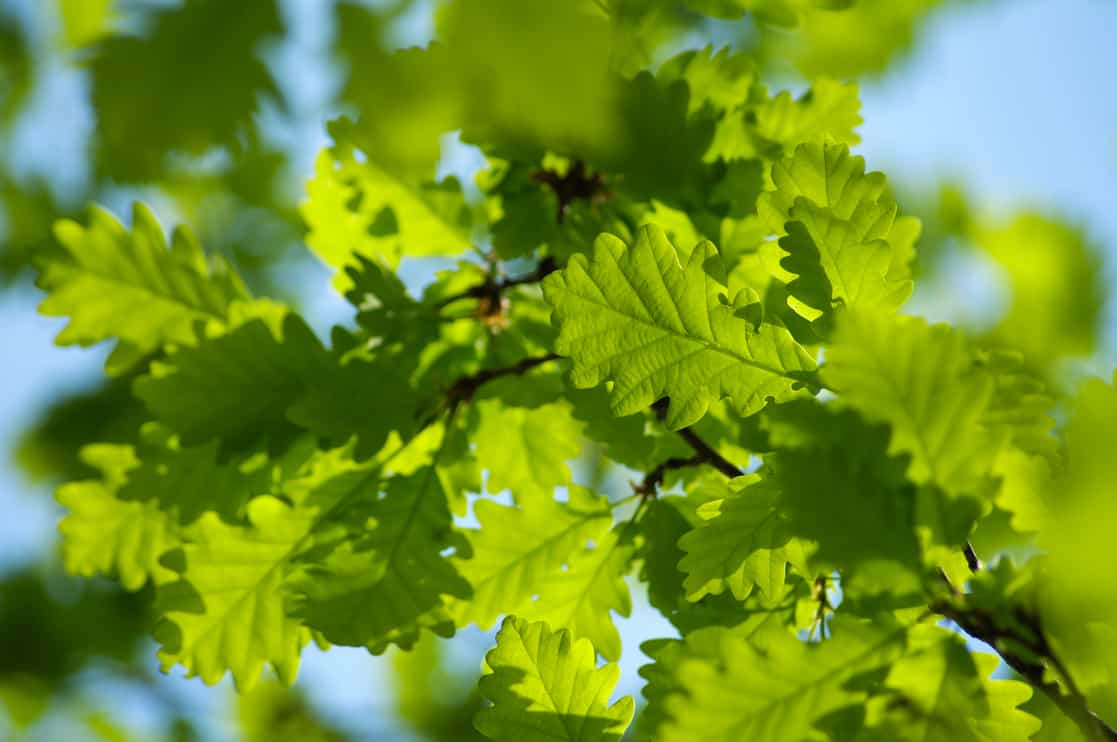
White oak tree leaves

The white oak, also commonly referred to as the eastern white oak, is a popular shade tree. It is found in the eastern United States, west into Minnesota and south to Texas, and eastward. It is commonly used for furniture, flooring, and wine barrels. 

The white oak grows to 100 feet tall, and boasts the typical, characteristic oak tree shape, with a round, wide crown. It has light gray bark with shallow furrows. Its leaves are an oval, elliptical shape and have anywhere between 5-9 lobes and slightly rounded tips. If you’ve seen an oak, this shape leaf is probably the most notable. 

There are even methods to use to figure out how many leaves a full-grown oak tree has!

Its acorns are annual, taking just one year to mature. Aside from its name, the acorns and leaves will tell you that this is part of the white oaks: rounded lobed leaves, without bristles, and annual acorns.

This tree does well in well-draining loamy soils and dry upland habitats. This tree is also known to grow at elevations in the Appalachian Mountains.

If you’d like to grow a white oak tree on your own, check out this Oregon White Oak Seedling from the Jonsteen Company which has been grown from their nursery in California’s Redwood Coast without pesticides!

Swamp White Oak, Quercus bicolor

The swamp white oak is commonly found throughout the northeast to the Midwest United States. It is found as far west as Nebraska, down to North Carolina and up into Maine, and even Quebec. 

This tree is used for construction, cabinets, boats, fences, and even railroad ties.

The swamp white oak grows to 100 feet and has characteristic dark gray, deeply furrowed bark. Its leaves are elliptical, with 10-20 shallow lobes, and no bristles. Its scientific name refers to the dual color of the leaf, with a dark green, glossy covering of the pubescence underneath it, which is white and velvety.

The swamp white oak does well in poorly draining, mineral heavy soils.

Pin Oak, Quercus palustris

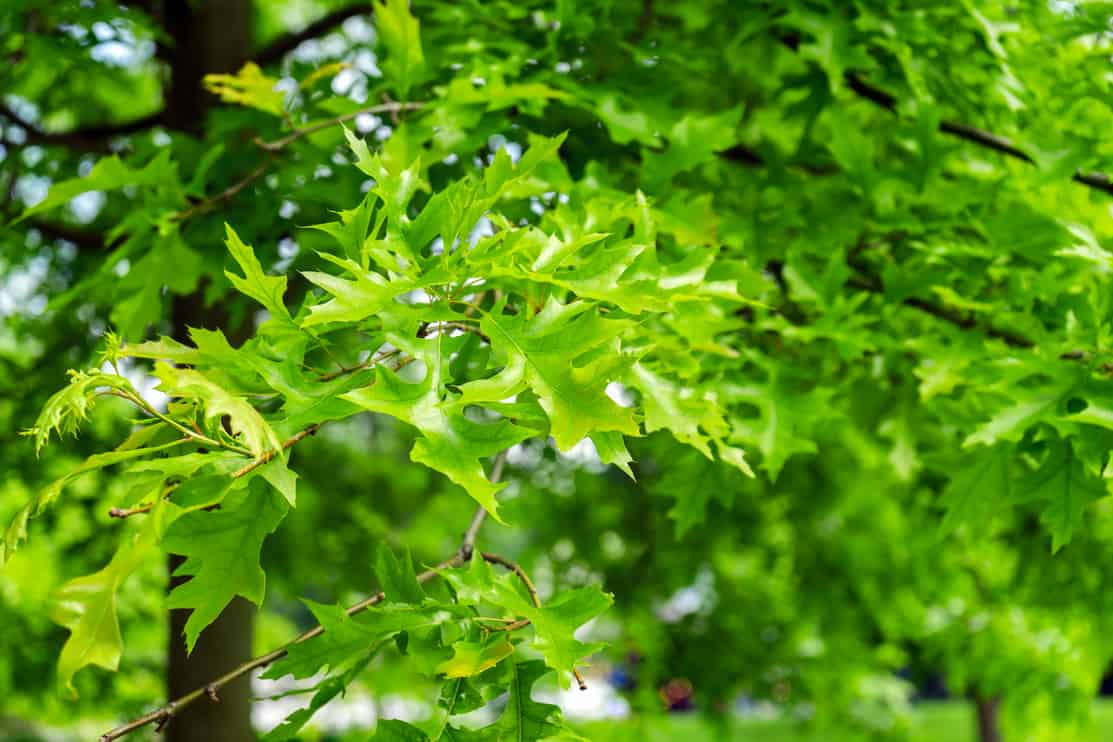
Green leaves of Quercus palustris, the pin or swamp Spanish oak

The pin oak, commonly known as swamp oak, Spanish oak, and water oak is found throughout the northeastern United States, from Vermont to North Carolina, and west to Oklahoma and Wisconsin. It is found in flood plains, and poorly draining soils, which makes it a no-brainer that it tolerates flooding and excessive moisture.

The pin oak is easily transplanted due to its shallow root system and is mainly used as an ornamental plant. 

It is a medium to large tree, growing anywhere from 50-130 feet. It has gray-brown bark with deep furrows. It is part of the red oaks with biennial acorns and pointed, lobed leaves with bristles at the pointed ends.

If you’d like to purchase a pin oak tree as they’re one of the fastest growing hardwoods, check out these 2ft tall Pin Oak Saplings from DAS Farms that you can plant on your own – they guarantee a successful transplant!

Northern Red Oak, Quercus rubra

The northern red oak is found throughout the eastern United States, north into Canada, and south into Georgia and even Louisiana. 

This oak is used exclusively in flooring and furniture and is considered the most valuable oak timber. 

The Northern Red Oak is one of the larger oak tree species that grows to 100 feet, with a vast rounded crown. You have probably seen this oak tree the most with its dark gray and almost black colored bark that has shallow furrows. 

Its acorns are biennial, making it part of the red oaks, which you could also tell by its pointed lobed leaves with bristles. 

It does well in a variety of soils, which is why it’s so commonly found. But it does best in loamy, sandy soils.

Southern Live Oak, Quercus virginiana

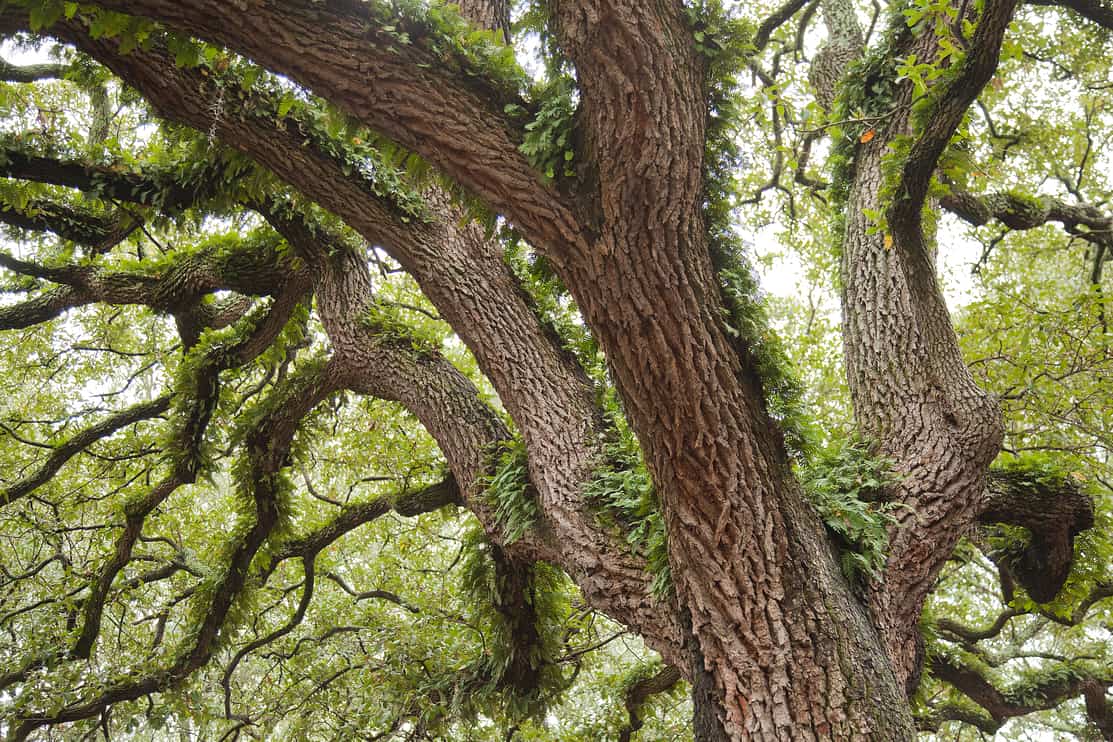
Spanish moss on southern live oak trees

The southern live oak doesn’t really resemble an oak tree at all, besides the acorn and its bark. But, if you’ve ever seen trees down south, especially in Louisiana or Florida, then this is probably what you’ve seen!

It’s used for construction and shipbuilding due to its tough and dense wood.

The Southern Live Oak Tree grows to 80 feet tall and has a sprawling, beautiful crown and canopy. It has narrow, single-lobed leaves and characteristic dark brown bark.

Additionally, its acorns are annual, making this a white oak!

Maple Leaf Oak, Quercus acerifolia

Although this species isn’t common, we thought it was an awesome one to include!

The maple leaf oak is a fairly small oak tree within the Quercus genus. It grows to only 50 feet tall and has dark gray, almost black bark with shallow furrows or grooves. Its leaves are shaped similarly to maple leaves, hence its name, with bristled tips. Its acorns are biennial, meaning they require two growing seasons to mature, making this part of the red oaks. 

It is found only in west-central Arkansas, in only four counties in the Ouachita Mountains.

Sand Live Oak, Quercus geminata

The sand live oak is commonly found along the coast of Louisiana, up to the coast of North Carolina along the coastal plain, but is most abundant in Florida. Its distribution makes it easy to guess what soils it grows best in, which is sandy soils in pine stands. 

This oak is an evergreen shrub or medium-sized tree growing to 50 feet and even 95 feet. It has dark brown bark that takes on black color, and narrow, leafy, elliptical blade leaves. It also has annual acorns making this part of the white oaks!

Bur Oak, Quercus macrocarpa

The bur oak is a unique oak that extends south into Texas and further north than any other oak species into Saskatchewan, northern Canada. 

It is mostly found in the mid-western United States as far west and north as Montana. Due to its wide distribution, it can tolerate most soil conditions and is known for being one of the most drought-tolerant oaks. 

The bur oak is used for construction and flooring, like the white oak. 

The bur oak is a large oak tree that grows to 100 feet and has a huge, thick trunk with a broad canopy. It also has light gray bark with deep furrows making it resistant to fires! 

Its leaves are probably one of the most unique features of this oak, although it is narrow and elliptical, it has a large, rounded top, and 5-7 rounded lobes. Its annual acorns and bristle-lacking leaves make this part of the white oaks.

If you’d like to grow a bur oak, take a look at these Bur Oak Acorns From North Texas!

Northern Pin Oak, Quercus ellipsoidalis

Pin oak tree in autumn

The northern pin oak, commonly referred to as jack oak or black oak, is found throughout the mid to the eastern United States, from Ohio to Michigan and Missouri. 

This tree grows to roughly 65 feet with a narrow crown. Unlike the typical oak form we know, it can grow larger, but it’s rare. If it grows beyond its range, it begins to take on a shrubby growth.

The northern pin oak has anywhere between 5-7 pointed lobes with bristles on the end. If you know what’s coming next, then you’d be right! The acorns! Its acorns are biennial, making this part of the red oaks.

The northern pin oak does well in dry and sandy soils commonly found in the boreal forest. A cool thing about this oak is that it is commonly found among pines, hickories, aspens, and black cherry trees.

Estimated Pricing Chart For Oak Tree Install

Tree NameHeightCaliperAvg. Install CostsBest Growing ZoneGrowth RateSun PreferenceEase of Transplanting
Northern Red Oak, Quercus rubra4-6 ft1.5”$2753-8Moderate Fast | +2 ft/yearFull SunEasy
White Oak, Quercus alba6-8 ft2”$3003-9Slow-Moderate | 1-2 ft/yearFull SunDifficult
Pin Oak, Quercus palustris9-12 ft2.5-3.5”$3504-8Fast | +2 ft/yearFull SunEasy
Swamp White Oak, Quercus bicolor12-14 ft3.5-4.5”$4504-8Moderate | 1.5-2 ft/yearFull SunEasy
Highrise Live Oak, Quercus virginiana Highrise®14-16 ft4-4.5”$5508-10Moderate-Fast | 2-2.5 ft/yearFull Sun, Partial Sun, ShadeEasy
Bur Oak, Quercus macrocarpa16-18 ft5”$8003-8Slow | 1 ft or less/yearFull SunDifficult
Millennium Live Oak, Quercus virginiana Millennium®18-20 ft6”$1,4008-10Moderate-Fast | 2-2.5 ft/yearFull Sun, Partial Sun, ShadeEasy
Sawtooth Oak, Quercus acutissima20-22 ft7”$1,7005-9Moderate-Fast | 2-2.5 ft/yearFull SunEasy
Sand Live Oak, Quercus geminata22-24 ft8”$2,0008-10Moderate-Fast | 2-2.5 ft/yearFull Sun, Partial Sun, ShadeEasy
Live Oak, Quercus virginiana26-28 ft10”$2,5008-10Moderate-Fast | 2-2.5 ft/yearFull Sun, Partial Sun, ShadeEasy
Cathedral Live Oak, Quercus virginiana Cathedral™25-28 ft10”$2,5008-10Moderate-Fast | 2-2.5 ft/yearFull Sun, Partial Sun, ShadeEasy
Cathedral Live Oak, Quercus virginiana Cathedral™28-32 ft12”$3,5008-10Moderate-Fast | 2-2.5 ft/yearFull Sun, Partial Sun, ShadeEasy
Average common oak trees install price when hiring a professional.

That’s All For Today!

Well, that’s all we have for today on oak tree pricing! Let’s recap everything we discussed in this article!

The cost of an oak tree, along with the cost of installation, varies depending on a few factors: height, landscape, and caliper. Depending on the type and size of the oak tree, install costs can range anywhere from a few hundred dollars to more than three thousand dollars.

Oak trees have lobed leaves and are separated into two groups. The red oaks group has lobed leaves that are slightly pointed and tiny bristles on the ends. White oaks, on the other hand, have rounded, lobed leaves without the tiny bristles on the end. 

But, the easiest way to tell an oak tree is to look for the acorns!

Thanks for sticking around and learning with us. We hope you revisit us along your tree journey, until next time! 

References 

Cienciala, E., J. Apltauer, Z. Exnerová, and F. Tatarinov. “Biomass functions applicable to oak trees grown in Central-European forestry.” Journal of Forest Science 54, no. 3 (2008): 109-120.

Epron, Daniel, and Erwin Dreyer. “Long‐term effects of drought on photosynthesis of adult oak trees [Quercus petraea (Matt.) Liebl. and Quercus robur L.] in a natural stand.” New Phytologist 125, no. 2 (1993): 381-389.

Granier, A., T. Anfodillo, M. Sabatti, Hervé Cochard, Erwin Dreyer, M. Tomasi, R. Valentini, and Nathalie Bréda. “Axial and radial water flow in the trunks of oak trees: a quantitative and qualitative analysis.” Tree physiology 14, no. 12 (1994): 1383-1396.

Vettraino, A. M., Barzanti, G. P., Bianco, M. C., Ragazzi, A., Capretti, P., Paoletti, E., … & Vannini, A. (2002). Occurrence of Phytophthora species in oak stands in Italy and their association with declining oak trees. Forest Pathology, 32(1), 19-28.

Acacia refers to a genus of about 160 trees that thrive in tropical and subtropical environments. If you are looking to find the most common places where acacia trees grow, this is the piece for you!

Acacia trees are best adapted to tropical and desert climates. These trees can be found around the globe and are native to Australia and different parts of Africa. In the United States, acacia trees grow best in USDA Hardiness Zones 9-11 and can even grow in USDA Hardiness Zone 8.

The first matter to take into account is that of regional growing zones, which indicate which geographical area a tree might grow in. Before we take a deeper dive into this topic and find out the most common places acacia trees grow, we should talk about the places where they can grow.

Where Can Acacia Trees Be Planted?

Sweet acacia, silver acacia, shoestring acacia, wattle acacia, whatever type of acacia tree you may (or may not) be familiar with, there is a trend that can be seen surrounding the locations where acacia trees grow and thrive.

Though acacia trees are quite a diverse genus, they are best adapted to tropical and desert climates, as a general rule. These trees can be found around the globe and are native to Australia and different parts of Africa.

According to Arizona State University, Acacia stenophylla, more commonly referred to as a shoestring acacia, and notes that this tree, in particular, is found most often along the river channels in Queensland, Australia.

Acacia trees are actually quite similar to eucalyptus, though they produce significantly less oil. We only mention this because the two are quite comparable and both staples in Australia between their wood, leaves, and shade, of course!

Acacia trees may be found in the savannas of Africa, the beaches of Hawaii, the desert in Australia, and across different regions around the borders of the United States.

While there are certain regions that acacia trees cannot grow in, they are suited to most warm regions of the country. If you are looking to plant an acacia tree in the United States, you can focus on the southern and western regions of California, as well as New Mexico, Arizona, Georgia, Florida, and Texas.

Now that you have a better idea of where acacia trees can be planted, geographically speaking, you may have a new question!

Can I Plant An Acacia Tree Anywhere?

In short, no. It could be detrimental to an acacia tree to plant it in an environment that is too cold for it to remain viable.

You can plant acacia trees in the majority of warm regions, thanks to their aptitude for desert, subtropical, and even tropical regions. 

We won’t dive into the specifics just yet, but the growing zones that we talk about a bit further down are going to be a game-changer as you decide whether to plant an acacia tree of your own.

As we mentioned, we’ll get there soon enough! For now, we should talk about how to successfully plant an acacia tree.

How Do I Plant An Acacia Tree?

You can plant an acacia tree from the seed, but this is not as common as you might expect. 

Most people prefer to transplant saplings from a nursery or other source since it is a bit easier to support an already-growing acacia tree. This may be considered more of relocation but it is the standard practice. 

In fact, according to the University of California Riverside’s Center for Bibliographical Studies and Research, a document from 1894 essentially gives the exact same instructions that are given today in the 21st century, how cool!

If you happen to be transplanting a tree from somewhere other than a nursery, you can use a D Handle Shovels for Digging Spade Shovel for Gardening, which should ultimately help you dig up the dirt and the roots, without severely damaging roots in the process.

You should plant (or transplant) acacia trees in the fall or spring, for best success.

Now that we’ve talked a bit about how this process of transplanting a sapling can be expected to take place, however, it is worth noting the depth at which your acacia tree should be planted.

How Deep Should An Acacia Tree Be Planted?

Big yellow blooming mimosa tree spring flowers acacia dealbata

Since you are most likely going to be dealing with a sapling, that is what we will focus on here.

You’ll mainly want to ensure that your hole is deep enough and wide enough to fit the roots and the bit of additional soil that they are intertwined with. 

One of the quickest ways to jeopardize the success of your new acacia tree is to crush the roots, not cover them with enough soil, or, well…both. 

So, while you will want enough space for the roots, you’ll also want to make sure that you plan to dig your hole a bit deeper than what will fit those roots. 

It is best to place 1-3 inches of soil over the roots of your tree so that they can get acclimated to their new home and begin to extend throughout the soil your tree will now be growing in. 

Speaking of soil, there is one more big question before we get into the four most common places where acacia trees grow and the type of soil that best suits these trees.

What Kind Of Soil Does An Acacia Tree Need?

This one is nice and simple because acacia trees are very tolerant and can do well in many different types of soil. 

However, there is always a preference when it comes to plants, and that of the acacia tree is a soil that is sandy and well-draining. This should not come as a huge surprise, since we know that acacia trees tend to grow in the desert and other tropically-focused regions.

The kind of soil that is a part of the Miracle-Gro Cactus, Palm & Citrus Potting Mix is exactly what you’re looking for when you plant an acacia tree. This soil mixture can give you an idea of what the soil at your acacia tree’s location should look (and feel) like.

Alright, now we are finally getting to the most important question at hand: what are the most common places where acacia trees grow?

4 Places Where Acacia Trees Grow

Big acacia tree in Negev desert, Israel

While growing an acacia tree may not be that simple, knowing about the most common places where acacia trees grow is a great start.

Now, it is time to go back to the topic of growing or hardiness zones. What are they? Why are they important?

Great question, let’s dive in!

What Is A Growing Zone?

According to the USDA, hardiness zones, also often referred to simply as growing zones, help us to categorize regions of the United States based on their average annual extreme minimum temperature. 

Essentially, growing zones are a way to determine what the lowest temperature in a region may be, which then helps to decide which plants can realistically thrive in any given region of the United States.

In the same way that people have their preferences in terms of temperature throughout different times of the year, plants may prefer an environment that gets a bit colder or, in the case of acacia trees, might be unable to survive in regions that are below a certain temperature

Acacia trees do best in USDA Hardiness Zones 9-11 but can be planted as low as Zone 8. 

The Hardiness Zones 9-11 are most commonly distributed throughout the West, Southwest, and Southeast regions of the United States.

These zones are split into ‘A’ and ‘B’, which account for a more specific minimum temperature variation. 

So, while the number of a growing zone represents a 10 degree Fahrenheit range, ‘A’ represents the lower 5 degrees and ‘B’ represents the higher 5 degrees of that particular Hardiness Zone.

Since we are talking about the USDA Hardiness Zones in this piece, we are going to focus on the regions in the United States that can act as good homes for acacia trees. Don’t forget, though, that acacia trees are mostly native to the African and Australian continents, so they need a fairly warm climate to grow in.

Acacia Trees Can Grow In Southern California

In this region, USDA Hardiness Zones 9a-10b, the lowest minimum temperature that can be expected in the winter is 20 degrees Fahrenheit. Southern California is very unlikely to see temperatures this low. 

The highest minimum temperature is about 40 degrees Fahrenheit, which fits many of the more temperate climates found across California.

This means that it is the perfect setting for an acacia tree to not only survive, but thrive. 

Acacia Trees Grow In Coastal California

All the way up the western coast of California we see a very similar growing zone, which is USDA Hardiness Zones 8a-11b. Though this one Zone gets a little colder and has minimum temperatures that are a bit higher. Since California is such a big state, this also may not come as a surprise to you. 

The lowest extreme temperature in this part of the country is 10 degrees Fahrenheit, which may be more likely in northern California, from time to time. The highest minimum temperature is 50 degrees Fahrenheit.

California as a whole is one of the most common places you will find acacia trees growing in the United States.

Acacia Trees Can Grow In The American Southwest

The American Southwest can range from a minimum of -15 degrees Fahrenheit all the way up to 35 degrees Fahrenheit, which is why we make the distinction that certain parts of the American Southwest are ideal for growing acacia trees. 

This region consists of USDA Hardiness Zones 5b-10a, and includes, Arizona, Texas, and a small portion of New Mexico are the only sectors of this region where we would recommend planting an acacia tree. 

Make sure to remember that the desert regions of the United States are going to be the best locations for acacias.

Acacia Trees Grow In Certain Parts of the American Southeast 

As we discuss the southern part of the United States, the American Southeast has some low minimum temperatures, but also the highest that we have seen yet. This area is comprised of USDA Hardiness Zones 7a-12a.

In Zone 7a, the minimum average temperature in winter might be a flat 0 degrees Fahrenheit. In zone 12a, however, you can expect an average minimum temperature of 50 degrees Fahrenheit- just a bit warmer on average than those Southwest California winters.

In this region, you can count on most locations being great hosts for your acacia tree, as opposed to a part of a state or a few select states in the region.

The variety of this region lends itself to be quite a good host for acacia trees to thrive in the warmth that is experienced year-round.

That’s All For Now!

African landscape with a beautiful Acacia tree (Acacia erioloba), Hwange National Park, Zimbabwe, southern Africa

While these are examples of the most common places where acacia trees grow, it is important to remember that there are over 160 species of acacia trees that fall under the genus of acacia.

So, you’ll always want to do a bit of research about the specific type of acacia tree that you are going to be caring for. 

Depending on what variety you choose, each will thrive more or less in certain regions where the average extreme minimum temperature in the winter ranges for that specific variety.

If you take one thing away from this piece (other than the most common places in the United States where acacia trees grow) it should be that properly maintaining an acacia tree from far before the planting stage is important.

You can have the healthiest, most viable tree but if planted in an undesirable location, your best efforts are likely to fail. 

So, do your research friends!

Remember, the 4 most common places in the United States where acacia trees grow:

  • Southern California
  • Coastal California
  • Southwest America
  • Southeast America

Thank you for taking the time to read this piece. We wish you the best of luck along your own personal tree journey!

References

Diatta, O., Sarr, M. S., Hansen, J. K., Diallo, A. M., Nielsen, L. R., Ræbild, A., & Kjær, E. D. (2021). Survival and growth of Acacia senegal (L.) Wild.(Senegalia senegal (L.) Britton) provenances depend on the rainfall at the site of origin. Annals of Forest Science, 78(4), 1-16.

Hoffmann, B., Kahmen, A., Cernusak, L. A., Arndt, S. K., & Sachse, D. (2013). Abundance and distribution of leaf wax n-alkanes in leaves of Acacia and Eucalyptus trees along a strong humidity gradient in northern Australia. Organic Geochemistry, 62, 62-67.

We all love our trees and we want to do everything that we can to make sure that they are in the best shape for the long haul. Watering practices are a big part of tree maintenance and can get a bit tricky if you aren’t properly prepared with the right information about how, when, and the amount that you should water your tree. 

In reality, you don’t need to water your plants and trees every day. Watering plants daily can lead to overwatering, which can waterlog roots and limit the amount of oxygen and nutrients plants are able to absorb. Using mulch and watering once or twice weekly is best general practice for most plants.

While that rule above is a good general outline, sometimes plants and trees need to water more than other times and we want to help you feel the most well-equipped to face the different needs of your tree. Keep reading to learn why you shouldn’t water your plants every day!

Should You Water Your Plants Every Day?

Many blooming apple trees in row on field with spring flowers

Before you pick up a hose, set up a sprinkler system, or check the forecast for rain showers, consider if you should water your plants every day. 

The answer to that question is no. You do not need to water your plants every day. You actually should not be doing this with any of your plants unless they are extremely new transplants or if you are in an extreme drought. 

Other than those few exceptions, you should be watering your plants on a less frequent schedule to avoid overwatering.

If you have a specific tree that you’re wondering about watering, you can check out our simple tips for watering your oak tree here!

Do Your Plants Need To Be Watered? 

Most likely, nature is going to take most of this responsibility off of your plate when it comes to established outdoor plants like trees, bushes, and even certain flowers. However, this is not always reliable so it is important to know how often, how much, and why you might need to water your tree

Additionally, gardens, flowers, and smaller plants will need to be watered more frequently than a tree or shrub will. So, when you consider smaller plants, keep in mind that this advice does change slightly depending on factors like plant size, environment, temperature, and more.

Let’s talk about some alternatives that you can use to avoid watering larger plants like trees and shrubs every day. Who doesn’t love saving time, money, and effort?

9 Things To Do Instead Of Watering Your Tree Every Day

A beautifully landscaped garden

Since we now know that you should not be watering your plants every day, let’s get into what else you can do.

If a tree appears in any way to need water, you should water your tree. Some signs that your tree is not properly hydrated are curling or wilting leaves, off-colored leaves, or soil that is dry to the touch and does not stick to your finger when you dip it in the soil.

How though, do you keep a balance between under-watering and overwatering

While there’s no real rulebook to follow here, it is safe to say that you should be able to touch soil a few inches down and see that it sticks to your finger but does not feel overly runny or saturated. 

As you work with your plants, you’ll acquire a sense of their needs and how much water is the right amount based on your environment and weather.

According to The University of Hawaii Manoa, rainwater or irrigation should penetrate the soil deeper than the roots to effectively ‘recharge’ the water that remains underneath the soil.

1. Use Mulch Around Your Tree

Mulch will cut down on the evaporation that can be released from the soil around your tree. 

For this reason, it is a great, simple, and environmentally-friendly way to keep your tree, flowers, and even some garden plants hydrated without being overwatered.

While trees may need a different mulch than house plants, you can opt for a Natural Cedar Shaving mulch that can act as a good option for most plant types. Especially if the goal is to keep moisture in the soil, any old sort of mulch does the trick.

2. Use A Water Storing Product

Lush landscaped grounds with garden in city park

Yes, there is a product for that! 

Often overlooked, water-storing products (mainly water storing crystals) are a great solution for plants both indoor and outdoor that may need some extra help retaining water. 

These crystals can be mixed into the soil, whether that is potting soil, the soil around a tree, or newly laid soil around a flower bed, in order to swell and absorb water that will remain in that soil for a longer period of time. 

Have you ever seen the infomercials for those glass bulbs that you can stick into house plants that slowly release water? These Besti Large Self-Watering Globes for Plants come in a 6-pack and are a fun way to add a pop of color next to your plants and take the stress out of watering!

The Miracle-Gro Water Storing Crystals do something similar. These crystals are added directly into the soil and allow plants to absorb extra water as needed. So, if you are looking to avoid visual clutter around your plants, or have primarily larger outdoor plants that need some extra help in the hydration department, this might be a better choice for you.

This type of product is especially helpful when you are looking to protect a plant from excessive heat, a drought, or any other extreme factors that could lead to a lack of hydration in your plant.

3. Use A Hose Every Week Or Two

If you are going to spend the time required to stand near your tree and water it with a hose, you’ll only need to do this every week or two, as needed. 

The LETIME Expandable Garden Hose is 100 ft and has 9 different pressure settings so that you can either hold your hose and water each plant or use your hose as an irrigation system and leave it slowly running in a certain area while you take care of things elsewhere for a bit. 

So many options!

4. Use A Sprinkler System Every Few Days

Beautiful lush bushes in garden

A sprinkler system is a great, and efficient way to keep the soil around your tree wet without allowing it to be soaked from overwatering. 

You can use a sprinkler system as a replacement for watering manually. This is great for those who don’t have the time or bandwidth to always keep to a watering schedule and can bring peace of mind to those concerned they might under or overwater their tree.

Products like the Orbit 50021 Digital Hose Faucet Timer are a reliable way to save time, stress, and energy on watering your tree.

These sorts of sprinkler systems are wonderful when used correctly. 

Let’s note that again: using a sprinkler system to water your tree is great as long as the system itself is properly set up, timed, and angled.

Something to consider when using a sprinkler is the placement and how that impacts the tree. Your sprinkler water should be going to the soil under the tree not hitting the trunk. 

If water from a sprinkler system is constantly hitting the trunk of a tree you’ll begin to see damage to the trunk. This can appear in the form of peeling bark from a water pressure that is too high, decay due to too much water on the surface, and more ailments.

Certain species of trees, like the paper birch tree, already have peeling bark. So don’t mistake that with bark damage!

5. Don’t Water Trees As Much In The Winter

Trees are often dormant in the winter and, therefore, do not need nearly as much water as they would in their more active stage during the warmer parts of the year.

Your tree should be able to take in some natural precipitation from rain and snow thanks to the colder temperatures that allow the soil to retain more water as evaporation is lessened.

If you’re wondering how trees get by in the winter without water, take a look at our guide on how evergreen trees survive the winter and year-round!

Additionally, hardy trees like ash trees don’t require as much water when it gets towards the colder season!

6. Water During Winter But Only In A Drought

Beautiful landscaping in garden

Now, we know we mentioned NOT watering your trees as much in the winter because of their dormancy, but we have a note to add to this point. 

If the temperature is above freezing, about 40 degrees Fahrenheit and above, and there has been no precipitation, including snow, you might be in a position that requires you to assist your tree a little more than usual.

So, what’s the deal with this?

Well, if temperatures are consistently warm enough in the winter, whether that is because of regional location or due to a warm spell in the midst of winter, roots may reawaken and find that there is not enough water to sustain them in this non-dormant state.

If you live in an area in a drought but the ground is frozen at any point in the winter, do NOT water your tree. The water will not be able to successfully penetrate the soil, therefore writing off the roots, and watering at this point is not necessary. 

Frozen ground means dormant roots that, even in a drought, do not need to be watered.

If you live in a warmer climate, you’re more likely to run into these drought issues. If you’re growing fruit, you can read our guide on how often you should water orange trees for tips on dealing with this climate! 

7. Water Trees Early In The Morning

Water will not evaporate as much during the early morning and will have the opportunity to really soak down through the soil to the roots.

This will allow you to water even less frequently than you otherwise might have to!

8. Keep Fallen Leaves Under Your Plant

Autumn forest at sunset

Yes, you saw that right! You don’t need to rake all of your autumn leaves. In fact, it’s actually better that you don’t!

Funnily enough, most people like to rake leaves, clean up fallen plant matter under flowers and bushes, and such that help the appearance of their yard. 

Well, do we have some news for you!

Keeping fallen leaves, flowers, and anything else of the sort underneath your plant will help to create a layer that acts as a mulch, minus the cost and time it takes to purchase mulch! 

It’s a win-win so far, wouldn’t you agree? Less landscaping and more pocket money!

Especially as trees and other plants begin to go dormant and lose their leaves, moisture will stay locked into the soil for a while, and eventually, when the leaves or flowers decompose, you’ll have a natural fertilizer. 

How much better can it get?

We’ve said it before and we’ll say it again- nature has some pretty cool systems in place to protect itself. We as humans just get to help out sometimes!

9. All Plants Benefit From Water During A Drought

As we mentioned above, all trees benefit from extra water during a drought. 

This, however, is the exception to a relatively consistent rule of nature. Watering your tree extra frequently is not something that you should plan on doing every year, as that can be harmful under conditions that are more normal and not drought-like.

The South Dakota State University Extension confirms that there is no set rule to follow regarding the amount of water that trees in a drought need, unfortunately. 

Drought-like conditions change everything, though. Plants are unable to get what they need from nature and that means that you as a plant owner have to step in to offer some extra support.

If you are in a drought during the spring, summer, or early fall months, you can frequently water your plants by hand or use an irrigation set to a slightly higher-than-normal level. 

If you are in a drought during the winter months, you should keep your climate in mind and water once in a while. Perhaps once or twice a month is plenty during this time of year. Remember, watering a plant that is in the frozen ground could actually harm your plants.

Fertilizing Your Tree Impacts Water Absorption

Beautiful deciduous forest. Fragrant linden flowers. Photograph taken from under a large branch of linden. Bright green foliage. Blurred bokeh in the background

In some instances, your tree might not be struggling because of the amount of water it is getting. There certainly can be other factors at play, like malnourishment. 

Using a fertilizer can be an absolute game-changer when it comes to the lasting success of your plant, no matter what type it is!

If you’re unsure of where to start, you can always opt for a balanced fertilizer like this Joyful Dirt Premium Concentrated All Purpose Organic Based Plant Food and Fertilizer.

However, if you are looking to dive a little deeper into the world of fertilizer and learn what the best type might be for a specific one of your plants, let us introduce you to the world of NPK values!

Wait a second, what on earth is an NPK value??

NPK stands for nitrogen, phosphorus, and potassium, which are some of the main elements that plants tend to benefit most from. If you look up ‘what NPK value does my ___ plant need in a fertilizer?’ odds are the internet is going to lead you to just the right place, especially since it differs from plant and tree species.  

It can sound intimidating to be searching for some seemingly random value, but just know that NPK values help us to easily see the balance of these key nutrients in the fertilizer. This should be the opposite of overhwhelming- after all, there are only 3 numbers to remember!

If an oak tree is your main focus, you can read our full guide on how to fertilize your oak tree (7 simple tips) here!

That’s A Wrap!

oak tree with yellow foliage at sunny autumn day

Outdoor plants, especially trees, may not need as much care as you’d expect, but a watchful eye is key! You want to make sure that your plants are thriving in the ways that you think they are. 

Younger plants of any species especially need a little extra care, water, and attention. If you can commit to providing this in the early stages of a plant’s life, you will ensure success in its mature years to come. 

Thank you for sticking with us and learning about more ways to keep your plants, not just trees, healthy and flourishing. 

While you may be on more of a plant journey than a tree journey, we are happy that we can be here to help you along the way. 

So, until next time!

References

Meade, G., & Hensley, D. L. (1997). Watering trees.

Young, R. F. (2011). Planting the living city: Best practices in planning green infrastructure—Results from major us cities. Journal of the American Planning Association, 77(4), 368-381.

Papayas, the delicious, creamy, sweet fruit can be found in most grocery store produce sections, but have you ever wondered if you can grow your own papaya trees? There are a few places you can grow them in the US, but where do papaya trees grow the best? 

Papaya trees are evergreen trees native to Mexico and South America. They typically grow in tropical and subtropical areas. In the United States, papaya trees are grown in similar climates such as Florida, Hawaii, southern California, and Texas.

Papaya trees can’t handle cold temperatures or soggy roots, and will grow only in the hottest zones in the United States; these Zones are 9-11. That doesn’t leave many options, but with the right conditions, you can grow your own papayas indoors or in a greenhouse as well! Let’s dive into more detail about where papaya trees grow. 

Where Should I Plant A Papaya Tree?

Papaya trees are tropical plants that don’t tolerate cold temperatures, and high winds can damage fruits and even topple papaya trees. If your area is hot enough year-round, you can plant papaya trees on your property and enjoy the fruits of your labor. 

If you do plant a papaya tree, you will need to plant it somewhere it will get plenty of sun, away from other trees. If there is a fence or building nearby, the papaya tree should be planted facing a southern or southeastern direction. 

Pick a place that does not flood or keep standing water. You’ll need sandy, loamy, or rocky soil that drains very well because too much water will cause root rot to your papaya which will kill it quickly. If you have thick clay soil, it will need to be broken up with organic matter and possibly some sand or gravel for better drainage.

Want to learn more about tropical plants? Check out our popular article: 9 Most Common Places That Coconuts Grow!

Can I Plant A Papaya Tree Anywhere? 

Papaya tree under blue sky background

As we mentioned previously, papaya trees are tropical trees that do not tolerate cold temperatures. Many of you probably have tropical houseplants that you keep indoors and they do wonderfully. You can take these plants outdoors during the warm months, but an unexpected cold snap can quickly take them out; it’s the same with papaya trees. 

In the United States, you can plant papaya trees outdoors in Hawaii, southern California, Arizona, Texas, and Florida. Although southern Louisiana is in the USDA Hardiness Zones 9-10, this area is typically too swampy and wet to grow papaya trees.

Papaya trees grow in well-drained soil. If the soil around the papaya tree roots stays waterlogged for too long, root rot can set in. 

Papaya trees have shallow roots, and even in wet regions, you might be able to grow these trees if you build a mound above the water table. With that being said, let’s get into the next subject of planting papaya trees. 

Interested in growing more tropical plants? Check out our guide on how long it takes to grow an avocado tree!

The 6 Best Places To Plant A Papaya Tree (Where They Grow)

green papaya fruits in growth on the tree

Okay, so now we know what it takes to grow these tropical trees, where do papaya trees grow the best? Keep on reading to find out.

Real quick, if you’re interested in learning more, check out our guide about how long papaya trees last and how long they take to grow!

Hawaii

The tropical paradise of Hawaii is a great place to grow papaya trees. This entire chain of islands seems to be made for these trees. The islands are between range from USDA Hardiness Zones 10-12. Right in the sweet spot for papaya trees!

Hawaii is a leading commercial producer of papayas for US consumption. The soil is usually sandy or rocky, which allows for easy draining. The temperatures stay warm and hardly dip in the danger zone for papayas, which is when it reaches at, or below 32℉.

Most likely, the only problem you will face growing papaya trees in Hawaii is if the wind gusts get too high. With the shallow root system, papaya tree roots can’t hold on very tightly to the ground. The fruits also grow at the top of the tree, making them very top-heavy. 

If you live in Hawaii, you should have no problem growing your own papaya trees and keeping a constant supply of these delicious, tropical, good-for-you fruits. You lucky dogs. 

Texas

Texas is another state where you can grow papaya trees. Since the state is so large, there are several Hardiness Zones, but the only area that is best for papaya trees is along the southern quarter of Texas. The areas around Houston, San Antonio, and farther south are more tropical in climate. 

Along the upper edge of this area, the temperatures may dip close to freezing. If you are planning on growing papaya trees in these areas you should think about how to protect them from the occasional dip in temperatures. You may have to cover them, or rig up some heating lamps so that your trees don’t get too close to freezing. 

Florida

Most of Florida has conditions conducive to growing papayas. Florida is another state here in North America that grows papaya trees for commercial production, especially around the Miami-Dade area. 

If you live in Florida, you shouldn’t have a problem growing papaya trees, just make sure to watch out for the water table and check your soil conditions carefully. Remember, papaya trees don’t like their roots sitting in water for long. If you dig into the ground and find standing water, or very wet soil, you may have to plant your papaya trees on a mound. 

You should also make sure the soil drains well. If you need to, add some sand to the soil mixture, however, papayas still need a lot of organic material to grow those delicious fruits. 

Another way to help with drainage is to throw a couple of inches of gravel into the bottom of your hole. This way the water runs through quickly and won’t sit on the tender roots for too long. 

Southern California

Southern California is another place you can grow papaya trees. You will just have to keep an eye out for the temperatures. For the best growth and fruit production, the plants need temperatures between 68℉ to 90℉. 

The southern tip of California usually hits these temperatures in late spring and into summer. If it’s going to be a cold winter, you will have to overwinter your trees. You can accomplish this by starting and keeping them in pots, or covering them if the temperature threatens to get too cold. 

Papayas are herbaceous plants that do not live for a long time. The average lifespan is about four years. You could probably grow more trees every year, as they tend to start fruiting 6 to 8 months in. 

When you harvest your fruit, keep the seeds from one fruit, start the seeds inside about December, then move the plants outside when it warms up. By mid to late summer you should be getting fruits on your new trees. 

Arizona

The desert heat of Arizona is a great place to grow papaya trees. Just be sure to keep them well-watered when the temperatures start reaching the triple digits. You don’t want the roots to swim in the water, but the tree does require plenty of water during long stretches of hot, dry weather.  

Don’t forget to add fertilizer during the growth times to keep your plants healthy and disease resistant. Something that is near equal straight across like a 10-10-10 fertilizer will work perfectly. 

For winter watering, the University of Arizona suggests making a three-inch trench around the drip line of the tree. The drip line reaches the outer edge of the leafy canopy.

Using a garden spade, dig three inches deep, and about the width of the spade, completely around the drip line of the tree. Fill the trench with water then stop. Don’t water again until the soil is completely dry in the trench. 

If you do encounter a cold snap during the winter there are things you can do to protect your trees. You can wrap them in burlap if the trees are not too tall.

Another way to try and prevent frost damage if the temps are going to drop is to use a high-output shop fan. Set the fan on the highest setting, and point it at the canopy. The freezing temperatures shouldn’t stick around for long and the wind prevents frost from settling on the tender green foliage.

Planting Papayas Indoors (And How To Do It)

If you live outside of the recommended growing areas for papaya trees, you can still grow the trees indoors if you follow the proper steps. They really adapt well to greenhouse growing, as long as you keep the papaya trees watered, and fertilized, and you keep it warm inside the greenhouse. 

Step 1

Start your seeds in large planter pots, that will become their permanent home. You’ll need about a 20-gallon planter pot with plenty of drainage holes. Use high-quality potting soil that drains well. You might even want to fill the bottom few inches of the pot with gravel for extra drainage. 

Step 2

Keep the room and the soil warm, especially when starting your seeds. The room itself should stay in the 70s and 80s, and the soil needs to maintain a temperature between 65℉ to 75℉. You can keep the soil warm during germination with a VIVOSUN Durable Waterproof Seedling Heat Mat.

Step 3

Place them in the sunniest spot you can find. Papayas need 6 to 8 hours of full sun. If there isn’t a spot bright enough, invest in a grow lamp to supplement the needed light. While they are growing, you’ll have to rotate the trees regularly to keep them growing straight. 

Step 4

Move your papaya outdoors when there is no longer a threat of freezing temperatures. During this time, you’ll have to water them frequently. The aim is to keep the soil moist, but don’t let the roots sit in any standing water. 

Step 5

If you don’t have a dwarf variety, the papaya tree could grow too tall to keep inside your house. If this happens you’ll have to prune the tree. Springtime is the best time to prune your papaya as it will heal from the cut in a day or two and start producing offshoots in no time. 

Cut the main trunk down to about three feet from the soil line. The tree will begin to sprout more branches just below the cut. After the new branches are 24-30 inches tall, cut the smallest branches off. You want to only keep one or maybe two branches or else the quality of the fruit will suffer. 

Step 6

Don’t forget to fertilize regularly during the growing months. Before long you should start seeing your own papaya fruits on your trees!

Papaya flowers need to be pollinated to produce big, ripe fruits. By placing them outside during the summer months, pollinators like bees and butterflies should take care of this for you.

But you can also do it yourself, using a small, soft paintbrush, dab at the stamens to pick up some of the pollen, then lightly brush the pollen onto the sticky pistil area of each flower.

How Do I Plant A Papaya Tree?

You can grow these fast-growing trees either from seeds straight from the fruit or from a sapling. To grow your own papaya tree from seed, scoop them out of the fruit, wash them, and break them out of the fleshy covering, then let them dry on a paper towel. 

Growing From Seed

Once the seeds are dry, plant them either in their permanent spot or in a pot. Cover them with about a quarter-inch of soil and water them. Keep the soil damp; not too wet, and don’t let it dry out. The seeds should start sprouting after two to four weeks.  

The soil needs to remain warm all the time, from 65℉ to 75℉ for the seeds to sprout and grow. Once you have plenty of plants growing, cull the weaker ones. You’ll need a few to keep growing because the trees could be male, female, or both.

Male trees have small clusters of thin flowers that grow on thin stalks. Female flowers are singular, bigger, and thicker, and grow very close to leaf stalks. The trees with female flowers are the plants that will net you this delicious fruit. 

For permanent placement, you’ll need a warm, sunny place that doesn’t get a lot of wind. The soil needs to be well-draining, and have a lot of organic matter. If you are in a wet area, you can still grow papaya trees but you’ll need to plant them in a mound that is above the water table. 

The mound needs to consist of existing soil, and be 2 to 3 feet tall by 10 feet in diameter. In clay soil, mix in potting mix or other organic matter that will allow for drainage. Next, you’ll need to water and fertilize your tree. 

Caring For Your Papaya Sapling

Papaya trees don’t like to stand in water, but they need to be watered regularly, because they are thirsty trees, especially when they are producing fruit.

In the summer, the soil around your papaya tree should be moist but not soggy, and in the winter it should dry out between waterings. 

Papaya trees need to be fertilized more than the average tree too. Since they are fast-growing trees, they need a lot of nutrients to keep them going well. During the growing season, a well-balanced fertilizer like this Nelson Citrus Fruit and Avocado Tree Plant Food should be applied about once every 4 weeks.

According to Texas A&M Agrilife Extension, Papaya trees can produce fruit in a year after planting from seed. A mature tree that is well cared for can produce up to 100 pounds of fruit a year!

How Deep Do You Plant A Papaya Tree?

papaya fruit on the tree in Papaya plantations

Papaya trees have shallow roots and don’t like to be submerged in water. When planting seeds you want to just cover the seed with your soil with about a quarter of an inch of soil.

The main thing is to dig a hole three times bigger than the root ball so the roots can spread. They don’t need to grow deep, but they need to extend out. Also, make sure your soil is not thick and compact, keep it loose so that it drains well. 

That’s All For Now!

The papaya tree on a very large .organic green papaya on tree

Papaya trees are a bit finicky, but they aren’t terribly difficult to grow, especially if you live in the more tropical areas of Florida, Texas, southern California, Arizona, or Hawaii.

Even if you aren’t lucky enough to live in a tropical paradise, you can still grow your own papayas, this way you can at least have a taste of the tropics. 

The biggest things to look out for with papaya trees are making sure the soil is full of nutrients and drains well, and keeping the temperatures above 70°F. Papaya trees like it hot!

We hope this has helped you in your papaya planting endeavors, until next time!

If you want to learn more about tropical plants, you check out our guide on full mango tree lifespan here!

References

Costa, Adelaide de Fátima Santana da et al. Advances observed in papaya tree propagation. Revista Brasileira de Fruticultura [online]. 2019, v. 41, n. 5 [Accessed 5 April 2022] , e-036.

Figueroa-Yañez, Luis, et al. “RAP2. 4a is transported through the phloem to regulate cold and heat tolerance in papaya tree (Carica papaya cv. Maradol): implications for protection against abiotic stress.” PloS one 11.10 (2016): e0165030.

Hafle, Oscar Mariano, et al. “Production of seedlings of papaya tree using Bokashi and Lithothamnium.” Revista Brasileira de Fruticultura 31 (2009): 245-251.

Serrano, Luiz Augusto Lopes, and Laercio Francisco Cattaneo. “Papaya culture in Brazil.” Revista Brasileira de Fruticultura 32 (2010).

Birch trees are typically prized for their lovely, papery, peeling, oftentimes white bark, and lush green foliage. But the ornamental yard trees are starting to gain popularity with syrup makers and hobbyists alike because they are relatively easy to tap.

If you are tapping birch trees for sap, you need to start before the buds on the trees begin to sprout. For most areas, that time is around mid-March to late April. Unlike maple sap which is quite sweet, birch sap has a more watery consistency with a woody, slightly sweet flavor when reduced.

You know now that birch trees, just like maple trees can be tapped to obtain delicious sap, and eventually boiled down into tasty syrup, but there are many things you should know before delving into this project. Keep reading to find out more about birch sap, how to cook it down into syrup, and how to tap the trees correctly.

Can You Even Tap A Birch Tree?

birch trees in field

I’d tap that tree! Yes you can, and not only birch trees—any variety of birch trees can be tapped.

In fact—you can also tap walnut, beech, and alder trees as well as many more. Tree tapping supplies are readily available online, and with a small initial cost, you can begin tapping trees for sap consumption, syrup, and other products!

When Is The Best Time To Tap A Birch Tree?

If you have tapped or still do tap maple trees, then you can jump right into birch tree sap collecting directly after maple sap season is over.

Once winter’s tight grip has loosened and the nights and days are no longer dipping into freezing temps, the sap inside birch trees starts to thaw and it’s time to tap. Depending on what area you live in, that time could be between mid-March to the latter weeks of April. 

A better indication is when the tree still has tiny buds on the branches but has not sprouted leaves yet. When you tap a birch tree you will soon know if the sap is starting to run or not.

A healthy birch tree during the tapping season will net you about a gallon of sap per day. If your tree is not producing any sap yet, and the leaves haven’t sprouted, give it a little time, the sap may still be thawing out. 

For a cheap tapping option, consider the TAP MY TREES Spile And Hook as it’s a great budget start to birch tapping!

Find Healthy Birch Trees For The Best Sap

You want to look for birch trees that have a large canopy, get plenty of full sunlight and are at the very least 8” in diameter. They should be healthy trees without a lot of broken, dead branches, and do not have any mushrooms growing on the branches or trunk.

Those trees are dying and have a lot of deadwood on them. Birch trees don’t typically live very long compared to oak trees, or elms which both can live for hundreds of years. 

If you are a beginner at foraging and using wild trees, consider getting a book such as the National Geographic: Field Guide To Trees Of North America.

Other trees to be avoided are ones located where pesticides, herbicides, and other chemicals are used or sprayed. Keep away from trees lining roadways because they will have absorbed a lot of chemicals from sprays and chemical-laden water runoff along the roadways themselves.

For more information on what a proper birch tree looks like, take a look at our piece on how far birch tree roots spread!

How To Tap A Birch Tree

Now that you have picked out your healthy, mature tree that’s free of pesticides, petroleum chemicals, and other hazardous gunk, let’s get to the good part. You will need a drill and bit the size of your tap or spile. You’ll also need a hammer or rubber mallet to tap the spile in, as well as collection buckets, preferably with lids to keep out debris and bugs. 

If you have tapped other trees like maple trees, then the same equipment you used for them will work for tapping birch trees. If you don’t have the equipment, Amazon.com has plenty of tree sap collecting kits or individual pieces you may need to get started. 

You just want to make sure your equipment is thoroughly cleaned to prevent any cross-contamination. Make sure anything that is cutting, drilling, or being inserted into the trees, or touches the resulting sap is cleaned and disinfected. 

Collecting sap from birch trees is similar to collecting sap from maple trees. Birch sap is quite different from maple sap because it contains simple sugars, fructose, and glucose, as opposed to the complex sucrose found in maple sap. Birch sap also differs in chemical composition.

Pick A Spot And Drill A Hole

drop birch juice

Pick a spot on the tree about 3 to 4 feet above the ground, and preferably on the northern or eastern side of the tree to prevent too much sun from hitting the fresh sap. Make sure your spiles and drill bits are sterilized using rubbing alcohol or by boiling them first and drilling one hole per tree. 

For regular drilling, most people recommend something like this Greenworks Hammer Drill Kit, along with something like this Liberty Supply Professional Maple Tree Tapping Bit.

The hole needs to be at a slight, upward angle. No more than 20-30 degrees. If it’s too steep, the full bucket could pull the tap right out of the tree. Only drill about an inch to an inch and a half deep into the tree—where you’re reaching the sapwood. Any deeper and you can injure the tree and you won’t collect much sap. 

Look Out For Dark Wood

If you get dark brown shavings while drilling, go pick another tree because this one is diseased or dying. The shavings should be very light-colored or white. 

Now, clean out the hole with clean water if there are any shavings left, and gently tap in the spile. Attach the bucket and you’re good to go.

If the sap doesn’t immediately start to flow, be patient. You can go tap another tree then come back to check or check again tomorrow. Once the sap is flowing, just make sure to collect it each day because it will net a lot in a short time.

A Few Side Notes About Birch Sap

You can drink the sap right away. Birch sap is considered a health drink in many countries and does contain many vitamins and minerals. Be sure to filter the sap first to remove any debris or impurities that could have fallen into the collection bucket.

Although most sap collecting equipment is now made of stainless steel or plastic, some older equipment may be composed of copper. You shouldn’t use anything copper when collecting birch tree sap. Birch sap is acidic enough to corrode copper.

Make Harvesting Birch Sap A Family Affair

Spring landscape. A birchwood on a background of the sky with clouds. Beautiful harmonous snow-white trees.

Tapping a birch tree, or any tree for that matter could be a fun activity for everyone in the family. It’s a great lesson for younger kids to teach them about how nature can provide for us, and respect trees and nature even more. Even though it’s still probably a bit chilly out, tapping birch trees is a great outdoor fun project.

Who knows, this undertaking could help them with a school project or essay if they happen to be studying trees or forests.

How Often Can You Tap A Birch Tree?

Maple trees are hardy plants that can endure being tapped nearly every year. Unfortunately, birch trees are a bit more fragile and probably won’t do well if they are tapped year after year.

After A Few Seasons, Give Your Birch Tree A Rest

You only want to drill one hole per year in a birch tree. Don’t worry though because if the tree is large and healthy, you will end up with gallons of sap per tree. You should only tap a birch tree about 3 years in a row, then give the tree a rest.

When drilling a hole for sap the following year, you’ll need to pick another spot. From the original hole, move to the right or left between 4 to 6 inches, and a few inches above. Refrain from drilling completely around the tree, as this is called girdling the tree, and it will not be able to heal itself.

Since birch trees are not as strong as maples, this is just another reason to stay vigilant about equipment cleaning and disinfecting. The trees do heal themselves from the drilled holes, but extra cleanliness won’t hurt at all.

Does Tapping Hurt Birch Trees?

Tapping does not hurt the tree if it is done in moderation, with clean equipment, and handled the right way. Even though birch trees are not as hardy as some other trees, that does not mean they can’t deal with getting tapped. Once you are finished collecting sap from the tree, remove the spile and the tree will soon close the hole itself.

The tree is going through a growth phase after winter, and will often heal a tap hole very quickly. As long as you only drill one hole per sap season, and then give the tree rest for a season or two after up to three taps, the tree will continue to grow and be healthy.

What To Do With Birch Tree Sap

production of birch sap in spring

You’ve collected gallons of sap per birch tree, now what can you do with it all? First off you need to figure out what to do with it quickly because birch sap is quite perishable. It will remain fresh for up to 7 days if refrigerated, longer if you freeze it.

According to the USDA Forest Service: Birch sap is becoming commercialized in Alaska where people are using sap and syrup to make candies, salad dressing, marinades, and even ice cream.

Ferment The Birch Sap

If you have the know-how and equipment, birch sap can be fermented into birch wine, birch beer, or even into birch mead.

Birch beer—the non-alcoholic kind that’s similar to root beer—is probably the most prevalent of beverages. Here the sap is processed, essential oils are added as well as carbonation and sugar to make a fizzy, spicy drink that carries flavors of spices, and wintergreen.

Boil Birch Sap Into Syrup

The most popular use for birch sap, after drinking it straight, is cooking it down into syrup. Birch syrup is very different in flavor from maple syrup because of the significantly smaller amount of sugar found in birch sap. Birch syrup is said to have an earthy, almost savory-sweet flavor that goes well on meats, in glazes, and marinades.

It takes remarkably more birch sap to craft syrup compared to maple sap. Where it takes approximately 30-40 gallons of maple sap to make 1 gallon of syrup, it can take 100 to 200 gallons to make a single gallon of birch syrup. With such high water content, and alternately low—and easily burned—sugar content, it can be difficult to make good-tasting birch syrup.

Birch Sap Is Perishable

birch forest in sunlight in the morning

When the sap does start pouring out of your tap, you’ll need to collect it daily, as the temperatures during this time will be warmer than maple sap season, and because birch sap is more perishable than maple sap. Birch sap will last about 7 days under refrigeration before it starts to ferment. If you are going to use birch sap, do so quickly.

If you don’t have the time to cook the sap promptly or you want to store it longer, you can freeze it, this way it will last a much longer time.

Be careful though, because if you plan on freezing the sap, make sure you have plenty of space. If you tap 5 or 6 trees, you could potentially harvest a gallon of sap per tree, per day, for 3 to 4 weeks. That’s a lot of sap!

Tips For Making Birch Syrup

Collection of birch sap from the bark of a tree.

Birch sap contains glucose and fructose sugars in small amounts. Those types of sugars will burn quickly if heated too high or for too long, leaving you with a caramelized tar-like substance that does not taste good. You’ll have to adopt a low and slow process to make delicious birch syrup.

Birch sap needs to be evaporated slowly to produce the best flavors. Most commercial birch syrup manufacturers use reverse osmosis to create the best syrup. Small birch syrup outfits don’t have access to that kind of equipment because of the hefty price tag, so they have to do it the old-fashioned way.

Boiling birch sap will create a lot of moisture because there is a lot of liquid that needs to be cooked off. Be prepared for this. If you plan on cooking a lot of birch sap, you might want to set up some kind of outside rig, say like a turkey fryer.

Get Out There And Start Tapping

You don’t have to have a lot of expensive equipment or be a big tree tapping operation to start collecting your own healthy birch tree sap. You don’t have to be a survivalist or homesteader either. Anyone can tap birch trees for sap if you know what you’re doing, and when to get started.

If you are interested in creating a home grown birch grove for tapping, check out this troubleshooting article on 4 Reasons Why Birch Trees Can’t Grow In The Shade!

You know, the air is crisp, the trees haven’t started budding quite yet, what are you waiting for? You now know when the best time to tap birch trees is, you know how to collect the sap, and you have several different ways to use the sap. Get out there and tap those birch trees.

References:

Jeong, S.-J., Lee, C.-H., Kim, H.-Y., Lee, S.-H., Hwang, I.-G., Shin, C.-S., … Jeong, H.-S. (2012, January 31). Quality Characteristics of the White Birch Sap with Varying Collection Periods. Journal of the Korean Society of Food Science and Nutrition. The Korean Society of Food Science and Nutrition. https://doi.org/10.3746/jkfn.2012.41.1.143

Trummer, Lori; Malone, Tom. United States Department of Agriculture, US Forest Service Alaska Region, State and Private Forestry Forest Health Protection, Anchorage Office. Some impacts to paper birch trees tapped for sap harvesting in Alaska. 10/02/2022 16:09:22. http://hdl.handle.net/11122/3198

Abby K. Van Den Berg, Mark L. Isselhardt, Timothy D. Perkins. March 2018. Identifying Sustainable Practices for Tapping and Sap Collection from Birch Trees: Optimum Timing of Tapping Initiation and the Volume of Nonconductive Wood Associated with Taphole Wounds

If you are growing your own papaya trees or merely considering growing them, you probably want to know how long papaya trees last and where papaya trees grow. After putting in the time and effort to grow these plants will you be rewarded with beautiful, broad-leaved foliage year after year, as well as tasty fruits.

Papaya trees are tropical tree-like plants that are generally short-lived. With the right conditions, papaya plants can live close to 20 years. Papaya trees grow best in USDA Hardiness Zones 9-12 because they need a tropical climate to successfully grow and produce fruit.

Papaya trees can last for several years if they receive the right conditions. These finicky plants live life in the fast lane, require moderate care, but are relatively easy to grow. Keep reading! In this article, we’ll be going over how long papaya trees live, how fast papaya trees grow, and how to care for them.

Why Papaya Trees Last So Long

fresh papaya tree with bunch of fruits

Papaya trees live fast, grow up quickly, and burn out just as fast. They may live for a few decades if the conditions are perfect, and there are reports of a very limited selection of trees that reach the ripe old age of 40. The lifespan of a papaya tree is also related to the weather, the climate, and what you are growing the papaya trees for.

Papaya trees will start producing fruit theIr first year. Compare that to apples, citrus trees, or other fruit trees, which take years for the first fruits to show up, papayas are a great choice.

The downside to that is, that papaya trees don’t produce fruit for nearly as long as actual woody trees.

Papaya trees may last for a decade or three if they are cared for very well, but they typically only produce fruit for a small amount of that time. Either that or the quality of the fruit starts to decline after 3 to 4 years.

If you are growing papaya trees for the fruit, you can expect them to last for a handful of years; even commercial papaya producers replace their trees every 3 to 4 years because of this.

The good thing is they are easy to grow!

You can renew your crop from seeds every 2 to 3 years. When you get great fruit, keep those seeds and grow some more papaya trees. That way, when the older trees start to fizzle out, you’ll have replacement trees either growing or ready to grow.

Papaya trees grow tall with a single trunk that often has a top-heavy crown. This makes wind a major factor in the lifespan of papayas. If a papaya tree reaches 20 to 30 feet tall and is laden down with fruit, a good gust of wind could knock the tree to the ground, thus, ending its lifespan early.

Too much rain or a sudden cold snap could end a papaya tree’s growth as well. These plants are quite susceptible to root rot as well as cold temperatures.

There are a few areas in the United States where you can grow papaya trees outside year after year. These places include most of Florida, south Texas, Arizona, southern California, and Hawaii. If you’re like me and the vast majority of the population, you probably won’t be able to grow papaya trees outdoors, unless you replant them every year like annual flowers.

Freezing temperatures will surely destroy papaya trees, as these tropical plants have not become accustomed to the cold. With proper care, you can protect them from a short cold snap, but prolonged freezes will finish them off.

So, if you live in an area that gets a typical winter, your papaya trees will be ornamental tropical trees that grow beautifully for a few months and then shrivel up during the first frost.

As Papaya Trees Get Older, They Get Weaker

Young, vibrant papaya trees are healthy, strong trees that are very resistant to most tree diseases and pests, but as the trees age, they get more susceptible to mold, rot, and pests. This is another reason papaya plants don’t typically live very long.

When growing papayas at home, they will probably only live for 5 to 7 years before either getting root rot, being blown over or some other disease that ends the tree’s life cycle.

Papaya trees do well for a short time, but then they begin to fizzle out in a few years.

Since they are very easy to grow from seed, it’s usually not prudent to try and fight a pest invasion or treat diseases in papaya trees; just get rid of the problem trees and grow new ones.

How Long Do Papaya Trees Bear Fruit?

Papaya trees will start fruiting in the first year, often 6 to 12 months after seeds have germinated. If they stay warm and well-tended, they should continually grow taller as they produce more fruit. They will stop producing fruit when the weather starts to cool down.

If you live in areas where you can grow papaya trees outdoors you will likely have better, longer yields of fruit. They thrive in hot humid temperatures and a lot of sunlight, which is a little harder to mimic indoors.

With optimal conditions, papaya trees will produce fruit for 7 to 8 years, but as the trees mature, the quality of fruit tends to decline. As the trees age, they are more likely to either get blown over by wind because they are always growing taller, or some other malady will strike them down. It’s recommended to replace your fruiting papaya trees every 3 to 4 years.

If you grow your papaya trees indoors, even if you can replicate outdoor, natural conditions it is still recommended they be replaced about every 5 years. This helps with fruit production, the height of the plants, and reducing the likelihood of disease in the trees.

What Is The Life Cycle Of A Papaya Tree?

Tree very full of green papaya

Papaya trees grow fast, are easy to start from seed, produce fruit within the first year, continue to produce quality fruit for a few years then they quickly hit their twilight years.

Let’s put that into a timeframe so you know what to expect.

According to the University of Florida IFAS Extension, papaya fruit production depends on factors like climate and plant care. A healthy papaya tree will start producing flowers about four months in, and then 3 to 7 months after that it will likely start producing fruit.

Seedling: Starting a papaya tree from seed only takes about 2 to 4 weeks if you rinse them and break the outer coating off the seed. Cover the seeds with about a quarter-inch of soil and keep it moist, soon you’ll have seedlings pushing up from the soil.

Sapling: After a month or two, if you started your seeds indoors, it is time to transplant the papaya plants to their permanent areas. It could be outdoors or in a large planter if you’re keeping them indoors. They should be about a foot or two tall before transplanting.

Young Tree: Around the four-month mark you should start seeing flowers on the plants. Papaya trees can be either male, female, or both. The seeds you get from fruits at the grocery store are likely to be both male and female.

Male flowers grow in thin clusters, with thin shoots that extend off the tree a few inches. Female flowers are fuller and grow right above leaf stems. The female flowers need to be pollinated to produce fruits. If you are growing papaya plants inside strictly, you can pollinate these flowers yourself by using a cotton swab or a small paintbrush.

Fruiting Stage: After the flowering stage, if the flowers have been pollinated you should begin seeing fruits growing from the flowers after a few more months. About 3 to 7 months after the flowers you could be harvesting fresh papaya fruit for yourself. Depending on conditions and the vitality of the plant, you could get high-quality fruit from your trees for the next 4 to 5 years.

Mature Tree: During this time the tree starts to get very high. You may not be able to safely reach the fruits of the tree, it could break and fall with a high wind gust, or it could get something like root rot. As the trees mature they get weaker and more susceptible to disease. Around this age, it’s time to start thinking about replacing existing trees.

Papaya Trees Are Easy To Grow

Papaya flower on the papaya tree

You can go to the grocery store, buy a papaya fruit, and grow your own plant from the seeds. All you have to do is wash the seeds, break the outer sac that contains the seed—this outer shell inhibits germination—dry the seeds for a day or two, then plant them.

That’s basically it, no stratification is required. The seeds will start sprouting in a few weeks. You’ll just need to have well-drained soil, keep the soil moist, and make sure they are kept very warm. Papaya trees thrive in higher temperatures.

According to the University of Florida, to start growing papaya trees, remove the seeds from ripe fruit and rinse through a colander. Break the seed’s surrounding sac by pressing the seeds against the side of the colander. Rinse them thoroughly then lay them out on a paper towel to dry. Once they are dry, the seeds can be stored in a plastic bag and in the refrigerator for a few years for later use.

Papaya Trees Need Moist Soil

One of the biggest problems with papaya trees is that the roots don’t handle standing water at all. They love water but are finicky about it. The soil has to stay moist, and the plant can’t dry out, but standing water will cause root rot to set in quickly.

If you plan to grow papaya or other fruit trees, the FoxFarm FX14100 Coco Loco Potting Mix is the perfect soil to do so! The coconut coir in this potting mix can hold more water than its weight, while still being a well-draining soil.

Papaya Trees Love The Heat

Since they come from a tropical climate, papaya trees need it hot to grow and produce fruit.

If you live in USDA Hardiness Zones 9-12 you should be able to plant papayas outside as long as you protect them from freezing temperatures. If you live in cooler climates the trees will most likely be ornamental trees for one year, unless you can bring them inside during the cooler months.

Starting your own papaya seeds is easy with this 2 Sets Seed Starter Tray with Heat Mats. This will help to keep the seeds moist, and it offers the correct soil temperatures as papaya seeds need the soil temperature to stay in the range of 60-70°F for proper growth.

Papaya Trees Need Fertilizer

Papaya fruit are growing on trees in the garden on a blurry natural background.

Papaya trees grow quite fast, so they require a lot of organic material such as compost, and/or fertilizer. Typical trees native to your growing zone only require fertilizer about every one or two years, whereas papayas will need nutrients about every month during the warm, growing months.

So while they are easy to grow, they do require a decent amount of your attention.

The Nelson Citrus Fruit and Avocado Tree Plant Food is a great fertilizer choice for your papaya tree. It has a balanced nutrient ratio specifically for fruit trees to properly grow fruit. Additionally, this fertilizer has added calcium to help improve the growth of the papaya tree trunk and limbs and added potassium to assist the tree during colder temperatures.

Papaya Trees Need Full Sun

Sunlight is crucial for the growth and development of your papaya tree. Papayas need a lot of sun. If you plant papaya trees outside, they need all the sunlight, so don’t plant them around other trees or buildings that might shade them. If you grow them inside you’ll need either a sunroom that gets 6 to 8 hours a day of full sun or a greenhouse.

Papaya Trees As Ornamentals

Some people like to grow papaya trees as annual, fast-growing, ornamental trees outdoors.

There’s certainly nothing wrong with this, and they can be beautiful specimens prized for their large, broad leaves and tropical look. Once cold weather sets in and they get a hard frost, it will finish them off for the season.

Once winter has played out, you can start seeds inside again, and once the threat of frost is gone, plant the papaya trees outdoors for a new round of ornamental trees. Papaya trees need consistent temperatures in the 80s and 90s to grow fruits, so areas farther north may not get the hot weather that will grow papaya fruit.

If you do end up getting green fruits but they don’t ripen, you can still use them. Green, unripe papaya is used in cooking or as a substitute for winter squash. There are a lot of recipes out there that utilize green papaya, so if that’s all you can grow in your area, don’t throw them away, cook them!

That’s A Wrap!

fresh papaya tree with bunch of fruits

Now that you know how long papaya trees will last and how fast they grow, we hope you go out there and grow your own. These trees are easy to grow, but they are a bit finicky. Once you have everything figured out, it’s not hard to keep papaya trees growing.

In perfect tropical conditions, papaya trees will last for decades. If you are growing them for fruit production, then you’ll only want to keep them growing for 4 to 7 years, after that it’s best to replace them with new, vigorous growing papaya trees. You can keep your trees alive for years with proper care, but as they age it gets less prudent to keep them alive because they are so easy to replace.

We hope this has been of some help to you on your papaya tree journey!

References

Wang, Ren-Huang, et al. “Leaf age and light intensity affect gas exchange parameters and photosynthesis within the developing canopy of field net-house-grown papaya trees.” Scientia Horticulturae 165 (2014): 365-373.

Wadekar, Ashish B., et al. “Morphology, phytochemistry and pharmacological aspects of Carica papaya, an review.” GSC Biological and Pharmaceutical Sciences 14.3 (2021): 234-248.

Liao, Zhenyang, Qingyi Yu, and Ray Ming. “Development of male-specific markers and identification of sex reversal mutants in papaya.” Euphytica 213.2 (2017): 1-12.

Niklas, Karl J., and Thomas E. Marler. “Carica papaya (Caricaceae): a case study into the effects of domestication on plant vegetative growth and reproduction.” American Journal of Botany 94.6 (2007): 999-1002.

Have you always wanted to have a banana tree in your yard? Maybe you are looking to start a produce business and banana trees would fit right in. After making sure you have the right climate for one, you need to find out about the best soil for banana trees.

If you live in a tropical climate, you won’t have any trouble finding the right type of soil to grow your banana tree in, which consists of lava rock and sand. Without this climate, banana trees can thrive in cactus-specific soil coupled with a sunny location.

Once you learn how to get the soil prepared for your banana tree you will be reaping the fruits of your labor in less than a year (I know, I couldn’t resist!) With a few added details and just the right soil, your banana tree will grow at its optimum level for many years to come.

What Are Banana Trees?

Banana plantations in Dong Nai province, southern Vietnam.

Banana trees are the plants that produce the sweet yellow fruit that you find in the grocery store and on produce stands. They love the tropics but the truth is you can actually grow them just about anywhere if you pay attention to their needs.

There are around 1,000 different kinds of bananas that can be found growing in over 150 countries. Some are pretty familiar, but a few will surprise you. 

The most common is the Cavendish, which are the ones that we buy at the grocery store. An interesting variety is the Blue Java, also known as the ‘Ice Cream’ banana because it tastes similar to vanilla ice cream. Musa Velutina bananas bear pretty pink fruit but have a lot of seeds and are difficult to eat.

According to Perdue University’s Center for Crops, the banana tree is a large herb (for the sake of this article we are going to continue calling it a tree.)

Because their makeup doesn’t include a woody stem, banana trees are considered to be an herb. As an herb, they can grow as tall as 40 feet high making them one of the tallest in this class in the world. 

Even though it is technically called an herb, it really looks more like a tree. The structure of this plant lies in the way the leaves grow. At the base of the banana tree, the leaves intertwine with each other creating what is known as a pseudo-stem, which can carry the weight of the tree. 

6 Conditions Banana Trees Need To Thrive And Bear Fruit

 Banana tree with bunch of green growing raw bananas

You may be wanting to grow banana trees just as an addition to your yard or you may be wanting to start a small banana plantation professionally. Either way, certain conditions that must be met for them to thrive and produce beautiful sweet bananas by the bunch.

1. Banana Trees Need A Humid Climate

Ideally, banana trees would like to have a flowered lei around their neck and call Hawaii home, but any place that is warm and humid will do. This does not mean you can’t grow a banana tree in an area that gets a little chilly here and there. More on how to deal with that in a minute.

2. Banana Trees Need Warm Temperatures

For a banana tree, a good day is when the temperature is around 80 degrees and it is humid outside. You will want to make sure you live in an area where the temperature doesn’t get below 55 degrees. 

You can up the humidity of your banana tree by misting it daily, or if it is in a container you can put it on a tray of pebbles or small rocks. Inside, you can place it near a humidifier.

3. Banana Trees Need Full Sun

Landscape of central Thailand, a banana tree, rocks in the background

They really like to bask in full sun, but you may need to keep an eye on the and give them a little bit of shade now and then. Six hours of sun is what they want, but you have to make sure they don’t get burned. (Think of it like telling your kids to make sure to wear sunscreen.)

4. Banana Trees Need Well Drained Soil

Ah, the all-important part that is truly the base that will help the banana tree thrive and bear fruit. Make sure not to get just any potting from a home and garden department. Banana trees need soil that can drain easily or the tree will die if it is left in any kind of water build-up.

Banana Plant Potting Soil Mix is a hand-made mixture that has been created specifically for banana trees! It comes in an 8-quart bag that will be the perfect soil for your banana plant.

5. Banana Trees Need Frequent Watering

During the summer months, a banana tree should be watered about every couple of days. When watering, take your time and make sure it is reaching down deep and getting to the roots. Do not overwater or the roots will rot. Feel the soil and if the top inch feels dry, it is time to water it again.

6. Banana Trees Need Fertilization

While your banana tree is growing, you should fertilize your banana tree every month. An all-purpose 10-10-10 fertilizer will work well for your banana tree. Southern Ag All Purpose Granular Fertilizer 10-10-10, has equal parts nitrogen, potassium, and phosphorous, to help your banana tree flourish.

How Do You Prepare The Soil For Your Banana Tree?

Banana trees in Thailand

There are a few things you can do before you plant your banana tree that will give it the best chance not only of survival but the most productive life it can have. You don’t have to wait until it’s warmer if you plan on planting your tree in the cooler months, just make sure it is not cold.

Because the roots of the banana tree do best when they have enough room to spread out, make sure the hole you dig is not only deep but wide. Put some of the special soil you have for your tree at the bottom of the hole so it can get directly to the roots right away.

To prepare the soil, make sure it is loosened up so it is porous enough for the water to drain properly. You can mix in some compost If you have some peat moss or manure will help with the mixture as well.

The soil should be one that is specifically for growing banana trees. These blends ensure that the roots get enough hydration but the soil can drain and not clump up leaving your banana tree sitting in water. 

Can You Grow Banana Trees In Pots? 

fresh green banana tree with flora

Not only can you grow banana trees in pots you can actually grow them inside your home. If you don’t have enough land to grow a banana tree with its expansive root system, you can easily grow a banana tree in a plastic, ceramic, or wooden pot. Just make sure you start with at least a 15-gallon pot.

Once it begins to grow and needs to be moved to a larger pot, you can either move it and plant it outside or find an even larger pot to plant it in. Growing your tree indoors you will need to make sure that the soil can always stay well-drained. Look for soil that has a good combination of vermiculite and perlite.

When you grow a banana tree indoors it is important to get just the right soil for it to grow. The soil has to be able to drain while still keeping the banana tree hydrated. Once you water your tree, make sure it is well-drained and dry before you water it again.

Until you decide if you want your banana tree to continue to grow indoors or if you want to move it outside, you may want to start with Soft POTS.

The 15-gallon pots are made of a thick fabric that is made from recycled water bottles. They are breathable providing good aeration for your trees and it has handles on each side so you can move them around when they need more or less sun.

What Is A Dwarf Banana Tree? 

dwarf banana

A dwarf banana tree is actually just a smaller version of the Cavendish banana tree. This is the type of banana tree that produces the bananas that we currently get at our local produce stands and grocery stores.

While the conditions it requires are similar to the regular-sized banana tree there are a few things it requires that are different. It does like full sunlight but it can exist in some shade.

As for the soil for the dwarf Cavendish banana tree, it likes it to be loamy and able to drain well. The makeup should be a combination of silt and sand with some clay added. They also like their soil to be more acidic with a pH level that ranges from 5.5 to 6.5

The Best Soil For Indoor And Outdoor Banana Trees

banana trees

While the soil needs for banana trees for indoor, outdoor, and dwarf banana trees are similar, here is an easy breakdown for each and how to prepare it.

Outdoor Banana Trees

The main type of soil that an outdoor banana tree must-have keeps the tree wet but not sitting in water. That will end up causing issues for your banana tree. It prefers some sandy soil but still needs to be well-draining.

If you are adding a banana tree to your existing outside garden, you can add some perlite to keep it well-drained. In the summer months when the weather is warmer, you should water your banana tree once or twice a day. 

Keep the pH level of your banana trees at 5.5 to 7. Make sure it does not go above 7.5. Keep an eye on the pH levels and invest in a home test so you can check it at least once a year.

Bananas have a lot of potassium in them and it is because they require a high level of potassium while they are growing. Use a fertilizer that is high in potassium and it will help the growth of your banana tree, and even add some compost to the soil. Mist them daily to bring up the humidity level.

Indoor Or Potted Banana Trees

When you are dealing with an indoor banana tree that you are growing in a pot, you may want to select a soil mixture that uses organic materials or one that will continuously provide nutrition. This will give your indoor tree nutrition regularly as it releases it in a time-release manner.

Make sure you keep the acidity level under the pH level of 7. Banana trees need to be in pots that are large enough to accommodate their spreading root system. And while they are growing, fertilize them regularly with a 10-10-10 combination of nitrogen, potassium, and phosphorous. 

Banana trees love to be treated with a lot of potassium. But they are not stingy with it, they use it to pass it on to their fruit.

Dwarf Cavendish Banana Trees

These mini versions of the common Cavendish banana trees are easy to grow and will make a great ornamental addition as a potted plant, or a fruit-bearing tree in your outside garden. 

Just like the other types of banana trees, they like soil that will drain well but still keep them hydrated. The soil should have a pH level of 5.5 to 6.5 and your banana tree should be fertilized every couple of months. You can plant it outside if you have room or inside in a roomy pot that has a good drainage base.

That’s A Wrap!

Banana plants on a farm beside the mountain

No matter where you live, the good news is that you will be able to grow a banana tree. If you have plenty of room you can grow several. 

If you don’t have much room you can grow just one.  And if you don’t have enough room for any trees you can grow one right in a pot in your home. 

Knowing the best soil for banana trees in each type of environment will give them the best chance not only for survival but for producing fruit on an ongoing basis. And if it looks like they are done producing bananas, don’t count them out.

Once they finish growing a bunch of bananas, another rhizome will pop up on the other side and will soon enough produce another bunch.

Thanks for sticking around and learning all about the best soil for banana trees! We wish you the best of luck on your banana tree journey!

References 

Collins, J. H. (1924). Growing Our Own Bananas. Scientific American131(2), 86-139.

Lahav, E. (1995). Banana nutrition. In Bananas and plantains(pp. 258-316). Springer, Dordrecht.

Your Competitors Are Already Running Ads. Are You?

This is for service business owners who are ready to SCALE.