Grow Your Business with Tree Journey

Our TradeWorks Revenue System™ builds a detailed advertising funnel that attracts, nurtures, and converts the right clients – so you can finally stop chasing leads and start scaling your business.

Oak trees are some of the most beautiful and most common trees that are grown throughout the United States. So vast, so beautiful, and truly a symbol of strength and endurance, oak trees are not known specifically for their size but are sure enough to always make a statement.

In truth, oak trees should be planted anywhere from 15-30ft away from your home and all other structures. Smaller oak trees should be planted at least 15ft away, where large oak trees should be at least 20-30ft away from your home. Oak trees branches generally have a spread of at least 50ft.

Depending on your location and the amount of space you have, and dependent on your own personal preferences when it comes to your outdoor space, there are a lot of variables when considering an oak tree, and today, we’re here to offer you an in-depth look to help you decide. But first – let’s start with the basics – and learn a bit about oak trees!

What Is An Oak Tree?

Part of the Quercus species of tree – although there can be five hundred plus types of oak, they generally can all be categorized into one of the two:  White Oak or Red Oak – and as a subset of the Red Oak – a Black Oak.

Depending on the type, oaks can be considered a medium to tall tree, as many oak trees range anywhere from 60-100 feet tall when fully grown. While they all grow at different rates and speeds, and even in differing environments, with differing shaped crowns, oak trees all have that distinctively oak, lobed leaf.

Although the leaf varies in color, shape, and size, a similarity amongst oaks is that they produce the fall-favorite acorns! Acorns are actually considered a fruit – I know, right? and an oak tree can produce up to 1000 acorns every year.

Fun Fact: Did you know planting a single acorn can actually produce an oak tree? If germinated and taken care of properly, an acorn can successfully start to grow!

Oak trees are a monumental tree in the United States of America – and you will absolutely be sure to see an oak tree in almost any wooded area. However, the question we wonder is – should we be planting oak trees in our backyards? But before we dive into that – let’s talk white, red, and black.

The Difference Between White, Red, And Black Oak Trees

Although there are many variations of oak trees out there, oak trees widely fall into one of these colored categories as either a White, Red or Black Oak tree. Similar in many senses, there are also some distinct differences amongst the oaks.

White Oak Trees

Native to North America and growing up to 100 feet tall, White Oak Trees take their sweet time until they finally achieve those skyscraper heights.

Tall but with a lighter gray-toned, shorter, and stockier bark, White Oak branches grow upward and out, mimicking that of an upward crown. With dark green leaves in the spring and summer and burnt orange to wine red in the fall – the White Oak is always a showstopper.

Red Oak Trees

Growing up to 80 feet tall and with a rate of growth much faster than a White Oak, a mature Red Oak provides a beautifully rounded-off crown spread and is the absolute perfect medium-sized tree. With its bristle-tipped leaves, a Red Oak provides those beautifully rusty brown and red leaves in the fall and is the easier of the oaks to grow.

Black Oak Trees

Technically considered a variation of a Red Oak, and although called Black Oak, the interesting thing about a Black Oak is that its bark is actually yellow inside!

With lobed-shaped leaves, and velvety-textured, bi-colored leaves year-round, and with a darker green on top and a coppery tone underneath, a Black Oak’s leaves are nothing short of amazing. Growing up to 100 feet in size, Black Oaks, although a bit more uncommon, make great shade trees and have a distinctively dark, almost-black trunk.

Further, all types of oak trees are classified based on their barks, leaves, acorns, and shapes.

What is Special About an Oak Tree?

Oak tree branches on blue sky background.

Before we start talking about planting an oak tree – let’s simply talk about why oak trees are so special! A symbol of strength, morale, resistance, and wisdom – an oak tree is a tree that has been fully loved and accepted worldwide and has much significance in many cultures.

Oak trees grow slowly; however, they stand very tall and can live up to 300 years. There are hundreds of oak tree variations across the globe, and in the United States of America alone, we have 90 different types.

An oak tree is a tree that wears many hats, thus, making it one of the most beloved trees. Its bark even has therapeutic properties.

An oak tree’s fruit, the acorn, will feed many species of livestock and also is edible to humans. The tree itself is the home to many different animals, as its vast canopies provide ample shade and protection for wildlife.

Specifically, from the bark of Red and White Oak trees, lumber is created and is used in construction, flooring, and furniture – due to its natural strength and durability.

How Much Space Do I Need For An Oak Tree?

Now that you know a little bit more about oak trees, and you may have more of an overall feel of the oak tree you would want to plant – there are some ideas to consider about the space before you start digging.

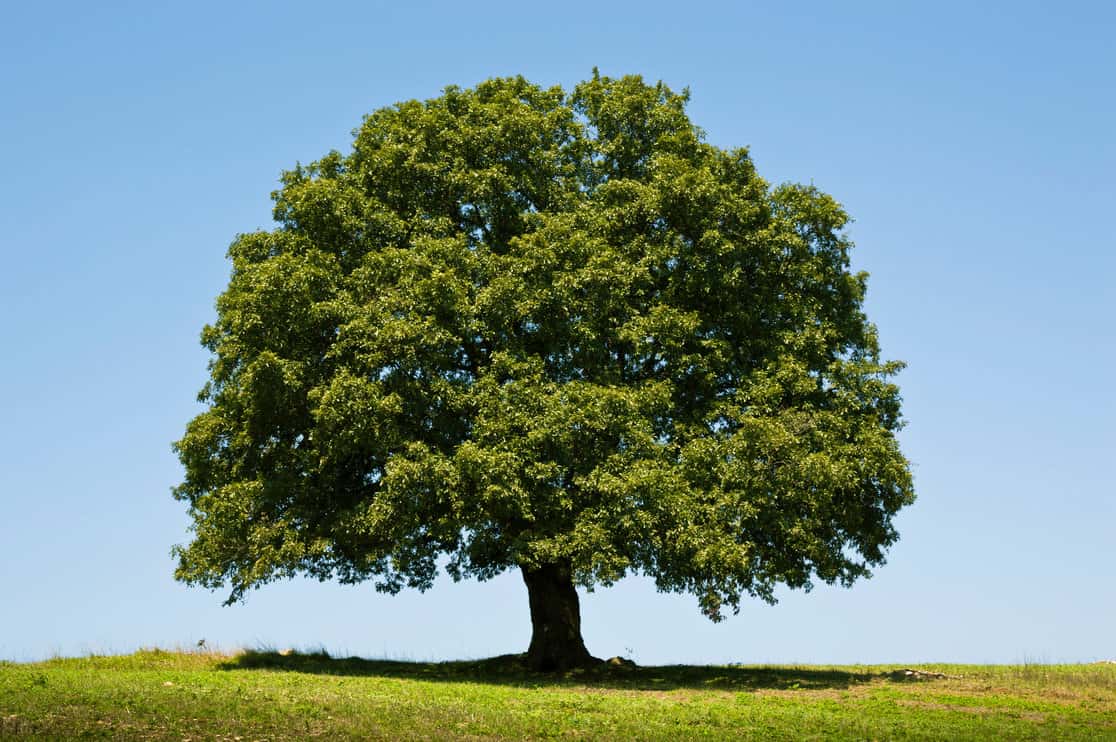
Beautiful, old, red oak (Quercus rubra) in the middle of a green meadow in the park

Plant Oak Trees Away From Overhanging Structures

I know that it may be hard to visualize an oak tree in its fullest capacity when you begin to plant; however, it’s important to think about how tall the tree will get and the amount of space that is available before planting.

Before you plant – take a walk around the area that you want to plant the tree in. Stop, and look directly upwards! Do you notice if there are any power lines close by? Is the roof too close? Are there streetlights nearby that can get in the way? Any structures that it could interfere with?

We often forget to look up when planting trees because we are focused on the here and now, and more often than not, the view in front of us. But when planting a tree, the most important area to consider before any other is the air space.

Making sure there are no limiting factors in the air space before you plant is so so important – especially when dealing with trees that are larger-than-life.

Oak Trees Need Minimum 15ft Of Space From Any Home

The next step in determining if you have the space for an oak tree is simply at eye level. Take a look at the area surrounding where your oak tree will be planted.

Remember, oak tree branches can get quite wide, so making sure there are no sheds or other restrictions on either side, and in front of or behind the anticipated planting spot is extremely important.

Make sure that you plant your oak tree at least 15ft away from any sheds, barns, and houses. If you already have an oak tree planted near your home, make sure that the spread (branches) are trimmed so that they are not touching your home and are as far away as possible.

Oak Trees Need To Be Away from Underground Structures

Another essential idea to consider before planting an oak is the ground coverage. Do you have pavers/concrete nearby? Do you have a pool? Oak trees grow fast and have vast roots, and need space underground to grow!

Much like in the space above our heads, there can’t be anything limiting the underground area because it not only can stunt the growth of the tree, but the roots can collide with and uplift any pavement.

If you’re planting a new oak tree, make sure that your oak is at least 50ft away from any septic field, lines, or underground wiring. It’s important to make sure that the roots of the tree don’t get intertwined with any underground utilities.

Should Your Oak Tree Provide Shade?

The next thing to consider is sun coverage. Imagine a canopy of leaves straight above where you’re going to be planting the tree – will it bring a lot of sun coverage to the area, or will it be too much shade?

As a general rule, most oak trees have a spread of at least 50ft. The spread is how far the branches and leaves stick out from the center of the tree. When considering planting an oak tree in your backyard, place your oak tree in a spot with ample room for the oak tree’s spread.

Mostly a personal preference, it’s good to think about whether or not you want sun or not in your outdoor space – because once you plant this tree and it grows, it will be difficult and costly to remove it!

Oak Trees Produce Debris

Remember, oak trees produce up to 1000 acorns a year – so, it’s important to consider debris when choosing an oak. Make sure the tree isn’t around any pools or growing over gutters – because the acorns can actually cause blockages in filters or gutters!

Besides that, if it’s growing over a lounge area or possibly an outdoor dining area – are you prepared to constantly pick up and move acorns from the area?

The thing with planting an oak tree is that there can’t be restrictions in terms of space. The trees need ample space to grow, and giving this tree the proper space, is one of the key ingredients in having this tree grow successfully! Besides space, planting an oak tree also consists of many personal preferences, all of which should be considered prior to planting.

The Pros of Planting an Oak Tree in Your Backyard

Garden tree being planted into the ground

Now that you’ve considered the space and your own personal preferences let’s talk about the benefits of planting an oak tree!

Oak Trees Are Strong

Stranding tall yet strong, oak trees are a great tree to plant in your backyard because of their sturdiness and stability. There is no doubting how stable these trees are, making it a great choice for a tree that may be close to your home, especially in areas that exhibit high winds and more extreme weather conditions.

Oak Trees Are Aesthetically Beautiful

Oak trees offer a wide variety of dark green leaves and velvety textures – and have some of the most beautiful Autumn colors. From reds to golds to browns to oranges, oak trees never have a dull moment and will continue to wow you from season to season.

Oak Trees Are More Disease Resistant Than Other Trees

Oak trees are very resilient. They are able to grow in many different soil environments and can even survive a drought! Oak trees are trees that surely love full sun, can take a lot of heat – and are generally not susceptible to disease or fungus.

Oak Trees Produce Countless Acorns

How about those acorns? Oak trees produce high-protein acorns that, although they can be consumed by humans, help feed nutrition to many different species of wildlife. Producing up to thousands of acorns a year, or even up to one million in a lifetime, healthy oaks can produce protein for animals and humans for years and years to come.

An oak trees’ leaves are also nutritious and provide food to over 500 species of moth and butterflies!

Oak Trees Are Environmentally Friendly

As you’d probably assume, oak trees are very environmentally friendly – but it’s not just because they are a tree! Oak trees actually provide health to the environment by stabilizing soil with their roots.

Believe it or not, because of their wide crowns and canopies that produce a ton of shade, they not only help a bunch of different wildlife species, but oak trees can even help you save on electricity! By providing areas of vast shade to your yards and homes, oak trees can potentially help by keeping your electric bill lowered!

Oak Trees Attract Wildlife To Your Property

Based on your personal preference, this can be considered a benefit – if you happen to like wildlife. Ranging from animals as small as birds or ducks to bigger animals such as deer or bears – oak trees attract all types of wildlife, and if you’re into that kinda thing, Oak trees would be perfect for your backyard!

Oak Trees Are Easy To Grow

Oak trees are also extremely easy to grow and are low maintenance in regard to the growth process. It’s possible to have an oak tree sapling form from a few seeds or an acorn.

Once planted, depending on the type of oak tree you choose, you can expect the tree to grow deep roots and continue to grow for many, many years thereafter.

If you’re interested, you can read our full guide on the best oak trees to plant here.

Oak Trees Can Live Hundreds Of Years

You would only need to plant an oak tree once because it can live for hundreds and hundreds of years. Because of its longevity, the oak tree is a common choice amongst the entire United States of America – and has become a staple in the American culture.

You can read our full guide on how long oak trees live here.

If you don’t want to read the guide just yet, you can view our table below for some data on how long most of the common types of oak trees live.

TREELIFESPANANNUAL GROWTHFULL HEIGHTBEST HARDINESS ZONE

The Cons Of Planting An Oak Tree in Your BackYard

Although there are many pros – there are also a lot of cons to consider when deciding to plant an Oak Tree!

Oak Trees Are Messy

Firstly, as wonderful it is that Oaks produce an abundance of acorns, acorns can be a mess to clean up and a lot to keep up with if you’re trying to keep your backyard tidy. Oak trees also shed catkins and other heavily pollinated flowers.

If you have an Oak over your patios or gardens, you will surely be doing a lot of maintenance to your space to keep it clean!

Oak Tree Roots Destroy Utility Lines

Although the Oak Tree itself is sturdy, the roots are, in this case, the root of the problem! The roots growing so deep and vast contributes to its sturdiness; however, it can possibly destroy anything in its underground path.

Because of this, you shouldn’t plant an Oak close to your home because the roots can crack foundations and other structures.

Oak Trees Require Annual Pruning Maintenance

So, although considered relatively low maintenance in the growth process, as it will grow well on its own without intervening, when an Oak Tree is grown, it requires routine pruning. If the branches get too heavy, they can actually break off and snap.

Insects Are Attracted to Oak Trees

Much like wildlife, oak trees attract many different types of insects, and because of this, it may not be a great idea if bugs aren’t your cup of tea. If oak is too close to your home, it’s likely that you will have some extra insects flying around and possibly getting indoors.

Oak Trees Attract Nearby Wildlife!

As mentioned earlier, the additional wildlife in your backyard can be pro – but it also can be a con! Because an oak tree attracts all of your favorite typical forest animals and insects – one oak tree can house an entire life cycleAgain, it’s your personal preference if that’s something you want in your yard!

Oak trees can also attract some unwanted guests, such as raccoons or squirrels. Although cute from a distance, a raccoon family or squirrel family moving in isn’t always the best thing and can cause problems for you and your family.

Where To Plant An Oak Tree

If you choose to plant an oak tree – we recommend planting it in an area that has full sun, well-drained soil, and has a humus-rich soil. An oak tree will grow best in this environment and especially in a hardiness zone of 8-10.

However, this is a general rule. Refer to the table we put above for more accurate info based on your specific tree.

Wrapping It Up

All in all, an Oak tree can be or may not be an option for you. The thing is – there really isn’t a right answer as it all comes down to personal preference.

Although there can be some destruction, or maybe the tree attracts some extra bugs – there’s nothing like the beauty the tree brings to the space and the abundance of food and life that it offers.

A true forest tree at that, oak trees are monumental in the USA and can be a great addition to your space.

References

And, C. D., & Rambal, S. (1995). Field study of leaf photosynthetic performance by a Mediterranean deciduous oak tree (Quercus pubescens) during a severe summer drought. New Phytologist131(2), 159-167.

David, T. S., Gash, J. H. C., Valente, F., Pereira, J. S., Ferreira, M. I., & David, J. S. (2006). Rainfall interception by an isolated evergreen oak tree in a Mediterranean savannah. Hydrological Processes: An International Journal20(13), 2713-2726.

Drake, C. (2011). Biomimicry: emulating the closed-loops systems of the Oak tree for sustainable architecture.

Schmid-Siegert, E., Sarkar, N., Iseli, C., Calderon, S., Gouhier-Darimont, C., Chrast, J., … & Reymond, P. (2017). Low number of fixed somatic mutations in a long-lived oak tree. Nature Plants3(12), 926-929.

Pine trees are one of the most absolutely beautiful wonders of nature on the planet. Even better, they grow quite well in many environments and are readily available for many uses. The wood has properties allowing it to be resistant to elements often found within nature.!

Pine trees are fantastic growing trees in the spruce family. They have plenty of uses from decoration to construction. Some common uses include sap production, resin production, building furniture, and in-garden use. Pine trees can be used for firewood and even as ornamental trees as well.

Read on to learn more about what some advantages to growing/using pine wood are, and some great things that you can do with pine!

What Are the Advantages Of Pine Wood?

Pine trees are hardy trees. Typically, they are grown in the Southern Hemisphere and are grown agriculturally for timber. The trees are loved for their fast growth. 

Some of the properties of pine wood are:

  • Stiffness
  • Workability
  • Resilience
  • Resistance to rotting

Because of how readily available this wood is, it is also relatively inexpensive when compared to harder woods like oak. Pine is considered softwood; therefore it provides less wear and tears on carpentry tools.

The stiffness of the wood is important for the integrity of buildings. If the wood was flimsy. The building is more likely to rot away into nothing. 

Due to its lighter weight, it is easier for somebody to move the wood around than it would be if it was heavier wood. This makes it much easier to work with.

You can even save money on wood by harvesting trees from your property. You turn it into the wood for building by either finding a mobile lumber mill or buying one yourself! One great example of a home mill is the Carmyra Portable Chainsaw Mill.

What Should I Do With My Pine Wood Chips?

During the processes of turning pinewood into paper and wood planks, or even cutting a tree down, byproducts are created like wood chips. Wood chips are good for a ton of uses:

Use Pine Wood Chips For Mulch

Mulch is important for many reasons. Mulch helps retain moisture in the soil, prevents weeds, and fertilizes your plants. Pine wood chips in their own right are able to absorb moisture quite well.

So, if you’ve recently been logging pine wood or have even had some cut down in your yard, you can use the scraps from the wood (the wood chips) as a mulching agent!

You can even mulch using the spent bedding as a way to provide extra nutrients to your plants!

Pine Wood Chips Make Excellent Compost

Composting with wood chips is a fantastic way to help reduce waste, create wonderful compost, and save money.

Use your wood chips as the brown part of your compost mix, and then save food scraps, leaves, grass clippings, and animal waste as your green material. You can use a composter such as this Miracle-Gro Small Composter

You can also build your compost bin using pine wood to build three compartments. This allows each compartment to always be in different stages and thus allowing you to have a constant supply of compost. 

Make sure to use a finer chip for your compost as this will speed up the decomposition process. Larger chunks will not harm your compost but will take longer to break down.

Hugelkulture Pine Wood Chips

According to Oklahoma State University Extension, Hugelkulture is a sustainable and economical way to garden! Hugelkulture means, mound culture, or hill culture. The premise of this style is creating mounds of organic matter. A good hugelkulture design with self-watering and self-fertilizing. 

Wood chips are a perfect resource to build mounds. They will decompose, creating lush compost in your beds! 

Pine Wood Chips Make Great Animal Bedding

According to UMass Extension, commercial pine bedding has a variety of uses, Including animal bedding! The chips help by absorbing moisture and odor and eventually break down. 

Because of its pricing, pinewood chips make wonderful animal bedding. Unlike cedar chips, pine chips do not agitate animals’ noses. More pungent woods like cedar can irritate the sinus cavities of your animals, so using pine is a wonderful way to keep your animal’s housing clean as pine absorbs urine well.

Many people use a deep litter method when raising livestock like chickens. Instead of continuously scooping their coop, they pile more bedding on top, occasionally turning it over to help aerate the underlying layers. This creates an environment similar to a compost pile. 

After a few months of deep littering, pine chips should break down into rich compost for your garden!

Use Pine Wood Chips To Cover Pathways

Pathways within a garden can often become overgrown with grass and weeds. Many choose to lay landscape fabric; however, this is not environmentally sustainable. 

Using pine chips is an economical way to cover your garden walkways to prevent overgrowth. Make sure to replenish the layer as the chips begin to break down.

Cover Play Areas With Pine Wood Chips

If you have ever been to a park, you know that the playground is often filled with mulch. An economical way to fill your kids’ play area is with pine chips. 

You can get free wood chips by contacting your local arborist or signing up for ChipDrop, which is a service for finding free wood chips near you.

A warning, however, is that ChipDrop usually supplies you with a lot of wood chips, so if you do not need a lot, purchase your wood chips commercially. You can also purchase a chipper such as the Sun Joe Silent Wood Chipper for yourself on Amazon!

What Can You Make Out Of Pine Wood?

Pinewood is loved by all for many projects! Due to its versatility, affordability, and availability, it is the choice for many for their work. 

Here is a wonderful Beginner’s Guide to Woodworking

Make Pine Wood Furniture

Woodworkers love working with pine wood. It is an easy and inexpensive wood for beginners and makes fantastic furniture. It is not as hard on tools, absorbs stain and paint well, and holds up as furniture.

Some kinds of furniture built out of pine are:

  • Tables
  • Beds
  • Chairs
  • And many more

Pine provides a clean medium for most projects and a lovely solid piece of furniture. Dressers made from pine have been handed down as family heirlooms for generations. 

Furniture making is a skill many enjoy learning. Many furniture companies as well love using pine wood pieces because of how versatile the wood is. 

Use Pine Wood For House Trim

Housing trim is usually made of pine. This is due to its cost. It stains and paints well, providing a clean trim inside and outside the home. 

Time is typically used around the ceiling, door frames, and windows. It helps hide where the drywall meets. Floorboards are also usually made of pine as well. 

Treated pine trim outside can hold up for years. It is aesthetically pleasing for most homes as well!

Use Pine Wood Plywood

Commonly, plywood is made from pine. Other kinds of wood such as fence boards, two-by-fours, and most other commercially available wood are made of pine. This is because of its hardiness and availability.

Using treated plywood is a great way to make things like chicken coops and animal pens. It is a relatively inexpensive build and can be used by even the beginner Craftsman. Pine holds up well to the wear and tear that comes with raising livestock.

Make A Deck Out Of Pine Wood

Deck boards are commonly made of treated pine. A sealed and treated pine wood deck should last well over ten years. Pine makes a fantastic wood for this project because like all other projects, it is a common wood. 

Once the deck is put in, one should seal their wood with a sealant, like Thompsons Water Seal. It is important to do this because it helps maintain the integrity of the wood and prevents rotting. 

Keeping your deck boards sealed and cleaned will prevent any rotting.

Use Pine Wood Flooring In Your Home

Hardwood floors are a beautiful addition to any home! Caring for a hardwood floor can be tricky, but once you get the hang of it, it is worth it. Pine is a very neutral wood to use for this project! 

Pine flooring gives a nice look with its knotting and grain. Many favor it just for its look. It can be stained to give it a darker look as well. Of course, hire a professional to install the floor and get a proper stain to give your pine wood the best tint possible.

Use Pine Wood For Siding

Pinewood does fantastic as siding! Typically they are used as sheets for the siding and treated. Another way to use it as siding is through logs on a log cabin. Your entire house can be built from pine!

Usually, siding is nailed on piece by piece. However, you can buy panels. 

Pine Wood Can Be Used For Decorations

Some artists use pine wood as a medium. Whether they paint on it, cut slices and make charcuterie boards, or do wood burning.

Pinewood makes a great medium to make decorations for your home!

Some people use pine to make butcher blocks. This can be used as a cutting board or even as decorations. 

Wood burning is a fun craft for most people to do. It is relatively inexpensive to get into and the most common wood to use is pine. You can cut pinewood from your trees or purchase it from any craft store.

What Is Pine Wood Commonly Used For?

Pine wood is the main character when it comes to building materials; however, pine has many other uses other than building a home. It is a main crop in the forestry industry because of its demand in the industry. 

Often, people go to school to learn to grow pine wood in forestry services so they can make a living. According to information from Mississippi State University Extension, Pinewood is a major crop in the United States.

Pine Wood Is Used For Paper

Pine wood makes sturdy paper. Paper mills carry in thousands of pine trees a year to produce paper by the ton. The wood is turned into pulpwood, whose final product is paper products. 

Use Pine Wood For Outdoor Firewood

Do not burn pinewood indoors. This is due to it producing excessive smoke and alkaloid content; however, pine can make wonderful wood for bonfires.

The smoke will quickly dirty your chimney. Make sure before burning any wood inside your fireplace, you make sure your chimney is clean and free of soot. 

Ashes from the wood can be used for things as well. Insects hate it as well as it provides natural fertilizers for plants. Wood ash also helps raise the pH of the soil.

Pine Wood Is Used As Building Material

As detailed above, pinewood is the superior building material. This is the main use of pine trees in the United States. It is just one of many uses for this versatile tree. 

This wood is used as the main framing of a house. Pine wood planks are used to build the bones of the home and plywood is often used for subflooring.

This creates a strong shell for a house that should last decades! 

Use Pine Wood For Gardening!

In gardening, pine is used in many ways. Wood chips, garden boxes, and pine straw are important to every gardener.

Pine makes great garden boxes and pine straw is a great mulch for plants, the only downside to pine straw is how long it takes to break down if you are attempting to compost it!

Some people even take pine wood and use it inside their garden beds to fill their raised beds before adding soil on top of that. This is an economical way to have raised beds. Over time, the wood will rot and create compost to feed the plants. 

Another use in the garden is using logs to build fencing and raised beds. There is no need to cut the logs into planks as many enjoy the rustic look. The logs will break down so it is not a permanent solution.

Using Pine Wood In Farming

In the agriculture industry, pine is used for various tasks such as making fencing. Logs are cut to make posts and fence boards. Pine chips, sawdust, and shavings are used for animal bedding. Plus, farmers grow the trees as a crop. 

Christmas tree farms are a lucrative business. Many farmers create a tree farm and turn it into agritourism. This creates a double profit as many families enjoy going and cutting a tree. 

Farming Christmas trees is a passive income since you only sell the trees once a year. However, it can be a wonderful way to make extra money for Christmas time. 

Tree farms take years to produce. During this time, pine straw is harvested from underneath the trees. The straw is harvested and baled like you would hay, and sold to nurseries everywhere. 

This makes pine trees a cash crop. Not only is it a cash crop, but it is a more versatile cash crop than growing trees such as oak, because with oak trees you can only use the wood.

That allows people to use their pine trees as a means of making money by selling them for decoration purposes, while waiting for the trees to mature enough to harvest the wood. 

What Are Some Other Common Pine Tree Uses?

Pinewood is a very valuable material in carpentry. It can be used to make high-value wood items such as wood frames, windows, doors, etc. On top of this, pine trees can also be used to many many other things such as sap and resins. 

Many think of pine trees as wood and straw. There are, however, many other products made from pine trees and their wood. 

Pine Nuts Can Be Used For Food

Pine nuts are the seeds produced by the tree. This is made in recipes such as pesto! People also eat the inner bark, needles, and pollen of the tree. It is often seen as survival food since trees are prevalent. 

The trees can also be fed to various animals such as goats. Rabbits also enjoy the pine cones that fall off the tree. Christmas trees that aren’t treated are often donated to zoos to feed their animals after the holiday season.

Pine Trees As Ornamental

When you think of pine trees, chances are you think of the ones that create pine straw and lumber. However, pine trees and Christmas trees are in the same category. Christmas trees are farmed for decoration in homes every holiday season. 

The branches are also harvested and used to make wreaths and other decorations. Pine cones are also turned into decor for year-round enjoyment!

Use Pine Trees For Landscaping

Planting pine trees can make a wonderful addition to your landscaping. They grow well and provide an interesting plant for your yard. With the right kind, you can even decorate it for Christmas every year!

That’s A Wrap!

Pine trees are versatile and fast-growing trees. The tree itself makes many products, including paper and wood. Renowned for its agricultural uses and its uses in gardens including making garden beds and pine straw. 

Pinewood makes a fantastic mulch. Mulch is important and keeping a garden. Weed-free and well-watered.

If you have a pine tree and it isn’t growing, make sure to check out our guide on why your pine tree isn’t growing and how to fix it.

References

“Eastern White Pine Fact Sheet – Signs of the Seasons: A New England Phenology Program – University of Maine Cooperative Extension.” Signs of the Seasons: A New England Phenology Program, The University of Maine, 2014, extension.umaine.edu/signs-of-the-seasons/indicator-species/pine-fact-sheet/.

White Pine, Eastern, et al. Pinus Strobus Figure 1. Middle-Aged Eastern White Pine. 1994.

Chalker-Scott, L. (2017). Hugelkultur: what is it, and should it be used in home gardens?

Walnut trees, most commonly English and black walnuts in the United States, are used most often for their nut production and sometimes timber. But how many walnuts grow on a tree each year?

On average, a mature walnut tree produces 50 to 80 pounds of unshelled nuts every year. Many species of walnut tree will begin producing at 7 to 8 years old but take until the 15-year mark to mature fully. Some walnut trees produce more heavily every other year as well.

We’ll be discussing how to plant and properly care for a walnut tree. This includes pointers to help your walnut tree grow! Alongside this, we will cover the full timeline of a walnut tree’s life.

Walnut Growing Season And Conditions

Walnuts have a growing season ranging from 140 to 150 days, beginning in late April or early May.

Most walnut trees require the temperature to stay above 27 to 29 ℉ while in the early stages of ripening. Walnut harvesting season is from mid-September through November.

You can tell they are ready for harvest when the hulls turn green, split, and start to fall naturally from the tree. 

Despite this, there are some hardier species like the Carpathian English Walnut. These are better suited for harsh winter climates. The Common English walnut, butternut, heartnut, and black walnuts are more acceptable in milder and warmer climates. Be sure to choose the right species for your local climate! 

How Long Does It Take To Grow A Walnut Tree? A Full Timeline 

Say you find walnuts nearby. What’s next? How much time and care will go into growing it? How soon can you expect to harvest walnuts of your own? 

While walnut trees are not the most complex to care for, they do require more attention than some others, like oak trees. However, walnut trees give back many times over in nut production what they require in care. 

Starting from the top, or more appropriately the nut, let’s go through the full timeline of growing a walnut tree! 

If you’d like to learn more about walnuts, read our post: 8 Differences Between Black Walnut Trees and Walnut Trees.

Day 1: Finding Viable Walnuts To Plant

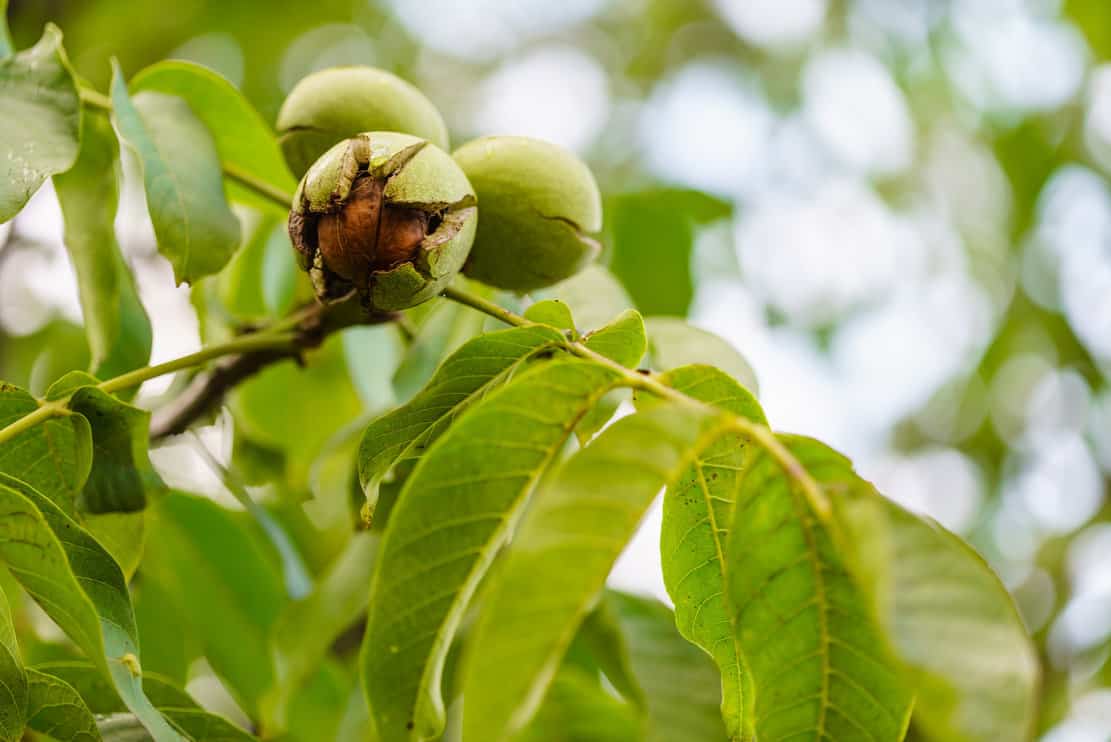
Walnut nuts in green husk on tree on natural background. Growth, spring, summer, nature. Food, seed, organic, health, vegetarian.

The first step to planting your own walnut tree is finding viable walnuts. Identify a local species of walnut tree and wait for the perfect moment.

Collect your walnuts in the fall during their harvest season! Some walnuts, like black walnuts, need to be hulled and washed directly after collection. When doing so, wear protective gloves. Some walnut trees have toxic oils on their leaves and in their sap. 

You might find something like the Large Nut Wizard useful for gathering numerous walnuts. You’ll need quite a few to get started, so collect as many as you see fit, within reason of course. It will also come in handy once your tree bears nuts for you to harvest in the future!

While you are washing your walnuts, discard any that may float. If walnuts float, they are underdeveloped or poorly filled. Poorly filled walnuts will not germinate properly, so keep an eye out for the ones that sink! They’ll be perfect to move on to the next step. 

From the walnuts that sunk during washing, cut open a small sample. If they are full of solid, white meat, then they are viable. Non-viable walnuts will be beige and give off an unpleasant smell. Use this information to generate a percentage of viable nuts out of what has been collected. 

If a large percentage of the harvested walnuts are viable, you will need fewer nuts per plot or container. Now we’re ready to move to the next stage of preparation, stratifying.

Day 1-120: Stratifying Your Walnuts

Stratification is an important, but not completely necessary, step to your walnut tree journey. It can be done in one of two ways. 

Place your walnuts in a container filled with a mixture of damp sterile sand and peat moss. This aids in germination and will help ensure it is uniform later on. Place the walnuts in your mixture at 2-3inch layers and keep refrigerated for 90 to 120 days.

An example of moss would be Hoffman Canadian Sphagnum Peat Moss. It increases the amount of moisture your mixture will hold, as well as the time it will stay moist. When you’re keeping your walnuts moist for up to 4 months, dampening them less often definitely comes in handy!

While stratifying, you can use containers like coffee cans, plastic storage bags, buckets, and similar closed spaces. As long as they fit in your refrigerator, you can use them. 

During this time, the sand and peat moss mixture must remain moist and cool.

The optimal temperature range for stratifying walnuts is 33 to 40 ℉. In terms of moisture, the sand and peat should be damp to the touch, but not soaked. Too much moisture may lead to molding. 

This process can be done naturally as well, though it is less controlled. By planting in a similar mixture in the fall and leaving them throughout the winter, the walnuts will experience the same dormancy.

With this method, you risk a large freeze halting germination completely.  

After stratification is complete, you can finally move on to planting your walnuts! 

Day 1-120: Planting Walnuts In The Spring

According to the University of Missouri, there are multiple ways to plant your walnuts. These include planting in plots, creating a nursery, and planting in containers. 

If you are going to plant in a plot, also known as in place, there is a bit of extra preparation. A seedbed for planting is the first step. It should be in an area that gets full sun.

You should also weed the area and keep it weed-free throughout the time it takes your walnuts to sprout. 

After tilling and preparing the soil, dig 2 inch deep planting plots and place three to five stratified nuts per plot. Depending on the species, plots should be 20 to 80 feet apart.

The soil should be moist and kept moist for sprouting. Space out the walnuts in each plot as well as you will only keep the strongest ones in the future. 

A nursery is another viable method for planting multiple walnut trees. Unlike planting in a plot, these will require transplanting later on. A seedbed is the first step in this method as well, though it will look slightly different. 

Like before, till the soil and dig 2 inch deep holes for your walnuts. With this method, they should be 2 feet apart in rows that are a minimum of 4 feet apart.

Keep your nursery weeded and well-watered throughout sprouting and while growing your seedlings. You will transplant the seedlings the following year, which we will cover further down.

The last method, growing trees in containers, allows for the close monitoring of the nursery, with earlier and simpler transplanting later on.

Choose open bottom containers, the preferred type, or planters with sufficient drainage. The open bottom containers allow for air pruning, which helps prevent taproot circling. If you are using open bottom containers, place them on a wire bench to allow this air pruning to occur. 

The potting soil you choose needs to allow free movement of water throughout the entire container. Mix in a slow-release fertilizer that will allow your walnut tree to get the proper nutrients for approximately seven to nine months. 

Plant only one stratified nut per container and water daily. Container-grown trees require very careful attention and monitoring.

However, container-grown seedlings can be transplanted in the fall instead of the following spring. They can be held in containers over the winter, but be sure to keep the roots protected from freezing temperatures and insulated.

After the trees go dormant, cover them with an insulating cover or hay mulch. 

Day 1- Year 1: Fertilization And Transplanting Of Your Seedlings 

Walnut tree

Keep an eye out for germination in four to five weeks. Your walnuts will begin sprouting and will require more attention. 

Around mid-June in all cases aside from container planting, fertilize your seedlings with a slow-release fertilizer. Each plot should be fertilized in the first method, and fertilization occurs per row in the nursery method. 

After fertilization, seedlings from the plot and nursery methods require watering once conditions become dry. Continue to water your container trees daily until transplanting. Any seedling area will need to be kept weed-free during this time as well. 

For your container planted trees, the transplanting season starts three weeks to a month before the first killing frost and can continue into mid-November. If you keep them warm and covered as we discussed before, they can be held until the spring. 

Weed and prepare the new planting location and start digging your walnut seedling a new home! The hole needs to be twice as wide as the root ball, and 16 to 18 inches deep, and spaced properly.

You should attempt to preserve as many roots as possible during this process. Space the holes according to the walnut species, though 30 to 50 feet is usually safe for planting at home. 

Throughout this first year, monitor all of your nursery and plot seedlings to decide which ones you will keep.

The strongest growing tree at each plot, as well as your strongest nursery contenders, needs to be selected out of the bunch. Any other seedlings can be cut off below the root collar and disposed of. 

You will transfer your nursery seedlings at the end of this section of the timeline. Once your seedlings are a year old, around March, the seedlings you choose to transplant need prepped.

To transplant, you will need to dig 16 to 18 inches deep around each seedling, preserving as many fibrous roots as you can.

The transplant process from here is the same as with the container-grown seedlings. Walnut seedlings will benefit from a layer of mulch 2 to 3 inches thick, kept away from the bark to prevent rotting.

Years 1-5: Growing Walnut Saplings

ripe walnut on tree

Once you have transplanted your saplings, the work gets lighter but does not end. Keeping the area weeded and properly watered is most important at this stage. 

For the first 2 years, your saplings will need your help to get water regularly. You should water your seedlings as soon as the ground has dried completely around them. Deep watering, or watering down into the soil, will also be necessary periodically. 

Deep watering can be done less frequently, around one to three times a month at the hottest point of the year, after the 2 to 3-year mark. The irrigation should occur about 2 feet deep around your tree. Walnut trees are not considered drought-hardy and benefit from this irrigation. 

Pruning will also help your sapling stay healthy and grow through the early stages. This should be done sometime between the late summer and late fall. If walnut trees are pruned during the late winter or spring, it may cause bleeding or excessive sap flow. 

When pruning, remove any damaged branches to prevent further spread. Thinning out crowded areas allows for more sunlight and air to reach the tree as well. 

Years 5-15: From Seedling To Fruit Bearing Walnut Tree

Year 5 is the earliest your tree will begin producing nuts, though most start year 7 or 8. By the time you reach year 15, your tree should be in full production, providing the 50 to 80 pounds of nuts mentioned earlier. 

When it comes to harvesting the fruits of your labor, you will know it’s time when the nuts begin to fall themselves. After you notice this, you can encourage the ripe nuts by gently shaking the limbs by hand or with something long and sturdy. 

At this point, the nut collector you used to collect your initial walnut will come in handy again! After shaking, roll the cage along the ground, gathering the nuts. The quality of walnuts depreciates quite quickly, so be sure to collect them often.

Nuts lose quality faster inside their husks. If the husks remain after harvest, remove them manually. Easier to remove husks can be hand-peeled or rolled against a hard surface until they come free. For those that are harder to remove, dampen and store in an airtight container for 1 to 3 days. 

All nuts need to be washed after their husks are removed to get rid of any remaining material. Walnut husks can stain your skin, so wear gloves!

Walnuts can then be dried in one of three ways between 95 and 105 ℉: 

  • Place on baking sheets outdoors: Make sure your trays somewhere they will receive plenty of sunlight (a southern wall preferably) and wait for 3 to 4 days.
  • Dry on baking sheets indoors: They can be dried similarly indoors with low humidity. 
  • Place in an onion sack: Hang indoors, but be sure to shake the bag daily to rotate the nuts. 

You can tell your walnuts are properly dried when the kernels and the packing material are brittle and break easily. 

Once dry, you can store walnuts for 3 months to 2 plus years depending on the storage method. Always keep them stored in a cool, dry place.

At room temperature, walnuts will keep for 3 to 6 months. 

To keep your walnuts good for even longer, store them at even lower temperatures. Below 32 ℉, they last up to a year. If you store them below 0℉, walnuts may stay good for 2 or more years. 

Years 15-50: Maturing Walnut Trees For Timber

Other than just nuts, walnut trees are often used for their timber. Walnut wood is very hard and sought after for projects such as furniture building. 

Your tree can fit the criteria for timber sale anywhere from 30 to 80 years after planting. The longer it is allowed to grow taller, the more it will be worth. Also, the straighter your walnut tree is, it is more likely to meet the proper standards for sale. 

According to the Missouri Department of Conservation, there are two types of walnut wood quality. Veneer or lumber grade are the categories your tree might fall into.

The specifications for both are quite different, but veneer trees are much rarer, raising demand for them. 

Consult a forester to assist you in identifying the value of your trees.

Your Results Walnut Disappoint! 

Terrible puns aside, that’s all the information we have for now! Hopefully, you have a decent concept of what and how long growing a walnut tree takes.

With time and a bit of dedication, you’ll have walnuts to spare in the future!

You may decide to keep your walnut tree for many generations to enjoy. You might also decide to continue to plant and teach them how to sell their own trees in the future. Either way, your beautiful trees will provide for you and yours for many years to come.

References:

Balandier, P., Lacointe, A., Le Roux, X., Sinoquet, H., Cruiziat, P., & Le Dizès, S. (2000). SIMWAL: a structural-functional model simulating single walnut tree growth in response to climate and pruning. Annals of Forest Science57(5), 571-585.

University, U. S. (n.d.). Walnuts in the Home Orchard. Extension.usu.edu. Retrieved November 4, 2021, from https://extension.usu.edu/yardandgarden/research/walnuts-in-the-home-orchard

Pecan and Black Walnut in Agroforestry Practices. (n.d.). Retrieved November 4, 2021, fromhttps://extension.missouri.edu/media/wysiwyg/Extensiondata/Pub/pdf/agguides/agroforestry/af1003.pdf

Le Dizès, S., Cruiziat, P., Lacointe, A., Sinoquet, H., Le Roux, X., Balandier, P., & Jacquet, P. (1997). A model for simulating structure-function relationships in walnut tree growth processes.

Selling Walnut Timber. (n.d.). Missouri Department of Conservation. https://mdc.mo.gov/magazines/conservationist/2013-02/selling-walnut-timber

Blue spruce trees are beautiful evergreen trees with a tint of blue to their needles. Some trees look bluer than others which is the result of primarily tree maintenance and fertilizer. What steps can you take to make your blue spruce look more vibrant and blue? 

In general, positioning your blue spruce in full sun exposure can help the tree appear more blue. More sun allows for more photosynthesis to occur, making the blue spruce pigments more concentrated. Additives like fertilizers can also increase the hue of your blue spruce.

Read on to learn more about how blue spruces grow, what they need to grow, and ways you can make them more healthy, vibrant, and of course, blue!

Basics of Blue Spruce Trees

If you are trying to understand why your blue spruce is not fully blue, you first need to know the basics: what they need, what they want, and what makes them blue. 

What Do Blue Spruce Trees Need To Be Blue?

Blue spruce trees in autumn park

There are a few necessities your blue spruces need to grow full and healthy. Some of these include having moist, well-drained, and fertilized soil. 

To start, blue spruces like to have moist soil. If you are in an area that receives regular rainfall (approximately 1 inch a week), you should be fine. However, if you are in a dryer area, you may need to hand water, or set up an irrigation system.

Blue spruces want more well-drained soil as compared to other plants and trees. This means that you want to find soil that has larger, looser components, such as sand, compost, and organic matter. These will act to make your soil more workable for the roots of the spruce and create a natural water control system. 

Spruces also prefer very fertile soil. In most residential areas, where the soil has lower quality, you will most likely need to incorporate some type of fertilizer. You might use compost, organic granules, or a pre-mixed liquid. This can help the health of the soil and your other plants.

Maintaining Blue Spruce Health 

Besides meeting your tree’s needs, it is important to maintain its health. Spruce health is strongly correlated to its appearance, so one reason your spruce may not be as blue as you would like could be because it is not as happy as it should be. 

In terms of watering, spruces want around an inch per week. This can vary to a certain extent, but it is important to know that your spruce would prefer occasional heavy watering compared to small, frequent waterings. 

Along with watering and maintaining spruce needs, you should also maintain spruce health by monitoring its outward appearance. Periodically checking if your spruce has dulling needles, algal spots, or falling needles, can help you assess and maintain its health.

What Causes Blue Spruces To Be Blue?

Blue spruce winter

So, the question of the day. Just why are blue spruces blue?

In truth, the blue color of blue spruce needles is mainly attributed to epicuticular waxes found on the outside of the needles. This wax reflects sunlight in certain wavelengths that appear to us as a frosty blue. Pigments within the needles, chlorophyll for example, also make a blue spruce more blue.

To explain this in more depth, the plant cells in blue spruce needles create exudate (wax) that coats the needles, leaving a waxy exterior. Therefore, blue spruce needles are often thick, waxy, and leathery on the outside.

This wax acts to insulate and protect the needle from outside stimuli, such as poor weather conditions. 

The waxy coating naturally reflects certain wavelengths of visible light, causing us to perceive them as a frosty blue color. Increasing or supporting your tree’s production of this wax can act to increase and maintain its proper blue color.

Next, we’re going to talk about just why your blue spruce may have lost it’s color, and then get into how you can make it more blue again!

Reasons Blue Spruces Lose Their Color 

There are a multitude of reasons your blue spruce might lose its iconic blue color. Pollutants and other natural causes in the air can make the wax coating deteriorate, causing spruces to lose their color. Certain fungal diseases or improper care can also cause a loss of blue spruce color.

To elaborate on air pollutants, we’re referring to specific compounds such as nitrogen oxides, carbon particulates, and hydrocarbons.

These are all things associated with bad air quality and C02 emissions. There is not a lot you can do to help this, other than making sure your tree is healthy and you are supporting your native wildlife. 

Specific fungal diseases and infections can also cause blue spruces to lose their iconic color. While some of these diseases affect the needles themselves, a lot is actually in the rhizosphere (root zone) of your tree, so you should target remedies towards your roots. 

As with most plants, improper care can cause your blue spruce to lose its luster. To start, if your tree is not getting enough water, nutrients, etc., it most likely won’t have enough storage to maintain and create the blue wax.

If your tree is being improperly watered or cared for, this can also cause the needles to yellow or fall off, which certainly affects how blue your spruce appears.

Did you know that blue spruce trees are one of the trees that keep their leaves year round?

How To Make Your Blue Spruce Tree More Blue 

Now you know what blue spruces are like, what causes them to have a blue color, and what can affect this blue color. We can look at some simple steps to making your spruce appear bluer. 

To preface, these steps aren’t in any chronological order. Instead, they are separate tips you can pair and use together to help your specific tree. 

Boost Blue Spruce Color With Proper Environmental Conditions

To begin, one of the best ways to boost the color of your blue spruce is to make sure that it has the right conditions, such as light, temperature, and moisture levels. The most important factor is usually light, as that is the ultimate source of energy for plants and trees. 

Light allows spruces to create sugars and energy, which it then uses to carry out functions like creating and maintaining the waxy coating of needles. This means that maintaining proper sun exposure can help your spruce in creating and maintaining a blue color in your blue spruce. 

Maintaining high light exposure and proper soil conditions also causes the needles to be shorter because they have to cover less area for the same amount of sun. This allows the waxy covering to concentrate over a smaller needle, making your tree appear bluer. 

There are other factors, such as temperature and wind, among others.

While these are important, they have less of an impact on spruce color as compared to sunlight. Simply keeping these factors stable and consistently in the range that your spruce likes could be all you need!

Protect Blue Spruce Wax Coating To Increase Blue Color

Dwarf slow-growing blue spruce  (Picea pungens)

One small thing to mention about your spruce’s color is protection. While the waxy coating is fairly stable and relatively water-proof, some things can physically remove it from your tree. 

Very heavy and consistent rains can wear down this wax over time, and reduce the wax on the blue spruce tree, which protects it and causes it’s blue color. Areas with less rain in the summer can allow it to maintain its blue color for longer.

Other conditions, such as wind and animal activity, can also remove the wax, so look into things such as repellents or planting wind barriers to protect the coating!

A decrease in wax can also lead to stunted growth, which is a reason why your pine tree (blue spruce) isn’t growing.

Blue Spruce’s Need Time To Regain Their Blue Color

One of the best tools to fix most problems is to give them time. Similarly, with the blue color of spruces, one of the best ways to help them is to give them time. As with most things, it takes time to grow new needles and create new wax. 

You may simply want to give your spruce more time to see if it can bounce back to its blue color on its own. This can be beneficial, as sometimes we can hurt our plants and trees by doing too much for them. Pruning, fertilizing, and watering could cause harm while attempting to help them. 

In other words, if your tree is healthy, try to let it sort itself out! 

Other than letting more wax develop, another reason to give your blue spruce more time is that it allows them to grow more needles. In most cases, new needles have an incredibly high concentration of this wax on them, making them appear extra blue.

If you allow your tree to grow new blue needles, you may have more luck in caring for them so that they retain their color for as long as possible. 

Fertilizers Can Regain Blue Spruce Color

While this is less researched, many people claim that using fertilizers can help maintain or turn your spruce bluer. 

Fertilizers are usually a good idea for your plants in any situation, as they add a boost of vitality to the soil that improves biodiversity, soil health, and the overall nutrition of your plant. Fertilizers could help restore some blue color by giving plants the nutrients used to make the wax coating. 

While most fertilizers will do the trick to help plants, some situations require specific remedies. Most people have selected fertilizer options that they claim will help maintain your spruce’s blue color. 

Many claims in favor of using some sort of fertilizer rich in iron have been made. This might help to give your tree its blue color back because we see many forms of iron as a blue color, and iron is a component of many waxed spruce needles. 

Another reason people recommend iron is because it combats things such as chlorosis, which causes yellowing or whitening of leaves and needles. One great example of an iron agent you can add is this 4-lb Iron Sulfate

If your tree needs an all-around nutrient boost, look into specialty all-purpose fertilizers, such as Scott’s Evergreen Flowering Tree & Shrub Fertilizer. Blue spruces, are in the evergreen family of trees. This fertilizer releases nutrients straight into the root zone of your tree, promoting good health all season long!

Fix Blue Spruce Fungus To Regain It’s Blue Color

Close view of the tips of a Colorado blue spruce tree

Along with adding things to your tree, assess the physical health of your tree. This means figuring out if you are meeting its required water and sunlight needs. It also means finding out if it is healthy, or if it has a certain infection or fungal disease. 

Many diseases can affect your spruce tree, each with its causes and appearances. 

One common disease among spruces is a needle disease brought on by the fungus “Rhizopheara.” This is often referred to as Rhizosphaera Needle Cast. According to Nebraska Extension, this disease normally stays on living or recently dead needles and can cause your tree’s needles to darken, turn brown, or even fall off. 

If your tree was recently transplanted or has gone through some sort of shock, like inclement weather, it may be more susceptible to this disease. 

To prevent or treat your blue spruce, identify the certain problem on your tree, if there’s any clear bark, needle, or nearby grass issues. Research or call an expert, and apply the proper fungicide or recommended tactic.

In the end, while this isn’t the only disease that can affect your blue spruce, it is a good example of how diseases show on trees, what they do, and some ways to treat them. 

Maintain Good Care Of Your Blue Spruce To Keep It Blue

While we have mentioned this before, the best way to have your blue spruce get a blue color is simply to find a correct care technique and stick to it. 

In the end, your tree has the genetics to be blue, so as long as you properly care for it, it should have enough energy and components to stay blue. 

By proper care, people normally refer to basic needs, so you should find what your specific spruce wants in terms of water, sunlight, soil type, temperature, nutrients, etc. 

Some spruces benefit from occasional pruning. This can help them get rid of old or dead growth, and make space and energy for fresh growth to come in.

This is especially true in trees with dead growth or fungal damage because pruning can help prevent spread!

That’s A Wrap!

In the end, blue spruces can be very rewarding to grow. They are magnificent and can add the perfect whimsical pop of blue to your garden all year long. 

Blue spruce trees have some special care requirements. If they are not met, it can lead them to change or lose their color. This color is caused by a wax coating they create, meaning you can specifically try to increase its production to make your tree bluer!

A few of the methods you can use to make your spruce bluer are to add iron fertilizers, monitor its health, and have it in a location with full sun exposure. These methods act to keep it healthy, allowing it to create and maintain its wonderful blue color. 

Overall, while keeping your spruce blue may be important, it is always good to remember to have fun while out in your garden, and to connect to your trees! 

Sources:

Kangas, M. (2004). Spruce Diseases In North Dakota [E-book].

Hanover, J. W. (1975). Genetics of blue spruce (Vol. 28). Forest Service, US Department of Agriculture.

van HavVan Haverbeke, D. F. (1984). Genetic variation in blue spruce: a test of populations in Nebraska (Vol. 253). Rocky Mountain Forest and Range Experiment Station, Forest Service, US Department of Agriculture.

Acorns and squirrels just seem to go together, but do you know much about acorns themselves? There are a few good reasons that squirrels eat these particular nuts, and they even have a specific way to eat them.

Acorns are a great source of nutrients for both red and grey squirrels. Many squirrels prefer white oak acorns and eat them immediately while burying red oak acorns. This is because red oak acorns contain a higher tannin content than white oaks do, resulting in a slightly more bitter taste. 

Below, we are going to dive into the important facts about acorns, why squirrels love them, how they eat them, and more! Curious to find out the difference between acorn varieties, or maybe why squirrels bury nuts? Stay awhile; we’ll get there.

What Is An Acorn?

Acorns on a white background. Creative autumn concept. Pastel colors. Top view, flat

So, what exactly is an acorn, really? 

Known as both an oak nut and, more commonly, an acorn, this is a nut that has a single seed kept safe by a shell that is most often associated with the appearance of an acorn.

Made complete by the cap-like top, acorns are easily distinguishable and a common source of food for many woodland creatures. Not only squirrels enjoy this food source. In fact, acorns are edible for humans if processed properly. 

More on that later, though.

Let’s first talk about the tannins that are in acorns by covering both what they are and how their implications are seen.

What Are Tannins in Acorns?

The word ‘tannin’ or ‘tannic’ is one you may have heard before, but not necessarily in relation to acorns. These terms are commonly referenced when it comes to wine and tastings. 

In reality, tannins can be found in a wide variety of plants and nuts. For example, they are found in the skin of grapes, which then turn into wine. Have you ever eaten a grape that was extra bitter? The skin probably had above-average tannin levels. 

The same goes for acorns, but on a scale that is much higher and can be dangerous. Whereas tannins might make wine unpleasantly strong in flavor, they also help to preserve the alcohol as it ages. Acorns do not have the same boozy advantage, and too many tannins will just result in poor flavor.

If these nuts are unpredictable, then why would squirrels want to eat them?

Why Do Squirrels Eat Acorns?

Eastern gray squirrel in Central Park in New York, USA

There are many types of nuts, berries, and other foods on trees in the areas that squirrels are typically located, so why acorns?

● Nutrition. Acorns are very nutrient-dense, notably a great source of potassium, vitamin A, and iron. They prove to be a great source of food for animals that do not eat large quantities.

● Abundance. Oak trees are incredibly widespread throughout many different environments, making acorns abundance through association. Where there is an oak, there is a food source. 

● Easy to Procure. Acorns are small nuts, meaning that they are easy to gather and then carry among the branches of the tree. On the other hand, squirrels may wait for them to fall from the tree for an even easier procurement.

● Relatively Safe. While there are tannins in acorns, squirrels are experts when it comes to this common food source. Acorns are a relatively safe source of food due to their familiarity.

Do Squirrels Eat The Top of Acorns?

Squirrels do not tend to eat the cap of an acorn. In fact, the shell is not used for much either. When it comes down to it, the shell and cap of an acorn do not have nutrients that compare to that of the actual nut.

So, if a squirrel were to eat the shell and cap first before getting to the inside, actual source of food, it will fill itself up with empty plant material that does not supply it with the nutrients it needs.

How Many Acorns Does a Squirrel Eat Per Day?

Well, this one is a doozy. Just how many acorns do squirrels eat per day?

Squirrels have quite a process to go through when it comes to eating these acorns, so it is no wonder that they do not eat more than 2 or 3 nuts per day. This is not typically all they will eat, but acorns combine with other nuts, mushrooms, and berries as a source of food for squirrels. 

Whereas berries and fungi are easily consumed, a squirrel must crack through the shell, remove the cap, and de-shell the acorn before it gets its meal. While this is worth the effort, thanks to the nutritional quality of acorns, it is certainly time-consuming for a squirrel.

The North Carolina Wildlife Resources Commission explains that when acorns and other tree nuts are plentiful in the winter months, more young will be born in the spring.

In years with less access to these food sources, fewer young will be able to be born because the female squirrels will not be as strong. Those who manage to survive the winter will often produce smaller litters. 

It is for this reason, among many others, that squirrels bury nuts to store up for the cold, barren winter months.

Why Do Squirrels Bury Nuts?

So, why else do squirrels bury nuts if the ability to produce a new litter is not the sole concern?

The competition for acorns can be fierce, and burying (and then reburying, and then reburying again) acorns is a good way to keep their food safe from other squirrels and animals that might also be vying for some extra food.

Not only do they rebury acorns to keep other animals off their track, but they also do this for their own memories. 

A well-hidden treasure trove of nuts is great, but if they don’t continuously shift locations, a squirrel might forget where its own stash is buried, let alone the stash of another squirrel.

Not to worry, though! If a squirrel loses its stash, those are just more oak tree seeds that are well dispersed and ready to grow into trees that are new sources of acorns! The circle of life, if you will.

What Kind of Acorns Do Squirrels Eat?

We always hear about squirrels eating acorns, but they must have a preference…right? 

Right! Squirrels eat a variety of different acorns that come from different species of oak trees. So, which types of acorns do squirrels eat, and which of those are their favorite?

Squirrels Prefer White Oak Acorns

sitting squirrel

While different species of squirrels may prefer one type of acorn over another, white oak acorns and red oak acorns are the ones that come up most frequently. 

In fact, research from the University of Maine shows that many squirrels tend to eat the white oak acorns right away while burying the red oak acorns that they find in similar areas. This is because red oaks contain a higher tannin content than white oaks do, resulting in a slightly more bitter taste. 

By storing the red oak acorns for a later date, squirrels still ensure that they utilize the nutrition that the large red oak acorns provide while allowing some of the tannic acid to dissipate before they consume them.

However, white oak acorns also germinate faster, which leaves squirrels a shorter period of time to eat them before they go bad.

This indicates that maybe white acorns being the first choice has even less to do with preference and more to do with the sheer maximization of food sources.

Pros of White Oak Acorns For Squirrels

● Low levels of tannins, creating a less bitter taste

● Widespread and easy to find

● More nutritious than peanuts or other tree nuts

Cons of White Oak Acorns For Squirrels

● A bit smaller than red oak acorns

● Germinate quickly, so less time to be able to safely eat white oak acorns

Squirrels Bury Red Oak Acorns

So, squirrels have tastebuds, after all.

Squirrels prefer red oak acorns, just after white oak acorns, because they tend to be a bit larger and have fewer tannins than some other varieties. Essentially, this means that they inherit less of a bitter taste that characterizes some of the other acorns, even if white acorns happen to have even fewer tannins. 

While these might be a second choice next to white oak acorns, they are still at the top of the list.

As we mentioned above, it might have to do more with survival instincts of eating the species that go bad more quickly and saving the ones that can survive until the winter.

If you’re interested in learning more, check out our piece on 29 Incredible Facts About Red Oak Tree here.

Pros of Red Oak Acorns For Squirrels

● Larger sized acorns for the same amount of de-shelling

● Widespread and easy to find

● More nutritious than peanuts or other tree nuts

Cons of Red Oak Acorns For Squirrels

● Higher levels of tannins, creating a more bitter taste

● The size of red oak acorns are larger than that of other species

All Other Acorns

While all acorns fall into two categories, red oak and white oak, there are so many different species within these distinctions.

Different species of squirrels may prefer different species of acorns that fall under the white oak acorn group when they need some food right away.

In the same vein, different species of squirrels may opt for specific species of red oak acorns to bury for winter in order to have their preferred source of food. 

In a way, squirrels and their acorns are like humans who drink tea.

Someone may love green tea while another may enjoy black tea, but think that green tea tastes too earthy. Though both types of tea are relatively similar, we all have our preferences, and so do squirrels.

Are Green Acorns Bad For Squirrels?

Green acorn among lot of ripe acorns.

Green acorns are a great source of extra tannins for any squirrels looking to bulk up. The flavor may not be great, in the same way, that acorns from other tree species than red oak are more bitter, but they will do the job when needed.

Green acorns are, in fact, not poisonous to squirrels. They will, however, create a negative mood shift in squirrels that consume a lot of them, thanks to the extra tannins messing with their typically amicable personalities. 

4 Reasons Why Squirrels Eat Acorns

There are plenty of reasons that squirrels eat acorns, but here are four of the main draws of these oak tree nuts:

Acorns Provide Squirrels With Nutrition

Compared to some other types of nuts, acorns are extra high in nutrients—namely vitamins A and E, potassium, and iron.

Not only do these oak tree nuts have great vitamin and mineral content, but they are also a source of fat and protein. Acorns tend to be on the larger end of the scale when it comes to tree nuts, so the extra nutrients come in a large bundle. 

Acorns Are In Abundance For Squirrels

Not only are oak trees the most well-known deciduous tree, but they are also one of the most abundant. If you are in an area full of deciduous trees, oak is most likely going to be the majority species, alongside others like maple, birch, and aspen.

So, take a moment to imagine you’re a squirrel. If you’re in a forest full of trees and need a meal, acorns will likely be one of, if not the very, most available type of tree nut you would find without putting much work in.

Acorns Are Easy To Procure For Squirrels

Speaking of not putting much work into gathering acorns, squirrels tend to have it easy when looking for these nuts.

While other animals might provide some steep competition, the acorns themselves are easy to locate.

Whether the acorns remain on the tree branches or they have fallen to the ground, they are easy pickings for a squirrel on the hunt.

Acorns Are Relatively Safe For Squirrels

Acorns may have tannins, but those are more of an issue to humans than they are to animals.

Squirrels may come across the inconvenience of a bitter taste or the unpleasantness of a negative mood swing, but that is the worst of it for these furry critters.

When all is said and done, acorns really are quite a safe bet for squirrels- from the knowledge that they are a secure food source to the ease of procurement and the benefit of the nutrients.

Can Humans Eat Acorns?

If prepared correctly, humans can, in fact, eat acorns!

You can take a look at our guide on 9 Amazing Fallen Acorn Uses here.

Acorns can be quite a useful resource, as seen in archeological studies, historical records, and practices of eating acorns that continue even today. 

As far spread as oak trees are across not only North America but also other continents, it is no surprise that acorns have been utilized throughout history. 

When it comes to processing acorns so that they are safe to eat, you’ll be surprised to find that the preparation is not as difficult as you might be expecting.

Before the processing truly begins, you’ll want to take a note from The Harvard Crimson and conduct a ‘float test.’ Essentially, acorns that float are either diseased or hollow due to rot, and those that sink are ready to move onto the preparation process.

First, you will make sure to remove the shell that gives acorns their well-known appearance, to find the nut that lies inside.

Following the de-shelling of the nut, you will want to break up the acorn into pieces so that it is not left as a whole nut. 

Once the nut is broken up, the tannins inside will be more easily released. To release these tannins (or bitter plant compounds), soak the acorn pieces in water until the color darkens to look like a very dark tea (or a very light coffee.)

The process should take at least a week of changing the water numerous times to allow as much of the tannic acid as possible to be released.

Soaking acorns helps to release the tannic acid, which tastes bitter but can also be harmful.

Boiling is a commonly referenced practice but can actually trap in some of the bitter flavors. So, it is instead recommended to soak your acorns in any temperature water that is lower than boiling (yes, even hot water that is not quite at its boiling point.)

Once your acorns are processed, they can be ground into flour, roasted as a snack, or pounded into mush to produce oil.

There are even some recipes out there that you can try!

You can find acorn flour in the form of this Acorn Starch Powder, showing that this is not a practice reserved for those in remote areas or difficult situations.

Acorns happen to have many nutrients, good flavor once processed, and are abundant. Oh, another bonus, they are free if you harvest them yourself!

Hooray for Acorns!

Squirrels eat so much more than just acorns, but they get associated with these specific oak tree nuts so commonly because of the fact that squirrels do tend to favor them.

We hope this piece helps you to understand why exactly squirrels love acorns, how they choose them, and what they do with them.

Thanks for reading!

References

Mason, S. L. R. (1992). Acorns in human subsistence. University of London, University College London (United Kingdom).

Rakić, S., Povrenović, D., Tešević, V., Simić, M., & Maletić, R. (2006). Oak acorn, polyphenols and antioxidant activity in functional food. Journal of Food Engineering74(3), 416-423.

Often times when we have the desire to plant a tree, it’s because we want to add some beauty to our outdoor spaces, or perhaps, add some shade or privacy to our surroundings. The thing is, we usually act too fast. We get the tree, plant it right away so we can reap the benefits of it as soon as possible, and overlook when the best time to actually plant the tree is.

The best time to plant an oak tree is between mid-fall and early spring. Oak trees grow best when planted during a drier time of year, as opposed to rainy. When planted properly during the correct time of year – oak trees can successfully live hundreds of years.

There are so many different types of oaks out there, and just as many different climates throughout the United States of America, that the time to plant an oak tree can differ from state to state. We’re going to give you the best time to plant an oak tree and how to do it. 

What is an Oak Tree?

Before we get too deep, you need a little bit of background info on oak trees.

An oak tree is a medium to a tall tree that can live hundreds of years. Oak trees are part of the Quercus family of trees and offer 500 + variations of oak. Typically categorized into White Oak and Red Oak, oak trees are seen throughout every state in the United States of America and beyond. 

Oak trees at their tallest can reach heights of over 100 feet. They offer a lobed leaf that is distinct to the oak tree, and they have dark gray to black barks that contain ridges and deep fissures. Most oaks lose their leaves in the late fall and provide show-stopping colors before. 

Oak trees are the trees that provide the abundance of the autumn-favorite acorns and can produce up to one thousand in a month’s period. One oak tree alone can provide up to one million acorns in its entire lifetime. 

Why We Love Oak Trees 

Oak trees are some of the most fascinating trees out there. They provide so many benefits to our ecosystem and can provide so many benefits to us as well.

Not only are they beautiful to look at and are truly built for shade, but oak trees are also strong and long-lasting trees, that when taken care of, can provide limitless abundance. 

Oak Trees Help our Wildlife 

We love oak trees because of what they offer to our animals. Oak trees become the housing for more than 350 species of animals, and we love it when our wildlife is protected.

Besides this, the acorns produced by oaks are full of protein – and can feed our wildlife for their entire life span. 

Oak Trees Produce Oxygen

Although their exquisite beauty is enough to want to plant one, an oak tree is used for medicinal purposes around the world.

The leaves themselves from the oak trees can trap nearby pollutants and can even improve air quality by storing carbon dioxide and releasing oxygen. 

Oak Trees Can Lower Your Electric Bills 

Oak trees also can help with your electric bills – I know, right? The thing is since oak trees provide so much shade, oak trees can help keep your outside spaces cooler, and if it’s planted near a home, they can keep your house shaded from the sun. 

Oak Trees are Beautiful 

Visually, we love oak trees because of their stature and the beautiful colors that they bring to our environment during the fall.

From orange to red and yellow, oak trees are one of the last species of trees to lose their leaves in the fall, and therefore, provide a beautiful assortment of colors for most of the fall season. 

If we haven’t sold you already on oak trees already, we’re going to share with you some benefits as to why you should plant one in the first place! 

Oak trees are beautiful and really will last a lifetime. You can read our piece on the lifespan for the common types of oak trees here.

Now that we know some of the benefits, let’s get to it – when is the best time to plant an oak tree?

When is the Best time to Plant an Oak Tree?

Spring Sun Shining Through Canopy Of Tall Tree

Depending on the type of oak you are looking to plant, there are specific climates, and with that, certain times, that all determine the best time to plant an oak tree. 

No matter the climate, though, the general rule of thumb is to avoid freezing temperatures when planting. 

If you’re interested, you can read our guide on the best oak trees to plant here.

In the United States of America, we have an overall temperate climate; however, being that oaks are generally easy to grow in all types of climates, the best way to guarantee your oak grows successfully is to determine the best time to plant in your climate.

Depending on where you are located in the USA – the best time to plant an oak depends on the climate you are in. Below is a general list of the best times to plant oak trees in the United States of America per region.

Best Time to Plant Oak Trees in The Northeast

Beginning in the northeast region of the United States, states such as New York, Maine, Connecticut, and Massachusetts are characterized by a generally diverse climate. 

Winters are cold, especially in the states bordering our northern neighbors, and can often sustain temperatures below freezing for extended periods of time. Summers, on the other hand, is hot with moderate humidity levels.

If you are planting an oak tree in the Northeast region of the US, you should start planting your oak tree in the late winter/early spring or late fall. 

Best Time to Plant Oak Trees in The Southwest

Moving towards the southwestern part of the USA., states such as Texas, Arizona, and New Mexico are typically dry with warm temperatures year-round. 

When it comes to summer, everything’s truly bigger in Texas, with average high temperatures exceeding 95 degrees Fahrenheit. 

In Arizona’s Death Valley region, daily temperatures of over 125 degrees Fahrenheit have been observed. High temperatures during the winter average around 70 degrees. It is best to plant your oak tree in late winter to early spring in the Southwest region of the USA.

Best Time to Plant Oak Trees in The West Coast

Along the West Coast, like in California, the climate is sub-tropical and mild, with warmer summers and cooler winters. 

In the winters, the weather never gets to freezing temperatures on the West Coast, and the weather is oftentimes rainy. However, in the summer, it gets very hot and dry and rarely rains. If you are going to plant an oak tree on the West Coast, fall is often ideal – especially after it rains! 

Best Time to Plant Oak Trees in The Southeast

Along the Southeast, in states like Florida, North Carolina, and Georgia, the climate is basically mild; however, it also exhibits extreme temperatures. 

In the summer, the heat is often intense, and it’s possible for extreme winter temperatures as well.

Subfreezing is common throughout the Southeast, while extreme weather like hurricanes happens often. The best time to plant an oak tree in the Southeast is during its dormant season and after the last frost. Late fall to late winter is ideal. 

Best Time to Plant Oak Trees in The Midwest 

Along with the Midwestern states like Kansas and the Dakotas, the climate is humid.

The weather in the Midwest is often severe, with severe heat and humidity in the summer, severe cold and snowy in the winter, and also severe storms like tornadoes throughout the year. If you want to plant an oak tree in the Midwest, the best time to do so would be in the fall – before the first frost.

What To Consider Before You Plant an Oak Tree 

Summer sunny forest old oak trees. Nature green wood sunlight backgrounds.

Now that you have determined your climate, there are some things that you need to consider before you plant. Planting an oak tree can bring immediate beauty to an outdoor space, but there are certain things that oak trees require and certain personal preferences you may need to go over before you choose to plant.

Specifically, if you’re thinking about planting an oak tree in your backyard, consider these things before planting an oak tree.

Oak Trees Needs Space

Before planting, you have to make sure that there are no power lines above the tree and watch out for any nearby structures like sheds, barns, or houses that may be on either of the four sides of the tree.  

Oak trees generally range from 60 feet to 100 feet, and their canopies can get up to 50 feet wide. So, space definitely needs to be considered before you plant! Because of how large they can get, oak trees need to be planted 15 feet away from all structures. 

Another thing you have to take note of is the space available underground. An oak tree’s roots grow wide and deep. You need to make sure that the roots will not interfere with any foundations or pavement as it can cause damage to these structures. 

Oak Trees Produce Debris

It’s the truth – oak trees produce a lot of debris. Whether it’s acorns or falling leaves, oak trees have a lot of both, and if you are planting it over a lounging area or anywhere close to gutters or roof, you have to be prepared for some clean-up. 

Oak Trees Provide Shade 

Another thing to consider before planting is if you desire the amount of shade that an oak tree provides. Oak trees grow tall and wide, and depending on your space, can provide an ample amount of shade – or way too much. 

Consider what your personal preference is for the space before you choose to plant an oak tree. 

How to Plant an Oak Tree  

If you have gotten to this part of our article, it goes without saying that you are so ready to plant your oak tree! So, without further adieu – let’s teach you how! 

Determine Where You’re Going to Plant Your Oak Tree

Using the information above, first, determine your location. Take a stand in the middle of the spot and look around. Take note if there are any structures nearby and how much ground room you have to plant. 

You’ll want to make sure of what oak tree you’re planting. Red Oak Trees and White Oak Trees can grow to different heights and take up more space.

Plant Your Oak Sapling in a Spot With Little Grass

The tree shouldn’t be planted in a spot where the grass is going to surround the base of the trunk. Grass can harm the tree in that it will be in a constant fight with it for air, water, and nutrients – and it may not grow as successfully. 

Dig a Hole Twice the Size of The Oak

Once you have the spot, look at the bottom of your tree or the root ball – oftentimes, the root ball is wrapped in burlap. Once the size is determined, dig a hole double the size of the root ball – twice as wide and twice as deep. 

Keep the soil on the side so that you can refill the hole with it. 

Place The Oak Tree in The Hole

After you dig the hole, remove the covering of the root ball, and place the tree in the hole and move it around until the tree is standing straight up. 

If you need to – add more soil to ensure the tree is tall and even

Fill the Hole with Compost and Soil

Once the tree is standing straight, fill the hole with compost and the soil that was set to the side while you originally dug the hole. Keep filling the hole until the tree is sturdy and the soil is compact. Using the shovel, pat the soil into place. 

Adding mulch on top of the soil can be an extra step to help protect the tree so that the tree doesn’t fight with any nearby grass for air, water, or nutrients. 

Water The Oak Tree

When you are done planting, make sure to water the tree thoroughly. Watering once to twice a week is ideal; however, in the hotter months, if it doesn’t rain at least an inch that week, make sure to water more often. 

Benefits to Planting an Oak Tree

Other than the obvious, there are so many reasons why you should choose an oak tree to plant in the beginning. Strong, reliable, and full of life – oak trees go unmatched! 

Oak Trees are Strong 

Choosing an oak tree is always a good option if you are looking to plant a tree because of its strength. They grow sturdy and stable, and when planting close to your home, these are great options as their roots grow deep and will keep the tree standing for hundreds of years. 

Oak Trees are Resilient 

Oak trees are resilient. They can grow in all different climates, in all different soils, and can even live through a drought. When planted correctly, oak trees can survive the highest winds and are very susceptible to disease. 

Oak Trees Require Little Maintenance to Grow 

After planting, oak trees require little maintenance and are very easy to grow. Although the time they take to grow can range, the roots of an oak tree will always grow deep, and with very little intervening, can grow for hundreds of years. 

Wrapping it Up! 

There are certain times to plant an oak tree to ensure successful growth. By planting before the last frost and by avoiding freezing temperatures, based on your climate – whether it’s the fall or spring – planting an oak tree in mild, less extreme conditions is always ideal.

Oak trees are absolutely beautiful, are wonders of nature, and provide beauty, abundance, shade, shelter, and nutrition to all of Earth’s creatures.  

References

“How to Plant a Tree.” How To Plant A Tree – NYS Dept. of Environmental Conservation, www.dec.ny.gov/lands

Dahlgren, R. A., SINGER, M. J., & Huang, X. (1997). Oak tree and grazing impacts on soil properties and nutrients in a California oak woodland. Biogeochemistry39(1), 45-64

“K-State Research and Extension.” Fall Tree and Shrub Planting Instructions, www.johnson.k-state.edu/lawn-garden/agent-articles/trees-shrubs/planting-trees-shrubs-in-fall.html. 

“Planting Native Oak in the Pacific Northwest.” Https://Www.fs.fed.us/Pnw/Pubs/pnw_gtr804.Pdf

“Southeast Temperature.” Southeast Temperature | North Carolina Climate Office, legacy.climate.ncsu.edu/edu/SETemp. 

In recent times, keeping trees and large plants in pots has been becoming more and more popular. On top of being decorative, they can make large plants more manageable, mobile, or even easier to water and fertilizer. With this comes the question, “what soils are best to use with my potted pine trees?” 

In truth, pine trees prefer more well-draining and loose soils, meaning that they prefer more sandy soils with lots of large organic matter. Terra cotta (or wood/concrete) pots are best if you are in an area that doesn’t freeze to ensure your pine is as healthy as possible. 

Read on to learn more about how pine trees grow, what soils they prefer, what containers they prefer, and how to use all of them to keep your pine tree happy and healthy!

What Are Pine Trees?

Pine trees are clarified as evergreen coniferous trees, meaning they have needle-like leaves, create cones for reproduction, and are supposed to stay green all year round (if they are properly healthy). 

In order to understand what soil we need for our pine trees, it is first important to understand the basics: how they grow, what they want, what they need, what hurts them, etc. 

How Do Pine Trees Grow?

One of the most important aspects of keeping plants in pots is knowing how fast they grow. This has an effect because plants could easily outgrow the container or even become root bound in worse situations.

This is especially important with trees, as they can tend to have sensitive taproots and can grow much faster than regular plants. 

With this, pines are fairly quick growing, and each species will have its own growing schedule/speed. As for the needles/sticks of the plant, the average pine can grow 1-2 feet (or more) per year in optimal conditions. This growth is in the vertical direction mainly, but as time progresses, pines also increase in width as well. 

As for the roots, most pines will have a larger central tap root, surrounded by a very shallow regular root system. This is good to keep in mind when picking a pot or when watering/fertilizing your pine. 

Best Growing Conditions For Pine Trees in Containers

Cypresses pine plants in pots on tree farm

Like most other plants, pines simply require light, water, carbon dioxide, and nutrients in order to survive. In addition to this, they have other preferences such as well-draining, slightly acidic soil. 

As for their basic needs, most pines will have no issues in containers with light, carbon dioxide or water, light, as they are all alterable in pots. On the other hand, some pine can experience nutrient issues in pots, meaning that you will have to hand fertilize/compost them regularly to ensure their health. 

As for soil needs, pines do prefer more well-draining, loose soils. When looking for a soil type to purchase, you want to look for something with more sand, large particulates, and organic matter. Going along with this, pines can also handle a little more dry soil, as they are used to being well-drained. 

Additionally, pines can manage most neutral soil types; however, they do tend to thrive in soils that are lower (more acidic) in pH. This can be accomplished by finding acidic soil amendments or by letting the needles drop and self-mulch their own tree. 

As for pots, many people claim that terra cotta is the best type. This is true for most plants, as it is sturdy, allows roots to grab on, and has amazing water capabilities (being able to suck in water if needed or evaporate it out if needed). 

Terra cotta can be dangerous if you are in colder climates, as freezing temperatures can cause it to crack, chip, or break, which all pose threats to the gentle root system of your pine tree. 

On the other hand, if terra cotta isn’t in your budget/style, pine containers are pretty adaptable, and that you can use other pots such as concrete or wood. 

What Growing Conditions Do Pine Trees Hate?

small green coniferous pines in the dry grass in the forest

Now that we know the things that pines like and thrive on, it is important to know what they do not like so that you can avoid them. 

To begin, pines prefer lots of sunlight, so shady conditions can stress them out. If you are growing in a pot (and your tree is a relatively small or medium size), it should be fairly easy to alter your setup to meet its requirements. Too little light can cause things such as droopy/yellow needles or even needles falling off as a whole (not to mention slow growth as well). 

Most pines also do not like being in very wet/soggy conditions for a long period of time. This can be a problem in many pots, which can often have problems with holding on to too much water for too long.

Did you know that pine trees keep their needles all year?

5 Best Soils/Amendments for Pine Trees in Containers 

With all of this information, now we can discuss the specifics of soil types that your pine needs and the different “soil” options for you. 

To preface, it’s quite common and sometimes even recommended not to use traditional soil, as it can cause issues in pots.

Instead, a blend of soils specifically formulated for pine trees often does the trick!

Soilless Mixes for Pine Trees in Containers

Soilless mixes are premade mixes that contain components such as barks, mosses, or sands. These are usually used for things like succulents due to their great water management ability. 

Most of the components of soilless mixes are very large in size and put together; they create large air pockets that roots can grab onto. This is very important with things like pines that need organic matter for their roots to hang off of. 

In addition, the soilless mix is great because it lets water go very easily, which is especially critical with potted plants. 

With soilless mixes, however, you normally will have to regularly fertilize and add things like compost in order to give your pine tree nutrients, vitality, and a small bit of water retention. 

One great example of the soilless mix is the Noot organic indoor soilless potting mix, which is a great component to add to your pine tree container that contains coconut husk, chips, coco coir blended with coarse perlite.

Remember, airflow is key to not allowing the soil to pack too tightly.

Peat Moss for Pine Trees in Containers

Peat moss is one component of the premade soilless mixes that is so beneficial that it must be named on its own. 

Peat moss is a heavily absorbent moss that grows in many historical sites around the world. It has great water properties and can be used in many different types of plantings, most notably being container plantings. 

Peat moss can be used on its own or added to a multitude of other things in order to make personalized mixes for your specific plants. 

For pine trees, they prefer lots of well-draining, well-aerated soils, so you can’t really go wrong with peat moss. Similar to the soilless mix (as it is a part of the soilless mix), you will have to add fertilizers such as compost in order to keep your pine healthy and vital. 

One great example of quality peat moss is the Miracle-Grow Sphagnum Peat Moss, which can be used for container or in-ground plantings. 

Coconut Coir for Pine Trees in Containers

outdoor greenhouse with many fir trees

Many people also suggest using coconut coir for container plants that require lots of aeration and water control. Coconut coir is a natural fiber/substrate made from coconuts that can be used in a variety of places, such as pet terrariums or potted plants. 

Coconut coir is an innate mediate, meaning it has no organic life/nutrients for plants and also requires additional fertility from things like compost and fertilizer. 

One great example that you can use with your pine trees is the Fjiro Coco Peat Brick

When shopping for coconut coir, it can be easy to buy too much, as it heavily expands when you “activate” it, so it is really good to keep in mind how much you need in general. 

In order to use coconut coir for pine trees, you have to “activate it.” When you first purchase it, the coir will come in a large compressed brick. To activate, you normally have to submerge it in water and hand separate the fibers until they are the right consistency. 

Although this is a lot of work, in the end, using coconut coir can be very rewarding, especially for trees that can be very particular with soils, such as pine trees.  

Compost for Pine Trees in Containers

Compost is an age-old “soil” that can be used in many settings, including container pine trees. 

Compost is technically the decomposed matter from organic substances such as leaves, old fruits/veggies, and natural fibers such as paper. In nature, “compost” is naturally created through all of the dying things falling on the forest floor and naturally decomposing. 

As for home use, you can easily create or find compost for yourself. 

As for store-bought compost, you can often find many great options from your local hardware, garden, or outdoor stores. This can be expensive, however, so you may want to create and use your homemade compost instead. For pine trees, this helps to mimic a bit what they may get out in the wild.

While certain premade soils will give you exact specific formulas, composting will be difficult to get the exact mixture right, but that’s OK.

To create homemade compost, you can make a pile of old food scraps, leaves, paper, etc., and let it naturally decompose. To help the process, you can also aerate the pile by turning it over to incorporate air. 

Compost is a great substrate/soil to use for all plants (especially pine trees) as it has lots of concentrated nutrients. In fact, if any of your container/garden plants start to look droopy or deficient in nutrients, you can simply put compost on them to give them some vitality. 

With pine trees, you can do this by incorporating compost in your initial container or periodically adding new compost on top to maintain proper nutrient levels. 

Acid Lovers Mix for Pine Trees in Containers

Another soil you can use is an acid lovers mix. “Acid lover’s” mixes are specially blended mixes meant to be used for plants that thrive in more acidic soils. 

In most cases, you can simply use premade acid lovers mix on its own; however, you can also add other things to it if you want, such as compost or mulch. Pine trees thrive in acidic to mildly acidic soil at about 5.5pH. So, acidic mixes help meet their natural soil condition.

One great example of an acid lovers soil mix is the Dr. Earth Acid Fertilizer, which can act both as a nutrient and acid boost for your growing pine tree. 

Using These Soil Mixes for Pine Trees

Although it was lightly touched upon, it is important to know how to use these soil options for your pine tree in order to start off on the right foot. 

Initial Planting

For your initial planting, you should most likely use a high-quality store-bought acid/soilless mix or a home blended mix of your choosing. In addition to this, you can opt to add things like compost in order to increase the initial fertility of your tree. 

Maintaining Health 

In order to maintain the health of your pine tree, it is important to make sure that it always has ample access to nutrients. You can do this by adding things such as compost/acid fertilizer, which are both loved by pine trees. 

In the event that your pine tree is evaporating water too quickly with the soilless mixes, you can also add mulch to the top of the container. Adding mulch can both increase fertility/soil life in your container and increase the amount of water retention (while decreasing the amount of water evaporation).

Troubleshooting Pine Tree Issues In Containers

In the event that your pine tree is already in a container and having issues, it is important to know how to identify them. 

First of all, if your soil is too compacted and tight, this can cause issues for pines, leading to many things such as water retention, nutrient loss, etc. All of these problems lead to a few main common issues such as drooping needles, yellowing needles, slow growth, and dropping needles. 

In the end, if your pine is experiencing any of these symptoms, it may be time to look at some of the factors such as pot type, soil type, water, pH, light, etc., as they could be playing a major role in the health of your pine.

If you’re interested in learning more, check out our guide to why your pine tree isn’t growing here.

That’s a Wrap!

In the end, pine trees can be very difficult to care for in pots. They are fast-growing, they have specific container needs, and most of all, they have very specific soil needs. Some of these soil needs include having well-drained soil, fertile soil, and slightly acidic soil. 

There are a few main store-bought/homemade soil options that you can use, such as compost, acid lovers mix, or coconut coir. While many of these work great on their own, adding and mixing them together can boost soil life, which can benefit the overall health of your pine. 

To sum up, there are a few main steps you can take when initially planting to start off your tree right, and there are a few things that you can monitor and change along with its life in order to keep your tree happy and healthy. In the end, each tree will be different, so remember to go with the flow and have fun along the way! 

References:

Gruda, N., Rau, B. J., & Wright, R. D. (2009). Laboratory bioassay and greenhouse evaluation of a pine tree substrate used as a container substrate. European Journal of Horticultural Science74(2), 73.

Jackson, B. E., Wright, R. D., & Gruda, N. (2009). Container medium pH in a pine tree substrate amended with peatmoss and dolomitic limestone affects plant growth. HortScience44(7), 1983-1987.

Sucoff, E. (1972). Water potential in red pine: soil moisture, evapotranspiration, crown position. Ecology53(4), 681-686.

Oak trees are amazing – there’s no denying it. They are tall, they are abundant, and they instantly beautify every and any outdoor space. However, although they are a true national favorite, as much as we hate to say it – oak trees are not always the best tree to plant. 

There are many reasons why you shouldn’t plant an oak tree. As beautiful as they are, oak trees produce a lot of debris, attract wildlife, take up a lot of space, and can be destructive. Without the proper maintenance, and if not planted correctly, oak trees can do more harm than good. 

In truth, planting an oak tree is not always the best idea. Today we will talk about oak trees and the reasons why you should reconsider planting one. 

What is an Oak tree?

An oak tree is a medium to a tall tree and is surely a sight to see. Reaching to house-sized heights and beyond, oak trees are grand trees that generally range from 60 to 100 feet in height and up to 50 feet in width. 

Part of the Quercus family, an oak tree produces green foliage for most of the year, and in the late autumn, its leaves change color. Oak trees are always one of the last trees to change color in autumn and one of the last to lose their leaves before winter. 

Oak trees vary in size, shape, and growth rate – however, with up to 500 variations, and 90 natives to the United States alone, and living up to 300 years old – all oaks have one thing in common – lobed leaves. Those distinctly lobed leaves are easily recognizable and vary in texture from oak to oak. 

Oak trees are typically categorized into one of the two: White Oaks or Red Oaks. A Red Oak also has a subset, Black Oak. The way to differentiate the two categories is by the tree’s bark. A Red Oak typically has smooth bark, whereas the White Oak has a bark full of ridges and furrows. 

Oaks are loved all throughout the world, and often, they are considered special in many cultures. 

Why Are Oak Trees Special?

Oak trees are loved and accepted around the world, as they embody the symbols of strength, morale, resistance, and wisdom.

Worldwide, oak trees offer humans and animals all types of benefits.

Oak Trees Produce Acorns 

Have you ever seen acorns on the ground? Well, often one of our symbols of fall, acorns are produced from oak trees. 

Oak trees are called mast trees – which means they produce fruit! And yes, acorns are fruit. Oaks can produce up to 1000 acorns in a month’s time and over 1,000,000 in their lifetime! 

Acorns are considered hard mast fruit because they have a hard outer shell and a seed inside. Believe it or not, one single acorn can produce an oak tree on its own.

Acorns are actually a source of carbohydrates, proteins, and fats and are used in the human diet and certainly the wildlife diet. While always producing acorns, oaks can provide nutritional variations to all of Earth’s creatures. 

Lumbar is Made From Oak Trees 

Another special feature of an oak tree is that it produces some of the worlds strongest lumbar and is still a source of raw material used today. 

With natural strength and durability, the bark of the White and Red Oak trees is one of the most commonly used woods in construction. 

Oak is also used in flooring and furniture, and let me tell you – it is worth a pretty penny. 

Oak Trees Have A Long Lifespan

Oak trees have been said to be around for 35 million years, and there are fossil records to show that oak trees and their acorns were a staple in the early settlements around the world.

There are fossils dating back 40,000 years ago, showing how the trees were used by the first modern humans. As acorns were used for food, other parts of the tree were used for medicine, fuel, shelter, and art.

I know what you must be thinking – so, with all these special attributes, all the history, and all these amazing things we’re saying about an oak tree – then why would we tell you not to plant an oak tree? Keep on reading to find out.

If you’re interested, you can read our piece on the lifespan of common oak trees here.

12 Reasons Why You Shouldn’t Plant an Oak Tree

a huge old oak tree in autumn park lighted sun sunrise

Planting an oak tree is rather a personal preference at that, but there are some facts about oak trees that may contribute to why an oak tree isn’t right for you. And it’s okay, we’re here for whatever you decide, but we wouldn’t be doing our job if we didn’t tell you about some of the potential cons of planting an oak tree. 

Oak Trees Require Frequent Branch Pruning

Pruning the branches when the oak tree is young is extremely important.

The branches can easily break and snap when young, and if they get too long, the weight of the branch may be too much for a young oak to carry.

Pruning the branches as it grows will help create a more stable weight throughout the tree, allowing the branches to grow strong. 

Oak Trees Require Heavy Limb Removal

Along with pruning, checking the limbs of the oak to ensure that they are not too heavy is important as well. Any heavy limbs should be removed or trimmed so that the weight stays evenly distributed. 

Oak Trees Can Get Messy 

Another aspect to consider when planting is an oak is that – oak trees are messy! Oak trees, as beautiful as they are, produce a ton of leaves, a ton of acorns, and a ton of pollen! 

Although we can’t argue to say how fascinating it is that oaks can provide all living things with such abundance, you have to ask yourself – do you want an abundant clean-up routine throughout most of the year? 

Of course, it all just depends on where you are planting the oak, like for instance, if you are planting it in a forest, that’s not the worst thing, but if you are planting it in your back yard – the mess is something you should consider. 

Oak Trees Can Provide Too Much Shade

Again, completely a personal preference, but when planting an oak, just know that eventually, your space will be covered in the shade.

An oak tree’s canopy reaches far and wide and will provide a beautiful shade no matter where it is planted. But the question is, do you want all that shade?

If you have a lot of plants and flowers, or perhaps a vegetable garden in your space, then planting an oak may not be a great idea. Flowers and plants need sunlight to grow.

If you just so happen to also enjoy sun coverage here and there, depending on the size of the outdoor space, planting an oak may not be a good idea for you. 

Oak Trees Require A Lot of Space

Bringing a lot of shade to any area that it’s planted brings us to this point that – you need a lot of space for an oak tree! 

Oaks simply cannot be planted within 15 feet of any structures. Homes, power lines, concrete and pavements, decks, sheds, pools – all of these structures need to be considered before planting an oak. 

Oak tree canopies also, when grown, shouldn’t be leaning over houses, pools, or gutters, as they produce a lot of debris that can clog filters and gutters or make a mess of your homes. 

Since oak trees can get up to 50 feet wide, you need at least 50 feet of space for them to grow. Because these trees are truly larger than life, they also house a lot of wildlife, which in turn, if planted too close to your house – can be a problem!

You can read our guide to whether or not you should plant an oak tree in your backyard here.

Oak Trees Attract Wildlife 

Arguably a benefit at times, depending on your feelings toward wildlife – oaks do attract a large variety of wildlife, and they house wildlife as well. However, sometimes there are some unwanted guests that live in these trees that can cause havoc to your space. 

Squirrels, birds, raccoons, chipmunks, and even reptiles like snakes, salamanders, and frogs – may live in an oak tree. Depending on the surrounding environment, whether it’s more wooded or swamp-like with wetlands, the type of animals that typically live in those environments will stay seasonally in an oak tree. 

Because of its ample source of nutrition from acorns, oaks also attract other types of animals like deer, rodents, foxes, and opossums. 

Animals will use an oak’s hollowed-out trunks, branches, and even its roots, to build their shelter, and some may say – forever homes.

Oak Trees Attract Insects

Although maybe at face value, and especially if the oak is planted far away from you and your homes, insects may not be an issue to you. However, insects can be an issue to oaks, and this becomes a two-part problem as to prevent insects, a lot of maintenance must be done. 

Oaks attract insects like worms, beetles, caterpillars, and spiders, all of which can eat at certain parts of an oak. Worms love to eat the foliage, and in turn, it can cause the tree to lose its leaves. Beetles, and specific ones known as Oak Bark Beetles, can eat at the bark and introduce disease to the tree. 

Sapling Oaks Require A lot of Maintenance 

You may have heard that oaks are easy-to-grow trees, and yes, that is true – oaks require little maintenance to actually grow once they’re past the sapling stage.

However, sapling oaks require a lot of maintenance in all other aspects to survive, grow successfully, and live their full lifespan. Once an oak tree is in adulthood, you won’t need to do too much to help it thrive.

Fertilizer Is Needed For Young Oak Growth

Fertilizing your oaks will give it the nutrients it needs, especially young oaks or oaks that are being transported.

Fertilizing an oak will help it absorb sunlight, which is needed to produce its food and energy.

Additional Soil Is Needed To Protect Oak Tree Roots

Adding soil to the base of the tree will help it survive because covering the roots with soil will prevent them from root damage or erosion. Healthy roots are the absolute key to having a healthy oak. 

Again, this is primarily geared towards young and sapling oaks, who need a bit more attention while they’re growing.

Oaks Are Prone to Certain Disease 

Oak trees, in general, aren’t the first tree to be said to get diseases. Remember, oaks are strong and resilient. However, the problem is that disease does show up, and when it does, it requires a lot of maintenance, treatment, and possibly, an expensive removal of the tree to manage. 

Oaks can get the disease from the bottom of the roots to the tips of their canopies, and it’s often caused by a lack of maintenance by humans!

Some things like improper irrigation, leaves that have fallen and are infected and not raked, not pruning correctly, and not controlling insects – all contribute to oak tree disease.

If you’re interested, you can read our piece on the most common oak tree diseases here.

Lifespan: Oak Trees Live A Long Time

old oak tree at sunset

Once you plant an oak tree, you can guarantee that this tree will live for centuries and centuries to come. Although you may be saying, so how does this affect me? Well, since Oak tree roots grow fast and strong, once you plant an oak – if you are not satisfied with it – it will be a pain in the butt to get rid of! 

Oak trees can live hundreds of years, and they are built to grow to sustain these long-lived lifetimes. They are strong, they are resilient, and they are stable – and although these are absolutely great contributions as a whole, they are difficult attributes when wanting to remove one. 

Before planting an oak – consider its longevity, as if you ever want to remove one, it is not – 1,2,3 and done! 

Oak Trees Can Cause Damage

Due in part to their strong nature, oaks can cause a lot of destruction if planted in the wrong place. 

An oak’s roots grow deep, and long, and fast at that matter, and if planted near any underground structure like a pool, or near underground pipes, or home foundations, or near an above-ground structure like a deck, pavement, and well, houses – an oak tree’s roots can actually uproot these structures. 

An oak tree’s roots can puncture underground pipes and structures and cause a lot of destruction to your systems. 

Oak trees also grow extremely tall and can collide with nearby power lines if planted in the wrong spot. Because of their strength, and their abundance of leaves and limbs, intertwining with power lines can cause electrical issues – and even wifi issues in your home! I know – not the wifi! 

Also, due to their abundant producing nature of acorns and leaves, oaks can clog up gutters, sewers, creeks, and filtration systems, if not kept up with!

3 Places you Should Never Plant an Oak Tree 

If we haven’t convinced you yet, and you still want to plant an oak tree – there are some places that you should never plant it.

Oaks Should Never be Within 15 Feet From a House 

Oak trees should be no closer than 15 feet from your house. The roots and limbs can quickly cause damage to the structure if they are too close. 

Besides damage, oaks house a lot of insects and wildlife, and the closer they are to your home, the more likely they are to get in!

Branches Should Not Hang Over a Roof 

Although some may say that oaks can help with the electric costs since it provides shade and therefore, less sun coverage, the truth of the matter is – oaks should not be above roofs. If the tree’s branches or limbs reach out above a roof – it is too close! 

The problem is that it will create a lot of debris on your roof and can easily clog up gutters. Another consideration is that since oaks house wildlife, giving an animal easy access to your roof from a branch can further cause an infestation of your own home!

Oak Trees Should Not Line the Streets

Oaks should never be the go-to tree to line the street, especially if there are powerlines lining the street as well.

Depending on the type of area you live in, you may have sidewalks or street parking, and it’s best to avoid spots where debris may fall and cause someone to slip or trip or cause damage to your car! Acorns are no joke, and when falling from full-grown-oak-heights, they can actually crack windshields and cause dents in your car!

That’s A Wrap!

Although an oak tree is definitely beautiful, it definitely does not always need to be planted. Oak trees need a lot of maintenance, attention, and care, and if not taken care of, they have the potential to create quite the mess.

References

Leroy, T., Plomion, C., & Kremer, A. (2020). Oak symbolism in the light of genomics. New Phytologist226(4), 1012-1017.

Plomion, C., Aury, J. M., Amselem, J., Leroy, T., Murat, F., Duplessis, S., … & Salse, J. (2018). Oak genome reveals facets of long lifespan. Nature Plants4(7), 440-452.

Phipps, R. L., & Whiton, J. C. (1988). Decline in long-term growth trends of white oak. Canadian Journal of Forest Research18(1), 24-32.

Nothing makes a hike in the woods or a walk in the park quite as nice as the beautiful landscape dotted with towering trees. Trees provide us with shade, oxygen, air purification, and they’re just nice to look at, especially in the fall! But, what we might not realize is that much of the tree lies underground, and beneath the soils lies a problem waiting to happen.

Tree roots can damage building foundations, as well as sidewalks and pavements. The most common trees that damage building foundations include Norway maples, silver maples, oaks, ash, poplar, walnut, cottonwood, and sycamore trees. These trees have a high potential to do damage underground.

There are a few things that make your foundation more susceptible to root damage. But rest assured, there are ways to mitigate and even prevent roots from approaching your foundation altogether.

Can Trees Affect House Foundations?

Before we talk about the specific trees that can cause damage, let’s discuss the damage itself. How exactly do trees affect your home’s foundation?

According to the Wyoming Department of Public Works, up to 90% of tree roots are found in the top 12 inches of soil. Foundations range in depth from a few inches below the surface to a few feet. 

Needless to say, your foundation is right in the target zone of grasping roots.

There are two main ways that roots cause damage to your foundation. They will either lift your building up, causing cracks, or they will shrink the soil, which causes the foundation to settle.

Large crack in the wall of the house, background

Trees Can Lift Up House Foundations

The first way that roots can damage your foundation is by causing your home to lift up slightly. This puts pressure on the foundation, which can buckle and crack.

Roots on a healthy tree will grow annually, just like the trunk does. Purdue University states that, normally, when a root hits an impenetrable object (your foundation) they seek to go around instead of under

This is especially true because the soil beneath your foundation is probably compacted from the original construction and dried out due to the cover over the soil.

However, some roots are stubborn and are determined to go under your foundation, or through pre-existing cracks.

As the roots continue to grow, they will take up more and more space beneath your house, literally lifting the building by tiny fractions. 

This phenomenon is a lot less common than other root issues. You are more likely to find roots growing along your foundation than beneath it. 

Trees Can Cause Soil Shrinking Near Foundations

The more common way that roots damage your foundation is by shrinking the soil. So, how exactly do roots shrink the soil?

Roots will look for the most advantageous path to grow. This means plenty of moisture, loose soil, and lots of nutrients. While this doesn’t normally cause a problem, roots that make their way into clay soils can significantly alter the height of the soil when they come through.

Clay soils have a peculiar property where they can hold a ton of moisture. But, when that moisture is gone, clay soils tend to shrivel up and, you guessed it, shrink!

So, when roots are sucking in all the water they can get, they’re actually shrinking the soil around them. This, in turn, causes the foundation to settle. In the process of settling, cracks can form in the foundation.

Most Common Trees That Damage Your Foundation

Whether you’re building a new home or buying an existing home, you’ll want to take a close look at the landscape. What kind of trees do you see?

If you’re not sure, you can always use something like the National Wildlife Federation Field Guide to Trees to help you figure out what you’re looking at! 

Some trees are more prone to damaging foundations than others. According to Michigan State University, trees that are fast growers above ground are often growing just as fast belowground.

These are the trees that you want to look out for because their roots will be far- and fast-reaching. Let’s get into it!

Oak Trees Damage Foundations

Oak Tree in field

Oak trees aren’t as common in landscapes as other trees, but despite this, they tend to cause the most damage to homes. 

There are plenty of different oak tree species, about 90 in the United States alone. They’re typically considered slow-growers, but they are massive, many species being able to top out at 100’ or more.

These enormous oak tree organisms are held in place by a deep taproot that shoots directly beneath the trunk. As the tree grows, lateral roots take hold and begin snaking out from the tree in all directions. These roots can reach as far as three times the height of the tree.

In addition to being a danger to your foundation, some oak species are prone to limb drop. If you have an oak tree in your yard and a limb is hanging over your house, it’s best to remove it before it decides to drop on its own.

If you need a proper oak tree fertilizer, we wrote a guide on the best fertilizers for your oak tree!

Ash Tree Roots Cause Foundation Damage

Big Tree Ash With Pathway In Sunny Day In Park On Spring.

Ash trees are often confused with some of our other problem trees like poplars, hickory, and boxelder. 

The biggest problem with ash tree roots is that they are shallow. After the deep taproot is established, lateral roots form, both large and small. The ash tree’s large roots can equally be found in the A horizon of the soil (surface soil) as well as the B horizon (subsoil) according to the USDA Forest Service.

To identify an ash tree, check out the twigs! They will be opposite each other on the limbs instead of alternating like most other deciduous trees. 

Poplar Trees Damage Foundations

The third most damaging tree on our list is poplar trees. These are often confused with quaking aspen trees or birch trees.

Poplar tree roots are typically a mix of shallow and deep roots. They don’t do well in compacted soil such as from construction in urban and suburban areas. Instead, they’ll find small pockets of loose soil to grow their roots.

This makes older foundations especially susceptible to poplar tree roots. If you have a small crack or imperfection in your foundation, a poplar tree root will find it and move in, widening the crack.

Norway & Silver Maple Tree Roots Damage Foundation

Unlike oak, ash, and poplar tree, not all maple trees are bad for your foundation. The two that are of most concern are Norway and silver maples.

Both Norway and silver maples are fast growers. Norway maple’s root systems are so shallow they can compete with your lawn grass for nutrients! Silver maples are known for their massive and fast-growing root systems.

If you plant a silver maple, it’s recommended to plant it at least 10 feet from your foundation. More, if you’re able.

The Norway maple is one of the only trees known to actually lift foundation instead of damaging it via shrinking of clay soils.

If you need a good maple tree fertilizer, take a look at our guide on the best fertilizers for maple trees here!

Black Locust Trees Grow Fast & Roots Can Damage Your Foundation

Robinia pseudoacacia (Black Locust Tree)

Robinia pseudoacacia, the black locust, is a fast-growing tree native to the Eastern U.S. This tree is very hard to control once it’s established, which makes it a possible problem tree for homeowners.

Black locusts reproduce in a similar way to aspen trees by creating clones. This is done through a process called suckering, where new shoots form from dying roots or old stumps.

Besides the difficulty of controlling these advantageous trees, they also have a very wide, fibrous root system. This can be problematic for foundations, especially because the roots are fast-growing.

In fact, it’s better if you just don’t even look at a black locust tree…

Boxelder Trees Can Lift Your Foundation

Boxelder trees are not very desirable in yards, streets, or urban areas. They attract boxelder bugs, are short-lived, and have brittle wood prone to dropping.

However, according to the US Forest Service, they can grow in a wide variety of conditions and pop up here and there on their own in many areas.

Similar to Norway maples, boxelder trees have a very shallow root system that can lift sidewalks and foundations, rather than shrinking the soil and causing settling.

Not ideal to plant near your home.

Spruce Tree Roots Can Damage Your Foundation

two spruce trees

Two types of spruce trees can cause foundation damage. Brewer’s weeping spruce and the Norway spruce. Seems like Norway species are just a no-go all around, right?

According to a 2003 study, the roots of the Norway spruce prefer humus-rich soils, which are typically found near the surface in the O horizon. 

While brewer’s weeping spruce do not have roots as shallow as the Norway spruce, they still cling to surface soils, with a few vertical roots penetrating deeper to hold the tree in place.

In total, the deeper the roots go (and the wider,) the more likely you are to have problems.

Other Trees That Damage Foundation

While the list of potentially damaging trees is long, the above-mentioned trees are the most likely to damage your foundation.

Here 8 other trees that can damage your foundation:

  • Sweetgum
  • Walnut
  • Hickory
  • Cottonwood
  • Sycamore
  • Loblolly Pine
  • Crimean Pine
  • Tuliptree

These trees are not as likely to damage your foundation but have the potential due to their fast-growing and shallow roots.

How Do You Know If Tree Roots Are Damaging The Foundation?

Closeup of house foundation made from concrete shuttering blocks filled with mortar and reinforcement bars

It’s not unheard of for foundations to crack due to things other than tree roots. Soils naturally grow and shrink with weather conditions, buildings settle into the recently-dug soils, and even small tremors and earthquakes can cause damage, even if you can’t feel them.

Nonetheless, if you’re noticing small cracks around your foundation, you’ll want to learn what’s causing it as quickly as possible to avoid costly damage.

There’s really only one way to tell if tree roots are damaging your foundation, and that’s to physically look beneath the soil near your foundation and check for roots.

According to the University of Florida, you can do this by excavating the area around your foundation and looking for roots. This can be made easy if you draw a line from the nearest tree to your house and simply dig around this area of your foundation.

Don’t be fooled if you find no roots in the direct line from the tree. Roots can be far-reaching, so excavate a few feet in each direction to ensure you are seeing the whole scope of the root system.

How To Fix Damaged Foundation From Trees

Owning a home can be a wonderful experience. You get your own space, no need to worry about paying landlords or dealing with flimsy, thin walls between you and your neighbor.

But it’s a lot of work!

The last thing you want to deal with is damage to the very foundation of your home. Literally! Cracks and fissures in your foundation and sidewalk can be a headache, but there are ways to fix and prevent the damage from tree roots.

Water Your Foundation

Don’t worry, you read that right! It may sound strange, but watering the area around your foundation can fix your problem fast.

This typically works best if your foundation is built on clay soils. Trees tend to be stingy with their water, sucking in all they can get and leaving little for anything else around them.

When roots horde water, it causes clay soils to dry up, shrivel, and shrink. Watering the area around your foundation will inflate the soil back up, possibly closing the cracks on their own.

Even if your foundation damage isn’t caused by stingy tree roots, you can use this method to fix your foundation.

Plant Less Invasive Species

This solution doesn’t really work if there are invasive trees already in your yard. Unless you want to spend the money cutting them down and planting new trees, you may be stuck with your current landscape trees.

However, if you’re thinking of planting new trees or have just built a home and have the option to choose your landscape trees, pick tree species that are less harmful to the foundation.

Trees that are not prone to building damage include:

  • Cypress Trees: There are several different types of cypress trees, but most have a deep taproot that is accompanied by lateral roots. These roots do not generally break the surface or cause problems in building foundations.
  • Fruit Trees: Trees from the genus Prunus are pretty safe to plant around homes. These include plum, cherry, peach, apricot, and almond trees.
  • Pine Trees: Except for Crimean, loblolly, and swiss tone pine, pine trees are an excellent choice to plant in your yard. Their roots tend to grow down instead of out, keeping your foundation safe from pesky roots.

Use A Tree Root Barrier To Save Your Foundation

Root barriers are meant to guide roots in a particular direction such as away from your foundation. They work by creating an impenetrable barrier that the roots cannot poke through, and must go around.

Something like DeepRoot Tree Root Barrier can help guide destructive roots away from your foundation, paved driveway, or sidewalks. The great thing about the DeepRoot product is it comes in a variety of sizes, so you can choose what best suits your situation.

Root barriers are especially effective on shallow root systems, which is what most of the damaging trees have. You can even use these on non-damaging roots such as bushes planted close to the house.

Getting To The Root Of The Problem!

Trees can add a lot of value to your landscape and they provide shelter, food, and shade to plenty of little critters that can be fun to watch. But one thing we don’t want our trees to do is harm our homes.

For trees like oak trees, they live for quite some time. Oak trees generally have a long lifespan. So, these foundation problems will only continue to grow!

If you notice cracks or fissures in your foundation, roots are not always the culprit. Be sure to check out what kind of trees are around your home to figure out if you have one of the more damaging trees around.

To recap, the trees most likely to damage your foundation include:

  • Oak
  • Ash
  • Poplar
  • Silver Maple
  • Norway Maple
  • Black Locust
  • Boxelder 
  • Norway Spruce
  • Brewer’s Weeping Spruce

There are a host of other potentially damaging trees, but these 9 seem to be the most often talked about and the most destructive.

Trees with shallow roots that are less far-reaching come with their own problems. These trees tend to be susceptible to wind damage and can blow over more easily than trees that have deep taproots and far-reaching lateral roots.

Taking steps to prevent roots from reaching your foundation before you have a problem is the best approach to dealing with invasive roots. But all in all, trees tend to have a more positive impact on our yards than negative, especially if you’re aware of and prepared for wandering roots.

References:

Biddle, G. (2001, October 10-13). Tree Root Damage to Buildings [Shallow Foundation and Soil Properties Committee Sessions at ASCE Civil Engineering Conference]. Houston, Texas. https://ascelibrary.org/doi/abs/10.1061/40592(270)1

Hitchmough, J., & Fieldhouse, K. (2008). Plant User Handbook: A Guide to Effective Specifying. John Wiley & Sons.

Randrup, T. B., McPherson, E. G., & Costello, L. R. (2001, March). Tree Root Intrusion in Sewer Systems: Review of Extent and Costs. Journal of Infrastructure Systems, 7(1). https://ascelibrary.org/doi/abs/10.1061/(ASCE)1076-0342(2001)7:1(26)

Roberts, J., Jackson, N., & Smith, M. (2006). Tree Roots in the Built Environment. The Stationery Office.

Lightning stuns us into silence. It is a powerful force of nature that can have different effects on the environment. It can provide nitrogen for the soil, and it can shatter trees into splintery pieces. So, which trees are most likely to get struck by lightning?

In truth, tall trees like pine and oak trees are at the most risk of getting struck by lightning due to their impressive height. High-water content trees like ash trees and willow trees are very water absorbent and, thus, more apt to conduct and attract lightning strikes.

Today, we will be talking about lightning and the probability of your trees being struck by lightning. It is essential to understand lightning, how it affects your trees when hit, and how to prevent damage so that you can give your tree the best chance for survival.

Factors That Affect The Chances of a Strike

Lightning does not simply strike the tallest object in the area. Taller objects have a higher chance of being struck than shorter objects. However, it is a lot more complicated than that.

According to a report by the National Fire Protection Association that expanded over four years, U.S. firefighters responded to 22,000 fires that had started due to lightning. In addition, wildfires in federal and state wildlands accounted for over 9,000 lightning-caused fires.

The chance of a lightning strike depends on the striking density of your area and the height of the objects there. The likelihood of an object being hit depends on its size, shape, and isolation.

There is a myth that seeking shelter under a tree during a thunderstorm keeps you safe. This is absolutely false. Trees are especially susceptible to lightning strikes, and being near one during a thunderstorm is extremely dangerous.

The only way to determine in which area lightning will strike is to look at the thunderstorm overhead. Lighting will strike anywhere from underneath the storm to three miles out from it.

Besides that, strike density and the characteristics of the objects within that strike zone are the only ways to estimate where lightning will hit.

What is Strike Density?

Storm in the forest at summer day

Strike density is the number of lightning strikes within a given period within a square area of land. This is how scientists determine the probability of lightning hitting particular objects.

When it comes to trees, experts have discovered that trees are hit more or less according to the strike density zone that they are in.

A study by the University of Georgia found that a lightning density of about 18 ground strikes per square mile per year had little difference in tree risk—or risk of being struck by lightning based on tree height. When the strike density lowers, the size of the tree becomes a more significant factor in the likelihood of a strike on it.

However, evidence has proven that regardless of the lightning strike zone and the height of objects around the trees, certain trees are still more likely to be hit by others.

How Does Lighting Affect Trees?

Trees are especially vulnerable to lightning because they tend to be very tall (go figure.) They contain the necessary moisture and sap to conduct electricity better than they would through the air.

Lightning will always take the path of least resistance, and in many cases, that happens to be a tree.

charred tree trunk burned by lightning, bottom-up view

Naturally, we imagine our trees lighting on fire, shattering their branches, or crashing onto our houses when lightning strikes them. But lightning can be damaging our trees underground as well.

When lightning strikes a tree, the electricity travels from the trunk to the root system. This can cause irreparable damage to the tree that may not even be seen aboveground.

If this happens, a tree usually has a 50% chance of restoring its root system and regrowing leaves the following year.

Next, you’ll be wondering which trees have the highest risk of being struck by lightning. Below is a list of those trees from the lowest risk of the group to the highest.

Which Trees Are Most Susceptible to Lightning?

While not made of pure metal, 5 species of trees are susceptible to lightning. Most likely, if you live in a city or suburban area, you probably haven’t seen lightning strike a tree.

But, it happens in nature all the time!

Pine Trees Attract Lightning Due to Their Height

There are approximately 111 species of pine trees worldwide, although the number varies by scientists. Pines are drier than other trees because they live in arid climates, but they are very hardy. They are found only in the northern hemisphere.

Lightning is attracted to pines because they are characteristically very tall. However, pines are not very strong against lightning strikes and will only survive part of the time when struck. Pines have a very high resin content in their wood, which means it conducts electricity better.

Because of this, pines are more likely to explode and be irreparably damaged from lightning strikes… yikes!

Ash Tree Moisture Level Attracts Lightning Strikes

Ash trees are deciduous and can be found in Asia, North America, and Europe. Most of the species are short, but the lumber-producing ones can grow very tall, up to 120 feet. There are approximately 65 different species of ash in the world.

However, ash trees are vulnerable to lightning strikes. Often, ash trees near water will have a higher level of moisture in their root system, which means more severe damage in the case of a lightning strike.

These trees are unique because they are beneficial to both land and water environments. They help to maintain riverbanks and provide shelter for a variety of animals. Since they absorb lightning strikes – they can help conduct electricity away from other vulnerable objects!

Willow Tree Moisture & Root System Attract Lightning

Willows are gorgeous and stately trees that originated in China but have grown throughout the northern hemisphere.

Some types of willows reach heights of 70 feet tall! It’s no wonder that they are more susceptible to lightning than other trees. Combined with a higher water level than most trees, willows are frequently struck.

Another characteristic of the willow tree is the extensive and invasive root system. Willows are notorious for entangling sewer lines and destroying sidewalks. Combined with their high water retention, willow trees are excellent conductors for electricity and are prone to lightning strikes.

When struck, willows can experience devastating trauma to the root system that makes them unlikely to recover.

Luckily, root damage doesn’t always happen when a tree is struck. Most of the time, it will only injure the immediate area that is hit.

Poplar Tree Height Attract Lightning

The poplar tree is native to most of the northern hemisphere but thrives in warmer weather. They can be a pain to homeowners because they clog drains and damage septic systems.

However, they are beautiful additions to yards, as long as they are planted in the right place.

Poplars have an extremely short lifespan and will only live to about fifty years.

Despite their brief lives, poplars grow very, very tall, reaching heights up to 165 feet. This makes them prime candidates for a lightning strike. While they don’t retain water like willow or ash trees, poplar trees will usually be closer to the sky than any other tree.

The tulip poplar, for example, will often rise above the tree canopy of a forest and stand alone as the tallest object in the area.

They are very vulnerable to lightning!

Oak Trees Are Susceptible to Lightning Strikes

Oak is commonly known as the tree that is most likely to be struck by lightning! This partly has to do with the fact that oaks are notoriously taller than other types of trees.

A mature oak tree can grow to reach 148 feet!

Oaks first appeared on the planet 65 million years ago, and they can grow to be over 1,000 years old. They are very strong, and their lumber is used for a variety of reasons. Unfortunately, they are decreasing in number due to deforestation.

Read more about oaks in our article Amazing Ways Oak Trees Help the Environment!

Besides their obvious height advantage over other trees, oaks are struck by lightning more than other trees because their moisture content is higher. According to research from the Iowa State University Library, Oak tees were twice as likely to get struck by lightning than popular, the next most lightning-prone tree.

The combination of height and moisture makes the oak tree likely to be struck by lightning when given the proper situation.

Refer to our other article: The Ways Oak Trees Cause Damage and How to Prevent Them, for some advice on what to do if your oak tree is hit by lightning!

3 Common Myths About Lightning And Trees

There are a few myths that are associated with lightning that should be dispelled for your safety!

Myth #1: Standing Underneath a Tree is The Safest Place to be During a Thunderstorm

Fact: This is false. Trees are struck by lightning very often because they are tall and have high moisture content. The electricity will travel through the tree into the ground.

Myth #2: Lightning Only Strikes an Object Once Per Storm

Fact: This is untrue! Your tree could be struck multiple times during a storm. Once a tree is struck, it will most likely break and may not be as good of a lightning receptor as before. However, it can still get struck again.

Myth #3: When Lightning Strikes Trees, it Only Affects The Tree

Fact: When lightning strikes a tree, the electricity moves through the trunk and into its root system. Objects touching the roots like metal pipes can be damaged. There can also be a side flash, which is when electricity jumps from one object to another.

Are There Any Trees Less Susceptible to Being Struck?

Yes, there are! Some trees are shorter and have a lower moisture content, which makes them less likely to be struck. This does not, however, completely eliminate the chance of them being hit.

One characteristic of trees that determines their efficiency of electricity conduction is their oil content. The higher the level of oil, the less effective the tree is at conducting electricity. For that reason, beech and birch trees have some of the smallest chances of being struck by lightning.

They are typically very short and have a higher oil content than the trees that surround them in their native habitat.

If you have a birch or beech tree on your property, then you now know they have a less likely chance of being struck by lightning, but remember that it can always happen anytime there is a thunderstorm. Lightning will strike anything which can connect it to the ground, which all trees can.

What Can You Do to Protect Your Trees From Lightning?

Burnt black crooked big old oak tree leftover hit by lightning and destroyed by fire in meadow near pine forest. Power of elements of nature.

If you live in an area with a high strike density, it would be very beneficial to protect your trees from lightning damage! The Agrilife Extension of Texas A&M University suggests installing a lightning protection system on trees that are vulnerable on your property.

A lightning protection system contains a series of copper wires and ground rods that redirects the path of electricity from the air into the ground instead of hitting the tree. They are extremely effective at protecting your tree from lightning damage.

Lightning protection systems are also beneficial as protection to neighboring structures. You should install these systems on trees near your house because it reduces the chance of a “side flash.”

A side flash is when lightning strikes a taller object, and then residual electricity jumps to a nearby object. This can be very dangerous. This is why it is important to stay away from trees during a thunderstorm.

It is extremely important to protect your most valuable trees. While it won’t be cost-effective to protect every single tree on your property (that could be exorbitant on a wooded property), protecting the trees with the most historical significance is a better option.

This means determining the oldest, largest, and most established trees on your property before choosing how many trees to protect.

Make sure to contact a professional arborist to properly install and maintain protection systems for your trees.

What Do I Do if My Tree Has Been Struck?

When a tree is struck by lightning, a number of things can happen.

First, the water in the cells is heated to boiling, causing steam to emit from the bark. This, in turn, can cause the bark to explode, sometimes penetrating deep into the tree and causing irreparable damage.

If your tree is struck by lightning and catches fire, call 911 immediately.

Even if your tree doesn’t catch fire, the damage can be fatal to your tree. The extent of the damage is largely dependent on the level of water in your tree and where that water is located. Trees with moisture deep under the bark will be more likely to explode when struck by lightning.

The first thing you should do when your tree is hit by lightning is to prune the branches that have been hit and remove any bark that is hanging off the tree’s trunk. You should then begin fertilizing the tree and making sure it has sufficient water.

Check out our guide on the best fertilizers for your oak tree here.

This is when you have to wait. Give your tree 2-6 months to check for signs of severe damage or stress. Usually, trees are very hardy and can repair themselves. It is only after a few months that you can see the extent of the damage.

Unfortunately, the electric shock may not be the thing that kills your tree. Sometimes the damage from the lightning exposes your tree’s inner layers to the elements. This leaves it vulnerable to the surrounding environment, disease, and pests.

Wrapping Up!

The forces of nature are nothing to joke about. Lightning is extremely dangerous, and you should take every precaution to protect yourself from it.

Luckily, you can protect your trees as well. Contacting your local arborist and discussing a lightning protection system for your trees is the best option. They will help you decide which trees to protect and how to tend to ones that have been hit.

After reading this article, you should be well-versed on how lightning affects our trees, which trees are most likely to be struck, and how to protect our trees from lightning damage. If you live in an area with a lot of thunderstorms, consider giving your most precious trees the ultimate protection!

References

Ahrens, Marty. “Lightning Fires and Lightning Strikes.” National Fire Protection Agency, NFPA, June 2013, https://www.nfpa.org/News-and-Research/Data-research-and-tools/US-Fire-Problem/Lightning-Fires-and-Lightning-Strikes.

Gora, Evan M., et al. “A Mechanistic and Empirically Supported Lightning Risk Model for Forest Trees.” Besjournals, British Ecological Society, 20 May 2020.

Clatterbuck, Wayne, et al. “Understanding Lightning & Associated Tree Damage.” Texas A&M Agrilife Extension, Texas A&M University, 2020, https://agrilife.org/treecarekit/after-the-storm/understanding-lightning-associated-tree-damage.

The gorgeous, delicate structure of willows may take you back to simpler times. All willows have a timeless quality about them. Willows grow in most places and tolerate numerous zones; you may even have one in your neighborhood and not know it!

All weeping willows are willows, but not all willows are weeping. The weeping willow has a delicate weeping growth pattern and is the classic shape you think of when you think of a willow tree. However, not all willows look the same, but they all are mighty beautiful!

Willow trees are native to Asia but are widely found throughout North America. We’ve got a list of differences between these classic trees. We’ll cover all types of willows, including the weeping willow, so keep reading!

History Of Willow Trees 

If you’ve ever seen a willow tree in real life or in a movie, you probably think of them near water. Maybe on the banks of rivers, near streams, or on the outskirts of ponds or lakes. Willow trees do incredibly well in wet soils, which makes it easy to understand why we see them near water.

The weeping willow, Salix babylonica, was given the Latin name babylonica after scientist Carl Linnaeus believed this tree to be the willow of Babylon. 

What he failed to recognize was that this willow had most likely been brought from China and spread into Asia and Europe. He believed this tree to be the tree in the Bible that grew along the Euphrates River in Babylon; however, it was believed that tree was probably a different species.

There are over 400 willow tree species in their genus, Salix, including both willow trees and shrubs. Willow species are water-loving plants and do remarkably well in wet and boggy soil conditions.

They are native to the Northern Hemisphere, where conditions are temperate and relatively cool, but it should be noted that willows should be planted in Zones 4-10.

The willow tree symbolizes many different things to traditions and peoples. For some, the willow tree is representative of perpetual nourishment due to its nature of always being near a body of water.

The willow tree is also representative of balance, strength, stability, and hope.

Differences Between A Willow Tree And A Weeping Willow Tree

All weeping willows are willows, but not all willows are weeping. If you want to know what I mean by that, keep on reading! We’ve got lots of interesting information on willow trees that will answer all of your willow tree questions!

Weeping willows are part of the genus Salix. Meaning that it is a willow tree; it just happens to be a well-known species with incredible characteristics. Notably, its weeping form!

To recap, here are some differences and similarities between willow trees and weeping willow trees:

  • There are over 400 species of willow trees in the Salix genus.
  • Weeping willows are a subspecies of willow trees, Salix babylonica.
  • There are weeping, vertical, upright, and shrub growth willows, all of which look according to their name.
  • Both willow trees and weeping willows grow 30-60 feet tall.
  • Willow trees generally have a spread of 30-40 feet.
  • All willow tree species love wet, boggy soil and are typically found near water bodies along banks.
  • Willow trees do not like dry soils and will not do well if grown in them.
  • Willow trees have an intense interlacing grid of roots, allowing them to maintain their grip in wet soils, helping to prevent erosion.
  • A weeping willows root system is extremely shallow and can easily spread as wide as tall as the willow tree height.
  • Most willows tolerate most soils, black walnut trees, and deer.
  • All willow trees have very fragile wood and can easily break and split.
  • Willows grow in all soil types, acidic, alkaline, loamy, sandy, and clayey.
  • They are water-intensive and grow best in full sun.
  • Most willows have fuzzy, adorable catkins.
  • Weeping willows can still grow in light shade, while most willow trees need full sunlight.

Willow species love wet, boggy soil and have lanced-shaped leaves, which have the shape of a spearhead and have fragile wood. Additionally, willows have an intense interlacing grid of roots, allowing them to maintain their grip in wet soils.

The difference between the willow tree and a weeping willow is that they grow in all soil types, acidic, alkaline, loamy, sandy, and clayey. Depending on the type of willow, that will determine the type of soil it can grow in best.

Weeping willows also require a large amount of space since they grow anywhere from 30-60 feet tall. They also have an insane-sized root system that extends out at least 30 feet, interlocking, and interweaving, creating a dense mass of shallow roots.

However, it should be noted that all root systems of willow trees are invasive, shallow, and spread. 

All willows are also extremely water-intensive, so if you have a willow or plan on growing one, it is advised to plant one near a water source or near an area with irrigation.

7 Common Willow Tree Species And Where They Grow

Now that we know a bit about the main difference between willow trees and

Corkscrew/Dragon’s Claw Willow, Salix matsudana’ Tortuosa’

The corkscrew willow is an incredible-looking tree with twisted branching with a gnarled and beautiful form. The corkscrew willow offers year-round interest with its unbelievable twisting shape of branches.

As if this tree wasn’t already cool enough, the foliage on the corkscrew willow is curled. And it has a broad and rounded crown that falls downward. This tree grows 20-30 feet tall and equally as wide.

This species is native to China and Korea and generally grows in Zone 4. This willow has such incredible characteristics that it typically sells out at garden stores each year! The branches of this tree are harvested and used in the floral industry for added interest in floral arrangements.

Dappled Or Nishiki Willow, Salix integra ‘Hakuro-nishiki’

Close up of Hakuro Nishiki willow in garden against the sea.

The dappled or Nishiki willow is grown as either a shrub or tree. It has beautiful variegated pink, white and green leaves, turning white as winter approaches. 

The Nishiki willow grows in Zones 5-7 but is native to Russia, Japan, Korea, and northern China. It also tolerates full sun to part shade, erosion, wet soil, and even black walnut trees!

The stems and branches of the dappled willow turn a reddish coral color in winter, and throughout spring and summer, has vibrant and striking variegated foliage.

Pussy Willow, Salix discolor

Pussy willow branches with blue sky background, Soft floral spring frame with very shallow dof
Pussy willow (Salix discolor) branches.

The pussy willow is native to North America and grows best in Zones 4-8. It is tolerant of deer, erosion, wet soil, and black walnuts as well.

Although it prefers full sun, it also thrives in part shade. Additionally, pussy willow grows in a variety of soils, including some drier soils, but it is not tolerant of dry soils. It is generally seen growing along swamps, lakes, and streams. They produce fuzzy catkins that resemble a cat’s paw.

Because of the pussy willow’s unique standout catkins, it is used frequently in the floral industry. It can also be grown in the form of a shrub or tree and can be used as a privacy or screening shrub. They will give you something to look at no matter what season and provide you with a calming scene.

Weeping Willow, Salix babylonica

Babylon willow (salix babylonica) in a public park
Babylon willow (weeping willow) in the park.

The weeping willows are an incredibly delicate weeping tree that is native to northern China. It grows best in Zones 6-8 and thrives in wet soil. It grows from 30-60 feet tall and wide. The weeping willow can also grow 8-10 feet per year!

Like the other willows we mentioned, the weeping willow is also deer and black walnut tolerant. It is seen growing along the banks of water bodies and does not do well in dry soil. However, like most of the willows, their wood is very fragile and can break easily in storms, generally in their crutches.

If you want your landscape to look like a painting, the weeping willow will do this! It moves with the wind and brings a romantic and timeless feel to wherever it grows.

Downy Willow, Salix lapponum

This willow is native to Northern Europe and Asia, lapponum means, of Lapland, which is northern Scandinavia. It naturally grows in alpine regions, like Scandinavia, within the Arctic circle. 

The downy willow grows best in sandy and rocky soils, in Zones 3-7. It is deer tolerant and can grow near black walnut trees. Furthermore, it can tolerate most well-draining soils, including poor soil conditions. It grows 3-5 feet high and wide and possesses silver catkins in spring.

White Willow, Salix alba

Springtime with <a href=
Springtime with small flowering White willow / Salix alba tree.

White willows are native to Europe, Asia, and the northern parts of Africa. It did not arrive in the United States until the early 1700s, and since then, it has spread throughout. 

White willow is a fast-growing species, which grows a remarkable 50-80 feet tall! Due to its weak wood, it is not usually used as a landscape tree in residential areas and is not really sold anymore.

The white willow tolerates erosion, clayey soil, black walnuts, and deer. It grows easily in Zones 2-8. Similar to other willows, it needs moist to wet soil, and although it prefers full sun, it tolerates part shade.

Wisconsin Weeping Willow, Salix x pendulina

The Wisconsin weeping willow is a hybrid willow that is crossed with Salix babylonica, the weeping willow, and Salix fragilis, the crack willow, or Salix euxina, the eastern crack willow

Most weeping willows found in the United States are commonly this species, rather than strictly Salix babylonica. It grows in Zone 4 and grows 30-50 feet tall and wide. It has fuzzy but non-remarkable catkins in the spring.

Although not all willows are practical for residential use, most can be, especially the bush form willows, such as the Nishiki willow, the downy willow, the pussy willow, the dragon’s claw willow, and the Wisconsin weeping willow!

Where Do Weeping Willow Trees Grow Best?

Willow trees grow in the majority of Zones. As we mentioned, weeping willows grow best in Zones 6-8, while other willow species can grow well in Zones 4-10. We’ll cover some Salix species so you can decide which one is best for you!

What Is Special About Willow Trees?

Willow trees are recognized as many different things to traditions and peoples. The willow tree is found in the Bible, in Native American cultures, and is significant in other cultures and in other religions.

The willow tree symbolizes perpetual nourishment to some. Willow trees are water-obsessed, and there is no such thing as too much water for them. Because they are commonly found near bodies of water, they provide a sense of everlasting sustenance.

Moreover, the willow tree can also be representative of balance, strength, stability, wisdom, and hope.

That’s a Wrap!

That’s all we have on the differences between weeping willows and willow trees. Most willows tolerate similar conditions, such as soil, water requirements, and sun requirements.

Moreover, they tolerate a wide range of climates that range from the southern United States to the Arctic circle of Scandinavia.

Willow trees are a beautiful addition to your landscape and can be found worldwide. The weeping willow has a delicate and intricate falling growth pattern and provides a sense of classic timelessness. The willow tree, for some cultures, provides a sense of everlasting sustenance, but for others, it is representative of balance, strength, stability, wisdom, and hope. 

References:

Mleczek, Mirosław, et al. “Biomass productivity and phytoremediation potential of Salix alba and Salix viminalis.” Biomass and bioenergy 34.9 (2010): 1410-1418.

Palo, R. Thomas. “Distribution of birch (Betula spp.), willow (Salix spp.), and poplar (Populus spp.) secondary metabolites and their potential role as chemical defense against herbivores.” Journal of chemical ecology 10.3 (1984): 499-520.

Rosso, Laura, et al. “Selection and testing of Populus alba and Salix spp. as bioenergy feedstock: preliminary results.” Applied energy 102 (2013): 87-92.

Smart, Lawrence B., and Kimberly D. Cameron. “Genetic improvement of willow (Salix spp.) as a dedicated bioenergy crop.” Genetic improvement of bioenergy crops. Springer, New York, NY, 2008. 377-396.

Yu, Xiao-Zhang, and Ji-Dong Gu. “Differences in uptake and translocation of selenate and selenite by the weeping willow and hybrid willow.” Environmental Science and Pollution Research 15.6 (2008): 499-508.

Rocky soil can seem like a deterrent in growing fruit trees. But thankfully it doesn’t have to be. There are 7 very hardy, delicious fruit trees that you can grow in rocky soil, with no problem. You may be pleasantly surprised by the ones that made the list!

Rocky soil can be a challenge for many gardeners. Finding the right fruit tree that will thrive in a rocky environment is key to a successful harvest. The best fruit trees for rocky soil include cherry trees, olive trees, apple trees, fig trees, peach trees, plum trees, and apricot trees.

In this guide, we will discuss the trees that will grow well in rocky soil, ways to improve soil, and how to care for them. Let’s get to it!

Why Are Rocky Soil Areas Bad for Plants?

If you have ever tried to hand-till a rocky area, you know how labor intensive this is. Now imagine plant roots. These roots can struggle at gaining the leverage they need to get deep into the ground. However, there are some pros to rocky soil.

Another disadvantage to rocky soil for fruit trees is that sometimes plants struggle at absorbing nutrients and water. Due to rockiness, water goes further into the ground, causing a lack of available resources.

Some of the pros are that some plants need rocky soil in order to survive. This is due to their adaptations to the harsher environments that typically come with rocky soil.

What Grows Well in Rocky Soil?

Rocky soil can be a challenge when gardening. Not only is it difficult to dig and it can be lacking in nutrients and too dense for the root systems of plants to thrive. This can create a challenge for many gardeners when picking the plants for them. 

Plants with more shallow root systems do well due to their ability to access water closer to the surface. They usually have fewer water requirements and are hardier than most plants. Plants such as aloe, for example, do well in these conditions.

Perennial herbs like Lavender love rockier conditions. They thrive in dry soil. Another good herb for these conditions is Rosemary.

Can You Plant Trees in Rocky Soil?

Growing cherry tree into ground

Trees can be planted in rocky soil with careful consideration. Some things to consider are:

  • Climate
  • Nutrient requirements for the trees
  • Care requirements
  • Are there any pipes under where you want to plant?
  • What kind of fruit do you like to eat?

After thinking these over, begin planning locations of trees and researching the best for your climate.

Rocky soil can help even heat distribution to the roots of the trees. Check your local growing zone to make sure whatever trees you choose are compatible with your area, and research local pests as well. This will help ensure that your planting is successful. 

Researching your tree’s nutritional requirements is a must. For a tree to produce fruit, it must have its nutrient needs met. Every species is different, so knowing what it takes for your tree to be healthy is important. 

Do you know the layout of your plumbing? Chances are probably not. It is important to know where piping, wires, and anything buried around your property is. Especially plumbing. Tree roots can grow into your pipes and cause expensive damage to your home. 

Just like every other living creature, trees have specific needs based on their species. Different seasons mean different care requirements for your trees. Having knowledge of various maintenance for the tree is critical for a healthy and happy tree. 

What fruit do you and your family eat? That is a big factor in deciding what to grow. If you are only growing a few trees for personal use, it makes zero sense to pick trees nobody will eat the fruit from. 

What Fruit Trees Grow Well in Rocky Soil?

Trees have very specific needs. We now know of various kinds that will do well in rockier soils compared to others. Many factors play into this and each tree has its own care requirements and zone requirements. 

Cherry Trees Can Handle Rocky Soil

close up of cherries on a cherry tree

Cherry trees grow well in zones 5 through 8. They like a colder environment compared to other trees like citrus. They can live between 10 to 20 years when properly cared for. 

Aphids are a major pest for cherry trees. Along with aphids, other insects target cherry trees along with fungal diseases. Trees should be monitored and treated accordingly.

They are often loved for their beautiful blossoms and fragrance. Many people also love the fruit. Cherries grow in two types: sweet and tart. 

Tart cherries self-pollinate and sweet cherries need another tree for pollination to occur. This is a factor that should be considered. If you only want one tree, tart cherries would be the way to go.

They love well-drained soil since their roots are susceptible to rot. Rocky soil is typically good for drainage as it does not retain water as well. Cherries also, like sunny areas as well. They should be pruned in late summer and fertilized in spring.

Pruning dead branches and branches that inhibit fruit production is important to the overall health of the tree. You can use a commercial fruit tree fertilizer, like Dr. Earth 708P Organic 9 Fruit Tree Fertilizer to fertilize the tree.

Olive Trees Grow on Rocky Soil

olive tree orchard

Olives grow well in zones 8-11. Olives make a great ornamental tree as well as a fruit bearer. They love sandy, well-drained soil. This can make rocky soil a suitable environment for optimal olive growth. 

Olive trees do not like fertilizers. They do well with low nutrients. However, this does not exclude nitrogen which is needed for proper foliage development. Too little can affect the oil quality within the plant.

Olives should be brined to have the classic olive flavoring. Most olives grown on a tree will have a pit as well. 

Pruning should only be done as needed since olive trees never produce fruit in the same spots. Not pruning can make the tree more susceptible to fungal diseases. 

Olives should appear after three years. These trees typically produce fruit every other year. 

They are pretty sturdy and resilient trees. Besides the occasional issue with fungus, these trees typically do not get pests or diseases. This is a good tree for individuals who want a low-maintenance tree!

Apple Trees Will Grow in Rocky Soil

apple orchard in summer, covered with colorful apples

There are hundreds of varieties of apples. These are specially designed for various zones, soil compositions, uses, and many other factors. This means there should be an apple variety for you.

Apple trees do fairly well in rocky soil, especially if the soil is amended with rabbit manure. Once the tree establishes, the watering requirement is typically only 15 gallons a week. You can help decrease watering needs with a water bag, like Greenscapes Tree Watering Bags.

These trees need another tree to pollinate usually. Some individuals can self-pollinate; however, so take special consideration when choosing your varieties.

These trees love fertilizers. Some say to use manure to help feed the tree’s needs. Commercial fertilizer can work as well. Mulch around the tree to maintain moisture, keep weeds at bay and fertilize the tree. 

Pests like apple maggot flies, moths, bores, and a few others can affect apple trees. Combat these with fruit tree safe pesticides. 

Rocky Soil Won’t Deter Fig Trees

Fresh Figs fruit  hanging on the branch of tree

Fig trees are very hardy and resilient. They prefer sandy soil but can really live in any soil type. They grow well in zones 5-8, though anything under eight needs to be a hardier variety. They grow well in rocky soil because of their hardiness. Regular watering and mulching may be required.

Fig trees can be grown in containers and do well without regular fertilization, though if growth is slow, you can fertilize with nitrogen. Most varieties are pollinated by species-specific wasps. 

If you live in a drier climate, a weekly heavy watering may be needed. To combat this, mulch around the tree. This will also help combat weed growth as well. 

Fig trees do not get many pests or diseases. They do get nematodes, rust, and a few others. Regular maintenance will help combat this or a commercial spray like the Bonide BND022- Ready to Use Neem Oil!

Stone Fruits Grow on Rocky Soil

stone fruit peach tree

Stone fruits do well in rockier soils because they’re roots like to be shallow for better watering. Stone fruit varieties include: peaches, plums, and apricots. These are called stone fruits due to the pit or stone in the center of the fruit.

Zones vary between varieties but are typically zone five and above. 

Growing stone fruit trees can be a bit of a challenge without proper knowledge of their needs. Many beginners do not understand that they need a second tree to pollinate them.

These fruits can be rewarding to grow, as many enjoy eating them. The flowers on the trees are equally as beautiful and they make wonderful landscape trees. 

They vary only slightly in care requirements but usually have the same needs. The majority harvest in the late summer and need to be fertilized early spring. You can fertilize with either compost or commercial fertilizer. 

Water regularly when establishing the new tree. Moths, flies, and bores are common pests. Watch the trees for any signs of pests. These trees require less pruning than apple trees. 

How to Plant a Tree in Rocky Soil

Though, it varies based on variety on how to plant a tree, it is a simple concept. Most every tree has similar needs regarding putting it into the ground.

Here’s how to plant a tree in rocky soil:

  • Choose the best spot to plant
  • If planting multiple trees, figure out the correct spacing for your species
  • Dig your hole twice as deep as the root ball of the tree.
  • Add in a layer of compost as deep as the root ball 
  • Loosen the roots and place into the hole 
  • FIll hole in and pat soil down
  • Add any extra compost to fill the hole 
  • Mulch and water the tree well

Adding compost will help to ensure proper nutrition for your newly planted tree. This should only be done up to ground level. You should allow 2 inches from the base of the trunk and ground level. 

Mulching helps maintain moisture within the soil. You should mulch about 6 inches deep around the tree. Leave around 6 inches around the trunk bare to prevent excessive moisture around the trunk.

Making sure you dig a deep enough hole is key to ensuring proper health of your tree, if it is too shallow roots can be exposed during soil erosion. Roots being exposed to the surface can cause a tree to fall as they do not have enough land to hold them in place; too deep can cause rot and improper air flow.

To choose the best spot for your tree, consider a few factors: sunlight, any pipes nearby, windiness, and finally how the tree will look in that spot. Thoughtful planning is key to successful growth. A tree is like any other living thing and needs specific things to thrive.

Caring for a Newly Planted Fruit Tree

damp soil at base of fruit tree

The first year after planting a new tree is crucial to helping the tree establish itself. Every species is different so additional research based on your species is needed.

Make sure your tree has adequate water for the first year. This is crucial to ensuring proper root development. A new tree can need up to 20 gallons of water a week.  

Make sure to prune any bad limbs. Though be conservative with any pruning to prevent stunting growth. Wait until the tree is well established to do any major pruning.

Pruning established trees is important for airflow; improper air flow can cause too much moisture on the leaves and subsequently fungal infections.

Watch the tree to make sure it does not need any added support. Sometimes saplings can be blown by the wind. If this happens, you may need to add stakes to help support the tree as it roots itself in.

How Can I Fix Rocky Soil?

Soil erosion and the lack of fertile soil in the United States is a growing problem. Amending soil to become a healthier growing medium is easier than you think. 

Familiarize yourself with soil types to correctly identify soil types you may have. Different soils require different things to help fix any issues.

The first thing you should do is take your soil for a soil test. Your local extension office can provide information on their free soil testing. Once the test comes back, you will know the composition within your soil.

If you do not want to take your soil to be tested by the extension office, there are some at home kits available online like the Luster Leaf 1601 Rapitest Test Kit. This will give you an answer quickly!

Testing is important for every gardener. Like our bodies, plants need a certain ratio of everything; too much of something can harm them and too little can do the same. 

The next step is to build compost. Compost is important in creating fertile soil. Layering the compost around is important. Continue mulching and adding compost until you have feet of fertile soil. 

You can also purchase compost locally or online, such as Michigan Peat 5240 Garden Magic Compost and Manure. Soil additives are also available online once you determine the requirements your soil needs. These will help you balance out your nutrients and pH. 

That’s a Wrap!

Fruit trees are a great investment for homeowners! They improve property values and the quality of your overall life by providing fresh produce. There are many factors you should take in before investing in a tree.

Some of these factors include location, climate, and your personal preferences. Take careful consideration when deciding the best trees for you, including your soil type. 

Some plants and trees do well in rocky soil. Choosing the best tree for your soil type helps to ensure you have the best outcome for production of fruit. Providing the best conditions optimizes the health of your tree. 

Making sure you amend your soil can help combat any rockiness within your soil. This will also help feed your trees and help them grow. 

References 

Davis, J.G., and D. Whiting. “Choosing a Soil Amendment – 7.235.” Extension, 2013, extension.colostate.edu/topic-areas/yard-garden/choosing-a-soil-amendment/.

“Olives – Gardening Solutions – University of Florida, Institute of Food and Agricultural Sciences.” Gardeningsolutions.ifas.ufl.edu, gardeningsolutions.ifas.ufl.edu/plants/edibles/fruits/olives.html. Accessed 5 Nov. 2021.

“Soil Types.” Murraystate.edu, 2016, www.murraystate.edu/headermenu/Offices/esh/OccupationalSafetyHealth/TrenchingShoring/SoilTypes.aspx

Roussos, P. A., & Gasparatos, D. (2009). Apple tree growth and overall fruit quality under organic and conventional orchard management. Scientia Horticulturae123(2), 247-252.

Your Competitors Are Already Running Ads. Are You?

This is for service business owners who are ready to SCALE.