Grow Your Business with Tree Journey

Our TradeWorks Revenue System™ builds a detailed advertising funnel that attracts, nurtures, and converts the right clients – so you can finally stop chasing leads and start scaling your business.

Looking around your yard, you might consider planting a palm tree in order to brighten your outdoor aesthetic. Or, you might ponder transplanting a palm tree to a different location in your yard for a practical purpose. Either way, these musings lead to a question: how do folks transport and plant a palm tree in their yard as well as reduce the transplant shock?

Here are 10 simple steps to transport a palm tree:

  • Dig around the root ball of your palm tree
  • Dig out the palm tree
  • Remove old leaves
  • Prepare for transport
  • Prepare the planting location
  • Plant the palm tree
  • Untie the fronds
  • Water the palm tree
  • Add mulch
  • Support the palm with timbers

Keep reading to learn about the root system of a palm tree, the steps in transporting it as well as helpful tips in reducing the tree’s experience of transplant shock.

How To Transport A Palm Tree

Palm trees are some of the least complicated trees to transport and plant. This is because they have a sizable, fibrous root ball instead of a deep, extensive root system. The root ball is fairly easy to dig out, and palm trees can usually have a speedy recovery after transporting and planting.

To safely transplant an adult palm tree, you must prepare the planting location. Afterward, plan to dig out the palm tree with minimal damage to the root ball, successfully transport it to the planting location, and care for the palm tree after it is securely planted in the ground. Remember that a palm tree grown in the field experiences more severe transplant shock than a palm tree grown in a container, which correlates to the amount of damage on the root ball.

A palm tree grown in a container is not cut like a palm tree grown in the field, even though the root ball is still exposed to the air during transportation. Transplant shock occurs when a tree copes with the stresses of its new environment, which include different soil and sunlight exposure. Lessening the severity of transplant shock in a palm tree is discussed in the section, “How to Reduce Transplant Shock in a Palm Tree.”

A quick note before we get started, did you know that you actually can grow certain types of palm trees in New York? Not tropical palm trees, however. You can read more about that in our piece: Here’s Why You Can’t Grow Tropical Palm Trees In New York

Step #1: Dig Around The Root Ball Of A Palm Tree

Small palm tree and flawers in a exotic garden, popular plants for decorating and creating exotic gardens

As previously mentioned, palm trees have a root ball that is composed of small compacted roots. The roots of broadleaf trees, like oaks, grow in diameter and also plunge deep into the soil; this is untrue of the roots of palm trees. The root ball of a palm tree remains the same size, and the small compacted roots stay closer to the surface of the soil.

A University of Florida study discovered that various palm tree species respond in different ways to the cutting of their root systems. The sabal palmetto’s roots, for example, die after cutting and are replaced by new roots; so, it does not make a difference if the roots are cut close to the palm’s base. For the coconut palm, 50% of its cut roots survive and keep growing regardless of how close they are cut to the palm’s base. 

With this in mind, the root ball can be kept small for the sabal palmetto and coconut palm trees when digging out these species. For palm trees that are up to 15 feet in height, dig a one to two feet radius from the trunk and dig one to feet into the soil. If you are in doubt about the sensitivity level to root cutting for your palm tree species, dig a larger radius around the trunk.

Step #2: Dig Out The Palm Tree

After digging around the palm tree, you will cut some of the roots. Root cutting happens regardless of how large the radius is around the trunk.

Cut the soil and palm roots with a spade that goes in a circle around the palm tree. This circle is about 12 to 24 inches away from the trunk of the tree, and it creates space for the root ball. Cut the palm tree’s roots about 12 inches underneath the surface of the soil.

Digging out the palm tree requires lifting, which usually requires multiple people depending on the palm tree’s size. For palm trees that are between 20 and 25 feet in height, a crane or a tractor is required in order to successfully move the tree. Palm trees can be monstrously heavy; in fact, a 20-foot palm tree is approximately 1,000 pounds.

Step #3: Remove Old Leaves On The Palm Tree

Palm leaf - The palm is an unbranched evergreen tree with a crown of long feathered or fan-shaped leaves, and typically having old leaf scars forming a regular pattern on the trunk. Palms grow in warm regions, especially the tropics.

Many nurseries remove up to two-thirds of old leaves on palm trees to minimize the level of water stress in the trees. Some homeowners will even remove all of the leaves. 

The amount of leaves that are removed depends on the particular palm tree species that is being transported. For example, since the sabal palmetto species’ roots all die and regrow during transplanting and planting, completely removing the leaves is the best option to help ensure the tree’s survival.

Step #4: Prepare To Transport The Palm Tree

Tie together the extra fronds of the palm tree to avoid damaging the leaves, which should be done before using a crane to lift the palm tree. Attach two splits on opposite sides of the tree trunk to prevent the palm tree from fracturing, which is particularly needed for skinnier palm trees. 

A palm tree cannot repair itself if its trunk is harmed, so it is crucial to avoid nailing something to the trunk. Also, any scratches along the palm tree’s trunk can make the tree more susceptible to fungus and insects. 

Wrap the trunk with nylon or polyester slings before fastening ropes, cables or chains. Using soaked burlap, wrap the root ball so the root system stays wet during transportation. 

If you are using a truck to transport the palm tree, then wrap the whole tree with a wet tarp. This shields the tree from damages to the fronds, bark and roots. This also protects the root ball from the wind, which can dry out the roots.

Step #5: Prepare The Planting Location

Test the planting location’s soil to ensure that it is the right spot to transplant a palm tree. Palm trees must be in a location with decent drainage. To begin the test, dig a hole that is two times the diameter of the palm tree’s root ball.

Pour water into the hole until it is filled and wait. After an hour, pour more water into the hole and observe the length of time it takes for the water to disappear. The location has decent drainage if it only takes a few hours for the water to leave; however, if the water has not disappeared after a few days, this indicates a drainage issue.

It is possible to create better drainage in this location by placing stones in the planting hole and drilling several holes at the bottom, which breaks up the soil. You can also install a pipe for drainage.

Step #6: Plant The Palm Tree

It is important to plant the palm tree as soon as you can. If you are unable to immediately plant the tree, then simply keep it in a shaded area and make sure that the roots stay moist. You can even put mulch over the root ball to keep it from possibly drying out.

Plant the palm tree at a similar depth in which it was previously growing. If the palm tree is planted too deeply in the soil, it could experience water stress and deficiencies in nutrients. If the palm tree is planted too shallowly in the soil, this could also be a problem because the wind might blow over the tree.

Before planting the palm tree, drench the soil with water and center the tree in the planting hole. Backfill the area with native soil, water and backfill again. Ensure that there are zero air pockets, and then make a soil boundary around the palm in order to hold the water.

Step #7: Untie The Fronds Of The Palm Tree

Gardeners have different opinions about the placement of this step: untying the fronds of the palm tree. Some think that leaving the fronds tied for several weeks after transplanting the palm tree can reduce water loss and stop the palm from shifting in the wind.

Other gardeners think that leaving the fronds tied does not help the growth of the palm tree. Rather, they think it might make the tree more susceptible to diseases. Ultimately, it is up to you to decide whether to untie the fronds after planting the palm tree or waiting to untie them at a later time.

Step #8: Water The Palm Tree

Palm trees grown in the field have cut roots, which means they have a tinier root ball in which to take in water. While the palm tree is growing new roots, its necessity for water is significantly larger than a palm tree grown in a container. Whether you have a palm tree grown in the field or one grown in a container, it will need to be watered on a daily basis for three weeks.

Once you have hit the fourth week, you can water your palm tree every other day. To successfully water your palm tree, turn on your water hose so that it drips water for about 20 minutes in the soil around the root ball. After six weeks, you can reduce your watering frequency.

Step #9: Add Mulch Around The Palm Tree

To keep moisture and prevent weed growth, add mulch around the base of the palm tree. Over time, the mulch will break down and enrich the native soil. Add around two inches of mulch, making the area thinner closer to the trunk and thicker directly above the root ball.

While adding mulch around the palm tree, place it about one foot away from the trunk of a tinier palm tree and about two feet away from the trunk of a bigger tree. An overabundance of mulch directly against the trunk can bring about rot in the trunk and even fungal diseases. It can also stop water from reaching the root system of the palm tree.

Step #10: Support The Palm Tree With Timbers

Palm trees grown in the field tend to have tinier root systems in relation to their height; this means that they usually need support after planting. This contrasts with palm trees grown in containers; their root systems tend to be large enough in order to maintain the trees in upright positions.

To stop a freshly planted palm tree from blowing over during storms, support the tree with timbers. Again, avoid nailing to the trunk because a palm tree cannot repair itself if its trunk is harmed. Using burlap, wrap the trunk and attach four short lengths of wood with bands; this will not harm the trunk, and it stops the wood from sliding out of place.

Nail up to five supporting timbers into the larger wood pieces. Maintain this support structure for around one year, or until you have noticed that the tree has grown enough new roots that allow it to stand on its own.

How To Reduce Transplant Shock In A Palm Tree

Garden of palm tree on green grass lawn under cloudy sky in good care maintenance landscape of public park

Even though you have done your best to be careful while transporting and planting a palm tree, the tree still experiences stress as it adjusts to its new location. If you observe drooping, yellow or brown leaves on your transplanted palm tree, this is a sign that the tree is experiencing transplant shock.

This might look like the tree is dying, but it is not: transplant shock is when the root ball hardens because it has been cut, moved and directly exposed to sunlight, air and different soil. Mother Nature did not create an organic situation in which palm trees are transplanted, so the tree is forced to cope with these unnatural changes.

It can take one year for a palm tree to fully recover from transplant shock. After three years, a transplanted palm tree is considered to be completely established in its new planting location. 

While transplanting a palm tree, much of its root system is lost or dies. The roots that survive face challenges in bringing in enough water for the palm tree, which causes water stress. In fact, any changes to the root ball of a palm tree causes stress to the tree. Again, this transplant shock is unavoidable, but there are a few tips to follow that allow you to reduce the shock in your palm tree.

To add, at this point you may be interested in another popular palm tree article: 5 Reasons New Orleans Has Palm Trees (Plus Growing Tips)

Tip #1: Transport And Plant The Palm Tree During Warm Rainy Months

The best time to transport and plant the palm tree is during months that are warm and rainy. Depending on where you live, this might not include the springtime. If you live in Florida (a state with a plentiful amount of thriving palm trees), transporting and planting a palm tree should be done between June and November, which is the rainy season. 

If you transplant your palm tree during a time that is warm and rainy, it profoundly assists in your palm tree’s survival and minimizes the transplant shock. In addition, planting in the evening is ideal because the sun is less intense and temperatures are cooler. This provides the palm tree both the evening and the entire night to start acclimating to the new location before its extensive exposure to sunlight the following day.

Tip #2: Acclimate The Palm Tree

If you are transporting a palm tree grown in a container, you can set the palm tree in the general area of its new planting location a week prior to planting it. Doing this offers the palm tree more time to acclimate to the varying levels of sunlight and temperature in its new planting location. 

You can also consider planting the palm tree in its new location and then covering it with a plastic canopy. Every week, you can poke holes in the covering, which slowly allows in more light. 

Tip #3: Leave The Old Soil In The Palm Tree’s Root Ball

Although you might be planning to offer healthier soil at the new planting location, you still want to leave the old soil in the palm tree’s root ball. This reduces the root system’s exposure to the elements, which decreases the tree’s stress levels. When you backfill the planting hole, this is when you can utilize a healthier, better soil around the root ball.

Tip #4: Avoid Fertilizing The Palm Tree After Planting It

Avoid fertilizing the palm tree immediately after planting it because this invites more stress for the tree. Make sure that you allow your transplanted palm tree some time to regenerate its root system. Wait at least two months or until you see significant root growth before you fertilize the palm tree. 

Be mindful of the fact that palm trees grown in containers are accustomed to high nitrogen levels because of the potting soil. This means that they require fertilizer that contains high nitrogen levels in order to thrive. If these palm trees do not receive that nitrogen, they can develop a deficiency in the element and be slow in establishing their root system.

Here are a few other tips you can consider to help reduce transplant shock in your palm tree:

  • Saturate the rootball area with a fungicide between two to four times during the first several months.
  • Between two to four months, apply a slow-release fertilizer to the palm tree. You can also utilize a foliar spray because the absorption by the root system is minimal.
  • Offer protection from the cold during winter until the palm tree has completely established its root system.
  • Frequently check for signs of diseases and insects, the latter of which can be attracted to weaker plants.

That’s A Wrap!

Whether you are purchasing a palm tree from a nursery or intending to transplant a palm tree from one spot in your yard to another, the steps in how to transport and plant the palm tree are the same. Knowing how palm roots grow and react to being cut can prevent damage to the root system. Plus, implementing this knowledge will bolster the likelihood of the palm tree’s survival. 

References

Hinkamp, Dennis. “Transplanting: Think Twice, Dig Once.” (2001).

Hodel, Donald R., A. James Downer, and Dennis R. Pittenger. “Transplanting palms.” HortTechnology 19.4 (2009): 686-689.

Hunsberger, A. G. B. “Tree Planting: A Quick Guide for Homeowners.”

Pittenger, Dennis R., Donald R. Hodel, and A. James Downer. “Transplanting specimen palms: a review of common practices and research-based information.” HortTechnology 15.1 (2005): 128-132.

For some homeowners, ball moss on an oak tree is a mark of character; for others, it’s an eyesore. A common plant that grows on the branches of oaks, it can quickly overwhelm its host tree. But, is ball moss helpful or harmful to an oak tree?

Ball moss is helpful because it converts nitrogen into a nutrient, adding it to the soil. Contrarily, it’s harmful because it potentially weakens an oak tree. Ball moss is removed through picking, pruning, and spraying. Using all three techniques is best for removing and prevention.

Keep reading to discover more about what ball moss is, the different ways in which it harms and helps oak trees as well as how to manage it on the oak trees in your yard.

What Is Ball Moss?

Ball moss is a flowering plant from the Bromeliaceae family that often grows on the branches of oak trees. It can even grow on power lines, fences, or rocks. Ball moss is sometimes mistaken for a jumble of Spanish moss, which hangs from tree limbs like a long, wispy beard. 

If you are having trouble figuring out what moss is growing on your oak tree, you should check out one of our popular articles, Moss On Your Oak Tree: Identification And Removal Guide.

Ball Moss Is An Epiphyte: A Non-Parasitic Air Plant

Neither ball moss nor Spanish moss is actual moss, though. They’re epiphytes, which are also known as air plants. They grow on structures and other vegetation with pseudo-roots. 

These pseudo-roots don’t take in nutrients or water as tree roots do. Instead, they provide an anchor that attaches the plant to the surface. This fact leads some homeowners to think that ball moss is a parasite.

Here’s the truth: ball moss isn’t a parasite. When a parasite attaches itself to a living organism, it collects food from that organism – usually at the host’s expense. Since ball moss can thrive on non-living structures such as power lines, it’s clear that it doesn’t receive nourishment from its physical supporters.

With its leaves, ball moss absorbs water from rainfall in addition to water vapor from the air. This acquisition allows ball moss to quickly grow from its fastened perch. This epiphyte also grabs most of its nutrients from the debris or dust that aggregates on the host plant or structure. Some minerals are absorbed from rainfall, too.

Ball Moss Needs A High Humidity Environment

Green valley surrounded by mountains is covered in fog and clouds. Heavy fog in green misty mountains on a cloudy day. Achishkho ridge - the wettest place in Russia. Krasnaya Polyana, Sochi, Russia

Most air plants thrive in tropical regions with plenty of sunlight and high humidity. Living among shaded tropical vegetation, air plants seize nutrients from the organic detritus that gathers in a tree canopy. Many of these air plants are flowering plants or angiosperms, which include orchids and other plants in the pineapple family.

Air plants such as mosses, liverworts, and ferns thrive in both mild and tropical areas. Interestingly, ball moss is the only air plant that is found to also live in arid regions. This includes the deserts along Mexico’s western coast where ball moss absorbs water from the oceanic fog.

Specifically, ball moss grows in regions with high humidity, little airflow, and reduced light intensity. These conditions often match the canopy underside of numerous shade trees like oaks. Since trees typically grow leaves and other vegetation toward the end of their branches, their central limbs are often empty; this interior area leaves a perfect place for ball moss to attach itself and flourish.

If you wish to keep ball moss alive in a more controlled area such as a greenhouse, you can try a handheld mister such as this Ebristar Glass Plant Mister.

Air plants like ball moss require the wind to disperse their feather-like seeds. Animals can disperse these seeds as well. The dispersal range of it’s seeds is vast. Currently, ball moss extends from the Southern United States to Chile and Argentina. 

Ball moss is often seen in Florida, Georgia, Louisiana, Arizona, Texas as well as Mexico, and most of Central and South America. This air plant is a staple on many southern live oak trees, even ones that are declining or expired. This causes a few homeowners to assume that ball moss is responsible for the deterioration of these oaks.

Is Ball Moss Helpful Or Harmful To Oak Trees?

Small ballmoss, ball moss or bunch moss  which is commonly provided by southern shade trees.

Ball moss grows in the central canopy of healthy oaks as well as sickly ones. The air plant is easier to spot in the oaks that are ill, leading to a common misperception that ball moss is harmful to the trees. Examining the misperceptions, benefits, and disadvantages of this moss can help you decide whether this air plant is good for your yard’s oak trees.

Misperceptions About Ball Moss

These are four common misperceptions about ball moss:

  1. Ball moss is a parasite. As a reminder, ball moss isn’t parasitic. It’s not actively harming an oak tree by stealing its nutrients (as a parasite does). Ball moss absorbs its nutrients from the atmosphere.
  2. Ball moss is responsible for a thinning tree canopy. It isn’t responsible for thinning an oak tree canopy. Insufficient drainage, disease, and compacted soil are much more likely suspects for a thinning tree canopy.
  3. Ball moss deteriorates an oak tree’s health by blocking the leaves’ access to sunlight. There’s no direct evidence that this is the case. Especially since ball moss populates in the interior part of the canopy (where the oak tree’s limbs are bare), it isn’t competing with the oak’s leaves that are growing at the end of the tree’s branches.
  4. Ball moss causes an oak tree’s limbs to break. Branches infested with ball moss can indeed break off from the tree due to the additional weight, especially if it’s rainy or windy. These branches, however, are typically dead or dying before the ball moss was on the tree. Interior limbs usually die because of little sunlight, regardless of the presence of ball moss.

Benefits Of Ball Moss

Ball moss offers some benefits to your yard’s oak trees. Birds can use a big cluster of ball moss as shelter. (This tends to happen if the cluster is near their nest.) Ball moss can also attract insects to the oak tree, and birds can enjoy these critters for their meals.

In addition, ball moss takes in nitrogen from the atmosphere and converts it into a nutrient. The nutrient is added to the soil at the tree’s base. This benefits the oak and all surrounding vegetation. 

Cosmetically, some homeowners even like the look of ball moss on an oak tree. These individuals say that it adds character to the tree. For them, ball moss provides an august quality to a mature oak tree.

Disadvantages Of Ball Moss

There are several disadvantages to ball mass growing in your yard’s oak trees. Some homeowners say that ball moss can weaken oak trees, which could lead to the trees’ premature decline. This might be caused by the tendrils on ball moss: they envelop the branches and stems of the tree to successfully affix the air plant to a branch. 

As the ball moss grows, these tendrils can intensify their grip. This can decrease circulation in the tree. Also, it’s conceivable that severe infestations can slow down the development of new buds and shoots on a tree.

Another disadvantage is that once ball moss attaches itself to a tree, it can spread to other trees in the locale. Since ball moss requires wind for seed distribution, it’s not too hard for the plant to get around. This can quickly lead to an overabundance in one small area.

Also, on a cosmetic level, some homeowners dislike the look of ball moss on a tree. They think that the air plant detracts from the natural allure of the tree. Some of them might even call it an eyesore.

What Is The Removal Process For Ball Moss?

Tillandsia recurvata aerial Plant growing.

If you decide that the disadvantages of this air plant outweigh its benefits, or that ball moss in your yard’s oak trees is too unsightly, then it’s time to learn about the removal process. Traditionally, there are three ways that you can remove ball mass from your oak tree. These techniques include picking, pruning, and spraying. 

On its own, each technique isn’t enough to entirely remove ball moss from your tree nor prevent its return. The best approach is to incorporate the three techniques in your removal process. Each technique – as well as an integrated approach – is detailed below.

Picking And Pruning Ball Moss

Picking requires pulling off each ball moss from the tree, usually one by one. Undoubtedly, this is laborious and time-consuming. This technique could be hazardous if you’re not using an aerial work platform or cherry picker; however, it can be effective in removing the ball moss from your oak tree.

Pruning is another technique that involves cutting away the dead or dying interior limbs from the oak tree and completely removing them. Since ball moss mostly grows on these dead branches, you’ll remove nearly all of the moss from your oak tree this way. This takes time, and you might want to hire a professional tree trimmer to do it.

Furthermore, ball moss thrives in conditions with reduced light intensity. If you choose to lightly thin the canopy of the oak tree while pruning, more sunlight will hit the central area of the tree, which will deter another infestation of ball moss. After pruning, make sure to use a pruning seal on the cuts because this prevents the spread of oak wilt.

For picking moss that is especially high up on the tree you could use a product like this RMS 34 Inch Extra Long Grabber.

Oak wilt is caused by beetles that bore into wood. They’re drawn to oak trees’ sap, and fresh cuts on oak trees attract their attention. The beetles’ bodies carry a fungus that generates oak wilt; so, wherever the beetles go, oak wilt will also spread. 

This is why it’s crucial to use a pruning seal on any cuts made while pruning your oak tree. The timing of pruning your oak tree also matters regarding to preventing the spread of oak wilt disease. The beetles are most active in moderate weather, so it’s recommended to prune your oak during the middle of summer or winter.

Removing Ball Moss By Spraying

Spraying includes lightly showering a chemical to your oak tree using a foliar spray. A copper-based fungicide is one chemical option. Copper-based fungicide is designed to eliminate ball moss on oak trees. 

You’ll apply the spray in the spring when the ball moss is readily growing. Avoid using more than the recommended amount because too much of this chemical could damage your oak tree. In five to seven days, the ball moss will no longer grow. 

It’s important to note that copper-based fungicide may drift during use. This can cause damage to vegetation that’s near the sprayed oak tree. Furthermore, it can also cause damage to metal surfaces, such as outdoor furniture. 

On the other hand, if you are looking to use homemade or dilutable sprays, you could easily disperse them with this CHAPIN Garden Sprayer!

Additionally, copper-based fungicides mark surfaces they touch with a blue stain. Take extra precautions if you’re spraying close to buildings and other outdoor objects. Given all of these considerations, while using a copper-based fungicide, you might want to hire a landscape professional to take on the job.

After the fungicide is applied, the ball moss will not promptly fall from the oak tree. Rather, it will slowly fall away as the year progresses. It may need the force from a rainstorm or a wind gust to push it out.

If you don’t want to wait for the ball moss to naturally fall from the tree, you can remove the air plant with a hose. You’ll simply attach a high-pressure nozzle to your water hose, turn on the water and direct the water stream at the ball moss. As you do so, be careful to not shoot off the tree’s bark or break any branches. Also, avoid using hot water because it can harm the tree.

For more natural treatment of ball moss, you can also use baking soda and water. You’ll add half of a pound of baking soda per every one gallon of water. For example, if you plan to use four gallons of water, then you’ll need two pounds of baking soda. Add this mixture to your sprayer, and directly spray all of the areas where the ball moss is growing on the tree.

The Best Approach To Removal: Pick, Prune, And Spray Ball Moss

Big oak tree with fresh green leaves and green spring meadow

Incorporating the three removal techniques for ball moss – pricking, pruning, and spraying – is the best approach to eliminating the air plant from your oak tree. This integrated method will also prevent ball moss from coming back. Starting to pick the moss is effective in removing it from the tree, but it won’t prevent the air plant from returning to the tree.

This is why pruning, in addition to picking, is essential. Removing the deadwood from your oak tree eliminates the opportunity for ball moss to attach itself to the interior branches. It also provides overall health maintenance for the tree.

Spraying ball moss can be done after pruning your oak tree. Using either a copper-based fungicide or baking soda and water, spraying stops ball moss from growing. Spraying can also curb the likelihood of a future infestation.

That’s A Wrap!

Ball moss is either a beauty mark or a nuisance for oak trees depending on a homeowner’s aesthetic and preference. Ball moss is helpful because it converts nitrogen into a nutrient, adding it to the soil underneath an oak tree. Yet, it’s also harmful because it potentially weakens the oak in which it resides. 

If you are dealing with other types of moss, you should look our other poplar moss article: Spanish Moss On Your Oak Tree: Here’s What To Do.

Removing ball moss through picking, pruning and spraying are effective in removing it and preventing its return. The best results include using all three of these techniques. The finest management of ball moss ultimately rests in your opinion about the non-parasitic air plant.

References:

Arny, Nancy P. Spanish moss and ball moss. University of Florida Cooperative Extension Service, Institute of Food and Agriculture Sciences, EDIS, 1996.

Birge, Willie Isabella. The Anatomy and Some Biological Aspects of the” Ball Moss,”: Tillandsia recurvata L. No. 20. University of Texas, 1911.

Harvey, Celia A. “Patterns of seed colonization and seedling establishment of ball moss (Tillandsia recurvata) on sand live oak trees (Quercus geminata) in Central Florida.” Florida Scientist (1996): 76-81.

You see olives lining the grocery shelves in glass jars, cans, and often several varieties arranged beautifully in the salad bar. But raw, unprocessed olives seem to be missing from the produce section. This seems to beg the question, can you eat a raw olive straight from the tree?

You can eat an olive straight from the tree, but raw olives are extremely bitter. This is because they contain the compounds oleuropein and ligstroside, which curing removes. Raw olives also have a different texture and contain pits, different from preserved olives.

In this article, we will discuss the regal olive and five reasons you should not eat olives straight off the tree. Let’s get to it!

Raw Olives Are Very Bitter

Let’s say you are walking among a grove of olive trees, enjoying the weather, you look all around you at the beautiful olives gracing the branches and you pluck one off to pop into your mouth. That wonderful moment of whimsy would be ruined as soon as you bite into the olive. 

Your mouth would not be greeted with the pleasant briny saltiness of a green olive from the jar. Nor would you get the soft, earthy, almost sweet taste of the ripe black olives from the cans.

Instead, an intense bitterness would assault your tastebuds, and your first instinct would be to spit the fruit out immediately. If you tried to muscle your way through the bitterness, you might gag on it. 

The Texas AgriLife Extension speaks about the bitterness of raw olives. Olives are a drupe, or stone fruit, like peaches. They are not palatable fresh because of the presence of glucoside, a bitter compound.

Therefore, olives must be processed to be served as food. They are pressed for oil or processed with lye and salt.

If you decide you want to process your own olives, you will need a source of the raw fruit. Luckily, olive trees can even be grown in rocky soil. You can learn more about it in this article, 7 Best Fruit Trees for Rocky Soil (And How to Plant Them).

Olives Have To Be Treated To Remove The Bitterness

When olives are harvested, they have to be cured or treated to remove the compounds oleuropein and ligstroside, which cause intense bitterness. These compounds protect the plant from insects and other predators who would normally consume the fruits. 

There are different methods to remove the bitterness from olives such as brining, dry salt curing, lye treatment, and water curing. 

Each of the above methods of curing either removes the bitter compounds from the olives or reduces them enough to make the olive much more palatable. Each method of curing takes weeks or months to leech out enough of the oleuropein and ligstroside compounds to create the delicious olives we are used to consuming. 

Raw Olive Texture Differs From Prepared Olives

Olives harvest picking in farmer basket at Mediterranean

Another reason not to eat raw olives is the texture. Straight off the tree, raw olives do not have the soft texture and pleasing juiciness to them. They are actually hard and almost crunchy. Also, the less ripe they are, the stronger the flesh clings to the pit inside. 

Olives start off green and slowly change color as they ripen. Green olives are the most immature and most bitter and crunchy of raw olives, whereas dark purple, brown, or black olives are more ripened. In this stage, the fruit has become softer and separated more from the pit, but they still have a very bitter taste unless cured. 

Raw Olives Have Pits

Like cherries, peaches, and plums, olives are stone fruits or drupes. Stone fruits have a fleshy outer fruity area surrounding a stone, or pit, which protects the seed inside. 

Most of the olives you purchase at the grocery store have already had the pit removed, so you can consume them easily or prepare them in your recipes. You can buy raw olives with the pits in them, but you will have to cure them to remove the awful bitterness, as well as having to remove the inedible pits. 

Olives Should Be Washed After Being Picked Off The Tree

The process of olive washing and defoliation in the chain production of a modern oil mill

Alright, you ignore the warning about how bitter olives are, or how they are rather crunchy, and you still want to put it into your mouth. Before you do, though, consider the environment.

You are outside; the wind is blowing, birds are singing in the trees and the olive could be crawling with dust, bacteria, and even bird droppings. Do you still have the desire to eat the raw olive?

You should always wash your produce before consuming it at home, but out in the olive grove, there are probably few places you can scrub all the unseen contaminants off. This is just another reason you should not eat a raw olive fresh from the tree. 

Olives From The Tree Need To Be Cured Before Consuming

Another reason you should not eat olives straight off the tree is they have to be cured first. The bitter compounds have to be removed by a curing or fermenting process to make the fruit palatable. Let’s look at a few different curing methods.

Please note, the below curing tips are for informational purposes only. Consult a curing expert for more info 🙂

Brining

After harvesting fresh olives, they get soaked in a saltwater solution anywhere from 2 to 6 months. The saltwater solution needs to be replaced several times during this process to remove the bitter compounds. 

This process takes much longer if you leave the olives whole because the water has a harder time penetrating the smooth skin of the olives. If you pit the olives before the saltwater bath or cut slits into the fruits, then the brining process is shorter. 

Lye Curing

Lye, also known as caustic soda or sodium hydroxide, is used in many processes. However, when used for curing olives, the lye has to be completely removed and the olives washed well before you can consume them. 

Lye works to break down the chemical bonds between oleuropein and the sugars present in the olives. This also changes the texture of the olives from hard and crunchy to soft and tender.

Once the process is done, the olives need to be washed several times to remove all traces of lye. The treated olives usually get packed in a brine solution for storage. 

Water Curing

Fresh olives can be split or cut and soaked in water to remove the bitter compounds. This process takes the shortest amount of time, but water curing removes the least amount of oleuropein, so olives treated this way will still retain some of their bitterness. 

Water-cured olives get soaked in a bath, changing the water daily for a week or two depending on the desired level of bitterness. Afterward, pack the olives in a vinegar, brine solution for storage.

Dry Salt Curing

Smaller, ripened olives are used for the dry salt cure method, which shrinks the olives a bit, leaving them soft and wrinkly. Dry salt curing is another method that does not remove all the bitter compounds, leaving a slightly bitter taste in the finished product. 

Dry salt curing takes 5 to 6 weeks to finish. 

Frequently Asked Questions About Raw Olives

Olives and olive oil

Can You Eat Raw Fresh Olives?

Yes, you can eat raw olives, but most people will not want to after the first bite. There may be some people who have built up a tolerance to the bitterness in raw olives, but these people are the ones growing and harvesting them. They need to taste them to make sure they are growing a good crop. 

How Do You Prepare Olives Off The Tree?

There are several factors involved when preparing olives from the tree. What flavors you are looking for, how ripe the olives are, how much time you will spend on preparing the olives, and what variety of olive you will use are all questions you need to be taken into consideration when preparing fresh raw olives. 

Some olives benefit from brine or lye curing, whereas if you are looking to keep some of the bitterness for extra flavor, you could think about water or dry salt curing. It all depends on what end product you are looking for. 

When Can You Eat Olives Off The Tree?

Since there is such an intense bitterness in olives on the tree, you cannot eat them until they are cured to remove those bitter compounds. Unless you are attempting to win a bet, or you like to torture yourself, it’s best to leave the olives on the tree alone. 

That’s A Wrap!

There it is, 5 reasons you should not eat olives straight from the tree. They are extremely bitter, the texture is not what we are used to with olives, and they have pits in them. Fresh olives are not clean, and raw olives have to be cured first to be edible. 

Olives have been processed and eaten for thousands of years, and even our earliest ancestors knew they needed to be cured one way or another. All to become the delicious fruit we now put on pizzas, consume as appetizers, or add to our salads. 

If you find yourself meandering among a grove of olive trees in a fairytale Mediterranean setting, resist the urge to pluck an olive from the tree. Whatever you do, do not put it in your mouth.

The resulting shock of crunchy, hard, and breathtaking bitterness will leave a foul taste in your mouth. Stick to the jarred, prepared varieties instead, you’ll be glad you did.

References

Barbaro, B., Toietta, G., Maggio, R., Arciello, M., Tarocchi, M., Galli, A., & Balsano, C. (2014). Effects of the Olive-Derived Polyphenol Oleuropein on Human Health. International Journal of Molecular Sciences15(10), 18508–18524.

Rebecca L. Johnson, Alyson E. Mitchell, “Reducing Phenolics Related to Bitterness in Table Olives”, Journal of Food Quality, vol. 2018, Article ID 3193185, 12 pages, 2018.

When oaks trees are fully covered in leaves, you may wonder just how many leaves they have. They grow quite old, sometimes over 100 years easily and, some species over 1000. Let’s answer the question of how many leaves are on a full grown oak tree and more amazing facts.  

A full grown oak tree can have anywhere from thousands of leaves up to even 1 million leaves. Oak trees are considered fully grown at 30-40 years. To get the approximate number of leaves on your tree, measure the width of the oak under the crown. For every 25 feet, oak trees have approximately 30,000 leaves.

Read on to find out facts you will want to know about your full-grown oak tree, including tree/leaf maintenance and identifying oak trees!

How Do I Measure My Oak Tree To Know How Many Leaves Are On It?

So, to actually measure your oak tree and understand just how many leaves that you may have to rake up when they all fall, you’ll first need to actually MEASURE your oak tree.

To do this, you’ll ideally want a soft measuring tape as opposed to a hard one so it will wrap accurately and tightly around your oak tree. A good soft measuring tape option is LAND’s Open Reel Fiberglass Tape Measure which will give you more than enough room to measure your tree.

Next, you’ll want to take the measuring tape and wrap it around the thickest part of the trunk near the base of the tree. You won’t want to measure all the way at the bottom of the trunk near the ground, but somewhere near chest level for you.

You can also get a ladder and measure directly in the middle of the tree but, this isn’t really worth it unless you need the most accurate measurement possible.

To measure your oak tree to see how many leaves it has, wrap your soft measuring tape around the tree to get it’s total circumference. Divide the total feet by 25ft, and multiply that number by 30,000. This will give you a rough estimate of how many leaves you have on your tree.

For example, if your oak tree is approximately 26ft around the trunk of the tree, your oak tree may have around 31,200 leaves.

You could additionally do this will ALL the oak tree on your property, and learn just how many rakes you’ll need to get this year!

With that being said, now is a great time to mention our guide on oak tree leaves called: How Big Do Oak Tree Leaves Get? Leaf Identification

What Is Special About An Oak Tree?

The grand oak tree is a symbol of great strength and wisdom. A member of the Quercus genus, there are up to 800 different species native to the Northern hemisphere. 

The oak tree is important for both humans and beasts all over the planet. Natural medical practitioners have used its bark in specialized ways for many years.

It yields acorns which is a food source for animals. They find them in large groups, which then provide shelter to many species of animals.

Next time you look at art involving trees–the oak is showcased many times over. A brush on canvas complements the lines and twists of oak trees.

Why Should I Plant An Oak Tree?

The Oak Tree Is A Generational Tree

If you have a property you want to make a garden, something generations to come can enjoy, then any appropriate species of oak fits well. So this is the first reason to plant an oak tree specifically. 

You can buy seeds like the White Oak Tree Seeds for Planting by The CZ Grain Company. It comes with 10 large acorns, which should be stratified for 30-60 days after you receive them. They include a video link and paper instructions with each order as well!

This article, How To Grow An Oak Tree From An Acorn (6 Easy Steps), would also be a fantastic guide throughout your journey. If you decide to plant an oak tree, give it a read!

The reason we are referring to the oak tree as generational is it’s still at the beginning of its lifespan at 30-40 years of age; when humans are middle-aged–the oak tree is just getting started!

This means if you plant it when you are in your 20s or younger, your grandchildren and their kids can enjoy the full-grown oak tree! 

Regardless of when you plant, you may still want to plant them all over the property properly, which we will get into next. Then you can enjoy a full fall color show from the bold and beautiful seasonal leaf turning. 

You Will Enjoy The Fall Leaf Colors

From the very first year, the oak trees show off their colors! Some are more muted and others are brilliant and bright! 

Kids love the memories of playing in the oak leaves!

Oak Trees Can Typically Live 200 Years

oak tree branch, copy-space background

Around the globe, they have found species as old as 1000 years old. Like this article about the British oak. So you are not only creating history for your family but creating oxygen for the planet and helping the ecosystem greatly. 

They do not have many issues as they grow, but you must take care of them properly. This is especially true if you are planting them from the acorn, which we will get into later. 

They grow healthy and vibrant from the start and even in their last days–a century or more–they stay gorgeous. Yes, identifying a dying tree without a professional can be difficult. 

Oak Trees Provide A Habitat For Many Creatures

If you want to draw creatures to your yard, then for sure, plant some oak trees! Squirrel and deer and the most common of the acorn marauders.

Oak trees attract over 100 vertebrate species of animals in the US.

Some creatures that live in oak trees are:

  • Squirrels- especially flying squirrels and grey or red squirrels.
  • Chipmunks
  • Wood Ducks
  • Blue Jays
  • Crows. 
  • Quails
  • Wild Turkeys
  • Rabbits
  • Raccoons
  • Possums

You can read more about what creatures live in trees in our article: 9 Different Animals And Insects That Live In Trees

Oak Trees Are Fairly Low Maintenance

All you need to do is read up on how to take care of the Oak, and let them grow! There is not a lot you need to do with this practically self-maintaining tree. Infestations or diseases are not something you have to worry much about with oak trees.

Oak tree diseases are not unheard of though. You can learn more about the most common issues here in our article: What’s Wrong With My Oak Tree? 10 Most Common Oak Diseases

How To Maintain An Oak Tree

As we mentioned in the last point, the oak tree does not need a lot of maintenance, but there are some very important things you should do. It is still possible to stunt the growth of your oak tree or harm it in other ways.

  • The Root Zone: The root zone is the area 6 feet from the trunk. If possible, maintain an additional ⅓ of the distance from the edge of the foliage. This area is commonly called the drip line. 

Make sure you keep things off of those areas and do not dig or interrupt them. This is the root zone, which is where food, water, and airflow must be free to feed the tree.

  • Low Pruning Your Oak Tree: The full-grown oak only needs to be pruned in the dry season and to get rid of dead or weak branches. You do not want one of those big heavy things dropping on you or someone else–it’s a lawsuit or worse.
  • Irrigation of your Oak Tree: Go to the outer edge ⅔ the way from the root zone and water the area deeply. To keep the weeds from drawing nutrients and water away from the tree root system–put down organic mulch. 
  • Fertilization: If you have a new tree, you can use fertilization to establish it quicker. Hire a professional to do it properly to make sure the tree stays healthy. 

On the mature oak tree, you will not have to fertilize unless there is unusually poor growth or disease. This TreeHelp Annual Care Kit for Oak is a great place to start with a new tree though. It is a complete care package for all your tree’s needs.

  • Planting around the Oak: Use drought-tolerant plants only. Never plant around the root system or up against the tree. Remember to leave the 6-foot radius around the tree. 

7 Amazing Facts About Oak Trees

Dawn, the young leaves of oak trees covered the first rays of the sun.
  1. Oak trees have two categories.

Oak trees can be considered trees or shrubs. Yup, you heard right. 

This is because they can reach a towering height of 148 feet, which accounts for the tree title. Besides, they look a lot more like a tree than a shrub. 

However, their branches also sprawl out quite far and can have branches from near the ground to touching the sky! 

  1. Oak trees have lived on the planet for 65 million years. 

Their leaves and acorns, which are the hard shell the seed comes in, are coated with tannic acid.

No fungi or any other creepy business lives through it, so they slime on out of there! 

  1. They can live 7-10 centuries! Which is 700 to 1000 years. Could you imagine? On one hand, this is not a long time and on another–it seems like forever compared to the time humans have on the planet.
  1. Oak trees produce 10 million acorns, the hard-shelled nut-like thing that falls from an oak tree. It contains one seed, which becomes a tree in the right conditions. However, the wildlife who enjoy them eat a majority of the acorns.

These acorns can have many amazing uses, which you can read about here: 9 Amazing Fallen Acorn Uses (And What to Do With Them).

Dogs, horses, and other large animals cannot eat them. They can be deadly. 

  1. Oak trees have over 600 species. The Americas, including Mexico, have a good number of these species. Mexico has 160 endemic species, and in North America, there are 90.
  1. Mandeville Louisiana houses the largest oak tree still alive. Professionals have also estimated it to be approximately 1500 years old. So, if it is true, then it knocks out the record for 1000 years.
  1. Wine barrels are made from oak wood because it is the best wood to age wine in. The wood can give a coconut, vanilla, and smoky tinge to the wine. This is a tradition people have carried on throughout centuries.  
  1. Like Truffles with your wine? You have oak trees to thank for them. 

How Do You Identify An Oak Tree?

Autumn. Fall. Autumnal Park. Autumn Tree.

There are tons of big and amazing-looking trees around. However, many species fall into the oak tree category. If you think you have one or are walking through nature and want to identify one, then do read on! 

You can find oak trees in North America, Mexico, Europe, and Asia, to name a few. Some are deciduous, while others are evergreen or semi-evergreen. Some are trees and some are classed as shrubs. 

They can survive very well in hot tropical or cold climates. They are by far one of the heartiest, if not the absolute hardiest, of all the trees in the tree kingdom. Sort of the green king of the jungle. 

Red And White Oaks

The first step is to identify which oak trees are growing in your region. Let’s use North America as an example here. 

Here, you would look for two types of oak trees. The red and the white oak tree. 

For the red oak, you would look for darker bark like a tanner color and lobed leaves, which come to a point sort of like a maple leaf. Though oak leaves are skinnier than maple. 

The white oak has a lighter bark with more rounded lobes. Between the lobes lie sinuses. They can be deep or shallow and will give the lobes their character. 

For a more detailed look at these two types of oak tree, consider reading Red Oak vs. White Oak Tree Growth Rate & Key Differences!

Using Leaves To Identify Oak Trees

Some evergreen species are smoother without sinuses and have a more fluid look with little shape.

The branches on an oak will grow from one central location and branch out. The leaves are more spiral from the stem and will never appear flat. 

The geographic region and the appearance of acorns are also important to identify oak trees.

The leaf color should also correspond to the season. The green leaves appear in summer–the red leaves appear in the fall and the brown in winter. This is a great telltale sign you have an oak. 

Of course, match the leaves up with the two possible shapes we mentioned along with the other facts we provided to decide if you have an oak tree.

If it’s in the early spring and you spot pinkish leaves, wait to see if they turn green shortly. This is another way to be sure. 

Oaks love their leaves and hate to part with them. Though you would not know it by the amount of them you may have to rake and bag. However, a young tree will hold its leaf stock well into spring and older trees will still wait until the new tender baby leaves come out.

Oak leaves decay at a much slower rate than other species of tree. They are great for self-fertilization. The oak needs no fertilizer unless something unusual like disease and poor growth happens. By understanding these facts, you will see how incredible this tree is. 

Oak leaves can also vary in size, among other things, and are actually generally targeted by insects of all types. To learn more about what happens, check out our guide: 5 Animals & Insects That Eat Oak Tree Leaves

Why Is There A Decline In Oak Trees?

Oak trees are in decline mostly because of our climate changes causing prolonged droughts. This can cause fires, and soil issues caused by humans moving in on vast territories are the cause for some other factors. 

Typically, apart from a direct hit from fire, oak trees can withstand some of these things, but fungi, infestations, and disease follow. That is just too much for an oak tree. 

We have no affiliation with them, but if you are a tree lover and want to help, you could join a charity of your choice like Save The Oaks who, according to their website, save saplings.

That’s A Wrap!

Well, that’s all we’ve got! We hope you have as much fun identifying and learning about Oak trees as we have teaching you. They are a majestic creation that deserves our reverence and protection. 

References

Reyes-French, G., & Cohen, T. J. (1991). A Mitigation Process for Impacts of the All American Pipeline on Oak Woodlands in Santa Barbara County. In: Standiford, Richard B., Tech. Coord. 1991. Proceedings of the Symposium on Oak Woodlands and Hardwood Rangeland Management; October 31 – November 2, 1990; Davis, California. Gen. Tech. Rep. PSW-GTR-126. Berkeley, CA: Pacific Southwest Research Station, Forest Service, U.S. Department of Agriculture; P. 255-261126.

Dagit, R., Carlberg, C., Cuba, C., & Scott, T. (2015). Economic incentives for oak woodland preservation and conservation. Gen. Tech. Rep. PSW-GTR-251. Berkeley, CA: U.S. Department of Agriculture, Forest Service, Pacific Southwest Research Station: 457-469251, 457–469.

Light, R. H., & Pedroni, L. E. (2002). When oak ordinances fail: unaddressed issues of oak conservation. In: Standiford, Richard B., et Al, Tech. Editor. Proceedings of the Fifth Symposium on Oak Woodlands: Oaks in California’s Challenging Landscape. Gen. Tech. Rep. PSW-GTR-184, Albany, CA: Pacific Southwest Research Station, Forest Service, U.S. Department of Agriculture: 483-500184.

Tree frogs are a large family of frogs that can be found in tropical forests, near ponds, in backyards, and even in pet terrariums. Because tree frogs are such a large and diverse group of amphibians, there is a lot of variability in their lifespans and habitats

On average, tree frogs live between 3-6 years. Small-sized tree frogs tend to have shorter lifespans, with some only living for a few months long enough to ensure the survival of a new generation. Larger species are popular beginner pets and have lived up to 21 years in captivity with proper care.

Read on to find out more about how long tree frogs live and where you can find them in the wild. You’ll learn more about what tree frogs are, how they fit into the ecosystem and their role with people!

How Long Can Tree Frogs Live?

Okay, on to our initial question! From finding food and water, to escaping predators and staying healthy in a stable habitat, tree frogs live a life wrought with uncertainty. Assuming tree frogs survive, how long can they live?

Tree Frog’s Lifespan Varies Between Species 

Since there are so many different kinds of tree frogs, it is no surprise that there is a lot of variability in their lifespans. There is still a lot we don’t know about their lives, but here’s what we do know.

Many species of tree frogs are long-lived. White’s Tree Frog and the Australian Tree Frog live to be 15 years old in captivity, with one White’s Tree Frog living to be 21 years old! The iconic Red-Eyed Tree Frog also has a long life span, living up to 20 years in captivity, but rarely survives past 5 years in the wild.

In the wild, their natural lifespan is much shorter. Even long-lived tree frogs usually only survive 3-6 years in the wild. White’s Tree Frog lives for about 7 years in the wild, while the Cuban Tree Frog can live up to 10 years in the wild. 

Bigger Tree Frogs Usually Live Longer

Smaller tree frogs tend to have shorter lifespans, while larger frogs live longer. There are a few reasons this is thought to be true.

  • Larger tree frogs can maintain a stable body temperature easier.
  • Larger tree frogs are more resistant to starvation and eat less frequently.

We already looked at some of the larger tree frogs, like White’s Tree Frog which measures 11.5 inches fully grown. So let’s take a look at the smaller species of tree frogs.

Chorus frogs are about the size of a grape. Their chorus can be heard over half a mile on way on warm nights throughout most of the United States. They usually only live for about a year in the wild, but can live up to 5 years in the wild, and 10 years in captivity.

Spring Peepers are small tree frogs, about the length of a paperclip. Their calls are commonly heard in the United States, and they are known to sound like young chickens. They live for a maximum of 4 years. 

Blanchard’s Cricket Frogs are part of the tree frog family. They are about 1.5 inches long when mature, about the size of a walnut. Most individuals only live about 4 months, with an average of about a year. In captivity, they can live up to 7 years old.

Tree Frogs In Colder Climates Usually Live Longer

Unfortunately, the bright-colored tree frogs of the tropics, where it’s warm all year, just don’t live as long as their cousins in colder places of the world. This phenomenon seems to be due to cold temperatures slowing metabolic rate and growth. Tropical tree frogs burn out faster.

Tree frogs that live in colder climates also have a special adaption to handle freezing weather. They go into a state of inactivity almost like hibernation, but in the case of tree frogs, as well as other amphibians and reptiles, it is called brumation. This reduces their metabolic rate and allows them to go dormant during cold months. 

During brumation they will be unable to escape predators, so tree frogs need a place to hide. Most tree frogs bury themselves into the soil or leaf litter, while others find crevices in trees and logs. Some tree frogs, like Spring Peepers, are known for being able to survive being frozen!

How Are Tree Frog Lifespans Measured?

Not all 800 species of tree frogs have been studied. The tree frogs that we do have lifespan data on come from tagging or the pet trade. 

Tagging is a way scientists can identify different individuals. Tagging can include making small incisions on their toes, with each individual having a unique pattern. However, as toes are limited, this limits the number of individuals that can be tagged. Tagging can also include small tags that are clipped to the back of the jaws, similar to how fish are tagged. 

Tree frogs that are tagged in the wild can be recaught multiple times, giving scientists an estimate of their average lifespan. This method requires scientists to be able to refind individuals, which can be very difficult in the wild.

The other way we learn about their lifespans is from pet owners. Tree frogs are popular as beginner pets and for frog enthusiasts.  As pets, they have full access to food and water, free from predators, disease, and other environmental hardships.

Data from pet owners give scientists an idea of their maximum lifespan but doesn’t say much for their normal lifespan in their natural state.

8 Interesting Facts About Tree Frogs

The name “tree frog” is a bit misleading, as they don’t all live in trees, some making their homes near water or moist ground cover instead! To further complicate matters, not all species of frogs that live in trees are called tree frogs.

The spring chorus of tree frogs is a welcome sign of warmer weather after a long winter. Tree frogs are admired all over the world, even winning the spot for the 2021 mascot of Cadbury. Easter Tree Frog has a nice ring to it, right?

They might not all live in trees, but there is one characteristic that all members in this group share and it’s on their feet. In addition to toe pads to help them climb trees, the terminal phalanx (which is just the scientific name for the last bone in their toes) is shaped like a claw.

Tree Frogs Are Not Toads

Both toads and frogs are amphibians. “Frog” is a catch-all term that also applies to toads. However, toads are a very different family within the frogs, so frogs are not toads. 

There are a few differences between the two to help tell them apart.

While frogs have long hindlegs capable of propelling them long distances, toads have shorter legs that are better equipped for walking and short-distance hopping. When approached, frogs are quick to hop away. On the other hand, toads tend to sit still, hoping they won’t be noticed.

You can also tell frogs and toads apart by their different eyes. Toads usually have big eyes that stick out. Frog eyes appear smaller and bulge out less. But this characteristic can be pretty tricky unless you have experience comparing frog eyes.

The best characteristic to tell them apart is their skin. Frogs have smooth, even slimy skin since they spend most of their time near water. Toads have warty, dry skin since they spend more time away from water sources.

Tree Frogs Are Small 

While other families of frogs have members that can grow to be over a foot long, tree frogs are all small in size. They range from less than an inch (2.5 cm) to 5.5 inches (14 cm). That’s about from the size of a grape to the size of a Bic pen. 

Their small size is helpful. Tree frogs that do live in trees are usually on the smaller side as it helps them to hold onto small branches and leaves without breaking them and falling to the ground where predators could find them.  

Tree Frogs Come In Many Colors

Small orange frog sitting on a leaf

In the United States, there are about 30 different kinds of tree frogs. They can be green, gray, or brown. Some can even color change, such as the squirrel tree frog (Hyla squirella), which quickly changes from green to brown in response to its environment or activities!

Frogs love humidity, so in the tropical forests of Central and South America, more than 300 species of tree frogs can be found. Many tropical tree frogs are like colorful jewels. Some species have bright colors, showing swatches of blues, reds, oranges, and pinks. 

Tree Frogs Eat Insects 

Tree frogs are all insectivores, meaning they eat insects. They are also opportunistic sit-and-wait predators. Active hunting requires a lot of energy and puts them at risk of running into a predator. Therefore, most tree frogs and frogs, in general, tend not to go out looking for food, unless extreme hunger compels them. 

Instead, tree frogs are passive hunters that wait for the meal to come to them. Their long, sticky tongues are folded up at rest. Once prey is spotted they quickly unfurl their tongue with accuracy. If a prey item is just out of reach the tree frog uses its long legs to jump closer to its prey.

Tree frogs feast on small invertebrates that most people consider to be pests such as crickets, flies, ants, and even mosquitos! A tree frog can consume thousands of mosquitoes per year. Thanks, tree frogs!

Another interesting thing about tree frogs, and other frogs, is that they blink every time they swallow their food. This is because frogs do not chew their food and swallow prey whole. They use their eyes to help push their food down.

Tree Frogs Start Out As Tadpoles

Treefrog tadpole changing into a frog

While some frogs hatch out of eggs looking like miniature adults, other frogs have a larval life stage. Tadpoles are baby frogs that have not yet undergone a metamorphosis into adults.

Tadpoles have tails and lack legs, so they usually spend this part of their life cycle in water. They are omnivores, which means they eat both plants and animals. 

Younger tadpoles tend to eat small aquatic plants and algae. Older tadpoles become voracious feeders as froglets begin the transition into froghood. They’ll eat anything that fits inside their mouths, including small fish. 

Tree Frogs Are Hard For Predators To Catch

On the other side of the food chain, tree frogs and tadpoles are important sources of food for other animals. Just about any carnivorous mammal, bird, fish, or reptile will make a meal out of tree frogs. That is, assuming they can find and catch these elusive amphibians.

Most tree frogs have excellent camouflage to live under the radar of predators. Their greens, greys, and browns allow them to blend into the trees, leaves, or ground they live on. Even colorful tropical tree frogs have adapted behaviors to help them blend into their surroundings.

The Red-Eyed Tree Frog is a popular and well-known representative of tree frogs. It is named for its vivid red eyes and identified by its green body, bright orange feet, and bright blue and yellow stripes on its sides.

When threatened by a predator the Red-Eyed Tree Frog jumps away, tucks in its legs to hide its bright feet and sides, and closes its eyes. This allows it to blend in more naturally to its environment.

Besides camouflage, tree frogs have a variety of other tricks they can use to escape.

Other tree frogs that are threatened by predators use their bright colors to their advantage. Instead of hiding their colors, they show them off. In doing so, bright-colored tree frogs hope to confuse predators and possibly mimic some of their other brightly colored dart frog cousins, which predators quickly recognize as being toxic and inedible.

One tree frog has an interesting and unique way to escape predators. The Gliding Tree Frog lives in the canopies of trees. Can you guess its superpower? 

If you said the power to glide, you’d be correct! 

This rare tree frog jumps from the treetops and freefalls. By spreading out its legs and webbed toes to create little parachutes, it can glide to the forest floor to escape predators, such as snakes and birds of prey.

Tree Frogs Don’t Drink Water Like Humans Do

Or breathe! Tree frogs have pretty amazing skin, and I don’t mean just a dewy complexion. Frogs can breathe and drink through their skin! This is why tree frogs are found most commonly in humid, tropical locations and right after rainfall. 

Tree Frogs Are At Risk Of Extinction 

All amphibians, including tree frogs, are among the quickest declining animal groups.

The ability to breathe through their skin makes them particularly vulnerable to environmental changes, such as air quality. This also makes them important indicator species for healthy environments, as you won’t find them in polluted areas. Healthy populations of tree frogs indicate a healthy local ecosystem.

A fast-spreading fungus that attacks tree frogs has also been worrying scientists because once individuals become infected, it is always lethal. Tree frogs also face risks from deforestation and habitat loss.

Do Tree Frogs Make Good Pets?

Yes! Tree frogs are a great beginner pet for a few reasons.

  • Low Maintenance – Unlike dogs and cats that need frequent attention and care throughout the day, tree frogs are pretty sedentary and require very little energy to care for.
  • Terrariums Can Be Beautiful – Terrariums are filled with small branches, vibrant leaves, and soft mosses. For tree frogs, terrariums are usually taller than they are longer. Designing your terrarium to mimic tree frogs’ natural habitats is an art. And the results can be as beautiful as the tree frog. There are many options available like this Reptile Glass Terrarium.
  • Tree Frogs Are Docile – Though tree frogs do have small teeth, they have friendly reputations. Bites from tree frogs are rare and do little damage. 

Can Tree Frogs Be Handled?

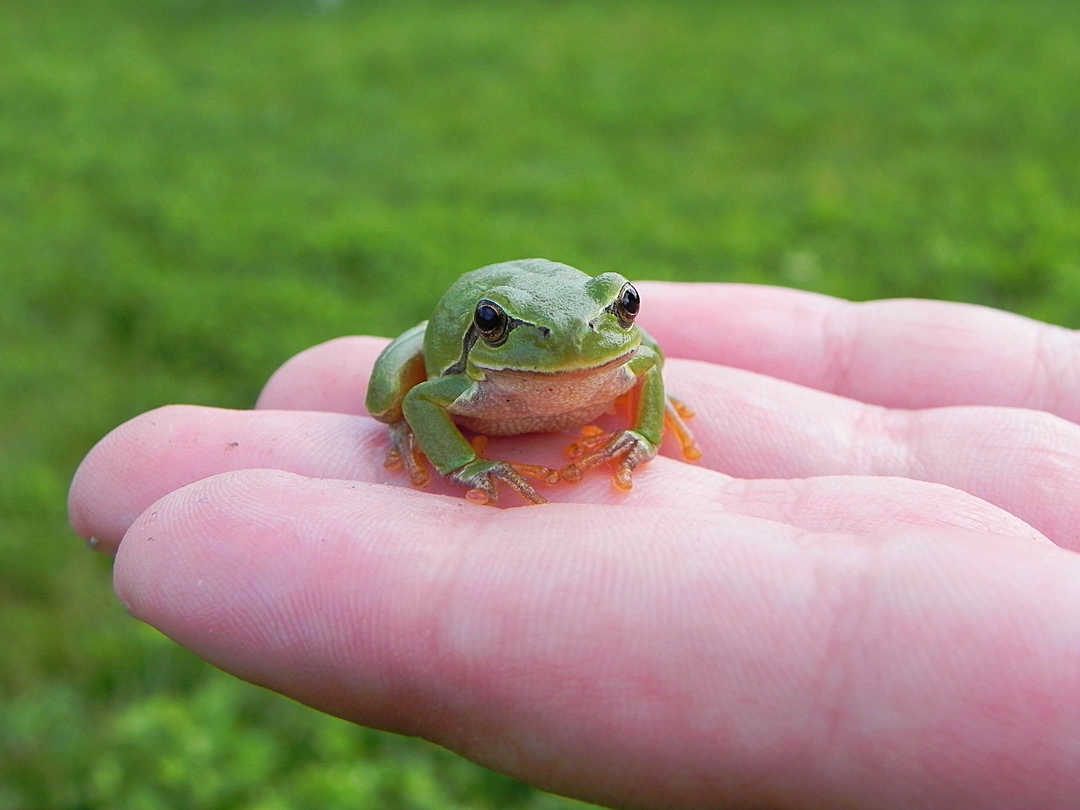
Green tree frog sitting on human fingers

Some tree frogs can be safely handled when caution is used. White’s Tree Frog makes a popular pet because it tends to be pretty tame and doesn’t jump around as much as other frogs. 

However, tree frogs don’t make good cuddle buddies. Owners should wash their hands before and after handling them, as frogs can cause salmonella poisoning.

Where Are Tree Frogs Usually Found?

Tree frogs are found in every corner of the planet. One species has even adapted the ability to survive the harsh deserts of Australia! So, let’s get outside and see if we can find some tree frogs.

As a quick disclaimer, we don’t recommend handling wild tree frogs. Instead, you should contact a professional if you happen to come across one.

Tree Frogs Are Often Found Near Water

Tree frogs need still, freshwater to survive and lay eggs, and their small size prevents them from traveling far from water. Look around ponds, marshes, wetlands, and even temporary puddles near trees after heavy rainfall.

Tree Frogs Have A Unique Call

Tree frogs don’t ribbit. Each species of tree frog makes its unique call to make sure they’re attracting the correct mates. They are loudest during the breeding season, which is usually in spring, but can be all year round in the tropics.

Listen for a chorus of peeps, clicks, chirps, and croaks. Listen closely and walk closer to see if you can find the source of the sound.

Tree Frogs Often Live On Or Near Trees

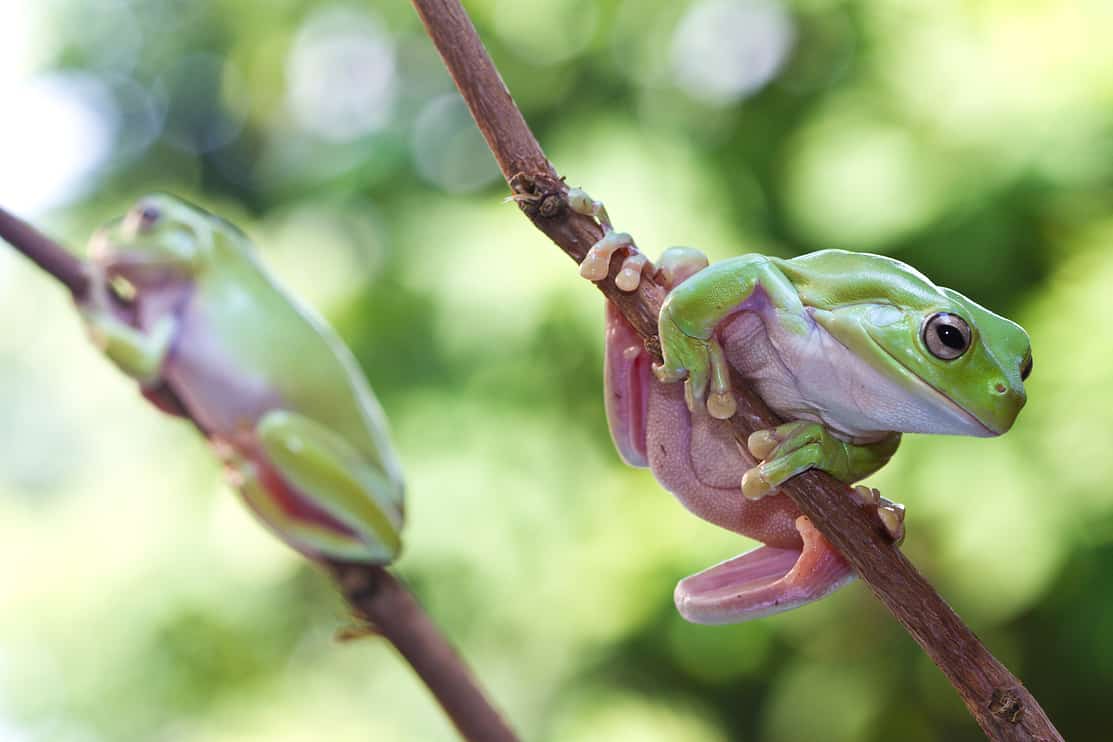
Green Tree Frog in a tree

Some tree frogs may stop calling when you approach, so that’s when you’ll need to use your eyes. 

Remember that tree frogs can be quite small, under one inch, and if you’re in the United States, they can be very cryptic. Look closely at small bumps on trees and leaves. Bases of trees and underleaf litter can also be sources of tree frogs.

Check out this article 9 Different Animals and Insects That Live In Trees to learn more about other animals that call trees home!

Tree Frogs Can Be Found Most Often At Night Or Early In the Morning

Tree frogs tend to be less active in the heat of the day. You’ll start to hear their calls around sunset, which can continue into the morning. Don’t forget the flashlight!

Let’s Recap!

That’s all folks! Let’s review to see what we’ve learned about tree frogs.

Tree frogs are small insect-eating frogs that are popular beginner pets. Tree frogs breathe and drink through their skin, which comes in a variety of colors, from greens and grays to bright blues and pinks. Unfortunately, their numbers are rapidly declining. 

Tree frogs are a huge group of many different species that can live from a few months to two decades, depending on different factors such as size, climate, and whether they live in the wild or as pets.

White’s Gray Tree Frog lives the longest, up to 21 years in captivity or 7 years in the wild, while Blanchard’s Cricket Frog has the shortest life span, living from a few months in the wild or 7 years in captivity.

Tree frogs are found all over the world, near clean, still freshwater, and often, but not always, found on trees. With tree frogs being so widespread, you can likely find tree frogs locally by listening closely and looking for small bumps on and around trees.

Now, go forth, and check your local park (or pet store, if you’re looking for a new family member!) and find some tree frogs!

References

Gaston, K. J., Chown, S. L., & Evans, K. L. (2008). Ecogeographical rules: elements of a synthesis. Journal of Biogeography35(3), 483-500.

Stark, G., & Meiri, S. (2018). Cold and dark captivity: drivers of amphibian longevity. Global Ecology and Biogeography27(11), 1384-1397.

Hilje, B., Chaves, G., Klank, J., Timmerman, F., Feltham, J., Gillingwater, S., … & Rojas, E. (2020). Amphibians and Reptiles of the Tirimbina Biological Reserve: a baseline for conservation, research and environmental education in a lowland tropical wet forest in Costa Rica. Check List16, 1633.

National Wildlife Federation, & Roger Tory Peterson Institute. (2003). A field guide to western reptiles and amphibians. Houghton Mifflin Harcourt.

Cherries- dark, light, round, long, sweet, tart; however you may think of them, there is more to cherries than meets the eye. It may surprise you to learn that some species of cherry trees are just for looks!

A mock cherry tree is a variety of trees grown for ornamental reasons. While they produce fruit, not all of it is for consumption, and many of them are even bitter tasting. These trees often grow best in the USDA hardiness zones 4-6 and can withstand low temperatures for short periods.

If this information intrigues you and you have more questions about these trees, you are in luck! Stick with us as we discuss mock (or ornamental) cherry trees and all that goes along with this lesser-known variety. 

What Is A Mock Cherry?

The first question that will come to mind has to do with what. 

What exactly even is a mock cherry, or a mock cherry tree?

Similar to an orchard cherry, one produced to be eaten as a fruit, the ornamental cherry is produced for its visual appeal. 

The University of Maryland Extension helps us understand ornamental flowering cherries are a part of a family of trees called Rosaceae and that the typical lifespan of these trees is only 20-25 years. 

External factors such as disease, pests, and other environmental concerns, ornamental (mock) cherry trees rarely last for long. 

While their lifespan is not the most enduring, these trees are visually attractive and add a pleasant touch to wherever you plant them. 

What Are Well-Known Types Of Mock Cherry Trees? 

When thinking of mock cherry trees, you may fall short, unable to come up with any types of cherry trees that would not produce the sweet (or tart) taste we all know and love. Never fear, we have just the information you need!

Now, these may not be all the varieties of ornamental cherry trees (not even close, if we are being honest), but we hope this short list helps you to understand and even possibly identify ornamental cherry trees down the road.

If you are planning on planting any type of cherry blossom tree, you may wonder if it will give your yard a pleasant scent. You can find information on the topic here: Do Cherry Blossom Trees Smell? 9 Cherry Blossom Facts.

Kwanzan Cherry Tree

Pink Kwanzan Cherry tree in fool bloom in Mirabell palace gardens in Austria.

This mock cherry tree grows no fruit at all. Crazy, right?

At least there are no mix-ups when distinguishing if this tree has edible cherries on it. No cherries mean no worries with the Kwanzan cherry tree. 

This low-maintenance variety of cherry tree is a bit showier, with brighter colors and larger flowers. 

The pink double blossoms of a Kwanzan cherry tree often draw interest from spectators, and critics, everywhere. Not only are the flowers made of double blossoms, but they cluster together in groups of 3-5. 

Think this tree sounds cool? Just wait until you hear this. 

Kwanzan cherry tree flowers also sport nearly 30 petals per blossom. When you combine the double blossom with 30 petals each, clustered in groups of 3-5, one can only imagine how stunning this tree becomes in the spring!

If not, there are plenty of cherry blossom festivals all around the world and this species is a fan-favorite every single time!

In fact, on top of festivals in the tree’s native Japan, this ornamental cherry tree is featured in many US cherry blossom festivals like the popular Cherry Blossom Festival in Washington, D.C.

You can see this showstopper for yourself, somewhere closer to home.

Yoshino Cherry Tree

This is another ornamental cherry tree sporting a white flower, though this one is much bigger than the Carolina cherry laurel. 

The Yoshino cherry tree’s flower has a similarly delicate look to it while benefiting from a fuller, more luscious overall appearance. 

With single blossoms, the flowers are clustered in groups of 2-5, which adds to the appearance of fullness in these blossoms. 

It’s all about the angles, right?

Akebono Cherry Tree

This species is, unfortunately, losing a bit of its popularity to newer ones, but the Akebono cherry tree still has much to offer. 

It is unique because its flowers change throughout their bloom, shifting from a pale pink to a bright white during spring. 

With a single blossom and clusters of 2-5, these flowers are also pretty subtle but beautiful.

Autumn Flowering Cherry Tree

You will find semi-double blossomed, pink flowers all over the autumn-flowering cherry tree. Its name derives from how this tree famously blooms during warm parts of fall, before fully blooming in the spring. 

What a wonder when this tree blooms unexpectedly as other trees are losing their leaves, or preparing to stay in the same evergreen disposition.

This means their small clusters of flowers are seen more than once a year, which is a magnificent thing on its own, but two separate times during a single year.

Sargent Cherry/North Japanese Hill Cherry Tree

Prunus sargentii accolade sargent cherry flowering tree branches, beautiful groups light pink petal flowers in bloom and small buds in sunlight against blue sky


The Sargent cherry tree, also known as the north Japanese hill cherry tree, is native to both Japan and Korea. 

Its blossoms are single, but clustered, and come in a deep pink color many associate with the very popular ‘Japanese Cherry Blossom.’ 

While many people might assume this popular spring phenomenon in Japan relates to a single type of tree, there are many species involved in the cherry blossoming of the spring. 

This is, however, one of the most notable varieties of blossoming cherry trees, and for good reason. 

While other ornamental cherry trees may only grow to be about 40 feet tall at a maximum, this species can easily make its way up to 60 feet tall in the wild. 

Fugenzo Cherry/Shirofugen Cherry Tree

Speaking of Japan, let’s not forget cherry trees originated in that corner of the world. 

While there is notable debate about whether South Korea, China, or Japan can rightfully stake their claim as the homeland of cherry blossoms, it is most important to know these trees are all descended from this area of the world.

The Fungenzo cherry tree (also known as Shirofugen cherry) is one of the oldest Japanese-cultivated cherry trees out there. It produces beautiful flower blossoms that honor the tradition that goes back at least hundreds of years, possibly longer.

With a double blossom and 30-40 petals each, you will see the flowers in a range of colors spanning from a rose pink to a light, nearly white but not quite color, which signals the aging of the flower.

Okame Cherry Tree

The okame cherry is said to flower the earliest of the cherry blossoms in the spring. The autumn-flowering cherry tree does not give much room for other cherry trees to earn this superlative in a year-round context.

With semi-double, bright pink blossoms, this is another crowd-pleaser and the droopy look of the flowers adds a level of singularity many people are drawn to.

Weeping Cherry Tree

Beautiful pink Shidarezakura(Weeping Cherry blossoms) at Tenshochi Park,Kitakami,Iwate,Tohoku,Japan in spring.

Alright, speaking of droopy cherry blossoms, we would be remiss to leave out the weeping cherry tree. 

Think of the commonly known weeping willow and the popular north Japanese hill cherry. 

Now, imagine they combined forces and created a hybrid tree. It is both cool and collected while being bright and vivacious all at the same time. 

Perfect, you’ve got yourself the weeping cherry tree!

This tree originates as a cherry tree grafted onto another tree to create the weeping effect, and this was first cultivated in Japan centuries ago. 

For this reason, it is difficult to pin down what the flowers of this tree might look like, as there is so much variety within this type of tree. 

However, this is one you will not want to miss when you hit a cherry blossom festival or are looking to get an ornamental cherry tree of your own!

How Long Do Ornamental Cherry Trees Live?

Realistically, this timeline depends on the species of the ornamental cherry tree itself. 

Kwanzan cherries live up to 15-25 years, while some live longer and some may live shorter. 

For example, some other species have can live around 30-40 years, instead of adhering to their relatives’ slightly shorten lifespans.

You can realistically expect your ornamental cherry tree will be around for 25 odd years but keep in mind some factors may shorten or lengthen this lifespan.

How Big Do Ornamental Cherry Trees Get?

Ornamental cherry trees usually grow to about 30-40 feet tall, depending on some environmental factors such as sunlight, soil quality, and how many other plants may share the same patch of land. 

The National Parks Service offers a list of some types of cherry trees at a festival, all of which range from 15-50 feet tall, while we know some species of ornamental cherry trees grow to be a bit taller than this.

How Can You Tell If A Cherry Tree Is Ornamental?

While most ornamental cherry trees produce no fruit at all, there are a few varieties listed above capable of producing fruit, but also get grouped along with trees that do not. 

This may seem confusing, but just know the Carolina cherry laurel is an exception to the rule. 

An ornamental cherry tree will have either single, double, or semi-double blossoms, most often white or pink. 

It is easiest to identify a mock cherry tree during the spring when these trees are in bloom. Otherwise, you can look at the leaves, bark, and other key factors used to identify any tree.

Where Do Ornamental Cherry Trees Grow Best?

Like all other types of trees, there are certain regions that ornamental cherry trees will do their best growing in. 

If you are someone looking to grow your trees in the United States, the USDA has a map of hardiness zones with information about which regions drop to certain low temperatures. 

From there, you can determine if your area is suitable for growing any type of tree. 

USDA hardiness zones 4-6 are often the best overall locations in which an ornamental cherry tree will thrive.

This means that an ornamental cherry tree can survive, and possibly thrive, in locations that have a low temperature of -25 degrees Fahrenheit through -5 degrees Fahrenheit. 

Keep in mind this does not mean you should try to grow these trees in areas where those low temperatures are the average. They are simply indicators of extremely low temperatures a region may experience once in a while, that a cherry tree could withstand. A different scenario arises when your average temperature gets that cold. 

How To Keep Ornamental Cherry Trees Healthy 

Beautiful Sakura pink flower on mountain with lake in thailand, cherry blossom

Ornamental cherry trees certainly do not have the longest lifespans, especially in relation to some other types of trees. However, there are many things you can do to help ensure your tree not only grows but thrives during its time here.

Pick The Right Location

The location in which you decide to plant your ornamental cherry tree is important. 

You will want to be sure you are not planting too close to any foundations of homes or other buildings, as well as giving enough space from other trees to ensure yours will get enough sunlight. 

It may not be the absolute most important thing about growing a cherry tree (of any kind), but it will help make your tree journey much easier in the long run. 

What exactly do we mean by right location, though? Well, the right location has to do with factors like sunlight and soil quality, but also with fertilization and access to water. Finally, keep those USDA hardiness zones we mentioned above in mind.

Utilize Your Land

So, by utilizing your land, you should be able to find somewhere with the right amount of space so for your cherry tree. 

Overcrowding of roots is an issue, sure, but it is also key to remember the more plants there are in a plot of soil, the fewer nutrients each plant can access. 

With knowledge about which plants can cohabitate without leeching nutrients, you can avoid this. If plants require different nutrients, they can survive close to each other.

If you do not have this knowledge or do not have a desire to research it, it is better to play it safe and separate your plants a bit.

Another way to help prevent root crowding is planting trees with shallow roots. You can find a wonderful list in this article about fruit trees specifically, 6 Best Fruit Trees That Have Shallow Roots: Identification Guide.

Look for an area with plenty of sunlight and space. If it will also showcase your ornamental cherry tree, it may just be the perfect spot for one.  

It’s ornamental for a reason, after all. You want people to see this beautiful specimen you have been growing.

You deserve to show off your hard work and (we hope) your neighbors deserve to drive by your magnificent cherry tree in bloom.

Fertilize Your Cherry Tree!

If you have read nearly any other piece that we have written, you will be familiar with the idea that fertilization is key to growing happy, healthy, and resilient plants. 

We need our nutrients, so who is to say trees do not need the same TLC we would expect to nurture our growing selves?

You will want a pretty balanced fertilizer. A 10-10-10 granular fertilizer like this Southern Ag All Purpose Granular Fertilizer is a great option. 

This fertilizer is an easy to apply, homogenous mixture. With an even sprinkling of fertilizer, followed by water, you can provide your tree with the nutrients it needs.

Keep The Cherry Tree Hydrated

Trees need water, just like most all other plants. 

Ornamental cherry trees are no exception. 

Water your tree often, especially if you live in a region with less rainfall. 

That’s All for Now!

We hope this was cherry helpful. 

Too much? Probably. 

Anyway, now you have learned a bit more about what exactly a mock (ornamental) cherry tree is, where they might do best once planted, and how else to care for these beautiful beings. It is obvious there is a lot to love about them.

Whether you are hoping to plant an ornamental cherry tree in front of your home or business, or are simply interested in learning more about this beautiful tree family, we certainly hope you got what you came for.

As always, thanks for sticking with us. Hope to see you again soon!

References

Hokanson, K. E., & Pooler, M. R. (2000). Regeneration of Ornamental Cherry (Prunus) Taxa from Mature Stored Seed. HortScience35(4), 745–748.

Jacobs, K. A., & Johnson, G. R. (1996). Ornamental Cherry Tolerance of Flooding and Phytophthora Root Rot. HortScience31(6), 988–991.

One of the most popular trees out there, oaks are a fixture throughout the many wooded areas of the world. It’s no wonder that these trees pop up so often, whether you see them as young trees beginning to grow in a developing neighborhood or as ancient beings with hundreds of years of life experiences behind them.

Oak trees typically fall due to old age, wind, or lightning strikes. Typically, you can still use most fallen oak tree wood on your property! The best fallen oak tree uses include cutting the wood for firewood, turning the oak wood into mulch, and using the wood for creative landscaping.

So, without further adieu, let’s discuss what to do with a fallen oak tree if it so happens to fall in your area. Are you ready? We are! Let’s get into the 9 BEST fallen oak tree uses and what to do with them. 

What Is An Oak Tree? 

The massive and old Angel Oak Tree in South Carolina

Oak trees have around 500 subspecies of trees and shrubs that are distributed throughout the world. 

These trees contain both female and male flowers, which reproduce to create an acorn, the ‘oak nut’ which acts as the seed of the tree. 

There are so many types of oaks, each of which is good for different things. Both red and white oaks (the two main categories that subspecies fall into) are commonly used for lumber when cut down, producing furniture and flooring while also being used in millwork, construction, and more. 

If you wish to grow your own oak tree for aesthetic or practical purposes, something like these Red Oak Tree Seeds from CZ Grain could help get you started!

What happens when the oak tree is not intentionally cut down for use but falls for whatever external reason? 

We’ve got you covered! Let’s dive into what you should do when a tree first falls on your property. 

What Do You Do With A Fallen Tree In Your Yard?

One of the first things you’ll want to do when dealing with a fallen tree is inspected the wood of the tree. It’s important to know that you cannot necessarily repurpose every tree. Some factors might render the wood unusable, unfortunately. 

For example, if a fallen tree ends up having been infested by insects or disease, the wood will likely be rotten, brittle, or both. This weak wood will be poor to use, especially if you were hoping to create furniture or any other weight-bearing pieces from it. 

If you are creating nicknacks, you may be able to recover some sections of wood to use for more craft-based purposes. This should be done at your discretion, and with the understanding that the wood may not be as easily worked with as you might hope. 

It can be disheartening to have to completely lose a tree and not be able to repurpose its wood, but sometimes it is worth the loss to avoid further issues or injury down the road with wood that is not reliable.

If you believe that your tree may have fallen due to pest or fungus damage, you could do a little research by reading similar articles from us such as 5 Animals & Insects That Eat Oak Leaves, or 6 Simple Tips To Prevent And Remove Oak Tree Fungus to learn more!

9 Amazing Fallen Oak Tree Uses

From furniture to home decor, functionality to aesthetics, reusing wood from fallen oak trees can serve as an environmentally conscious, cost-effective way to spruce up any area. 

If you have a fallen tree, it’s time to spring into action and make use of the wood while it’s still relatively fresh. After a while, you may not have a choice between leaving the tree to nature and using it for yourself- animals move quickly, too!

Here are 9 of the best ways that you can use the wood of fallen oak trees.

Cut Fallen Oak Into Firewood

A stack of beautiful wood. firewood chopped and ready for the kindling of the fireplace lie beautifully. natural energy

Looking for a simple, not super time-consuming, way to get a fallen tree taken care of while still reaping the benefits of all your newly gained access to completely free oak wood? 

Chop the wood up and get yourself tons of firewood. Depending on the size of the tree, the temperature of your location, and the frequency that you have fires- this firewood has the potential to last you for quite a long time. 

Also dependent upon the type of equipment and experience you have, you might hire someone to help you break the tree up into pieces that have a firewood-sized width or length. Use an ax (or a woodcutter, this is easier if you have access to one) to break those pieces up into little logs that will fit into a bonfire or a fireplace and burn evenly. 

If you want to invest in a great tool for cutting up wood, you could get something like this INTERTOOL 35-Inch Splitting Maul.

One thing to consider, that the University of Kentucky reminds us of, is that your firewood will need to dry out. You can’t just chop up a fallen tree and throw it into the fire- this will create smoke and your fire is likely to fizzle out in a hazy plume. 

If you have access to a kiln, you could very quickly speed up the drying process. Most likely, you will just need to practice some patience and plan on using this firewood next year.

Fresh firewood pieces will take anywhere from 6 months to a year to dry out. Hey- we said that chopping the firewood wouldn’t take super long, this is a whole different part of the process!

Store your firewood until it can be used, mindful of the fact that a tarp can be placed over the stacks of wood to ensure that no more moisture gets into it. 

Finally, enjoy nice nights outside roasting marshmallows, or a cozy evening in front of the fireplace with some movies. Either way, this is a relatively simple method to handle a fallen oak tree that is practical and fun- all in one!

If you’re interested, take a look at our guide: 10 Best Oak Trees for Firewood Ranked to learn more about the best oak firewood!

Create Furniture That Is Eco-Friendly And Unique From Fallen Trees

You don’t have to burn the wood that you cut down. 

If you have any experience or are committed to learning how to woodwork- this could be the perfect opportunity for you!

You could build a set of patio chairs that reflect the transformation of your tree while allowing it to stay in your backyard, or on your property somewhere. 

If your home has more of a rustic feel, or you’re hoping to incorporate your fallen oak tree into the interior where it can remain well-preserved, perhaps a rocking chair or lounging chair in the corner would be a better fit. 

While there are many factors, from sanding to staining, that take place as the furniture itself is being built- you can be sure that you will have a piece that not only looks great but is also a fun conversation topic. 

Maybe you prefer to keep it simpler (and less weight-bearing) and build a little slanted shelf that could hold a few books or some blankets in your living room. 

Whatever furniture you pick will be unique, and authentically yours, bringing nature and your old tree and turning them into something that you can continue to use and appreciate.

You get to know where your wood was sourced from while making all other decisions about everything from design to comfort and where you want to display your newest furniture piece (or pieces, if you’re feeling ambitious.)

Create Other Unique Household Items With Fallen Oak Trees

Did you think it was just furniture you could make out of your fallen oak tree? No way!

So, what else could you make, in that case?

Let’s talk about a few of the unique household items you’d be able to create using your fallen oak tree’s wood.

Oak Coasters

You could create some really beautiful yet functional pieces by cutting some branches into little cylinders that are ½ inch to an inch in height.

Sand them and treat them however you see fit, and voila! You’ve got yourself some coasters that are great for a coffee table, or wherever else in your home drinks tend to get placed on bare surfaces. 

These coasters will go together, of course, but will each vary in a way that makes them fun and unique. No cookie-cutter pieces here!

Oak Tree Cutting Boards

Speaking of ‘cutting’, you could make some wonderful cutting boards out of this wood. 

Perhaps you just want one, or maybe you’ll decide to create a 5-piece set of different-sized cutting boards that can be used on all occasions. Say goodbye to plastic cutting boards and hello to durable yet-replaceable ones that should last you quite some time.

Oak Picture Frames

Looking for something that can be a bit more purely decorative? We’ve got you!

What could be better than a photo of you and a loved one, or some beautiful landscape, or a degree, surrounded by natural oak wood that frames it? The oak wood frames you use on a photo fall in your entryway may be what draws your guests’ eyes at first, but your photos will quickly become the stars of the show- as they should be. 

This is a fun way to add an extra touch to the already-personal elements of your home. 

Oak Candleholders

Are you a candle lover but tired of the same old wax warmers or little glass jars that candles come in? Add some oak wood!

Whether you opt to cut a small piece of wood (from an oak branch that is about the width of a standard drinking glass) and hollow it out far down enough to fit your favorite candle, or you simply want to sit a tea-light or candle atop a piece of oak, you will soon forget about your boredom with the old candle holders you’ve been using.

These are all great ways to add some decor to your home all while maintaining a common look and theme. Oakwood is beautiful and can be used in so many ways, including some that we haven’t yet mentioned. 

That being said, let’s continue- shall we?

Make Hanging Wall (Or Mantel Piece) Decor With Fallen Oak

If little things sitting around your house stress you out, you can opt for decor that is a little more eye-level. 

Beyond picture frames hanging on walls, you could also hang an interesting-looking piece of oak wood as a centerpiece above the focal point of a room. (Extra points if the wood looks at all like driftwood or is curved uniquely.) 

Not only would this draw the eye of anyone you invite over, but it can also be a special way to commemorate a tree that has fallen but was once important to you for any reason. 

Maybe your kids climbed the tree every day after school, or it was planted after a wedding, or you just really loved reading in the shade of its branches on hot summer days. 

No matter what the backstory may be, you can keep a piece of any special tree with you even after it has fallen.

Turn Fallen Oak Wood Into Woodchips Or Mulch

Mulch Background

Take a note from the University of Florida and go ahead and turn some of your leftover oak tree pieces into mulch!

Spreading this organic mulch around your other plants- from trees to flowers to the garden vegetables you’re growing- will help to support them. While your oak tree may be gone, it is far from finished with its work in your landscaping. Now, it just helps you out in a different way.

Instead of paying all that money to buy bags of mulch each year, you could rent a wood chipper and call it a day! 

If you see yourself doing this task more often in the future, you may want to invest in something like this Sun Joe Electric Silent Wood Chipper.

Any machinery and equipment should be mindfully operated and carefully used, of course.

Fallen Oak Can Make Great Outdoor Chairs And Tables

If you are not keen to use fallen oak wood to build chairs that go indoors, we get it! That doesn’t mean, however, that you cannot still repurpose this wood into furniture that gets used in the great outdoors. 

Just think of hosting a backyard party and getting to tell your friends or relatives that the chair they are sitting in, or the piece of wood acting as a side table, or the little outdoor coffee table, was made from that tree that blew over in the storm a while back. 

Not only is this environmentally conscious and a great way to repurpose a free and available resource, but it is also cool!

Use Oak Pieces As Decorations

Whether this looks like planning for a rustic-themed event or simply adding some character into the design of your home, pieces of wood in any shape or size are great additions to areas where you have already decorated. 

Fallen Oak Pieces At Events 

For example, if you are planning an anniversary dinner, you might gather some pinecones, needles, and other leaves to put in clear vases while sitting candles on top of little wooden coasters. These can be cut directly from branches and you can vary the size so that the look is cohesive without looking like you bought matching wood cylinders from your local craft store. 

Add an old book or some dried flowers and boom, you’ve got yourself a creative and fun centerpiece that has real thought put into it. 

Another great way to use elements that tie in an oak tree is to decorate your centerpieces with acorns and use them as additional decorations!

Fallen Oak Pieces At Home

Trying to figure out what you can do to freshen up your entry table or the alcove near your dining area? 

You can take a similar idea from the event options, and shift it into something fitting for a home decor scenario. Maybe a little less ‘centerpiece-focused’ and a little more ‘spread out throughout your home’, for example.

Do you have a bowl where your keys go once you walk in the door? Sit that on a thin but wide cylinder of wood, and place a taller but thinner (from further down the branch) piece of oak wood next to that centerpiece. 

If you want to get fancy, carve a little circular section from the top of that taller wood piece and sit a tealight into it. You can use an electric one, in the name of fire safety!

Feeling extra bold? Maybe you take a piece of the trunk or one of the largest branches (if the tree was quite mature) and turn it into a bedside table, an end table by a couch, or a statement piece by the front door where you throw your mail from time-to-time. 

The possibilities for incorporating wood as decor in your home are endless, and we know that you will do something super cool!

Use Fallen Oak For Creative Landscaping

Growing herbs and vegetables, including tomatoes, in a small Victorian kitchen garden

Keeping with the theme from a few ideas up about using some of the oak wood to create mulch, you could also always use parts of your tree as a landscaping element that is a bit more obvious. 

Line a flower bed with evenly-sized pieces of wood (cut from a medium-sized branch, for example.) Who needs rocks, anyway? These wood pieces can help prevent erosion of the soil and mulch in your flower bed while also creating a unique, fun, visual effect.

To protect yourself while moving around these pieces in your yard, you may want to put on something like these Ironclad General Utility Work Gloves.

Let Critters Live In Fallen Trees

The bird spots the owl in a tree hole.

Fallen trees can be the perfect habitat for many little creatures, from chipmunks and squirrels to raccoons and red foxes. If you have a large property and feel comfortable leaving your tree to the land you’ll create less work for yourself while providing a potential new habitat to some woodland critters. It’s a win-win if your area is appropriate for this.

Especially if you are someone that would love to be creative but just does not have the time, or if you have no interest in using the wood for anything personal. These ideas are all great, but they aren’t for everyone. 

Leaving a tree to go back to the earth is the most natural way to do it and, as long as disease or infestation is not a factor, this can be so deeply beneficial for the area around where your tree once stood.

Naturally, of course, this is just one of the amazing ways how oak trees help the environment. You can read more in our piece: 7 Amazing Ways Oak Trees Help The Environment.

That’s A Wrap!

Now that we have shared some amazing ways that you can make use of your fallen oak tree, it’s time for you to put them to the test!

So, get your saw, your ax, your hammer and nails, your wood stain, and anything else that you could need to create all of the best pieces for inside your house and out.

Remember, these are only some of the amazing uses for fallen oak trees. Get creative, and let us know if you come up with any more. This is all a new part of your tree journey, and we just hope that these ideas spark something in you- whether it be creative, functional, or both. 

The fact that a tree falls is never ideal, but the loss of your tree does not have to mean the loss of all that it has to offer. 

Like nature itself, trees can provide some pretty unexpected gifts if you take the time and effort to search for them. Plus, all that free wood should get some use out of it- do you know how much all that firewood, or a new chair, or some end tables, would cost at the store?!

Thanks for reading! If you’d like to learn more about oak trees, check out our fun article: 32 Incredible Facts About White Oak Trees.

References:

Bugalho, M. N., Caldeira, M. C., Pereira, J. S., Aronson, J., & Pausas, J. G. (2011). Mediterranean cork oak savannas require human use to sustain biodiversity and ecosystem services. Frontiers in Ecology and the Environment9(5), 278-286. 

Julyus, P. (2019, November). inland waterways transportation interior decor laminated wood layout LEAN. In Nautical and Maritime Culture, from the Past to the Future: Proceedings of the 3rd International Conference on Nautical and Maritime Culture (Vol. 3, p. 219). IOS Press.

Robinson, S. C., Tudor, D., MacDonald, G., Mansourian, Y., & Cooper, P. A. (2013). Repurposing mountain pine beetle blue wood for art through additional fungal colonization. International Biodeterioration & Biodegradation85, 372-374.

Did you ever look at your cardboard delivery box and wonder how it was made, or what materials were used to make it? Trees provide us with a plethora of things, from paper, pulp, and tannins to dyes, gum, and corks. Surely you can’t make paper with just any ol’ tree, can you?

The trees used for papermaking fall into two categories: hardwood and softwood. Softwood trees like pines, spruces, hemlocks, and firs are excellent trees for paper. Hardwood trees, like poplars, birch, hickory, maple, and sweetgum, are for sturdier printing paper and magazines.

Trees are amazingly beneficial to humans, the environment, and wildlife. Let’s check out which trees can make paper and also discuss some alternatives.

How Many Trees Are Needed To Make Paper?

When you think of how thin copy paper is, you might not think it takes much to make. You would be right – a single piece of paper uses a tiny percentage of the tree. But how many people buy just a single piece of paper…. none, really.

Let’s put into perspective just how many trees are necessary to keep the world spinning. According to 2016 statistics gathered from Dartmouth University, in North America alone, each person used about 474 pounds of paper that year.

This seems like a staggering number, right? Well, take into consideration this includes ALL paper products – computer paper, newspapers, towels, toilet paper, cardboard boxes, corrugated paper, etc.

A single tree can make around 8,333 sheets of copy paper. That comes out to about 6% of a tree being used for each ream of paper (500 sheets).

You get the point… you need a lot of trees to provide paper products for everyone who needs them. So where exactly do paper industries get these trees from?

If you are interested in more information about the number of trees needed to let the paper industry thrive, check out this piece: How Many Trees Are Cut Down For One Piece Of Paper? The sheer amount is astounding.

Where Do Paper-Making Trees Come From?  

Paper industries are not out to get your lovely backyard oak for their paper products. So where do they get the trees they need?

A lot of the wood used in the paper-making business comes from waste products of lumber mills. Wood scraps, sawdust, and woodchips are all sent to paper mills to be smashed into a pulp and eventually made into paper.

This is an excellent way to reduce wasting the unusable parts of the tree at lumber mills. For example, branches typically have no use in lumber, only trunks. They can chip those branches up and ship them off to a paper mill to put them to good use!

If they do not get the trees from lumber mills, they can also get the wood from some national forests.

According to the U.S. Department of Agriculture, around 190,000 acres of trees are available for harvesting in various Forest Service lands. It may seem like a lot, but the 190,000 acres is out of 193 million acres of all Service lands (about 0.1%)

When the above two options are not used, paper mills can get trees by owning forest land. They will clear-cut the trees and use seeds to replant those trees. However, they will not be ready to cut again for about a quarter of a century.

Can Paper Be Made From Any Tree?

If you can make paper from any old tree, then why not use plantations with the fastest growing trees? Unfortunately, not all trees can be used for paper.

There’s a reason some trees are better for making paper than others. Pines, spruces, birch, and hickory are all popular trees used in the paper-making industry. Using trees of a lesser quality can cost more to make in both monetary value and environmental pollution.

The harder the process to make paper, the less useful the product. Some hardwood trees have fibers too small to make into proper paper products. Instead of wasting time and energy on these trees, paper industries prefer easier trees like those mentioned above.

This process creates less waste and uses lower energy to produce paper products. Humans have been making paper for a few thousand years. Surely they have the process down by now!

You can give the process a try yourself if it piques your interest. Kits like the Aoibrloy Paper Making Screen Kit can give you a head start on your journey. They have two different sizes to choose from, so you can decide how big you want your paper to be.

9 Different Trees Used To Make Paper

Now onto the good stuff! We’re going to start with softwood trees since they are the most prized trees for paper making.

Softwoods are so valuable for paper because they have long fibers in the wood. This makes for great paper and not-so-great construction materials.

Pine Trees

Bright summer pine forest head-up view

Pine trees are conifers and evergreens, keeping their holiday-themed pine needles all year round. They are also softwood trees with long fibers good for paper making.

Even though these softwoods can be made into paper, pine trees aren’t the best choice because all pines contain pitch. This adds a few more steps in the pulping process some of the other softwood trees can skip.

According to the USDA’s Forest Products Laboratory, the most popular pine trees used to make paper include:

  • Lodgepole Pine
  • Eastern White Pine
  • Southern Yellow Pine
  • Jack Pine
  • Ponderosa Pine
  • Sugar Pine

Pine trees used in the paper industry will preferably contain as little heartwood as possible. This is the strong, albeit dead, inner part of the pine tree’s trunk.

Spruce Trees

If you are not careful, you could easily mistake a spruce tree for a pine tree. These trees are also evergreens, conifers, and softwoods with needles and cones.

One of the biggest differences between pine and spruce is the needles. Pine trees have clusters of needles connected to the pulvinus (sort of like a joint that the needles attach to), while spruces have only one needle per pulvinus.

Just like pine trees, spruce trees have a variety of different species, each with its quirks and characteristics.

Spruce trees are used for a ton of different things. They are a prized choice for Christmas trees, used to make wood for musical instruments, and, of course, paper! Pretty much all spruce trees are wonderful for the paper industry.

Hemlock Trees

You can find hemlock trees all over the United States and in Canada. Only four species are native to North America, the rest find themselves at home in Asia. 

The two big categories of hemlock are eastern and western. These names coincide with where the trees grow in the United States. No matter what species of hemlock, they are evergreen and coniferous.

Hemlocks are a lot harder to grow for sustainable purposes than other trees. They are old and wise, living as long as 900 years sometimes and take about a hundred years to mature.

There are several faster options than the hemlock.

Western hemlocks are preferred to eastern hemlocks because of the need for more bleach on eastern hemlocks. Its pulp is darker than the western hemlock and makes weaker paper.

Fir Trees

There are fir trees and then there are true fir trees. True fir trees are what we are talking about here, not those fakers like Douglas-fir.

True fir trees provide similar paper quality to spruce trees. Pretty much any true fir can make good-quality paper.

There is one exception, the California red fir. Similar to Eastern Hemlocks, Cali red firs make for a darker pulp, which requires more bleaching. Most paper manufacturers want the process to be as fast, cheap, and convenient as possible, so they opt for the better fir trees.

White Cedar Trees

Thuja occidentalis in garden center. Plant nursery.

The last softwood tree on our list is the white cedar tree. And despite its name, it is not a cedar tree. You may know them by another name: arborvitae.

These evergreen trees enjoy wet, boggy areas with well-drained soils and lots of sun. Similar to hemlock, white cedar trees grow slowly according to Iowa State University

Along with being good for the paper-making business, white cedars make fantastic privacy fences and windbreaks.

Speaking of paper-making, how do white cedar trees stack up against our other softwood trees so far? 

White cedar is easy to make into pulp with little to no extra effort. However, each tree yields less fiber than the others because of the wood being less dense than, say, a spruce tree or pine tree.

Hickory Trees

Hickory trees range from the eastern United States and west until about the middle of the country. They are not commonly found any further west.

These hardwood trees are not used as commonly as the softwood trees mentioned above, but they can be made into printing paper and writing paper. 

There are over 15 species of hickory tree, all of which belong to the walnut family. Who knew?!

Hickory trees are used more often for shipping boxes and corrugated boards, but the short fibers can be used for paper if they are in good condition. The process for making these walnut cousins into paper requires more energy than the softwoods, so it’s not highly sought after.

Poplar Trees

Aspen trees, Cottonwoods, and balsam poplars all belong to the willow family. These trees are all poplars and are rather popular in the paper-making industry.

Poplars do not make very strong paper, so they are often used to make newspapers and magazine papers with flimsy sheets. They are also used to make toilet paper.

This popular tree is both useful and nice to look at in the yard. We all know the quaking aspens that glow a brilliant yellow in the fall, but there are plenty of other species that look just as nice in your backyard.

However, you cannot plant these trees very close to buildings or other structures. The roots are very fast-growing and can damage foundations and sidewalks.

While poplars have decent wood for pulp making, they also have the benefit of being fast growers. They can grow up to five feet per year, which is significantly more than, say, an oak tree

Poplars are typically between 50 to 80 feet tall at maturity, making them a good choice for both hardwood products like lumber and plywood, as well as softwood products like paper.

Birch Trees

According to North Carolina State University, there are around sixty species of birch trees in the Northern Hemisphere. Like the other hardwood trees on our list, birch trees are deciduous, meaning they lose their leaves in the fall and winter.

For paper-making, birch trees are similar to poplar trees. They are a hardwood tree, so the fibers are small, so the paper is less durable than a softwood tree. 

Popular paper-based products from birch trees include books, wrapping paper, and container boards such as those used to fill spaces in shipping boxes.

Birch trees do best in colder climates, where the snow covers the ground for most of the winter. You will not see a birch tree next to a palm tree very often!

Maple Trees

Yellow Maple Autumn Leaves  in Aberdeen, Scotland UK

Ah, maple syrup, the best companion to pancakes and waffles. Maple syrup does come from maple trees. As do a few paper products!

In terms of paper production, maple trees most closely resemble the paper from birch trees. The wood is often used to make container paper, books, and wrapping paper.

Being a hardwood tree, maples are used for more than just paper products. They’re also made into furniture and railroad ties according to the Ohio Department of Natural Resources.

Maple trees do not get as much use as some of the softwood trees mentioned earlier. They are also slow growers, making them more undesirable than fast-growing trees for paper making.

What Are The Best Trees To Make Paper Out Of?

Now that we have gone over the nine most popular trees that are made into paper, let’s figure out which one is the BEST to make into paper.

Spruce and fir trees are the best choice when making paper. They are moderate- to fast-growing trees, making them more renewable than some of the other choices. Spruce and true fir trees also require little energy to make into pulp.

No extra removal techniques or additional bleaching are required to turn these trees into paper. Since both spruce and fir are softwood trees, they’re also not highly sought after for furniture, cabinets, or other manufactured wood products, making them more available for paper products. 

What Are The Worst Trees To Make Paper Out Of?

As we mentioned before, not just any old tree can be used to make paper. It has to have long enough fibers to form paper properly, and the trunk must not contain a lot of heartwood.

So, which trees do paper manufacturers avoid harvesting? The least desirable trees include:

  • Bald Cypress
  • Larch
  • Redwood
  • Douglas Fir
  • Red Cedar

The reason these trees are so undesirable for making into paper is because of the lengthy (and expensive) process the wood must go through before it is viable for paper manufacturing.

The wood must undergo an alkaline process and get pre-treated with steam to be fit to make it into paper.

The additional resources and time needed to convert these trees into paper are just not worth it, especially when the finished paper is typically lower in strength and quality than other options out there.

Is Paper Always Made From Trees?

According to the University of Massachusetts, southern white pine is the most common source of paper pulp in the United States. 

While some companies try to be sustainable with their paper-making processes, they still need a ton of trees to produce the necessary amount of paper. That means clearing hundreds of acres of trees just to produce a few months’ worth of paper.

Is there anything out there we can use instead of trees to make paper? The answer is a surprising yes!

Bamboo, hemp, and cotton are all alternatives that are used to make paper. While this sounds like excellent news, you may wonder why we are still cutting down trees to make paper.

One reason is hemp was illegal in the United States until 2018 when hemp was legalized at the federal level.  It’s a great alternative to paper, but it needs to gain some traction and momentum to affect the market.

If you would like to test out hemp paper, the Green Field Paper-Hemp Heritage® Mini Ream is a great place to start. It can be used in laser or inkjet printers and is the stark white color we are used to.

A second reason is the U.S. is a little stubborn. India and China are the major producers of pulp made from bamboo, but the U.S. continues to use trees. Why? They’ve always used trees, and the paper processing plants are made for trees, not bamboo.

Seems like a lame excuse, but it’s true. To change all the harvested forests into bamboo forests would cost a lot of time and money. Not to mention, changing the manufacturing process from wood to bamboo would require money, time, and new resources.

Paper Can Be Made From Kenaf

Hibiscus cannabinus also known as Kenaf

If you have never heard of kenaf, it is understandable. Few people know about this possibly world-changing crop.

Kenaf is part of the Hibiscus genus and is native to Africa. It is cousins with okra and cotton and enjoys warm, tropical climates and shivers at temperatures below 50℉.

Kenaf is very useful in the wood and paper industry. This plant combines both softwood and hardwood properties. Remember, softwood is better for paper products, while hardwood is better for lumber, furniture, and cabinets.

This multi-use plant has a hard inner part of the stem that is made of hardwood-like short fibers, while the outer part of the stem is long fibers like softwood trees.

The most beneficial aspect of the kenaf plant is that it grows to maturity in less than six months. Its height at maturity can reach up to 20 feet, but most grow between 8 feet and 14 feet. 

Comparing this to trees, which can take 25 years or more to reach maturity, it’s a no-brainer to use kenaf instead of trees.

The only states putting time into researching and using kenaf are Texas, Oklahoma, Mississippi, and the Southeast United States, according to Purdue University.

Wrapping Up!

There’s more to making paper than many people think: the type of tree used, the need for additional bleaching or steam, the type of paper you can make, and the quality of the final product are all things to think about when choosing a tree for paper.

Each tree has a unique type of wood. One might be better for magazines, while another is better for copy paper.

Overall, the 9 most common trees used in the paper industry include:

  • Pine
  • Spruce
  • Hemlock
  • True Fir
  • White Cedar
  • Hickory
  • Poplar
  • Birch
  • Maple

Trees are a staple to the health of the environment. We are conscious now more than ever of our impact on the planet, which is why paper alternatives are being researched. 

Bamboo, cotton, hemp, and kenaf are all gaining traction to replace trees in the paper manufacturing process.

Trees provide us with so many benefits and are truly one of the most important organisms on the planet. The next time you see a tree on your morning commute or your lunchtime walk, maybe you will smile and have a little more appreciation for all the things trees do for us.

If you’re interested in finding out more about different types of trees, what the best ones are for your landscape, or how to grow a tree from a seed, check out our the rest of our website to start your tree journey today!

References

Krishna, P. J. (2003, August). Transgenic Aspen Trees with Altered Lignification: Good News for Pulp and Paper Industry. ISB News Report

Maminska, R. T. (2017, October). Limits and perspectives of pulp and paper industry wastewater treatment – A review. Renewable and Sustainable Energy Reviews, 78, 764-772. https://www.sciencedirect.com/science/article/abs/pii/S1364032117306561

Seth, M. K. (2003). Trees and their economic importance. The Botanical Review, 69, 321-376. https://link.springer.com/article/10.1663/0006-8101(2004)069[0321:TATEI]2.0.CO;2

Sinclair, P., & Walton, J. (2003, September 17). Environmental reporting within the forest and paper industry. Business Strategy and the Environment, 12(5), 326-337. https://onlinelibrary.wiley.com/doi/abs/10.1002/bse.376

Cypress trees look like evergreens with their small needle-like leaves and round cones, but they are deciduous, meaning they lose their leaves in Autumn. Cypress trees have many uses and applications which make it cypress wood valuable and expensive compared to wood such as pine. 

Milled cypress wood is naturally water-resistant, decay-resistant, and durable. These qualities make cypress wood a premium choice for use in homes and heavy construction and thus, more expensive. Other cypress wood uses include boat docks, piers, siding, furniture, paneling, fence posts, and boats.

Read on to learn more about the uses of cypress wood and its value!

Cypress Wood Is Valuable

Cypress lumber usage has been documented since before America was settled. The trees create an oily resin that makes the milled lumber water-resistant, decay-resistant, and also repels most insects.

These traits, along with other quality characteristics, make cypress lumber some of the most versatile, as well as valuable lumber to come from the coastal US.

Cypress Tree Are Slow Growing

Cypress trees require wet areas to grow, especially before they get established. They also do not grow as fast as some trees like the fast-growing pine trees, meaning it takes years longer for the trees to grow large enough to use for lumber. 

Some cypress wood, like pecky cypress wood, is extremely valuable because it is created by a fungus. The fungus creates a pattern of pockets pleasing to the eye and sought after by artisan woodworkers. This type of wood is also quite rare, adding to the value. 

Uses For Cypress Wood

Stunning Cypress Tree Tunnel

Cypress lumber is an all-around useful wood with many practical uses.

A Journal of Delta Studies tells us cypress wood is used for roof shingles, boats, posts and pilings, caskets, water tanks, sugar crates, furniture, and appliances. This is, of course, alongside its construction uses.

Cypress Wood Was Used For Dugout Canoes And Boats

Cypress wood use has been documented since the beginning of record-keeping. Native Americans use cypress to craft canoes for transportation across the swamp and wetlands. They would cut down the tree and hold the trunk over a fire to soften the bark so they could carve it out into the shape of a canoe.

The natural water and decay-resistant traits made these canoes a staple for Native American life on the swamps and marshlands. With these hollowed-out trunks, Native Americans could trade with other communities, fish, and hunt in other areas. Without these cypress wood canoes, they might not have survived in the swamps. 

We still build some boats today with cypress wood. Especially by boating enthusiasts who want to build vessels. It is softer than oak or teak wood, meaning it is a little easier to work with, and of course, as stated above, it is naturally water and rot-resistant.

Skilled craft workers with the right tools can create gorgeous works of art that also serve as watercraft. 

Cypress Wood Is Used To Build Log Homes

Cypress wood today is still used to build log homes. These trees produce a preservative called Cypressene, which helps with water and decay resistance. It also repels insects like termites and carpenter bees who love to cut out perfect-looking dime-sized holes and burrow into soffits and siding of wood houses.

Cypress trees are softwood, but because of the tightly packed growth rings, they are often considered hardwood. Also, because of the narrow growth rings, they are less susceptible to shrinkage, twisting, and warping, making cypress trunks a perfect wood for log homes. 

If you have stayed in a log cabin on a vacation, it was most likely built with cypress logs.

Cypress Wood Is Used For Boat Docks And Piers

Cypress trees often grow in swamplands and marshes, leaving the lower trunks and roots completely submerged. Therefore, it makes sense to use this wood to make boat docks and piers. The wood stains well and can last upwards of 40 years.

If the wood came from heartwood and/or from an old-growth tree, with proper care, the wood could last upwards of 100 years. Again, the minimal shrinkage, twisting, and warping associated with cypress wood makes a splendid choice for docks and piers. 

Cypress Wood Is Used For Siding And Roofing Shingles For Houses

Similar to the benefits of using cypress wood for the above-mentioned applications, this wood is also used for siding and roofing shingles. Similar to cedar, cypress makes great siding and shingles because they both have resistant qualities to insects, harsh weather, water, and shrinkage.

Cypress has more of the insect resisting oils in it making it a slightly better choice, and it is oftentimes cheaper than cedar. 

The cypress wood used for shingles also ages well, slowly turning a silvery-gray color as the years go by. To prevent the wood from maturing to a pewter color, just seal the wood or stain it. Cypress wood takes sealants and stains very well compared to more resinous types of lumber. 

Since it is a softer wood, cypress works well on the exterior of your house and acts similarly to some pine species. Nails and screws are less likely to bend, break, or split the wood when attaching to the side or roof of the house. 

Cypress Wood Is Used For Outdoor Furniture 

With the natural ability to weather well, cypress wood is a great medium for outdoor furniture. Cypress wood is often used for outdoor fireplace mantels, tables and chairs, and outdoor kitchen cabinets. Outdoor cypress furniture that is properly treated and sealed will give its owner a lifetime of quality service. 

The lumber from cypress trees is easily worked. Meaning it can be cut, carved, and sanded with power tools or by hand with ease. This makes cypress wood a standout choice for woodworking and furniture making. 

Paneling Is Made From Cypress Wood

Cypress wood paneling is gaining popularity in houses because of the pleasing, compact grain pattern and the rich golden color of the natural wood. Cypress also takes stains, oils, sealers, and paints well, making it a versatile option for wall coverings. 

Stadium Seats Are Sometimes Made From Cypress Wood

Similar to outdoor furniture, stadium seats are sometimes made from cypress wood. Cypress wood simply seems to be made for this kind of application.

Stadium seats spend a lot of time in disuse, in harsh weather like baking sun, heavy rains, and snow. With all the beneficial attributes included in cypress wood, it makes stadium seating last a long time, reducing the cost of having to replace seats often. 

Ground Cypress Trees Are Used As Mulch

You can ground cypress trees down for mulch. It is a light-colored mulch, and it often carries a pleasing aromatic scent. It is a natural insect-repelling mulch as well as containing fungal resistance.

Like the long-lasting qualities of cedar mulch, cypress mulch lasts as much as two to three times longer than comparable hardwood mulches. 

Cypress mulch deters weeds, holds in moisture for your plants, prevents airborne seeds from reaching the ground and germinating, and regulates temperatures for plant roots. It also deters insects and reptiles. 

One thing to be on the lookout for is to be sure your cypress mulch does not contain sapwood. This could end up attracting insects because they can make a meal of it. 

Cypress Oil Is Used In Shampoo And Beauty Products

Cypress oil has many uses as well. The oil-resin of cypress trees is extracted using a steam distillation process. The purified cypress oil is in several products many of us use all the time.

Things like shampoo, beauty products, and health products contain cypress oil occasionally. 

You can even get it as an essential oil, like the Artizen Cypress Essential Oil, which some claim has a host of health benefits. It comes in high quality, UV protected glass bottles, and has a lifetime warranty. As with any health related products, be sure to contact a professional before use.

Is Cypress A Hardwood Or Softwood?

Cypress trees and gooses in a swamp

Softwood With Attributes Of Hardwood

Cypress wood is a softwood, but it has some of the best attributes of hardwood. It is easy to work like softwood, but has a tighter grain and growth rings like hardwood. Cypress is also less likely than other softwoods to warp, shrink, split, or twist, making it a good option where hardwoods are often preferred.

Another attribute of cypress wood is it is strong and light. It is strong, like hardwoods like maple and ash, but is light like the softer pine wood. It’s no wonder why this wood is so popular and coveted all around. 

Is Cypress Wood Good For Furniture?

Furniture made from cypress wood is durable and long-lasting both indoors and outdoors. Being water-resistant and decay-resistant only adds to the value and is an excellent choice for outdoor furniture.

From tables and Adirondack chairs to outdoor cabinets, furniture made from cypress wood has exceptional longevity and durability, even when exposed to the extremes of outdoor elements. 

Where Do Cypress Trees Grow?

Bald cypress’ native range includes the southeastern U.S., where it is the dominant tree in swampy environments. Although it is a conifer, it loses its leaves in the fall.

The cones and balls of bald cypress trees also have many uses. You can learn about a few of them here: 5 Different Uses For Bald Cypress Cones And Balls.

Two factors limit the natural range of the bald cypress: the need for constant moisture until a sapling root reaches the water table and the need for seasonal flooding to eliminate invading hardwoods.

What Makes Cypress Wood So Valuable?

Cypress wood is valuable for several reasons. First off is the natural water-resistance of the wood, making it a great building material for many applications, such as piers, docks, boats, and exterior siding and shingles for houses.

Cypress Is Rot And Insect Resistant

It also has ingrained rot and insect resistance. These reasons make cypress wood more valuable in some applications compared to pine, poplar, oak, and others that have to be treated chemically to increase the rot and insect resistance. 

An article from Texas Parks and Wildlife tells us Cypress is also referred to as “wood eternal” because its heartwood is so decay-resistant.

Cypress Wood Is Less Likely To Twist Or Warp

The compressed wood grain or growth rings of cypress wood also increase the value. Because of the tighter growth rings of the tree, when the tree is processed and turned into logs or other building materials, cypress wood is less likely to warp, twist, or shrink. These traits make cypress wood the perfect material for exterior applications and log cabins. 

Cypress Wood Makes Great Log Cabins

Log cabins are meant to last lifetimes, and they will not be any good if the wood shrinks in a few years or warps and bends because of the weather extremes. Cypress wood logs are characteristically resistant to twisting or misshaping because of the tight grain patterns in the wood.  

Exterior Applications Look Beautiful With Cypress Wood

The excessive longevity and durability of cypress is great for nearly all outdoor applications. Brilliant looks, and a natural golden hue of the wood, which matures into a silvery-gray hue when left untreated, are more reasons it is used.

Matured cypress is reminiscent of aged pewter that some people find exceptionally pleasing and increases the value of cypress wood.

Old-Growth Cypress Is More Valuable 

Old-growth cypress trees are getting harder and harder to find for several reasons. This rarity makes heartwood cypress, the wood with much fewer knots, richer color, and a tighter grain, more valuable. Old-growth, heartwood cypress is also the most aesthetically pleasing.

Old-growth cypress trees are more valuable because of fewer knots, a tighter grain, and richer color. A tree has to be at least 80 to 150 years old to be considered old growth. Most old-growth trees are protected or have already been harvested, making old-growth wood more valuable and expensive. 

Cypress trees used in building materials are rather slower-growing trees. It may take some up to 30 years to become mature enough to get enough lumber from the tree to make it worth cutting down. This makes old-growth trees harder and harder to find. 

Pecky cypress is the most valuable because of a fungus that creates patterns of pockets people find appealing. 

Why Is Cypress Wood So Expensive?

swamp cypress branches on sky, spring time.

The rising cost of cypress wood has several factors built into it. Most of all is the law of supply and demand. As demand for quality cypress wood increases and the supply decreases, naturally the price will increase.

There are other mitigating factors added to the high cost of cypress wood. Let’s explore those reasons now. 

Cypress Tree Habitat Destruction

Bald cypress trees grow along the marshlands and swamps along the Eastern coast of the US. They also need lots of water, nearly flooding, until their roots get deep enough to reach the water table before they become established. 

These wetland habitats are getting drained and covered over to make room for houses, buildings, and roads, making natural cypress groves rare, thus causing a shortage of cypress wood. 

Quick Harvesting And Slow Growth Makes Cypress Wood Valuable

It does not take long to cut down a tree and mill it into usable lumber, but it takes a cypress tree around 30 years to reach commercial maturity. The resources it takes to grow a cypress tree and keep it growing and healthy for 30 years makes the wood more expensive. 

Cypress trees in the wild can take a long time to germinate as well. In the swamps and wetlands when the seeds from a cypress tree drop they often fall into standing water.

Even though they grow in standing water, the seeds will not germinate while submerged. There have been reports of seeds staying underwater for 30 years before they reach dry land and sprout. 

Cypress Trees Have Become Unsustainable

The demand for cypress wood products, destruction of its habitat, and cutting down of old-growth cypress groves has made this wood unsustainable. Meaning the supply continues to dwindle, but the demand for cypress wood stays the same or increases.

Demand for cypress wood has increased along the gulf coast because of its inherent water and rot-resistant qualities, therefore increasing the price of good cypress wood.

Just these traits alone, being exceptionally water resistant, rot resistant, as well as insect-resistant, help to increase the value and price of cypress wood. 

Demand For Antique Cypress Millwork

Along with the above reasons, more and more people living in finer homes along the coast are looking for and collecting antique cypress millwork to display in their residences. Again, as the demand goes up and supply dwindles, the cost will also rise.

Reclaimed Wood

Reclaimed wood is often more expensive than fresh culled lumber. But old-growth cypress wood is increasingly difficult to come across, and people who want that kind of heartwood cypress will pay the prices.

The pecky cypress wood mentioned earlier is also part of the rise in cost. It looks like linear divots carved out of the wood, making it seem more aged, and giving the wood more character. People will pay premium prices for the distinguished pecky cypress, sometimes up to 3 or 4 times as much as solid cypress. 

That’s A Wrap!

Cypress wood has many uses, especially in housing and building construction. From siding and shingles, log cabins, paneling, boat docks, piers, mulch, and even boats, cypress wood is a versatile lumber useful for many projects. 

Its water, insect, rot, and decay-resistant characteristics make it a very valuable wood as well. Unfortunately, because of the slow growth rates, reduced supply, and higher than typical demand, the price of cypress lumber will continue to grow.

References:

Beilmann, A. P. (1940). The Bald Cypress as a shade tree. Bull. Mo. bot. Gdn28, 111-4. https://www.cabdirect.org/cabdirect/abstract/19400621403

Liu, W., Thummasuwan, S., Sehgal, S. K., Chouvarine, P., & Peterson, D. G. (2011). Characterization of the genome of bald cypress. BMC Genomics12(1).

Therrell, M. D., Elliott, E. A., Meko, M. D., Bregy, J. C., Tucker, C. S., Harley, G. L., Maxwell, J. T., & Tootle, G. A. (2020). Streamflow Variability Indicated by False Rings in Bald Cypress (Taxodium distichum (L.) Rich.). Forests11(10), 1100.

As you probably know, mangoes are a sweet fruit that comes from a tree and is used in many dishes and desserts. But do you know anything beyond that, like how or where mango trees grow? 

Mango trees typically live well past 100 years and can produce fruit until the late stages of their life cycle. Mango trees planted from seeds will take roughly 8 years to produce fruit, while mango trees planted from saplings will take up to 5 years to produce mangoes.

Before we dive any deeper into those intricate details about mango trees, let’s take a moment to get back to the basics, shall we? To talk about how a mango tree grows, we should first give a mention to the mangoes themselves, the reason why these trees are so loved. Let’s get into it!

What Is A Mango?

A mango is, of course, a sweet fruit that comes from a tree…but it is also so much more!

Native to South Asia, this fruit is one of the most highly cultivated tropical fruits.

The flesh of the mango (the part you eat) is typically yellow or orange, but the skin can be quite the range of colors! You can see red, yellow, orange, green, or perhaps a mixture of them all in the skin of a mango. It just depends on the stage in the ripening process and some other chemical processes that impact the outward appearance of the mango.

The type of fruit is called a ‘stone fruit’ which is exactly what it sounds like. 

Why Is A Mango A Stone Fruit?

Stone fruit is a type of fruit that contains, you guessed it, a stone (or a pit.)

Did you know, though, that the pit itself is not the seed of these sorts of fruit? 

The seed is found inside of the stone, which can be cut open to retrieve the seed. This is an important nuisance to be aware of if you are looking to grow a mango tree directly from a mango seed. 

Popular stone fruits are peaches, mangoes, apricots, cherries, nectarines, plums, and dates. 

What Type Of Tree Is A Mango Tree?

Close up of mangoes on a mango tree in plantation,Green mangoes on the tree

Mango trees are evergreen and their leaves last for many years at a time. 

As one of the most widely cultivated tropical fruits in the world, mangoes’ variability in color and size is not the only part of this plant that is adaptable. 

These trees can live for quite some time and can produce fruit quite late into their lifespan. 

Speaking of which, let’s finally dive into the lifespan of a mango tree.

What Is The Lifespan Of A Mango Tree?

mango tree and mango garden,mango  tree

Alright, alright- we are finally getting to the part that you are here for!

A mango tree lives for well over 100 years, producing fruit well into the late stages of its life.

Let’s dive into the different stages of a mango tree’s life, from planting to maturity to the end of it all. Here are some of the things you can expect as you work to grow and maintain a mango tree:

Early Mango Tree Lifespan And Planting

Young plant in the morning light on nature background

To plant a mango tree from the seed, you have to start with the pit and the rest will follow. 

Follow these easy steps to procure a mango seed and plant yourself a tree!

  1. Cut open your mango to reach the pit (aka the stone.)
  2. Clean the pit until you can see the husk without much extra mango on it.
  3. Grab a pair of heavy-duty scissors and cut the pit open.
  4. Squeeze the mango seed out of the husk of the pit.
  5. If the seed has any extra coating around it, clean this off.
  6. Wrap your seed into a wet paper towel and place it inside a bag until it sprouts. Check often to be sure that you don’t leave your seed for too long.
  7. Plant the seed in potting soil. 
  8. Watch your tree begin to grow!
  9. You’ll need to re-pot the mango tree as it grows, eventually placing the tree directly in the ground.

You will want to start by covering the roots of your not-quite-mature mango tree, especially any newly planted trees or shrubs, with a few inches of shredded mulch. 3-4 inches of this layer should do the trick to create some insulation around the base of the tree. Creating a mulch donut of sorts, pulling the mulch to about 6 inches around the trunk on every side, will ensure that any stray roots will not be subject to the freezing temperatures.

If there are any cracks in the soil around your tree as you are completing this first step, you’ll want to make sure that they are filled in with new soil before you move on. 

If you wish to grow a mango tree without having to purchase the actual fruit itself, you can look into products like these prepared Dichondra Fresh Mango Seeds.

Growing Mango Trees To Maturity

If you are planting a mango tree from the seed, you should expect to wait 5-8 years before getting any fruit. 

However, planting seeds is not the only way to go. Planting saplings will help you lower your wait time as you patiently let the tree mature long enough to bear fruit. 

A mango tree sapling will bear fruit about 4 years after it is planted, significantly less than a mango tree planted from seed. 

This is no surprise, as saplings are often already a few years old by the time of purchase, but can be an important factor to remember if getting fruit sooner is your ultimate goal.

End Of Life For Mango Trees

Information from the University of Wisconsin- La Crosse tells us that the oldest living mango tree is 300 years old and still produces fruit! This tree can be found in East Khandesh, in India. 

So, that mango trees can live over 100 years feels almost like an understatement. These trees have quite a long lifespan and the ability to produce fruit until the end of the tree’s life says a lot about the vicarious nature of this tree. 

How Long Can A Mango Tree Produce Fruit?

Mango tree plantation in Northern Territory Australia

After flowering, a mango tree takes three to five months for the fruit to ripen.

These trees can begin producing fruit as young as 5 years after being planted from the seed and can bear fruit until the very end of their lifespan as seen by the 300-year-old mango tree in India that continues to bear fruit. 

This means that mango trees produce fruit from early mature life until the very end. 

Theoretically, if every tree lived as long as the oldest tree, each plant could bear 295 years’ worth of fruit.

How To Grow A Mango Tree

As a reminder, you can plant a mango tree from the seed in a few simple steps.

  1. Cut open your mango.
  2. Clean the pit.
  3. Cut the pit open.
  4. Squeeze the mango seed out.
  5. If the seed has any extra coating, clean it.
  6. Wrap your seed into a wet paper towel and place it inside a bag until it sprouts. Check often.
  7. Plant the seed in potting soil. 
  8. Watch your tree begin to grow!
  9. You’ll need to re-pot the mango tree as it grows.

These few steps are important factors to plant a tree, but there is more that goes into growing the tree itself. 

If you want to start your mango seedlings off on the right foot, try out some good seedling mixes such as this Sun Gro 8-Quart Mix!

The basis of a healthy tree starts at its origin, so making sure to take external factors into your planting plans can make a big difference. 

Then, as your tree grows you’ll be able to make informed decisions about how you maintain it to keep a healthy mango tree with great fruit. 

Best Time Of Year For Growing And Harvesting Mangos

Mango is harvested in the warmer months of late spring and summer, but when should you plant a mango tree for best results?

Late winter to early spring is the best time to plant a mango tree. 

This is because the plant does not actively grow during this point of the year and will be better able to get situated in the soil before active growth continues in the warmer months of the year.

Best Location For Growing Mangos

Where do mangoes grow best, exactly?

Mango trees are best suited for a tropical climate, really anywhere in the USDA hardiness zone 9 and above. 

This means, essentially, that you should be planting a mango tree in an area where the temperature does not dip below 20 degrees Fahrenheit. 

Areas that do not tend to have a frost are the prime candidates for these trees, like warm regions of Hawaii,California, Florida, and other areas along the Gulf of Mexico. 

No matter where you plan to plant your mango tree, it is important to be aware of hardiness zones and their implications.

Fertilize Your Mangos To Maximize Their Lifespan

Agriculture / Nurturing baby plant / protect nature / planting tree

If you have been reading our pieces for a while now, you know that fertilizer is the name of the game. 

While this does not plant food, as it is often (and incorrectly) referred to, it does act as a way to help trees and other plants absorb more of those oh-so-important nutrients that they need.

You can fertilize your mango tree 3 times a year, during each season that is not winter, starting at a lower amount when the tree is young and increasing slightly to adjust to the larger size of the tree as it matures. 

Though mango, by definition, is not a citrus, the tree does require many of the same nutrients to grow at a healthy, stable rate. 

Balanced fertilizers, but a little high in nitrogen content, will be best for these types of trees. 

When looking for certain specific nutrients, you’ll want to keep an eye out for phosphorus, potassium, and nitrogen (the big 3 of fertilizers), manganese, zinc, and iron. 

The big three will show up pretty clearly in the N/P/K ratio (standing for nitrogen, phosphorus, and potassium) while the other types of nutrients may need to be sought after a little more. 

Speaking of the big three and ratios, if you see fertilizer with the numbers 5-5-5, 6-6-6, or 8-3-9-2 (the 2 is an add-on and refers to magnesium), you can safely bet that you’re purchasing the right type of fertilizer. 

If you are having troubles with your tree even after fertilizing, it could be a pest issue. Check out this article on 9 Different Animals And Insects That Live In Trees.

This Dr. Earth Natural Wonder Organic Fruit Tree Fertilizer is a great option, with an NPK of 5-5-2, it is a well-balanced fertilizer with extra emphasis on stimulating healthy root development. 

Ways To Use Mangos From Your Mango Tree

So, now that you know how to plant, grow, and sustain a mango tree, what can you do with the fruit? There are so many dishes to make with mango that you won’t even know where to start!

Mango Sticky Rice

This Thai classic is a favorite among locations, served as a slightly sweet dessert for those who prefer the flavors of this fruit more than a dish completely lost to the sugar content. 

If you’re looking to get kids to eat more fruit, this could be a fun start– add in some blueberries along with the sticky rice and condensed milk for a fun yet healthier dessert dish.

This warm and filling dish can be eaten at any time of year, warm or cold!

Mango Popsicles

On a similar note, if you’re looking to reap some benefits of mango without all the processing that you’ll find in store-bought popsicles, buy some mangoes and create your own!

Be sure to have a bit of lime juice, some honey for sweetness, and fresh water on hand to blend with your mango chunks. You’ll have a refreshing summer treat in the time it takes to freeze (though popsicles also pair well with a relaxing day at home, staying out of the winter cold- no judgment here!)

Mango Salsa

Looking for a fresh way to use all that produce you bought for the holiday gatherings? Whip up a quick and easy mango salsa using some peppers, onions, mangoes, tomatoes, lime juice, and whatever else you have sitting around the kitchen. 

Use as a dip with some chips or chop the veggies into larger chunks and eat it as a salad. You’ll love this dish and all of the crisp, fresh flavors that are mixed in.

Salmon With Mango Sauce

Salmon with mango salsa and white rice on plate.

Bake some salmon and use mango salsa, or any sort of version you concoct, to top it off. You can balance the crispy edges of the fish with the softer, lighter pieces of mango to create a meal that feels as delightful to eat as it does healthy to prepare.

Shrimp Tacos With Mango Salsa

On the note of using a sauce or salsa, why stop at chips and salmon? Let’s talk tacos!

Make some shrimp tacos ( white fish tacos pair well, too) and add some purple cabbage, a spicy sauce, and mango salsa on top. This combination of textures and flavors combines to make the perfect lunch that feels balanced yet yummy.

Mango Lassi

The University of Southern California notes that a mango lassi recipe can provide 39% of the daily calcium recommendation in just a little drink. 

This creamy yogurt drink originates in India, home to the oldest mango tree currently producing fruit as well as one of the biggest consumers of mango in the world. 

Combine mango pulp, yogurt, and a dash of carbonated water with a few other ingredients to easily re-create this healthy yet tasty treat.

Mango Fruit Salad

Why go for a regular, boring fruit salad when you can add mango and elevate any version of a fruit salad immediately? 

Combine some apples, grapes, mango, raspberry, strawberries, and blueberries to make a semi-tropical fusion fruit salad that takes ‘regular’ and spins it on its head. 

The taste is great but the antioxidants and vitamins that these salad packs are more than enough reason to give this dish a try.

Mango Chutney

Another Indian dish, chutney is a gluten-free savory condiment that can be used with a whole spread of different foods. 

Mango chutney in particular is rich in vitamins A, B, and C, along with other antioxidants and heart-healthy factors.

This is also, like most other mango dishes, a great way to get some extra iron in your diet when needed. 

Mango Sorbet

Mango ice cream sorbet in olive wood bowl

Finally, one more sweet dessert dish that is easy to make, has a great taste and will leave you feeling like your final course didn’t go to waste. 

This light relative of ice cream is great after a heavier meal when you want something else, without feeling much fuller.

Wrapping Up!

Well, that’s all we’ve got for now.

If the bad pun didn’t scare you away, feel free to check out some more pieces on more trees here anytime!

Remember these important facts about mangoes as a fruit, the lifespan of the trees, how to grow them, and more!

If you ever forget, just pop back over to this piece for a refresher. We like to do all the deep-diving for information so that you don’t have to you’re welcome!

If you are ever are interested in mango trees and how their roots work, you can check out this article on the 6 Best Fruit Trees That Have Shallow Roots.

Also, keep some of these recipe ideas in mind- they might come in handy in a few years when your tree is producing plenty of mangoes and you’re trying to keep some new dishes in the rotation.

Thank you for taking the time to read, I hope you learned lots of new information about mangoes and their trees. We invite you to stop back sometime and check out a little more. 

Remember, we are always here to help you along your tree journey. 

References

Boudon, F., Persello, S., Grechi, I., Marquier, A., Soria, C., Fournier, C., … & Normand, F. (2018, August). Assessing the role of aging and light availability in leaf mortality in the mango tree. In XXX International Horticultural Congress IHC2018: International Symposium on Cultivars, Rootstocks and Management Systems of 1281 (pp. 601-608).

Wall‐Medrano, A., Olivas‐Aguirre, F. J., Ayala‐Zavala, J. F., Domínguez‐Avila, J. A., Gonzalez‐Aguilar, G. A., Herrera‐Cazares, L. A., & Gaytan‐Martinez, M. (2020). Health Benefits of Mango By‐products. Food Wastes and By‐products: Nutraceutical and Health Potential, 159-191.

Boudon, F., Persello, S., Grechi, I., Marquier, A., Soria, C., Fournier, C., … & Normand, F. (2018, August). Assessing the role of ageing and light availability in leaf mortality in the mango tree. In XXX International Horticultural Congress IHC2018: International Symposium on Cultivars, Rootstocks and Management Systems of 1281 (pp. 601-608).

The Japanese blueberry tree is a gorgeous evergreen tree native to Japan and China that has gained a lot of popularity in countries across the world, especially in the United States. While they are well-liked and very hardy, they still come with their own set of potential problems. 

The most common issues with Japanese blueberry trees are leaf rust, chlorosis, sunburn, pest infestation, and sooty mold. Prevent these issues by limiting pruning to the end of February and mid-March, which keeps the tree branches safe from issues that typically happen during warm weather.

Reading the rest of this article will prepare you for the various problems that you might have with your Japanese blueberry tree. Thankfully the tree is generally disease-resistant, but it can still come into trouble if overwatered or not given enough sun.

Why Do People Love The Japanese Blueberry Tree?

Japanese blueberry trees are very beautiful and beneficial additions to your yard. They can grow up to 30 feet wide and 40 feet tall but can be pruned into many different shapes. Their leaves are a rich, deep green that occasionally turns red before falling. They bloom the prettiest white flowers during spring.

These trees are attractive to birds and butterflies, which makes them pleasant additions to the yard for more than just you. 

The best part about the Japanese blueberry tree is how easy it is to take care of. They require no maintenance if you plant them in the right conditions (discussed below). However, many people prune and fertilize the tree to maximize its beauty’s potential. 

People also like them because it’s hard for them to catch a disease, but it is possible. The most frequent ailment you’ll see on the blueberry tree is sooty mold, which I’ll talk about later. 

Prime Environment Japanese Blueberries

beautiful blooming Elaeocarpus Sylvestris or Elaeocarpus decipiens

Japanese blueberry trees are generally very hardy and can withstand drought once they are established. However, they won’t reach their maximum potential unless you put them in the right place with the right soil and conditions. 

Japanese blueberry trees should be planted in zones 8 to 11. They enjoy a full sun location and soil that is well-drained and rich in nutrients.  

If you have a Japanese blueberry tree, you should water it once a week during the summer months, and twice a week if it is extremely hot. The tree should get 15 to 20 gallons of water each week during its first two growing seasons. You want the root system to become fully established during this time. During its third growing season, you can begin watering it as needed. Don’t allow any standing water to form near the tree. 

Experts suggest fertilizing your tree three times a year, in spring, summer, and fall. There are several fertilizers available, but I recommend Jobe’s 01660 Fertilizer Spikes Tree & Shrubs because they release fertilizer slowly into the soil so it doesn’t overwhelm the tree. Place these spikes along the dripline, one per every three feet of height of the tree. 

Problems That Can Arise With Japanese Blueberry Trees 

You have spent so much precious time and money on maintaining your beautiful blueberry tree that it is no wonder why you’ve become frustrated if you experience a problem with it. 

Luckily, Japanese blueberry trees are quite hardy and relatively disease-resistant. Their problems are few, but they require care to keep these problems at bay. If you have noticed any of the issues below, don’t worry, we can fix them! 

Leaf Rust 

Normally, the leaves of the Japanese blueberry tree will fall after 2-3 years and be replaced by new leaves. The tree naturally sheds a lot of leaves and berries, but there is a problem if it is excessive and the branches are starting to become bare.  

First things first, look at the color of the leaves that have fallen. Do they have reddish-brown spots? If so, that may be leaf rust. Read on further to figure out what to do if you’re dealing with leaf rust.  

A lot of leaves will fall off if the tree does not have good enough drainage or it is not getting enough nutrients. If you notice standing water near your tree or hard, compacted soil, you probably have poor soil drainage. If you haven’t fertilized your tree since planting it, it may be lacking nutrients. 

To improve the soil drainage around your tree, start by mixing compost into the soil. It will create more air pockets for water to drain. You should add 3-4 inches of compost every year to greatly improve drainage. 

Apply a fertilizer every spring, summer, and fall to keep strong leaves growing and your tree nourished. This will create the best possible environment for it to grow full and tall. 

Tree Tops Have Begun Dying (Sunburn)

If you notice the top of your blueberry tree has started to die off leaving bare branches sticking out above the leaves, there are two reasons why this has happened. 

Japanese blueberry trees are thin-barked, so they are prone to sunburn. The part of the tree that is sunburned will die and stop sending nutrients to the leaves and branches above it. You can usually see where the damage has occurred by looking at the tree trunk right below the dying area. 

You will notice sunburn on the side that gets the most sun by its discolored bark. This happens because the top of the tree wasn’t shaded enough by the canopy. Cut off the dead branches during winter and put a burlap sack over the top of the tree to shade it until new growth appears. 

Another reason the tops of your blueberry tree are bare is an invasion of borers. Borers are wood-chewing insects that burrow into tree trunks and feed on the inner layers. They are usually beetle or caterpillar larvae. If they bore into your blueberry tree, they may have caused damage to the trunk, which means the top of the tree has been cut off from water. 

Check for this type of damage by inspecting the trunk just below the bare branches. The bark will come off easily, especially if it’s facing the most sunlight. The borers will have burrowed right underneath the bark. 

You can’t reverse the damage caused by borers, but you can apply insecticide to the tree’s soil once a year to keep them from coming back. Prune back the dead parts of the treetop during winter and be careful to leave proper canopy shade to the living branches below.  

Anytime you are pruning off the dead parts of the top of the blueberry tree, you want to keep the exposed branches from getting sunburned. Like I said before, you can put burlap sacks over the tops of the tree to provide shade. You can also paint diluted latex paint over the exposed tree branches to lower the surface temperature and allow for new growth. 

The Tree Canopy Is Thinning 

Excessive shedding of leaves is a cause of concern for your blueberry tree. You’re frustrated at the canopy thinning in your Japanese blueberry tree, but you don’t know what caused it. 

There are a couple of reasons that may explain why the canopy is thinning on your tree. The first reason could be that your tree is not getting enough water. If you’re in a desert area or somewhere with excessive heat, be very careful to water your blueberry tree often! 

If your tree isn’t getting enough water, the leaves will thin out and the inner canopy will be exposed to the sun. Like I said before, Japanese blueberry trees can get sunburned. Taking special care to water the tree enough so it doesn’t get scorched is important if you want to have this type of tree in a hot and dry climate. 

Another possible reason the canopy is thinning is that the areas that are becoming bare are not getting enough sunlight. Japanese blueberry trees will only thrive if they are getting enough sunlight, so the areas that don’t will suffer. This happens a lot when they are planted up against a fence. 

If your blueberry tree is getting enough sun and water and it still is losing a lot of leaves, then you might have other trees or Japanese blueberry trees too close to it. If the tree’s roots are competing for resources, then it might not be getting enough nutrients to keep the leaves going. 

Iron-Deficiency Chlorosis 

Closeup of vine grape leaf with chlorosis closeup. Diseases of grapes. Chlorosis of leaves.

Chlorosis occurs in a Japanese blueberry tree when the soil doesn’t have enough iron in it or the soil’s pH levels are too high. If it is severe and combined with dry weather, then the leaves can be seriously scorched. 

Generally, the soil will have enough iron in it. However, if the soil doesn’t have a pH level higher than 6.5, it won’t be able to absorb the necessary iron. Iron is needed for the leaves to produce chlorophyll, so the first thing you’ll notice with this disease is that leaves are lightening in color and turning yellow. If it becomes severe, the yellowing leaves will fall off and branches may die back. 

Factors that can make the chlorosis worse on your blueberry tree are overwatering, soil salinity, phosphorous content, concentrations of zinc, magnesium, and copper in the soil, soil temperature, and root damage. 

The first thing you should do if you suspect chlorosis is to test the soil’s pH level. Japanese blueberry trees prefer soil that has a pH level between 6.1 and 7.3. If the pH level is too high, you know you’re dealing with chlorosis. 

As a quick fix, you can use a foliar iron spray to speed up the process of healing your blueberry tree. Try using a chelated liquid iron spray like Southern Ag Chelated Liquid Iron to get quick results on your blueberry leaves. Apply it directly on the leaves and you’ll see results within a couple of days.  

The foliar spray will only provide nutrients to the leaves themselves and doesn’t do anything to correct the problem in the soil that started the chlorosis in the first place, so only use it as a spot treatment. 

To fix the soil, create a mixture of equal parts ferrous sulfate and elemental sulfur. I highly suggest using Monterey LG7115 Dr. Soil Acidifier Granules for this job. Add 1 cup of the mixture to the soil of your Japanese blueberry tree and water it thoroughly (do not overwater!) to reach all of the tree’s roots. 

The foliar spray will have an almost immediate effect on the leaves, but don’t expect the entire tree to recover from chlorosis instantly. You will notice the changes in the next growing season. 

Sooty Tree Mold Caused By Pests 

Sooty mold, also known as black silt, is one of the very few diseases that can affect a Japanese blueberry tree. You’ll recognize it by the ugly black shadows and patches it creates on leaves, almost as if it were covered by the ash of a nearby campfire.

Luckily, sooty mold is usually harmless to your tree, but it can make the tree unpleasant to look at if too much of the black mold builds upon the leaves. The buildup can block the photosynthesis process too, which will turn some of the leaves yellow. 

If you want to do more research on what pests could be living/damaging your trees, you should check out this article on 9 Different Animals And Insects That Live In Trees.

Sooty mold can only grow on honeydew, which is the waste left by aphids, scales, or other insects feeding on your Japanese blueberry tree or any plants near it. Bees or yellow jackets buzzing around your tree is a sign that there is a lot of honeydew on it. 

You can get rid of some of the mold temporarily by spraying your tree’s leaves off with the garden hose. This doesn’t solve the pest problem that created the honeydew in the first place, so I recommend using neem oil, specifically Verdana USDA Organic Cold Pressed Neem Oil, to take them out and keep honeydew from continuing to form on the tree. 

Leaf Rust Discoloring Leaves 

The front view of a leaf infected with juniper hawthron disease.

The last common problem that Japanese blueberry trees experience is leaf rust. Leaf rust is caused by the fungus Naohidemyces vaccinii. Younger leaves are more vulnerable to this fungus and older leaves are more resistant. This fungus will grow faster in warmer weather, so it is more detrimental to Japanese blueberry trees in warmer climates. 

According to Michigan State University, you will notice leaf rust by the yellow spots that grow on the leaves in mid-season that turn brownish-red as time goes on. The leaves will eventually fall off. 

Luckily, the disease is not fatal to the tree. It is annoying, however, because it can ruin the beauty of your tree by causing leaf loss and stunting new bloom growth in the next spring. 

The ailment can grow on your tree fast. The fungus can grow on leaves after 48 hours of wetness. Because of this, you should only water your Japanese blueberry tree at the soil line without getting any of the leaves wet. Avoid overwatering as well. 

The first thing you should do if you notice leaf rust is to apply a fungicide to stop the spread and save the rest of your leaves. I suggest using Bonide 811 Copper 4E Fungicide on the leaves to keep any more from getting affected.  

Rake up any fallen leaves beneath the tree and burn them (if your area allows it). Doing this will keep the fungus from being spread by humans, animals, air, or water.  

Later on, in the season, some of the infected leaves will grow telia on it, which is a fungal structure that lets the fungus stay alive during the winter and reinfect again in the spring. That’s why it’s important to rake up the fallen leaves and destroy them. 

Wrapping Up 

Good maintenance of your Japanese blueberry tree will give it the best chance of flourishing into a gorgeous tree, shrub, or topiary, depending on your tastes. Its versatility and attractiveness make it a highly sought-after tree by those who have discovered it. 

If you do decide to add this tree to your yard, make sure to give it the best chance of survival from the moment of planting. You can do this by choosing somewhere with good air circulation, full sun, and well-draining soil.  

If you’re interested in growing other trees that can bear beautiful fruit, consider reading this blog on 6 Of The Best Fruit Trees That Have Shallow Roots.

If you have a Japanese blueberry tree, research to find out the best living conditions for it. Even though they are hardy plants, these trees are beautiful when they have flourished. Don’t waste your money with a sad blueberry tree when you could have a healthy and thriving one that compliments your yard!a

References

“Elaeocarpus Decipiens.” North Carolina Extension Gardener Plant Toolbox, NC State.  

Koenig, Rich, and Mike Kuhns. “Control of Iron Chlorosis in Ornamental and Crop Plants.” Cooperative Extension, Utah State University, June 2010. 

Schilder, Annemiek. “Beware of Blueberry Leaf Rust.” MSU Extension, Michigan State University, 20 Sept. 2018. 

When you think of tropical palm trees you probably think about warm, tropical climates that you spend your vacation in. But believe it or not, some palm trees can withstand temperatures below freezing! But some states are just too cold.

Most tropical palm trees cannot grow in New York. The cold temperatures, high winds, and length of winter prevent palm trees from growing the whole year. The temperature in NY generally stays under 40°F from December – March, which is too cold for most tropical palm trees.

Palm trees add a lot of aesthetic value to your landscape, but if you live in New York it’s pretty tricky to get a palm tree to survive. Read on to discover the reasons why you can’t grow a tropical palm, and what you can plant instead.

Can Tropical Palm Trees Grow In New York?

We already hinted at the answer above, but let’s dive down into some details to get you all the information you need on palm trees in New York.

Although we mentioned above that most tropical palm trees cannot grow in New York, that doesn’t mean that ALL palm trees won’t survive in the state. After all, New York is more than just a city that never sleeps.

Most people refer to tropical palm trees as those big, recognizable trees you see in Florida, California, and Hawaii. Any palm tree can be considered ‘tropical,’ but there are some that are cold-hardy too. 

The cabbage palm, for example, is a tropical palm tree often seen in Florida. It’s considered ‘cold hardy’ but still needs to be in hardiness zone 8b or higher to survive according to the University of Florida.

No area in New York has a hardiness zone above 7b.

But don’t lose hope! Some palm trees are very cold-hardy and might survive in the warmer areas of the state.

The areas of New York with the highest success rate for growing palm trees will be along the Atlantic coast such as Long Island and south of New York City. These areas have a hardiness zone of 7b.

Temperature isn’t the only factor when considering growing a palm tree. Altitude, wind, soil conditions, and anthropogenic conditions also impact a palm tree’s survivability. More on that later!

If you are interested in palm trees growing in other areas, check out this article on 5 Reasons New Orleans Has Palm Trees.

For now, let’s talk about the necessary conditions for some of the most popular palm trees and see if New York fits the bill.

Growing Conditions For Tropical Palm Trees: Does New York Have Them?

Just like oak trees and maple trees, there are tons of different varieties of palm trees. Some are those tall, spindly ones with coconuts, others are so small they can fit in a pot and be kept inside.

Keep in mind that this means each variety of palm trees will require different environmental conditions. Some like arid conditions, others need lots of rain, and still, others need partial shade or full sun.

First, let’s see what New York’s climate data looks like. This includes New York City and Long Island.

  • The average high in January – 39℉
  • The average low in January – 26℉
  • Average Precipitation in January – 3.90 inches
  • Soil types (According to the City University of New York)
    • North Shore – rocky
    • South Shore- sandy
  • Elevation
    • Long Island – 401 ft
    • New York – 33 ft

We chose January because that is the coldest month in New York. If a palm tree can survive January in Long Island, it can survive the other months as well.

Let’s talk in detail about all the reasons why you can’t grow most palm trees in New York.

Temperature Requirements For Tropical Palm Trees

Coconut tropical palm trees an pristine bounty beach close to sea.

When most people think of New York, they think of the city, of the empire state building, and the statue of liberty. But the reality is New York city only covers a small portion of the state. 

The rest of the state is mostly rural and country (where I’m from, let’s go Upstate!) But for this article, we are going to cover southern and eastern New York, the warmest areas in the state.

Palm trees are tropical trees and therefore require mild, tropical climates to thrive. The most cold-hardy palm trees like the needle palm and the Windmill palm can survive temperatures around 10℉ and sometimes brief exposure to colder temperatures. 

With that being said, you might be thinking that New York fits those parameters perfectly! Not so fast…

The thing you have to remember about required temperatures is that a palm tree can survive only brief exposure to these chilly conditions

It’s not uncommon for South Carolina or Florida to have a brief cold snap, but New York’s entire winter season may have several cold snaps followed by prolonged cold temperatures below 20℉.

The average palm tree needs temperatures to be above 55℉. But again, this number varies greatly among the different species of palm.

Soil Condition Requirements For Tropical Palm Trees

The aciditymoisturetemperature, and type of soil are important factors to take into consideration for growing any plant, including palms. 

Going back to our earlier example of the cabbage palm, these trees require wet soils and commonly grow along coastal marshes according to the South Carolina Department of Natural Resources.

Cabbage palm also thrives in warmer soils that range from 68℉ to 104℉. You really won’t find that anywhere in New York except during the hottest summer days.

While cabbage palms need high moisture content, needle palms can thrive in both wet and dry conditions. Almost all palms benefit from magnesium supplementation in the fertilizer.

So what type of soil grows in New York?

The most common soil found in New York is unofficially named their state soil “Honeoye.” This soil is slightly acidic to neutral, has a high moisture content, and is considered fertile.

Honeoye can sustain some palm trees, and you can always try to supplement your palm tree with magnesium such as Jobe’s Fern & Palm Fertilizer Spikes. These are mostly for indoor palm plants and have a time-release for continuous nutrient supplies.

Necessary Elevation For Tropical Palm Trees

Tropical palm trees

As you can imagine, most palm trees are located at or near sea level. They’re found on islands after all, right?

However, New York isn’t too far behind islands and coastal areas in terms of elevation. The average elevation of New York is only around 33 feet, with the highest point being on long island at 401 feet (Jayne’s Hill).

In most areas of southern New York and Long Island, they pass the test for the necessary elevation for palm trees. 

Some palm trees like the windmill palms are native to the Himalaya Mountains and can thrive at high altitudes. However, most palms enjoy being closer to the sea than the summit of a mountain.

Wind Conditions Can Affect Tropical Palm Trees

Wind can be a huge factor for palm survivability. Having those big fan-like leaves or long slender leaves means they catch the wind more regularly than a streamlined leaf.

Part of New York is situated directly on the coast of the Atlantic Ocean. As such, tropical storms have the potential to land on the coast and travel inward. 

Since New York City and Long Island are the two preferred locations for growing palms, this is an important factor when deciding whether a palm can survive in New York or not. These two areas are very close to the coast and are more affected by wind than Albany, for example.

City Life Can Be Rough On Tropical Palm Trees

When you’re on vacation in a tropical area and see palm trees lining the streets and sidewalks, you can be sure those trees aren’t as comfortable as trees in a natural forest. 

Anthropogenic effects can range from car pollution to cigarette butts to littering plastic bottles. All of these can affect the soil conditions including water levels, PH, and nutrient levels.

In a 2011 study, they tried to identify how people affected the growth of palm trees. As you might well guess, the more disturbance done by people, the less likely the palm trees were to germinate or grow from seed.

With a population of more than 8 million people, anthropogenic pollution plays a big role in the plant life in New York City. 

Another downside to city life is the water stress that gets put on the soil. Spillways and waterways attempt to guide water in what would have been a natural direction. This doesn’t always work.

Some soils get waterlogged and other soils become far too dry to support such tropical plants as palm trees.

Now that we know what kind of climate palm trees need, let’s move on to the hardiest palm trees and see if any can survive in a city that never sleeps.

Cold Hardy Palm Trees That May Grow In New York

Leaves of palm trees covered with snow, unusual weather on the Adriatic coast in January 2017

Some palm trees can survive cold temperatures and even snow. Crazy, right? Five species of palm trees are pretty cold-hardy, some even surviving through -15℉!

Don’t get too excited, just because it can survive -15 doesn’t mean it will thrive. Let’s check out the five hardiest palm trees and see if they can survive in New York.

Needle Palm Tree

Needle palms are native to Florida and are endangered in the wild. Their name wasn’t given randomly. The leaves of the needle palm are pretty sharp!

These prickly palms make an excellent addition to northern landscapes to bring a tropical feel. They can survive in a variety of conditions, making them a perfect match for beginners.

Hardiness zone: Needle palms aren’t considered the hardiest palm out there, but they can survive the most extreme low temperatures. You can find these trees in hardiness zones as low as 5 and as high as zone 11.

Sun: Needle palm can tolerate full sun or shade, but it prefers shaded areas such as beneath a tree.

Soil conditions: In the wild, needle palms grow on shady slopes with moist soil, but they can adapt to dry and even drought conditions once they are established. 

Height: When mature, needle palms are more shrub than a tree. They grow to a maximum height of six feet and have a six-foot spread as well.

Can grow the needle palm tree grow in New York?: Yes.

European Fan Palm Tree

This cold-hardy palm tree can be grown as a shrub or as a small tree. European fan palms may also go by the name Mediterranean palm, but rest assured they are the same tree. They can even be grown indoors if you like a tropical look in your house!

All ‘fan’ palms have similar leaves that fan out like, well, a fan. They’re the branches you see in the movies that people would wave at pharaohs and kings and queens to cool them off.

Hardiness zone: Although the European fan palm is considered cold-hardy, New York is a little too cold for this palm. It can survive in temperatures of 10℉ or more. This coincides with a possible zone 8, but more comfortably a zone 9 or higher.

Sun: European fan palms thrive in full sun or partial shade. They need at least 4-6 hours of sun tanning to be healthy happy trees. If you notice your palm starting to thin out with fewer leaves and more stems, it’s probably getting too much shade.

Soil conditions: In terms of soil conditions, the European fan palm can withstand nearly any PH level. They do well in sandy soils but require good drainage as wet soils can rot the roots.

Height: Since these palms can be grown indoors, they can be as small as you like. If you let them grow to their max, they’ll reach a size of about 15ft and have a spread up to 20ft. 

Can grow the European Fan Palm Tree Grow In New York?: Yes if planted in a pot and brought inside during the winter months.

Pindo Palm Tree

The pindo palmaEUR(TM)s other common name is jelly palm

This palm goes by many names! Jelly, Pindo, Yatay, and Brazilian Butia Palm just to name a few. A cold-hardy palm, pindo palms can survive cold snaps of 15℉ according to North Carolina State University.

Hardiness zone: Pindo palms aren’t as cold-hardy as some of the other palms on our list. It can grow in zones 8b to 10a.

Sun: This many-named palm tree requires full sun and cannot tolerate very much shade.

Soil conditions: The fertile soils of New York City and Long Island would do well for this palm, which requires a high organic content in the soil to thrive.

Height: The pindo palm can grow as tall as 20 feet and reach a maximum width of 15 feet.

Can grow the pindo palm tree grow in New York?: No

Saw Palmetto Palm Tree

Remember our good ol’ cabbage palms from earlier? Well, the correct name for a cabbage palm is a saw palmetto palm tree. These trees are pretty recognizable and might remind you of Jurassic Park.

Hardiness zone: Saw palmettos thrive in zones 8a to 11. Temperatures must average above 10℉.

Sun: These bushy palm trees prefer the sun, but have adapted to living in the light shade by making their leaves longer, wider, and more numerous. This gives the plant access to as much sunlight as possible.

Soil conditions: Saw palmettos are not picky about their soil. They can grow in both acidic and alkaline soils and prefer any soil type except clay.

Height: Sometimes you can find the saw palmetto wider than it is tall. They can reach a max of 5 feet wide and grow between 3 and 6 feet tall. The saw palmetto is a slow-growing plant.

Can grow the saw palmetto palm tree grow in New York?: No

Windmill Palm Tree

Trachycarpus fortunei palms in bloom

The mother of all cold-hardy palm trees, the windmill palm can survive freezing temperatures and grows as far north as New York!

Windmill palms are the largest tree on our list of five cold-hardy palm trees. It is an evergreen tree that provides bountiful materials to locals such as rope, thatched roofs, brushes, and hats.

Hardiness zone: These hardy palms can thrive in zones 7b to 11.

Sun: Windmill palms prefer partial shade, but in the colder climates (like New York) they do well in full sun to keep them warm and happy.

Soil conditions: LIke the saw palmetto, windmill palms are not picky about their soil except for one condition – they can’t grow in soggy soil. It must be well-drained.

Height: Windmill palms can grow as tall as 40 feet high and 10 feet across. Their height makes them susceptible to wind damage, so be sure to plant them on the south side of buildings, away from the wind.

Can grow the windmill palm tree grow in New York?: Yes

Signs Of Cold-Damaged Palm Trees

Now that you know what kind of palm trees you can and can’t plant in New York, it’s time to discuss what the symptoms are of a cold-damaged plant. This can be helpful if you notice something off about your palm tree after a particularly cold night.

Some signs of palm tree damage to look out for after a few cold days include:

  • Leaf discoloration
  • Leaf necrosis
  • Trunk damage caused by secondary fungi
  • Canopy collapse
  • Peeling bark

You can try to help reduce cold damage by insulating your palms with some sort of mulch or straw. One great example is this Double F Farms Natural Organic Straw.

Some of these symptoms will appear days after, but others (like trunk damage) may take months to show any symptoms.

Summary

Now that you’ve invested a couple of thousand words on cold-hardy palm trees, let’s recap some important information.

Palm trees thrive in tropical climates but can survive in a wide range of conditions, including the cold. While there are tons of different species of palm trees, there are only a few that are cold-hardy.

New York provides rich soils but is lacking slightly in temperature conditions to support most palm trees. To recap, the palm trees that you can plant in lower New York City and Long Island areas include:

  • Needle Palm Tree
  • European Fan Palm Tree
  • Windmill Palm Tree

It’s not a long list, but it’s something! Go on and give your temperate landscape a tropical twist with one of these three palm trees!

References:

Anthelme, F., Lincango, J., Gully, C., Duarte, N., & Montufar, R. (2011, March). How do anthropogenic disturbances affect the resilience of a keystone palm tree in the threatened Andean cloud forest? Biological Conservation, 144(3), 1059-1067.

Broschat, T. K. (2020, October). Fertilization Improves Cold Tolerance in Coconut Palm. HortTechnology20(5), 4. ml

Oliveira, D., Medeiros, M., Pereira, S., Oliveira, M., Frosi, G., Arruda, E., & Santos, M. (2016, Apr-Jun). Ecophysiological leaf traits of native and exotic palm tree species under semi-arid conditions. Basic Areas75(2).

Sahari, J., Sapuan, S. M., Zainudin, E. S., & Maleque, M. A. (2012). Sugar Palm Tree: A Versatile Plant and Novel Source for Bio fibers, Biomatrices, and Biocomposites. Polymers from Renewable Resources3(2).

Your Competitors Are Already Running Ads. Are You?

This is for service business owners who are ready to SCALE.