Grow Your Business with Tree Journey

Our TradeWorks Revenue System™ builds a detailed advertising funnel that attracts, nurtures, and converts the right clients – so you can finally stop chasing leads and start scaling your business.

If you have experience with bonfires, campfires, fire pits, or fireplaces, you know some firewood puts off a lot of smoke while others seem to burn with no or very little smoke. Have you ever wanted to know which firewoods burn the cleanest? If so, you’re in luck because we have a list of 9 types of firewood that produce the least amount of smoke!

All firewood is going to produce smoke, but with proper seasoning and an informed wood choice, you can have a relatively smoke-free fire. Oak, ash, beech, and hickory are examples of low-smoke firewood. However, some hardwoods, like eucalyptus, poplar, and elm, produce a lot of smoke when burned. 

No one wants to play musical chairs because a thick stream of choking smoke keeps chasing everyone around the fire. So if you are looking to burn firewood for heat in your fireplace or wood-burning stove, or you want to have visitors over for a campfire in the backyard, make sure you have a stack of good, clean-burning firewood. 

Green Firewood Produces The Most Smoke

For this list, we are assuming all these firewoods have been properly seasoned. It does not matter what kind of wood you burn—with ash being the sole exception to this rule—if your firewood is not seasoned properly, it will probably smoke a lot. 

Heavy smoke is a sign the wood is still wet or still has a lot of sap or pitch in the pores. Seasoning your firewood properly reduces the moisture to about 20%, which is an optimal moisture level for proper burning. 

When firewood is not seasoned properly, it does not burn efficiently.

When you use firewood, it’s imperative to season it especially in a wood furnance. Seasoned firewood is easier to start, burns brighter and hotter, and produces little smoke.

Green firewood will hiss as the water burns out and produces more smoke. Fires with a lot of smoke are inefficient and wasteful.   

Firewoods That Produce The Least Amount of Smoke

Whether you are cutting and splitting your own firewood or buying it from someone, the more knowledge you have about different firewood, the better. Informed decisions will help your fires reach their maximum potential.

If you’d like to learn more about firewood, take a look at our article on the top 10 firewoods (ranked) and how long they last before you make a firewood decision!

If you are looking specifically for the least amount of smoke from your firewood, here is the list. You and your guests will not be playing smoking, musical chairs around the firepit. 

Before we get started, I have to say all firewood is going to produce some smoke when burned. We have compiled a list of firewood, which, when properly seasoned and burned correctly, will produce the least amount of smoke. 

1. Ash

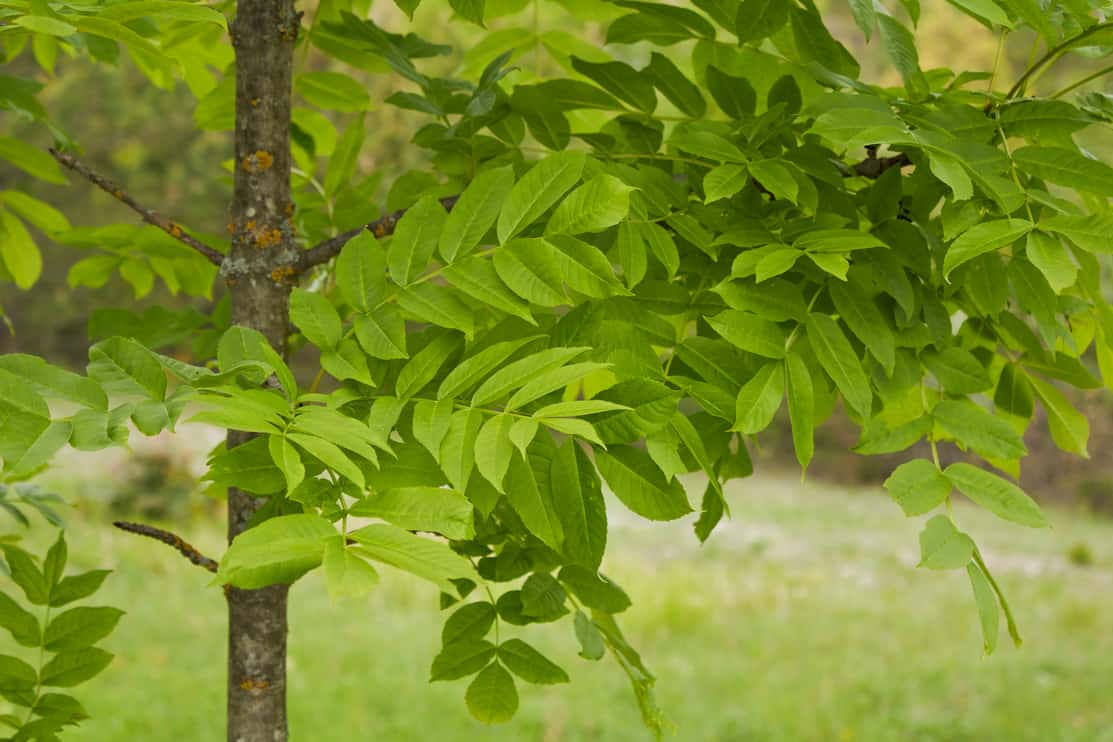
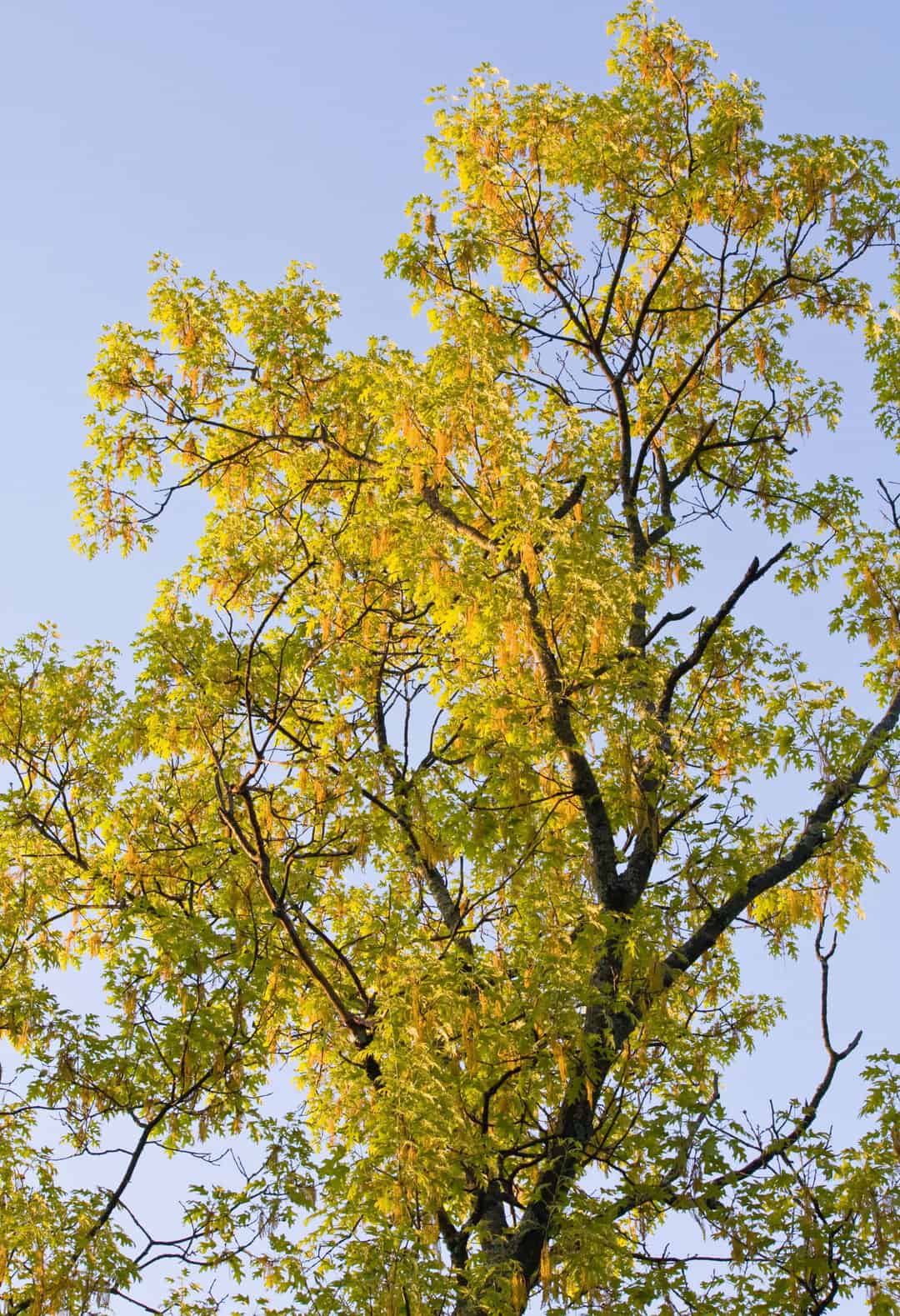
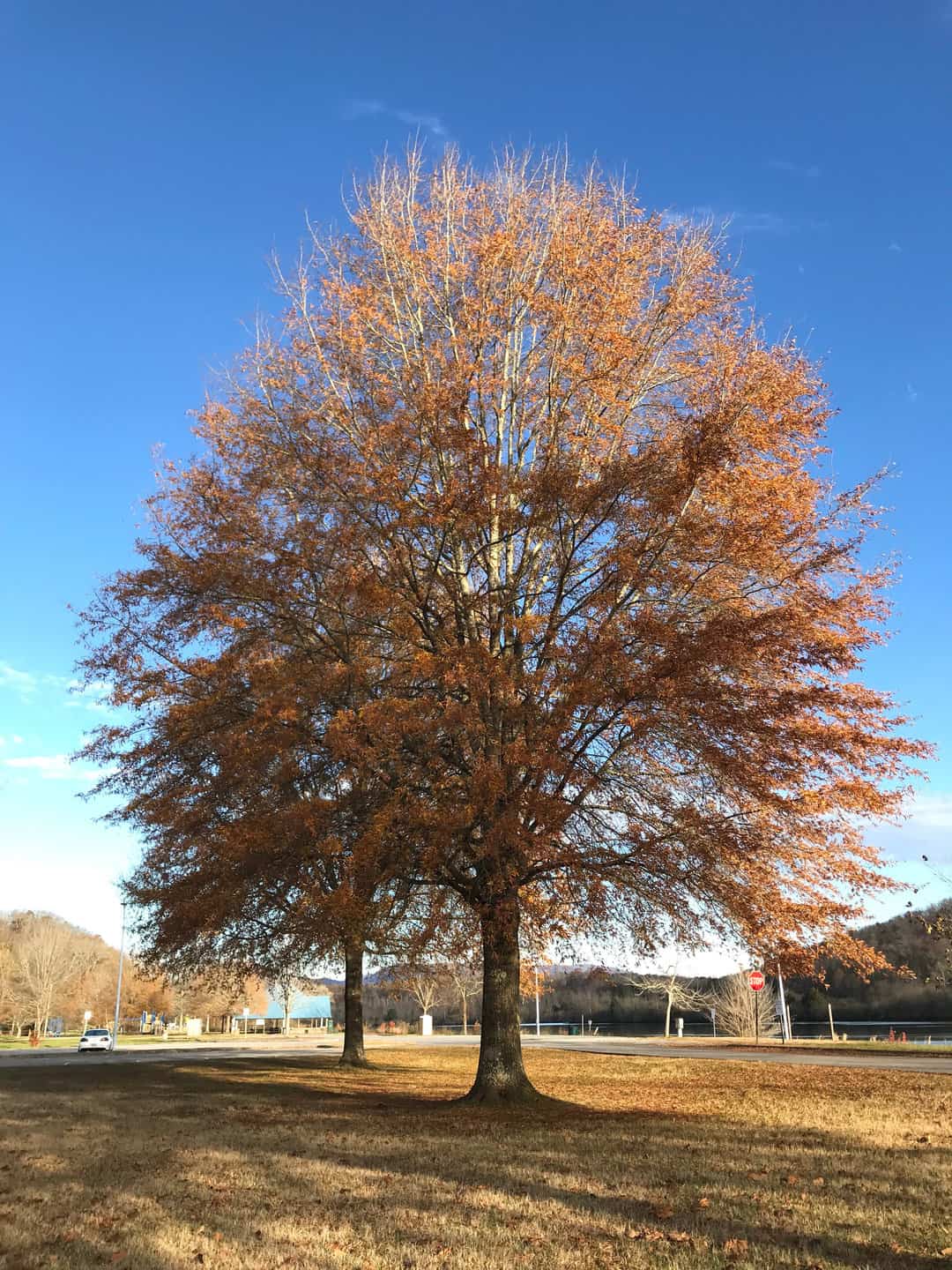
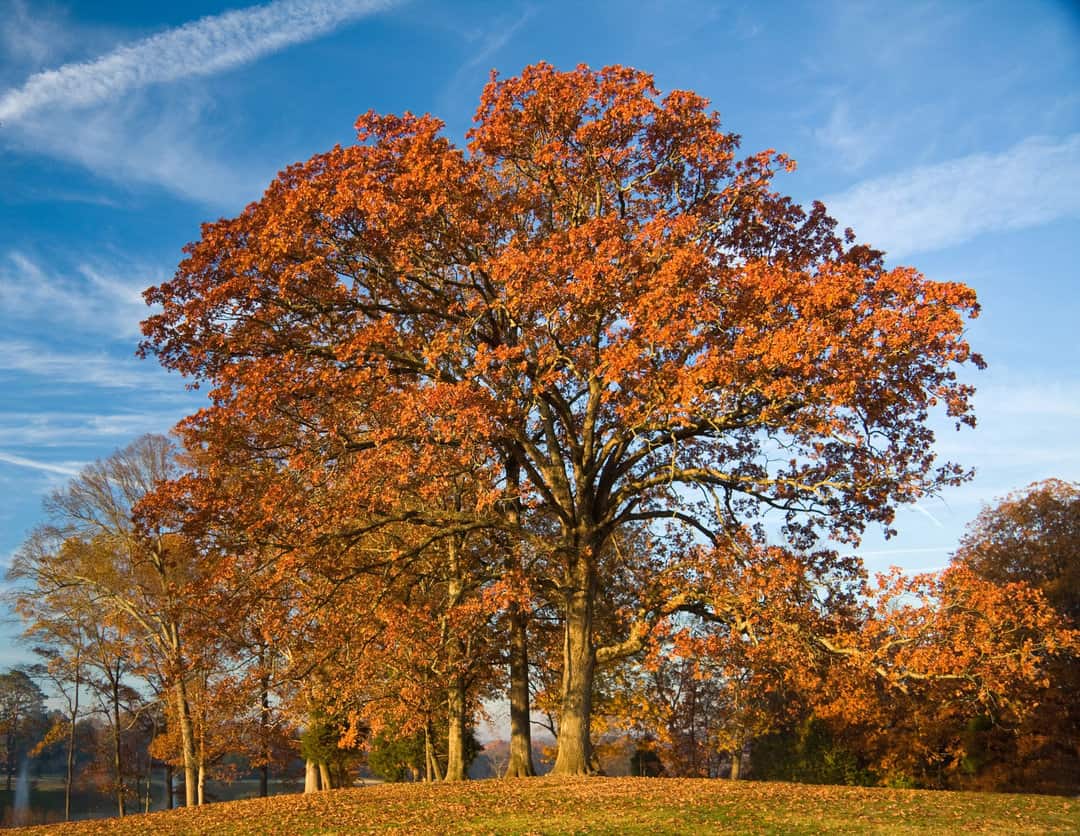
large ash tree growing in park

Ash firewood is a great all-around firewood, produces almost no smoke, puts off a moderate amount of heat, and is a quick seasoning wood. You can process this firewood in the spring, and it will be seasoned and ready to burn when the weather gets cool again. 

Some people say ash can also be burned green, but if you do, you will not get an efficient fire and it may smoke more. This is because the flames are using a lot of energy to burn off the excess moisture. With an inefficient burn, you will get more smoke.

The Department of Consumer Products tells us ash burns easily with medium-high heat. Very little smoke or sparks comes from this firewood. Overall, ash is excellent firewood.

One of the major problems with ash firewood is it can be hard to find because of a pest called the Emerald Ash Borer Beetle, which has severely threatened ash trees. This invasive pest, in the larval stage, kills ash trees by eating the tender bark around the tree, thus starving the tree of nutrients.

2. Oak

There are over 600 different varieties of oak trees from around the world! We are focusing on the most prevalent varieties from the US and grouping them into one category. 

If you are looking for a specific variety of oak wood to burn, read our guide on the 10 best oak firewoods here!

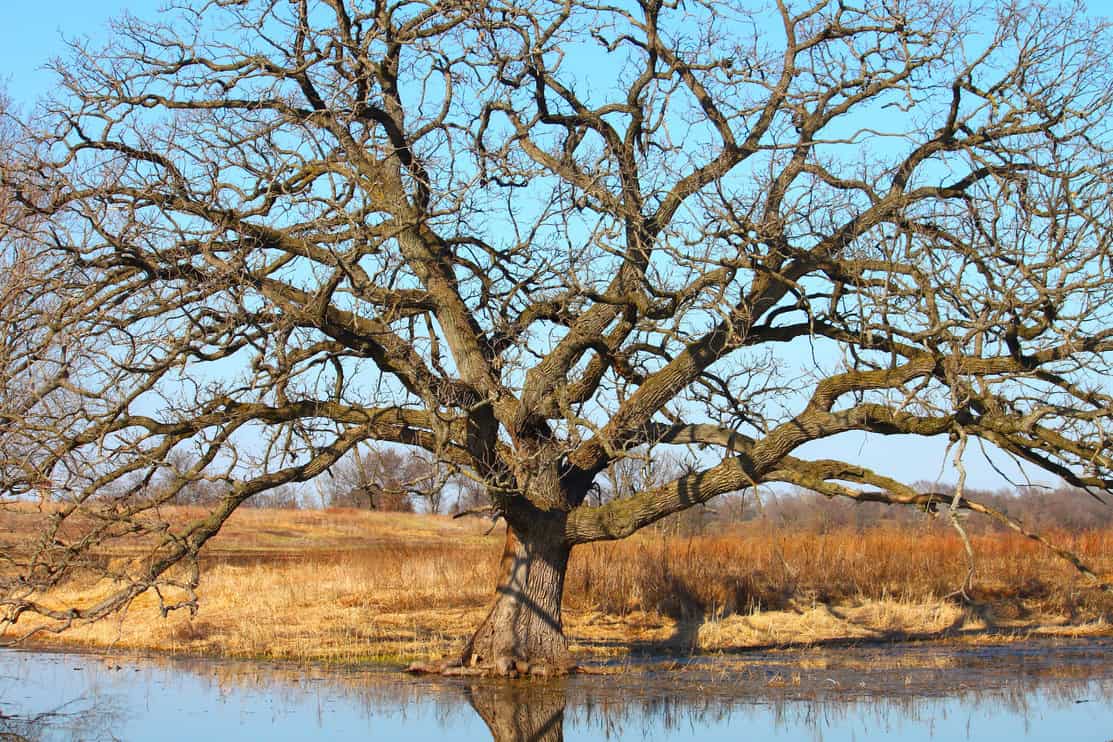
Oak may be the king of firewood (in my humble opinion). It is readily available nearly everywhere trees grow, is a dense, compact wood, burns hot, for a long time, and produces very little smoke. Oak can be a bit of a chore to split, especially the larger logs.

But hey, firewood is the only heat source that warms you twice; once when cutting it, another time when you burn it. 

Oak firewood will take a little longer to season than ash, but give it a year, and you should be ready. You will have a hot burning fire that lasts you all night and produces very little smoke. There may be a thin line of white smoke rising into the air, but there will be no black clouds of choking discomfort coming your way.  

To make sure your firewood is properly seasoned, check out this Moisture Meter For Wood. It has built-in calibration and can be used for more than just wood!

You want your firewood to be 20% moisture content or lower before you burn it. Any higher and you will have an inefficient fire that spends a lot of energy trying to burn off the excess moisture.

Specifically talking about oak variaties of firewood, if you didn’t check out our linked list above, you should know that white oak is better than red oak for firewood.

3. Maple

We usually know maple trees for the syrup produced from the sap of the sugar maple. There are several varieties of maple trees, but they are all hardwoods that burn well. Maple trees on the whole are not as dense as oak trees, but they burn similarly. 

The major difference between maple firewood compared to oak is maple burns a little faster, but maple wood smells great when burned. This firewood still burns hot and clean, making it a great choice for all of your wood burning needs. 

4. Applewood

Another great-smelling firewood with little smoke production is applewood. It burns hot and clean, but it can be difficult to find. Once an apple tree is no longer used for apples, the wood is often scooped up for smoking meats. 

Have you ever had applewood smoked bacon or an applewood smoked pork loin? But wait, you may ask, “if applewood doesn’t smoke much, why is it used for smoking meats?” Applewood is soaked in water first before it’s used to smoke meats, so it creates more smoke to impart the unique flavor. 

When seasoned and burned as firewood, applewood is a very clean burning firewood and produces very little smoke.

5. Beech

Beech firewood is a very hot burning firewood sought by those with wood-burning stoves because of the intense heat. Beech wood burns clean with little smoke, and it is said to have a nutty, pleasant smell when burned. 

Beech firewood dries out to a much lower moisture content than most other firewood varieties. On average, when seasoned, beech firewood will dry out to around 10 to 12% moisture. It’s this low water content that makes beech such clean and hot burning firewood.

The only problem is it takes longer for beech to season well. It needs at least a year to season enough to burn but to get the most benefit out of your beech firewood, season it for two years. 

6. Black Locust

Robinia pseudoacacia, Black Locust Tree

The black locust tree is not a well-known tree unless you are well versed in wood varieties or do a lot of woodwork. This fast-growing tree makes for excellent firewood though. It burns very hot and produces very little smoke.

Among the contenders on this list, the black locust is one of the best when it comes to the least amount of smoke. 

This firewood needs at least a year to season, but to reap the benefits, a year and a half to two years is optimal. When black locust is seasoned longer, the moisture content will go below 20%. You will get a very lean smoking, hot fire, which will burn all night long. 

Black locust firewood also has little to no smell when burned. So if you don’t particularly like the smell of burning wood, this is an excellent firewood choice for you.

7. Hickory

Hickory firewood often outperforms oak when compared side by side, especially if you are looking for fragrant-smelling firewood. The only reason I would choose oak firewood over hickory is oak is easier to find and typically will season slightly faster than hickory. 

Hickory burns hotter than oak, not as high as black locust, but very similar. As for smoke output, hickory is pretty on par with black locust because both produce very little smoke. Hickory, when burned, smells like a backyard barbeque and brings back all those wonderful memories. 

It’s a very popular wood for smoking meats and cooking on because people want the smoky flavor. However, when used as firewood, the smoke content is quite low. You’ll get a great fragrance from it, but it won’t choke you out of the campsite.

Winner winner, smoked chicken dinner! 

8. Black Walnut

In North America, there are three popular varieties of walnut trees, but the best overall for low smoke when burned is the black walnut. This wood is a little difficult to find for firewood because it is sought after as furniture building wood. Black walnut trees also hate shade and typically grow in bright sunny patches by themselves, so you will not find a large grove of black walnut trees. 

If you find a mature black walnut tree, you can most likely get a full cord of wood or more from it. As a firewood, black walnut is an excellent choice. It burns pretty hot, for a long time, and produces very little smoke. It smokes similarly to oak. 

Black walnut may smoke more than hickory or black locust. Even so, this firewood still produces so little smoke, you’ll hardly notice it.

The walnut is one of the slowest burning woods to burn in your fire. You can view our full top 10 list of the slowest burning firewoods here!

9. Osage Orange

Osage orange trees are easy to identify from the large, green, wrinkled fruit they bear in the summer months. They were planted in residential areas many years ago and are found now in 39 states. Osage orange wood is used for bows and furniture, but when the lumber cannot be used for these products, it makes for great firewood.

Osage orange is a heavy, very dense wood that burns exceptionally hot, and creates very little smoke. It is an excellent choice for wood-burning stoves when it can be found. There is one problem with Osage orange as firewood though, it sparks… a Lot!

Since it creates an Independence Day level show of sparks, it’s not recommended to burn Osage orange in the fireplace. In a wood-burning stove, you do not have to worry about sparks as much until you open the door to put more wood in. Outside, make sure you have a large fire ring to handle the sparks.

As far as smoking, this wood burns so hot and efficiently, there is little smoke to speak of. You will get a show because of the constant sparking, crackling this wood creates, but you won’t have to worry about smoke at all. 

Other Reasons You Have Smokey Firewood

Summer camping fire pit with blue smoke

Let’s say you are using wood from this list in your fire, but you are still getting heavy clouds of smoke. What could be the problem? There could be a few reasons your hardwood firewood is smoking everyone out, such as wet wood or a suffocating fire. 

The Fire Is Not Getting Enough Air

If your logs are piled together tightly, you could have a hard time lighting them. Once it is burning, you might end up still getting thick clouds of smoke rolling off your fire. When a fire is not properly “breathing”, it can smoke because the wood is not burning cleanly.

When you start a fire or when you add logs to an existing fire, make sure there is plenty of space around the logs so that it burns efficiently. 

By stacking your wood either in a teepee shape or alternating logs like a log cabin, you let enough air flow between the logs so your fire burns hot and efficiently, reducing smoke.

When you start your fire, there is often a good amount of smoke at the start because the fire has not got hot and efficient. This also depends on what you use for fire starter or kindling. These materials may be softwoods like pine, which usually put off a lot of smoke. 

If you are using yard debris like pine cones, pine needles, or leaves to start your fire, they could still be wet. This will cause heavy smoke before you get a solid bed of hot coals built up. 

Firewood is Wet Because of Weather

We already went over green, unseasoned firewood, but did it rain a night or two ago? Was your firewood covered with a tarp or plastic sheeting keeping moisture in? If either of these happened, you may be trying to burn wet wood. It’s just the same as trying to burn green wood. 

Wet wood from bad weather will smoke and smolder as the fire fights to remove moisture from the wood. Before burning your wood, use your trusty moisture meter to make sure you don’t have wet wood. 

That’s A Wrap!

That does it for this article. Now you have a long list of firewood that produces very little smoke. Hardwoods are the best for fires, but not all hardwood varieties are equal.

If you are looking for firewood that produces the least amount of smoke, you can’t go wrong with oak, hickory, maple, applewood, ash, and the others on this list. 

We hope this article has helped you find the right firewood for your needs!

References:

Todd, John Jeffrey, and J. Good. Wood-smoke handbook: Woodheaters, firewood and operator practice. Environment Australia, 2002.

Olsson, Maria, Jennica Kjällstrand, and Göran Petersson. “Specific chimney emissions and biofuel characteristics of softwood pellets for residential heating in Sweden.” Biomass and Bioenergy 24.1 (2003): 51-57.

Schueftan, Alejandra, and Alejandro D. González. “Reduction of firewood consumption by households in south-central Chile associated with energy efficiency programs.” Energy Policy 63 (2013): 823-832.

Njenga, M. A. R. Y., et al. “Trees on farms could satisfy household firewood needs.” Tree Farmers Mag. Afr 33 (2017): 20-23.

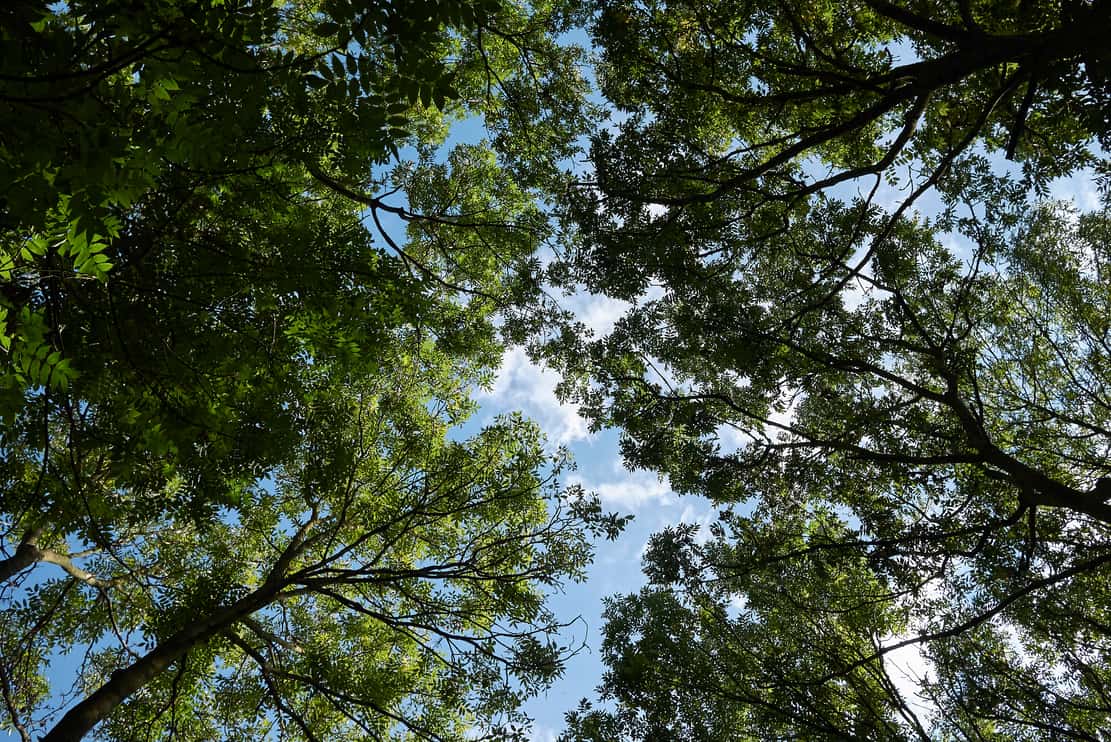
While it’s nice to soak up the sun on a warm summer day, we can probably all agree that it’s a wonderful feeling to sit underneath a tree and soak in that shade. We all know of the popular trees like oak and maple, but did you know that other trees like ash trees are good shade trees?

Ash trees are ideal shade trees! They are large, fast-growing trees that provide lots of shade. Ash trees are also low-maintenance trees that have huge canopies, making them perfect for your backyard or along streets. Ash trees do attract emerald ash borers pests in certain states.

If you’re debating on what tree to plant in your sunny backyard, look no further, we’ve got that covered. Read on to learn why ash trees make wonderful shade trees.

Are Ash Trees Good Shade Trees?

Let’s talk about shade trees. 

Shade trees are usually large trees with large, sprawling canopies that provide shade to their environment.

Ash trees adapt to just about all soil types and are even drought tolerant. They also grow anywhere from 30-120 feet tall and have a canopy that reaches 40-50 feet! Talk about a huge tree! Additionally, ash trees grow at a medium to fast rate, with 12-24 inches of growth each year.

As we mentioned, ash trees adapt to and grow in all soil types, so if your soil is acidic, alkaline, sandy, moist, well-draining, clayey, or wet, you can bet an ash tree can grow there. 

Ash trees do well in Zones 2-9, which are almost all USDA Hardiness Zones. 

So, back to the question at hand, are ash trees good shade trees?

Absolutely! Because of their wide, sprawling canopy that reaches anywhere between 40-50 feet, you can bet they’ll provide you with lots of shade on a hot summer day. 

You can learn more about ash trees in our article about ash tree daily water requirements.

In addition to this, you can also learn a plethora about what makes a good shade tree from a book such as The Sibley Guide To Trees.

1. Ash Trees Have A Huge Canopy That Provides Shade

Fraxinus tree solhouette (ash)

According to Vanderbilt University, among ash trees, there are three of the most common ashes that you’ll see. This includes the white ash, Fraxinus Americana, and the green ash, Fraxinus pennsylvanica. 

White Ash 

The white ash, Fraxinus Americana, is found throughout northeastern and central North America, except for the southern coast of the United States. White ashes get their name from the pale grey undersides of their leaves. 

The white ash tree reaches anywhere between 60-90 feet tall and can even reach up to 120 feet tall in certain cases. It has a moderately dense, pyramidal crown that reaches 40-50 feet, which creates sizable shaded areas. 

It is classified as Critically Endangered by the International Union for Conservation of Nature (IUCN). The IUCN Red List measures the status of biological diversity and evaluates how close species are to extinction.

However, the white ash is susceptible to a variety of pests and diseases. The main pest that affects the white ash is the lilac borer, but this is not limited to the banded and emerald ash borers, leaf spot, and canker diseases.

The white ash grows well in USDA Hardiness Zones 4-9 and grows well in almost all soils. Additionally, it grows at a medium rate with a growth rate of 13-24” every year!

Green Ash 

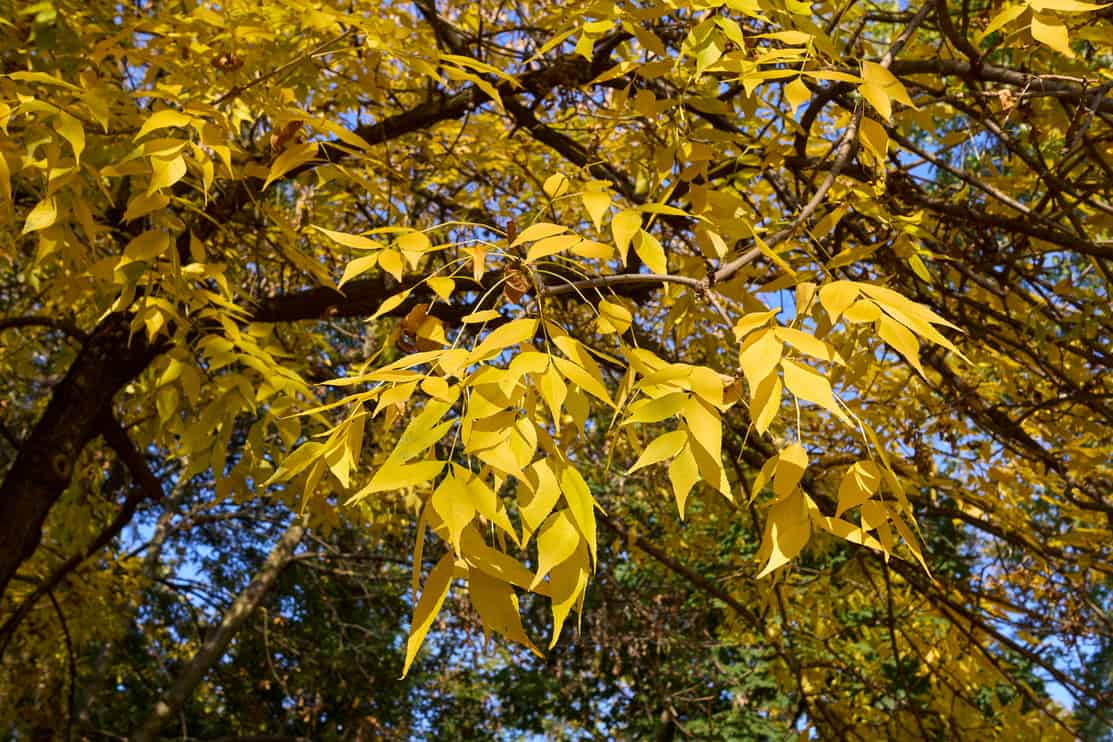
Fraxinus pennsylvanica yellow foliage (ash)

The green ash, Fraxinus pennsylvanica, is an extremely adaptable tree. It is native to Iowa but is found throughout the United States. It is generally found near wetland areas but is also found in many other habitats.

It has a pyramidal crown shape that is slightly rounded. Like other ash trees, the green ash will grow best in full sun and well-draining soils, but will grow in just about every soil it’s put in! The green ash grows best in almost all zones, but more specifically, USDA Hardiness Zones 2-9.

According to Iowa State University, green ash is the fastest-growing ash tree, growing more than 2 feet per year! It also reaches a height of anywhere between 50-80 feet tall and wide! Because of its fast growth rate and large size, it is widely used as a shade tree! 

To start your own green ash tree, get off on the right food with these Green Ash Seeds!

Unfortunately, like all ash trees, green ash is susceptible to lots of pests and diseases. It is listed as Critically Endangered by the IUCN Red List. Some of the most notable pests are the emerald ash borer, and the lilac borer. It is also susceptible to diseases like ash rust, ash dieback, anthracnose, and verticillium wilt. 

2. Ash Trees Can Grow Across Most Of The United States

Ash trees grow well in USDA Hardiness Zones 2-9, which is just about every zone. But, just like most plants, which zone they will grow in will depend on the variety.

We mentioned green ash trees and white ash trees, let’s recap what zones those do well in.;

  • The green ash tree grows best in Hardiness Zones 3-9. 
  • The white ash tree grows best in Hardiness Zones 4-9. 

If you live in Zones 4-9 you can bet these will take well to your climate. 

3. Ash Trees Do Well In All Soil Types
Fraxinus excelsior branch close up (ash)

As we mentioned, ash trees grow in just about all soil types, but let’s get into that a little bit more. 
The green ash tree adapts well to all different soil types. It does best in wet soils, but can also grow in moist, and well-draining soils, and is slightly drought tolerant. Additionally, it does well in acidic and alkaline soils, loamy, sandy, and clayey soils!

The green ash tree also tolerates soil compaction, which is when the compression of soil creates a reduction in space between the soil pores. This can be a result of a lack of water within the soil, making the soil more compact, denser, and harder for roots to penetrate. 

The white ash tree grows best in moist, and well-draining soils. But it can grow in acidic and alkaline soils, as well as loamy, sandy, moist, well-draining, and even wet soils. 

To keep your ash trees looking happy and healthy, try out a fertilizer such as Humboldts Secret Base A & B Bundle.

White ash trees are fairly shock-tolerant and have a good soil salt tolerance, which is why they can handle a variety of soils. 

4. Ash Trees Are Drought Tolerant Shade Trees

We mentioned the green ash tree being slightly drought tolerant. On the other hand, the white ash tree is moderately drought tolerant. 

Now, if you live in the desert, we’re not saying this is necessarily a good tree choice. All we’re saying is that because ash trees are fairly tolerant of most conditions if you live in an area that gets a somewhat low to a fair amount of precipitation. This would be a good choice for a shade tree!

The green ash tree can tolerate being planted on highways, in urban areas with pollution, in reclamation areas, and even around parking lots.

Fertilizer can be a great addition to the care of your trees. Fertilizer not only strengthens the tree but can also strengthen the tree’s immune system. If you already have one, a 10-10-10 fertilizer is perfect for your ash tree. 

A 10-10-10 fertilizer has an equal ratio of nitrogen, phosphorus, and potassium. The GreenView 2129872 Multi-Purpose Fertilizer is a 10-10-10 NPK fertilizer, which is ideal for your ash tree. As with all chemical applications, before you apply it make sure to read the label for directions!

5. Ash Trees Are Extremely Fast Growing

Ash trees are mostly moderate to fast-growing trees, which makes this a great choice as a shade tree. 

The green ash tree has a fast growth rate, growing more than two feet every year. 

The white ash tree has a medium to the fast growth rate of 1 to 2 feet every year, meaning in just 10 years they can reach 12 to 24 feet tall!

We recommend checking in your area to see if ash trees are recommended for planting. Currently, because of the emerald ash borer, planting ash trees is not recommended in some places. 

Ash trees are kind of the powerhouse of shade-providing trees, aside from their susceptibility to pests and diseases. 

Should I Plant An Ash Tree?

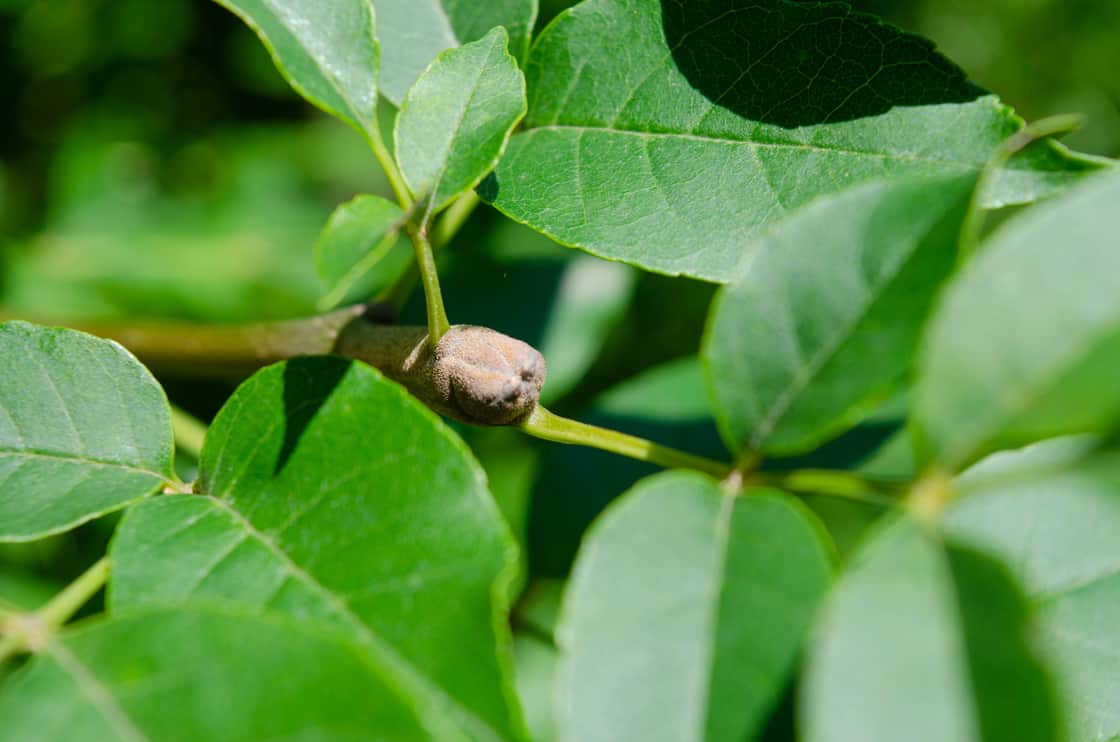
Fraxinus ornus bud (ash)

Alright time for the bad news, while ash trees make great shade trees, tolerate almost everything, and are fast-growing, they are not recommended to plant in certain areas due to the emerald ash borer. 

The USDA Animal and Plant Health Inspection Service lists the states where the emerald ash borer is found, which include:

  • Alabama
  • Arkansas
  • Colorado
  • Connecticut
  • Delaware
  • Georgia
  • Illinois
  • Indiana
  • Iowa
  • Kansas
  • Louisiana
  • Maryland
  • Massachusetts
  • Michigan
  • Minnesota
  • Missouri
  • Nebraska
  • New Hampshire
  • New Jersey
  • New York
  • North Carolina
  • Ohio
  • Oklahoma
  • Pennsylvania
  • Tennessee
  • Texas
  • Virginia
  • West Virginia
  • Wisconsin

The good news is that research done by scientists suggests that green ash trees that survived, and were considered lingering from emerald ash borer infestations, were less preferred by the emerald ash borers, resulting in a higher tolerance or resistance to them. 

Research also suggests that the emerald ash borer preferred blue and black ash trees. Conservation efforts are currently focused on long-term control of the infestation, and will likely result in selective breeding in ash trees for emerald ash borer resistance.

What’s Good About Ash Trees?

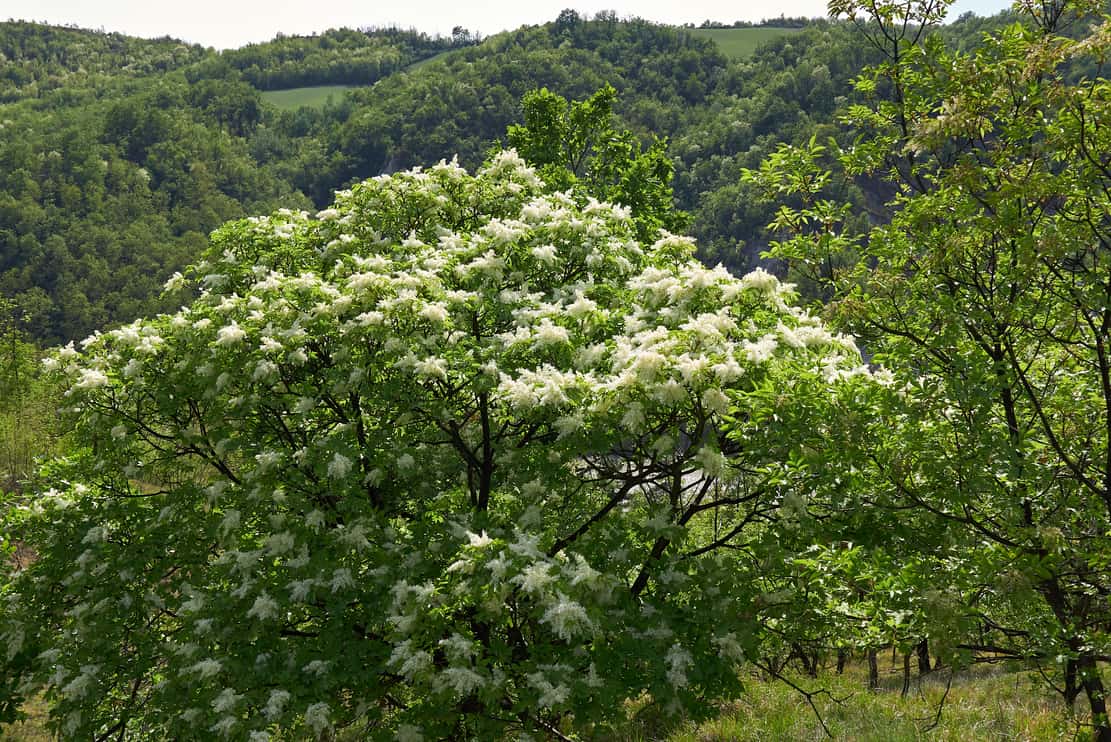
Fraxinus ornus tree in bloom (ash)

Ash trees are part of the flowering plant genus called Fraxinus. Included in this genus are also lilac trees and olive trees. The ash tree name goes back to the Latin and Indo-European language to mean spear because ash tree wood was good for spear shafts. 

One amazing thing about ash trees is that they are a vital food source for frogs in North America. As their leaves fall into ponds and other water bodies, they provide a food source for tadpoles. Additionally, ash trees provide food and shelter for insects, birds, and mammals.

Ash trees are known for their hard, dense, elastic-like wood and are used for things like bows, and baseball bats. Additionally, ashes are used for electric and acoustic guitar bodies. And these are only a few of the many uses of ash wood. Ash trees even make outstanding firewood!

If you want to plant an ash tree of your very own, despite the emerald ash borer, consider starting off with something like these American White Ash Seeds, or these European Ash Seeds!

Ash trees have a few key features, including opposite leaves, which only a few trees have, and their well-known seed pods! Can you guess what those are? They are helicopter seeds! You know those cool-looking things you throw up in the air and they come twirling down? Yep, those are ash tree seeds!

Unfortunately, ash trees have been declining at a steady and incredibly fast rate due to the emerald ash borer, a wood-boring beetle. The emerald ash borer larvae feed on the vascular system of the tree, which is responsible for nutrient and water flow. Feeding on the vascular system prevents all nutrients and water from flowing to the rest of the tree. 

That’s A Wrap!

That’s all we’ve got today! So the answer to the question: are ash trees good shade trees? Yes! Ash trees are great shade trees. But let’s recap everything we covered!

Ash trees are ideal shade trees! They are large, fast-growing trees that have huge, sprawling, dense canopies. Ash trees are also low-maintenance trees that tolerate a variety of soil and weather conditions, making them perfect for your yard. 

Because they provide so much shade they are commonly planted in parks, along parking lots, on residential streets, and even along highways. 

Ash trees have a medium to fast growth rate, growing anywhere between 1-2 feet per year! Additionally, they do well in Zones 2-9. 

Unfortunately, ash trees are susceptible to a variety of pests and diseases that have caused the ash tree population to decline rapidly. Conservation efforts are being taken to combat the spread of pests and disease, but currently, the USDA says the best way to combat the spread is to not move firewood. 

Although planting ash trees is not recommended in some areas, it’s best to check with your local and state government to see if there are any regulations and if it is recommended to plant ash trees in your region.

References

Duan, Jian J., Leah S. Bauer, Roy G. Van Driesche, and Juli R. Gould. “Progress and challenges of protecting North American ash trees from the emerald ash borer using biological control.” Forests 9, no. 3 (2018): 142.

Knight, Kathleen S., John P. Brown, and Robert P. Long. “Factors affecting the survival of ash (Fraxinus spp.) trees infested by emerald ash borer (Agrilus planipennis).” Biological Invasions 15, no. 2 (2013): 371-383.

McCullough, Deborah G., Therese M. Poland, and David Cappaert. “Attraction of the emerald ash borer to ash trees stressed by girdling, herbicide treatment, or wounding.” Canadian Journal of Forest Research 39, no. 7 (2009): 1331-1345.

Mota-Sanchez, David, Bert M. Cregg, Deborah G. McCullough, Therese M. Poland, and Robert M. Hollingworth. “Distribution of trunk-injected 14C-imidacloprid in ash trees and effects on emerald ash borer (Coleoptera: Buprestidae) adults.” Crop Protection 28, no. 8 (2009): 655-661.

Smitley, D. R., Doccola, J. J., & Cox, D. L. (2010). Multiple-year protection of ash trees from emerald ash borer with a single trunk injection of emamectin benzoate, and single-year protection with an imidacloprid basal drench. Journal of Arboriculture, 36(5), 206.

When you go camping, one of the most important and iconic features of camping is the campfire. It provides warmth, comfort, light, helps to keep the biting bugs away, and you can cook on it. When you are getting a campfire going, you want a big, bright, and hot flame, so here we have compiled a list of the 9 best woods that burn the brightest for your fire.

For the brightest flames, hottest fires, and longest-lasting burns, hardwoods are best. They burn bright, create less smoke and creosote, and produce hotter, brighter fires. Firewood from hickory, beech, pine, hawthorn, oak, birch, dogwood, maple, and fruit trees burn the brightest.

With so many options now for firewood, how can you tell which ones will bring on the brightest flames? Continue reading on as we have compiled a list of which wood will burn the brightest in your campfire or fireplace. 

Why Are Bright Flames Beneficial?

Since the dawn of time, people have had a fascination with fire. It keeps us warm, cooks our food, and in the early days, fire-protected our ancestors from predators, so it’s only natural that we feel comfortable around a fire. When we start a fire in the fireplace or at the campsite, we want bright flames, and here’s why.

Bright Flames Typically Mean Hotter Fires

A good bed of coals is great for cooking and toasting marshmallows, though tall flames can set your marshmallows on fire, turning them into knobs of flaming napalm. The bright flame is what we want when we are all gathered around the fire. They light up the campsite and provide warmth for everyone while keeping wild animals away. 

I’m sure we have all heard the term “white-hot,” while technically the blue-violet flame is the hottest, a white flame is still over a thousand degrees. When it comes to wood-burning fires in your fireplace or at the campsite, a brighter flame is hotter than the glowing bed or orange coals. 

You do not want a small, smoldering fire in your house or at the campsite. It does not provide the benefits of a clean, bright, efficient fire. 

The USDA addresses this in their article; Fuel Efficiency & Conservation–Firewood, that you should not allow your fire to smolder. A low, smoldering fire creates a lot of pollution because the low temperature doesn’t allow for proper combustion. You get more smoke and unburned wood being swept up the chimney and into the air. 

Brighter Firewood Is Cleaner

Brighter flames signify a cleaner fire. When the wood burns hot and clean and you can see the flames, it signifies a healthy fire. You have probably noticed when the firewood is too wet, or you do not have a good bed of coals for your fire, it usually smokes more. Thick smoke will chase away the bugs, but it will chase away people gathered around the fire as well. 

When burning in a fireplace, the last thing you want is a smoky fire. Smoke carries larger particulates, which can stick to the sides of your chimney. This means you have to service your chimney more often by having the deposits cleaned off. You also do not want smoke wafting through your house smelling the place up and leaving everything looking dingy.

Now, some of the firewoods below while they do burn clean, should not be burnt inside and should be used for outdoor firewood. We’ll cover that in the list below!  

9 Brightest Burning Firewoods

Without further ado, let’s get to the best and brightest burning firewoods!

1. Hickory Is The Brightest Burning Firewood

Topping the list of bright burning firewood is hickory. This firewood is among the best firewood you can find for all your wood burning needs. Hickory provides a lot of heat, slow burn, and a bright flame. 

Hickory is a very dense wood and may take some time to get burning, but once this hardwood has caught flame, the bright flames dancing around this wood cannot be beaten. You will get a long burn and a pleasant smoky aroma that might have you thinking about smoking some meats around this campfire instead of s’mores.

To add some more heat to the fire, hickory is also #1 on our list of the best overall firewoods to burn!

2. Beech Wood Burns Hot And Clean

Beech is another excellent choice for bright burning fires. This hardwood throws off bright yellow flames when it’s burned. It may not be as dense or long-lasting as hickory, but you probably will not notice the slight difference.

Beech firewood burns clean and also has a pleasant odor when burned. It rarely sparks and leaves a good bed of embers, so you might still have warm enough coals in the morning to start breakfast rather quickly. 

3. Fruit Woods Smell Fantastic When Burned

Fruit woods include favorites such as cherry, apple, or plum trees. When you cut these trees for firewood, they make great, bright flames you can watch burn for extended periods. Of the fruit woods used for firewood, apple wood is the king here. 

Apple wood smells great, burns hotter than most other fruit woods, and burns brightest among them all. Cherry wood is also a great smelling—probably the best smelling in my opinion—long-burning firewood, but it does not quite compare to apple wood’s heat and brightness. 

4. Pine: The Bright Burning Softwood

Pine Logs Background

Pine is a softwood and comes with some cautions when you choose to burn this wood. First off, you should only use pine as kindling when burning it inside. Pine contains a lot of resinous sap, which can make it smoke quite a bit, and will cause creosote to build up quickly in a fireplace or wood-burning stove.

As a firewood, you should only burn pine outside. 

However, pine burns with a bright flame. The downsides are heavier smoke than most hardwoods, burning hot and fast, and plenty of sap pockets, which pop and send sparks everywhere. 

Pine is good in a pinch, and you can find pines almost everywhere. You will frequently find broken limbs lying around when you are out gathering wood and kindling for your campsite. 

5. Hawthorn Is An All-Around Great Choice

Hawthorn is great firewood for all-around purposes. The downside to hawthorn is it is not very prevalent, and it has menacing, 3” thorns. Although, it is a very bright burning, hot firewood! Maybe because it seems to be a tree from hell with all those thorns. 

Jokes aside, hawthorn firewood is a dense, hot burning, long-lasting, bright burning firewood, and it would make a great addition to any fireplace or campfire. If you have any of these trees on your property and are thinking of chopping them down, consider making them firewood. It would be a superb choice. 

6. Oak: The Middle Of The Road Firewood

Oak firewood is an amazing firewood for all the right reasons. Therefore, you will see oak time and again on nearly any firewood list. Oak firewood is dense, burns hot and clean, does not pop, has a neutral odor, and burns bright in any setting. Oak is also very prevalent nearly anywhere you live. 

You can find out where the specific species of oak trees in your area fall on our tiered list of the 10 best oak firewoods here.

If you weigh oak firewood solely for how bright it burns, it’s still in the middle of the pack. When burned, it produces solid, bright flames. You will not have to wear your sunglasses at night when you burn it, but it will still produce nice, pleasing, bright flames. 

7. Birch Bark Is A Great Fire Starter

Birch firewood is a decent choice for how bright it burns. Overall, as a firewood birch is a pretty good choice as it burns clean, burns pretty hot, and does not spit sparks often. It also has a pleasant smell when burned. 

The bark, if collected, is a natural tinder and firestarter because of the peeling, papery effect. Birch firewood is a good choice if used in a fireplace or wood-burning stove and certainly has a nice, bright flame when burned outdoors in your firepit or campfire. 

8. Dogwood Trees Make An Excellent Bright Fire

Yep, you read that right, dogwood makes a great, bright burning firewood. There are people out there who use it as firewood, but since dogwoods are mostly ornamental trees, most people, myself included, have never burned this tree as firewood. 

If you have dogwood trees and they have been destroyed by a terrible storm, or have reached the end of their life cycle, then it’s a brilliant choice to save for firewood. The wood is dense, and it burns hot, leaving you with a bright flame. The only reason it is not higher on the list is that dogwood firewood can be difficult to find. 

9. Maple Firewood Burns Bright

Maple comes in last because of all the previous firewoods on the list, its flame is still bright, but just not as great as the others. This does not mean maple firewood is subpar in any way; it is a wonderful firewood.  

Maple firewood is a fantastic choice for firewood. It is a dense, good-smelling firewood and works great in your fireplace, wood-burning stove, and outdoor fire. Some people, depending on the variety, say they smell maple syrup when they burn this wood.

This checks out since the sugar maple is where the mouth-watering syrup originates from. 

As far as bright flames jumping off your firewood, maple is not a great choice, but it is not an awful choice. If you have maple around your house or can find it for sale, go ahead and pick some up. It will not disappoint you.

To add some more heat to maple trees here, it comes in as the #2 slowest burning firewood on our top 10 list.

2 Tricks For A Brighter Fire

Large burning bonfire with soft glowing flame and sparkles flying all around

Even if you have firewood that isn’t blazing with eye-piercing, bright flames, you can still make the flames just a tad bit brighter with the way you burn them. If you throw your logs in the fire without caring how they land, you will get them to burn, but below, we have two ways to capitalize on fire dynamics to get brighter flames.

1. The Teepee

The shape of the teepee works best for outdoor fires, but the conical shape helps to increase the number of flames, thus giving you a brighter fire. The way to get it started is to ball up your fire starter in the middle, then stack small pieces of tinder around the tinder in a cone shape. Once the fire has taken off, continue to stack your firewood in this fashion when the flame gets low, to keep a bright fire burning. 

This shape increases the surface area of the wood, so there is more space for flames to take hold. More flames means a brighter fire, so even if you have firewood that does not burn as intensely, you can manipulate the fire to make it brighter. 

The only problem with the teepee method is you have to put a few logs in at a time to keep them standing on end, and it can fall over after the wood burns for a while. As long as you have a good fire ring, there is little danger of sparks and flying embers. 

2. The Log Cabin

The log cabin stacking method works for fireplaces as well as outdoors and is a little more stable than the teepee stack method. It starts with your fire starter or tinder inside, but you lay two logs flat on either side, then stack two more logs on the ends of the first pieces.

Those of you who used to play with Lincoln Logs as a kid know this method intimately. 

Keep alternating stacks until you have three or four stacks high. Laying the logs this way forces more airflow through the gaps in the firewood and helps to create a bright burning stack of firewood. When the flames die down, add two more logs and they will light up and quickly knock the darkness back again. 

3. Don’t Smother Your Fire

Bonfire in the forest

For a fire to keep burning, it needs three things; heat, fuel (firewood), and oxygen. If you stack your firewood too closely or too densely, then you restrict airflow and that can smother your fire, or even prevent it from really taking off. A smoldering fire you cannot get to catch on is no fun, as the smoke will have everyone choking and running off to do other things. 

When you start your fire, and when adding logs to an existing fire, keep airflow in mind. Leave plenty of space between the fresh pieces of wood you throw on there and the existing flames, and you will continue to have a bright burning, pleasing fire.

Here’s a Little Something For Added Campfire Fun

A fireplace or outdoor fire can be a great place for friends and family to gather, hang out, and have fun. Whether you have beverages in hand, are roasting weenies, or toasting marshmallows for s’mores, the warm ambiance of a fire cannot be beaten.

Unless, of course, you add in a little fun to your fire. Put one of these packets into your fire and watch the colors change before your eyes with these Magical Flames. Just toss the unopened packs into the fire and watch the colorful show they have in store for you!

This Fire Has Burned Out!

There we have it. The 9 best woods that burn the brightest for your fire burning needs. You cannot go wrong with oak, hickory is one of the hottest, and brightest burning hardwoods out there, and beech and fruit woods work wonderfully to burn off the encroaching darkness. 

Go out there, have fun outdoors or inside with a bright burning, warmth-giving fire. Just be responsible whenever you burn firewood.

References:

Ramos, M. A., de Medeiros, P. M., de Almeida, A. L. S., Feliciano, A. L. P., & de Albuquerque, U. P. (2008). Can wood quality justify local preferences for firewood in an area of caatinga (dryland) vegetation?. Biomass and Bioenergy, 32(6), 503-509.

Abbot, P., et al. “Defining firewood quality: A comparison of quantitative and rapid appraisal techniques to evaluate firewood species from a southern African savanna.” Biomass and Bioenergy 12.6 (1997): 429-437.

Collier, Kathy, and Larry W. Turner. “Obtaining, Seasoning & Burning Wood: Part One in a Series on Wood as a Fuel Source.” (1979).

Chen, Y., and T. C. Bond. “Light absorption by organic carbon from wood combustion.” Atmospheric Chemistry and Physics 10.4 (2010): 1773-1787.

Is your flowering cherry tree looking like it woke up with a severe case of bed head? Well, it may be time to break out the pruning shears. What are the best ways to prune your flowering cherry tree?

Properly pruning flowering cherry trees encourages flowering and fresh growth. It also removes dead branches and abnormalities. You should prune your flowering cherry tree in the late winter, early spring, or immediately after blooming using pruning sheers while removing any damaged branches.

Keep reading to learn the best ways to prune your flowering cherry trees, and when to manage this task. Even if you have no experience in trimming trees, you will have the confidence and know-how to trim your flowering cherry tree and keep it healthy for many years to come.

Why Do Flowering Cherry Trees Need Pruning?

Ornamental trees like the flowering cherry need regular maintenance to remain healthy, encourage new growth and allow the beautiful blooms to greet you with bright vitality every spring. Without proper pruning, the tree can overcrowd itself, branches can rub across each other, leaving open wounds. This can make it look rather unattractive in your yard. 

The blossoms are quite beautiful, and they may bring a pleasant scent to your garden.

Some trees, like the flowering cherry tree, also have dense growth patterns and, left alone, will become too dense to be properly healthy. Pruning once a year will thin them out and help to reduce the possibility of fungal growth because of the increased sunlight and airflow between branches and foliage. 

If you are looking into different types of ornamental, or mock, cherry trees, you can find information here in our article about the types of mock cherry trees and where they grow!

Pruning Keeps The Tree Healthy

Regular pruning on your flowering cherry tree will extend the life of your tree by keeping it healthy. Removing dead and afflicted branches allows the tree to grow stronger because it spends less energy on problem areas. Pruning also eases overcrowding of branches and removes branches rubbing across each other, which could cause problems later on. 

When you prune and trim your tree properly, it keeps the canopy—the top, the foliage-covered section of the tree—open and able to get plenty of airflow and sunlight. This helps make the foliage and flowers resist fungal growth as the airflow removes more of the problematic spores.

Regular pruning also removes weaker branches, which could break off and open the tree up to pests and infections. 

Overgrown and improperly maintained trees can become weak and unhealthy. If the branches and foliage of the tree are too dense, this can weaken the tree. Dead branches can accumulate and cause more problems as well.

Not to mention, when a tree is not pruned properly, it just makes the tree look bad and unattractive.  

Pruning Is Preventative Maintenance

Pruning your trees also lets you see and remove potential problems before they can manifest into bigger issues. When you are pruning your trees, you can see if there is something wrong with them, almost like your yearly checkup at the doctor. 

Sometimes rubbing branches can open up the bark and expose the inside of the tree, leaving the area weak and susceptible to infections. While pruning, you will notice little signs such as weakness, pests capable of harming the tree, or infections you need to remove before the tree needs professional care.  

Proper Pruning Does Not Harm The Tree

When you perform regular, proper pruning, it helps to strengthen the tree. Pruning removes afflicted and infected branches and leaves, leaving energy for the tree to focus on regular growth, making the tree stronger and healthier.

Trees can heal themselves faster after a proper trimming. If pruning is not maintained, branches can break off, leaving hard to heal wounds that open up the tree for infections and pests. It’s just like if we get a cut and do not treat it properly, it takes longer to heal, and can cause bigger problems later on. 

Pruning Makes The Tree More Attractive

Trees in the forest, growing wild, with branches all over the place, moss creeping up the trunk and dripping off the branches, have a certain rugged appeal. However, most people do not want a wild, unruly-looking mess in their front yards or gardens.

You bought a flowering cherry tree to show off the beautiful blooms, attractive bark on the trunk, and the appealing shape of the canopy. By following this guide, you can keep your tree appealing and attractive.

When you do not trim your flowering cherry tree, it can quickly start to look unkempt, and be a big eyesore compared to the neatly trimmed hedges and lush carpet of maintained grass. Pruning your tree keeps the attractive shape, encourages more blooms, and healthy, full foliage, adding to the overall appeal to your yard.

When Should You Prune A Flowering Cherry Tree?

Branches of a flowering cherry tree Prunus serrulata bursting with pink blooms in the Spring sunshine

Now you know why a flowering cherry tree needs to be pruned, so let’s get into the proper times you should trim your tree. Yes, there are certain times when it is beneficial to trim your tree, and others when it is not advised. 

If you prune your trees at improper times, you could do more harm than good. It may send your tree into shock, effectively showing down growth for a season, and causing it to look sickly. Trees have growing stages. In the winter they lay dormant, and grow little, if at all, while in fall they are trying to store up energy for the long, cold winter. 

Not all trees are the same, and you can prune some during dormant stages without harm, but in this article, we are only focusing on flowering cherry trees. If you have questions about when or how much you can prune other trees on your property, please consult a professional arborist or tree specialist to answer your questions. 

Below we will go over the best times for pruning your flowering cherry trees are.

Trim Cherry Trees In Late Winter Or Early Spring

Do not start the pruning on your flowering cherry tree in late fall or early winter because the tree is trying to store up energy for the long dormant season. It will not have the proper time or energy to seal off the open cuts made from pruning.

Wait until late winter or early spring for your area to do most of your cherry tree pruning because the tree is about to exit the dormant stage and it will be more able to heal itself where the branches were cut. The tree will have plenty of energy to deal with the pruning at this time of the growth period. This is also the time for your heavier pruning. 

During late winter or early spring, pruning will be easier because all the foliage is gone, and you can see the branches better. There will not be a thick canopy of leaves getting in the way and blocking the view. You can better see if branches are rubbing on each other, where the dead wood is, and if there are any unhealthy areas you need to remove. 

Trim Immediately After Blooming

You can also start your pruning after the cherry tree has finished blooming to help promote new growth and production of more flowers next year. Do not wait long after the blooms have fallen, though. Trim immediately after blooming, or wait until next season.

During this time, keep the pruning light. Just trim off smaller branches to promote better growth and accentuate the shape of the tree you are looking for. Leave larger branches and heavier trimming for late winter or early spring. 

How To Prune Your Flowering Cherry Tree Properly

woman cut cherry tree branch with pruning shears. spring gardening

First off you want to stand back to get a good feel for your tree and notice the natural growth patterns. Does it droop down like an umbrella, does it grow upward toward the sun, or does it bush out in an oval or circular pattern? Contour your tree to the natural shape it takes on.

This also helps you to formulate a plan for pruning your tree. 

Make sure you have time to step back and look at the progress after each cut. It pays to be methodical, or you could end up with a lopsided tree that has lost all its beautiful appeal.

1. Remove Unhealthy Branches

When cutting back the branches or removing unhealthy branches, cut them back to a healthy part of the tree. Do not leave a long piece of stub sticking out, as this could cause the branch to continue rotting. Cut it back to a healthy side shoot, as this will promote the section to grow stronger.

If you have to remove an entire branch, you want to cut it just above the branch collar. The branch collar is where the bark around the bottom of the branch looks wrinkled up. You want to cut straight as possible just above the branch collar to help the tree heal itself faster.

Cuts need to be straight, clean, and cut with a properly sized tool. If the cut is frayed, crushed, or the branch splits while cutting, get a larger tool and cut it again. 

Hand shears are for branches only about the width of a pencil to ½ of an inch. Loppers will cut branches up to 1½ inches thick, whereas the saw will cut larger branches. 

If a branch breaks during the cut, clean it up and make the cut as clean as possible, so it is easier for the tree to heal itself.

2. Do Not “Top” Your Tree

“Topping” a tree refers to cutting nearly all the growth off a tree to shorten the height or restrict its growth. This practice will severely shorten the life of a tree and opens it up to a host of problems it may never recover from. 

Topping a tree is really never a good idea. It removes the main leader and branches, which can leave the tree wounded and unable to heal properly. This practice can also shorten the life of the tree greatly.

3. Remove Any Dead Branches

Now that you are ready to trim, look for any dead, or damaged growth on your flowering cherry tree and remove those first. Once all the undesirable branches are gone from the tree, again step back from the tree to see what it looks like now. 

It’s easy to start trimming, get into the “zone” and then realize you may have gotten a little overzealous. Now it looks like the Charlie Brown Christmas tree. 

4. Clean Out The Tree’s Canopy

Next, you want to clear the clutter and open up the canopy. You are not looking to cut the top completely off, but you want the tree opened up. This is so air can easily circulate through the fully leafed-out branches. 

A good rule of thumb here is to be able to see patches of sky through the canopy of your flowering cherry tree. Opening it up like this also allows sunlight to penetrate the inner and lower branches and leaves. This helps the tree grow stronger, healthier, and produce more food for itself. 

Again, after each cut, stand back and look at the tree and plan your next section to trim. There is no rush! You would not rush a fine painting, so do not rush the trimming of your tree either. 

5. Remove Undesirable Branches

Look out for branches crossing or rubbing on each other. Rubbing branches can open up wounds and expose the tree to afflictions. Cut one of these branches off to prevent further problems. 

The same goes for branches crossing each other. They may not be causing a problem now, but during a growing season, the branches could start rubbing or even start growing into each other. 

Other branches to look out for are branches shooting straight up, or water sprouts. The problem with water sprouts is they typically grow faster than other branches on the tree and can break off easily with gusts of wind. Remove any water sprouts you see. 

Any branches of the flowering cherry tree growing toward the inside of the tree or other branches need to be removed next. These types of branches will only cause problems, and it is best to trim them off before they can. 

You want to be left with branches growing outward in uniform patterns. They need to be relatively evenly spaced, neat, and open enough to allow plenty of airflow. 

6. Trim Any Suckers

Suckers are small branches at the bottom of the tree along with its root system. These suckers do exactly as they are called—they suck energy from the rest of the tree. They are an attempt to grow more branches.

However, the problem, aside from usually looking unattractive, is they take a lot of energy and slow the growth of the rest of the tree. 

Remove these suckers from the base of the tree and any other branches along the trunk to keep the attractive allure of your flowering cherry. 

7. Step Back And Take Another Look

Now that you have trimmed the canopy, removed any dead, broken, or abnormal-looking branches, and cleared away any suckers at the base of your tree, how does it look? Is it looking lean and healthy?

Trim off any small growth growing outside of the natural habit of the tree. You want to shape it now to make it look more attractive and uniform. This part of the pruning should be light and only to accentuate the tree because you have done all the heavy pruning before this step.

If your tree looks pleasing and you are happy with the look, congratulations, you have successfully trimmed your flowering cherry tree! Now all you need to do is clean up the trimmed branches and clean and disinfect your tools for later use. 

What Tools Do You Need For Cherry Tree Pruning?

Hands with gloves of gardener doing maintenance work, pruning the tree

Before you hack away at your cherry tree, make sure you have the proper equipment. You will need:

  • A pair of hand pruning shears or anvil shears
  • A pair of loppers for branches over an inch and a half in diameter
  • Pruning saw for larger branches
  • Gardening gloves
  • Step ladder for higher branches

The THANOS A1101 Extendable Anvil Loppers are a great option if you are looking for tools to prune your larger trees. They can easily chop through branches 2 inches in diameter. It can also be adjusted to lengths between 27 and 40 inches to fit your needs.

If you already have these tools in your shed or garage and have been using them, make sure you clean and disinfect them before trimming your ornamental cherry. You can use a 70% rubbing alcohol to clean the cutting surfaces of these tools.

Disinfecting your blades before using them will prevent cross-contamination between trees and other plants. Once the tools are clean and disinfected, do not forget to oil them to prevent rust. 

If you are still uncomfortable about pruning your tree, or if it is very tall and you are not completely comfortable on a ladder, then consult a professional in your area. Make sure they have experience with ornamental trees and will not just lop all the branches off.

Wound Paints Are Not Needed

In the gardening section of your local hardware store, there are undoubtedly plenty of tree stump sealants, or wound paints claiming to help promote the health and vitality of trees after trimming them. Maybe you have seen the black or white telltale markings on trees after they have been trimmed, but you do not need these.

They come in convenient spray cans and tell claim you need the product, but a tree is better off taking care of its own wounds. Trees have their own arsenal to deal with pruning wounds. If pruning is done at the proper time, then it does not harm the tree and they can heal themselves easily.

The article, Caring for Cherry Trees in Washington DC by the National Park Service, says they no longer use wound paints for cherry trees! Wound paints are no longer seen as an effective way to prevent or reduce decay, or insect infestations on flowering cherry trees.


There You Have It!

Flowering cherry trees are a beautiful addition to your yard or garden and, with a little maintenance, they will continue to grace your space with years of beauty.  

As you have read, proper pruning during the correct time is beneficial for a tree’s overall longevity. Pruning keeps the tree strong, growing better, encourages more blooms and foliage, and is necessary for the extended life of a tree.

Here are the 7 simple steps to prune your flowering cherry tree:

  1. Remove unhealthy branches
  2. Do not “top” your tree
  3. Remove and dead branches
  4. Clean out the tree’s canopy
  5. Remove undesirable branches
  6. Trim and suckers
  7. Step back and take another look

Pruning your flowering cherry trees need not be a daunting or monumental task. With the right tools, a small dose of know-how, and a little elbow grease, you can trim them yourself and, keep your outdoor investment growing beautifully for many years.

References:

Guimond, C. M., Lang, G. A., & Andrews, P. K. (1998). Timing and Severity of Summer Pruning Affects Flower Initiation and Shoot Regrowth in Sweet Cherry. HortScience33(4), 647–649.

Douglas, S. (2001, August). Pruning: An introduction to why, how, and when. CT.gov – Connecticut’s Official State Website. https://portal.ct.gov/CAES/Plant-Science-Day/2001/Pruning

As you are probably quite aware, there are many varieties of trees- even within species themselves. If you are looking to get an overview of some species of trees with blue needles, and what genera of tree they fall under, this is the place for you!

Coniferous evergreen trees are the most common trees to sport blue-colored leaves and needles. The most common trees that have blue leaves and needles are specific variants of:

  • Cedar trees
  • Cypress trees
  • Fir Trees
  • Juniper Trees
  • Sprue Trees

Before we continue our discussion about these different species, we should start on a broader note. What kinds of trees even have needles in the first place, and what are some trees in this category?

Okay, let’s dive in!

What Are Some Types of Coniferous Evergreens That May Have Blue Needles And Leaves?

Now, since you know what a coniferous evergreen is, you probably wonder which trees fall into this category. 

Evergreen trees are something to behold because they stay beautifully green year-round. You can find out more about how evergreens grow year round in our article here if you’d like to go down that rabbit hole!

If not, let’s talk about it!

Here are some of the common coniferous evergreens you might see year round:

Cedar Trees

There are many types of cedar trees, but when it comes down to its cedars are all enormous trees you might come across in large, open spaces. These coniferous evergreen trees grow tall and take up space.

Their size makes cedars less likely to be seen in more residential areas. Though, if you have a lot of land on your property, you may still sport some cedars on your property.

Since cedars grow fast and are such large trees, they are well suited to a range of climate zones. Additionally, they act as a great wind barrier in areas where they are necessary.

Cypress Trees

Cypress trees are an exception to the general rule of conifers being evergreens. This deciduous conifer still holds its own among its relatives, growing fast and proving to be extremely adaptable. 

For example, cypress trees do the best in wetter soil, but once they are established and growing self-sufficiently, they can thrive in dry soil. These species can even keep growing in short droughts, speaking of their adaptability. 

Fir Trees

Fir trees have needle-like leaves, which grow directly from the branches of the tree, and leave very specific circular markings when they eventually fall from those branches. 

The needles of a coniferous evergreen tree do not fall annually, but fall as needed to give way for newer, healthier ones.

These trees often make cedars look short, which is saying something! This is another tree you are not likely to see in someone’s neighborhood backyard. Think forests and vast properties, instead.

Juniper Trees

Juniper trees sport needle-like leaves when they are young, though the leaves become more complex as the tree matures. They are most often described as awl-shaped. 

While juniper trees are among these other big names, they do not grow nearly as tall. As a mid-size tree, junipers are more decorative and suitable for residential areas where space is tighter. 

This makes the juniper more versatile, thanks to its ability to fit in smaller spaces. 

Unlike our other trees, where blue leaves or needles are not necessarily the standard, juniper trees are typically blue. Other colors are less common, and blue needles are just the default here. Pretty cool, huh?

The cones themselves of a juniper tree might even be blue. Talk about a visually appealing plant!

Spruce Trees

Our final conifer on this list is another whose size rivals the cedar, cypress, and fir. The spruce has about 35 species under its umbrella, with most of them having multiple names. For this reason, you might hear certain spruces called by many names.

With four-sided needles and cones hanging directly downward, you can easily distinguish this type of tree from its relatives. 

There is a wide range of spruces, and you will soon learn many of them do have blue needles.

Pine, Spruce, or Fir?

Silver pine tree, silver spruce pine, fir tree brunches closeup photo

Okay, it’s great to know there are so many different types of coniferous evergreens (and remember, what’s listed above isn’t even the full list!), but how can you distinguish between them?

Pines, spruces, and firs are the most commonly mixed-up coniferous evergreens and we want to help you feel equipped to differentiate between them. 

Needles

Conifers are most commonly identified by their leaves, which appear as needles. 

Pine trees sport needles clustered in groups. While they are attached directly to the branch, these groupings are relatively easy to distinguish. 

Spruce and fir trees, on the other hand, have their needles individually attached to the branches. 

How would one go about telling the difference between a spruce and a fir, in that case?

Well, fir needles are rather soft. As a flat needle, you would not be able to roll the needles of a fir tree between your fingers. Spruce, alternately, has sharply pointed needles you could roll between your fingers thanks to their square-shaped design.

The color and length of the needles differ among individuals, so these are not the best factors to consider in your differentiating process.

When looking at needles, one would need to be pretty close to a tree to determine what type of tree it is. If the needles are blue (which we’ll go over in a second) then you’ll quickly be able to identify what species you’re working with.

So, there are other ways to determine which kind of conifer you might be seeing. 

Cones and bark also offer some important clues.

Cones

While these appendages are most commonly called pinecones, this is an incorrect assumption. Many of the conifers that have these cones are not pine trees, hence why pinecone is a very specific distinguishment. 

That tangent aside, true pinecones have a scaly, rigid feel while spruce cones have thinner, smoother feeling scales. 

Bark

Cones and needles are not the only ways to identify a tree. Using bark alone may not do much for your understanding of this task, but combining bark with cones and needles is a fantastic, comprehensive way to identify a conifer. 

Spruce bark is typically rough and ridged, especially as the tree matures. Pine bark is often smooth when a tree is juvenile and becomes flaky with age. Fir bark falls somewhere in between, with smooth gray bark when the tree is young that turns into a more hardened, weathered texture with maturity.

We have covered some of the basics, from what conifers are to some examples, and how to tell between them. Now it’s time to give you the specifics! 

You made it this far- so keep on reading to find out more about the 16 trees with blue needles. 

16 Trees That Have Blue Leaves and Needles

Alright, your patience was all worth it!

The moment you’ve been waiting for: the 16 trees that have blue leaves, or needles!

Here are some of the trees with needles that appear to be blue. After reading this piece, maybe you will even be able to recognize some of them specifically!

Cedar Trees

We know cedar trees can have blue leaves, but which kind is the most common species we can expect to see sporting this color?

1. Blue Atlas Cedar

The blue atlas cedar, true to its name, has needles that give off a very blue tone. 

Hardy to a USDA zone as low as 6, this tree is pretty resilient when it comes to temperature, to a certain point. 

If you are looking to learn more about hardiness zones and what they are, you can check out this USDA Hardiness Zone map. 

Cypress Trees

fresh blue fruit and foliage of Cupressus arizonica

2. Arizona Cypress 

This cypress grows in hardiness zones 7-9 and is both heat and drought tolerant. 

The Arizona cypress helps evade erosion, breaks harsh winds, and thanks to its pyramid shape, it even acts as a splendid Christmas tree.

At maturity, this tree gets up to around 50 feet tall at a maximum. So, while this is a great indoor Christmas tree in its middle years, or at maturity if you have super high ceilings, the Arizona cypress is also a great variety to just plant in your yard. 

What’s better than enjoying a beautiful tree during a holiday season? Enjoying it for years on end!

The bark of this tree may end up being a rough brown tone, or a grey-brown color. Likely, the bark will begin shedding at a certain stage.

If you are interested in growing one of these beautiful trees, you can start looking here: Brighter Blooms – Arizona Blue Cypress Evergreen. These trees, while not at maturity on arrival, come with detailed growing instructions. The company warns they may show up drier than expected, so be sure to water them right away!

3. Boulevard Cypress 

This dense, semi-dwarf evergreen is more shrub-like than treelike, which makes it well adapted to fit in most spaces!

Whether you want a pop of blue needles outside of your home in a city or on your land in a wide-open space, the boulevard cypress is always an option. If you are in USDA hardiness zones 4-8, that is!

This tree may mature to about 12 feet tall, but it will take 10 years to even reach 5-6 feet tall. 

Another selling factor is this cypress can be pruned to whatever shape and/or size your heart desires, so the blue tone of this tree isn’t even the only visual factor. 

4. Curly Tops Cypress 

The densely packed, steel-blue leaves of this cypress give it quite a unique appearance. Some of its shoots are curled, hence the name ‘curly tops.’

It is a very slow-growing tree, so maintenance is pretty easy, thankfully. 

Similar to its predecessor in this list, the curly tops cypress does best in hardiness zones 4-8, as well. 

You can plant this tree in a chalky or sandy type of soil, as long as it drains well. 

5. Golden Mop Cypress

No surprise here, but this cypress also thrives in hardiness zones 4-8. It’s like these trees are all related or something!

This one gets its name from its mop-like appearance, as a short shrub-like organism with branches that often hang down and look like… well, a mop. 

This evergreen does very well as a decorative piece, seen commonly in Japanese gardens or near homes.

Fir Trees

6. Balsam Fir 

Native to much of Canada and the Northeastern United States, the balsam fir is a small to mid-size evergreen, which thrives in individual residential areas and public settings. 

With very straight and spread apart branches, the blue of these needles is quite the sight. This tree is also used as a Christmas tree, unsurprisingly. 

This is also one of the most cold-hardy trees there is, doing well in hardiness zone 2. The balsam fir can thrive in temperatures as low as -49 degrees Fahrenheit. 

7. Candicans White Fir 

The candicans white fir’s silvery-blue needles are soft and, as a white fir, this tree is incredibly adaptable. 

Not only is this plant suitable for a city environment, but candicans white firs are resilient in other ways. Resistant to heat and drought, this fir can withstand harsh conditions so long as the soil it is planted is can be well-drained. 

Hard clay is one type of soil that should be strictly avoided when working with the candicans white fir. 

Often used as a replacement for the Colorado Spruce, this species has needles ranging from the common blue-green color to the silvery blue it is most well known for.

With a pyramid shape, the smell of citrus, and its soft needles, this tree is a great option for when you want a pop of color you can also plant in a residential environment. Thanks to the mature height of 30 feet tall, the size fits well in this environment, too. 

You will find this tree in the Midwest, as disease seems to be less of a threat in this region of the United States.

Juniper Trees

8. Blue Star Juniper 

The dense branches of this juniper are great for displaying its blue needles. This is another shrub-like tree, perfect for a smaller blue showcase.  

You can find this tree in our (new favorite) USDA hardiness zones 4-8.

9. Blue Chip (Creeping Juniper)

This low-growing, evergreen shrub is one of the lowest maintenance plants we can think of.

Creeping juniper can adapt to any soil, including areas suffering from drought or is severely lacking nutrients.

We’ll leave you with that, but this is a great one to keep in mind!

10. Blue Point Juniper 

Blue point juniper acts as a great screen, or something to add if you are looking for some easy lawn vegetation. 

It maintains its broad pyramid shape well without the need for pruning. 

As it’s shaping out, junipers are a pretty low-maintenance option!

11. Blue Pfitzer Juniper 

The blue pfitzer’s needles turn a bluish-purple color in the winter months, creating a brilliant contrast to the snow and the grey of dreary days.

This shrub grows up to about 10 feet tall and gives off the appearance of being very loose, almost fluffy if one does not look too closely at all the little needles making up this outward appearance.

12. Blue Creeper Juniper

This juniper is smaller than usual. Reaching a maximum height of 2 feet, it is more of a mid-sized shrub than a tree at all. 

Fit for USDA zones 3-7, this juniper does well in relatively cold climates. 

Its foliage appears bluer in the winter months, but it is a great accent piece for any yard during any time of year.

Also, as it only needs to be watered occasionally, this bush is low maintenance with the reward of its beautiful blue-green coloring.

Spruce Trees

Young blue spruce tree growing outdoors. Planting and gardening

Spruce trees are often kept as shrubs instead of full-sized trees. If this is your intent, you can read our article on on the 6 simple steps to keeping your blue spruce tree small to make sure your desires are met!

Also, it is possible to make these trees even more blue than they currently are. You can find out more in our article about how to make your blue spruce tree more blue!

13. Blue Spruce AKA Colorado Spruce  

Native to the Rocky Mountains, it is no wonder the blue spruce is also commonly referred to as the Colorado spruce. 

You can find this one in USDA zones 1-7, showing how adaptable this tree can be as it thrives in so many temperature ranges. 

If you’re wondering why your blue spruce isn’t very blue (or not as blue as it should be) you can learn more about how to fix your blue spruce’s color here.

14. ‘Baby Blue Eyes’ Spruce 

This is another dense, pyramid-shaped tree with bluish-green needles, which stand out nicely against the other, deep green trees in its region.

This one is not as cold-hardy as other spruces, starting to die in zone 3. This just means it prefers an environment more similar to the juniper trees listed above. 

15. Skylands Spruce 

A unique species, the skylands spruce has much to offer. It is a robust, symmetrical tree that gives its denser relatives a run for their money, visually speaking. 

A mature skylands spruce will reach only about 15 feet, making this another one of our most manageable city and small yard-friendly trees. 

16. Kosteri Spruce

A form of the common blue spruce, this spruce essentially just takes on its own unique form. Whether it is straight and tall or sweeping and loose, the kosteri spruce is a beautiful offshoot of its more common parent tree.

Why Are These Trees Needles Blue?

The question of the day is here- what makes these needles blue? Do they simply appear blue or is this color an accurate representation of these needles?

The truth is, these needles are just a different color. It’s like how certain trees have leaves of a deeper green than others. There’s no specific ‘cause’, it’s just how the tree itself was created. 

It is a beautiful, unique, characteristic, though!

If you already have one of these trees and it is looking a little less blue than usual, here are some tips to get the beautiful color back, 4 Reasons Your Blue Spruce Isn’t Blue (And How To Fix It).

That’s All, But Don’t Feel Blue!

That’s what we have for you today. As a reminder, this is not exactly an exhaustive list of every single tree with needles or leaves with a blue hue, but it is comprehensive enough to get your education started!

If you decide you want a blue conifer yourself, or just want to remember the trees we talked about today (after all, 16 is a lot!), you can use the below list to job your memory.

Here are the 16 trees that have blue needles and leaves:

  • Blue Atlas Cedar
  • Arizona Cypress
  • Boulevard Cypress
  • Curly Tops Cypress
  • Golden Mop Cypress
  • Balsam Fir
  • Candicans White Fir
  • Blue Star Juniper
  • Blue Chip Juniper (AKA Creeping Juniper)
  • Blue Point Juniper
  • Blue Pfitzer Juniper
  • Blue Creeper Juniper
  • Blue Spruce (AKA Colorado Spruce)
  • ‘Baby Blue Eyes’ Spruce
  • Skylands Spruce
  • Kosteri Spruce

Thank you for reading this article, and taking the time to learn a little more about the trees that are such a big part of our world!

I hope this piece helps you feel informed as you continue along your personal tree journey. It’s all about growth!

References

Cetin, M., Sevik, H., & Cobanoglu, O. (2020). Ca, Cu, and Li in washed and unwashed specimens of needles, bark, and branches of the blue spruce (Picea pungens) in the city of Ankara. Environmental Science and Pollution Research, 27(17), 21816-21825.

Pekins, P. J., Lindzey, F. G., & Gessaman, J. A. (1991). Physical characteristics of blue grouse winter use-trees and roost sites. The Great Basin Naturalist, 244-248.

When choosing and burning firewood there are multiple factors to include such as, where you are burning the wood, indoor, outdoor, in a fireplace, wood-burning stove, or campfire is it for looks and ambiance or heat. Which overall are the best firewoods to burn?

Dense woods like hickory, ash, and oak burn longer because there is more material or fuel per log. The time a fire will last correlates to the density of the wood because the denser it is, the longer it burns. Beech, cherry, apple, black locust, maple, hawthorn, and sycamore also burn exceptionally.

Once you have a good bed of coals in the fireplace, the orange, red, and yellow flames rolling over the logs, and a cold drink in your hand you do not want to get up to feed the fire. In this article, we will cover the 10 best firewoods to burn, and how long they last. All the information included here will assume you are burning your wood in a fireplace for either a secondary source of heat or the appeal and ambiance a warm, glowing fire creates.

Not All Firewood Is The Same

All wood will burn, but not all wood is a good choice for firewood. If you have the wrong firewood in your fireplace, you could get a lot of smoke, pops, and crackles while throwing dangerous sparks everywhere, or a buildup in your chimney, which can catch fire. 

If you start a fire using pine, spruce, or other softwoods, you might get a quick starting, brightly burning fire, but soon all the early energy burns off. Softwoods often sizzle, pop, and smoke as well, because of all the resin and thick sap in these varieties of trees.

Tossing a few sticky pine logs onto your campfire when it gets low can be fun with the pop, crackle, and showers of sparks it likes to display. They catch fire fast and burn quickly. It is a great way to get low-burning embers to catch quickly, but they are not a good choice for your indoor fireplace for all the above reasons. 

Hardwoods burn better than softwoods when placed in a fireplace or woodstove because they are denser, burn slower, and create a long-lasting bed of coals. Most will not shower you with scorching sparks or smoke as much either. However, this does not mean all hardwoods are great to burn in your fireplace.

Take poplar, for instance. It is still considered hardwood, but you burn it, it pops and crackles vigorously. It also emits a choking smoke, which could fill your house with dangerous carbon monoxide. So, while hardwoods are better, they are not all equal when it comes to burning them. 

Hardwoods Vs. Softwoods

All trees are technically hard wood. I can certainly attest to that fact… I think I still have a knot on my forehead from when I was a young boy. While climbing down a pine tree (too fast), I slipped, hit my noggin on a branch; I did not come up with the idea for a flux capacitor, but I saw stars. 

Wood from trees is broken down into two categories; hardwood and softwood. 

Hardwood trees are defined as having broad leaves, not needles, and usually bear fruit or nuts. Oak, hickory, cherry, birch, aspen, tulip and mulberry trees are all examples of hardwood trees. The wood from these trees is dense, usually has a smaller growth ring pattern, and is “hard” compared to those of the conifer family.

Hardwoods are often used for furniture, flooring, tools, boats, musical instruments, and charcoal. I love the smell and taste of hickory-smoked meat from the grill! 

Softwood trees are from the conifer family, are less dense, usually have needles instead of broad leaves, and have resin canals, which carry sap and pitch through the tree. Have you ever cut your own, or bought a Christmas tree? If so, you probably have had experience with the sticky, resinous sap that oozes from these trees. 

Softwood lumber is typically used in construction. Think of framing studs and the beams in your attic. These are usually a type of pine softwood. 

As we discussed earlier, softwood trees have resin canals, which is one reason softwoods do not make good firewood. When the resins burn, they can create a lot of smoke, and also leave creosote buildup in chimneys, which can cause chimney fires. Softwoods also burn quickly because they are not dense.

All firewood, whether you are using hardwood or softwood, will put off some creosote, which can stick to the sides of your chimney. However, softwoods create a lot when burned. If you use a wood-burning stove or fireplace in your house, have it checked and maintained regularly by a reputable chimney sweep company. 

Sometimes it might be feasible to use softwood kindling to start your fire. A few small pine twigs will light fast and burn hot, which is great for starting your hardwood fire, but afterward, only burn properly seasoned hardwood. 

Season Firewood Before You Use It

It’s not advisable to cut down an oak tree, split it, then throw it into your fireplace to burn. It will have too much moisture in the wood to burn efficiently if you can get it to catch fire. Firewood needs to be seasoned, or dried before it makes good firewood. 

You can season firewood by letting Mother Nature take care of it, or kiln drying, which takes less time, but is usually more expensive. Either way, the wood needs to be dried to a maximum of 20% moisture for it to be seasoned firewood.  

To make sure your wood is properly seasoned to 20% moisture content or less, you can use this inexpensive Wood Moisture Meter. It has four scanning modes for different materials, and it measures the current temperature along with the humidity of the material.

The EPA says in their article, Best Wood Burning Practices: Test your firewood before burning it. You can get the best burn from your wood at a moisture content of less than 20 percent. A moisture meter can make checking this a breeze.

10 Best Firewoods To Burn

Fire pit close up

If you ask ten different people what the best firewood to burn is, you might receive ten different answers. Some hardwoods can burn without seasoning, some may take 2 to 3 years to season, and others may be a beast to split or put off more heat than others. Any of these factors can make for a top firewood, but this list is simply about good, hard firewood, and how long it burns. 

It’s also quite difficult to give a close, approximate time of how long a single log of firewood will burn. It depends on how much airflow there is, how hot the fire burns, the size and thickness of the log, and so on.

So for the longevity of each type of wood, we will look at the average density of the wood. The more dense a hardwood is, theoretically the longer it should burn, so this list of the 10 best firewoods to burn goes in descending order of wood density.

The USDA talks about firewood density in their article, Fuel Efficiency & Conservation–Firewood. In this article, they back up the claim that dense woods are the best firewoods. They provide the most heat compared to a lighter, less dense wood. Dense woods such as hickory and oak rival the heat output of burning coal. 

With that out of the way, here’s our list of the 10 best firewoods to burn and how long they will burn.

If you’re interested you can read our full guide on the slowest burning firewoods here and bookmark it for after this article!

1. Hickory Burns The Longest

Hickory is the densest of our hardwood list, burns hotter than oak and maple, and burns the longest on this list. You can start a fire with hickory, get a nice bed of coals going, and let it burn through the night. In the morning, you could still have a warm bed of coals to start another roaring fire in only a few minutes.

Another fantastic aspect of burning hickory firewood is the pleasing, smoky aroma it puts off. It burns clean, so you do not have to worry so much about creosote buildup in your chimney, or have underlying concerns about harmful smoke inside your house.

It holds little moisture, so you do not have to season it for a long time. Hickory also tends to crackle pleasantly without sending out showers of sparks. It makes the fire more pleasing, but not as dangerous.

Overall hickory firewood is the longest burning firewood. It also has a delightful smell when burned and heats well. If you can find hickory firewood, you should get some for your next fire. 

2. Oak Wood Burns Almost As Long As Hickory

Oak firewood runs a close second to hickory and could be considered a tie for first place overall. It is very dense, creates a substantial amount of heat, all while burning steadily for a long time. Oak is also widespread around most of America, so you can find almost everywhere it.

Oak can take a year or possibly two to season well, but once it is ready for firewood, you would be hard-pressed to find a better all-around wood in terms of heat, long-lasting fire, and the small amount of smoke produced when burned.

More specifically when breaking down the two species of oak trees, white oak is better firewood than red oak because of it’s non-porous nature. White oak produces 29.1 BTU’s while red oak produces 24.6 BTU’s – leading white oak to burn hotter and last longer!

Seasoned oak firewood works great in your fireplace, wood stove, or fire pit. It burns well, and clean, and is a brilliant choice for roasting marshmallows and making s’mores! Since it is so prevalent, you will have no trouble finding this long-lasting, dependable firewood for all your needs. 

There are many varieties of oak wood, many of which are fantastic firewood options. For more information on the best choices, give our on article, 10 Best Oak Trees for Firewood Ranked, a read!

3. Beech Wood Burns Hot

single beech tree in meadow at spring

Beech wood is hard to beat compared to other hardwoods in terms of the exceptional heat it gives off. It is great for wood-burning stoves, and when it is seasoned properly, most people report a nutty aroma when burning this wood. 

Even though beech wood is naturally dry, it still needs to be seasoned. Unfortunately for beech wood, it should be seasoned for at least a year, possibly two, for the absolute best burning results. Although, once it has been seasoned well, this wood dries out to an incredible 12% moisture content, compared to 20% most woods dry out to. 

This extremely low moisture content allows this wood to burn much hotter, and the longer you season it, the less smoke it puts out. It is not as dense as oak or hickory, and so will not burn as long as those two kinds of wood.

However, with the extra heat it puts out, beech firewood is still an excellent choice of firewood. You probably will not mind throwing an extra log on the fire for added comfort.

4. Cherry Wood Smells Fantastic When Burned

People love burning cherry hardwood in their fireplaces because of the pleasing aroma this wood puts off. It’s one of the best smelling woods around if you like the smell of a fireplace or campfire. 

It’s still a very dense wood and burns for a decent time, but it does not burn as hot as the previous mentions in this list. If you cut it yourself, it is easy to split, but if you purchase cherry wood, it will probably cost you a bit more than oak.

Seasoning cherry wood does not take nearly as long either. Potentially you could cut and split your cherry wood in early spring, then by late fall or winter, it should be ready to burn.

Cherry wood crackles and sparks a little more than your average wood, so if you burn it in your fireplace, make sure you have a screen in place, just in case

If it were up to me, and this is purely an opinion, I would mix my firewood if I was using cherry for firewood. I would burn something more economical and neutral smelling as a base for heat and coals like oak, then add a log or two of cherry wood occasionally for the smell. 

If the pleasant scent is what you are after, you can learn more about the scent mock cherry trees give off here.

5. Ash Burns For A Long While With Little Smoke

Next on the list is Ash. As far as density, this one lands on the upper middle of the stack and will still burn for a long time. However, there are many more pros to this wood, which makes it an excellent choice for your fireplace. 

Some people will say ash firewood is their favorite wood to use. It splits well, is still hardwood, and has a neutral odor. It seasons in about six months, so you can use it the same year it’s cut, and can even be burned green. I would only want to burn green wood of any kind outdoors, for extra precautions.

Ash does not produce much smoke at all because of its naturally low moisture content, does not produce many sparks or pops, and burns with a neutral aroma. Some say ash firewood works best in a wood-burning stove because of the heat it puts out, the efficient burn, and the lessened smoky odor; for those who do not love the smell of wood smoke. It is available mostly along the eastern side and north-central areas of the United States.

Ash is still a dense wood and will burn for a decent time. When you add in all the other pros for this wood, it still makes for an excellent heat source and a pleasing fireplace experience. 

6. Apple Wood Smells Devine When Burned

Apple wood is another wood that produces a sweet scent of smoky happiness when it is burned. Like cherry, when you burn apple hardwood, you have a built-in potpourri diffuser in your fireplace. Can you tell I like the smell of burning firewood?

Aside from the room freshening scent, apple wood is still a dense, slow-burning wood and creates a long-lasting bed of hot embers. It’s so dense it may have a hard time starting.

This is where some good, softwood kindling comes into play to help start the fire. Once the apple wood is burning, however, all you have to do is add a log or two when it burns down. 

Apple wood also burns very hot, a little hotter than oak, and it puts off very little smoke. It is great when burned as a main or additional heat source. The pleasing scent is also used to smoke meats; applewood smoked bacon anyone? 

Apple wood could be a tie with ash as far as density and burn time. Its average density comes in only a hair less than ash, so they should both burn about the same length of time. Apple burns hotter than ash, but if you do not want your house to smell like a smokehouse, then you will probably want to go with ash. 

7. Black Locust Firewood Is Long-Lasting

Flowers of blooming Black Locust tree,  Robinia pseudacacia.

Black locust is a fast-growing tree and is invasive in some areas because of how quickly it can spring up. Even though it is a fast-growing tree, the wood is still very dense and burns hotter than most other hardwood varieties. 

This firewood does not produce much smoke when seasoned for a year, and has a neutral, to mild aroma. It puts off a moderate amount of sparks when burned, so you would benefit from using a screen when burning black locust in an open fireplace. 

One of the few downsides to dealing with black locust wood, is when you are splitting the wood yourself, you tend to get the long, sharp thorns of this tree species. You will need thick gloves when handling it yourself, but otherwise, black locust wood is an excellent, long-lasting, very dense firewood. 

8. Maple Firewood Seasons Fast

I know for me, when I think of maple, my mind goes instantly to maple syrup-drenched pancakes, not firewood. Nonetheless, maple wood is readily available all over and is an excellent source of firewood. It may not be as dense as others in this list, but maple wood provides good heat and also smells like maple syrup when burned. 

Maple as firewood is a wonderful choice for a few reasons. It seasons fast, you can cut it early in the season then burn it the same winter. It burns relatively hot and lasts a decently long time.

Maple wood does not produce much smoke and is almost spark-free as well.  

If you are heating your house with firewood, you may need to use a little more maple wood than you would for oak or beech wood. Although since you could burn it the same season, unlike oak, it might still be a good option. 

Maple is lower on the density scale, but is still a good choice for firewood, especially since these trees are fairly common, are easy to cut, split, and season, not to mention the burned wood fills your house with the smell of holiday baked goods. 

9. Hawthorn Is A Very Neutral Firewood

Hawthorn is a great, dense firewood, and it grows around the world. It has a few downsides, though, including rather large thorns, and the trees grow small compared to most other trees on this list. Also, hawthorn trees are twisty and full of knots, which makes this wood quite difficult to split. 

The benefits of burning this firewood make it a good choice for heating. Once this wood is split, it takes only minimal time to season; around six months. It burns very hot for a decent amount of time and leaves behind only a small amount of ash. 

Hawthorn emits little smoke and sparks and does not have much of a smell either. It’s another neutral-smelling wood. This way, your clothes will not smell like you have spent the weekend camping when you go to work. 

Of all the hardwood varieties out there, hawthorn is a decently dense hardwood that will give you plenty of burn time in your fireplace. 

10. Sycamore Firewood Is Smoky With A Short Life

Finally, we come to sycamore wood, a very dense hardwood with a few challenges. It is probably the shortest-lived hardwood on our list. Sycamore will start easily, but it flames out rather quickly compared to the others here. 

The sycamore tree is an abundant species found all over America, so you will not have a hard time finding this firewood. Once you find it though, it takes a long time to season. It takes at least two years to get enough moisture out of the wood for it to be a viable firewood choice. 

Because of the high moisture content of this wood, it can put off a higher amount of smoke than our other firewoods, and it sometimes throws off some showy sparks. 

Most people who use sycamore as firewood mix it with other, longer burning, lower moisture content woods. Sycamore will light easily, and burn fast, so mixed with hickory, beech, or ash you get a fast starting, hot burning, and long-lasting fire. 

The final opinion on sycamore is to use it if you have to and then mostly as a starter. Throw a log or two on your fire if it has burned down to embers to get a quick, intense set of flames, then add something higher on the list for a long, slow burn.

This Fire Has Burned Out

There’s not much out there you can compare to the crackle of a fire. Watching the colorful flames of yellow, red, and blue flicker around the logs while relaxing with friends and loved ones is hard to beat. So, when looking for firewood, you usually want something easy to light with a long burn time, so you can enjoy the ambiance of the open flame.

You do not want to have to get up and tend to the fire constantly. 

Now you have at least 10 good choices of hardwoods to choose from and know which ones will last the longest so you can enjoy the warmth longer. We hope this article has given you some insight and would love to hear from you. Drop us a comment or questions below.  

References

Robert Francis, Alexa Dufraisse, Firewood and timber collection and management strategies from early medieval sites in eastern England. Initial results from the anthraco-typological analysis of oak charcoal remains, Quaternary International, Volumes 593–594, 2021, Pages 320-331, ISSN 1040-6182.

Mani Ram Moktan “Social and Ecological Consequences of Commercial Harvesting of Oak for Firewood in Bhutan,” Mountain Research and Development, 34(2), 139-146, (1 May 2014)

Wassenberg, M., Chiu, HS., Guo, W. et al. Analysis of wood density profiles of tree stems: incorporating vertical variations to optimize wood sampling strategies for density and biomass estimations. Trees 29, 551–561 (2015).

Chafe, Zoë, et al. “Residential heating with wood and coal: health impacts and policy options in Europe and North America.” (2015).

Coconuts are a popular tropical food, which can grow in regions that range from warm subtropical to fully tropical. If you are looking for information on how to successfully plant and sustain your coconut trees, you are in the right place! While thinking about planting them, you may have wondered how far apart you should plant coconut trees.

Coconuts are a unique yet versatile crop that can thrive when planted and spaced correctly. A good rule of thumb is that coconut palms should be planted about 20 feet apart from each other. This ensures enough room for each individual coconut tree to thrive.

Before we continue our discussion about how far apart coconut trees should be planted, it is important to understand the classifications that coconuts hold. Let’s dive into what a coconut is before we focus on just how far apart you should plant coconut trees and the best ways to grow one yourself. Let’s get to it!

What Exactly Is A Coconut?

Exotic tropical coconut palm trees at summer, view from bottom up to the sky at sunny day

Okay, so it’s all well and good that this is a tropical food that grows on trees in warm regions, but does anyone know how coconuts are actually classified? 

Are coconuts a fruit, are they a nut, maybe a seed? What classification best fits this popular tropical food?

Is A Coconut A Fruit?

Coconuts grow on trees, fall off of them, and are edible. That sounds like a fruit to me, or does it?

Coconuts have an inner flesh and a ‘seed’, although it may not look like one would traditionally expect. But, it can be considered to be a fruit. 

We might be on to something here, but let’s go through the other options before getting to the real explanation. 

There’s an even more in-depth explanation for this? Of course, there is!

Is A Coconut A Nut? 

Coconuts could be compared to almonds, pistachios, and cashews based on the way that the edible ‘fruits’ grow and spread. The hard shell around the internal ‘meat’ of the coconut only furthers its comparison to other nuts.

Also, coconut, right? It’s in the name so how can it not be a nut? 

The answer to this is that the way that coconuts are not considered true nuts.

What is a true nut, then, you ask?

A true nut is different in the way that it releases its seeds and spreads throughout the soil. 

This type of ‘true nut’ does not open at maturity to release its seeds, which includes things like acorns, chestnuts, and hazelnuts.

Thanks to the hard-shelled pods that enclose the fruit and the seed of a plant, the nut does not ever have the opportunity to open up at maturity. Coconut seeds are spread through the animals that consume them. 

Say, for example, that a squirrel takes an acorn to eat, breaks open the outer shell and then eats the inner contents. The squirrel will either leave a bit behind (not as likely) or will dispose of anything left of this nut after it has been processed by the squirrel’s body. 

Either way, the seed is spread and the species of tree (an oak, in this case) can continue to live on and spread across a viable area. 

While a coconut might not be a ‘true nut’ in this sense, it is still technically able to be classified as a nut.

Is A Coconut A Seed?

So, a coconut can sort of be a nut, and might technically be a fruit, but what about the plain and simple notion that a coconut is a seed meant to create more trees?

In short, the answer is that yes, coconut is technically the seed for a palm tree. 

According to the Universities Space Research Association, the ‘coco de Mer’ or double coconut, is actually noted as the largest seed. How about that? 

So, which one of these three titles does a coconut actually hold?

Perhaps It’s All Three!

Field of coconut trees in thailand

Aside from the confusion of how coconut is really classified, is the idea that all of these classifications have the potential to be correct.

When we loosely define a coconut, in the way that real average humans would, as opposed to professionally trained botanists, a coconut can be all three of these things. 

So, coconuts are a fruit. Coconuts are a seed. Finally, coconuts are a nut. 

There must be some way to describe this that doesn’t rely on multiple classifiers, right? Right!

Let’s talk about the technical term that you may hear when referring to a coconut: a drupe.

A Coconut Is A Drupe

As defined by the Library of Congress, coconuts are technically fibrous, one-seeded drupes. 

What on earth even is a drupe? Good question. 

A drupe is a word that describes a hard fruit whose seed is enclosed by a hard, stony covering. 

All drupes have three layers. The three layers are defined as the outer layer, or the exocarp, the fleshy middle layer known as the mesocarp, and the hard, woody layer that surrounds the seed and is known as the endocarp. 

Does a coconut even have a seed, though? What would this look like?

The part of the coconut that you are likely used to seeing among the aisles of your favorite grocery store is that inner layer, the endocarp, that surrounds the coconut meat and the water within this drupe.

With the fibrous outer layer removed, as well as any other external layers, the coconut is prepared for easier consumption.

You can read more about these drupes in our guide on the most common places where coconut trees grow!

How Far Apart Should Coconut Trees Be Planted?

Field of coconut trees in thailand

Penn State University research discusses the benefits of a multi-storied cropping system in which coconut trees are planted in rows of a North-to-South orientation.

The distance between two coconut trees in any direction (in the same hedgerow of trees or to the East or West in a neighboring row) is about six meters in this model. 

The IFAS Extension at the University of Florida confirms this spacing model, noting that coconut trees should be planted anywhere from 18-30 feet apart to maximize space and soil quality at the same time.

The reason for this spacing requirement essentially boils down to the fact that sunlight is a key factor in the success of palm trees, as is the quality of the soil. 

So, for example, if another tree was too close to another tree it might have soil that is not fully helping to nourish it but is also supporting another tree. More than that, that tree might end up being partially shaded by another tree that is too closely spaced, causing it to lack the sunlight it so deeply needs to flourish.

While there are other factors, the point is that coconut palms should be planted about 20 feet apart, which is between 18-30, so this is a good bet to rely on when you find yourself unsure.

What Equipment Might You Need To Plant A Coconut Tree?

Field of coconut trees in thailand

So, now that we know a little more about the classification of a coconut, what one might expect while growing this type of tree, and how far apart coconut trees should be planted, let’s talk about the resources necessary to keep the coconuts coming!

Water

If you are planning on planting a coconut tree from the coconut itself, water is going to be an essential part of the process. Especially at the start!

You will want to soak your whole coconut (damaged, cracked, or otherwise no longer filled with its coconut water will not do the trick) in a large bowl of water for 2-3 days.

You’ll need to practice regular watering when it comes to your coconut tree. But, what does regular really entail?

Your coconut palm tree should be receiving at least one inch of water weekly. Whether this comes in the form of natural precipitation, or as the result of an irrigation system of your choice, at least an inch of water every seven days is essential to the wellbeing of your coconut tree.

Something like a simple Drip Irrigation Kit can do the trick if you want to have a plan in place to back you up if rain doesn’t come.

You can also read our guide on how much water coconut trees need for more in-depth info!

High Quality Potting Soil

When your coconut has soaked for a long enough period, you’ll want to move it from the water to a pot full of potting soil in which it can begin to grow and thrive. 

This soil should be able to drain well, have a loamy texture, and have a relatively acidic pH. The pH should be somewhere between 5-8, to be specific.

Soil is still important no matter if you are already planting a sapling directly into the ground. You’ll still want to ensure that your maturing coconut tree is planted in the right conditions to promote a healthy level of growth.

As long as you remember that loamy, drainable soil is essential for these trees and you’ll be fine!

Potting Your Coconut Tree

When you plant a coconut itself to begin the process of growing into a tree, you’ll want to make sure to utilize a pot that is about 12 inches deep. The main thing, though, is that your coconut should be placed inside about 10 gallons of soil that is well-draining.

Now, we know that this is just the start and that many of you will be planting many coconut trees over a wide plot of land. So, there are many other tools that you will want to plan on utilizing during this process. 

Especially if you are planting a coconut palm from a container, whether or not you originally planted the tree from a coconut or purchased a bunch of saplings to relocate to your property, you’ll want to use the planter as a reference for the size of the hole you create in the ground. 

The easiest way to do this is by grabbing a shovel, something like this Radius Garden Rootslayer Shovel will do, and then digging a hole that is roughly the same depth and width of the space that the tree was already beginning to grow in.

The good thing about having such a heavy-duty shovel is that you can use it for many other types of planting in other environments, should you ever need to. Or, just be that friend with the really good shovel that people borrow, who are we to decide!

Fertilizer For Coconuts

One of the absolute most important aspects of maintaining healthy coconut trees is going to be enriching the soil in which they live. 

This comes into play as well when we talk about how far apart you should plant your coconut trees, because the more space between trees the more nutrients each tree can get from a section of soil. 

However, if you do have to plant your trees relatively close together, adding fertilizer can be a game-changer when it comes to the growing progress that they make. 

Even if your trees are planted miles apart (yes, that is a very extreme example), you should still keep fertilizer in mind. Its value is priceless for your trees!

There is a reason that we always come back to the topic of fertilizer, and that is because of the immense benefits and support that it can offer your tree.

Thankfully, obtaining the right kind of fertilizer is as easy as opting to order a Miracle-Gro Palm Tree Food fertilizer that is both inexpensive and can be bought online with same-day delivery for when you are in a pinch!

Keeping Your Coconut Tree Healthy Long-Term

Coconut palm tree garden

Keeping your coconut tree healthy over a long period of time is going to take a couple of things, really. 

Nothing too high maintenance, but just a little extra TLC from time to time.

Great, what a relief! What kind of care should be given regularly to a coconut tree throughout its life?

General Maintenance

General maintenance can include everything from watching your tree to checking for any sort of infestation or disease, to knowing when it is time to prune some leaves or branches. 

The thing about general maintenance is that it is commonly overlooked or undervalued while it happens to be the most important thing you can do in the long-term. Paying attention to your coconut trees, just like any other crops or personal plants you may own, is vital to the success of the plant itself.

We’ve got even more information on coconut trees for you! Check out more our article about how tall coconut trees grow!

Healthy Soil, Happy Tree

What, did you expect that to rhyme or something? No way!

Anywho, keeping your soil healthy is going to be the biggest factor that supports your coconut tree into maturity and throughout the rest of its life. 

This can look like everything from proper watering practices to fertilizer to help promote the absorption of nutrients and keep other species (and individual coconut trees) from getting too close to your tree’s source of life. 

That’s All For Now!

Field of coconut trees in thailand

Well, that’s pretty much what we have for you today. Thanks for sticking around to learn a little more about the nuances that come with growing and sustaining a coconut tree. 

Don’t forget to plant them about six meters, or 19-20 feet apart!

I hope this piece helps you feel confident in maintaining your coconut trees to the best of your ability. 

To end, here is a gentle reminder that we are all at different stages of our tree journeys, and we are wishing you the best of luck as you continue to navigate your own!

If you want to continue your coconut tree journey, check out our article all about palm trees 10 Best Steps For Transporting Palm Trees (And How To Do It)!

References

Pandey, S., & Gupta, S. (2020). Diversity analysis of ACC deaminase producing bacteria associated with the rhizosphere of coconut tree (Cocos nucifera L.) grown in Lakshadweep islands of India and their ability to promote plant growth under saline conditions. Journal of Biotechnology, 324, 183-197.

Swezey, O. H. (1952). Insect fauna of a coconut tree.

Grab your marshmallows – because there is nothing better than relaxing by a toasty fire. Whether it’s by a campfire or by a fireplace, sitting by a fire is a time to relax and unwind and embrace the cozy feeling that it brings. But there are some things that will make this fire moment the best it can be – and it all starts with your firewood.

White Oak is better than Red Oak as firewood for a multitude of reasons. Because of its non-porous nature, White Oak has the ability to last longer and get very hot without a lot of smoke. White Oak is denser than Red Oak and produces 29.1 BTUs per cord, while Red Oak produces 24.6 BTUs.

Keep on reading because today we are going to talk about why White Oak is better than Red Oak and the must-haves of firewood in general!

The Must-Haves of Firewood 

What makes good firewood can pretty much be summed up into two factors: density and water content. If the wood is dense and the wood is dry, this makes for an ideal piece of firewood. The denser and drier the wood is – the more heat it allows for burning. 

White Oak is in the top firewoods when it comes to comparing the High Heat Value. The High Heat Value is a term used to compare the heat from a cord of firewood to the heat that comes from the burning of 200-250 gallons of heating oil. 

A cord is a standard measurement of volume for firewood. The measurement is based on 4 x 4 x 8 feet stacks of firewood, making up about 128 cubic feet of wood. When you see stacked firewood, it actually has a name and a purpose! 

Hardwood Makes for Better Firewood 

Wood comes in all shapes and sizes, but when we are talking about firewood, an important factor to use in determining if the wood is good firewood is whether or not it is softwood or hardwood. 

Hardwoods are best for firewood because of their dense and hard nature. Hardwoods like White Oak and Red Oak are both perfect for drawing a fire; however, White Oak does have some better attributes than Red Oak. 

Hardwoods burn cleaner, are slower, have less moisture, and are more economical because you need less of it than softwood. Since softwoods burn faster, you will inherently go through softwood firewood faster, and thus, you need more wood, will need to spend more money on wood because you need more of it, and for the environment overall, hardwood is a better option. 

9 Reasons Why White Oak is Better Firewood than Red Oak 

Although both White Oak and Red Oak stand at the top of the list of best firewood out there, there are some good reasons why White Oak is a better choice than Red Oak. 

Background with burning firewood in a brick fireplace. Warmth and comfort

White Oak Is Denser Than Red Oak

The truth is, since White Oak Trees take longer to grow, the wood actually becomes denser. Dense wood is great for firewood because it creates better heat production. 

When you picture yourself at a campfire or fireplace, you want to enjoy the fire for a good amount of time and also want a good amount of heat. Because White Oak is so dense, it allows you to sit back and enjoy the fire without constantly having to get up and replace the wood for more heat. 

Because of its density, White Oak is a strong and heavy wood almost readily available and comparable to the strength of Hickory. The stronger the wood, the more heat it produces. 

White Oak Burns Longer Than Red Oak

Due to its density, White Oak burns longer than Red Oak. Realistically, when something is denser, it takes more to get through – and it’s the same idea when it comes to fire. 

When you’re enjoying a fire, you want to have a nice long burn. Longer burns make for less firewood, and thus, is even more environmentally friendly. A White Oak firewood log can burn for two to three hours. 

White Oak is Non-Porous 

One of the two most important factors of picking good firewood is its moisture content, and the drier the wood, the better. 

Since White Oak is considered to be a non-porous wood, that means that it doesn’t seep up water and moisture like a Red Oak does. 

Because it is non-porous, White Oak is denser, is more sturdy, stronger, and drier altogether. All reasons as to why White Oak is a great firewood option. 

White Oak Dries Faster Than Red Oak 

Likewise – a reason why White Oak is better than Red Oak also is because it dries faster. Of course, just because it is non-porous doesn’t mean that it doesn’t get wet. 

Our oak trees are outside all the time, and because of rain and precipitation, the wood does get wet, but since it is non-porous, the water doesn’t get into the actual wood, and therefore, keeps it relatively dry. 

When you season firewood, it takes oak wood anywhere from 6-24 months to fully season properly. When compared to Red Oak, White Oak firewood dried faster in this period of time – the drier the wood, the better the burn. 

White Oak Burns Cleaner Than Red Oak 

Because White Oak is relatively drier, when seasoned correctly and given the time to dry fully, it will burn cleaner than other woods. 

To burn clean means to produce less smoke, less sizzling and popping, and less dark and dirty smoke. White Oak burns clean, so you can expect more fire to smoke, and generally has reduced toxic emissions. 

White Oak Produces Less Smoke Than Red Oak

Since White Oak is cleaner, it produces less smoke. 

White Oaks density contributes to the amount of smoke it produces. The more wood in a log, the more organic material it has, and therefore, less bad stuff to help make wood burn. 

The wood itself is all you need for the fire, and because it is so dense, one log, when given enough oxygen and when it is extremely dry, can produce little to no smoke. 

White Oak Produces More Heat Per Cord

White Oak gets extremely hot and will stay hot for a long amount of time.

White Oak, when dry, produces 29.1 BTUs per cord, and Red Oak produces 24.6 BTUs, making white Oak the hotter choice. 

The hotter the burn, the better the firewood, especially for your fireplaces. 

When looking for firewood – the heat is always something to consider. Warmer fires will help heat your homes in the cold weather faster and longer, and the hotter the fire, the less creosote buildup in your chimneys – the horrible black stuff that comes from a dirtier fire. 

White Oak Trees Have Straight Grains That Are Easy to Split 

White Oak is also great firewood because it is easier to split! Although when compared to Red Oak – a little bit more difficult – White Oak has long, straight grains, which makes for easier splitting. 

Since White Oak Trees take so long to grow, and they grow to extremely tall heights, the grains of the tree grow long and tall and straight, perfect for splitting. 

The grains are what you use to split the logs in half. Of course, if you are using a machine, splitting doesn’t matter – but if you’re doing it with an ax – then White Oak is a great option. 

White Oak is Less Expensive Than Red Oak

In the long run, although White Oak, because it is denser and a great quality wood, maybe expensive upfront – it is cheaper in the long run, especially if you are always using firewood. 

When you purchase good quality firewood, the wood burns longer and lasts longer, so you will be using a portion of the amount of wood you would use if you were using other types. White Oak is one of the best quality woods for firewood, and it will burn for long periods of time.

Compared to Red Oak, White Oak burns hotter, lasts longer, smokes less, and dries faster. If

Tips for the Getting the Most from White Oak Firewood 

Now that we have established how good of a firewood White Oak can be, there is more to this firewood story. At face value – White Oak is great, but there are things to consider getting the most from your firewood, no matter the firewood you choose to burn! 

Fire in a vintage vintage fireplace. Firewood and coals.

Buy Firewood Locally

Buying local can sometimes be the best choice when buying your firewood. Buying local firewood promotes sustainable forestry

Buying White Oak locally also inhibits the import of insets and fungi from other regions. Sometimes in some regions, there are infestations of certain dangerous bugs, and because of that – it’s important to keep things local when you can. 

Economically speaking, the price of the firewood will also be better because you don’t have to add high transportation costs. The wood is heavy and is expensive to ship – so, buying local will not only help your local businesses but will help your pocket as well. 

Check The Density of The Wood 

Of course, we know that White Oak is a great, dense option for firewood – but the density truly matters. The denser the firewood, the longer the burn, the cleaner the fire, and the less smoke it will have. 

When choosing your firewood, always make sure to choose a wood that is on the denser side. 

Buy Wood Without Moisture

This is one of the most important attributes of firewood. Wet firewood will create smokey fires, produce more of the bad stuff like creosote, 

You can always check to see the moisture level of your firewood by using a hydrometer. It is said that any firewood that has a 30% or less amount of moisture is good; the lower, the more ideal it is. 

If you don’t have a Hydrometer, you can always tell by looking at the ends of the logs. If the ends of the logs are cracked – it usually means it is dry and good to go. 

If you are looking to purchases a hydrometer, you can check this one out – Moisture Meter by Tyho Tech

Avoid Scrap Wood or Lumbar for Firewood

If you are not into firewood and want to just light up your fire pit for the season, the most important tip we can give you is to avoid using scrap wood or lumbar. 

You shouldn’t just use any wood because there are woods that are treated with chemicals, have paint on them, glue, varnish, and even nails in them.

If you are burning these woods, you are creating toxic fumes, and it’s not only going to be bad for you but bad for the environment as well. 

Although it may be free or cheap, the risks are not worth the price. Additionally, this wood will burn very poorly as well and be awfully smokey.

Buy Seasoned Wood or Season it Yourself 

If you are buying firewood, there is a good chance it is already seasoned. However, if you chopped your own firewood – you need to season it before it is used. 

How Do You Season White Oak Firewood? 

Seasoning White Oak firewood is a lengthy process – although not much actually needs to be done. If you ever wondered why people stack their firewood in big piles (which are called cords), it’s not always just for decoration – in fact, seasoning White Oak firewood takes anywhere from 2-3 years. 

Seasoning wood consists of piling your firewood and letting it dry out completely before use. To fully dry a log, it can take two to three years to reach 20% moisture. When talking about White Oak drying faster than Red Oak, this is what we are referring to. 

Seasoning wood is essential because if you use the firewood too early, it really is a waste. White Oak wood that is too wet will never provide all the amazing benefits it provides when dry. It won’t burn clean, it won’t burn long, and you will need so much more of it that it will become costly. 

We really like the idea of clean-burning wood, and even if the wood is inherently clean, when it has moisture, it will always produce black soot and will burn unevenly.

Red Oak Firewood Is Still a Good Option

We’ve talked a lot about the benefits of White Oak – but the truth is, Red Oak has its perks too. 

Red Oak is a good firewood option for many reasons as well. Red Oak is a hardwood, has a high heat production, provides a decently long fire, and also, because it is less valuable in terms of lumbar, helps save White Oak for other tasks. 

Red Oak has a high heat value and is also abundantly available. It’s a clean-burning wood; however, because it is pros, the downfall is that it produces a lot more smoke and burns quicker. 

Other Types of Firewood 

If you are not sold on White Oak firewood, there are other options out there that can be just as good. Compared with Oak – Maple and Ash are part of the top three firewood. 

More on the differences between Oak and Maple Tree’s here.

If you can’t seem to find Oak, and Maple and Ash are available – these are two great options that will give many of the benefits that White Oak or Red Oak provides. 

Although White Oak is definitely the choice of firewood – as long as your firewood burns clean, is long-lasting, provides warmth, and is cost-effective and environmentally friendly – you are doing a good job! 

That’s a Wrap!

Some of the best moments in life are shared around a campfire or fireplace. We use a controlled fire to heat our homes, cook our food, and sometimes – for pure enjoyment.

Making sure the fire is safe for use and safe for you and the environment is always essential when choosing your firewood. All in all, you can’t go wrong with White Oak, and you will surely be please with all the benefits it has to offer. 

References: 

Jacobson, Michael, et al. “Sustainable Forestry.” Penn State Extension, 4 Sept. 2021

Aubuchon, R. R., Thompson, D. R., & Hinckley, T. M. (1978). Environmental influences on photosynthesis within the crown of a white oak. Oecologia35(3), 295-306.

https://www.uky.edu/Ag/Forestry/McLaren/firewood_properties.htm

Sonti, N. F., Hallett, R. A., Griffin, K. L., & Sullivan, J. H. (2019). White oak and red maple tree ring analysis reveals enhanced productivity in urban forest patches. Forest Ecology and Management453, 117626.

Sitting by a fire is always one of the best places to be. It’s relaxing, it’s warm, and it’s the time to wind down and call it a day. Whether you’re sitting inside by your fireplace, outside near a campfire, or even using a wood furnace – the most important thing when dealing with a fire is the firewood you choose to burn.

White and Red Oak Trees produce the best firewood as they both produce a high heat value, long-lasting fire, and clean burn. The best oak trees to burn are the Shumard Oak, Black Oak, Willow Oak, Pin Oak, Cherrybark Oak, Oregon White Oak, Post Oak, Bur Oak, Chestnut Oak, and Swamp White Oak.

Although you can’t go wrong with oak trees for firewood, we still have the top 10 oak trees for firewood that we want to share with you! But first – let’s talk about why oak is such an amazing firewood option.

Why Are Oak Trees Good for Firewood?

Oak is simply the best when it comes to firewood because of two things: the density of the wood and the water content. The more dense and drier the wood is – the better the burn. But that’s just the start of all the wonderful things that oak has to offer for firewood.

Since Oak Trees provide such dense and dry wood, it checks off some of the most important factors when enjoying a fire. Oak lasts long, oak burns clean, and oak produces little smoke.

Since Oak Trees provide hardwood, it automatically sets them at the top because hardwood firewood is the best wood to consider burning.

Hardwood is the best for firewood because it is denser than softwood, takes longer to burn through, has less moisture, and is more economical – since you will need less of it.

Oak Tree Firewood Gets Very Hot

Whether you are choosing a White Oak Tree or Red Oak Tree for firewood doesn’t matter. Although White Oak Trees do produce hotter fires per cord, Red Oak Trees produce fairly hot fires as well.

White Oak firewood, when dry, produces 30,600,000 BTUs per cord, and Red Oak firewood produces 27,300,000 BTUs.

Having a hot fire is so important for many reasons – the hotter the fire, the better the burn.

A hot fire will help warm your homes faster and longer. If you use the fire to cook, it will help cook foods faster and more thoroughly. If the fire is hot, there is also less of a chance of getting the bad stuff that can occur from a fire – like the black soot called creosote, build-up in your chimneys, and a lot of smoke.

Oak Trees Are Very Dense

Another determining factor in why oak trees make amazing firewood is how dense they are. With Janka hardness levels of 1290 for Red Oak, and 1360 for White Oak, on the Janka scale – oak is very dense and strong.

The denser firewood is, the longer it burns. Imagine burning through a thin piece of wood, compared to a thick – it will take absolutely longer to get through the thick wood!

The actual wood from an oak tree is very dense, to begin with, as oak trees grow for long periods of time and to very tall heights, creating time for the wood to get thick, the grains to be straight and long, and in turn, a denser piece of wood.

Since grains are straight and long on oak tree firewood, it will provide less smoke and burn cleaner. There won’t be so much popping and sizzling when your fire is burning through the wood, and along with the patterns of the wood.

Oak Trees Provide Dry Firewood

Although a Red Oak Tree is porous, and a White Oak Tree is non-porous, on paper, yes – White Oak Trees are better for firewood – but that’s only when compared to one another. When both types of oak trees are compared to other trees out there, Red Oak and White Oak are the best firewoods.

Both White and Red Oak Trees will provide dry firewood, which is ideal for fire burning.

But – oak trees are definitely not in ideal conditions when it’s cut down right away. When an oak tree is cut down, for the ultimate fire experience, oak tree firewood should be seasoned for 2-3 years until it reaches less than 20% of moisture.

You can check the moisture in your firewood by using a Moisture Meter – like with the General Tools Digital Moisture Meter. You use the pins to pierce through the wood, and it will give you the moisture percentage.

So you may be wondering – What’s the Best Oak Tree Firewood to use? Without further adieu – here is our rank!

10 Best Oak Trees for Firewood Ranked from Good to Best!

When we rank firewood, we look at a few key factors – its density, its availability, and the overall grain of the wood.

#10 – Shumard Oak Tree

A Red Oak firewood, Shumard Oak, is found in the South Eastern Part of the United States and is commonly available for purchase.

Shumard Oak is dense and has a hardness level of 1290 lbf. Shumard Oak is abundant, comes in many sizes, and is typically less expensive than other types of oaks, making it good firewood.

The downfall with Shumard Oak is that it has very large pores. Although straightly grained, the texture is uneven, and the pores are big enough for someone to blow through and get to the other side.

In terms of firewood, it does have a lot of pros – however, the large pores will make it burn faster and may create more smoke.

#9 – Black Oak Tree

Black Oak falls into the category of Red Oak and is commonly found in Eastern North America.

Flowering Black Oak (Quercus velutina) in early spring.

Black Oak is relatively dense. Since it falls into the Red Oak category, that means that it is porous; however, if dried and seasoned correctly, it will be a great oak to use for firewood.

Black Oak is also an oak that won’t produce a lot of ash or smoke because its bark is relatively smooth. With grains that are typically straight, this yellow-colored oak wood will be a perfect addition to your firewood.

#8 – Willow Oak Tree

Another Red Oak, Willow Oak, is a good option for firewood. Found in the Eastern United States, Willow Oak is abundant.

A fall foliage willow oak (Quercus phellos)
A fall foliage willow oak (Quercus phellos.)

Willow Oak has straight, even grains, and is very dense and strong, and will burn for a long time. Its Janka Hardness Level is 1460 lbf, making it one of the harder Red Oaks.

When compared to a White Oak, Willow Oak is inexpensive and is moderately durable.

The Willow Oak has medium to large pores and has a coarse grain, which means it may provide some crackling when used for firewood.

#7 – Pin Oak Tree

Pink Oak is a Red Oak Tree and is a great option for firewood – and not really a great option for anything else.

Pin Oak Tree Leaves in Autumn.

Pin Oak is found in the Eastern United States and is very hard with a Janka Hardness Rating of 1500 lbf; however, it does not have straight grains and cannot be used in furniture because of its warping abilities.

Although Pin Oak warps and may not be good for other things, the warping isn’t too much of an issue for firewood, as it will move along with the fire. It is a great firewood option; it is very abundant and inexpensive.

#6 – Cherrybark Oak Tree

The last Red Oak Tree on the list – Cherrybark Oak, is one of the highest quality Red Oak firewoods available and amongst the strongest.

The Cherrybark Oak Tree is very hard and dense and has relatively straight to curved grains. It is a dense wood that will burn for long periods of time.

Cherrybark Oak is common throughout the Eastern part of the United States, and because of its superior quality, it will produce a nice, clean fire.

If you’re interested, you can read our piece on 29 incredible facts about Red Oak Trees here.

#5 – Oregon White Oak Tree

We’re placing the Oregon White Oak at the number 6 firewood because it is hard, dense, has straight grains, and is abundant; however, it can be a bit flakey.

An Oregon White Oak (Quercus garryana) on a foggy Fall morning.

Oregon White Oak firewood will burn for long periods of time and has one of the hotter heat values in the category of White Oak.

The downfall to Oregon White Oak is that the bark is generally flakey – and can produce a lot of ash, and can be very messy.

#4 – Post Oak Tree

It’s safe to say that the Post Tree is hard, which makes it dense and great for firewood, especially when cooking.

Autumn Post Oak (Quercus stellata) with blue sky.
Autumn Post Oak (Quercus stellata.)

Live Oak Trees, such as Post Oak, are commonly seen in the Eastern United States, and they are abundant. They are part of the White Oak family, and although they grow straight, they do have some diagonally shaped grains that can create smoke.

However, usually smoke is not the best when considering firewood, but if you’re looking for a cooking fire, then the Post Oak Tree may be the firewood to choose. Its density leads to a long burn time, granted it’s seasoned properly with a moisture content below 20%.

But don’t count it out as firewood – because Post Oak is abundant, it is dense, it will create a long burning fire and produce a lot of heat!

Fun fact – Live Oak Trees are one of the longest living oak trees. You can read more about how long oak trees live here.

#3 – Bur Oak Tree

Bur Oak is placed at number 3 because it is dense, can be found in most parts of the United States. It has a BTU of up to 29 Million and has a fantastic burn time while producing low smoke.

Old Bur Oak (Quercus macrocarpa) grows along a wetland of northern Illinois.
Old Bur Oak (Quercus macrocarpa.)

Bur Oak is a White Oak, which makes it non-porous, meaning it is less susceptible to moisture – when dried seasoned correctly (.5 – 2 years), Bur Oak can be an amazing firewood option.

Found in the Eastern to Mid-Eastern part of the United States of America, Bur Oak is abundant and is moderately priced.

The only downfall to Bur Oak is that it has medium to large pores, which means it may crackle and pop when it is burning. The more cracking and the more popping, the more smoke it may produce.

If you’re finding your firewood is crackling and burning, it either has a high moisture content or is a tree with larger pores. You can either get a moisture reading device or look into a fireplace chain curtain (like this chain curtain from Midwest Hearth Store) to stop access sparks leaking from your fireplace.

#2 – Chestnut Oak Tree

Commonly found in the Eastern part of the United States – Chestnut Oak is another great option for firewood.

Chestnut Oak Trees have very straight grains, and although not the hardest White Oak, it has enough hardness to be dense and long-lasting. Chestnut Oak doesn’t have as many tyloses as other White Oaks, which is good – because it will dry faster for use.

Additionally, Chestnut Oak firewood isn’t very porous, leading to less crackling and popping than, say, a Bur Oak Tree.

#1 – Swamp White Oak Tree

The Swamp White Oak tree has been determined, by us, to be the best firewood.

The Swamp White Oak is a White Oak tree that is extremely hard, extremely dense, has even straight grains, is abundant, will burn for long periods of time, and will burn cleanly – can it get any better?

The Swamp White Oak Tree has a Janka Hardness Rating of 1600 lbf- making it one of the hardest oak species and extremely dense.

The Swamp White Oak Tree is seen in the Eastern to the Mid-Eastern United States. It primarily grows in well, swampy and damp areas. However, it can survive quite well in residential areas as well.

You should wait at least 18 months to allow Swamp White Oak to season before using it as firewood. Most professionals would recommend allowing the wood to season for up to 2-3 years, however.

Is White Oak or Red Oak Better for Firewood?

Now that we have our Top 10 – you may notice that the White Oak Trees are considered the best when comparing firewood! Although this is like comparing Red Autumn Leaves to Orange Autumn Leaves, we love them both; equally, there are some benefits to choosing White Oak to Red Oak for Firewood.

White Oak is better firewood because it burns at higher heat values, is non-porous, and is denser than Red Oak.

Here are some reasons why you may want to consider White Oak for your next burn.

You can also read our full guide on why white oak is better than red oak for firewood here.

White Oak Produces More Heat

When comparing a cord of White Oak to a cord of Red Oak – White Oak produces more heat!

Like we mentioned earlier – White Oak, when dry, produces 30,600,000 BTUs per cord, and Red Oak produces 27,300,000 BTUs, making white oak the hotter choice.

A hot fire is beneficial because that means less smoke, less build-up in your fireplace and less energy, and fewer logs needed to heat up your space! You’re saving a lot here.

If you ask us, the amount of heat a fire produces is important – especially if you are heating up your home or cooking with it.

If you’re interested, you can learn more about the key differences between Red and White Oak Trees here.

White Oak Dries Faster

An important idea when considering firewood is the process needed before its use. Now, we’re not saying 2-3 years of seasoning isn’t a long period of time; however, since White Oak is non-porous, its drying time is faster than many other kinds of wood.

All firewood should be dried before it is used. Of course, we’ve all found some twigs on the floor or chopped down our own tree and couldn’t wait to use it in our fire pit – and okay, if you’re not a firewood enthusiast, maybe that’s not the worst thing – but, if you want to actually reap the benefits from firewood, you need it to be dried and seasoned correctly.

Dried firewood means less smoke, longer burns, less wood needed, and less popping, cracking, and smoking. When wood holds moisture, it’s only going to start putting itself out as it burns, creating a ton of smoke in the middle of the burn.

But if you just can’t wait, and you don’t have any seasoned firewood available, the best tip we can give you is to only burn clean wood.

If you’d like to check it out, here are 32 incredible facts about White Oak Trees.

Avoid Burning Scrap Wood

No matter which firewood you choose, White Oak, Red Oak, or something else – do not burn wood that has been used for other purposes.

Scrap wood and lumbar were often used to build things. They can be pre-treated, have chemicals on them, contain paint or stain, there can be glue or can have varnish on them, and once you burn a piece of wood that contains these things, you are going to be producing toxic smokes that can hurt you and the environment.

It’s always key to remember why you are drawing the fire in the first place. If you are using it for your indoor space and heat, you want to make sure your wood is clean to protect you and your house.

If you are using it for leisure in an outdoor setting, there’s a good chance you are going to be close to it – and an even better chance that you’re going to roast some marshmallows, and that being said, if it produces any smoke at all – it needs to be free of chemicals and any of the bad stuff.

And because we are believers in clean fires – this is why we think oak trees are a superior option!

That’s a Wrap!

When choosing firewood, it’s important to remember why you need this wood in the first place. Firewood needs to be as clean as possible, but picking a dense, long-lasting, and evenly grained firewood can make all the difference.

With firewood, it’s like a domino effect. When it is dense, that means it will burn longer. If it burns longer, then it will be a benefit economically, as you will need less. If you need less, you are helping the environment.

Firewood, having very personal preferences attached, should always be seen as something that will be beneficial for you and the environment.

References

Dow, B. D., & Ashley, M. V. (1996). Microsatellite analysis of seed dispersal and parentage of saplings in bur oak, Quercus macrocarpa. Molecular ecology5(5), 615-627.

Gardiner, E. S., & Hodges, J. D. (1998). Growth and biomass distribution of cherrybark oak (Quercus pagoda Raf.) seedlings as influenced by light availability. Forest Ecology and Management108(1-2), 127-134.

Kabrick, J. M., Dey, D. C., Van Sambeek, J. W., Wallendorf, M., & Gold, M. A. (2005). Soil properties and growth of swamp white oak and pin oak on bedded soils in the lower Missouri River floodplain. Forest Ecology and Management204(2-3), 315-327.

King, W. W., & Schnell, R. L. (1972). Biomass estimates of black-oak-tree components (No. TVA-2902217). Tennessee Valley Authority, Norris (USA). Div. of Forestry, Fisheries and Wildlife Development.

When you start a fire, whether it’s in a fireplace, campfire, or for your wood-burning stove, the last thing you want is to have to add more wood constantly because it burns up too fast. A wood burning fire should be relaxing, long-lasting, and provide plenty of heat. So, which are the slowest burning firewoods and how long do they last?

Dense, properly seasoned hardwoods burn the slowest and longest because there is more wood packed into every square inch, so it takes longer for the fire to get through. Oak, maple, ash, hickory, cherry, apple, hornbeam, walnut, hawthorn, and Osage orange trees are the slowest burning firewoods.

There are tons of hardwoods to choose from out there depending on what exactly you want from your fire and where that fire is located. Today we are focusing on the slowest burning firewood, so get cozy and kick up your feet! Here is the list of the 10 slowest burning hardwoods and how long they last. 

Hardwood vs. Softwood For Firewood

When it comes to firewood and lumber, you have two basic choices: hardwood and softwood. Hardwoods come from most deciduous trees. These trees lose their leaves in the winter, have broader leaves instead of needles, and produce less sap or resin than softwood trees. 

Softwood trees are your conifers. They include cedars, pines, and most evergreen trees. They do not lose their leaves in the winter, but they drop some of their needle-like leaves each year. Softwood trees also produce thick resinous sap when cut or damaged. 

Why Does Hardwood Make Better Firewood?

Denser hardwoods such as oak and birch burn slower, produce less smoke, and provide better heat energy than softwoods of similar size.

Not all hardwoods are created equal when it comes to firewood. There are several types of hardwoods you should not burn in fireplaces or wood-burning stoves. Poplar, for example, is a poor firewood choice because it can produce a thick smoke with a bitter smell, and may pop many sparks when it burns. 

However, hardwood is much better than most softwoods for fireplaces and wood-burning stoves. Hardwoods, as their name suggests, are denser, and therefore burn longer, and hotter. 

Firewood cut and properly seasoned from quality hardwood trees produce less smoke and creosote buildup, burn longer and produce more heat than softwood does. It means you have to worry less about thick chimney buildup, and you do not have to spend your entire night throwing more logs onto the fire to keep it burning.

Softwood Firewood Uses

Although, this does not mean softwood cannot be firewood. Softwoods, especially when chopped into kindling, make great fire-starters. Softwoods catch quickly and burn hot for a short period, which is great for starting a hardwood fire.

The resins that flow through softwood help to burn quickly. 

Softwood can be used as outdoor firewood when burned in a campfire. It smokes and pops a bit, but since everything is outside, with a proper fire ring, you don’t have much to worry about. You get a quick-burning, hot fire that doesn’t last all night long. When you’re out camping, you’re probably not going to stay up all night long, you’ve got to go catch those early rising fish!  

The 10 Slowest Burning Firewoods

Small firewood logs stacked up neatly in summer forest

It is difficult to narrow down an exact time for each type of firewood, and exactly how long each one burns. There are many factors to include, such as how much airflow is around the fire, how you stack the logs and the thickness of the logs. Even in a single tree, you can get different densities and logs with varying burn times.

All the hardwoods in this list are pretty close to one another in density, heat output, and length of burn from start to ash. The average burn time for this list is from 5 to 8 hours long. This means you can get yourself a nice roaring fire full of warmth and ambiance, go to bed, and still have enough coals to continue a fire when you wake in the morning. 

Now that we have established the difference between soft and hard wood, and which is best used in which application, let’s get into the 10 slowest burning firewoods. 

1. Oak

Oak firewood is probably one of the best firewoods you can find. It does not put off the most heat or burn longer than any other firewood out there, but the other benefits simply put oak firewood near the top of any list. 

Oak is an excellent firewood because it produces a lot of heat, creates very little smoke or sparks, but it’s not very easy to split.

Oak firewood puts off plenty of heat. For one cord of wood, which is 128 cubic feet, oak measures an average of 27 million BTUs. There are a few species of hardwoods that burn hotter than oak, but they are harder to find. Oak is abundant nearly anywhere in the US, which makes it an easy-to-find, hot-burning, long-lasting choice for firewood. 

Oak firewood also burns clean when seasoned. You will not have a lot of smoke or creosote build-up when you burn oak firewood. 

An oak fire will burn for a long time. We used a wood-burning stove to heat our family house, and plenty of oak firewood. It was easy to find, and when I had a good bed of coals burning at night, it created plenty of heat that lasted all night long. 

When you get up in the middle of the night for a drink of water, or to stumble to the bathroom, you might have to put a log or two on the fire just to keep it extra toasty, but most times it is unnecessary with oak firewood and it can last at least half of the night (5-8 hours) if in a wood stove.

For more specific varieties of oak, check out our article on the 10 best oak trees for firewood!

2. Maple 

Maple firewood is another great choice for firewood as it burns hot, is efficient, and is readily available almost everywhere as well. It doesn’t get as hot as most oak firewoods; it burns at about 25 million BTUs per cord.

This hardwood is not as dense as oak, so normally it does not burn as long, but it is still a hot, long-lasting choice for firewood. Another benefit—as some see it—is if you burn this wood in your fireplace or campfire, the smell that comes off maple is sweet. Depending on which variety you burn, you could smell maple syrup, or get scents similar to cherry and apple wood. 

In your wood-burning stove, maple is a good choice because of the heat it puts out, the long-lasting fire, and its availability. In this list, for longevity, maple firewood would be somewhere in the middle of all these long-lasting firewoods most likely lasting around 4-7 hours in a wood stove at average temperature.

If you’d like to learn more about our top two firewood trees, you can check out our article on the major leaf and bark differences between oak and maple trees here.

3. Ash

Some people will swear by ash trees for firewood and say it’s the best around. It certainly has plenty of reasons it’s a great firewood. If you cut and split your own firewood, it is a very easy splitting wood, does not take long to season, especially compared to oak, and it burns clean and hot. 

In a wood-burning stove, meant to heat your house, ash is great because it puts off about as much heat as maple firewood. Although, because of the harder density, it will probably last longer.

Ash firewood also produces very little, well, ash when it is burned. It burns very clean, meaning you have less to clean out after a fire. Ash firewood lasts about as long as oak does, meaning a good fire should go for around 6 to 8 hours, providing plenty of long-lasting heat for your home. 

People enjoy ash tree firewood because it splits easily and seasons in a brief period. Where oak may take at least a year, sometimes even three, ash is ready to burn in about 6 to 8 months. It makes a superb choice when you are running low or need firewood soon. 

4. Hickory 

Hickory is one of the few firewoods that tops even the mighty oak. It’s a super dense wood and burns hotter than oak at 28 million BTUs per cord. It also lasts slightly longer than oak. 

In a fireplace and wood-burning stove, hickory firewood is an all-star champ. It provides even more heat than coal and lasts a very long time. It may not be as prevalent as oak or maple firewood, but if you can find or buy hickory firewood, you should. 

Hickory lives up to the legend of being a very hard wood. If hickory nuts are tough to crack, the wood is equally, if not more, tough to split. You will probably need a hydraulic splitter if you are cutting and splitting your own firewood. Other than the difficulty in splitting, hickory firewood is among the hottest and longest burning firewood. 

If you are in the market for a small hydraulic splitter, the Bestauto Log Splitter Pump Kit is a fantastic option! It is made of a high-quality aluminum, which is also wear resistant. It is also compatible with horizontal and vertical shaft engines.

5. Cherry 

Probably the most pleasing attribute of burning cherry firewood would be the sweet aroma. You might not notice this when you burn cherry firewood in your wood-burning stove, but it’s very noticeable in fireplaces and campfires. 

That’s where this wood really shines, though. Cherry firewood only burns at about 20 million BTUs, which is lower than our other firewoods on the list. If you cut your own wood and use firewood to heat your house, cherry is actually a good wood in a pinch because it splits easily, and seasons quickly. 

Cherry firewood is still a longer burning choice compared to poplar, or butternut. It’s similar in density to oak and should still give you a long burn time of at least 5 to 7 hours in a fireplace or wood-burning stove. 

6. Apple 

Apple is another fragrant firewood known for its aromatic scent. Unlike cherry firewood, apple is a hot-burning wood and produces around 27 million BTUs per cord. This is right on par with oak. 

Apple trees are not nearly as prevalent as oak trees though, because of course these trees are also prized for their fruits every late summer and fall. If an orchard is downsizing or getting rid of trees because they do not produce as much fruit anymore, you might get lucky and be able to purchase apple wood.

Apple firewood works great in wood-burning stoves because of the long-lasting, intense heat. The firewood is also great for fireplaces and campfires because of the heat, and the sweet smells that come from burning this wood.

Overall, apple firewood is almost as long-lasting as oak, puts off just as much heat, but also provides a glorious scent when burned; it’s great firewood for whatever your needs. 

7. Hornbeam 

Hornbeam tree in the twilight forest in Crimea

More prevalent on the eastern side of the US, hornbeam is a firewood that will have you tending to the fire less, and enjoying the toasty warmth this firewood provides more. Hornbeam is a very dense wood, so it will burn for much longer than some others. 

One cord of hornbeam wood provides a high heat output of 27 million BTUs. It may take a little longer to get this firewood started because of the high density, but once this firewood takes, you can load up the wood-burning stove or fireplace and go about your business. For a firewood that will chase away the most bitter of chills, and last 6 to 8 hours, you cannot go wrong with hornbeam firewood. 

8. Walnut 

Even in a list of great, long-lasting firewoods, we still have to have one that is basically at the bottom of the list; walnut. This wood, though still good firewood, is about your average grade as far as longevity and heat. It may be a little difficult to find as firewood unless you cut it yourself because the wood is valued in furniture making.

Walnut burns a little hotter than cherry at 22 million BTUs, but it’s a medium-density wood and will not burn as long as cherry firewood. In a fireplace or campfire, if you mix walnut with something that burns hotter, longer, and has a more neutral smell, then you get the benefit of a great smelling fire with added heat and longevity.  

If you have walnut trees on your property, you probably notice there is not much growing around it because walnut trees produce a substance most other vegetation dislike. Not to mention, the nuts that drop off the tree every fall can wreak havoc on your mower.

I mention this because you might cut the walnut trees out of your property. If so, then why not use it as firewood?

Walnut is not the firewood you will be actively seeking, but if you are thinning them out of your property, it makes decent, long-ish-lasting firewood logs. It is better than turning it into mulch—because you might end up inadvertently killing off your landscaping if you do.

9. Hawthorn  

If you have twisty, thorny hawthorn trees on your property and you want them gone, then you have a good season or two of great, hot, long-lasting firewood waiting for you. Hawthorn trees are very dense and burn quite hot at 25 million BTUs per cord. 

Since this tree has large thorns and is difficult to split, you might not find hawthorn sold commercially. If you are cutting your own firewood or clearing these trees off your property, then you are getting some of the best firewood around.

Hawthorn wood has a wavy, twisted grain that is difficult to split, and large spikes you will need to be careful around, but it’s a dense wood that will burn for a long time. Think somewhere between oak and hickory as far as longevity. So if you have hawthorn, burn it in your fireplace, wood-burning stove, or campfire. It’s a great firewood.

10. Osage orange 

Fruits of Maclura pomifera on a branch

Osage orange, also known as horse apple—although the green, wrinkly-looking fruits are not really edible—is at the top of the list for density, heat, and long-lasting firewood. Some people have even reported the heat that comes off Osage orange is so hot, it can warp wood-burning stove meta

Osage orange firewood releases intense heat, 34 million BTUs per cord, and is better used as a supplement for cooler burning firewoods such as hawthorn, or ash. It’s also known to spark, so the best place for this firewood is in the campfire. 

This firewood is not as prevalent in the US as others on the list because they require perfect soil conditions, are considered somewhat of a nuisance, and are so dense they are difficult to cut. That all being said, if you cut your own Osage orange trees, you will have a raging hot, marathon long-lasting fire from this firewood. 

What Wood Should Not Be Burned?

When burning firewood inside your wood-burning stove, if you don’t know what kind of wood it is, then the best advice is to leave it out of your stove. Only burn wood you have purchased from a reputable firewood dealer, or if you know exactly what kind of wood it is. You don’t want to burn softwoods that will smoke and cause a lot of creosote buildup that will need to be cleaned out all the time.

Softwoods are fine for outdoor campfires. They produce a lot of heat quickly, and can spark quite a bit, so they are better suited for outdoor fires. 

You already know this, but you should not burn scrap wood/building materials anywhere. Unknown chemicals can be released if you burn scrap wood, which isn’t safe, even outdoors. 

That’s A Wrap!

There you have it, 10 slowest burning firewoods and how long they burn. All the woods on the list are great, long-lasting woods, with burn temperatures high enough to keep you warm and leave you plenty of time to enjoy the amazing, natural heat. 

Oak, maple, and ash are all firewoods you can probably purchase from local firewood dealers and work great in all your wood burning needs. Some others on this list such as hickory, Osage orange, and hawthorn are woods to consider cutting for yourself to use as firewood because they are great, long-lasting firewoods. 

References:

Larjavaara, Markku, and Helene C. Muller-Landau. “Rethinking the Value of High Wood Density.” Functional Ecology, vol. 24, no. 4, [British Ecological Society, Wiley], 2010, pp. 701–05.

P. Abbot, J. Lowore, C. Khofi, M. Werren, Defining firewood quality: A comparison of  quantitative and rapid appraisal techniques to evaluate firewood species from a southern African savanna, Biomass and Bioenergy, Volume 12, Issue 6, 1997, Pages 429-437, ISSN 0961-9534.

Robert Francis, Alexa Dufraisse, Firewood and timber collection and management strategies from early medieval sites in eastern England. Initial results from the anthraco-typological analysis of oak charcoal remains, Quaternary International, Volumes 593–594, 2021, Pages 320-331, ISSN 1040-6182.

Tulip trees are beautiful, large trees, with gorgeous blooms. They are commonly referred to as yellow poplar and white wood trees. But there is some controversy on if tulip trees are hardwood or softwood trees.

Tulip trees are hardwood trees because they have lobed shaped leaves and dry fruit. This leads tulip trees to being classified as angiosperms or flowering trees, which is why they fall into the hardwood category. Softwood trees are generally coniferous trees that bear pine cones or needles.

If you’ve ever seen a tulip tree flower, you’ll know it bears resemblance to a magnolia tree in bloom. Let’s get into the details as to why tulip trees are hardwoods and not softwoods.

What Is A Tulip Tree?

flowering tulip tree

The tulip tree, Liriodendron tulipifera, is also known as yellow-poplar, whitewood, and tulip poplar. Despite their name, tulip trees are part of the magnolia family and not a poplar. It is native to North America and has beautiful yellow blooms that resemble tulip flowers, it is also one of the largest native trees. 

The tulip tree is deciduous, meaning that it loses its leaves in the fall. The seeds are held in a cone-shaped casing, which sits upright on the branches. This seed casing is called a samara, which is just a dry fruit that bears seeds, specifically winged seeds.

It grows between 70-90 feet tall and 30-50 feet wide and has a fast growth rate with more than two feet of growth per year!

Tulip trees grow in USDA Hardiness Zones 4-9 and grow well in moist and well-draining soil. It also grows well in acidic, loamy, sandy, and clayey soils. 

Additionally, this tree provides food in fall and winter for mammals and birds, and nectar in spring for hummingbirds. 

What Is A Hardwood Tree? 

Healthy, big green coniferous trees in a forest of old spruce, fir and pine trees in wilderness area of a national park, lit by bright yellow sunlight. Sustainable industry, ecosystem and healthy environment concepts.

So, what exactly is a hardwood tree? What does that even mean?

Despite the names hardwood and softwood, it has nothing to do with the hardness or softness of the wood. It has nothing to do with how weak or strong the wood is either. What hardwood and softwood refer to is the way the tree reproduces, which is characterized by angiosperms and gymnosperms.

A hardwood tree is a flowering, fruiting tree, or nut-bearing tree, also referred to as angiosperms. Angiosperms are the scientific classification of flowering plants that produce seeds enclosed in fruit. 

Hardwood trees are found in temperate and tropical forests and can be both deciduous (in the temperate regions) and evergreen (in the tropical regions). An angiosperm tree is also a broad-leaved tree, unlike conifers, which have needle-like leaves. 

The broadleaf tree is a characterization of the group of trees that lose their leaves in the fall. These trees have leaves just like the name says and are flat leaves.

Additionally, hardwood trees are not always considered to have harder wood. They can be softer wood than some softwoods.

When trying to determine if a tree is a hardwood or softwood tree, we can look at a cross-section to help determine this. 

For more of a helping hand in hardwood tree identification, consider getting a field guide such as the Trees of The Central Hardwood Forest, or the Sibley Guide To Trees!

Hardwoods have wood that is porous and contains vessels. The vessel element within the wood contains the xylem, which is responsible for transporting water throughout the tree. 

The pores within the xylem are found in angiosperms but are lacking in gymnosperms, which makes it a distinguishing characteristic between hardwoods and softwoods. 

Hardwoods are used for things like tools, constructions, boats, furniture, and flooring. Because it is an extremely dense wood, it is hard to work with, resulting in its use in flooring and furniture. 

Hardwoods include oaks, maples, walnuts, and cherries, all of which are broad-leaf trees that don’t contain cones or needle-like leaves. 

You can determine that a tree is a hardwood and the species of hardwood tree based on their growth ring pore arrangement, which examines the size, distribution, and changes in the number of pores within a growth ring between earlywood and latewood. 

Earlywood is considered early springwood, produced in the early season, and latewood is considered autumn wood, produced late in the growing season. 

Hardwoods are classified into three groups based on their pore arrangement, unlike softwood. 

The following hardwood classifications help determine the species of tree:

  • Ring-porous, which have pores that change between the earlywood and latewood, transitioning from small in the early season to large in the late season. This group consists of oak trees and elm trees.
  • Semi-ring porous contain pores that transition between small and large within a growth ring, where pores are larger in earlywood, and generally smaller in the latewood, but do not have the distinct pattern of zoning that is seen in ring-porous species. This group consists of walnuts, pecans, and hickories.
  • Diffuse-porous have the same size pores throughout their growth ring. This group consists of yellow poplars or tulip trees, gum trees, and maple trees.

You can learn more about hardwood trees in our article 10 Silver Oak Tree Uses (And What To Do With Yours)!

What Is A Softwood Tree?

Beautiful mixed pine and deciduous forest with footwalk through it. France, Europe

As we said, the name softwood has nothing to do with the hardness or strength of the wood. So softwoods are anything but soft!

When compared to hardwoods, softwoods on the other hand are gymnosperms, which have unenclosed seeds. Gymnosperms are conifers, meaning they are cone-bearing plants. Softwood trees also have evergreen leaves, which are made up of needles or scale-like leaves.

Softwood trees lack pores in the xylem. Instead, they contain tracheids and resin canals, which are responsible for water transport, and resin transport. Tracheids and resin canals are lacking in hardwood trees.

Softwood trees are the source of 80% of the world’s timber used in construction and are also used for paper products. Softwood is also used for roofing, framing, furniture, doors, and windows because it is lighter in weight than hardwood. Softwood, when compared to hardwood, is also much easier to work with, which explains its various uses in windows and doors.

Softwoods include trees that we know to have needle-like leaves and cones. This includes trees like pines, firs, hemlocks, spruces, and cedars. 

Softwoods lack the vessel elements of pores and instead have what is called resin canals. Resin canals are ducts that produce resin to serve as a defense mechanism to insects. 

Aside from the bad taste of resin to insects, resin canals allow the resin to seep out and form a protective barrier to a damaged or attacked area of a tree. The resin forms a scab-like covering on these damaged areas.

These resin canals can look very similar to pores that are found in hardwood, so it can be hard to determine if a tree is softwood or hardwood based on this. However, resin canals are generally much smaller and can be seen in cross-sections of the trunk. These resin canals, unlike pores, are oftentimes found in the latewood of the growth ring instead of throughout.

Additionally, resin canals are not always present in softwoods. So you may not see any resin canals if the species is a fir, hemlock, cedar, redwood, bald cypress, or a yew. Softwood species that contain resin canals are pine, spruce, larch, and Douglas fir.

Like pores found in hardwood, resin canals are separated by size, from small to large resin canals that can help determine the species of softwood tree. 

All of the Pinus genus pine tree species, for example, have large resin canals. Spruce, larch, and Douglas fir on the other hand have small infrequent resin canals. And species like cedar, fir, hemlock, juniper, and yew lack resin canals. 

Also, softwoods have what are called tracheids, which can be used to determine the softwood species. Tracheids are measured by diameter and rated by their transition between earlywood and softwood.

In softwood, generally, tracheids are larger in the earlywood, which transitions to smaller in the latewood. The transition of tracheids is then described as being anywhere from gradual to abrupt, which is represented by light to slightly dark transition in the color of the wood, to an abrupt light to dark transition in the color of the wood.

If you are trying to grow a healthy softwood tree of your very own, consider getting some great equipment such as this AeroGarden Liquid Fertilizer, or this THANOS Tree Trimmer!

Is A Tulip Tree Hardwood Or Softwood?

Blooming tulip tree in spring

Now that we’ve gone over the differences between hardwoods and softwoods, and exactly what a tulip tree is, let’s get into the question of the day: is a tulip tree hardwood or softwood?

What do you think it is? If you guessed hardwood, you’d be right!

The tulip tree has all the characteristic features of hardwood, the first being an angiosperm or flowering tree. The tulip tree bears large, yellow, and orange tulip-shaped flowers in the springtime. 

And like we just covered, tulip trees have a dry fruit, a samara, that covers and bears seeds, unlike that of a softwood, which has ‘naked’ or unenclosed seeds. 

Next, the tulip tree has four-lobed leaves, and not needle-like leaves, which distinguish the hardwoods from the softwoods. 

Lastly, tulip trees contain pores within their wood, unlike softwoods which lack these pores. 

If you want to make sure you can take care of your tulip trees, the Fiskars Chain Drive 7–16 Foot Extendable Pole Saw & Pruner is perfect for this! It is extendable to 16 feet so you can prune those high-up branches on your trees. You can also prune those branches that are 1.25 inches thick with this pole saw!

That’s A Wrap!

That’s all we have for today on just why tulip trees are hardwoods and not softwoods. 

Let’s recap what we covered in this article, like the differences between hardwoods and softwoods and why tulip trees are hardwoods.

Tulip trees are hardwood trees. Tulip trees are part of the flowering angiosperms fruit-producing trees. They fall into the hardwood category because they are flowering, unlike that softwood trees, which are coniferous trees that bear pine cones.

The tulip tree is deciduous, which means it loses its leaves in the fall. The seeds are contained in a casing, called a samara, which is just a dry fruit that bears seeds, unlike that of softwoods, which have ‘naked’ or unenclosed seeds.

Softwood trees lack pores in the xylem. Instead, they contain tracheids, which are responsible for water transport. Additionally, softwoods also contain resin canals, which are lacking in hardwoods.

Now knowing the difference between hardwoods and softwoods, it makes sense what trees are considered softwoods, like pines, and spruces. As we know that they contain resin canals, and are also needle, and cone-bearing.

Thanks for sticking around and learning why tulip trees are hardwoods and not softwoods!

If you want to learn more about hardwood trees, check out our article 4 Maple Trees That Produce The Most Helicopter Seeds!

References

Busing, R. T. (1995). Disturbance and the population dynamics of Liriodendron tulipifera: simulations with a spatial model of forest succession. Journal of Ecology, 45-53.

Han, Si Ho, Ji Young An, Jaehong Hwang, Se Bin Kim, and Byung Bae Park. “The effects of organic manure and chemical fertilizer on the growth and nutrient concentrations of yellow poplar (Liriodendron tulipifera Lin.) in a nursery system.” Forest Science and Technology 12, no. 3 (2016): 137-143.

Kim, Y. H., Lee, S. M., Lee, H. W., & Lee, J. W. (2012). Physical and chemical characteristics of products from the torrefaction of yellow poplar (Liriodendron tulipifera). Bioresource technology, 116, 120-125.

Park, Jongsun, Yongsung Kim, and Mi Kwon. “The complete mitochondrial genome of tulip tree, Liriodendron tulipifera L.(Magnoliaceae): intra-species variations on the mitochondrial genome.” Mitochondrial DNA Part B 4, no. 1 (2019): 1308-1309.

Zwieniecki, Maciej A., Lucy Hutyra, Matthew V. Thompson, and N. Michele Holbrook. “Dynamic changes in petiole specific conductivity in red maple (Acer rubrum L.), tulip tree (Liriodendron tulipifera L.) and northern fox grape (Vitis labrusca L.).” Plant, Cell & Environment 23, no. 4 (2000): 407-414.

Have you ever noticed a tree that is full of beautiful branches and leaves, but wondered why the tree doesn’t have branches that grow on the bottom portion of the tree?

Branches don’t always grow at the bottom of a tree due to the amount of sunlight this part of the tree tends to get. Many trees also shed their lower branches as they continue to grow so that the higher branches can receive more energy from the sunlight.

There is a pretty simple reason that explains why some trees don’t have branches growing down the entire length of the trunk just a bit deeper than what we said. We won’t keep you waiting any longer- let’s get into it!

Why Don’t Branches Grow At The Bottom Of Trees?

Trees growing without bottom branches, deciduous trees

Biologically, there is no one thing stopping branches from growing at the bottom of trees, at the base of the trunk. 

The culprit, simply put, is the amount of sunlight this part of the tree tends to get. 

It is for this exact reason that tree branches also tend to continue growing outward for long periods after becoming large, established branches. It’s all about which branches can get more sunlight!

Many trees shed their lower branches as they continue to grow so that the branches that are higher up and therefore closer to the sunlight can receive more energy to grow. 

Branches Grow Where The Sun Goes

To make it easy, you can remember that branches tend to grow wherever the sun goes. 

Things like nutrients from the soil, water, and sunlight are the key components to the health and success of a tree. While different species certainly have different needs, this is a constant that you can bet on almost every time!

Why Would Trees Not Lose Their Bottom Branches?

Group of trees in rocky mountain forest

When it comes to an evergreen tree like pine, the biology of the tree works a bit differently. 

In a tree like this, the lower limbs (meaning the branches) tend to support the higher branches. 

This makes sense if you look at the triangular shape of a pine tree, where the lower branches are longest and then each row gets a bit shorter until the top ends in a small point of branches and twigs. 

Because of the shape and structure of this type of tree, vying for sunlight is not as much of a concern. Therefore, structural integrity and support turn into the main priority

Pros And Cons Of Pruning Bottom Branches On Trees

While pruning is a great, and important practice the way you go about doing so can differ depending on the type of tree you are dealing with. 

Deciduous Trees

Autumn. Fall. Autumnal Park. Autumn Tree.

Deciduous trees do the best with pruning, thanks to the anatomy of a deciduous tree. According to Virginia Tech University’s Cooperative Extension, corrective pruning can be quite useful when the purpose is to remove any dead branches or branches that are rubbing too close together. 

Even if the latter is healthy branches, any that are growing too close together for too long can hinder sunlight, trap moisture and cause decay, or offer a host of other complications. 

Pruning deciduous trees is a pretty regular practice that when done correctly and without being overzealous, can be a very beneficial part of tree maintenance.

You can learn more about deciduous trees here!

Evergreen Trees 

Beautiful pine trees on background high mountains.

Evergreen trees can benefit from pruning. The University of Idaho Extension highlights this by saying that you should locate the live zone of the tree and remove any branches that may be decaying or otherwise damaged. 

It is important to remember that evergreens have a dead zone closer to their trunks, which is where branches have been so densely shaded by other sun-facing branches that new branches cannot develop nor be sustained. 

So, as you prune an evergreen, be sure to keep the live zone full enough to continue growing. If you over prune and expose the dead zone, likely that new branches and needles will not be able to take place of the old ones.

Additionally, there is another extra consideration for evergreen trees. Since there are branches that grow so much lower on many of the species in this category, you’ll want to be careful about ‘limbing up’ evergreens or removing the lower branches for the sake of appearance.

If you decide that pruning your tree is the way to go, you can try these Fiskars Bypass Pruning Shears for nice, clean cuts that leave you knowing that you got the job done cleanly and efficiently.

Want to learn more about evergreen trees? Check out our article Here’s How Evergreens Grow During The Winter And Year-Round!

How Can You Keep Your Trees Branches Strong?

Road covered by southern oaks

Alright, so now that you have a better idea of the (simple) reason that branches don’t always grow at the bottom of a tree, and the ways that pruning differs in evergreens and deciduous trees, what’s next?

Keep your tree healthy and maintained regularly, of course!

Learn more about tree maintenance in our article 5 Simple Tips For Trimming A Cedar Tree!

Regularly Monitor Your Tree

By this, of course, we mean that the prize is your tree’s health and you should keep a watchful eye over your tree to ensure that it maintains its strength and wellbeing. 

This is perhaps the simplest, most constant part of general tree maintenance and a good practice to get in the habit of early on.

By keeping tabs on how your tree is doing every once in a while, you’ll be able to catch problems before they start, instead of needing to take a more reactionary approach. 

If you remember one thing about how to grow a good tree it should be this: prevention is the best method!

By watching your tree, you’ll be able to more quickly notice anything out of the ordinary. This could mean seeing signs of weakness, early detection of disease, noticing insect infestation, and more. 

Malnourishment and under watering are also some common culprits when it comes to the weakening of a tree, so we will go into a little more depth about those two below. 

Frequently Water Your Tree

Speaking of those important measures you can take to equip your tree with the best chances of not only survival, but the ability to thrive, you should be regularly watering your tree. 

Watering a tree? Just like its any other plant on my property? But trees don’t need watering like other small plants, do they?

This is a common misconception and one that often leads to issues down the road when it comes to tree growth. 

A tree that is not receiving proper hydration will not be able to put the same amount of energy toward growing those beautiful branches, getting taller, or sprouting lush new leaves. That energy will all go toward keeping the tree alive. 

Think of it like this, you’re sitting in the sun all day, soaking up lots of heat and rays. If you only drink a sip or two of water, you’ll probably be feeling pretty thirsty. Trees are the same way.

Even if there was a rain shower a few weeks ago or you sprayed a bit of water when you watered the flowers on the porch or the vegetables in the garden, that doesn’t mean that the tree is fully hydrated and performing at its best capacity. 

Utilizing an irrigation system can help determine how often, and how easily, you make sure your tree is receiving water. 

If you are starting out and looking for a simple solution the Raindrip Rootwise 360 Precision Drip Irrigation System is a great option. This is great for saplings and younger trees that don’t have a very wide trunk just yet. Eventually, you and your tree will need to graduate to either a larger size or a different system.

Fertilize Your Tree Each Season

That may sound dramatic that fertilizer can be a lifesaver for your tree, but using a product that helps nourish your tree is as easy yet crucial as it gets!

How do you know what type of fertilizer would be best for your tree? 

Using a balanced tree fertilizer like this J R Peters 52024 Jacks Classic No.1.5 20-20-20 All Purpose Fertilizer can act as the perfect starting point. 

Hold on, though. What does balanced mean, really, and what do all of those 20’s stand for? 

Simply put, fertilizers have an NPK value (standing for nitrogen, phosphorus, and potassium), which indicated how different elements are balanced within the fertilizer. So, if you see 6-6-6 or 10-10-10 or 20-20-20, you can rest assured that your fertilizer is going to be well-balanced and can work on most if not all trees. 

For specific species, you can look up the NPK value that is recommended by experts, and go from there.

We’ve Reached The Bottom (Of The Article)

Golden Fall Foliage Autumn Yellow Maple Tree on golf course fairway in seasonal mountains

Sorry for that one, but we’re trying to branch out!

Get it? 

Anyway, we are glad you stuck around to learn a little more about why branches don’t always grow at the bottom of a tree.

We are wishing you the very best of luck as you continue along your own tree journey. For now, keep learning and we’ll see you soon!

References

Clowes, M. S. T., & Allison, J. C. S. (1983). The growth and development of lateral branches in the top, middle and bottom of pruned coffee trees in a hedgerow. Zimbabwe Journal of Agricultural Research (Zimbabwe) v. 21 (2) p. 115-134.

Massonnet, C., Regnard, J. L., Lauri, P. E., Costes, E., & Sinoquet, H. (2008). Contributions of foliage distribution and leaf functions to light interception, transpiration and photosynthetic capacities in two apple cultivars at branch and tree scales. Tree physiology, 28(5), 665-678.

Your Competitors Are Already Running Ads. Are You?

This is for service business owners who are ready to SCALE.