Grow Your Business with Tree Journey

Our TradeWorks Revenue System™ builds a detailed advertising funnel that attracts, nurtures, and converts the right clients – so you can finally stop chasing leads and start scaling your business.

Oranges are one of the most popular fruits in the world, and that’s no surprise because they’re great for many reasons. They’re deliciously juicy, great for snacking, and have fantastic health benefits! If you’re interested in growing your own oranges – we don’t blame you, we want to as well, there are some common places where orange trees grow the best – and we’re going to talk about that today!

Orange trees grow in regions with hardiness zones between 9 and 11, like the North American states of Texas, Arizona, California, and Florida. Internationally, oranges grow well in some parts of Brazil, Asia and the Mediterranean regions. Oranges typically grow best in subtropical and tropical climates.

If you love oranges as much as we do – read on to learn more about them and the 4 Most Common Places Where Orange Trees Grow!

About Oranges – A Brief History

Orange trees have a pretty rich history! You may be wondering: where exactly do oranges come from? In that case, you may be surprised to learn that despite the United States being one of the largest orange tree cultivators, oranges come from Southeast Asia. So how did they make their way around the world?

Citrus followed trade routes starting in Southeast Asia, making their way to Arabic countries, working through Africa, then to Italy and Spain.

Oranges were being used for their medicinal benefits long ago. Europeans would use oranges and other citrus to prevent scurvy on their long voyages. Good thing because in 1493, Christopher Columbus brought citrus seeds to the new world. Later, Juan Ponce de Leon and his men planted the first citrus seeds in Florida.

Fast forward to today, it’s easy to see that oranges have come a long way, and for a good reason at that! North America grows about 50 percent of the world’s citrus. According to The University of California Riverside, there are more than 1,000 varieties of citrus available today.

The Best Type Of Climate For Growing Orange Trees

Oranges are picky about the climate in which they grow, and they will not survive in cold weather, so the best type of climates for oranges to grow in is tropical and subtropical climates.

Oranges love the warm weather and grow best in temperatures that reach 95 degrees Fahrenheit in the summer months and temperatures that drop to low 50 degrees Fahrenheit in the winter – where they will go dormant.

A tip of the trade: If you are planting an orange tree, plant it on the south side of your land to ensure optimal sun exposure. This will let your orange tree soak up all that incredible warmth it needs to thrive.

Where Are The Most Common Places To Grow Orange Trees?
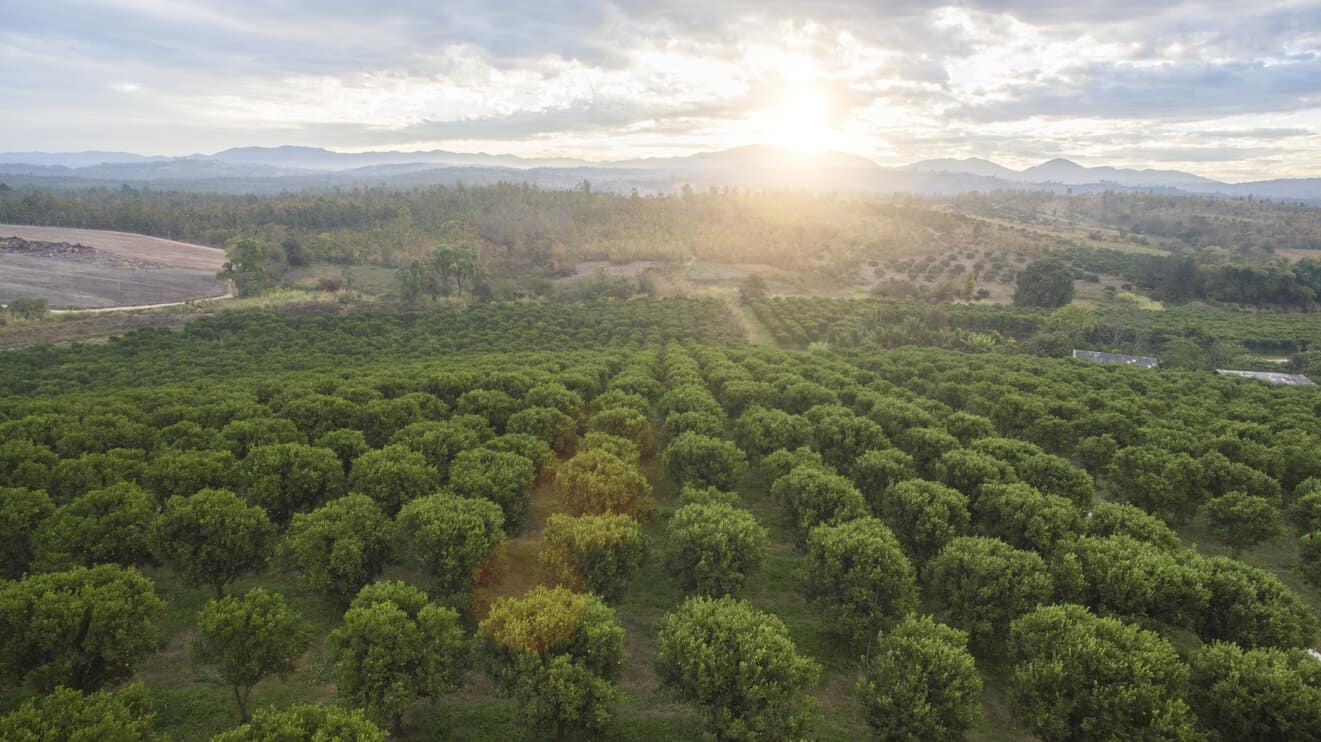
Bird's-eye view of an orange trees.

Orange trees typically grow across 4 main areas – the United States, South America, Mediterranean countries and Asia. Below, we’ll get into the nitty gritty of each of those!

Orange Trees Grow Widely In The United States

Florida, California, Arizona, and Texas are the most common places to find oranges in the United States. Oranges love growing in Florida. After all, Florida did name the orange as their state fruit!

You Can Find Orange Trees Growing In Florida

Oranges from Florida often have thinner skin than oranges grown in other places and will be much juicier than others.

According to the University of Florida, the most common varieties of oranges grown in Florida are the Navel, Hamline, Amebersweet, Valencia, and Pineapple. Naval oranges specifically are what you’ll typically find in groceries stores as some of the most common that are exported.

Perhaps this is why most of our orange juice comes from Florida! 

Orange Trees Grow In California
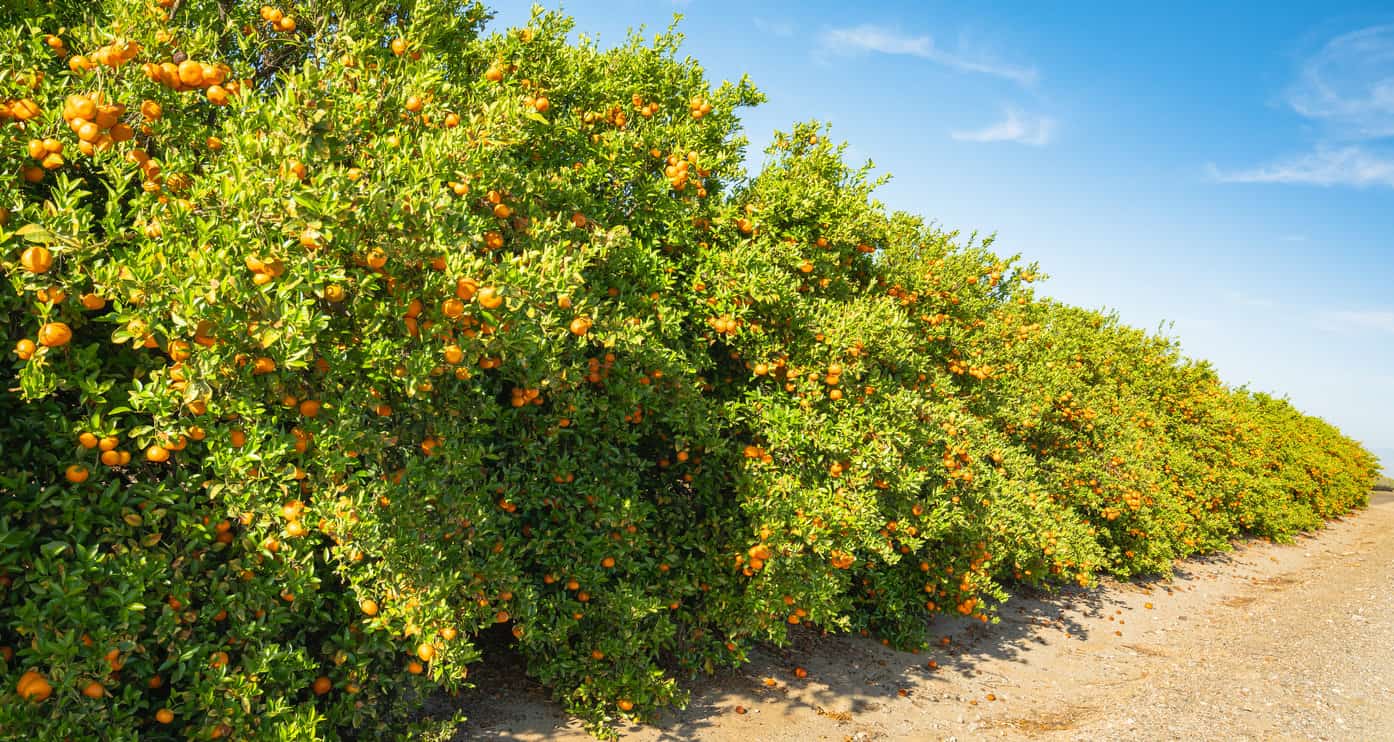
Mandarins grove in California. Trees with ripe fruits in a row, oranges, harvest season

California is the second largest orange producer in the United States. Farmers began to grow oranges in California in the 1860’s. Due to the variety of hardiness zones in California, fresh oranges are always available. 

California oranges are known for their thicker skin that easily peels off, baring a sweet fruit that breaks into segments easily. Most California oranges are used for eating rather than juicing. 

According to the University of California, just about 90% of California’s citrus comes from Fresno, Kern, Tulare, Ventura, and Orange counties. 

Orange Trees Also Grow In Arizona

Arizona produces about 2 percent of the United States’ orange production, with nearly half of these oranges used for fresh consumption. Valencia and Navel oranges are the most common oranges grown in this state. 

According to the University of Arizona, a variety of oranges are always ready to be eaten from October through May. 

Another great perk of growing oranges is that they are pretty beautiful. In many Arizona cities, it’s common to find orange trees used for ornamental purposes. The oranges on these trees are sour and rarely used for consumption.

You Can Find Orange Trees Growing In Southern Texas

In Texas, you’ll find that most of their orange production is in the southern part of the state since much of northern Texas has weather that is too cold for oranges.

Texas oranges will vary in color, usually lighter than those grown in Arizona and California.

According to Texas A and M Agrilife Extension, the most common orange varieties that grown in Texas are the Naval, Marrs, Pineapple, Hamlin, and Valencia varieties. Again – those navals are usually what’s in those big ol’ orange bags in your grocery store!

Orange Trees Love To Grow In Brazil

Brazil is known for its beautiful beaches, the Amazon river, FIFA World Cup, and carnivals. But did you know that Brazil is famous for one other thing? Orange juice!

Keeping the United States on its toes, Brazil produces the most oranges in the world. Surprisingly, 70% of the oranges grown in Brazil are turned into frozen concentrated orange juice. The warm weather and low hurricane risk give Brazil a leg up.

In Brazil, the orange trees are found in an area known as the Citric Belt. The Citric Belt runs through the regions of Sao Paulo and Triângulo Mineiro. More than 80% of the oranges produced in Brazil come from the Citric Belt alone.

Orange Trees Grow In The Mediterranean
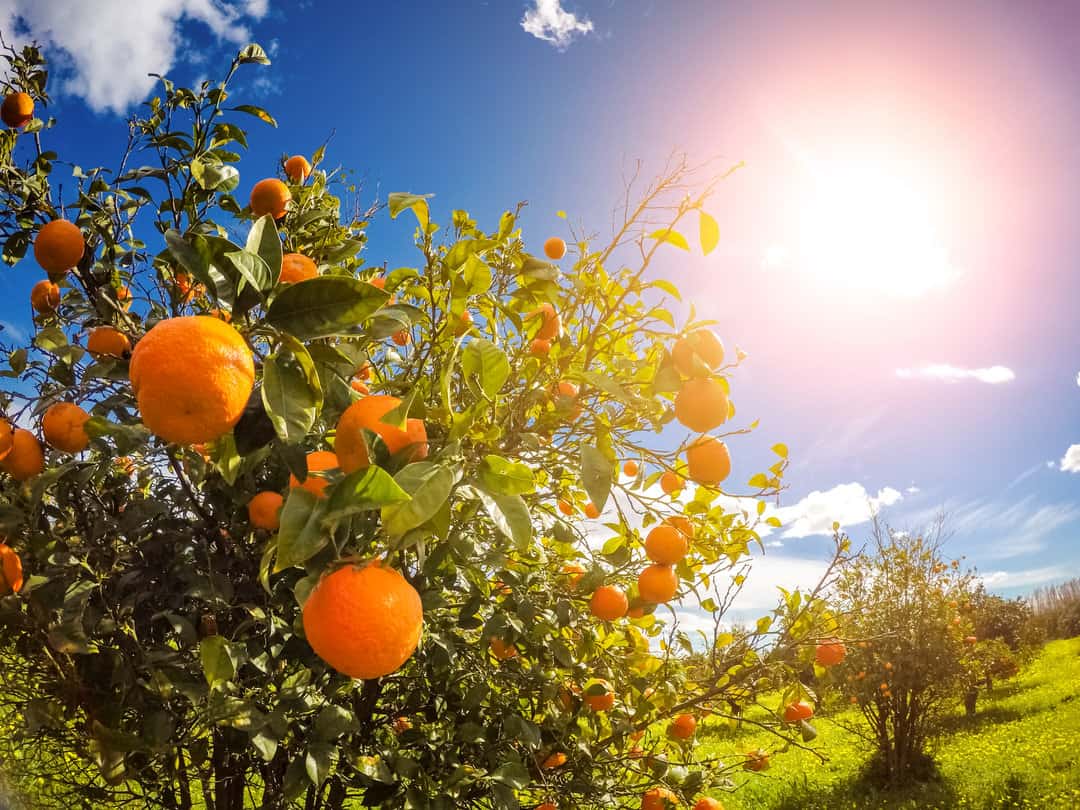
Fantastic views of the garden with blue sky and oranges.Mediterranean climate. Sicily island, Italy, Europe. Beauty world.

Surrounding the Mediterranean Sea, countries such as Spain, Italy, Greece, Egypt, Turkey, and Morocco are fantastic places to find oranges.

Due to the ideal climate for orange production, according to the International Center FOR Advanced Mediterranean Agronomic Studies, the Mediterranean Basin accounts for about 20% of the world’s citrus production. Spain produces the most, Italy produces the second most, and Egypt the third in this region.

The kinds of oranges produced in the Mediterranean are sweet oranges that are easy to peel, like mandarins. It’s common to find delicious Mediterranean recipes with oranges as one of the main ingredients.

Orange Trees Are Also Growing In Asia 

With oranges originating in Asia, it’s only natural that Asia would make our list of the most common places where oranges grow. 

Among the vast varieties of oranges grown in Asia, I’m sure you’ve heard of the mandarin orange, as it is one of the most popular oranges in the world. The mandarin orange comes from south-eastern Asia, the Philippines, Japan, Southern China, and India. 

The mandarin orange tree is smaller in size than the varieties of sweet oranges. Mandarin oranges are cold-hardy and drought-tolerant and usually taste much sweeter than other oranges. The mandarin is known to be one of the original citrus variations. 

You Can Even Grow Orange Trees Indoors!

You read that right; yes, you can plant oranges in your house!

If you live outside the four common orange growing regions, consider growing a small orange tree inside your home.

Remember that an orange tree grown in your home won’t produce oranges precisely like the ones you’d find on outdoor oranges. They will be smaller in size and need a bit more care. 

Miniature orange trees can be grown as houseplants in pots. Common varieties include:

  • Tangerines
  • Kumquats 
  • Calamondin 
  • Otaheite 

If you are growing oranges indoors, be sure to keep your home at around 65-70 degrees whenever possible and keep your orange plant in a sunny spot. Like orange trees planted outside, indoor orange trees prefer soil with a pH between 5.0 and 6.5. Try taking it outdoors during the summer months to allow your tree a chance to pollinate.

Planting Orange Trees Outside 

fresh orange on plant, orange tree, growing oranges outside.

According to the University of Florida, there are a few essential things to consider when planting your oranges.

First, you will need to pick a partly shady location or mostly sunny. You can plant container-grown orange trees at any time of the year in Florida, but only in the springtime in other cooler temperature regions.

You should wait three weeks after planting before fertilizing your tree. Lastly, your tree’s best pH level is between 5.0 and 6.5.

Consider using the XLUX Soil Acidity Test Meter to test your soil pH to ensure you are planting your tree in the most optimal soil. It’s not only quick and easy to use but will give you all the confidence you need when planting your orange tree. 

Once planted, keep up with water, fertilizing and keeping your orange tree safe from pests, disease, and weeds. You can read our guide about caring for your orange tree to learn more!

How To Harvest Your Oranges From Your Orange Tree

After all of your hard work and patience, it’s time to harvest your oranges (and celebrate!) Orange trees begin producing fruit three to five years after planting. There are a few things to note when it’s harvesting time. Be sure to pick your oranges at the proper maturity because they don’t continue to ripen after you’ve removed them from the tree. 

A good rule of thumb is to pick your oranges when about 25% of the peel has a yellowish-orange color. Additionally, oranges grown closer to the bottom of the tree will be less sweet than the oranges that grow higher up on the tree. 

Fun Fact: Believe it or not, orange trees are considered evergreens, meaning they always have green leaves on them. Springtime is the best time to pick your oranges since that’s when they bloom! They produce beautiful white or pink flowers and usually grow anywhere between 25 to 50 feet tall. Check out our list of 9 Common Citrus Trees That Are Actually Evergreens to learn more!

Key Things To Consider When Growing An Orange Tree

As a beginner, getting to know your tree is important! Try picking and tasting your oranges at different stages. Once the acidity and sugar content suits your taste buds, you’ve got a winner. Hey, that’s the beauty of growing your own food! 

A few key points to growing your own orange tree: 

  • Oranges don’t ripen once they’ve been harvested 
  • Snap or clip the orange off of your tree from its stem
  • If the peel breaks when gathering, it will quickly spoil (eat these ones first) 

There are so many different ways to enjoy oranges: from creating marmalades to ice cream to using them as essential oils to put into your diffuser to elevate your mood. You can even use oranges to help you recoup from a stubborn cold and eat to keep you from getting nauseous in the car! Oranges have so many amazing uses. 

If you’re looking for some more “orange-spiration,” consider adding a 5-star cookbook to your cookbook collection like this Orange Appeal: Savory and Sweet cookbook. This cookbook is filled with orange recipes, so you can be sure to use up all that fresh home-grown citrus!

And There You Have It!

Oranges thrive in hardiness zones between 9 and 11 and love a tropical or subtropical climate. They do very well when planted in an area with lots of sun and well-draining soil. 

Originating in Asia, orange trees are found in many different parts of Asia, Brazil, parts of the United States, and the Mediterranean. The largest population of orange trees is found specifically in Brazil and Florida.

However, if you’re feeling adventurous, you can plant small citrus trees in your own home. 

Now that you know the most common places where orange trees grow, it’s time to get planting! 

References:

Burns, A. J. (1976). California-Arizona Fresh Oranges: Marketing Patterns, Prices, Costs, Margins, and Grower Returns (Vol. 638). Economic Research Service, US Department of Agriculture.

Coltro, L., Mourad, A. L., Kletecke, R. M., Mendonça, T. A., & Germer, S. P. (2009). Assessing the environmental profile of orange production in Brazil. The International Journal of Life Cycle Assessment, 14(7), 656-664.

Neves, M. F., Trombin, V. G., Lopes, F. F., Kalaki, R., & Milan, P. (2011). Brazil’s citrus belt (São Paulo and Triângulo Mineiro). In The orange juice business (pp. 53-57). Wageningen Academic Publishers, Wageningen.

Morton, J. (1987). Mandarin Orange. p. 142–145. In: Fruits of warm climates. Julia F. Morton, Miami, FL.

Lacirignola, C., & D’onghia, A. M. (2009). The Mediterranean citriculture: productions and perspectives. Citrus tristeza virus and Toxoptera citricidus: a serious threat to the Mediterranean citrus industry. Bari: CIHEAM. Options Méditerranéennes: Série B. Etudes et Recherches, 65, 13-17.
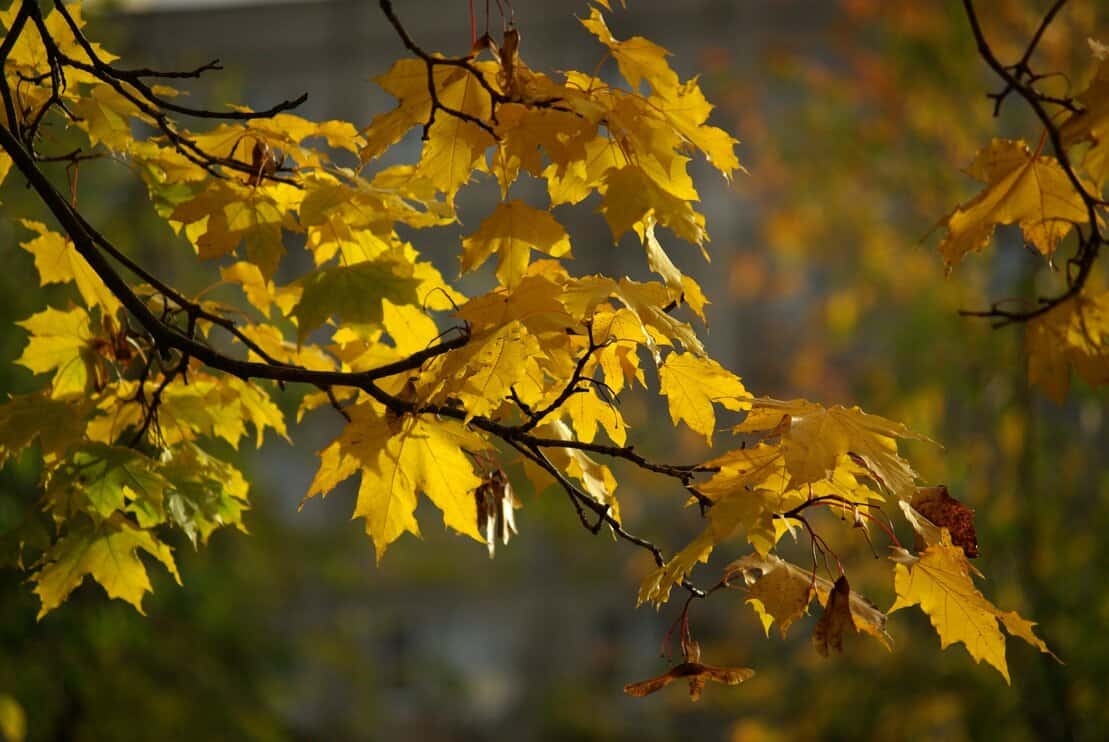
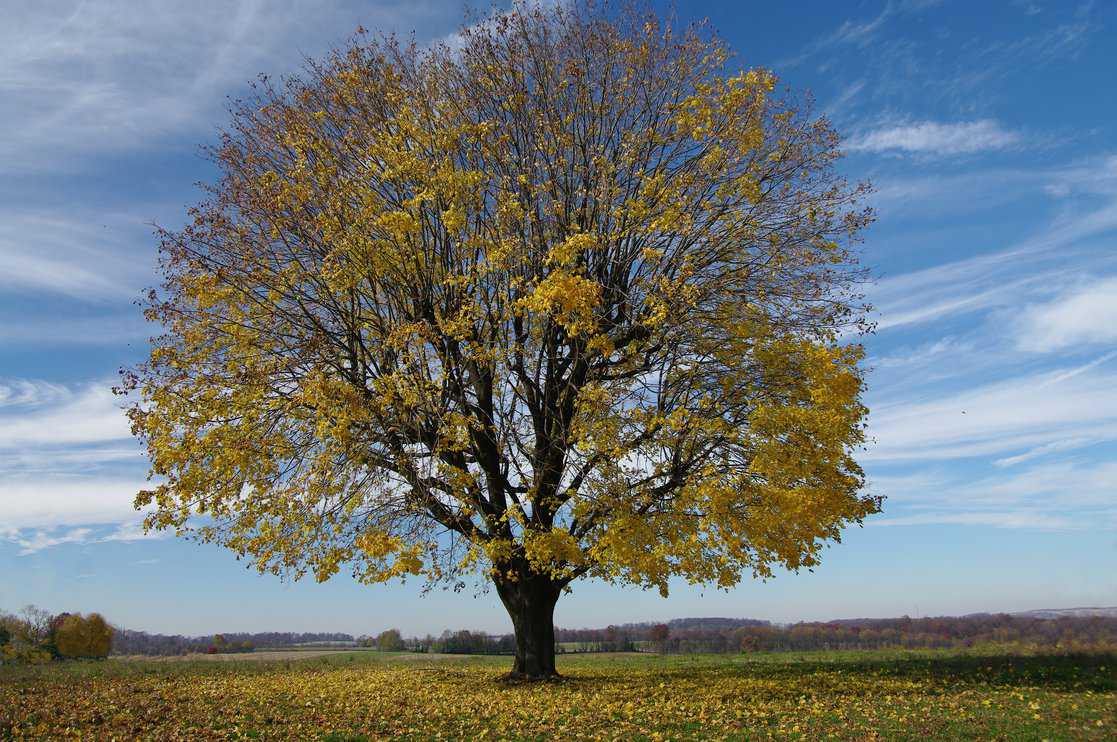
Maple trees are a classic tree in the United States, particularly in the northeast region. They are easy to grow, provide wonderful shade, and produce brilliant and beautiful fall foliage that is famous worldwide. Caring for a maple tree can be easy in the right environment, but if you do not live in the right climate, or you are living in an area experiencing drought, you might find that the fall foliage is not as brilliant as it could be due to lack of adequate water.

Maple trees need a great deal of water. They take water in through their roots and lose it through their leaves, especially in the warm months. If your home is getting little rain, you are experiencing a drought, or very warm temperatures, run a soaker hose to your maple tree 1-2x per week.

Maple trees need even more water than some other tree varieties. If you have a maple tree in your yard or garden, or even if you are just thinking of planting one, read on to learn about how to keep these beautiful trees hydrated year-round!

The Varying Water Needs Of Maple Trees

Tree shedding leaves: a maple tree reveals an intricate pattern of branches as leaves fall away on a sunny autumn afternoon.

All trees need water to grow and stay healthy, plus they need water to make sure their leaves (if they are deciduous trees) go through a normal annual cycle of fall foliage and new buds in the spring.

All trees are affected by how well and how much they can grow depending on whether their water needs are met. There is also some concern that changes in our global climate might affect how much water maple trees get.

Maple trees like to live in cooler climates where their leaves do not dry out.

A sign of a dehydrated maple tree can start with leaves that look dry, curl up, or even look dead. If your maple tree’s leaves look unhealthy, considering its water availability is a great place to start in attempting to solve the problem.

Maple trees are quite interesting plants. You can learn more about the maple tree growth timeline and facts in this article!

Watering Young Maple Trees

While mature maple trees also need water, the most vulnerable time for a maple tree is during the first couple of years of its life.

If you have recently planted a maple tree seedling or sapling, water it regularly no matter what type of weather you are experiencing (unless you are experiencing daily heavy rainfall that is assuredly providing a great deal of water to your young tree.)

According to Utah State University Extension Yard and Garden, it is imperative for the health of your maple tree’s canopy and root growth that you water the soil around your new tree so that the soil is moist a full foot underground. If the soil takes a lot of water to be watered that deep, you may have to water your tree more often than even once a day.

Once your maple tree is well-established, which usually takes somewhere around three years, it will not require as much water, but it probably will still require some watering unless you live in a very rainy place.

According to the city of Seattle, tree saplings need 30 to 40 gallons of water per week, split into two waterings. This can vary, of course, depending on the type of tree and the climate you live in. In Seattle, for example, there is a lot of rain, so this recommendation might be different if you live somewhere that is less humid than Seattle, a very humid city.

The Virginia Department of Forestry provides this guideline: saplings or trees that have just been planted need to be watered at least two or three times per week with the amount of water varying depending on how thick the trunk of the tree is.

The thickness of the trunk of the tree is called the caliper, and a young tree needs about two or three gallons of water for every inch of the caliper. This guide can help you determine how much to water your young maple tree.

Controlling The Water If Your Tree Is In A Container

If you are growing a maple tree sapling in a container like a raised bed or a pot, you have more control over the amount of water in the soil and, while your tree requires a great deal of water, it is possible in these cases to over-water the tree.

To avoid this, check how damp the soil is throughout the pot. If the soil is very moist, you may not need to water the tree that day.

Another way to keep from over-watering a container sapling is to put a layer of rocks or bark at the bottom of the pot. This will encourage the water in your maple tree’s soil to drain, protecting the young tree’s roots.

Addressing Drought With Maple Trees: Maybe Not As Obvious As You Would Think

You probably think of drought as something that comes with scorched earth, dry and cracked dirt, and very dry days for a long period. But maple trees can suffer from drought in as little as a few days.

If you think that watering your tree once a week or even less during the hot summer months is enough, you are probably wrong.

According to Purdue’s University Extension office, a red maple tree that has a soil ball of about two feet wide needs about twenty gallons of water every day.

Then the tree will lose a few gallons of water just through the leaves in a single day if the temperatures are warm. So it could only take a couple of days for the tree to be without enough water.

Make sure that, no matter what type of climate you live in, you are paying attention to the amount of rain your home is getting and the temperatures throughout the day. If it is hot outside or it hasn’t rained in a while, you probably need to water your maple tree.

Some Easy Ways To Water Your Maple Tree

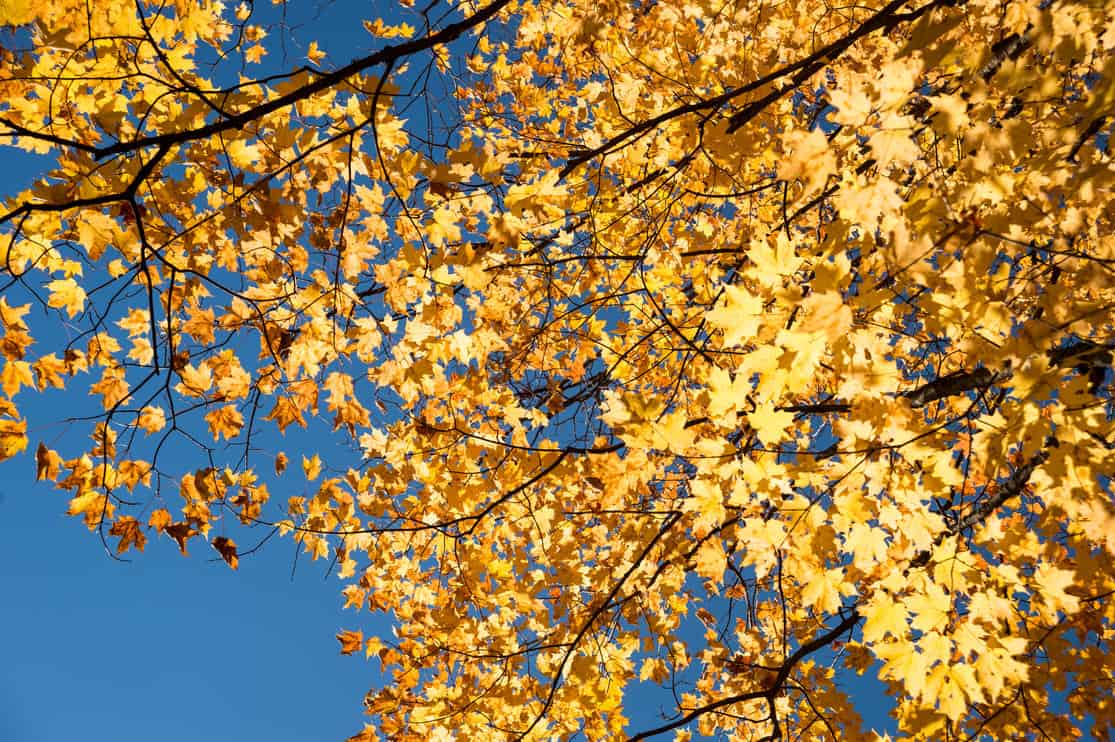
Autumn maple trees with yellow leaves against blue sky in Quebec, Canada

Watering your maple tree might be enjoyable for some people who might find it relaxing to take the garden hose out and water the tree each day.

But some people might view this as a chore, plus there may be some times that you are not home to water the tree or you just forget.

To make sure your tree is watered regularly, there are some steps you can take to make the process easier or to even automate it.

Using A Sprinkler System

Sprinkler systems are probably the easiest and most reliable way to water your yard or garden, but they are not always as easy for watering trees.

Unless you have already placed a sprinkler head or two or three near the base of your tree, your sprinkler system is unlikely to produce enough water for your maple tree’s needs.

Most sprinkler systems are set up to provide water for lawn grass or flower beds, not enormous trees like most varieties of maple trees.

Therefore, if you rely on an already-installed sprinkler system, you are probably not getting enough water into the soil around your tree.

Remember that you are aiming for a whole foot of wet soil around the entire base of your tree, so that is a lot of water!

If you can adjust your sprinklers to meet this need, that is great. Just program them to run on a schedule that keeps the tree watered. This may mean too much water to other parts of your yard, though, so again, a sprinkler system that is not very customizable for different zones may not work well for this watering task.

Using A Hose-Attached Sprinkler

Sprinkler systems can be great, but if you need to move them around, that isn’t an option. One solution to the immobility of an installed in-ground sprinkler system is to use a sprinkler head attachment on your garden hose.

For watering the base of your tree, your best option is probably to go with a sprinkler that provides a lot of water to a relatively small area.

Remember, you aren’t trying to water your whole lawn; you are trying to provide a concentrated amount of water to the base of your maple tree.

You can attach a sprinkler head to your hose, then place it under your tree and let it run until you have reached the desired amount of water. One problem with this method is that this will probably only water one side of your tree.

You may need to move the sprinkler once or even twice during a watering session to provide complete coverage around the circumference of the tree trunk.

If your tree is still a sapling and therefore still quite small, you might be able to set up a sprinkler that can water the entire tree. But if the tree is mature, this is probably not the best option.

Using A Soaker Hose

If you want to provide a lot of water to a specific area, a soaker hose is a great option, no matter whether you are watering a mature maple tree or a small sapling.

A soaker hose is exactly what it sounds like: it’s a garden hose that soaks the surrounding ground. These hoses have strategically placed holes in them that let water out in a continual stream all down the length of the hose, so anywhere you lay the hose gets water.

Since your goal is to soak the ground around your maple tree, a soaker hose can be ideal.

Another bonus of soaker hoses is that, if you buy one that is long enough, you can wrap them around and around the base of the tree in concentric circles, providing water to a large amount of area that is sure to soak the soil above your maple tree’s entire root system.

The Linex flat soaker hose, which is 50 feet long and able to be wrapped around the base of your tree in multiple layers that can spiral out to provide water to the soil on top of the roots, too. Another option is the Rocky Mountain Goods flat soaker hose, which is also 50 feet long.

To use the soaker hose, just attach it to the faucet on your house or to a splitter if you plan to use another garden hose at the same time. Then make sure it stretches to your maple tree. You may need to buy a longer hose if you have a long way to go before you even get to the tree.

Wrap the soaker hose around the base of the tree in concentric circles, sort of like a spiral out from the tree trunk. Leave a few inches between each circle. Turn on the hose and the ground will be soaked. How long you need to leave the hose on can vary, so check the soil after your first watering and adjust the time from there.

You can also adjust the frequency of watering. Some trees may need to be watered every day, while maple trees in more humid climates may not need water as often.

Remember, young trees need more water than mature trees, whereas larger trees will need a larger area covered by concentric circles, as their underground root systems are much bigger.

Using An Automated Timer For Watering

While the soaker hose systems, or even the sprinkler attachment to your hose, can run for hours and hours with no attention from you, you will still have to remember to turn the hose on every day.

Or whenever you need to, depending on your determined watering schedule. You also have to remember to turn it off, otherwise, you may face an unintended, very high water bill!

There will probably also be times you are not home or not able to turn the water on and off. Also, if you go out of town for any length of time, you don’t want your maple tree to suffer a lack of water because you are not there to turn on the hose.

For these reasons, it can be very beneficial to install and program a timer for your hose. These timers, like the Orbit Single-Outlet Hose Watering Timer, can be programmed for a day of the week, a time of day to turn the hose on, and the length of time to let the water run before turning the hose off.

This is a brilliant solution to help you water your tree regularly and to make sure you don’t forget. This system also helps ensure that your maple tree gets enough water, but not too much.

Signs That Your Maple Tree Needs More Water

To know how much water your tree needs in varying seasons throughout the year, it is helpful to know what signs to look for. Your maple tree could be thirsty, or it could suffer from root rot from too much water.

Here are some signs to help you learn more about how to recognize signs of a healthy maple tree or one that needs a little help.

Signs That Your Maple Tree Needs More Water

According to the Illinois Department of Natural Resources, some signs of trees that need more water can include these symptoms:

  • The leaves on your tree have started to wilt.
  • Your tree’s canopy is smaller than it used to be.
  • The leaves of your maple tree look “scorched,” meaning they look like they have burned in the sunlight.
  • The leaves of your maple tree are changing color too soon or are falling off long before fall.

If any of these things are happening to your maple tree, check the surrounding soil. You may even need to dig deep into the soil, as it will be hard to know without digging whether the soil is still moist a foot down into the ground or container.

You can also just pay attention to the soil at the base of your maple tree. If the soil is dry, your tree needs water. If the soil cracks, your tree needs a lot of water! Adjust your watering amount and schedule accordingly.

Sometimes, you will need to give your maple tree extra water for a while until it is back to a healthy baseline when you can resume your regular watering schedule.

The amount of sun and shade your maple tree gets is important too. The more sun your variety needs, the more water it will eventually require. Check out this article on different maple trees and how much sun they need!

Times To Pay Special Attention To Watering Your Maple Tree

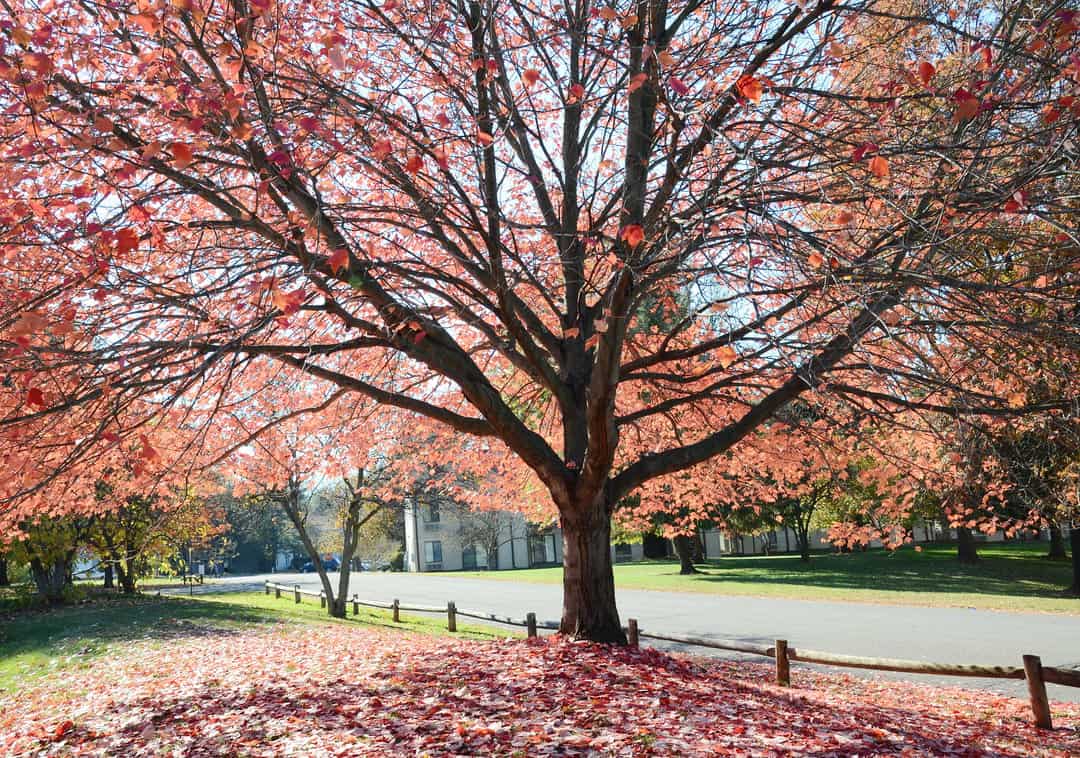
Autumn maple tree

Sometimes, your maple tree may need more water than usual. These times can be crucial for the health of your tree.

When Your Maple Tree Has Tar Rot

There are some common ailments that can affect maple trees, and, while these problems are not always serious, they can affect the look and health of the tree overall. One such common problem with maple trees is tar spot.

Tar spot is very common in maple trees and is characterized by, as the name indicates, dark spots on the tree’s leaves. According to the state of Connecticut, the best ways to prevent tar spot from coming back in the spring are to make sure you get rid of all the fallen leaves from your maple, then be very diligent about watering your maple tree.

When You Want To Ensure Bright Fall Foliage

It is entirely possible that you planted a maple tree solely because you want to see those beautiful characteristic yellow, orange, or red leaves in the fall. But something that can prevent your maple tree’s leaves from changing or make the colors less vibrant is a lack of water throughout the year before autumn.

According to Harvard Forest, trees that have not had enough water throughout the summer may lose their leaves before they even change color, or they might just not have as much color when the leaves change.

Also, too much water during the early days of fall can be problematic, as rain can cause the leaves to fall early before they reach peak foliage color.

According to the University of Tennessee Extension, trees that do not get enough water in the summer can be late to change the color of their leaves. And trees that get a lot of rain right around the time their leaf colors are due to peak might not change color as brightly.

While you cannot control how much or how little rain your maple tree gets, you can at least help make sure it gets enough water and you can make sure that you are not the reason it has gotten too much water.

If you want to ensure bright, colorful fall foliage that doesn’t fade or fall away too soon, or that doesn’t arrive too late, monitor your maple tree’s water supply throughout the year.

Remember, fall foliage is also affected by water amounts in the summer months, so it won’t work to wait until autumn to correct watering issues.

That’s A Wrap!

Now you are ready to keep your maple tree watered adequately, but without giving it too much water. You can help your tree grow stronger, healthier, and faster by ensuring that it gets enough water. You can also aid your mature maple tree in warding off disease and reaching peak fall foliage.

For more information about adding maple trees to your own personal arboretum, take a look at our post on the 9 Best Maple Trees To Plant – Pros and Cons Of Major Types.

Enjoy your maple Tree Journey!

References

Burr, H. S. (1945). “Diurnal potentials in the maple tree.” The Yale Journal of Biology and Medicine, 17(6), 727.

Wullschleger, S. D., Hanson, P. J., & Tschaplinski, T. J. (1998). “Whole-plant water flux in understory red maple exposed to altered precipitation regimes.” Tree Physiology, 18(2), 71-79.

Cherry trees have amazing blooms and delicious fruit, making them an excellent choice to plant in the yard. When choosing a place to plant a cherry tree in your yard, it’s important to take into consideration how much sunlight the area gets, as cherry trees do best in full sun conditions.

Cherry trees grow best in full sun because it increases their growth rate, flower production, and fruit production. Sunny locations help dry the branches and leaves after rainfall. Full sunlight is necessary for the temperature to be warm enough for your cherry tree to break dormancy in the spring.

Read on to learn all about why cherry trees grow best in full sun. We’ll also go over how to give your indoor cherry tree enough light and what happens if your cherry tree gets too much or too little sun.

Why Cherry Trees Grow Best In Full Sunlight

When it comes to cherry trees, you have plenty of options to choose from. There are sweet cherry, sour cherry, and flowering cherry trees.

Each of these trees has unique characteristics that make them appealing. For our purposes, we’re going to lump them all together and simply refer to them as “cherry trees.

However, if there are any significant differences, we’ll note them!

Sunlight is essential to all life, including people, animals, plants, and trees! Most trees benefit from being planted in full to partial sun to photosynthesize.

Cherry trees grow BEST in full sunlight, getting at least 6 hours of sun per day. There are a few reasons why cherry trees prefer full sun over partial or full shade. 

Let’s check out the specifics!

Cherry Trees Grow Faster In Full Sun

Every plant has a specific habitat where it grows best in. A tropical palm tree will not survive harsh Montana winters, and a very cold-hardy Norway spruce cannot survive in the hot Arizona desert.

Cherry trees have their favorite habitats and will grow much faster when given proper soil, water, and sun.

Sunlight is the most important trigger for a tree to begin photosynthesis. 

According to the Massachusetts Institute of Technology (MIT), as soon as the sun touches the leaves, chemicals called light-harvesting complexes get all excited and sound the alarm to start photosynthesis.

What exactly is photosynthesis and why does it influence a tree’s growth? 

Photosynthesis produces sugars that feed the tree. It’s the equivalent of when our parents always told us that eating will make us grow up big and strong.

A study reported in the Journal of Photosynthesis Research found that, unsurprisingly, the more sun a leaf gets, the higher the rate of photosynthesis.

The more sugars that cherry trees produce, the more energy they have to grow. This means a stronger trunk, taller branches, wider branches, and an overall healthier cherry tree.

Cherry Trees Bloom Better In Full Sun

While growing tall and having stronger branches is a huge benefit, full sun conditions also promote a higher number of flowers on cherry trees.

Cherry trees will bloom better in full sun, but this isn’t true of ALL plants. Shade-loving plants like begonias and primrose will struggle to bloom with too much sun.

Weird, right? What makes some plants benefit from sunshine while others wilt?

It mostly has to do with where the plant is found in the wild. Some plants like ferns and mountain laurels are used to being in the understory, beneath a thick canopy of trees. These plants have adapted to shady conditions.

Others, like cherry trees, are used to being out in the open in full sun or else towering over other trees in a mixed forest stand. 

Birds have a lot to do with why cherry trees hog all the sunlight in forests. Birds eat the fruit of cherry trees and help disperse the seeds all over the place. As long as there is adequate sunlight, cherry trees will sprout right up and take over!

Cherry trees aren’t unique due to the fact that birds help spread their seeds. However, there are some other cherry tree facts that might surprise you! Did you know that cherry blossoms actually don’t smell (at least not as strongly as tradition might imply?)

Spring blossoms in the sun. Tree branch with apple flowers, blur background.

Cherry Trees Produce More Fruit In Full Sun

Cherry trees take advantage of every bit of sunlight to improve their growth, flowering, and fruit production.

Similar to how more sunlight means a faster growth rate, more sunlight also means more fruit! There are a few reasons why cherry trees produce more fruit in full sun:

  • More energy: The more sun the cherry tree gets, the more ‘food’ the tree has. When cherry trees have tons of energy, they can focus on more than just surviving. They can grow faster and divert more energy to fruit production.
  • Fewer pests: full sun conditions help dry out cherry trees faster than if they were located in a shady spot. This helps prevent pests from attacking the tree and destroying the fruit.

Almost all fruit trees do better in full sun, including cherry, plum, citrus, and apple trees. Selecting a sunny spot in the yard to plant your cherry tree is super important!

Sunny Conditions Promote A Healthier Cherry Tree

We mentioned a few times how sunlight will help dry off the branches and leaves of cherry trees. This is more important than you may think.

Wet branches and leaves create an environment where the tree may contract an ailment. They may not have the sniffles or sneeze, but there will be a few signs that they aren’t feeling well.

  • Holes in leaves: Wet conditions will promote something called cherry leaf spot, sometimes referred to as cherry shot hole.
  • Yellow leaves: yellow leaves are the next step in cherry leaf spot. According to the University of Maryland, soon after the leaves turn yellow they will drop from the tree.
  • Brown flowers: If the flowers on your cherry tree are wilting and turning brown, it may be due to brown rot, a fungus that spreads rapidly in wet conditions.
  • Cracked fruit: When water sits on the fruit for too long, it will crack, making the fruit unusable except to maybe feed to the birds.

Once your tree shows some of these signs, bugs will zero in on the problem areas and can wreak even more havoc on your cherry tree.

Water is a necessity for trees to survive, but too much water can be a problem. Planting your cherry tree in a sunny spot will help the entire tree dry out quicker after heavy rain.

Another way to keep your cherry tree from getting too wet is to properly prune it each year. Pruning thins out the branches, allowing for better air circulation and more sunlight.

There are some tree maintenance tasks you can do on your own. Here are some simple steps to prune your cherry tree.

Warm, Sunny Spots Help Cherry Trees Break Winter Dormancy

Believe it or not, some trees require cold temperatures to survive! Most (though not all) deciduous trees like require a certain number of days with cold temperatures, called a chilling requirement.

According to the University of California, sweet cherry trees require about a month of continuously chilly temperatures (below 45℉). Sour cherries need even longer chilling periods, around 50 days.

These are only approximations. Specific cultivars may have different chilling requirements. A study in the International Journal of Biometeorology found that chilling requirements may be as little as 17 days and as long as 102 days.

Now, what does chilling have to do with the sun and breaking winter dormancy?

Cherry trees need chilly temperatures followed by warm temperatures to trigger new growth and blooms. If cherry trees are growing in shady areas, they may get the order to break winter dormancy late.

Late winter dormancy break will mean:

  • Slower growth
  • Lower fruit yield
  • Later and shorter bloom period

While it won’t necessarily harm your cherry tree to be planted in partial shade, it will struggle more than a cherry tree planted in full sun.

Sunlight Helps Shape Your Cherry Tree

The shape of a tree influences both its aesthetics and health. We all want our yard trees to look good, but we also want them to be healthy and strong so we don’t have to worry about falling branches or a messy yard full of leaves.

Sunlight is an important component of shaping your tree because new growth is always going to gravitate towards a sunny spot.

Have you ever planted something on your windowsill and noticed the plant begin to lean toward the window? 

The same concept can be applied to trees. They are going to try to grow toward the sunniest spot. When sunlight is available everywhere, your cherry tree will grow uniformly with an upright canopy.

If your cherry tree is in partial shade, there may be a few unwanted consequences:

  • Lopsided tree: If sunlight is only available in a few concentrated spots, new growth will gravitate to these areas, creating a lopsided appearance.
  • Weak branches: Branches that are not exposed to full sun may be weaker due to reaching. They also may not be attached as firmly to the trunk as branches located in sunny areas.
  • Less uniform shade: Cherry trees make great shade trees, but if they are planted in shady conditions, the shade they provide will not be uniform and will not be as upright and spreading.

With plenty of sunlight, your cherry tree will grow into a vast, uniform canopy with strong branches that won’t make a mess in the yard.

Now, another benefit of having a cherry tree is that that make excellent shade trees in their own right! So shade isn’t all bad.

Cherry tree blossom explosion in Hurd Park, Dover, New Jersey

How To Give Indoor Cherry Trees Enough Sun

Not everyone has enough space in their yard to plant a full-grown cherry tree. That doesn’t mean you can’t enjoy the wonderful blooms and fruit of a cherry tree, you just need a dwarf variety to grow indoors.

Growing cherry trees indoors is a little tricky, but with enough care and patience, you’ll be baking cherry pies and topping ice cream in no time!

To successfully grow an indoor cherry tree, it has to receive enough sunlight to grow, flower, and produce fruit.

Indoor sun isn’t really the same as outdoor sun because it’s filtered through a window. It’s recommended to put your potted cherry tree outside each day to get some much-needed sunshine.

Cherry trees typically require around 6-8 hours of direct sun per day. You can increase your cherry tree’s exposure to sunlight by placing it near a south-facing window while indoors.

Your cherry tree will not be very successful if you do not place it outdoors at certain times. There are two important reasons to put your indoor cherry tree out on the porch or balcony:

  • Sunlight: Your cherry tree needs unfiltered, direct sunlight to properly grow. If you don’t place your cherry tree outside to get some sun, it’s going to struggle to grow and may not bloom or produce fruit.
  • Chilling Period: Cherry trees must have a prolonged chilling period to bloom and set fruit the following growing season. For this reason, you’ll need to expose your cherry tree to continuous cold temperatures for at least a month by placing them outside while temperatures are 45℉ or below.

The key to chilling periods is that it needs to be continuous. Don’t bring your cherry tree inside on winter nights and warm it up. It needs to be at a steady, cold temperature for a month or more depending on the cultivar.

What Happens To Cherry Trees On Cloudy Days?

If sunlight is as important as we say it is, then what do cherry trees do on cloudy days? Will they start to wilt if there’s a week of cloudy weather?

According to an article in the European Geosciences Union, decreased light from clouds or other obstructions such as smoke or smog significantly reduces the amount of radiation available for photosynthesis.

However, just because it’s cloudy does not mean that your cherry tree will completely shut down.

Cloudy days are not as productive for cherry trees as sunny days. Cherry trees will produce less energy, meaning they’ll have fewer resources to put towards growing, blooming, or fruiting.

A few cloudy days here and there will not have a significant effect on cherry trees. If you live in a place that has a high number of cloudy days (Looking at you Seattle, Portland, and Pittsburgh), you may have to settle for a cherry tree with slower growth, fewer blossoms, and fewer fruits.

There’s no good way to remedy having cloudy weather. Your cherry tree will survive, but a boatload of cloudy days could have small consequences, some of which you may not even notice.

For those who have indoor cherry trees, there is a way to solve cloudy days – LED lights. Artificial grow lights can help supplement your indoor cherry tree with the light that it needs.

WTINTELL’s LED Plant Grow Light with Stand is adjustable up to 56 inches tall. It comes with 4 lights that are adjustable and can be set to a timer. These are perfect to keep your cherry tree happy and healthy!

If you live in an area that’s just too shady for cherry trees, you can try one of these types of mock cherry trees. Depending on where you live, it might be a better fit for your yard!

Can Cherry Trees Get Too Much Sun?

There’s no such thing as too much sun for a cherry tree, right? Right?

Unfortunately, there are a few downsides to having a ton of hot, sunny days in a row. Most of the time it’s the hot, dry weather that affects a cherry tree as opposed to just simply sunlight.

Below are some of the signs that your cherry tree is getting too much sun.

  • Cherry spurs: Too much sun paired with hot weather can cause cherry fruits to double up. One full-sized cherry will be paired with a smaller cherry. While the fruit is still edible, it’s not the best site to see on your cherry tree.
  • Sunburn: Just like people, trees can get sunburned from being in the sun for too long! Signs of sunburn include discolored bark, bark that looks dried out, and loose/peeling bark.
  • Water stress: Mature cherry trees do not typically need watering. If your cherry tree appears droopy with dry, discolored leaves, it might be water stressed. This can happen when the cherry tree is exposed to too much sun, which dries out the soil.

How (And When) To Protect Your Cherry Tree From Too Much Sun

If you live in an area that’s always sunny, you may want to take some steps to protect your cherry tree. 

According to Washington State University, you’ll want to focus on the south or southwest face of your cherry tree’s trunk, as this is the area most likely to be affected by too much direct sun.

You’ll also want to look lower rather than higher when trying to spot damage. The light reflected off the ground is a double-whammy to the lower half of the tree’s trunk.

With that being said, it’s better to take preventative measures before you notice damage!

One easy way to help your cherry tree is by using tree wraps. Tree wraps are basically like a layer of sunscreen that you can wrap around the tree to protect them from too much sun.

Dalen’s Protective Tree Wrap is light-colored, which works perfectly to reflect the sun’s harsh rays. It’s also breathable and light, so it won’t hold moisture or prevent your cherry tree from growing.

red ripe cherries

That’s All For Now!

Sunlight makes the world go round. It gives us Vitamin D and a boost of serotonin to help us feel better! Sunlight is also incredibly important for trees, including cherries!

Cherry trees benefit from being planted in an area that receives full sun. This means at least 6 hours of direct sun per day. There are a few different reasons why cherry trees grow best in full sun.

Now for a quick recap.

Here’s why cherry trees grow best in full sun:

  • Faster growth
  • Better blooms
  • Higher fruit production
  • Promotes a healthier tree
  • Helps break winter dormancy in the spring
  • Gives cherry trees a uniform shape

Sunlight is important, but too much sun paired with hot, dry weather can cause problems. Keep an eye on your cherry tree and look out for signs of sunburn or water stress.

If you are growing your cherry tree indoors, it’s recommended to place it on a porch or patio so it can receive direct sunlight for a few hours each day.

Your local arborist can help you pick out the right variety of cherry tree for your yard or home and give you some insight into what your cherry tree needs to thrive!

References

Goncalves, B., Santos, A., Silva, A. P., Moutinho-Pereira, J., & Torres-Pereira, J. M.G. (2015, November 07). Effect of pruning and plant spacing on the growth of cherry rootstocks and their influence on stem water potential of sweet cherry trees. The Journal of Horticultural Science and Biotechnology, 78(5), 667-672.

Lichtenthaler, H. K., Babani, F., & Langsdorf, G. (2007, May 08). Chlorophyll fluorescence imaging of photosynthetic activity in sun and shade leaves of trees. Photosynthesis Research, 93(235).

Luedeling, E., Kunz, A., & Blanke, M. M. (2012, October 06). Identification of chilling and heat requirements of cherry trees – a statistical approach. International Journal of Biometeorology, 57, 679-689.

Predieri, S., Dris, R., Sekse, L., & Rapparini, F. (2003). Influence of environmental factors and orchard management on yield and quality of sweet cherry. Food, Agriculture & Environment, 1(2), 263-266.

Yamasoe, M. A., von Randow, C., Manzi, A. O., Schafer, J. S., Eck, T. F., and Holben, B. N.: Effect of smoke and clouds on the transmissivity of photosynthetically active radiation inside the canopy, Atmos. Chem. Phys., 6, 1645–1656.

Shade trees are a wonderful addition to the yard, providing a cool oasis on a hot summer day. While some shade trees are better than others, cherry trees run near the top of the list for a few different reasons.

Cherry trees make great shade trees because they are tall with a large canopy that provides plenty of shade. They are also extremely colorful with edible fruit and flowers that will attract wildlife. Cherry trees generally grow at a quick rate of 2ft per year, giving you shade quicker than other trees.

If you’re thinking about planting a shade tree, consider a cherry tree! Read on to learn why cherry trees make great shade trees.

Are Cherry Trees Good Shade Trees?

Cherry trees are part of the genus prunus and belong to the rose family. There are many different kinds of cherry trees, which can make picking a shade tree a little confusing.

There are three basic types of cherry trees:

  • Sour cherry
  • Sweet cherry
  • Flowering cherry

If you’re picturing the beautiful blooming cherry trees commonly associated with Japan or Washington D.C., you’re thinking of flowering cherries. Sour and sweet cherry trees are the ones that produce the fruit we all know and love.

Each cherry tree has unique characteristics that make them appealing shade trees. One of the most important aspects of a shade tree is its ability to provide shade!

Most species of cherry trees grow tall and wide enough to provide adequate shade. A few species are considered better shade trees than others.

Some of the best cherry shade trees include:

  • Kwanzan cherry (Japanese flowering cherry)
  • Sargent cherry
  • Black cherry
  • Sweet cherry
  • Yoshino cherry (Tokyo cherry)

The Yoshino cherry, black cherry, and Sargent cherry all have a rapid growth rate, meaning they can grow 24 inches or more per year. This is an excellent quality to have in a shade tree as it won’t take as long for the tree to grow tall enough to provide shade.

The Kwanzan cherry and sweet cherry have medium growth rates, which is still faster than some other species of shade trees such as Japanese maple and eastern Hemlock.

Shade? Check. Decent growth rate? Check.

One other thing that makes cherry trees good shade trees is that they are adaptable to different conditions.

According to North Carolina State University, black cherry trees are one of the most adaptable when it comes to hardiness zones. They can survive anywhere from zone 2a to 8a, which covers most of the United States except the extreme southern regions.

Most other species can survive around zones 5 through 8, with some variation. The Kwanzan and Yoshino cherry trees are the most adaptable to different soil and PH types.

The answer to ‘are cherry trees good shade trees’ is a definite yes! Let’s check out some of the specifics.

Cherry Trees Provide Lots Of Shade

What would a shade tree be if it didn’t provide shade?! Luckily, cherry trees have dense, upright branches that spread out to provide you and your yard with tons of shade.

According to an article in the Journal of Horticultural Science, trees with spreading, open canopies tend to provide the best shade.

Except for sweet cherry and black cherry, most other cherry trees have a spreading, open canopy shape that is the perfect form for a shade tree. 

Black cherry and sweet cherry tend to have more of a pyramid shape, but they more than make up for it by having a taller height at maturity.

To give you an idea of which cherry trees provide the best shade, here is a table with some of the most popular cherry trees and their height/spread:

Cherry Tree VarietyHeightSpread (Width)Growth RateShape
Kwanzan Cherry15-25’10-20’MediumRounded, vase
Sargent Cherry20-30’20-30’FastUpright, rounded
Black Cherry60-80’30-60’FastPyramid
Sweet CherryUp to 65’30’MediumCone-shaped
Yoshino30-40’20-50’FastRounded, spreading, vase-shaped

As you can tell, some cherry trees like the Yoshino may not grow as tall, but they have a very wide, spreading canopy that provides plenty of shade.

To make sure your cherry tree grows in the best possible shape to provide shade, prune the tree yearly. This will encourage flowering and new growth and also give you a way to shape your tree how you want it.

You can read about the simple steps to prune your cherry tree here.

Cherry Trees Are Interesting All Year Long

There are plenty of choices out there when it comes to shade trees. The question is, do you want a boring old shade tree or one that keeps the yard interesting all year?

Cherry trees are known for their beautiful blossoms and delicious fruit. But spring isn’t the only time these trees will provide amazing color and interest in the yard.

  • Spring: In the spring, your cherry tree will blossom with beautiful, fragrant flowers. Typical cherry trees have either white or pink flowers.
  • Summer: During the summer, cherry trees show off the fruit that gave them their name. The Kwanzan, Sargent, and Yoshino have black cherries, while the black cherry and sweet cherry trees show off red, purple, and yellow cherries, depending on the cultivar.
  • Fall: We all know fall is the time for leaves to show off, and cherry trees do not disappoint! Depending on the variety, you may see gold, yellow, orange, red, or burgundy-colored leaves.
  • Winter: You may not utilize your shade tree as much in the winter, but cherry trees still provide an interesting landscape piece. The bark has a chance to shine in the winter, showing off its glossy coat and lenticels (horizontal pores).

No matter what time of year it is, your cherry tree is going to spruce up your yard and make your neighbors slow down to admire it!

Cherry Trees Attract Birds And Butterflies

We’re not talking about the annoying wildlife like raccoons or coyotes. Cherry trees produce fruit in the form of cherries and also provide nectar from their flowers.

Cherry trees attract a variety of birds that feed on the fruit. They also are hosts to a wide variety of butterflies. Lastly, cherry trees attract pollinators like hummingbirds, bees, and adult butterflies.

If you enjoy watching wildlife, then planting a cherry tree is an excellent choice for your yard!

Sour cherry trees are typically too tart to eat raw. Unless you plan to use them in a pie, sour cherries are for the birds – literally! You can expect to see turkeys and deer in addition to songbirds.

In terms of butterflies, you may see:

  • Eastern tiger swallowtail
  • Coral Hairstreak
  • Spring Azure
  • Viceroy
  • Red-spotted Purple

Compared to other shade trees, cherry trees tend to be more attractive to wildlife simply because of the fact they produce fruit. For example, oak trees have acorns that attract deer and squirrels but they do not really attract birds or pollinators.

If you want to get a little closer to the butterflies and other pollinators, consider installing a bench or swing under your cherry tree to observe these lovely creatures up close.

FDW’s Garden Bench has floral roses weaved into the bronze bench, fitting perfectly with the cherry tree theme (cherry trees are part of the rose family!)

Cherry Tree Blossoms Are Beautiful And Fragrant

Shade trees aren’t always the most interesting trees. They may provide cool shade, sure, but what else?

Cherry trees give your yard some shade AND a burst of color and fragrance. When you sit beneath a cherry tree, you can breathe in deep and take in the scents of spring.

Aesthetics are important in the yard. You don’t want a tree that looks droopy or lopsided. Cherry trees have a pleasing appearance and give off a lovely scent in the spring and summer.

You can read more about cherry blossoms and their fragrance here.

Cherry Trees Have A Fast Growth Rate

Planting a new shade tree is an exciting time. Soon, though, the excitement wears off and you realize you have a long way to go before your tree will provide any shade.

Growth rate is an important factor when selecting a shade tree for the yard. You don’t want to wait 30 years before you can enjoy the shade!

Most cherry trees have a fast growth rate, meaning they grow an average of at least 2 feet per year, sometimes more. At that rate, your cherry tree will be reaching 10 feet in just 5 years!

Soil, light, and water conditions will affect how fast your cherry tree grows. For the best growth rate possible, take into consideration these factors:

  • Soil Type: According to Ohio State University, cherry trees grow the best in well-draining soils. They will not do well in an area that sits in water or has compacted soil.
  • PH: Try to aim for a neutral to slightly acidic PH for cherry trees. Somewhere between 6 and 7 is ideal.
  • Water: When your cherry tree is first established, you should water it thoroughly to encourage deep root growth. Once the tree is established, provide water only when there is no rain in the forecast or if you’ve only received light rain (less than 1 inch.)
  • Sun: Cherry trees will grow the fastest when planted in full sun. They can survive some shade, but the growth may be stunted. Take a look at our guide on why cherry trees grow best in full sun!
  • Nutrients: Cherry trees are not heavy feeders, but they will benefit from light fertilizing in spring before the flowers begin to blossom. Use a low-nitrogen fertilizer like Lilly Miller Morcrop Tomato & Vegetable Food which has a 5-10-10 NPK ratio.

One thing to note about fertilizers is that you don’t want to apply them too late in the season. This can prevent your cherry tree from hardening off for the winter season. It’s recommended to stop fertilizing around mid-summer.

Cherry Trees Provide Fruit

One of the biggest advantages of planting a cherry tree is that you get fresh, delicious fruit right from your yard.

Remember how we mentioned sweet and sour cherry trees? If you’re planning on harvesting the cherries, you may want to consider if you want sweet cherries or tart cherries.

Sour cherries are better for pies, jams, and cobblers, whereas sweet cherries are better for eating raw or topping ice cream and milkshakes.

If you’re leaning towards sweet cherries, just know that you’ll have to plant two trees for them to bear fruit, as sweet cherry trees are not self-fruitful. 

Sour cherry trees are self-fruitful and can produce fruit with just a single tree.

Some of the best sour cherry varieties include:

  • Montmorency
  • English Morello
  • Evans
  • Early Richmond

Some of the best sweet cherry varieties include:

  • Bing
  • Lapins
  • Ranier
  • Lambert

Flowering cherries like Yoshino and Kwanzan have showy fruit, but they are not very tasty and it’s not recommended to eat them. If you’d like more options, take a peak at our guide on mock cherry tree varieties here.

The Best Places To Plant A Cherry Tree

Sold on planting a cherry tree? Good choice! Now, the next question is where should you plant it in your yard?

When choosing a site for your cherry tree, there are a few things to take into consideration.

Give Your Cherry Tree Enough Space

It’s not recommended to plant your cherry tree right next to another tree or close to the house. Cherry trees need enough space to grow without being crowded.

For instance at my childhood home, we have a choke cherry tree planted near the edge of our pond (image below.)

Choke Cherry Tree edge of pond

It has ample space to grow and the roots almost always have a water source unless the summer is SUPER dry.

Cherry trees are susceptible to a few problems such as leaf spot and powdery mildew. This can be minimized by planting your cherry tree in a very open area away from buildings and other trees.

The more space your cherry tree has, the better air circulation there is between the branches and leaves. This helps keep moisture from building up on the branches and leaves.

Pruning is another way you can help your cherry tree receive plenty of air circulation and minimize the chances of pests and ailments. Pruning should be done in the winter when your cherry tree is dormant.

Give Your Cherry Tree Enough Sun

Planting your cherry tree in the shade of your home or in the shade of another tree will stunt its growth.

Here’s a shot of the other cherry tree at our family home, a weeping cherry tree, which is out in the front yard getting PLENTY of sun.

Weeping Cherry Tree in yard

Of course you’d really have to trim a weeping cherry tree to make it a decent shade tree, but this one just grows pretty freely and has never had any significant issues 🙂

Pick a spot in your yard that receives plenty of sun, at least 6 hours per day. By giving your cherry tree enough sun, you’ll promote faster growth and better health.

Plant Your Cherry Tree At The Right Time

Just because you picked out your cherry tree in the summer doesn’t mean you should plant it right away.

Spring and Fall are the two best times to plant a cherry tree. The ground is typically too frozen in the winter and the summer is too hot for the trees to properly take hold in their new home.

Why Plant A Cherry Tree?

What makes a cherry tree better for shade than an oak or maple tree? ‘Better’ is a relative term and depends mostly on what you want out of your shade tree.

Cherry trees are a little higher maintenance than maples, oaks, and birches. They need to be pruned and can struggle in shade or poor soil conditions.

Cherry trees are also pretty susceptible to bugs including aphids, caterpillars, Japanese beetles, and boring insects.

With that being said, you can’t beat a cherry tree when it comes to a showy shade tree. Their edible fruits make them even more appealing as a shade tree, especially if you enjoy harvesting fruits and veggies from your own backyard.

Roots are an understandable concern of many homeowners when they plant a tree. We don’t want roots to mess with the foundation or sidewalks, and we don’t want them to heave up the soil and cause mowing problems.

Luckily, cherry trees rarely cause problems with their roots. They usually do not break the surface or cause problems with underground water lines. You can plant your cherry tree with peace of mind that, even when it’s fully grown, its roots won’t cause problems.

That’s All For Now!

Shade trees are a great addition to the yard. They provide a cool spot on hot summer days and are often the statement piece of our yards.

Cherry trees make good shade trees for a few different reasons:

  • Wide canopy
  • Interest all year long – spring blooms, summer fruit, fall leaves, winter bark
  • Fruit & flowers attract wildlife
  • Blossoms are fragrant & showy
  • Fast growth rate
  • Provide fruit

There are pros and cons to planting a cherry tree when compared to other shade trees. The best attributes of a cherry tree are that they are very showy and they provide fruit.

Check with a local professional to see what type of cherry tree is the best for your location!

References

Goncalves, B., Correia, C. M., Silva, A. P., Bacelar, E. A., Santos, A., & Moutinho-Pereira, J. M. (2008, May 20). Leaf structure and function of sweet cherry tree (Prunus avium L.) cultivars with open and dense canopies. Horticultural Science, 116(4), 381-387.

Konarska, J., Lindberg, F., Larsson, A., Thorsson, S., & Holmer, B. (2014). Transmissivity of solar radiation through crowns of single urban trees – application for outdoor thermal comfort modeling. Theoretical and Applied Climatology, 117, 363-376.

Lauri, P. E., & Claverie, J. (2008). Sweet cherry tree architecture, physiology and management: Towards an integrated view. ISHS Acta Horticulturae, 795, 605-614.

Loewe, V. M., Gonzalez O., M., & Balzarini, M. (2013, October 15). Wild cherry tree (Prunus avium L.) growth in pure and mixed plantations in South America. Forest Ecology and Management, 306, 31-41.

Sitarek, M., & Sas-Paszt, L. (2014). Sweet Cherry Root System Structure Depends On The Rootstock/Cultivar Combination. ISHS Acta Horticulturae, 1020, 233-237.

Most gardeners and arborists recommend that Japanese maples be planted in what is often referred to as “dappled sunlight” or partial shade. Some recommendations even give different sunlight guidelines for parts of the country, such as full sun in some states and shade in others.  

Japanese maple trees thrive best in partial shade – but some can tolerate more sun. Bloodgood, coral bark, crimson queen, orangeola, and Shishigashira Japanese maple trees are varieties with a higher sun tolerance. If your Japanese maple is already in full sun, make sure it has plenty of water.

While you cannot plant your Japanese maple tree and walk away if it is in full sun (as you might be able to do if it is planted in dappled light), you can put forth some extra effort to grow a Japanese maple in full sunlight.

What Is A Japanese Maple Tree?

Japanese maple trees come in multiple varieties, but, overall, they are smaller, ornamental versions of the standard, large maple trees found predominantly in the northeastern United States.

Japanese maple trees originated in, as their name indicates, Japan, and they are also native to China, parts of Russia, and Korea.

Despite being native to lands far away from the United States, Japanese maple trees generally grow very well here and have become a favorite of gardeners for their ability to bring some shade, beautiful and interesting colors, and varying shapes to gardens and yards of all sizes.

Because they are much smaller than most other varieties of maple tree, Japanese maples are able to be placed in small yards, small gardens, and even containers.

Planting these trees is a great way to bring those characteristic maple leaves and fall colors into a smaller space without having to plant a large red or silver maple that could reach a height of 80 feet or more. 

While Japanese maple trees do not like very hot climates, they can appear to die in the winter months if the temperatures are very cold, according to Goodlettsville Parks and Recreation. But they are not gone, and they will grow back in the spring! 

According to the Portland Urban Forestry, there are over 120 different types of Japanese maple trees.

That means there are different kinds for different purposes, and different kinds for different environments. Some trees are better suited to sunlight than others, making it easier for you to plant a Japanese maple tree even if you have a varying amount of sunlight in different parts of your yard or garden. 

Most recommendations will state that Japanese maples are easily scorched and burned by direct sunlight and high temperatures, which is true. But if you are determined to plant a Japanese maple tree in a very sunny spot, there are some measures you can take to set yourself up as best as possible for a thriving tree. 

Some of the basic things you can do include:

  • Choose a type of Japanese maple tree that is already predisposed to grow better in full sun.
  • Prep your soil so it will keep your Japanese maple well-watered at all times.
  • Have equipment on hand to allow you to protect your Japanese maple from the sun.
  • Adjust your tree’s environment when possible.
  • Understand the coloration of your particular Japanese maple tree so you will know at any given point in the year whether its leaves look healthy or whether they might be showing signs of distress that could mean that you need to change something about the way the tree is being shaded or watered.

Next, we will examine a few different varieties of Japanese maple that are better suited for full sun than many other types of Japanese maple. This is your first step in planting a Japanese maple that can thrive in full sun!

Japanese maple (Acer palmatum)

Choosing The Best Variety Of Japanese Maple Tree For Full Sun

Perhaps the easiest way to make sure your Japanese maple tree can thrive in full sun is to choose a variety that is one of the more sun-tolerant species.

Some Japanese maples do better in full sun than others, so you can get a head start on growing your Japanese maple tree in full sun just by picking the right tree from the start. 

According to the University of Washington Botanic Gardens, there are actually a number of species of Japanese maple that can survive in full sun, provided the right steps are taken regarding watering, irrigation, and planting.

In general, Japanese maple trees with green leaves are those that will do better in full sun, whereas the red-leafed varieties are more likely to burn in direct sunlight.

Varieties Of Japanese Maple That Can Tolerate Full Sun

These are some specific varieties of Japanese maple trees that are most likely to thrive in full sun. We are also including information about the leaves and colorings of these trees, as knowing what their typical year-long leaf cycle looks like can help you identify problems as soon as they occur.

If your tree’s leaves change color too soon, change the wrong color, or start to fall off early, those can all be signs of distress. Distress can mean that the tree needs more water, the mulch is wrong in some way, or the tree needs some shade for a while.

Keep an eye on any Japanese maple you are growing in full sun, as the extreme conditions make this tree more vulnerable to problems than one grown in dappled light or partial shade. 

Here are some types of Japanese maple tree that are good choices for growing in full sun:

The Bloodgood Japanese Maple Tree

Bloodgood Japanese Maple Tree

The bloodgood is a variety of Japanese maple tree that, according to Bellarmine University, actually needs some direct sunlight part of the day.

Unfortunately, it also needs some afternoon shade, but if you are able to provide a location where it can be at least partially shaded, this tree is likely to survive the bright light of direct sun.

Bloodgood Japanese maples are one of the larger varieties of Japanese maple. While they are nowhere near as big as standard maple trees, this variety of Japanese maple can grow as tall as 15 to 25 feet.

Like many trees, the bloodgood gets its name from the color of its leaves. Though the green leaf varieties of Japanese maple are often the ones that thrive most in full sun, the bloodgood is an exception. Its leaves are red all year round, with deep, dark colors in the spring and summer and bright red colors in the fall.

If you like red leaves, this might be the perfect tree for you!

The Coral Bark Japanese Maple Tree

The coral bark Japanese maple is the common name for the Sango-kaku Japanese maple. It is one of the green-leaved varieties of Japanese maple that is most able to tolerate full sun, so this is one to put at the top of your list. 

This tree is able to be planted in full sun, as long as it is kept in moist soil, according to the North Carolina State University Extension. If you are willing and able to be very diligent about keeping the soil around your Japanese maple tree well-watered at all times, this might be a good variety to try for full sun. 

The coral bark Japanese maple gets its name from the color of its bark in fall and winter, which literally appears to be the reddish color of coral. The trees are, like most Japanese maples, slow-growing and rather small.

The coral bark is particularly well-suited to gardens or yards that you want to add some color to in winter, as the bark is most colorful during the cold seasons after the leaves have fallen off the tree. 

Coral bark Japanese maples have light green and yellow leaves in the spring and summer; in the fall, their foliage changes to a bright yellow color followed by an almost pink color in winter before the leaves finally fall to reveal that characteristic bark. 

This tree can lend an unusual and very interesting aesthetic to your yard or garden. 

The Crimson Queen Japanese Maple

According to Washington State University’s Clark County Extension, the Crimson Queen Japanese maple tree can grow in full sun, though, like most Japanese maple trees, it prefers to be in the shade on hot afternoons.

If it is exposed to direct sunlight in the hot summer afternoon sun, the leaves can be scorched, as is a common problem with Japanese maple trees. 

The Crimson Queen variety of Japanese maple is yet another variety that gets its name from the colors of its leaves. Its leaves are dark red in the summertime and then lighten to a brighter red in the fall. 

This variety of Japanese maple is on the smaller side, so it is ideal for small gardens or containers. The Crimson Queen usually only grows to a height of about 6 to 10 feet.

This small tree might be a perfect addition to your garden, and its small size makes it easier to water and protect from too much sun. 

The Orangeola Japanese Maple Tree

Acer palmatum var. dissectum, ‘Orangeola’

The orangeola is a variety of Japanese maple tree that is very tolerant of high temperatures and hot climates. This makes it a great tree to plant in a spot that receives full sun.

Once again, the tree in question was given its name because of the colors of its leaves. Orangeola Japanese maples have a mix of orange and green leaves in springtime that turn dark purple before turning green again in the summer, then orange and purple again. The fall foliage of these trees is a striking bright orange, lending the tree its name.

The foliage of this tree is very interesting and changes a lot throughout the year, making this tree a favorite. It is also one of the fastest growing varieties of Japanese maple, so it might work well if you are looking to plant a tree that will reach maturity quickly. 

Orangeola Japanese maples grow to be about 3 to 5 feet tall but they are very wide trees, reaching a width of up to 8 feet. You can therefore plant this variety of Japanese maple in a small corner of a garden or in a container.

If you are looking for a small tree with stunning foliage that can survive heat better than most other types of Japanese maple, look no further than the orangeola.

The Shishigashira Japanese Maple Tree (Lion’s Head Japanese Maple Tree)

Acer palmatum 'Shishigashira'
Acer palmatum ‘Shishigashira’

Also known as the Lion’s Head Japanese maple, the Shishigashira is a variety of Japanese maple that is more sun-tolerant than most.

According to the Washington State University Clark County Extension, the Lion’s Head maple, as it is commonly called, does well in full sun. It will be easiest to grow with some dappled light or shade, but the full sun helps its leaves produce the most vibrant colors in the fall. 

The Lion’s Head Japanese maple is a medium-sized Japanese maple, growing to about 10 to 15 feet tall. Its leaves are green in spring and summer, then they turn orange and dark orange in the fall. The tree earned its nickname of “Lion’s Head” because the leaves are often so vibrant that they appear like a golden lion mane. 

If you want to choose a Japanese maple that does not need as much protection in the shade as other varieties, the Lion’s Head is a great choice. 

Some General Guidelines For Planting Japanese Maple Trees In Sunny Locations

No matter what variety of Japanese maple you have chosen, planting one in full sun means that you will have to take some extra steps to help your tree thrive in these difficult conditions. Missouri State University recommends that Japanese maples are planted in full sun only if the soil is kept moist and is also mulched. 

Keep in mind that leaves can be scorched and sunburned no matter how much water you give your tree, so taking care during the summertime to protect your tree can be quite the task.

Acer in Autumn

Providing The Right Amount Of Water For Your Japanese Maple Tree’s Soil 

One of the most important things you can do for a Japanese maple tree that is planted in full sun is make sure it is adequately watered and that the soil it is planted in is kept moist but also drained.

Using Mulch To Retain Moisture In The Soil

It’s good to use mulch to keep the soil moist and keep the roots of your tree from overheating.

Follow these guidelines to help keep your Japanese maple tree’s soil hydrated and healthy:

  1. Choose an organic mulch, like this Rio Hamza Trading Pine Bark Mulch.
  2. The best time to apply mulch is springtime while making sure that your maple tree is well mulched during the hottest days.
  3. Mulch as wide in diameter as the thick of the tree’s canopy.
  4. Mulch your Japanese maple no thicker than 4 inches. Doing so can actually prevent oxygen from getting to your tree’s roots! It can also make the tree too hot, which is the opposite of what you are trying to achieve by providing the mulch in the first place.
  5. Don’t pile up mulch on the tree trunk. Create a buffer zone between the tree trunk and where the mulch starts, making sure that the root flare is completely free of mulch materials.

Remember that you will need to check on the mulch periodically, as it can get moved or disrupted by weather and wildlife. You will also need to replace or reapply mulch every so often, at least once a year. It is recommended to make this annual chore a springtime task. 

Placing mulch around the base of your Japanese maple tree can go a long way in preventing some of the drying problems that occur due to exposure to direct sunlight. If you plan to put your Japanese maple tree in full sun, mulching is a very important step in helping your tree thrive.

Setting Up A Regular Watering System

Another crucial step in helping your Japanese maple tree thrive in full sun is to provide adequate water for it, particularly during the hot summer months.

You should water your tree either in the early morning or in the evening. There are a number of ways to water your tree, but you should choose whichever method is most likely to result in regular watering of your tree.

You can use an installed sprinkler system, a garden hose with a sprinkler attachment, a soaker hose, or even an automated timer on your soaker hose or garden hose sprinkler.

Whichever method you choose, try to make it as foolproof as possible so your Japanese maple is never without adequate water. This is key to helping it thrive as it grows in full sun.

You should also make sure to water deeply as well, so that the water hits the bottom of the tree’s roots.

Giving Your Japanese Maple Tree A Break From The Sun

While many of these techniques can help you grow a Japanese maple tree in full sun, it might be a good idea to give your tree a break from all that direct sunlight every now and then.

One way to do this is to cover your tree during some of the hottest, sunniest hours of summer with a tree cover normally used to protect trees from frost, like this Sunpro Plant Cover.

You can cover your tree just as if you were preparing it for winter, but you can leave this cover on for just an afternoon or even give your Japanese maple tree a break in the shade for a few days. 

Another creative solution is to use shade netting, like this Garden Expert Black Sun Plant Mesh, to create a sort of awning over your Japanese maple tree in the afternoons.

You probably shouldn’t just drape the mesh directly on top of your tree, as this has the potential to harm the leaves and twigs, but you can use sticks or stakes to prop it up over the tree and provide some relief from the sun. 

These methods would be particularly useful in the summer, when bright, direct sunlight can combine with heat to both dry out your Japanese maple and also scorch it, damaging the leaves irreparably. 

japanese maple seedlings

That’s A Wrap!

Now you are ready to choose a type of Japanese maple tree and plant it in your garden or yard, even if the chosen location is in full sun.

Make sure you are prepared with the proper equipment for mulching, watering, and perhaps even providing some shade for your tree. As long as you are diligent about keeping your tree hydrated, keeping the soil around it moist, and make sure the leaves are not experiencing too much scorching or sunburn, your Japanese maple tree can thrive in full sun. 

If you’re still not sure if your Japanese maple needs sun or shade, here’s how to tell!

Enjoy your Japanese maple tree!

References

Shaughnessy, D., & Polomski, B. (2006). “Maple.”

Triolo, V. “The Japanese Maple: A Deciduous Tree Graft.”

Julie, A. (2022). Bloodgood Japanese Maple Tree. Findings from the Field5(1), 63.

A tulip tree (sometimes called a yellow poplar or tulip poplar) can make a tall and beautiful addition to any garden. With proper care, this towering tree can live for centuries, producing beautiful blooms year after year. But just what is a tulip tree timeline?

A tulip tree’s life cycle has several stages. It starts from a seedling, growing each year until it transitions into a sapling and then a mature tree. Tulip trees produce blooms when they are 15 years old. After that, it will continue to grow until the end of its life cycle at around 200 years.

Interested in learning more about the life cycle of a tulip tree? Read on below for the scoop, as well as for our tips on how to best care for your tree and ensure it has a long and healthy life ahead of it!

Tulip Trees Take Many Years to Grow and Reach Maturity

Tulip trees are considered full grown when they reach 15 years of age, although they’ll continue to grow throughout their lifespan. At that point, they’ll begin blooming and produce beautiful, lightly scented flowers in the late spring!

Be aware that if you purchase your tree from a nursery (rather than growing it from seed), it can be difficult to know exactly how old it may be. Most nurseries sell trees when they are one to three years old, but this isn’t always the case.

If your sapling has come from a garden center or nursery and you’re worried that your tree isn’t flowering at fifteen years, you may have gotten a younger tree than expected and simply need to wait another season or two for it to mature.

You may be able to use your tree’s height as a rough estimate of how old the tree is, although the exact growing rate can vary depending on the growing condition and the individual tree. Read on below for more info on a tulip tree’s growth rate.

A Tulip Tree Growth Rate Depends on Several Factors

Although it may seem slow initially, your future tulip will quickly grow from a seedling to a sapling to a large and blooming yellow poplar. But just how fast will it get there? 

On average, a tulip tree will grow about 2-3 feet per year, although it may grow a little faster or slower in some years. The exact growth rate can depend on the soil and growing conditions the tree experiences. 

For example, if a tree has full days of unrestricted sun, you’re more likely to see growth rates closer to 3 feet. But if the tree lacks nutrients, appropriate sunlight, or doesn’t receive the proper amount of water, you may find that your tulip tree’s growth is limited.

Because of the variation in growth rates, it can be hard to determine a tree’s age simply by looking at its height. For example, if a tree experienced good growing conditions and poor ones the next, the growth rate might have varied so much that the size doesn’t correspond to the age.

But one thing’s for certain: don’t be concerned about whether your tulip tree will thrive in an urban environment. One study from Georgetown University showed that yellow poplars (tulip poplar/Liriodendron tulipifera) can grow and populate in both forest and urban environments, making them a great option no matter where you live.

The Timeline Of A Tulip Tree

A tulip tree’s life cycle happens not in decades, but over centuries! A tulip tree typically lives 200-250 years, although it’s possible for them to live as long as 300 according to the USDA.

During that time, your tulip tree will continue to grow, eventually reaching about 120 feet tall. But before it reaches that height, it will pass through several distinct stages.

Read on below to learn more about each stage, as well as to hear our tips on how best to support your tree as it grows.

Day 1: How To Find The Right Tulip Sapling Or Seed

The first step to growing your new tree is to find it! 

When looking for a good tulip tree seedling or sapling, look for a tree with healthy green leaves with flat edges. In addition, the tree should look like it has recent growth, and there shouldn’t be any signs of damage or pests on the trunk, branches, or the underside of leaves.

If you do choose a sapling, check out our sapling planting instructions below (found in the Year 1 instructions). Otherwise, keep reading for our tips on starting your tree from seed.

Poplar seedlings in artificial light conditions, rooted cuttings in multi-cell growing trays.

Although finding the right sapling can be as easy as heading down to your local nursery, you may also want to start your tree from the very beginning.

If you’d like to grow it from seed (or if your local nursery does not have any tulip trees available), consider using a product like this Tulip Poplar Tree Seed Grow Kit.

You may want to consider starting your tulip tree seed indoors, especially if you plan on starting it in the fall or winter. Starting it indoors will give it the best growing conditions, allowing it to germinate and thrive before it’s exposed to harsh outdoor conditions.

You can start your seed in a small pot with some potting soil, placing it near a window or under a grow light like the GooingTop LED Grow Light. Ensure the soil remains moist but not soaking wet. Once the seed sprouts and becomes a small seedling, it’s time to transplant it outdoors!

The U.S. Forest Service Southern Research Station states that your seed will need to stay in temperatures 32-50 degrees for a period of 70-90 days in order to germinate. But once it does, you can easily replant it outside and watch it thrive.

When To Plant Your Tulip Tree

Whether you are planting a tiny seedling or a larger sapling, you’ll want to transplant it into the ground in spring. The exact timeframe is going to be based on your region’s typical final frost date.

You don’t want to risk planting too early. If a late frost occurs, it may damage your tree before it has a chance to get big and tall.

That’s why it’s best to plant in the early spring, but after the danger of any frost has passed.

Speaking of frost, there’s good news for those worried about whether their tulip tree will survive next winter.

The University of Kentucky College of Agriculture, Food and Environment state that the yellow poplar is winter hardy to Zone 4. This means that the tulip tree can withstand winter temperatures for most of the United States, but may not survive without help in the very coldest areas.

When planning your planting time, you also don’t want to wait too long to plant your tree.

Getting it in the ground early in the season will ensure that the tree has plenty of time to grow and establish its roots before the weather gets cold and the tree’s active growing time is done.

Where To Plant Your Tulip Tree

Plant your tulip tree seedling in a large, open space with slightly acidic soil, where it will receive as much sunlight as possible during the day (at least 6 hours). You may want to consider testing it before planting by using a kit like the Luster Leaf Rapitest for Soil pH.

You’ll want to avoid planting too close to buildings, underground piping, or other structures.

Tulip trees can have widespread root systems that go as deep as three feet, and though your tulip tree is small now, eventually, it may grow as high as 120 feet tall with a root system three times that size!

Flower of tulip tree (Liriodendron tulipifera) or tulip poplar, closeup and top view

Day 1 To 365: Becoming A Tulip Sapling

If you do choose to grow your tree from a seed, during the first year, you’ll see it grow taller, with plenty of additional branches and leaves. In fact, it may grow as much as three feet, leaving you with a beautiful growing sapling.

The Minnesota Department of Natural Resources defines a seedling as a young tree that is less than one inch in diameter and less than four and a half feet tall, while a sapling is less than five inches in diameter and less than four and a half feet tall.

This means that in the first year, your tree may quickly grow from seed to seedling to sapling and be well on its way to maturing and producing flowers.

Years 1 To 3: Encouraging Growth And Protecting From Pests

You’ll quickly find that your sapling has become a full tree in the second to third year of growth! 

During this time period, you should be focused on encouraging healthy growth by trimming dead branches in the fall and winter, as well as watching for signs of pests (like the appearance of chewed leaves or branches that fail to grow).

It’s also important to keep an eye out for excessive sap production, which may actually be a sign of aphid or tulip tree scale infestation. If you do think your tree has been infested, one study by the Annals of the Entomological Society of America shows that freezing conditions, ice, or other temperature extremes will often take care of the scale, so the arrival of winter may take care of your problem.

Although you have several years to go before your tulip tree will bloom, your tree will still make a beautiful supplement to your yard and garden.

Years 3 To 15: Waiting On Your Tulip First Blooms

After your seedling (or sapling) has grown, you may become impatient waiting on the first gorgeous spring blooms to appear. 

During this time, you may consider planting additional vegetation around the base of your tree or even planting another few tulip trees to create a tulip tree grove.

Now is also an excellent time to start shaping your tree, pruning back errant branches, and trimming it into the desired shape.

You’ll also want to take care of any diseased or damaged branches or limbs by trimming at the end of summer, in the fall, or in winter so as to not threaten your new trees next growing season.

Years 15 And On: Preparing For The Long Haul

After your tree has fully matured, your primary responsibility is to keep it pruned and healthy.

You can do this by periodically checking the soil to ensure the proper pH and nutrients are being maintained near your tulip tree, as well as watering it during any time of drought.

Read on to hear more of our favorite tips on how to keep your tulip tree happy and healthy.

Here’s The Best Time To Prune Your Tulip Tree

The best time to prune your tulip tree is not during the growing season in spring or summer but after leaves drop in fall or winter.

This is because pruning can be stressful to your tree, so doing any major trimming in the winter lets the tree recover while it’s not trying to grow or fight off pests and disease.

If needed, you can do some small and minor pruning in late summer as well, without risking the health of the tree. But if possible, it’s best to save the big pruning projects for the off-season.

And, if you need to cut the tree back wholly (due to damage, pests, or other reasons), you’ll want to do it during the winter. The good news is that as long as the root system is intact, your tree will have a chance of growing back.

If you do end up cutting the tree down, don’t despair! The wood of tulip trees can be used for a variety of purposes, even to create timber for flooring or framing. 

In fact, tulip trees are also referred to as “canoe wood” because Native American tribes often used the yellow poplar to create dugout canoes.

If you’re curious to learn more facts about tulip trees, you can read about why tulip trees are considered hardwoods and not softwoods here.

Here’s How to Best Take Care of Your Tulip Tree

The best news of all is that a tulip tree is a low-maintenance tree, meaning that once your tree has grown, it usually requires little in the way of fertilizing or watering.

liriodendron tulipifera plant

Give It Full Sun!

Tulip trees do best in an area with full sun (at least 6 hours of direct sunlight a day, although more is better) and with slightly acidic soil. Be sure not to build any structures or plant any other trees that may cast shade across your tulip tree.

Give Your Tulip Tree Lots Of Space

You’ll also want to avoid building anything nearby, as a tulip tree’s root system can be very widespread (several times the horizontal spread of the branches). In order to allow your tree to continue to grow, it’s best to give them plenty of space to spread out.

Keep An Eye On The Soil Ph Under The Tree

Tulip trees don’t require specific fertilizer but keep an eye out on the soil pH in the area surrounding the tree. Spotting signs of nutrition deficiency early and correcting any imbalances can help your tree live the best life possible.

Things like leaves curling or wilting, inconsistent coloring across leaves, or a scorched appearance can sometimes mean your tulip tree lacks certain minerals.

If you do notice some signs of a deficiency, you may want to try a product like Jobe’s Fertilizer Spikes. These pre-measured spikes can be placed in the ground surrounding the tree, providing nutrients and food for your yellow poplar all season long.

Maintain Deep Watering

As far as watering goes, you want to tread carefully between underwatering and overwatering.

If you under-water your tree, you risk affecting the growth and overall health rate of the tree. If you overwater, you expose the tree to a higher risk of disease and pests, which is a particular concern for tulip trees that are at risk for aphid and scale infestation.

A good rule of thumb is to check the top few inches of the soil underneath the tulip tree. If they feel really dry to the touch, the tree may need a good watering. 

You want the soil to be slightly moist but not soaked after you are done.

Be especially careful about two things in particular: letting your tulip tree become too dry or experiencing too much shade. One study by the International Society of Arboriculture showed that the tulip tree is often more intolerant of shade and drought than other similar species of tree.

That’s A Wrap!

Tulip trees grow from a seedling, maturing and producing their first blooms at fifteen years of age. But that’s just the beginning of their journey, as they continue to grow several feet a year until the natural end of their life cycle at 200 years old.

When properly maintained and provided for, tulip trees will add scent and beautiful flowers to your yard for generations to come.

References

Burns, Denver P., and David E. Donley. “Biology of the tuliptree scale, Toumeyella liriodendri (Homoptera: Coccidae).” Annals of the Entomological Society of America 63.1 (1970): 228-235.

Carter, David R., Robert T. Fahey, and Margaret B. Bialecki. “Tree growth and resilience to extreme drought across an urban land-use gradient.” (2013).

Gutierrez Ozuna, Ricardo. Population genetic differentiation, mating system, and effective population size of the tuliptree (Liriodendron tulipifera L.) in the Mid-Atlantic United States. Diss. Georgetown University, 2017.

Apple trees come in many different varieties, and they are great trees for many reasons, the least of which is certainly not the delicious fruit they produce. If you are thinking about planting an apple tree, you may be wondering how long it will take to grow to its mature size or how long it will be before it starts to produce apples.

Apple trees vary in their growth based on variety but in general, you can expect your apple tree to take between 2 to 8 years to start producing fruit. Small varieties can bear fruit faster, but they do not live as long as standard sized apple trees, which can live for longer than 50 years.

Read on for more information about how to choose an apple tree, how to plant and care for one, and what you can expect during its lifetime!

Most Common Apple Tree Varieties

There are over thousands of varieties of apple trees, with a few being much more common than others. The general scientific name for an apple tree is malus pumila, and apple trees actually belong to the rose family. 

Some of the most popular types of apples are:

  • Honeycrisp (some of the most expensive but large, sweet and delicious)
  • Red Delicious (known for sweetness and their namesake solid, bright red peels)
  • Golden Delicious (similar to Red Delicious, but with gold or pale yellow peels)
  • Granny Smith (tart, crisp apples with bright green skins)
  • Gala (sweet apples with striped peels in yellow and orange colors)
  • Fuji (Japanese apples that are extra sweet and crunchy)
  • Snapdragon (a newer variety that is spreading east and west coast)
  • Macintosh (mac apples are more of your standard, baseline apples)

History Of The Apple Tree

Though the phrase “as American as apple pie” has long lived in American culture, the apples themselves and the trees that grow them are, somewhat surprisingly, not native to North America, according to the National Parks Service. Rather, apple trees were brought to North America from Asia by European settlers.

According to Maryland’s Best Agriculture, apples were first grown in a nursery in 1730 in Flushing, New York. Now, of course, apple orchards can be found in many parts of the country, and apples have become synonymous with a great number of things that are considered all-American.

Johnny Appleseed, according to the Pennsylvania Center for the Book, was a real person named John Chapman from Massachusetts who dedicated his life to planting apple tree seedlings across several states in the 1800s.

cluster of apples

How To Grow Apples In Your Yard

Apples are one of the most popular types of fruit, and a single apple tree can produce hundreds each year.

Even dwarf apple trees can produce hundreds of apples. If you like to eat apples or make apple butter, applesauce, apple pie, or any number of the myriad dishes that use apples, you could be looking at an easy source right in your own yard every year.

The speed at which your tree starts to produce apples is somewhat proportionate to how long it lives.

Smaller trees produce fruit faster but do not live as long, whereas larger trees take longer to produce apples but will continue to do so for significantly longer than their dwarf-sized counterparts.

There are a few things that make growing apples a little more complicated from the start. You will need to check your tree’s environment before even choosing a spot to plant it, and a little maintenance can go a long way with apple trees. Once you get everything set up correctly, however, you can sit back and enjoy the literal fruits of your labor every fall.

You Can’t Grow Any Type Of Apples Without Two Varieties Of Apple Tree

You may think that growing apples every fall is as easy as choosing the type of apple you want and planting that variety of apple tree, but things are not quite so simple. According to the University of Maryland Extension, apple trees cannot produce fruit unless they are pollinated by another variety of apple tree. Even two trees of the same variety of apple won’t work. 

But one of the trees can be a crabapple tree, which are very common trees found in neighborhoods and yards, so you might be able to plant just one apple tree and still have lots of fruit each autumn. But you have to check your neighborhood. 

Pollination is the work of insects, usually bees, who fly around from tree to tree in the spring, spreading pollen from the apple blossoms that will eventually be apples themselves. So in order for pollination to occur, you need another apple tree for the bees to move the pollen back and forth from. 

According to the University of Maryland Extension, the pollen source for your apple tree should be no further than 100 feet away from your tree. That isn’t very far, so it should be easy for you to look around your yard and neighborhood for any other apple trees, including crabapples. 

If there are no other apple trees nearby, you can simply plant two trees. But you do have to make sure to plant two apple trees of different varieties.

For example, you cannot plant two Granny Smith trees, but you can plant one Granny Smith tree and one tree that grows Golden Delicious apples. This might be a great opportunity for you to have not only more apples every fall, but a variety with two different types of apples. 

If you are short on space, you can change your plans regarding the type of apple tree you have chosen in that instead of planting standard sized apple trees, you can plant two dwarf apple trees. They will still look great in your yard and will still produce a lot of apples.

In fact, dwarf apple trees produce apples faster than their standard size counterparts. They don’t live as long or produce fruit as long, but they still live for several decades of apple growing. 

Where To Plant Your Apple Tree In Your Yard

The location of your apple tree can determine how well and how fast it grows, how quickly and how much fruit it produces each year, and how easy it is for you to care for it.

Here are some tips about specific things to consider as you choose a location for your apple tree. 

Apple Trees Grow Best In Full Sun

Apple trees grow best in full sun, which means that they want a minimum of 8 hours of sun every day. If you are planning to plant them in an orchard or part of your yard with other trees, make sure to leave enough space between trees so that the apple tree is not shaded very much.

The same goes for buildings and structures, like your house; observe the spot you have chosen to make sure it receives a lot of sun throughout the day, especially in the morning.

If you are planting two apple trees, the size of each tree will determine how far apart they need to be. Smaller dwarf trees can be planted closer together, but standard size apple trees need to be at least 20 feet away from each other.

Apple Trees Grow Best In Slightly Acidic Soil

According to Washington State University, fruit trees, like apple trees, like soil that is a little acidic, like soil with a pH of 6.0 to 7.5. If you want to make sure your soil is optimal for growing apple trees, you can purchase a kit that will give you results of a test of your soil, like this Kensizer Soil Tester, which measures both pH and moisture levels.

If you want something that gives even more varied results, you can try something like the MySoil Test Kit, which measures not only pH but also nitrogen levels and 11 other nutrients found in garden soil.

If your soil is not at the acidity level you want, there are some ways to change that pH level. Or you can try testing various areas of your yard, if you think that the pH of the soil might vary.

Either way, it is best to check ahead of time before you plant your apple tree so you can set it up for success without wondering later why it isn’t growing as well as you had hoped.

How To Plant An Apple Tree In Your Yard

Once you have chosen a location, you are ready to actually put your apple tree in the ground!

Dig A Hole To Plant The Tree

Step one is to dig a hole to plant the tree in. The size of the hole will depend on the size of the root ball of your apple tree seedling. Aim for the hole to be about three times as big as the root ball, but not much bigger.

If your tree is in a container, be careful as you remove it that you don’t damage the tree. You can try a few different techniques to loosen it from its container. First, just gently pull, holding it close to the root, where the tree is strongest.

If it feels stuck, you can gently squeeze the container to try to loosen the soil that might be packed in around the sides. If that doesn’t work, you can get some garden shears and cut the plastic container away from the root ball.

Place The Apple Tree Sapling In The Ground

When you are ready to plant the tree, make sure it is not too far above the surface of the ground or too far below it.

You want the tree to sit so that the top of the rootball is just about even with the surface of the ground, as the tree might sink in a little bit when you start packing in the dirt around it and water it thoroughly.

Once you have placed the tree, begin filling in the hole with the soil you dug up earlier. Don’t pack it in tightly just yet.

Instead, loosely fill the hole by adding a little soil to each side of the root ball at a time until the hole is filled. Add soil around the root ball, but not on the top of the root ball itself. You can gently pat the soil into place, but there is no need to tightly pack it down. 

Water The Sapling

When the tree has been planted, it’s time to grab your garden hose and give the newly planted apple tree a good soak. Water the apple tree at the root until you think the entire root ball has been watered beneath the surface.

And, according to the University of Minnesota Extension, if the soil around your apple tree starts to sink further into the hole once you add water, just add some more soil until the soil around the tree is level with the ground again. 

Remember not to overwater, especially if you have planted your tree in an area that does not drain water as well or if you have planted your tree in soil that contains a large amount of clay. Drainage is very important to apple tree health, and you don’t want to deprive this young tree of oxygen as it tries to establish itself in this new location. 

Now your tree is planted and it’s time to watch it grow. But along the way, there are a few things to keep in mind for the optimum health of your new apple tree. 

Growing fruit trees in the prepared hole in the spring .work of the gardener

Taking Care Of Your Yard’s New Apple Tree!

Apple trees, when planted in the right spot with the right soil, do not require a great deal of upkeep. But there are a few things you can do to make sure your apple tree is as healthy as possible. Here are some tips to help you grow the best apple tree you can. 

Apple Trees Need Water, But Not Too Much Water

Moisture levels are also important to the soil of apple trees, which like to be well-hydrated but to not do well in standing water.

That’s because standing water can reduce the amount of oxygen getting to the roots. It is therefore very important that your apple tree is watered but also has good drainage. 

According to the University of Maryland Extension, it is common for soil that does not drain easily to have a high content of clay. You can actually take steps to improve the drainage of the soil around your apple tree. Here are some things you can try:

  • Use a garden fork to simply break up the soil so it isn’t so compacted, which will make it easier for water to move through the soil, draining away from your apple tree’s roots. 
  • Add some organic matter to your soil like compost or mulch, which will help drain water. 
  • You can actually change the makeup of the soil itself by mixing in some sand. Then the soil itself will be more conducive to drainage. 

These tips can help you solve a drainage problem that might be detrimental to the health of your apple tree. 

Apple tree sapling in the park. Young tree.

Properly Prune Your Apple Tree

It is important to prune your apple tree to help it produce the most and best fruit possible. Pruning also improves the look and overall health of your apple tree. 

According to the Oregon State University extension, these are some of the benefits of pruning an apple tree:

  • Pruning can help keep your apple tree from growing so tall that it becomes very difficult to reach the apples.
  • If you prune the limbs, that will encourage new limbs to grow in their place. New limbs will produce apples whereas older ones might have stopped.
  • Pruning also removes parts of the tree with insolvable issues, which can help your apple tree’s overall health.

The best time to prune most trees is in the spring, and that is also true of apple trees, though it also works well to prune them in the summer.

Sometimes your tree will need a little more than pruning. Here’s when to know when to cut down your apple tree.

Use A Fertilizer On Your Apple Tree

While it is not necessary to use fertilizer when planting your apple tree, your tree can benefit from fertilizer throughout its life.

The University of Tennessee Agricultural Extension Service recommends using fertilizer on all fruit trees because it helps the tree grow and produce healthy fruit.

There are a number of different types of fertilizer you can try. If you want to try a fertilizer that is organic and that you sprinkle onto the soil under your apple tree, you can try Dr. Earth Natural Wonder Organic Fruit Tree Fertilizer, which is, as the title indicates, formulated especially for fruit trees, like apple trees. 

If you prefer to use spikes that you simply stick into the ground around your tree, a good option might be Jobe’s Fertilizer Spikes for Fruit and Citrus, which are also made specifically for fruit trees and therefore might be a good fit for your apple tree.

Keep Your Apple Tree Free Of Weeds

It is very important to keep weeds from growing under your apple trees, and they can have a lot of negative impact. 

It is very important to use a herbicide in the spring to keep weeds away from your apple tree, as weeds can cause your apple tree to produce too little fruit or low quality fruit. This happens because the weeds steal nutrients, water, and sunlight from your apple tree. 

There are herbicides you can use that will get rid of weeds under your apple tree without harming the apple tree itself.

If you would like to go a different route and deter weeds without using herbicides, check out the 7 best plants to plant under your apple tree, which notes plants’ ability to deter weeds from growing under your apple tree instead.

That’s A Wrap!

Now that you have learned more about apple trees, their lifespan, their different varieties, and some of the best ways to help them grow, you are ready to start planting. 

Enjoy all those apples!

References

Merwin, I. A., & Stiles, W. C. (1994). Orchard groundcover management impacts on apple tree growth and yield, and nutrient availability and uptake. Journal of the American Society for Horticultural Science, 119(2), 209-215.

Roussos, P. A., & Gasparatos, D. (2009). Apple tree growth and overall fruit quality under organic and conventional orchard management. Scientia Horticulturae, 123(2), 247-252.

Pine trees are a beauty in any landscape and any season. They’re also evergreens, which means you can count on some natural color year round, whether you’re in the height of summer or the peak of winter. While they’re known for being fairly hardy trees, pine trees still need some special care, especially in the seasons they tend to be neglected the most.

Pine trees need some kind of watering year-round, even in the winter. However, it’s not always appropriate to water them every single winter day. Make sure the air temperature is at least 40 to 50°F, and that you water from the trunk of the tree to the area covered by the branches.

Of course, there are plenty of circumstances in which you should avoid watering pine trees in winter. And, there are just as many reasons to find the right conditions and take the time to water it throughout the winter.

Why You Should (Or Shouldn’t) Water Your Pine Tree In The Winter

Far too many people make the mistake of thinking that because they are evergreen the trees will essentially take care of themselves. Now, there’s a reason people think that: evergreens are known to be fairly easy to care for.

However, like any other living organism, pine trees still need a little oversight, some
maintenance, and the proper resources to grow.

Think of evergreens also as ever-growing. They aren’t plants that go dormant for months at a time until you’re ready to plant them again in spring. That means that, unlike plants that go dormant over the winter, they still need the resources to maintain their health.

But there are some times during the winter months when pine trees shouldn’t be watered. Some guidelines for reasons you shouldn’t water your pine during the winter are:

  • Temperatures under 40°F
  • Recent precipitation
  • Snow cover
  • A heavy frost expected during the day

It’s overall quite fascinating these green giants grow during the winter – you can take a peak at our article on how evergreens grow during winter if you’d like to learn about that. Otherwise, read on!

4 Reasons To Water Your Pine Tree During The Winter

1. Pine Trees Don’t Lose Their Leaves Like Other Trees

Deciduous trees lose their leaves in the colder seasons. Then, the leaves grow back as the weather warms.

As you might assume, pine trees don’t lose their leaves based on season, like deciduous trees (like maple trees) do. Because they don’t lose their leaves, (or in this case, needles) they still have to expend resources maintaining their foliage throughout the year.

Note: foliage is a term widely used to describe the ‘green’ parts of a plant, typically meaning stems, shoots, and most notably, leaves.

While trees that lose their leaves can more or less ‘hibernate,’ evergreens can’t. This means that your pine tree needs to be hydrated enough to keep its needles supplied with crucial resources.

pine trees in the snow

2. Pine Trees Tend To Grow During The Winter Months

Unlike other trees, which lose their trees during the fall and winter, pine trees keep their needles throughout the year.

This allows them to take any bit of sunlight they get and convert it into energy to fuel their growth. Whenever any plant does this, it’s referred to as photosynthesis.

Because pine trees keep their needles, even in the winter months, they need some sources of sunlight and water. This is not only to maintain their leaves (needles) but also to use the sunlight gathered by those leaves to continue their growth.

Even though growth rates are slower in the colder months, the pine tree still needs the resources to balance the maintenance of leaves and new growth.

3. Watering Pine Trees In The Winter Can Keep The Soil Loose And Healthy

Most people think of soil as simply being the medium in which they grow their plants. However, far too few people take the time to consider the makeup of their soil (aside from fertilizing it and perhaps checking the pH levels).

Pine trees are like any other plant, they get the nutrients and water they need from the soil, but they also absorb some oxygen from it.

Very dry soil can become compacted, which means that aside from cracking on the very topside of it, there’s very little room for oxygen to move through. The roots of any plant need oxygen for healthy growth.

When soil becomes dry, water helps to loosen it up. As the soil loosens, there’s more ‘room for movement,’ so to speak. Essentially, that means that by watering your pine tree, you also loosen the soil. As a result, it allows more oxygen to move through the ground and reach the plants’ roots.

4. Watering Can Prepare Pines For Spring Growth

Most plants experience reduced growth throughout the winter, and pine trees are no exception. However, many evergreens spend much of the warmer months making up for growth and resources they went without during the winter.

By watering your pine tree during the winter, you’re helping it maintain its health during a tough season. Not only that, but you’re actually giving your pine tree a head start to begin better growth in spring.

Rather than seeking to make up for lost time and energy (i.e. repairing and replacing damaged or deprived needles), they can get started with optimal growth right away.

If your pine tree was newly planted in the Fall, take a look at our guide on what to expect with our full pine tree timeline overview!

How To Water Your Pine Tree During The Winter

So, you’ve decided that the right choice is to water your pine tree during the winter? You’ve verified that all the right conditions are in place? Great!

Now all you need to know is just how to water pine trees during the winter.

You may even have a regular irrigation system in place for the other three seasons. That’s wonderful, but chances are you’re not looking for burst pipes in the winter, and therefore likely don’t run it (And by the way, don’t risk burst pipes and water damage, just manually water your pine trees in winter).

Let’s review the pre-watering checklist again:

  • Is the ambient air temperature at least 40 degrees Fahrenheit?
  • Is there little chance of a hard frost within the next 12 hours?
  • Is the ground free of snow cover?

If you can answer yes to these three questions, continue on. Otherwise, wait until your area does meet the conditions you read above.

Test The Soil For Moisture First

In many cases, this means you need to check the soil at a depth of at least four to six inches. Otherwise, the roots could already be saturated with moisture. By adding more water, you can actually cause more problems.

After you dig a very small hole to that depth, you can just feel for moisture with your fingers. The soil should be mostly dry or just a little damp before you begin watering.

Here’s a tip: it can be difficult to feel moisture accurately in cold weather. If you’re unsure, a moisture meter can let you know for sure. We recommend the SONKIR Meter– it measures soil moisture, pH level, and light exposure.

Find The Area You Need To Water

Watering pine trees in winter is more precise than it initially appears. In the spring and summer, you may be able to get away with watering the general area. Or, if you have an irrigation system, where to water your pine isn’t likely something you usually even think about.

But you want to keep the ‘watering area’ contained within a certain diameter. And it’s important to know that this area is completely dependent on your tree, and its size.

Remember, the roots of your pine tree spread underground, and aren’t limited to the area beneath the trunk.

With that in mind, you should still start watering your tree around the base of the trunk. However, you still need to spread the water further, to ensure that the roots get equal moisture.

But where do you stop?

Water your pine tree in the area that starts from the base of the trunk and extends to the length of the lower branches. This area is often called the ‘dripline.’

Figure Out How Much Water To Give Your Pine Tree

While you’ll see many sources telling you to water the pines with 10 gallons of water for every inch it measures around (and yes, that is a lot of water), that rule doesn’t necessarily apply to watering in winter.

You do want to make sure you give your pine tree enough water. At the very least, you should make sure the moisture from the initial watering seeps at least a few inches deep (for a mature tree). For juvenile pine trees, saturating the soil by just one or two inches is usually sufficient.

A study from Forest Ecology and Management notes that the larger the pine tree is, the
deeper the watering needs to go to supply the roots.

The key is to go slow and check saturation as you go. In winter especially, it takes a little longer for water to seep down into the soil. It’s far better to take a little extra time and ensure that your tree is getting a proper balance of moisture and oxygen. Remember, while watering can help oxygenate the soil, too much water can drown the roots.

If you’re not experiencing much humidity or active precipitation, watering your pine trees once or twice a month during the winter should be sufficient.

Mulching Your Pine Tree During Winter

Mulching is a pretty familiar concept to regular gardeners. But, for the uninitiated, mulching is basically covering the soil around your plants or trees with a natural material, often including wood chips, grass clippings, straw, or fallen leaves.

If you’re concerned about your pine trees’ well-being in the winter, and you’re (clearly) doing your research, mulching is going to come up pretty frequently.

So, should you mulch your pine tree in the winter? Yes! Mulching insulates plants, helps moisture retention, and can even help fertilize them.

Read on to find out why mulching pine trees is important, especially around winter.

Mulch Helps Retain Moisture For Pine Trees

A lot of moisture that isn’t immediately used by plants evaporates through the soil as it dries out.

If you experience a lot of precipitation, such as in a rainy season, this isn’t necessary. However, in winter, even if you see snowfall, this isn’t moisture that’s really available for the deeper roots of your trees.

Using a mulch like FibreDust CoCo Mulch (which is designed for moisture retention) can make keeping your pine trees hydrated much easier.

It’s best to mulch your pines before the temperature really drops (to 40 degrees or below). This allows your soil to retain as much moisture as possible. As a result, it lowers the chances of your pine trees becoming dehydrated throughout the winter even when you can’t water them.

As a bonus, mulching can also help insulate the soil and maintain the temperature for longer.

Mulch Acts As A Fertilizer For Pines

If you thought mulch was only useful as an insulator or method of retaining moisture, just wait. Not only does mulching serve that purpose, but it does more than that.

Because the materials you use for mulching are organic (meaning they will go through natural processes of decomposition) they go back into the soil. How does that affect your pine trees?

It allows essential nutrients to release into the soil. This begins slowly when you add mulch around your pine trees, and amplifies as spring and summer arrive.

snow on pine branch needles

Fertilizing Your Pine Tree In The Winter

If you mulch your pine trees, there’s really no reason to fertilize them in the winter. The temptation to fertilize, when you water during the winter is strong. However, it’s not necessary!

A lot of people think that if they’re watering, they may as well do two things at once and fertilize. The problem is that your pine tree isn’t trying to grow significantly during the winter.

Sure, your pine tree might grow a bit during the winter. But this isn’t its main growing season. Your primary focus should only be on helping your pine tree maintain the best health possible for when spring and summer arrive.

In short, do not fertilize your pine trees in winter.

Wait Until Spring To Fertilize Your Pine Tree

If you’re going to do the work of watering your pine trees in winter, why not fertilize them? It’s a fairly common question.

The fact is, fertilizing during winter can do more harm than good.

You’re basically confusing your plants with the nutrients you give them. Fertilizing your pine tree in winter gives it a signal that it should put energy into producing new growth. There’s a reason new growth happens in spring.

Warmer temperatures and increased sunlight are ideal conditions for new growth. In cold temperatures with decreased sunlight, a pine tree’s resources are diverted to new growth that really has no chance of thriving.

Several studies, including a particularly notable study published in Nature Communications, show that while the temperature may play a contributing factor, increased sunlight (referred to as solar radiation) is the main indicator for boosting photosynthesis, and as a result, hastened growth.

snow on pine branch needles in front of sunrise sunset

Wait Until Spring To Fertilize Pine Trees

This gives new growth a chance to thrive and harden off, or acclimate to cooler temperatures before winter comes.

Hardening off is an important process and allows pine trees to absorb the proper amount of sunlight, without any abnormal decrease due to the change. A study published in Planta showed that without allowing new growth time to harden off, the ability of the pine (in the new needles and branches) to absorb sunlight is limited.

Here are some of the best soils for pine trees!

Wrapping Up!

Should you water your pine tree in the winter? Yes! As long as there isn’t snow cover and it’s at least 40 degrees or warmer outside.

Other important points to remember before planting or watering your pine tree:

  • Fertilize only in spring, not winter
  • Mulching preserves moisture and humidity
  • Adding mulch also helps fertilize pine trees
  • Water pine trees slowly
  • Distribute water evenly through the dripline area (from the trunk to where the lowest branches reach)
  • Check the soil before you water
  • A little water helps the tree and the soil, but too much can suffocate roots

Pine trees do have some growth during the winter. But more importantly, they have to maintain the needles they have. If they become dehydrated, they won’t have the resources available to keep their existing needles healthy. In turn, that means they have less foliage to gather sunlight and convert it into usable energy.

Should you water your pine tree in winter? Yes, but only do it once or twice a month, and only when the conditions are right.

References

Bag, P., Chukhutsina, V., Zhang, Z., Paul, S., Ivanov, A. G., Shutova, T., … & Jansson, S. (2020). Direct energy transfer from photosystem II to photosystem I confers winter sustainability in Scots Pine. Nature Communications, 11(1), 1-13.

Kerhoulas, L. P., Kolb, T. E., & Koch, G. W. (2013). Tree size, stand density, and the source of water used across seasons by ponderosa pine in northern Arizona. Forest Ecology and Management, 289, 425-433.

Vogg, G., Heim, R., Hansen, J., Schäfer, C., & Beck, E. (1998). Frost hardening and photosynthetic performance of Scots pine (Pinus sylvestris L.) needles. I. Seasonal changes in the photosynthetic apparatus and its function. Planta, 204(2), 193-200.

Correctly planted and cared-for pecan trees can produce an abundance of deliciously crunchy edible nuts. When growing your pecan tree, the right place to start is to make sure you’re planting it at the best time of year!

Always plant your pecan tree during the winter, specifically anytime between December and March. Planting pecan trees during the winter will allow them to acclimate or adjust to their new home before springtime comes. Then you will pick between bare root planting and container transplanting.

In addition to planting your pecan tree in the winter, you’ll want to follow a series of guidelines to ensure your tree’s health. Read on to learn all about how to plant your pecan tree, when to plant it, and how to care for it to ensure a solid first-time harvest. Let’s go!

Just What Is A Pecan Tree?

The pecan tree, native to North America, has been around for thousands of years. Initially originating in the Mississippi River Valley, you can now find pecan trees throughout North America and Northern Mexico.

In fact, the southern United States and northern Mexico now produce about 98% of the world’s annual pecan production according to research from the USDA Research Service. That’s nuts! Interestingly, Texas and Georgia are the top producers despite having no native trees.

Not only does modern-day society love pecans, but according to the Missouri Department of Conservation, Native Americans made pecans an essential part of their diets for many years. So much so that the word pecan originated from Native American words meaning “nuts cracked by rock.”

Today, pecans are used for a variety of purposes. They’re perfect for throwing into your pecan pies, baked into sweet loaves of bread, tossed into summer salads, or simply roasted for a lovely afternoon snack.

On top of the delicious fruit you get from a pecan tree, the trees themselves provide many benefits for your yard. Growing anywhere from 70 to 100 feet tall, the pecan tree can provide shade for those hot summer nights, and they’re especially pleasing to the eye.

Now, let’s talk about when to plant your pecan tree and how to care for it so you can reap all its benefits!

The Best Time To Plant Your Pecan Tree For Each Planting Method

Cluster of green pecans

The most common way to plant your pecan tree is by bare root or container-grown transplant. Depending on which route you go, this will affect what time of winter will be best to plant.

Let’s discuss the difference between these two planting options so that you can pick the one that’s right for you!

Bare Root Planting

Bare root pecan trees are just as it sounds, trees with bare roots. This means that they are packed and sent without soil around their roots. These bare-root trees are usually grown in a nursery until they’re about one to three years old.

While in your care, bare root transplants need to stay moisturized until planting, but be sure to plant it as soon as possible! The best time to plant your bare-root pecan tree is while dormant, anytime between December and March, but the earlier in the planting season, the better.

Container Grown Transplants

Container-grown transplants will have all of their roots intact and are a bit more hardy. For this reason, containerized pecan trees can be transplanted later in the season (all the way until May) if you prefer.

However, your container-grown transplant will suffer less transplant shock, offering it a better chance at survival when done while dormant, so it’s not a bad idea to plant them early enough to adjust to their location before springtime.

When planting your container-grown transplant, loosen up the root ball before planting. This will allow the roots to spread out and grow in all the directions they need to.

How To Plant Your Pecan Tree

Now that we know when the best time is to plant our pecan trees and a bit about their rich history, let’s talk about how to plant your pecan tree! From the best kind of soil to how big the hole needs to be, we’ve got you covered.

Choose The Best Soil

Good soil is going to make all the difference for your young tree. Soil gives your tree nutrients, helps it soak up just the right amount of water, and gives it some strong support.

Be sure the soil for your pecan tree is:

  • Well-draining
  • Fertile
  • Free of weeds 

Always prepare your soil by clearing it of any debris and weeds. Be sure to level the land so your tree is not planted in an area that collects any water. Most importantly, you should do a soil analysis to ensure ideal soil conditions.

According to The North Carolina Department of Natural and Cultural Resources, the soil pH for new pecan trees should be 6.0 to 6.5. If you’re not sure how to tell the pH level of your soil, you’re not alone!

This Soil Testing Kit by MySoil, is not only convenient and incredibly easy to use but provides accurate results. We love it because you mail your results in for a professional lab analysis rather than trying to decipher hard-to-read test strips.

For more information on soil pH, check out our article about what pH trees actually like!

Actually Plant Your Pecan Tree

When digging the hole for your pecan tree, you will want to make the hole as wide and deep as the root system. Consider the roots’ horizontal and vertical lengths to ensure the hole is big enough. The taproot should settle nicely, just at the bottom of the hole.

If possible, a good rule of thumb is to try to plant your pecan tree at the same depth it was in the nursery. You can tell by looking for the soil line on your tree and matching it. Be sure to pack the dirt in nice and tight to give your pecan tree the structure it needs.

When planting more than one pecan tree, be sure to plant them at least 50 feet apart. It’s important to note that the roots of two pecan trees grown together will crowd a lot sooner than the branches. For example, in the fourth year of the pecan tree’s life, its lateral roots are typically about two times the size of the height of the tree.

Additionally, pecan trees need a lot of sunlight to produce and stay healthy. Due to their great size, if planted too closely, they can shade each other without allowing proper sunlight exposure, which will be detrimental to your tree.

Things To Know About Pecan Tree Pollination

The pollination process of a pecan tree is quite impressive! One pecan tree produces both male and female blossoms. The pollen from the male flowers needs to be transported to the female blossom to create fruit.

Despite the male and female flowers being on the same tree, they are produced at different times in the season.

The female flower matures at the end of the current season’s growth, while the male flower matures at the end of the last season’s growth. The male flower produces catkins, and a large amount of pollen sits on these catkins.

The wind blows the pollen from the catkins to the immature nutlets made by the female flowers, allowing fertilization to take place. See, pretty amazing stuff!

How Do I Maintain My Pecan Tree?

Young pecan orchard

Irrigation

It’s a great idea to set up your irrigation before planting so that you don’t risk leaving your new tree without water. Young pecan trees need soil moisture to thrive, but too much moisture can be quite problematic.

Drip, micro-irrigation, or flood irrigation systems are great options for younger trees. These types of sprinkler systems help target the root zone, keeping these young roots moist enough to thrive.

Keep in mind that as the trees grow, they will require more water. For example, a one-year-old tree will do well with about 20-30 gallons of water in the hot month of July, while a 4-year-old tree would need about 200-300 gallons in the same month.

The exact water measurements your pecan tree needs vary on region, variety, and soil drainage. However, generally in the cooler months, your pecan tree will need moisture about every three weeks. In the warmer months, opt for weekly or bi-weekly watering.

Weed Control

Weed control is just as important as proper planting and irrigation. Young pecan trees cannot compete with these weeds, so it’s crucial to get them under control right away.

Herbicides are one tool you can use to manage weeds around your pecan tree. The types of weeds will dictate the type of herbicide you’ll need. Contacting a professional before using herbicides around your pecan trees may be beneficial to ensure proper application.

Of course, you also have the option to manage weeds without herbicides. You can do this by keeping the vegetation around the pecan tree mowed or lightly tilled. You can also plant vegetation cover that can out-compete the weeds. Or by using a thick layer of mulch to keep weed seeds from germinating.

Fertilizer

Fertilizer is a way to give your trees and plants the extra nutrients needed for healthy growth. It’s important to note that young trees do not necessarily need or respond to fertilizer, and focusing your fertilization efforts on a mature pecan tree is better.

According to the University of Arkansas Division of Agriculture, nitrogen and zinc are essential for your pecan tree. You can refer to their pound-per-acre recommendations to ensure proper fertilization.

Pruning

Pruning is an important part of proper tree maintenance. For a young pecan tree, you’ll want to use a tip prune method which is done to help the limbs branch out as it grows. When tip pruning, you are just cutting off the tip of the branch.

The Natural Resources Conservation Service suggests tip pruning in early March, cutting off about three to four inches from all growth. Then tip pruning all limbs beside the central leader in mid-summer.

Lastly, they suggest leaving the lower lateral branches on the tree until they are an inch in diameter. Once they’ve reached that point, remove the lower lateral until the central stem is about 9 feet tall.

Harvest 

Now that you’ve set your pecan tree up for success, you’ll enjoy the fruits of your labor with a bountiful pecan harvest! Depending on the variety, you may see some pecans three to four years after planting with the best production beginning in the eighth or ninth year.

Pecan trees are typically harvested between the fall months of September through November. When your pecans begin to fall from the tree, it’s a sign they’re ready to be harvested. Shake your pecan tree to get the stubborn nuts off the tree.

It’s best to pick your nuts up immediately when they fall to the ground and leaving them there too long will encourage pests or rot. Plus, the sooner you gather your pecans, the sooner you can eat them!

Brown kernels and hulls that break easily are a sign that you’ve got some ripe nuts. It’s important that your nuts are as dry as possible. So, when you harvest them, give them about one to two weeks to dry by placing them in a cloth bag and leaving them in a well-ventilated room.

Last, but not least, after you shell your pecans, be sure to store them in the freezer to keep them from going rancid.

That’s A Wrap!

There you have it! Pecan trees are an outstanding addition to your yard or orchard. With proper care and planting, you’re going to be so pleased with the results.

Some key takeaways before embarking on your pecan-tree growing adventure:

  1. Plant your pecan tree during the winter months of December and March
  2. Plant in soil that has a PH between 6.0 and 6.5
  3. Allow at least 40 to 60 feet of spacing between pecan trees
  4. Manage weeds by either natural or chemical options
  5. Use the proper irrigation practices to keep your pecan tree watered
  6. Harvest your nuts as soon as they fall to the ground

So, whether you say “pee-cahn” or “peh-cahn,” we’re just happy you’ve trusted us with your peh-can-growing needs!

Happy planting!

References 

Conner, Patrick J. “Pecan pollination.” (2010).

McEachern, G. R., & Stein, L. A. (1986). Planting and Establishing Pecan Trees. Bulletin/Texas Agricultural Extension Service; no. 1545.

Stuckey, H. P., & Kyle, E. J. (1925). Pecan-growing. Macmillan. 

Thompson, T.E., Conner, P.J. (2012). Pecan. In: Badenes, M., Byrne, D. (eds) Fruit Breeding. Handbook of Plant Breeding, vol 8. Springer, Boston, MA.

Wells, M. L. (2009). Establishing a pecan orchard. University of Georgia.

Apple butter, applesauce, and apple pie are all fantastic reasons to have an apple tree in your yard. But what happens when your apple tree isn’t doing as well as expected? When is it time to cut it down and start over again?

It’s time to cut down your apple tree if it’s damaged, attracting pests, or the tree is dying. Homegrown mature apple trees can produce around 600 apples per year under proper conditions. These apples can attract a variety of wildlife including deer, birds, squirrels, chipmunks, and raccoons.

Interested in learning more about when it’s time to say goodbye to your apple trees? Read on below for our suggestions on the best way to cut down your apple tree and our recommendations to help you get the job done quickly.

Here’s Why You Should Cut Down Your Apple Tree

Contrary to popular belief, trimming or cutting down your apple tree may be the best thing for it! Regular trimming of branches can help encourage healthy growth, ensuring your tree has a long and happy life ahead of it.

As you’ll read in the next section, even cutting the tree down entirely doesn’t mean your apple-picking days are done forever.

Trimming or cutting your tree may be a good option if your tree is damaged, dying, or if it’s grown too tall to harvest from easily. You also may want to consider cutting down the tree if it’s past the point of rescue, if it’s dangerous, or if it is causing other damage to your property.

Here are the reasons you specifically should consider cutting down your apple tree:

1. To Remove Dying Branches

In their article “Rejuvenating Old Apple Trees,” The Connecticut Department of Energy and Environmental Protection states that if a trunk is split into two or it lacks more than a few branches that look healthy and growing, it may be time to cut down the tree entirely.

However, if most of the tree is still healthy, it’s likely the afflicted parts simply need to be removed, so it has a chance to truly thrive. Therefore, it’s essential to inspect your tree regularly, so you can catch any signs of browning branches or affected fruit early and treat them appropriately before they spread.

Once you cut down any affected branches, you’ll want to discard any trimmed limbs by burning or transporting them elsewhere.

2. To Remove Tree Damage

If something has physically damaged your tree, it’s better to remove any damaged portions early before issues or pests cause issues.

If there is significant damage, at best, damaged limbs won’t produce fruit. At worst, they may fall off without warning, acting as a future danger to anyone who may pass beneath them.

Trees may become damaged from storms, long-term problems, or even from animals. Deer, in particular, love to make a snack of the fruit and bark or to chew on tender young saplings.

If you find deer are making quick work of your orchard, you might want to use a product like the Voglund Nursery Mesh Tree Bark Protector to prevent any damage from occurring to the trunk, especially when the tree is young.

If your tree is damaged, it’s worth your time and energy to remove any limbs (or the whole tree, if necessary), to prevent any future dangers and to help encourage healthy growth.

An apple tree that doesn’t need to waste its resources on damaged sections can better concentrate on growing strong new branches.

3. To Reduce Excessive Growth

An apple tree canopy that grows unchecked makes life harder for both the tree and you. For example, a tree with limbs too close together can be hard to prune.

It also may be difficult to reach areas to spray for pesticides, and you might have a tough time picking and harvesting fruit.

Consider using the Tabor Tools Bypass Lopper for your pruning needs. Meant for heavier branches, this tool will make quick work of overcrowded areas, allowing you to safely and easily remove excessive growth without a fuss.

4. To Encourage More Apples To Grow

A tree packed full of branches and apples may be a beautiful sight, but it’s not always in the tree’s best interest to allow new growth to go wild.

Interior areas of the trees that see little light see higher rates of problems, more pests, and fewer happy, healthy apples overall. That’s why it’s best to trim any tall vertical branches, drooping limbs, or new growth causing significant amounts of shade.

One study by the Institute of Horticulture even showed that reducing the amount of fruit in an area can lead to larger apples being grown, meaning that by cutting back your apple tree, you’ll soon be on your way to swimming in pies and cider!

In addition, older trees produce less plentiful and lower quality fruit, so cutting down a portion of your older trees can help extend its growing years by allowing the tree to concentrate its energy and resources.

Usually, these older trees are used for pie fruit / filler anyways rather than snacking apples.

5. To Create New And Strong Limbs

While removing limbs from your apple tree may seem counter-productive, you’re doing your leafed friend a favor!

Thinning out a tree allows additional sunlight to reach the interior of the plant, and removing smaller limbs can help your tree devote resources toward growing and producing additional fruit.

If you’re worried about your tree looking too bare, don’t be too concerned. Oregon State University reports that cutting down a portion of an apple tree can help encourage entirely new limbs to grow.

Just a tip: After trimming and pruning away excess limbs, expect any new branches that appear to take two years to produce fruit.

6. Your Apple Tree Is Too Tall

Apple trees will happily grow upwards as long as they have the food and the sunlight to do so. And while a tall apple tree may look great, it can be a real pain for someone who wants to harvest apples on the upper branches.

If an apple tree grows too tall, the fruit may quickly get out of reach of even the tallest ladder. That’s why it’s crucial to cut down part of the vertical growth of your apple tree so that you can fully harvest it each year.

Although one study by the Missouri Agricultural Experiment Station suggests trimming a tree may initially affect how many apples are produced during the sapling’s early years, by 10-12 years old, the tree will not show any effects of the pruning, and it will be much more accessible to whoever is doing the picking.

In general, 12 feet of height is a good amount to aim for. If you need to trim up high, consider using a product like the Fiskars Extendable Tree Pruning Stick to reach those out-of-the-way branches easily.

7. The Apple Tree Is Too Old

North Dakota State University states that although an apple tree’s greatest fruit production peaks around 25 years, a tree can continue to produce and live up to 100 years!

Don’t expect buckets full of apples as the tree reaches the end of its life, however. Instead, as the tree grows older and the apple productivity drops, you may be better off cutting down the tree as a whole and replacing it with a younger sapling.

8. The Tree’s Root System is Too Shallow

If an apple tree grows in a less-than-ideal area (such as in a dark, forested place), it may develop a root system that lies just below the surface. Shallow roots mean the tree will be very susceptible to strong winds, making it a potential problem in the event of a particularly heavy nor’easter or hurricane.

Trees with shallow root systems because of poor growing conditions will need to be cut down and removed. They can easily fall over onto sheds, cars, or even your house and should be cut down before they cause damage or hurt someone.

9. The Root System Is Causing Damage

Just like a tree in a dark forest can cause a root system that stays at the surface level, a thick carpet of grass growing right up to an apple tree trunk can cause a root system that is unnecessarily deep.

So, although it may look pretty in your front yard, this type of tree can cause problems in your home that may go unnoticed until it’s too late.

Tree roots that travel deep into the ground affect pipes and wiring that run underground into your home. They can puncture sewer lines, causing plumbing backups and slow draining pipes.

These can all be costly issues to fix, so if your tree is in the same areas as your water, sewage, or gas pipes, it may be time to cut it down.

10. The Tree Is No Longer Producing Fruit

If your apple tree is no longer alive, the structure of the tree itself is at risk of falling down or being knocked over in the first big storm of the season.

It also may be at risk of losing limbs, causing excessive debris in your yard and even falling.

If your apple tree isn’t producing fruit and shows no signs of new growth, it may be dead, and you should consider cutting it down.

Important Considerations For Trimming Your Apple Tree

If you decide to cut down your tree, there are a few important things to know before you start.

The way you trim the tree (and when you do it) is essential to the future health of your tree.

Whether it’s an older or it’s a new sapling, it is important. Trimming can also affect future fruit productivity, so it’s good to be aware of the following points before you begin:

Your Apple Tree May (Or May Not) Grow Back After Being Cut Down

The good news is, even if you need to cut down the apple tree to the roots, your apple tree can grow back!

If enough of the root system is left over, an apple tree can come back and produce again (although it may take a lot of time to reach its former height).

It May Take Some Time To Produce Apple Again

Be aware that if an apple tree is cut down to the main stump, it must first grow its limbs back. Therefore, it may be five or more years until you see the first harvest, depending on how much was cut down.

Even if you’ve only trimmed and pruned, don’t expect apples to appear like magic overnight on recently grown limbs. New branches must grow for about two years before they produce any fruit.

That’s why it’s best to keep the tree regularly pruned, so you consistently have a mix of old and new growth in your tree and your fruit production isn’t severely affected.

The Tree’s Shape Is Up To You!

Although most apple trees naturally adopt an umbrella-like appearance, the ultimate shape is entirely in your hands!

For example, you may choose to thin the top of the tree as it grows, encouraging the tree to grow horizontally and spread out. This can make it easier to pick fruit, prune limbs, and spray the apples if you choose to do so.

Just make sure to properly prune and thin apples if you do go this route!

When (And How) Should I Take Down My Apple Tree?

Scab On Apple Tree Leaves

So what’s the key to helping your apple tree thrive in the future? Trimming at the right time and cutting down the right amount!

Read on below for our recommendations on how to keep your apple tree producing long into the future:

Trim When The Tree Isn’t Growing

If you’re going to trim or cut back your apple tree, it’s best to target the dormant period during the late winter or early spring. This will help reduce the stress on the tree during the growing season and also help you stress the tree when insects and apple tree long-term issues are less of a risk.

The exception to this? If you’re looking to cut back limbs that aren’t producing well, do so in the summer, when you can see how much fruit is on each branch.

Only Take Down One-Third (Or Less) Of The Tree

You can safely cut down one-third of your apple tree each year, and the tree will continue to grow and produce each spring with no issues.

That’s one-third of the healthy tree and doesn’t take into consideration any dying or damage branches. These should all be trimmed and pruned as well.

If you’re looking for tips on general pruning for the health of the tree, you’ll want to encourage as much sunlight to reach each tree branch as possible. To do this, trim upper branches and branches near the center, and make sure limbs aren’t blocking one another from getting a healthy dose of sunlight!

That’s A Wrap!

There are plenty of reasons to cut down your apple trees. You may choose to remove or heavily prune them because they are on their way out, browning, or damage or because your tree has simply gotten too big to handle. You also may be interested in pruning your tree to encourage better fruit production or a healthier tree overall.

Whatever your reason, by trimming and cutting it down at the appropriate times of the year and having a good pruning plan, you can ensure years of healthy growth and large harvests are ahead of you!

If you’re interested in keeping your apple tree, take a look at our guide on what plants you can plant under your apple tree to help its asthetic- it’s a doozy!

Resources:

Robinson, Terence L., Alan N. Lakso, and Zhongbo Ren. “Modifying apple tree canopies for improved production efficiency.” HortScience 26.8 (1991): 1005-1012.

Talbert, Thomas Jesse. “Results of some young apple tree pruning experiments.” Research Bulletin. Missouri Agricultural Experiment Station 313 (1940).

Valiuškaitė, Alma, et al. “The effect of sustainable plant protection and apple tree management on fruit quality and yield.” Zemdirbyste-agriculture 104.4 (2017).

Willow trees, particularly weeping willows, are iconic trees for anyone who lives near water. These large trees have unique leaves and drooping branches, making them a popular choice for anyone looking to make their yard stand out. But where do willow trees grow?

Willow trees were originally native to parts of Central Asia and later to North America. In the United States, willow trees commonly grow in Kentucky, Arkansas, Tennessee, North Carolina, South Carolina, Georgia, Alabama, and Louisiana in hot and humid climates near rivers, swamps and ponds.

However, there’s a lot more that goes into the location than just rattling off the names of a few states! In this article, we’ll dive into what makes an ideal habitat for willows, the types of willow trees, and the most common spots where you can find them.

How To Identify Willow Trees

Some species of trees are difficult to identify at a glance. Similar leaf shape and bark texture can leave two different trees nearly indistinguishable in the eyes of an amateur. Luckily, the willow is perhaps one of the easiest trees to identify.

Brandeis University explains that weeping willow trees (scientific name: salix babylonica) can grow up to 90 ft tall and have drooping branches. From afar, a willow tree might look like a large mushroom with an exceptionally large cap.

As you get closer to the tree, you’ll see that the leaves are thin and pointed, almost like a spearhead. The outer side of the leaves is usually a light green color, while the underside has a pale complexion. Willow bark is gray in color and very rough.

You’ll often find willows growing near water, whether that’s a stream, pond, or swamp. Because of the flexible nature of their branches, some willow trees might look like massive bushes, since their foliage reaches all the way to the ground. 

Willow Trees Grow Super Quick

According to the Arbor Day Foundation, willow trees can top more than 2 feet each year! In their early years, they can easily grow more than that amount in the right conditions. However, willows tend to have a short lifespan, living no more than 30 years in most scenarios.

If you’re interested in learning more about how to identify willows and other kinds of trees, it can be beneficial to get in a field guide for when you’re out hiking!

There’s nothing wrong with searching for photos on online, but it’s always nice to have a paper copy in the outdoors with you. The National Geographic Pocket Guide to Shrubs and Trees of North America is an essential reference guide that will make plant identification and your tree journey so much smoother!

Most Common Types Of Willow Trees

Willow Tree Overhanging Lake

The Weeping Willow (Salix babylonica) is the kind of willow that most people are familiar with. Despite being originally from Asia, the weeping willow is widespread across the United States. 

But there are a few other kinds of willow trees out there, too!

Scouler’s Willow (Salix scouleriana) – Scouler’s willow is one of the smallest kinds of willow trees, usually only reaching to be about 36 feet tall. It is named after the Scottish botanist John Scouler. This willow is common in the lower parts of Canada, throughout the Rockies, and parts of the Pacific Northwest.

White Willow (Salix alba) – The white willow can grow to be anywhere from 30 to 90 feet tall, and is largely located in the Great Lakes regions of the United States. Additionally, it’s fairly common in Europe and Central Asia. The white willow has lighter leaves than its brethren, hence the name.

Peach-Leaf Willow (Salix amygdaloides) – According to the United States Forest Service, the peach-leaf willow is one of the most widespread willow trees in North America, appearing in 27 states and 6 territories in Canada. It only grows to be about 40 feet tall, but still manages to be one of the tallest trees in the Great Plains region. Like its relatives, it thrives in wet conditions, but can also be found in dry, silt-like soil.

Types Of Willow Shrubs

Not all willows are trees, however, most are shrubs!

The Hakuro Nishiki (Salix integra) shrub is a common landscape feature, known for its colorful, variegated leaves. Other willow shrubs include the Bebb Willow (Salix bebbiana), Purple Osier Willow (Salix purpurea), and the Salix discolor

There are many variations of willows, some of which only grow in certain areas throughout the USA. These shrubs are used by conservationists to help combat erosion.

In a study conducted by the USDA and the Soil Conservation Service, willow shrubs were found to “maintain or restore endemic riparian and wetland plant communities.”

The tightly-woven root systems and rapid growth rate of willow shrubs make them the perfect vegetation for combating erosion during flood season. 

Plus, they provide foliage, vegetation, and food for native animal species! Elk, moose, small birds, and even honey bees benefit from willow shrubs.

The Most Common Places Where Willow Trees Grow

The weeping willow is a pretty hardy tree, and according to Pace University, it can even thrive in acidic soil conditions. They do, however, require a lot of water! This is why they are frequently found near or around ponds, lakes, streams, and rivers. 

As we mentioned earlier, willow trees can be found across the United States, typically growing close to the water in zones 4 through 9, although they flourish in zones 6-8.

Excluding a few areas in the northern reaches of the United States, as well as the lower parts of Texas and Florida, willow trees thrive in North America. Let’s discuss a few of these places in greater detail. The eight most common places where willow trees grow are:

  • Kentucky
  • Arkansas
  • Tennessee
  • North Carolina
  • South Carolina
  • Georgia
  • Alabama
  • Louisiana

1. Kentucky

Kentucky is a great state for growing all kinds of plants. It’s right in the middle of the United States and has a hardiness zone of 6-7, making it the perfect place for weeping willows to grow.

Kentucky has a relatively temperate climate, with a clear start and end to its seasons. According to data collected by Kentucky State University for a state climate summary, Kentucky’s summers are hot and humid while winters are mild with occasional bouts of extreme cold.

Generally, high temperatures in the summer don’t break 90 degrees Fahrenheit, while in the winter high temps might be anywhere from 38 degrees to 44 degrees Fahrenheit.

On average, northern Kentucky receives 42 inches of precipitation while Southern Kentucky receives 52 inches. Parts of southern Kentucky inch their way into hardiness zone 7.

Fun Fact: One of Kentucky’s Champion Trees is a black willow (Salix nigra) in Harlan County at the Pine Mountain Settlement School. It was nominated as a champion tree in 2020 and is 62 ft tall with a 75 ft crown.

Branch of a flowering willow. Concept springtime background

2. Arkansas

Arkansas has a wide range of growing conditions, with the northwestern part of the state a zone 6-7, while the middle of the state is a zone 8. 

Arkansas has a humid subtropical climate, with temperatures ranging on both ends of the spectrum. In a climate study conducted by NOAA, it was found that this state experiences extreme temperatures. The average high temperatures in the summer can reach more than 100 degrees Fahrenheit, while winter lows sit at about 25 degrees Fahrenheit!

The state is known for having massive amounts of precipitation, be it rain or snow. The climate study showed that generally, storms in Arkansas are capable of dropping 10 inches of precipitation in short periods of time. 

Like Kentucky, a black willow made the list of Arkansas’ Champion Trees. The tree is located in Burns Park in North Little Rock. The tree is about 134 ft tall with a crown width of 36 ft. 

3. Tennessee

Tennessee is probably one of the best places to grow a willow tree. The state is pretty much exclusively a hardiness zone 7, which is right in the middle of the recommended zones for S. babylonica.

When thinking about climate, Tennessee can be divided up into four distinct sections, as outlined by the East Tennessee State University Department of Climatology.

The westernmost division of Tennessee has a median temperature between 60 and 62 degrees Fahrenheit. The easternmost division of Tennessee is the mountainous region, so in some places, median temperatures can be as low as 50 degrees Fahrenheit. Generally, Tennessee has a temperate climate.

When it comes to precipitation, most of Tennessee ranges anywhere from 60-65 inches per year. The lower flatlands experience less precipitation, and it mostly drains into the Cumberland or Tennessee rivers. These areas are where the bulk of willows grow.

Tennessee has one willow as its champion tree, again a black willow. It’s significantly smaller than the champion trees in Arkansas and Kentucky but still stands at 57 feet tall with a 50-foot crown spread. The black willow is located in Knox country.

4. North Carolina

North Carolina is split almost down the middle in terms of hardiness zone. The western portion of the state is zone 7, while the eastern part of the state is zone 8. Thankfully, weeping willows thrive in either zone, so they are widespread across the state. 

North Carolina is like Tennessee in terms of climate, with a range of temperatures throughout the year.

Generally, the temperatures can top 95 degrees Fahrenheit in the summer, and drop to 20 degrees or below in the winter in North Carolina. According to a climate study conducted by the North Carolina Institute for Climate Studies, the number of extremely hot days hasn’t increased in the past years, but nighttime temperatures have increased, sitting at around 70 or 75 degrees Fahrenheit.

In terms of precipitation, North Carolina gets about 48-50 inches each year, but the climate study suggested that heavy rain and hurricane events could increase the average precipitation rate in the coming years. The wetter the better for weeping willows!

North Carolina boasts a weeping willow as one of its champion trees, with a height of 73 ft and a total circumference of 167 inches. The weeping willow is located in the town of Cashiers in Jackson county.

5. South Carolina

South Carolina is best known for its sandy beaches and palm trees, but it’s also an ideal growing spot for willow trees. The state is almost completely a hardiness zone 8, with a small portion of the northwestern tip inching into zone 7.

Data collected for a climate study by NOAA indicates that South Carolina is primarily classified by its hot, humid summers and lackluster winters. Average temperatures range from the 50s to the 60s, with warmer temps felt closer to the coast, while cooler days are the status quo in the Appalachian Mountain range.

Summers can be brutal in the low country, but winters are quite mild, with average temperatures between 40 and 47 degrees Fahrenheit.

The Midlands is the driest part of the state, with less than 40 inches of precipitation each year. Most other areas of South Carolina receive about 40-50 inches of rain a year, with more precipitation in the mountains. 

While there isn’t a registry of champion trees in South Carolina that features a willow, there is a unique variation of the tree that appears throughout both North and South Carolina. According to North Carolina State University, the Carolina willow (Salix caroliniana), commonly known as the swamp willow, only grows to be about 20 ft tall, but is notorious for growing in the worst possible soil conditions. For that reason, it’s often found near salt water and other water run-off areas. 

6. Georgia 

Like South Carolina, Georgia is primarily located in zone 8. There are a few areas in the north that are in zone 7, and a few places in the south and southeast that are in zone 9. While willows will grow in zone 9, the bulk of them are growing in hot, humid zone 8. 

Because Georgia has a portion of coastline near the Gulf of Mexico, and mountainous regions throughout the state (Appalachian and the Blue Ridge Mountains), temperature zones vary greatly. According to a study conducted by NOAA into the climate of Georgia, the state is known for long summers and short winters with temperatures rarely dropping below freezing. 

Precipitation also ranges pretty drastically, with 70+ inches in mountainous areas, and an average of about 45-50 inches in the lowland areas. Snow is infrequent, and doesn’t usually amount to more than 5 inches.

Since the summers are so hot and humid, and rainfall is fairly consistent, Georgia is largely an agricultural state. But willows grow alongside those Georgia peaches!

In Georgia, a weeping willow made their champion willow list. It is located in Young Harris, which is in Towns Country, Georgia. The tree has both a height and crown spread of 52 feet, and was last measured in 2010.

peach-tree willow branches
Peach-tree willow branches.

7. Alabama

Alabama is largely land-locked, with the lower three-quarters of the state residing in hardiness zone 8, and the northern portion reaching into zone 7.

Alabama is at the perfect spot where air masses meet, coming up from the Gulf and down from the rest of the US, giving it a pretty mild climate.

NOAA conducted a study of the climate in 2020 and found that Alabama’s temperatures haven’t changed much since the early 2000s. Summer days are hot, with frequent days reaching above 95 degrees Fahrenheit. But, winters are mild and temperatures don’t drop much below 30 degrees in the north and 45 degrees in the south.

Alabama has pretty consistent precipitation, with only a few dry months near the end of the summer. On average, you can expect to see 55+ inches in any given year. This hot, wet weather is perfect for agriculture and even better for willow trees.

But, because Alabama sits right where air masses collide, the state has frequent tornadoes. These nasty storms wreak havoc on willows, which have characteristically weak limbs and snap easily in high winds.

Alabama has plenty of champion trees, but as of 2021, they lack a champion willow.

8. Louisiana

Louisiana is at about the southernmost point in the United States where willow trees grow. The northern portion of the state is a zone 8, while the lower half is firmly a zone 9.

The climate in Louisiana is hard to pin down because there will be wildly hot streaks and occasional brutally cold days. NOAA’s climate study indicated that historically, there are usually between 25 and 40 extremely hot days each summer, while the days with temps below freezing are next to none.

Precipitation in Louisiana is almost constant, with some places experiencing 60+ inches of rain every year.

Louisiana, being so close to the Gulf of Mexico, is subject to hurricane conditions during the summer. These storms often destroy a lot of property in southern Louisiana and can be a nasty problem for willow trees, which typically grow near floodplains.

Unfortunately, no willow trees made the list of Louisiana‘s champion trees.

Don’t Weep (Willow, That Is!)

Get it? Weeping willow? Ok, I’ll stop…

So, where do willow trees grow? Hopefully, you’ve learned that the ideal climate for willow trees is often hot and humid. Because willow trees have a relatively short lifespan (about 30 years), low temps can stunt their growth, so they love the weather in the southern US.

But just because they’re fans of the marshes, swamps, and riverbanks in the lower states, doesn’t mean they don’t pop up in other places! Most states in the US have weeping willow trees, and black willows too. The only states where you’ll be hard-pressed to find willows are in the north. Think Michigan, Wyoming, and Montana. 

Remember, willows prefer:

  • Neutral or slightly acidic soil
  • Full sun
  • Rich, moist growing conditions

Willow trees, like the weeping willow, are originally from Asia. But, because of their extensive root systems and incredibly fast growth rate, they’ve become a staple of erosion control specialists and landscapers throughout North America.

If your willow tree is causing an issue, take a peak at out guide on the reasons to cut down your willow tree for some tips!

References

Mutlu-Durak, H., & Yildiz Kutman, B. (2021). Seed Treatment with Biostimulants Extracted from Weeping Willow (Salix babylonica) Enhances Early Maize Growth. Plants, 10(7), 1449.

Szekely, G., & Dagmar, V. (2011). Willow trees in the parks of Timisoara. JOURNAL of Horticulture, Forestry and Biotechnology, 15(1), 75-77.

Roloff, A. (2020). WEEPING WILLOW AS A POTENTIAL URBAN TREE IN BHUTAN.

If you have found yourself wishing for a tree that will grow fairly quickly, provide nice shade, and also produce some beautiful foliage in the spring and fall, you might find that the ash tree is the right fit for you! Ash trees can grow from seedling to mature tree quickly in the right conditions, and they can flourish for decades and decades with the right environment and care.

The time for an ash tree to grow to maturity can vary wildly, but in general, expect it to take about 3 to 15 years. Once the tree has grown fully, it can be 120 feet tall and live for up to 200-300 years depending on the species and growing conditions.

Read on for all the info you need to plant your ash tree, help it grow, keep it healthy, and protect it from destructive pests!

How Long Does It Take To Grow An Ash Tree?

Branches of red ash against the sky in October

Ash trees grow fairly quickly, but how fast they grow depends on a few factors.

First, young ash trees grow faster when exposed to a lot of sunlight. If you want to accelerate the growth of your ash tree, keep this in mind when choosing a planting location.

Another factor in tree growth is the soil around the roots. Your ash tree will grow bigger and faster with rich, healthy soil. You can enhance the soil of your ash tree by using fertilizer, like Miracle-Gro Shake ‘n Feed, which is made specifically for flowering trees.

Typically however like we stated above, expect your ash tree to reach maturity at around 15 years (this will vary widely based on the species.) During their peak growth, ash trees can grow around 1-2ft per year until they reach their full height!

Planting Your Ash Tree For Faster Growth

Ash trees can be found around the world and prominently in North America. Billions of them grow in the United States. They are flowering trees that have a few different species.

According to the USDA, the most popular of which is likely the white ash tree, which is also sometimes called the Biltmore ash. In the United States, ash trees grow mainly in the east, but it is possible to grow them in other parts of the country, too, as long as you can take care of them with good soil and watering.

In general, the best time to plant ash trees outdoors in your yard is the spring. This will give the tree the most time possible in warm weather, allowing its roots to strengthen and its branches to grow before the cold temperatures of fall and winter arrive. This start will allow your ash tree to get the best possible head start on fast growth.

If you plant your tree in the summer, you will see its leaves change with its first fall season, no matter how few leaves there are. For ash trees, this means yellow leaves that might darken to red or even purple, then turn brown and fall off for the winter.

Trees also do well when they are planted in the fall. With this timing, according to the Conservation Seedling Program, the tree’s roots can establish themselves over the winter while the tree’s growth is dormant.

Then, in the spring, the young ash tree will grow new, green leaves. Ash trees will then soon produce white flowers that linger through most of the summer before the new fall season changes the leaves yellow once again.

If you are concerned about the health of your young ash tree over the winter for any reason, you can protect a young tree from the cold elements by wrapping it in burlap or covering it with a tree protector, like these Alpurple Plant Protection Covers.

Whether you choose to plant in the spring or the fall, ash trees are likely to do well with either planting season as long as you plant them properly and set them up for a healthy first year with plenty of sunlight, water, and protection from pests (more on that later). 

To learn more about when it is the best time to plant your ash, check out our article on the best time to plant ash trees!

Where Should You Plant An Ash Tree For Fastest Growth?

Ash trees can be planted under shade, but they do better with at least a little sunlight. If you want your ash tree to grow as fast as possible, plant it in full sun (unless you live in a harsh sunny climate, like the southwest United States; then the sun might be too much for your new ash tree). The sun will help your ash tree grow tall faster than shade. 

But if you do not have a spot without shade, don’t sweat it. Your ash tree will still grow; it will probably just be slower to get tall than an ash tree that gets lots of sunlight. 

Make sure to plant them at least 10 feet apart if you are planting more than one ash tree. 

You can plant your tree in a garden area or a grassy area. Most ash trees do well even in wild areas that are not regularly weeded, especially after the first few years. Once your tree is well established, the only regular care it will need is pest control and the occasional pruning.

Just remember – ash trees loveeeee sun!

One reason why you may want to plant an ash tree is because it can cool down your yard. Read more in our article on the 5 reasons why ash trees make great shade trees!

How Do You Plant An Ash Tree In Your Yard?

Once you have determined the optimal spot for your new ash tree, there are a few things to keep in mind during planting to set your tree up for success. If you are not able to plant your tree right away, make sure to keep the soil around the tree moist until you can plant it. 

Here are some steps to help you plant your ash tree outdoors:

  • Dig a hole that is larger than the root ball of your ash tree. It is good to err on the side of the hole being too big, as it is easy to fill the hole with loose dirt if you need to make it smaller. Ideally, the hole should be at least twice as big as the root ball. 
  • Remove any plastic, burlap, or paper from the root ball of your tree. Check to see if any tags or ties have been left behind. If you purchased your tree from a store, it may have a tag on its branches to identify it. You can leave this on if you like. Just make sure to remove anything that will end up buried underground. 
  • Loosen the soil around the edges of the hole you have dug. This will make it easier to completely cover the root ball with soil. 
  • Put the root ball in the hole you have dug and see how close the tree’s trunk flare, which is where the tree’s trunk emerges from the roots, is to the ground surface. The trunk flare should be even with the ground. Fill in the bottom of the hole, under the root ball, as needed until the base of the tree trunk sits level with the ground. 
  • As you fill in the hole, water the soil. According to New York State Conservation, this will help eliminate air bubbles and make the tree more secure in the hole. 
  • Fill in the hole with the dirt you dug, or supplement with growing soil. 
  • Once you have planted your tree, use a garden hose to thoroughly water it, giving it a good start. 
  • Check on your tree over the next few days to see if the trunk is planted securely, the tree seems to be getting enough water, and nothing unexpected has entered the tree’s environment. 
  • Enjoy your new ash tree!

What Can You Do If You Don’t Have A Good Spot To Plant Your Ash Tree? 

Did you know that you can start some trees in containers? While some trees can live their entire lives in containers, that is not the case for the ash tree, which will eventually be too big. But if you have a reason that you cannot plant it in the ground right away, a large container might be the solution to your problem.

Maybe you want to give your ash tree a head start with plenty of sunlight, then move it to a shadier area. Maybe you are planning to move in the next couple of years and want to take your ash tree with you. Or perhaps you want to plant your ash tree in the fall or winter when outdoor conditions would possibly be too cold for a young ash tree seedling. 

For any of these reasons, you might look into planting your young ash tree or seedling in a container, which is usually just a very large pot. 

Here are some steps to getting started with your container ash tree:

  • Buy a very large pot or container. It should be significantly bigger than the root ball of your ash tree seedling.
  • Choose a spot for your container. If this is indoors, make sure you can put the container in a spot that gets enough sunlight. A window with southern light exposure is best, if possible. If your container will be outdoors, watch the spot you have chosen for a day or two to see how the sunlight changes throughout the day. In general, unless it can be sunny most of the day, choose morning light over afternoon light.
  • Put a layer of rocks, pebbles, or even tree bark at the bottom of your container. This will help the water drain away from the roots of your ash tree and prevent them from rotting.
  • Plant your ash tree in a container with potting soil, like Miracle-Gro Potting Mix, which can help your tree grow faster and healthier.
  • On top of the soil, put a layer of peat moss, like Miracle-Gro Sphagnum Peat Moss. This will help keep the soil moist and prevent your tree from going without water for too long.
  • Once your container is planted, make sure to water it regularly or place it in a location where it can receive natural rainfall.
  • When the tree has grown too big for the container, move your ash tree to a spot in your yard where it can reach its full size and live the rest of its years.

What Are Some Problems To Look Out For When Growing An Ash Tree?

Ash tree with browning flowers and leaves

Ash trees are fairly hearty trees that can survive both summers and cold winters, so once your tree has established itself in the soil, it is unlikely that you need to take steps to protect it from the weather. There is, however, a major threat to ash trees that you should be prepared for from the very first day you plant your tree.

Ash trees are often plagued by the emerald ash borer, an Asian beetle that was first found near Detroit, Michigan in 2002. These destructive beetles can cause the demise of an ash tree in anywhere from one to four years, depending on the age and size of the tree.

Three major species of ash tree–including the white ash tree–are listed in the northeast United States as critically endangered because of emerald ash borer infestation.

Emerald ash borers are incredibly invasive, and they are devastating to ash tree populations. In the national parks of the National Capital Area (in the eastern United States), for example, there used to be 300,000 ash trees. In only a few years, the National Parks Service states, emerald ash borers eliminated all but less than 80,000 of them.

In states bordering the Great Lakes, the number of ash trees had been increasing in the 1980s and 1990s, but after the emerald ash borer arrived around 2004, the number of trees was drastically reduced.

In addition, you may have problem with how much water or sun you are giving to your tree. Read more about how much water ash trees actually need!

How Do You Protect An Ash Tree From Emerald Ash Borers?

While this information might seem scary, it doesn’t have to stop you from planting an ash tree, nor does it have to stop your ash tree from living a long lifespan. With the proper attention and treatment, particularly insecticides specific to emerald ash borers, your ash tree can thrive.

You should take steps early to prevent emerald ash borers from infesting your ash tree. Don’t wait until it is too late.

According to the City of Burnsville, these beetles are so prevalent now that if you have an ash tree in your yard, you should plant another species of tree in your yard, as well, so that you will not lose all of your shade if you have to remove the ash tree.

One of the easiest ways to protect your ash tree is to treat the soil around it with a fertilizer that also includes a pesticide to help keep it safe from emerald ash borers.

These beetles can eliminate your tree very quickly, so it’s best to start with this protective measure. Use something specific to emerald ash borers, like BioAdvanced Tree & Shrub Protect & Feed.

How Do You Know If Your Ash Tree Has Been Infested?

Because emerald ash borers live under the ash tree bark, you may not know they are there until it is too late–unless you know how to look for the signs of infestation.

Here are the main signs of emerald ash borer infestation, according to the State of Maryland:

  • There are lots of woodpeckers on your ash tree. They are there to eat the emerald ash borers, so if you see a lot of woodpeckers, that might be a sign that the beetles are under the bark of your ash tree.
  • Your ash tree starts to lose leaves at the top of its canopy.
  • There are holes in the bark of your ash tree in the shape of the letter “D.”
  • The bark of your tree is splitting. 

If you treat your ash tree preventively to keep emerald ash borers from infesting it in the first place, and you are vigilant to make sure there aren’t telltale signs of emerald ash borers in your ash tree, your tree can grow healthy and strong and stay that way for many years. 

Make Sure To Prune Your Ash Tree

Ash trees grow wonderfully in wild forests, so they can survive and thrive without pruning. If you are growing an ash tree in your yard, however, you might want to take some steps to prune it to remove dead branches.

This will make it less likely to fall under the weight of heavy snow, and it will just make the tree look better. Pruning also helps with the control of pest infestation, but hopefully, you are already using an insecticide to prevent that, as well.

Lower ash tree branches die frequently, which is normal and not a cause for alarm. The best time to remove them, according to officials in Minnesota, is during the fall or winter.

This is because, during the colder seasons, the emerald ash borers are dormant and less likely to be spread to other ash trees that may not have been treated for them like yours has.

What Colors You Can Expect Your Ash Tree’s Leaves To Be Once Grown!

Orangey yellow autumnal foliage of Fraxinus pennsylvanica against blue sky in October

In the fall, you can expect the trees on your ash tree to change from green to yellow for most of the season, though some ash trees will also darken to a red that even looks purple as the fall comes to an end.

To make sure your ash tree’s leaves experience the full potential of their autumn foliage, be sure your tree gets plenty of water throughout the year.

If you live in a very dry climate or your area experiences periods of drought in any given year, you should water your tree. This will ensure those bright autumn colors.

In the late spring through the summer, ash trees usually produce white flowers (white ash!)

So, Why Should You Plant An Ash Tree?

Ash trees are critically endangered due to the widespread infestation of emerald ash borers, so every new ash tree that is planted helps keep these trees part of nature.

Ash trees are important in the myths and rituals of some native people across Europe and Asia. Ash tree wood is also the most popular wood used in making baseball bats.

Ash trees are home to many wildlife species, such as squirrels, bats, and even porcupines. That is not to say that a porcupine is going to take up residence in your yard!

But the more ash trees there are, the more their seeds can spread and grow in the hope that their populations will soon return to the huge numbers that used to exist in the United States!

That’s A Wrap!

Now you are ready to plant your ash tree and watch it grow. Just keep an eye out for emerald ash borers and all should be well. Enjoy your new shady addition to your yard!

If you’d like to learn more, take a look at our guide on the plants NOT to plant under your ash tree if you’re thinking about growing one!

I wish you the best of luck on your ash Tree Journey!

References

Dumont, Darl. J. (1992). “The Ash Tree in Indo-European Culture.” Mankind Quarterly, 32.4, 323.

Pugh, Scott A., Andrew M. Liebhold, and Randall S. Morin (2011). “Changes in ash tree demography associated with emerald ash borer invasion, indicated by regional forest inventory data from the Great Lakes States.” Canadian Journal of Forest Research, 2 November 2011. 

MacFarlane, D. W., & Meyer, S. P. (2005). Characteristics and distribution of potential ash tree hosts for emerald ash borer. Forest Ecology and Management213(1-3), 15-24.

Sheeren, D., Fauvel, M., Ladet, S., Jacquin, A., Bertoni, G., & Gibon, A. (2011, July). Mapping ash tree colonization in an agricultural mountain landscape: Investigating the potential of hyperspectral imagery. In 2011 IEEE International Geoscience and Remote Sensing Symposium (pp. 3672-3675). IEEE.

Your Competitors Are Already Running Ads. Are You?

This is for service business owners who are ready to SCALE.