Grow Your Business with Tree Journey

Our TradeWorks Revenue System™ builds a detailed advertising funnel that attracts, nurtures, and converts the right clients – so you can finally stop chasing leads and start scaling your business.

If you’ve planted a fruit tree in your yard, you’ve probably become passionate about its care. After all, there’s nothing quite like biting into a fresh apple after months of hard work maintaining the beautiful tree. After your apple tree blossoms, you may be wondering if there are any plants that you can grow under it to enhance it’s beauty!

The best plants to grow underneath your apple tree are chives, wildflowers, lavender, comfrey, berry bushes, chamomile, and nasturtiums. These plants can help improve soil quality and increase apple production while not taking away any nutrients from the tree.

Keep reading to learn more about the specifics on these beneficial plants, and how their presence improves your apple tree’s environment and the ecosystem around it. Let’s get to it!

What’s Special About Apple Trees?

Besides the obvious—their delicious fruit—apple trees are great for the environment.

Like all trees, they produce essential oxygen. Anytime you plant a tree you are helping everyone on Earth breathe easier by reducing the effects of greenhouse gases.

Secondly, fruit trees help the environment flourish. Whether or not you like it, animals like deer, turkeys, bears, rodents, raccoons, and birds will feast on the apples, helping sustain their populations.

When it comes to bad weather, fruit trees can make a significant impact on the durability of the soil. They suck up the extra moisture from heavy storms that would otherwise erode the soil or carry pollutants into larger water sources.

Additionally, fruit trees can also be beneficial for rocky soils, improving the health of almost any ecosystem.

Some people solve drainage problems in their yards by planting trees. – which soak up that excess water!

So, planting a fruit tree means introducing a friendly neighbor into your local neighborhood. Now it’s time to decide what to plant next to it.

Why Should I Plant Something Under My Apple Tree?
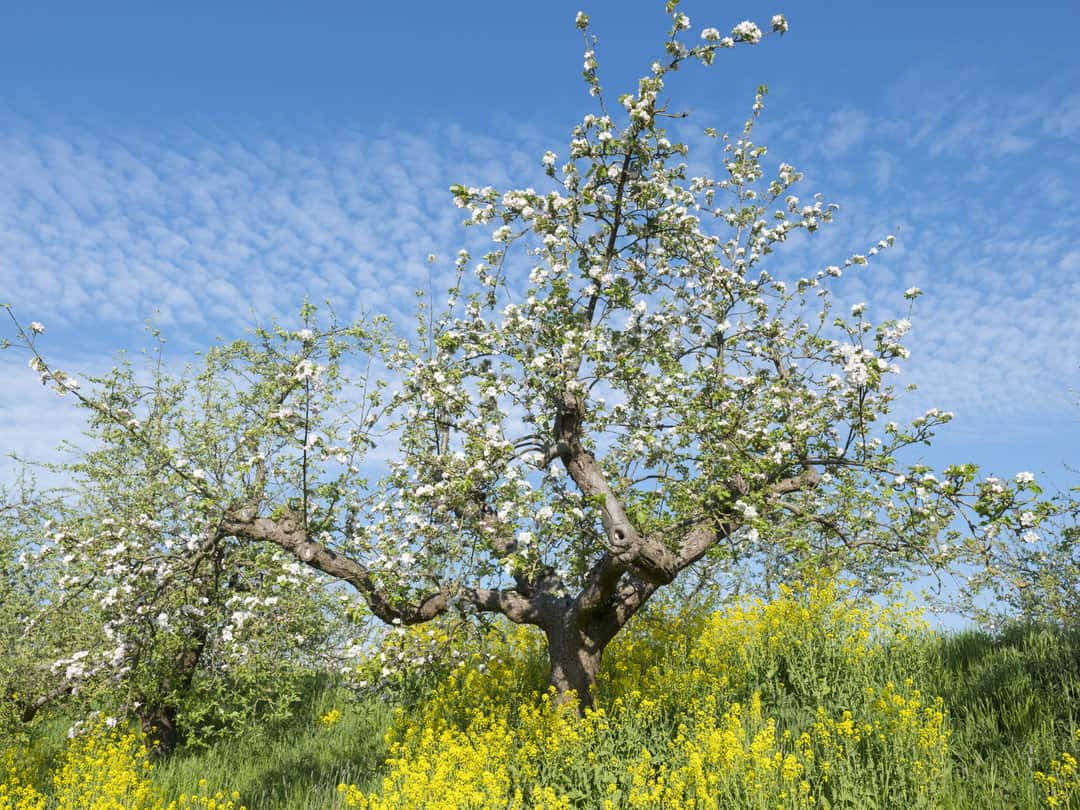
blossoming apple trees and yellow spring flowers under blue sky

Giving your apple tree some “companions” can have some excellent benefits like increased production, weed prevention, and pest deterrents.  

Many gardeners will purposefully plant-specific things that are beneficial to each other as a whole. They are called companion plants. 

A companion plant benefits its neighbors in the following ways: 

  • Improves soil 
  • Amends growing conditions 
  • Attracts pollinators 
  • Repels pests 
  • Stifles the spread of weeds 

This companionship is a great little biological function called symbiosis at work here, and this is when two or more organisms mutually benefit each other as they live nearby. 

In horticulture, gardeners use the term “guild” to describe the network of plants they’ve planted to achieve a goal. This could be anything from increased fruit yields to attractive ground cover.  

When you plant a “guild”, you need to be sure that they all work together in symbiosis to create as healthy of an environment as possible. 

This is especially important for fruit trees or vegetable plants as their purpose is to produce large, healthy crops for you to eat. Planting the wrong things could keep your plants from producing to their fullest potential. 

If you want to get a good start with your companion plants, consider getting a high quality set of tools, such as this ENGiDOT Heavy Duty Garden Tool Set!

Luckily, the rest of this article will detail the best plants for you to plant underneath your apple trees that will make them as healthy and as fruitful as possible! 

Can I Just Plant Grass Under My Apple Tree? 

If you want to keep your yard looking minimal and only surround your apple tree with grass, this is okay too but isn’t considered very beneficial unless the tree is young. 

When the tree is immature, its roots are shallower. This means the battle for nutrients will be much harder because it’ll be shared among all the grass. The deeper and older the tree roots grow, the easier it’ll be for it to get nourishment.

For that reason, you should wait to plant grass near an apple tree until it has matured, around 5 years. 

You may dislike grass, however, because it can become patchy or dry and riddled with weeds like dandelions, which are the bane of many a homeowner’s existence. 

Oddly, dandelions have become so unpopular over the years though because dandelions are some of the absolute best plants to have around your garden. 

If you’re up to it, let the dandelions grow freely in your yard and you’ll get their array of benefits. They’re the first companion plant I’d suggest for your apple trees, but it isn’t a part of the official list because it’s so unpopular. 

So, if you want to keep a simple aesthetic and just surround your apple tree with grass, wait until the tree has matured before you grow grass close to it. This way the tree won’t have to battle for resources with another plant. 

How To Build A “Guild” Of Plants Around Your Apple Tree
Spring background. Sunny meadow blurred background with wildflowers, grasses and green fresh grass.

Before you choose what to plant underneath your matured apple tree, it’s important to know exactly what to do with them to make them the best possible companions. 

When you build a “guild” of plants around trees, make sure to water them regularly for one year to establish their roots and keep them from taking away moisture from the tree in the process. 

If you’re using mulch, do not put too much. Many people have ruined their trees by piling mulch around their bases (you can view our article on how to properly mulch the base of a tree here.)

A little mulch is fine. It regulates soil temperature and maintains moisture. It looks good. But too much mulch is fatal. It can hide issues that appear on the base of the tree, it can retain too much moisture, and it can suffocate the roots.

With that in mind, use mulch with care. You can tell if you’ve over-mulched your tree if the leaves are abnormally small or oddly colored or if the twigs or branches have seen their better days.

The last thing you should remember when you’re growing a “guild”, don’t forget to research!

You want to be very careful in choosing the right plant before planting it near a fruit tree as it could have devastating consequences and prevent the tree from growing. I’ve listed what not to plant under an apple tree at the end of this piece if you fancy a look!

For now, start with WHAT you should grow underneath your apple tree!

What To Plant Under Your Apple Tree

Now, onto the good stuff!

These are the best plants to plant underneath your apple tree that will complement and benefit both the tree and the entire yard.

Chives

Gardeners love chives not just because they’re tasty but because they’re beautiful and awesome companion plants, too!

Because of their high sulfur content, chives are great for preventing mildew. All you have to do is boil chopped chives in water, let it cool, and spray it on leaves.

They also prevent soil erosion. Chives have super dense roots that help your soil stay in place, so they can be a huge factor in preventing erosion in your yard.

For apple trees specifically, chives are extraordinary partners.

Their flowers attract bees and wasps that feed on a variety of apple-loving pests who come near the tree.

And, of course, chives are smelly. Their strong odor (in high volume) can ward off pests like deer, rabbits, and beetles.

Most importantly, a chive’s strong odor deters aphids. These are the most common pests that invade orchards and they cause a lot of damage to fruit trees.

Aphids are the thorns in many tree lovers’ sides because they suck out the juices from leaves, turning them into yellow, moldy, and twisted shells.

If the apple tree isn’t mature, aphids can completely stop growth development and kill them. Fortunately, they rarely take down mature trees. 

Aphids are known for loving fruit trees. They particularly have a taste for apple trees, so you may want to research some pest prevention tips as well!

The last reason why chives make such good neighbors to apple trees is that they prevent apple scab. 

Apple scab is a severe issue that attacks every type of apple tree and can have devastating effects. It destroys leaves and can leave the tree bare, sometimes totally.

It also greatly reduces fruit production and it can make the fruit crack, fall, and look misshapen or diseased with olive-green spots.

Although it’s not detrimental, apple scab can render your tree so weak that it can easily be affected by other common issues.

If you are looking to start chives on a budget, you should try starting from seed. Brands such as Gaea’s Blessing Chive Seeds offer you some great ways to get a start on growing!

If you’re considering chives, keep in mind that they spread fast, so they’ll take over your garden bed quickly if you don’t keep them in check. Use their clippings as mulch.

Comfrey

Purple Comfrey Flowers

Comfrey plants are beautiful additions to yards and are great for every plant around them, especially apple trees.

They’re considered one of the best partners for apple trees because of their numerous benefits. 

For one, they’re expert weed preventers. When planted in a line, they act as barriers and keep weeds from spreading into their “circle”. 

Be careful with the comfrey plant! They are like weeds in that they grow like wildfire. Every offshoot can grow into a separate plant and it is very hard to get rid of once fully established. Do not rototill it!

Despite their aggressive growth, gardeners love them! Besides weed prevention, comfrey plants provide essential nutrients to the soil that apple trees (and many other plants) need including phosphorus and potassium. 

They also prevent pests and draw in pollinators and insects that eat the pests that manage to get close.

Some gardeners have even reported fewer deer in areas with comfrey present! There’s no question why they’re highly recommended by horticulturalists.

Lavender

Apple trees love lavender plants because they keep codling moths at bay. They have a confusing scent to insects, so they’ll drive away more than just these moths.

Lavender will ward off rodents, fleas, ticks, and other moth species. They draw in beneficial insects like butterflies, too.

The deterring of the codling moth, though, is the most important thing about lavender because they are very damaging to apples and will render them inedible.

Female moths will lay upwards of a hundred eggs on young, small apples and the larvae feed on them, eventually burrowing into the fruit.

You can tell you have a codling moth infestation if your apples have brownish-red spots on the surface or tunnels inside.

Once it reaches this point, only pesticides or traps will get rid of them.

Luckily, though, planting lavender around the tree may very well keep the moth invasion from ever occurring! Just make sure it’s not too close to the base of the tree because lavender needs full sun to flourish.

As a bonus, lavender attracts all sorts of good insects to your yard like bees and butterflies. 

Wildflowers

The list goes on and on for the reasons why wildflowers are good for not just your apple tree, but your entire yard.  

First, just like lavender, they attract the best insects for your local ecosystem—particularly pollinators.

A common wildflower species named milkweed is the only type of flower that a monarch caterpillar will eat before metamorphosizing. It’s not just beautiful, it’s vital.

As for your apple tree, adding wildflowers as a companion means a significant improvement in soil quality.

The U.S. Department of Agriculture suggests adding native wildflowers to your local ecosystem to boost soil health, improve water quality, prevent erosion, and increase food production.

This is great news for your apple tree. Adding wildflowers will not only bring colors and vibrancy to your yard, but it’ll also help the tree grow as tall and as fruitful as possible.

You’ll be doing your local ecosystem a favor, too. What’s better than that?

Chamomile

Chamomille flowers grow at wild summer meadow

Typically we think of sleepy time tea when we hear the word chamomile. It’s also a pretty, dainty little flower that pairs well with apple trees for multiple reasons.

Like other plants on this list, chamomile is a great companion for fruit trees because it attracts pollinators when blooming. Any time we can support these vital animals in their quest to spread pollen is beneficial to the entire ecosystem.

Some of the other insects that chamomile can attract are hoverflies and ladybugs, which will eat harmful pests like aphids.

Besides that, it’s really easy to grow. It only needs a partial shade, so it’s perfect along the east side of the trees so it can get the morning sun.

Perhaps the most impactful benefit of chamomile is its effect on soil. Research published in Frontiers in Microbiology found that chamomile balanced the levels of nitrogen in the soil by producing the good bacteria that store it.

And nitrogen-rich soil is a must for apple trees.

Clemson University noted that fruit trees need nitrogen to produce amino acids and proteins, both of which are necessary for healthy fruit yields.

This means chamomile is an excellent choice as your apple tree’s companion. It’s probably one of the best options out there.

Nasturtium

Nasturtium is commonly used as a ground cover because of its full horizontal growth and richly colored red flowers.

Pollinators are obsessed with it because it’s rich in sucrose. You can eat the flowers to taste for yourself, too!

And it doesn’t just attract pollinators. Nasturtiums draw aphids away from other plants and survive their pestering. They’re really tough and can take on these pests better than your apple tree would.

Best of all, this plant is easy to grow and its roots are shallow, too, meaning it won’t be competing with your apple tree for nutrients.

As a ground cover plant, the shallow roots of the nasturtium prevent soil erosion and its abundance of shade reduces evaporation, benefiting the entire soil system around it.

Berry Bushes

Planting a berry bush under your apple tree will not only produce more fruit for you, but it’ll also benefit the tree directly.

Just like chamomile, berry bushes increase the nitrogen levels in the soil.

Berry bushes are nitrogen-fixing, meaning they transport the nitrogen in the air into the soil to be used by every plant around it. As you know, this is essential for proper fruit production.

Most berry bushes are also great for deterring grazers.

Animals like deer and raccoons love apples, as you know, so putting up any kind of barrier is a great way to keep them away. Berry bushes are excellent barriers because of their thick brambles. This keeps most grazers at bay. 

The only type of berry bush that doesn’t produce brambles are strawberry bushes. They grow horizontally as ground cover, so they reduce evaporation and promote a proper soil ecosystem just like other ground cover plants.

These plants are also beneficial when they are ground up and left as mulch for the tree. The residual nutrients get absorbed through the tree’s roots and increase its production and growth.

What Shouldn’t I Plant Under My Apple Tree?

There are a few plants you should avoid planting near your apple tree because they attract the wrong kind of insects, they steal essential nutrients, and they don’t survive the shaded areas under the tree. 

Here’s a list of anti-companions for apple trees: 

  • Mint 
  • Carrots 
  • Potatoes 
  • Eggplant 
  • Conifers 
  • Tomatoes 

Now let’s get into the plants your apple trees will love! 

Wrapping Up!

So, the best plants to plant under an apple tree are: 

  • Chives 
  • Comfreys 
  • Wildflowers 
  • Chamomile 
  • Nasturtiums 
  • Berry bushes 

These companions are sure to help your apple tree produce the biggest and the healthiest yields every year. 

Happy planting! 

References 

Benjamin, Jocelyn. “Wildflowers Benefit Agricultural Operations, Ecosystems.” Natural Resources Conservation Service, United States Department of Agriculture, 1 May 2017. 

Layne, Desmond. “The Importance of Nitrogen.” College of Agriculture, Forestry, and Life Sciences, Clemson University, North Carolina, Mar. 2006. 

Schmidt, Ruth, et al. “Effects of Bacterial Inoculants on the Indigenous Microbiome and Secondary Metabolites of Chamomile Plants.” Frontiers in Microbiology, vol. 5, Feb. 2014. 

Schrader, Tom. “Aphids on Apple Trees.” Agriculture and Natural Resources, University of California, 20 June 2021. 

Sycamore trees are known for their fast growth, massive height, and huge leaves. This stately giant stands out all on its own, but a little landscaping beneath can make this tree the centerpiece of your yard!

The best plants to plant under your sycamore tree will be those that are both shade- and drought tolerant to some degree. Some of the best plants include jasmine, barrenwort, azalea, ferns, brunnera, Solomon’s seal, hellebores, and meadow rue.

Below, we’ll go over the BEST plants to plant under your sycamore tree. We’ll also give you some growing tips so you can be sure your plants will thrive beneath your sycamore tree.

Can You Grow Plants Under Your Sycamore Tree?

Before we get started, let’s answer one important question: is it even possible to grow something beneath your sycamore tree?

These giants are likely to throw a lot of shade and they prefer to grow in moist, organically rich soil. And such a large tree is going to use a lot of nutrients. Will there be any left for your smaller landscape plants?

Yes! It’s possible to grow plants under your sycamore tree. Your options will be slightly limited due to the growing conditions, but there is still plenty of variety to choose from.

However, you won’t be able to just choose any shade plant and throw it under your sycamore tree with fingers crossed. Careful selection is key, and we’ll be here to help you along the way!

How To Grow Plants Under Your Sycamore Tree

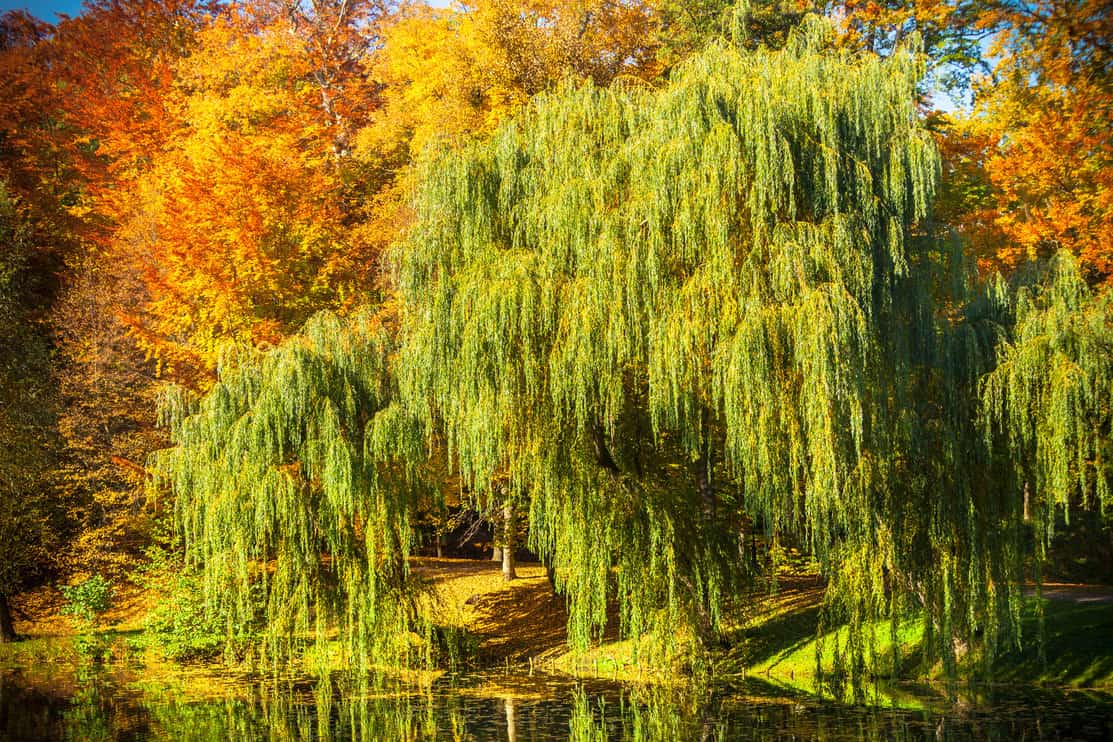
An old giant sycamore tree in a public park near Dresden.

If you want to grow plants under your sycamore tree, you’re going to run into a few challenges associated with the conditions beneath the tree.

Shade is one thing, but you should also take into consideration the soil conditionsmoisture level, and nutrient requirements before choosing a plant to put under your sycamore tree.

Choose The Right Location For Your Plants

Landscaping beneath sycamore trees isn’t as easy as landscaping beneath some of the smaller variety of trees.

There’s a lot of space under your sycamore tree! According to the University of Kentucky, American sycamore trees typically reach 70 to 100 feet in height with a spread of around 70 feet.

And it doesn’t take sycamores long to become large specimens. Under the right conditions, sycamores can reach 10 feet after their first year of growth.

So, where to put your landscape plants?

In general, landscaping beneath a tree occurs in a circle around the trunk. Sycamore trunks can grow very large in diameter. If your sycamore is young, be sure to place your plants far enough away that the trunk has room to grow.

Another issue with location is the amount of sun that gets through the canopy. Depending on the shade tolerance of your chosen plants, you may want to place them in a location that receives more or less sun.

If you ever need to OR are thinking about it, take a look at our guide on the reasons to cut down your sycamore tree here!

Choose A Plant With Similar Requirements

Sycamore trees may prefer moist organic soils, but we can’t always get what we want, right? Depending on where you live, your sycamore may be planted in sand, clay, loam, or who knows what!

Sycamores are tolerant of a variety of soil conditions. 

In fact, according to an article in the Journal of Forests, sycamores are one of the first trees to reestablish disturbed soils such as reclaimed coal mines. Even in these poor conditions, sycamores grow fast!

So, it shouldn’t come as a surprise if your sycamore is growing in less-than-ideal conditions.

Wherever your sycamore is growing, it’s best to get an understanding of what type of soil it’s growing in so you can choose a good companion plant to place beneath it. If you’re not sure, go for a plant that can tolerate a variety of conditions just like your sycamore.

Another requirement you’ll want to pay attention to is the hardiness of your chosen plant. Sycamores are hardy to zone 4.

There are only a few places in the US where sycamores can’t grow such as the northern regions of Montana, North Dakota, Minnesota, and Wisconsin, as well as the extreme northeast. The plant under your sycamore will need to be able to survive in whatever hardiness zone your sycamore is in.

Give Your Plants Enough Water And Nutrients

Sycamore trees require a lot of water to keep their foliage green, their branches growing, and the roots stable. 

Planting something beneath your sycamore tree means that it now has to compete with those plants for water and nutrients

Typically, when sycamore trees are mature they do not require watering and can get enough water from natural rain and what’s available in the water table. However, your landscape plants may struggle to find enough water and nutrients to thrive.

The good news is that this can easily be combatted by watering your newly planted landscape plants and providing them with fertilizer when necessary.

Watch for signs of water stress for both your chosen plants and your sycamore tree. For sycamores, yellowing leaves indicate a lack of water, which means your plants probably aren’t getting enough water either.

It is important that you choose the right plants to go under your sycamore however, as some can impede its growth or even cause damage.

In addition to water and nutrients, some plants also have specific pH requirements. Normally, trees like acidic soil for a few reasons, so you may want to look for plants with similar pH needs.

Don’t worry, we’ll go over the specific requirements of each plant below so you can be sure they’ll thrive beneath your stately giant sycamore tree.

The Best Plants To Plant Under Your Sycamore Tree

When it comes to planting under your sycamore tree, you’ll want a plant that requires minimal water and nutrients and doesn’t mind a bit of dappled shade.

You have plenty of plants to choose from, all with differing flowers, bloom times, and care requirements so you can find a plant that fits your specific situation.

Star Jasmine

Star jasmine, also known as Confederate jasmine, is well-known for having fragrant, star-shaped flowers. Despite the name, star jasmine is not a true jasmine plant.

These evergreens are considered vines and can be grown in two different ways:

  • As groundcover
  • As a vine

According to Clemson University, when grown as a vine, this beauty can reach up to 20 feet. As a groundcover plant, it will only reach 1 or 2 feet in height but will have a spread of up to 5 feet.

You can get creative with star jasmine if you want to grow it as a vine beneath your sycamore tree. Otherwise, it makes a great groundcover plant to help control weeds. Just be aware it is a fast grower and will need pruning if you want to keep it small.

Star jasmine is hardy only to zone 8, so this is a better companion plant for sycamores if you live in warmer climates.

Sun: The more sun star jasmine gets, the more flowers it will produce. However, star jasmine can grow in partial shade as well.

Water: Star jasmine is drought-tolerant but prefers to be watered once a week. This may need to increase if there is a drought or the weather is extremely hot.

Blooming: Star jasmine will bloom in early spring and summer.

Soil: Well-drained soils are best for star jasmine. Otherwise, they aren’t picky.

Barrenwort

Small flowers of epimedium sagittatum, barrenwort, bishop's hat, fairy wings or horny goat weed close up. Traditional chinese herb epimedium with yellow and white flowers

This easy-to-care-for perennial shrub is a great choice to plant under your sycamore tree. It’s deer resistant, non-invasive, and requires little maintenance. What’s not to love?!

Barrenwort thrives in hardiness zones 4 through 8, similar to sycamore trees. They can tolerate a variety of soil conditions. According to Cornell University, they can easily be planted where moisture competition is high, such as beneath a sycamore tree.

Depending on the variety, barrenwort will produce pink, purple, white, or yellow flowers. They only grow to 1-2 feet with a similar spread. 

Barrenwort is a good choice if you want a smaller plant that won’t take over the entire space under your sycamore tree.

Sun: part to full shade.

Water: Water your barrenwort when the soil becomes dry.

Blooming: You can expect your barrenwort to flower in mid-spring

Soil: Barrenwort prefers well-drained soil with organic material. If you don’t feel your soil has enough organic material, consider adding something like Eden’s Best 100% Organic Earthworm Castings to the soil. 

The good thing about sycamore trees is that they shed their giant leaves in the fall, providing the soil with plenty of organic material. However, if you rake your leaves and do not allow them to decompose, you’ll want to use a soil amendment like the worm castings listed above.

Dwarf Azalea

Another fragrant flowering plant, dwarf azaleas are the mini version of full-grown azaleas. They are sometimes referred to as coastal azaleas as well.

Dwarf azaleas reach a height of around 3 feet and are hardy from zones 3 through 9. The large, showy flowers of dwarf azalea come in many different colors depending on the variety. These flowers also attract bees, hummingbirds, and butterflies.

Like sycamore trees, dwarf azaleas can tolerate various soil conditions and don’t mind being a little wet or a little dry. However, they do prefer acidic soils.

Sycamore trees can survive in acidic, alkaline, or neutral PH. If your azalea doesn’t seem to be blooming, it may be because the soil to too alkaline. Consider adding an acidic fertilizer such as Down To Earth’s All Natural Acid Mix Fertilizer.

This will help your azaleas thrive and won’t harm your sycamore tree.

Sun: Full sun to partial shade. Try to place your azaleas in an area under your sycamore that gets at least 2 hours of direct sun.

Water: Best practice is to water your dwarf azaleas about once a week unless your area has received heavy rainfall.

Blooming: spring or summer depending on the variety.

Soil: As previously mentioned, dwarf azaleas can tolerate various soil conditions but require acidic soil to bloom well.

Christmas Fern

Christmas ferns may not have showy, colorful flowers, but they provide you with evergreen foliage year-round.

This low-maintenance fern grows to a maximum of 1 ½ feet, making it a good choice if you want a smaller plant beneath your sycamore tree. Christmas ferns can grow in hardiness zones 3 through 9.

During the winter, don’t be surprised if the leaves of your fern appear droopy. According to a thesis paper from Appalachian State University, this is the plant’s way of surviving the winter so it can continue to photosynthesize on warm winter days.

Sun: They are happiest when grown in part to full shade, but will tolerate sun

Water: Water your Christmas fern once a week unless your area receives a heavy downpour.

Blooming: Christmas fern flowers are inconspicuous, so don’t expect a big show in the spring. These tiny flowers will bloom in late spring.

Soil: Like Barrenwort, Christmas ferns prefer soil that is high in organic material. Consider saving some of the fallen leaves of your sycamore tree, shredding them, and placing them around your Christmas fern for an organic (and free!) fertilizer.

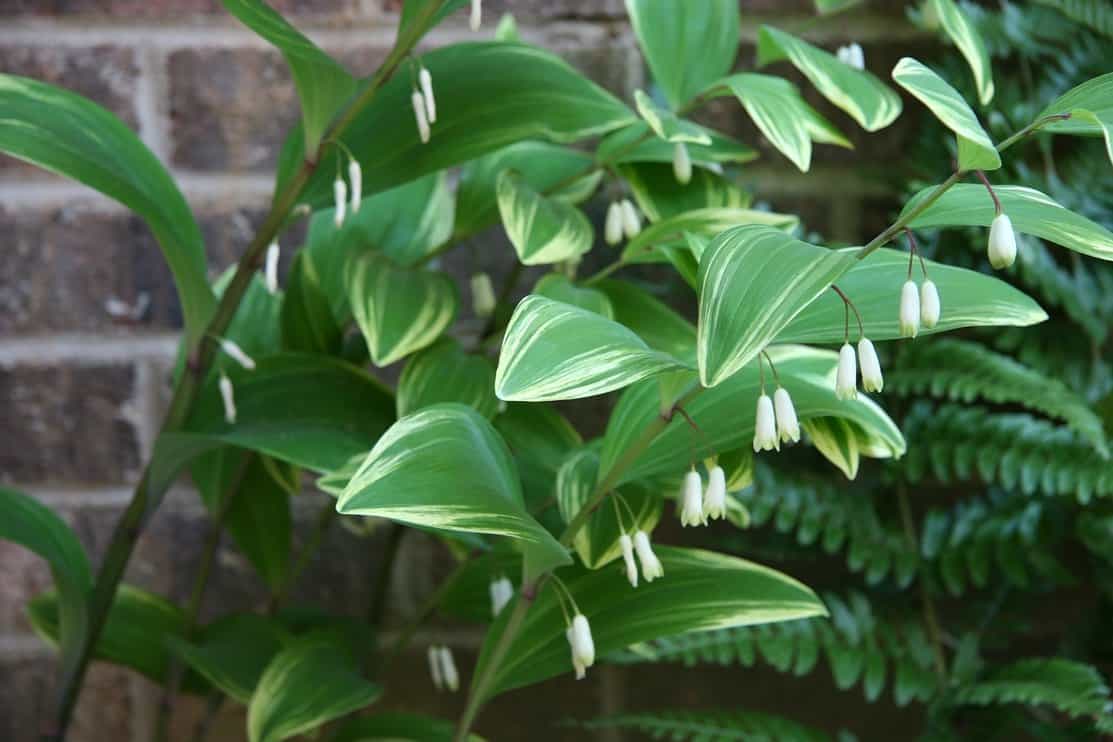
Solomon’s Seal

Close up of blooming plant solomons seal Poligonatum in spring sunny garden. Green grass in the meadow, spring texture background

Solomon’s seal refers to a large group of around 60 species of perennial flowers. They are part of the lily family. Only a few of the species are grown as ornamentals, the rest grow in the wild.

As an ornamental, Solomon’s seal produces green or cream-colored flowers. Depending on the variety, the flowers may droop or be egg-shaped.

According to the University of Wisconsin-Madison, Solomon’s Seal will thrive in challenging areas such as near tree roots or dry, shady areas. This makes them PERFECT for planting under your sycamore tree.

Solomon’s seal grows in hardiness zones 3 through 9. Depending on the variety, they may grow up to 7 feet tall or be as small as just 8 inches, so make sure you grab a variety that fits your intended plant height.

You can grow Solomon’s seal from seed, but it is easier to buy them in pots from a garden center. These pair great with ferns, so try planting Solomon’s Seal next to your Christmas fern!

Sun: Partial to full shade.

Water: Keep the soil of your Solomon’s seal moist but not soggy.

Blooming: Solomon’s seal is more often grown for its attractive foliage, but you can expect the small drooping flowers to show up in the spring.

Soil: Well-drained soils. This is another plant you can use the fallen leaves of your sycamore to fertilize to provide extra organic material.

Brunnera

Also known as false forget-me-nots, brunneras have attractive foliage and small, dainty blue flowers. The leaves range in color depending on the variety but can be green, gray, silver, or white.

These perennial plants are considered mounding and will typically reach a height of only 1 to 2 feet. As they grow, they will become ground cover plants but do not grow very fast.

Brunnera will grow in hardiness zones 3 through 8. It is low maintenance and requires almost nothing except a drink or two when conditions are dry.

Brunneras are a good choice if you want to plant a variety of flowers under your sycamore tree. They pair well with ferns and other shade-tolerant flowers that will explode with color in the spring. 

They’re also a great choice for someone whose thumb isn’t so green. Brunnera is probably the easiest plant on our list to take care of.

Sun: partial shade

Water: Water only during dry conditions. Otherwise, natural rainwater will suffice. If you use a mulching material, watering is seldom necessary.

Blooming: Brunnera will bloom mid-spring. They produce a large amount of small, pale-blue flowers that last for about a month.

Soil: Brunnera prefers well-draining soil, but can grow in clay soils as well. Adding shredded sycamore leaves to the soil will improve the soil’s organic content, making your brunnera plant very happy.

Hellebore

If you’re looking for something that adds a splash of color early in the season, go for the hellebore plant! They are the earliest bloomers on our list and present a wide variety of spectacular colors.

Hellebores are evergreen perennials. Their hardiness depends on the variety, but most can survive to hardiness zone 4 or 5. You can expect your hellebore to reach about 2 feet at maximum height.

This is another plant that boasts very fragrant flowers. The flowers can range from whites and yellows to pinks and purples. 

Hellebores do well when planted with other early-blooming perennials. But they can also be planted alone or with other hellebore plants.

Sun: Hellebore does best in partial shade.

Water: Once established, hellebores are semi-drought-tolerant. However, when first planting, be sure to provide enough water to keep the soil evenly moist.

Blooming: Later winter to early spring.

Soil: Hellebores aren’t too picky about the soil type as long as it is well-draining.

Meadow Rue

Blooming common rue or herb-of-grace (Ruta graveolens) with yellow flowers, aromatic herb and medicinal plant since ancient times, copy space, selected focus, very narrow depth of field

A member of the buttercup family, meadow rue is a perennial and has many variations within the species. 

Meadow rue has small white, yellow, or purple flowers. These subtle plants will not WOW you with their blooms. The attractiveness comes from the foliage, not the flowers.

Meadow rue is a slow-growing flower that can take a few years to establish and begin flowering if grown from seed. Alternatively, you can buy them as potted plants from a garden center.

These hardy plants can be grown to hardiness zone 5 and prefer dappled shade. The size of meadow rue varies with the species, but you can expect them to grow anywhere from 1 to 6 feet.

If you decide to grow the taller varieties, try to plant at least two plants together. This way, they can support each other in their growth as taller varieties usually require stakes otherwise.

Sun: partial shade or dappled shade.

Water: Keep the soil of your meadow rue moist but not soggy.

Blooming: When your meadow rue blooms will depend on the variety. They typically bloom in either spring or summer.

Soil: Moist, rich soil that retains water. Like many of our other plants, meadow rue will benefit from your fallen sycamore leaves as this will add organic material to the soil.

Final Thoughts

There’s something so refreshing about seeing spring flowers blooming under a huge sentinel like a sycamore tree. The contrasting colors can breathe life into your landscape, making your centerpiece sycamore even more attractive.

The plants under your sycamore tree should require little nutrients and water and be able to tolerate some shade. Sycamores themselves aren’t very picky about their growing conditions, which opens up a lot of options for planting under them.

To recap, the 8 best plants to plant under your sycamore tree include:

  • Star Jasmine
  • Barrenwort
  • Dwarf Azalea
  • Christmas Fern
  • Solomon’s Seal
  • Brunnera
  • Hellebore
  • Meadow Rue

These plants come in a variety of colors, shapes, and sizes, giving you plenty of options to fit your intended landscape theme. 

You can also try planting multiple types of flowers under your sycamore tree for a blast of color in the spring and summer.

If you have questions about other types of trees, shrubs, or flowers, you can find all the information you need here at Tree Journey!

References

Eisner, T., Carrel, J. E., Tassel, E. V., Hoebeke, E. R., & Eisner, M. (2002, April 09). Construction of a Defensive Trash Packet From Sycamore Leaf Trichomes By a Chrysopid Larva (Neuroptera: Chrysopidae). Proceedings of The Entomological Society of Washington104(2), 437-446.

Jennifer, O., Aguilos, M., Morkoc, S., Heitman, J., & King, J. S. (2021, December 20). Root Biomass Distribution and Soil Physical Properties of Short-Rotation Coppice American Sycamore (Platanus occidentalis L.) Grown at Different Planting Densities. Forests12(12), 1806.

Nielsen, D. C. (2017, August). Habitat Distribution and Frond Reorientation as Photoprotection and Drought-Avoidance Mechanisms in Christmas Fern (Polystichum Acrostichoides) In the Southern Appalachian Mountains [Thesis Paper]. Appalachian State University.

Sena, K., Agouridis, C., Miller, J., & Barton, C. (2018, December 18). Spoil Type Influences Soil Genesis and Forest Development on an Appalachian Surface Coal Mine Ten Years after Placement. Forests9(12), 780.

If ever there were a stately tree to dominate your yard, it is the mighty oak tree! These attractive trees provide shade, food for wildlife, and beautiful fall colors. If you would like to add some color to the space under your oak tree, there are a few plants you should make sure NOT to grow under your oak tree.

Plants that need full sun, high nutrient content in the soil, and lots of water won’t do well under an oak tree. Never grow english ivy, bee balm, hibiscus, chrysanthemum, peonies, marigolds, asparagus, pumpkin, squash, lisianthus, or butterfly bush under an oak tree as they will grow poorly.

Whether your oak tree is a massive statement piece or just getting started, we’ll go over the plants you can and can’t grow underneath an oak tree. Let’s get to it!

Why Is It Difficult To Grow Plants Under An Oak Tree?

Some trees produce plant toxins that can inhibit other nearby plants from growing. Other trees only grow in harsh conditions, preventing other plants from growing under them.

You won’t have these sinister problems with oak trees. However, depending on the species, oak trees will take up a lot of nutrients and water and they’ll cast a ton of shade.

In general, you don’t want to plant anything that requires the following conditions:

  • Full sun
  • High nutrient content
  • Ample water
  • pH sensitivity

Instead, opt for plants that are shade-tolerant, low-maintenance, and drought-tolerant. But don’t worry, we’ll get to those plants a little later in the article!

In addition to competing for sun, nutrients, and water, the plants under your oak tree should be able to thrive in a variety of pH conditions.

The reason is that oak trees contain the chemical tannin, which over time, can turn the soil slightly acidic. (you can read more about why acidic oil can be good for trees here.)

All in all, this takes a long time and shouldn’t be expected in new oak trees. However, if your oak tree is old, the soil may be more acidic than when it first started growing!

According to an article in the Journal of Plant and Soil, tannins were originally thought to deter herbivores from eating certain plants, but this take on tannins has recently been called into question. 

Instead, researchers now think tannins are used to protect the plants from possible afflictions. More specifically with fruits – from getting eaten before the seeds are ready for dispersal!

Nonetheless, over time, tannins can turn the soil’s pH acidic and contribute to the reduced productivity of surrounding plants.

Most oak trees prefer the soil to be slightly acidic, but if you find your soil is too acidic, you can always use something like Jobe’s Additive De-Acidifier Lime Soil to help bring the soil back to a more neutral pH.

On the other hand, if your soil appears to be too basic, you can add an acidifier like Jobe’s Organics Soil Additive Soil Acidifier.

Performing a simple soil test will help you identify the pH of your soil and some other important characteristics, such as the nutrient content and soil type.

Plants You Should Never Grow Beneath An Oak Tree

According to Michigan State University, there are around 600 different species of oak trees. That’s a LOT of variety! 

With this vast differentiation comes different preferences for soil, sun, and nutrient conditions. Some oak trees thrive in swampy conditions while others need dry, well-draining soil. Oak trees differ in their hardiness tolerance as well.

The point is, there’s no one-size-fits-all when it comes to oak trees. So, not every plant on our list is going to apply to your situation.

However, we tried to cover the most common oak tree species paired with some of the most common plants known to homeowners and gardeners alike.

As a quick side note, I highly recommend taking a look at our how to article on tips for watering your oak tree, especially if you have a garden!

English Ivy

Hedera helix plants flowering in wassenaar, netherlands.

As the name suggests, English ivy is an evergreen vine. These perennials are considered groundcover plants when they are young but will climb once they get established.

English ivy thrives in part shade, which is what you’ll find under your oak tree. BUT, the reason we put this plant on our list is that it will cause your oak tree a lot of problems.

If planted under your oak tree, this vine will take over FAST. It grows quickly and can creep up your oak tree’s bark, loosening it. According to the University of Maryland, English ivy can also promote leaf scorch, which is a bacterial affliction prevalent in oak trees.

If you really want to plant English Ivy under your oak tree, it will need constant pruning to ensure it doesn’t end up overtaking your tree. 

If it ends up getting out of control, you can read about what to do if you have vines on your oak tree here to help solve your problem!

Bee Balm

Red Bee Balm Close Up

Also known as bergamot or horsemint, bee balms are part of the mint family. These perennials produce pretty flowers from July through August.

But don’t let the pretty flowers lure you into planting these under your oak tree!

Bee balms prefer full sun and can become susceptible to powdery mildew if planted in part shade. They will also not flower as much if planted in the shade.

Bee balms are quite fond of water and need watering at least once a week. While competing for water resources with an oak tree, you would most likely have to increase the watering schedule.

While bee balms aren’t the WORST plant to plant under an oak tree, there are plenty of better choices out there.

Hibiscus

For those who live in warmer climates, hibiscus may seem like a staple in the landscape. It boasts huge, beautiful flowers that come in a variety of colors.

Sounds great, right? 

The problem with hibiscus is that it requires a lot of nutrients and it requires full sun to bloom properly.

According to the University of Minnesota, hibiscus are heavy feeders that require a complete fertilizer through the entire growing season to keep them in tip-top shape. Hibiscus also does best in full sun and may struggle to bloom if placed in shady areas.

Some hibiscus species will perform better than others under an oak tree. For example, hardy hibiscus will survive under an oak tree, but it won’t thrive. Tropical hibiscus will struggle even more under the magnificent shade of an oak tree.

Perennial Chrysanthemum

Pink chrysanthemum flowers in the garden close up

More commonly known as ‘mums,’ chrysanthemums are known for giving homeowners a blast of color in the fall, while everything else around them is slowing down and going dormant.

We put the added ‘perennial’ for a reason. Many homeowners will plant mums in the fall and treat them as annuals. They give off a blast of color for a few weeks and then they’re spent, not to bloom again next year.

Annual mums are totally fine to be planted under your oak tree. Mums are heavy feeders, but an established oak will not be affected by a plant that only lasts a few weeks. Despite preferring full sun, annual mums will do okay for one season in partial shade.

However, if planted in the spring in colder climates (or if you live in warmer climates), mums can be treated as perennials that will come back each year.

It’s these perennials you need to watch out for!

According to Clemson University, perennial mums are heavy feeders that will compete with your oak tree for nutrients. This can be especially damaging if your oak tree is young. Mums also require plenty of water, which can make them difficult to grow under an oak tree.

Besides their heavy nutrient and watering requirements, perennial mums will do poorly in the shade after their first year.

Peonies

Peonies boast huge flowers in the spring and summer that vary in color. The flowers are sometimes so big that they can topple over the stems.

These beautiful plants are perennials that will come back year after year, just not under your oak tree! 

Peonies are water and nutrient hogs. They don’t play well with other plants, especially trees that are likely to take up most of the nutrients and water they need to thrive.

Another challenge with planting peonies under an oak tree is the access to sunlight. Peonies are known for their amazing blooms, and if not given enough sun, the blooms will be lackluster.

Marigolds

Marigolds are annuals that are considered easy to grow. They come in a host of different colors and varieties and tolerate drought and extreme heat.

However, one thing marigolds can’t tolerate is shade. According to the University of Minnesota, marigolds require full sun to bloom properly. In fact, it’s recommended to keep them in the sun all day long.

Oak trees will cast too much shade for marigolds to thrive. They are unlikely to bloom as well and may contract powdery mildew if left in a location that’s too shady.

You can read more about that in our guide on why marigolds need full sun!

Asparagus

Most of the plants you want to put under your oak tree will be landscape flowers. Annuals, perennials, shrubs, that sort of thing.

This one is for the gardener who has an oak tree within the immediate vicinity. There are a few vegetables you may want to nix in your garden if you have an oak tree nearby, and asparagus is one of them.

Unlike some garden veggies, asparagus is a perennial that will keep coming back year after year. They require full sun – at least 8 hours according to the University of New Hampshire.

In addition to needing more sun than the space under an oak tree can provide, asparagus are also heavy feeders. They require a complete fertilizer worked into the soil before and during planting.

This makes them a poor candidate to plant under an oak tree. But there are still plenty of garden vegetables you can plant if you have an oak tree nearby. More on that later!

Pumpkins & Squash

Green Squash Growing In Garden

Pumpkins and squash are other vegetables that will not do well under an oak tree. These annual vines are sensitive to frost, so will do best in warmer climates or if planted late in the spring.

Pumpkins and squash require lots and lots of sun, making them a less-than-ideal plant to place under an oak tree. 

Another challenge is that pumpkins and squash require a lot of water to grow properly. According to the Maine Department of Education, pumpkins are 90% water! 

When competing with an oak tree for water, pumpkins and squash don’t stand a chance unless you take the time to water them thoroughly each day.

Lisianthus

Close-up of purple eustoma flowers on a flower bed on a summer sunny day against a background of dark earth.

Also known as Texas bluebell, this beautiful purple flower is becoming more and more popular with experienced gardeners and green thumbs alike.

Why experienced, you might ask? Well, this pretty flower is also a LOT of work to grow. Because of its demanding growing conditions, it’s not a great choice to plant under your oak tree.

Lisianthus can be even more difficult to grow under established oak trees because the soil may be acidic. According to the University of Arkansas, this can cause zinc toxicity in Lisianthus, which will stunt growth.

Despite its beautiful purple flowers, there are easier, less demanding flowers out there that you can plant under your oak tree.

Butterfly Bush

As the name suggests, butterfly bushes attract butterflies, bees, and hummingbirds. These colorful bushes produce attractive purple flowers from summer through fall.

Butterfly bush checks off almost all the necessary boxes to plant under an oak tree. They thrive in a variety of conditions, require minimal care, and are readily available at garden centers or nurseries.

The problem? These plants can GROW. And grow and grow and grow! They produce a ton of seeds each year and can quickly overtake the space under your oak tree.

Like English ivy, butterfly bush is not a good choice unless you are willing to have this plant spread.

One more barrier that prevents butterfly bush from being a good plant under your oak tree is its sun requirements. Butterfly bush does best in full sun if you want to see their beautiful flowers.

What Plants Can Live Under An Oak Tree?

We’ve gone over annuals, perennials, bushes, and even some vegetables that won’t perform well under an oak tree.

So, what can you plant under an oak tree?

For flowers and vines, try to stick with some of the below plants. They tolerate shade and require minimal care:

  • Brunnera
  • Fern (Try Christmas for cold climates and sword ferns for warm climates)
  • Barrenwort
  • Daffodils
  • Wild ginger
  • Periwinkle

For vegetables that work well under your oak tree, consider these low-maintenance, partial-shade-tolerant vegetables and herbs below:

  • Potatoes
  • Carrots
  • Lettuce
  • Beans
  • Garlic
  • Radishes

With proper care, these flowers, vegetables, and herbs will thrive under your oak tree. Always make sure your chosen plant can survive in your hardiness zone.

Ways To Help The Plants Under Your Oak Tree Thrive

Having an oak tree in your yard doesn’t mean you can’t plant something under it. There are plenty of things you can do to make sure the space under your oak tree looks stunning.

Below, we’ll cover some tips on what you can do to make the area under your oak tree more hospitable to some beautiful annuals, perennials, vines, and whatever else you have in mind!

Know Your Oak Tree

One of the first things you should do before planting anything under your oak tree is to identify what variety of oak tree you have.

While many oaks share the same characteristics, they differ from each other in a few, subtle ways, such as:

  • Soil type preference (Sand, clay, loam, etc.)
  • Moisture preference (swampy versus dry, upland soil)
  • pH preference
  • Root structure
  • Drought tolerance
  • Growth rate

If you can identify these characteristics, it will give you a better idea of the plants to pair with your oak tree.

Try to plant plants under your oak tree that need similar growing requirements for soil type, moisture, and pH preference. All plants planted under an oak tree should be somewhat drought tolerant.

Growth rate is another important feature of your oak tree that is good to know. If you want to landscape beneath a slow-growing oak tree, you’ll want to give it a few years to get established before even considering planting something.

Use Raised Beds

If you’re someone who has struggled to grow grass under your oak tree, you may be hesitant to even attempt flowers. 

The reason nothing grows under an oak tree is that the roots are so close to the surface. In general, most oak tree roots are within the top 6 to 8 inches of soil. 

Imagine you’re a little marigold trying to establish some roots and you run into a solid oak root! These roots make growing difficult for anything above them.

Because of an oak’s shallow roots, you can use raised beds to help give your chosen flowers some breathing room between their roots and the roots of your oak tree.

Be careful when constructing a raised bed, as you don’t want to smother the oak trunk in soil. You also don’t want to use fabrics or other materials to cover the space between your flowers and the natural soil. This can smother oak tree roots, which need to breathe.

Construct the raised bed far enough away from the oak trunk to give it space to grow, and place 1 to 2 inches of good quality soil in whatever shape or pattern you prefer. This should give your flowers enough space to flourish while preserving your oak tree.

Be Aware Of Your Oak Tree’s Needs

This section goes hand in hand with knowing your oak tree. But instead of focusing on what your oak tree prefers, we’re focusing on nutrients and water.

Oak trees that are just starting may benefit from having flowers planted around them, as the extra watering will help them grow. But for established oak trees, over-watering can stress the roots and even promote rot.

You can read more about why you shouldn’t water plants everyday here.

In terms of nutrients, planting a plant that is a heavy feeder that requires fertilizer could spell disaster for your oak tree.

A good NPK (nitrogen, phosphorous, potassium) ratio for oak trees is a 12-4-8 or 12-6-6 fertilizer. If you plant something that has other nutrient requirements, you could cause nutrient burn and harm your oak tree more than help.

Therefore, planting a low-maintenance, drought-tolerant, shade-tolerant plant will be your BEST bet under an oak tree.

That’s All For Now!

Having an oak tree in your yard is like having a piece of history close to home. These stately trees are long-lived and steeped in myth and lore.

While oak trees do just fine being exceptional on their own, adding a few low-maintenance flowers under your oak tree can add a splash of color in an otherwise barren area.

There are a few plants, vines, and vegetables that you want to stay away from when planting under an oak tree. Plants that are sun-loving, heavy feeders, or cannot tolerate drought are poor choices.

Now, for a quick recap!

The plants you should not grow under an oak tree include:

  • English Ivy
  • Bee Balm
  • Hibiscus
  • Perennial Chrysanthemum
  • Peonies
  • Marigolds
  • Asparagus
  • Pumpkins
  • Squash
  • Lisianthus
  • Butterfly Bush

Instead of these, opt for plants that thrive in partial to full shade, require little maintenance and care, and can withstand a little drought. 

Best of luck on your oak tree journey!

References

Davey, M. P., Berg, B., Emmett, B. A., & Rowland, P. (2007, March 27). Decomposition of oak leaf litter is related to initial litter Mn concentrations. Botany, 85(1), 16-24.

Demchik, M. C., & Sharpe, W. E. (2000, October 01). The effect of soil nutrition, soil acidity and drought on northern red oak (Quercus rubra L.) growth and nutrition on Pennsylvania sites with high and low red oak mortality. Forest Ecology and Management, 136(1-3), 199-207. https://www.sciencedirect.com/science/article/abs/pii/S0378112799003072

Kraus, T. E.C., Dahlgren, R. A., & Zasoski, R. J. (2003, September). Tannins in nutrient dynamics of forest ecosystems – a review. Plant and Soil, 256, 41-66.

Salminen, J.-P., Roslin, T., Karonen, M., Sinkkonen, J., Pihlaja, K., & Pulkkinen, P. (2004, September). Seasonal Variation in the Content of Hydrolyzable Tannins, Flavonoid Glycosides, and Proanthocyanidins in Oak Leaves. Journal of Chemical Ecology, 30, 1693-1711.

Spruce trees are stately evergreen trees that can be a cornerstone of your yard. However, it can be difficult to landscape beneath these towering giants. But not impossible! There are plenty of shrubs and flowers that can thrive in the dappled shade of your spruce tree.

The best plants to plant under your spruce tree should be non-invasive and tolerate both shade and acidic soils. These plants include hostas, Christmas ferns, rhododendrons, hydrangea, Virginia bluebell, bergenia, periwinkle, and Lily of the valley.

Below, we’ll go over the BEST plants to plant under your spruce tree. We’ll also go over some of the challenges you might face while landscaping beneath your spruce.

Can You Grow Plants Under Your Spruce Tree?

Depending on the species of your spruce tree, you may have a 30-foot evergreen in your yard or a 100-foot evergreen. Some are pyramidal while others are cone-shaped.

No matter what spruce tree species you have in your yard, you can count on a few challenges to face when planting below them:

  • Shade: Unless you have a dwarf variety such as the Dwarf Alberta spruce, your spruce tree is going to cast a lot of shade beneath it. This can be challenging for plants that need full sun. Instead, you’ll want to look for plants that can tolerate shade.
  • Nitrogen deficiency: Spruce trees require a lot of nitrogen to thrive. It’s the most important mineral for spruce trees. Look for a flowering plant that has minimal nutrient requirements, or at the very least fewer nitrogen requirements.
  • Acidic soil: According to a study in the Scandinavian Journal of Forest Research found that when compared to ash, beech, elm, hornbeam, and oak trees, spruce trees generate the most acidic soil. So, not only do you need a plant that tolerates shade, but you also need one that tolerates acidic soil!
  • Water availability: Spruce trees may be big, but they do not have deep roots. Instead, most spruce tree roots are just below the surface, sucking up all the water that your little landscape plant needs. Try looking for a drought-tolerant plant, or be ready to water your plants often.

Putting it all together, you need a plant that can tolerate shade, acidic soils, dry conditions, and requires minimal nutrients.

Do these plants exist?

Absolutely! There are tons of available plants that fit this bill. You won’t have as much of a variety to choose from as you would for a sunny site with good soil conditions, but you have choices.

How To Grow Plants Under Your Spruce Tree

We discussed some of the challenges you’ll face when choosing a plant for the space beneath your spruce tree. As we said, it’s not impossible! But it can be challenging.

One of the ways to make sure your plants thrive beneath your spruce tree is to give them extra care and to choose the right location.

Choose The Right Location For Your Plants

Spruce trees do not have a deep root system. Before you plant your beautiful hydrangeas or hostas, scope out where the surface roots of your spruce tree are.

When you dig a hole to place your plants, you don’t want to dig into your spruce tree’s roots. This is especially true if the spruce tree is on the younger side and still establishing itself.

Pick a space that is free of roots and can be easily dug into. If possible, remove any rocks from the soil as these can block your plant from establishing its roots. 

It doesn’t hurt to dig deeper than your plant requires and loosen the soil up a bit. This will help your new plant’s roots grow into the soil more easily.

Another way to make sure you’re choosing the correct site is to scope out the areas under your spruce tree that receives light. There are bound to be a few specks where sunlight seeps through the branches at certain times of the day.

Plant your landscape plants in these locations so that they can receive sunlight and can implement photosynthesis, which is what feeds a plant.

Give Your Plants Enough Nutrients

Granules fertilizer in hands of woman gardener. Spring work in garden, fertilizing plants, decorative, rose bushes

When you plant something next to or beneath another plant, those two plants are going to compete for water and nutrients.

A little fern plant doesn’t stand a chance against a full-grown spruce tree. Because of this, you’ll want to make sure your plants are getting enough nutrients.

Nitrogen is likely to be the most displaced nutrient under a spruce tree. You can solve this problem by using a complete fertilizer like Miracle-Gro Water Soluble All Purpose Plant Food

This product has an NPK ratio of 24-8-16 meaning 24% nitrogen, 8% phosphorous, and 16% potassium. These are the three nutrients that plants need the most. And with higher nitrogen content, your plants are sure to get what they need despite your spruce being a nitrogen hog.

Of course, this is a general fertilizer that isn’t specific to any one type of deficiency. If you want to narrow it down, get a soil test done to tell you exactly what nutrients your soil is missing, including both macro and micro-nutrients. This will also establish the PH of your soil.

Give Your Plants Enough Water

Once a spruce tree is established, it rarely needs water or fertilizer. You can pretty much just let your spruce do its spruce thing and it will thrive.

But if you decide to plant something beneath your spruce tree, the plant may need a little extra help since it is competing against your spruce tree for resources.

You’ll want to water your plants according to their specific watering needs. Remember, spruce trees have somewhat shallow roots and will suck all the water up before your plant does.

9 Best Plants To Plant Under Your Spruce Tree

Now that you know the best location, the best nutrients, and the best watering schedule your plant needs, let’s check out the actual plants that can live in this semi-challenging environment.

The plants on our list will have a few attributes that will make them thrive beneath your spruce tree:

  • Shade-tolerant
  • Non-invasive
  • Acid-tolerant
  • Resilient

We’ll go over each plant and some of the care requirements so you can be sure they will be happy growing in the shade of your spruce tree.

Hostas

Hostas underneath a spruce tree

We put hostas first on our list because these perennial plants can survive pretty much anything. They thrive in shade but can tolerate the sun, there are plenty of varieties, and they’re not picky about soil type.

You can buy hostas as potted plants from a garden center or purchase bare-root plants online. The leaves range in color from yellow and gold to green and bluish. They sprout pretty flowers in the summer that unfortunately do not last long.

According to the University of Minnesota, hostas will benefit from deep but infrequent watering. They need about 1 inch of water per week but should be left alone if heavy rains come through.

The biggest problem associated with hostas is deer browsing. Those cute white-tailed critters will chow down on hostas. Luckily, you can learn about how to use cayenne pepper to repel deer here.

Hostas thrive well in hardiness zones 3 through 9, allowing many homeowners the opportunity to grow these beautiful plants.

Water: Equivalent to 1 inch of rainwater per week. Hostas do not appreciate soggy soil (and neither will your spruce tree).

Sun: dappled shade

Flowering: Flowers in summer or early fall. Flowers last about three weeks.

If you have a larger spruce tree with hostas, you can take a look at our recommended best spruce tree fertilizers here!

Rhododendron

Rhododendrons are another perennial plant that will thrive beneath your spruce tree. They come in many varieties, some of which grow quite large, so make sure to get a variety that will fit beneath your spruce.

According to Clemson University, rhododendrons thrive beneath pines. The dropped needles provide rhododendrons with plenty of nutrients to keep them happy and healthy.

Rhododendrons grow best in slightly acidic soil that has good drainage. They’ll thrive in hardiness zones 4 through 8 and can be purchased in pots from a local garden center.

Because there are so many varieties of rhododendrons, it’s best to pick a variety that is somewhat native to your region. The plant will already be accustomed to the soil, weather, and temperature fluctuations.

Water: Rhododendrons should be watered so that the top 8 inches are moist. Allow the soil to dry before watering again.

Sun: Dappled shade

Flowering: Depending on the species and the environment, rhododendrons will bloom brilliantly colored flowers in spring or summer.

Periwinkle

Periwinkles are an excellent choice to plant beneath your spruce tree. They are considered a ground cover plant, meaning they will spread to cover the ground around them.

These evergreen plants can sprout colorful flowers of white, purple, or blue. The small periwinkle plants will reach a height of around 6 inches while larger varieties can reach up to 2 feet high.

Periwinkles prefer acidic soil and partial shade, but the more sun they get, the more flowers they produce. They’ll thrive in hardiness zones 4 through 8.

When these plants are first being established, you’ll need to weed the area around them. Once they are established, they’ll throw too much shade for weeds to grow. Bonus!

One thing you’ll want to watch out for with periwinkles is their ability to grow FAST. A single plant can cover an 8-foot area. They are not considered invasive, but they will certainly spread fast beneath your spruce tree.

Water: Once periwinkles are established, they are quite drought-tolerant and should do just fine with natural rainwater, even when it’s sparse. Water during droughts and when the plant is first getting established.

Sun: Periwinkles prefer partial shade, so they will do great beneath your spruce tree.

Flowering: You can expect periwinkle-colored flowers to bloom in April or May. Depending on the weather, they may bloom again in fall.

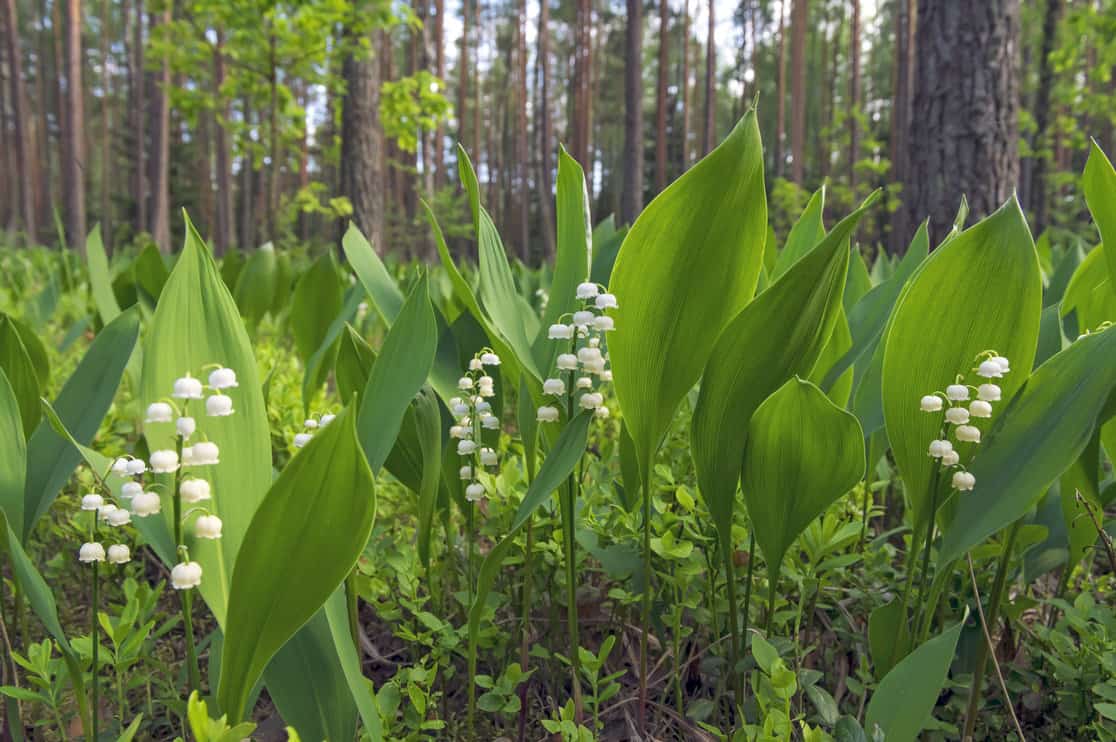
Lily Of The Valley

Flower Spring Sun White Green Background Horizontal. Lily of the valley. Sun rays fall on beautiful spring blooming flower. Ecological background Blooming lily of the valley on green grass background in the sunlight.

Lily of the Valley is a perennial plant that is, weirdly enough, related to asparagus. Its native origin isn’t certain, with some listing North America and others listing Europe and Asia.

Either way, it’s a great choice for a shade plant to place beneath your spruce tree. Lily of the Valley produces dainty white flowers and is considered a ground cover plant just like periwinkle.

Lily of the Valley thrives in hardiness zones 3 through 9. According to North Carolina State University, Lily of the Valley has few pests and is deer and rabbit resistant.

These pretty plants are also drought-tolerant and require little maintenance, making them perfect to place under your spruce tree.

Water: Water Lily of the Valley only when the soil is dry to the touch. Once established, they should not need additional watering unless there is a drought.

Sun: Dappled shade

Flowering: Lily of the Valley will bloom in late spring through summer.

Christmas Fern

Christmas ferns are evergreen plants that love the shade. They may not bloom pretty flowers like periwinkle or Lily of the Valley, but these little plants stay green all year, just like your spruce!

You can plant Christmas ferns with other flowers that are more colorful to give the landscape beneath your spruce some color in the spring and summer. 

If not, you can enjoy the dark green and shiny foliage of your Christmas fern all year long on its own.

Christmas ferns thrive down to hardiness zone 3 and will remain green through winter, although the snow can weigh down the fronds, giving your fern a sad appearance until the snow melts and the leaves bounce back up.

Highly adaptive, Christmas ferns can thrive in wet or dry soil, neutral or acidic PH, and require no pruning.

Water: Christmas ferns prefer the soil to be moist but not soggy. The fallen needles of your spruce tree will help retain moisture, keeping your fern happy.

Sun: Partial shade to full shade.

Flowering: According to the University of Maryland, Christmas ferns will bloom in late spring, but the flowers are inconspicuous and located at the tips of the leaves.

Hydrangea

Similar to rhododendrons, hydrangeas come in a variety of different cultivars to fit specific landscape needs. For example, mountain hydrangeas do great in shady conditions, but panicle hydrangeas thrive in full sun.

Make sure to get the correct variety to plant beneath your spruce tree. You’ll want one that does good in dappled shade, but you also need a hydrangea plant that won’t grow too tall.

You can expect hydrangeas to bloom beautiful big flowers in spring or summer, depending on the variety. Hydrangeas vary in their hardiness. Mountain hydrangeas thrive in hardiness zones 6 through 9.

One downside to hydrangeas is that they require pruning each year. The University of Illinois has a good explanation about telling the difference between hydrangeas that bloom on new wood versus old wood, and how/when to prune them.

Water: Hydrangeas require plenty of moisture. Be sure to water them once a week unless heavy rains occur. 

Sun: Mountain hydrangeas do well in partial shade such as beneath your spruce tree.

Flowering: Mountain hydrangeas will bloom from June through the first frost. Other hydrangea varieties may bloom in early spring.

Virginia Bluebell

Close up of a single bluebell flower (hyacinthoides non-scripta) in bloom

Virginia bluebells are perennial flowers that bloom bright and fast in mid-spring. They will go dormant in the summer, but make a great companion plant to hostas and ferns that can take over in the summer and fall.

Virginia Bluebells may be difficult to find at garden centers, but if you can grab one it’s worth it! These pretty flowers are tolerant of shade and do well with organically-rich soil, which is what you’ll find beneath your spruce tree.

These delicate plants thrive in hardiness zones 3 through 9. It is native to North America and produces trumpet-like flowers that are, as the name suggests, blue.

Water: Virginia bluebells prefer moist soil, so keep the soil wet in the spring. Once summer rolls around and the plant goes dormant, you can stop watering.

Sun: Partial to full shade.

Flowering: You can expect Virginia Bluebells to bloom in mid-spring.

Bergenia

Bergenia is a perennial, evergreen ground cover plant. Like many of the plants on our list, it will tolerate shade and does just fine in acidic soil.

These evergreen plants grow to about a foot in height and are considered slow-growing so you don’t have to worry about them taking over the space beneath your spruce tree.

Bergenia are drought-tolerant and require minimal nutrients and care. They are also resistant to disease and pests and thrive in hardiness zones 3 through 8.

According to Cornell University, the leaves of Bergenia will turn red and bronze in the fall, so even after the flowers have stopped blooming, you can still get some color out of this plant!

Water: Bergenias prefer moist soil. Similar to Virginia Bluebells, it’s best to keep the soil moist but not soggy.

Sun: Deep shade to full sun.

Flowering: Bergenias will bloom in the spring, typically from March through May.

Alternatives To Acid-Loving Shade Plants

If none of the plants on our list are particularly alluring, you have other options to plant beneath your spruce tree.

Instead of planting an acid-loving shade plant, consider planting ANY shade plant in a pot and burying it in the soil beneath your spruce tree.

Some of the easiest shade plants you can grow in a pot include:

  • Impatiens
  • Petunias
  • Pansies
  • Begonia
  • Lobelia
  • Sweet Alyssum
  • Fuchsia (consider hanging this one beneath your spruce tree!)

Simply plant your shade-loving flowers in a pot with soil that is more to their liking. In most cases, a typical potting soil like Wonder Soil Organic Potting Soil will do just fine and will provide a more neutral PH as opposed to the acidic soil likely to be beneath your spruce tree.

Next, create a hole beneath your spruce tree and place the entire pot into the hole. Bury any evidence of the pot and suddenly you have shade plants that can’t tolerate acid growing beneath your spruce tree! 

If any of your neighbors have a green thumb, don’t be surprised when they stop over to ask how you managed it!

Now, after all this you have a small blue spruce tree (or another smaller spruce) – you can take a look at our guide on how to keep a spruce tree small. However, I’m assuming you’ve got a decent sized tree if you want to put plants underneath!

Wrapping Up!

Having a spruce tree in your yard can add some color during the drab winter season. Its evergreen needles are sure to breathe life back into your yard after everything else has gone dormant.

So, while your spruce tree is doing its thing in the wintertime, what about the spring and summer? You’re sure to add some color and style to your spruce tree by planting something beneath it that will bloom in beautiful colors.

The plants below your spruce tree must be tolerant of both shade and acidic soil.

Now for a quick recap –

The 9 best plants to plant under your spruce tree include:

  • Hostas
  • Rhododendrons
  • Periwinkle
  • Lily of the Valley
  • Christmas Fern
  • Hydrangea
  • Virginia Bluebell
  • Bergenia

All of these plants thrive in shaded conditions and don’t mind acidic soil. Additionally, these plants require little care and won’t steal all your spruce tree’s nutrients and water.

Another option is to plant shade-tolerant plants in pots and bury the pots in the soil beneath your spruce tree. This way, you can have your favorite shade plants even if they can’t tolerate acidic soil.

If you have other questions about landscape trees, shrubs, and flowers, you can find the answer here at Tree Journey!

If you have a blue spruce tree, check out our simple tips and tricks getting it more blue!

References

Kochian, L. V., Pineros, M. A., Liu, J., & Magalhaes, J. V. (2015, January 15). Plant Adaptation to Acid Soils: The Molecular Basis for Crop Aluminum Resistance. Annual Review of Plant Biology66(23), 1-23.

Oostra, S., Majdi, H., & Olsson, M. (2007, February 18). Impact of tree species on soil carbon stocks and soil acidity in southern Sweden. Scandinavian Journal of Forest Research21(5), 364-371. https://www.tandfonline.com/doi/abs/10.1080/02827580600950172

Puhe, J. (2003, March 03). Growth and development of the root system of Norway spruce (Picea abies) in forest stand – a review. Forest Ecology and Management175(1-3), 253-273. https://www.sciencedirect.com/science/article/abs/pii/S0378112702001342

Zhang, J. Z., Shi, L., Shi, A. P., & Zhang, Q. X. (2004). Photosynthetic Responses of Four Hosta Cultivars to Shade Treatments. Photosynthetica42, 213-218. https://link.springer.com/article/10.1023/B:PHOT.0000040592.10133.ee

The space beneath the towering, majestic pine tree in your backyard is beckoning you to plant something beneath it. Let’s be honest, you would like to grow a plant there as well! Hold up — before you get started, you should know that there are some plants that you should NOT grow under a pine tree.

Pine trees grow best in acidic soil. They have shallow root systems and create a lot of shade. Because of this, many plants, including potatoes, carrots, lettuce, tomatoes, onions, cucumbers, broccoli, peas, zucchini, peppers, poppies, zinnias, cosmos, and roses, do not grow well under pine trees.

For your pine tree to thrive, some plants will have to go to the other end of the yard. Before we list some of the incompatible plants, let’s talk about the factors that cause the incompatibility: acidic soil, too much shade, and a shallow root system.

What Does It Mean When Trees Are Acidic Or Basic?

To understand what this means, we need to rewind to chemistry class. (Don’t worry — there’s not a test, and this concept doesn’t involve complicated calculations.) It all has to do with soil pH level.

The pH scale goes from 0 to 14. The middle of the scale, 7, is neutral. Pure water (with no other additives, minerals, or contaminants) is considered a 7 on the pH scale.

If a substance has a pH below 7, it is considered an “acid”. Some common examples are lemon juice (pH 2.3) and vinegar (pH 3.3). But even milk (pH 6.4-7.6) can be slightly acidic.

On the pH scale, basic does not mean boring. “Basic” means the substance had a pH above 7. Baking soda (pH 8.2) and ammonia (pH 11.0-11.5) are good examples of common bases.

This scale does not work in a linear fashion like a thermometer does. Every time you move down a unit on the scale, the pH is multiplied by 10. So a pH of 5 is ten times more acidic than a pH of 6.

Why does this matter in your garden? According to Cornell University, pH is a crucial part of plant longevity. Nutrients from the soil must be dissolved in water for plants to absorb them.

If the soil is too basic, water might not be able to dissolve the micronutrients that plants need to thrive. But if the soil is too acidic, it can dissolve too many nutrients.  

Yes, you can have too much of a good thing! Just like over-watering or dumping on too much fertilizer, the nutrient overdose from acidic soil is TOO MUCH for plants. 

If you’d like to learn more about pH, take a peak at our piece on what specific pH level trees like for growth!

Pine Trees Love Acidic Soil – But Don’t Make The Ground Acidic

You may have heard before that pine trees make the surrounding ground more acidic. According to the University of New Hampshire, this is a myth. Pine trees do not create acidic soil.

While it is true that pine needles themselves are acidic once they have fallen off the tree, they will not make your soil more acidic. As the needles decompose, they slowly become neutral. (They make good mulch if you’re looking to repurpose the gift your pine tree keeps bestowing upon your yard.)

A study published in Hort Technology showed that if a pine tree is used as a substrate (ground up into pieces to serve as a makeshift soil), it would still need additional fertilizer to be acidic enough to sustain plant life. 

This is a classic case of “correlation does not equal causation”. Pine trees don’t cause the soil to become acidic. They grow well where they do because the soil is already acidic.

How To Determine Your Soil pH Level

Before you plant ANYTHING underneath your pine tree, you need to check the soil pH. If your tree is already struggling to grow in alkaline soil, the last thing it needs is competition from other plants.

There are clues as to what your soil pH may be (like mixing the soil in vinegar or baking soda to see how it reacts), but these methods can be unreliable. You can only know your soil pH level for sure if you take the time to measure it

Measuring doesn’t have to be hard. Take a look at this Digital Soil Meter!

Instead of messing around with litmus paper, you just poke the probe into the soil you would like to test. It’s reusable and also has options to measure the temperature and water content as well. 

If you would rather not use a probe, litmus paper is an affordable, tried-and-true method of testing pH levels. This also works well when measuring the pH of something that you cannot probe. 

How Can I Change My Soil pH Level?

Every year, gardeners and farmers across the world modify their soil in an attempt to meet their plants’ needs.

Even though this is a common practice and often involves using natural substances like limestone and wood ashes, changing the pH of your soil is still a chemical reaction. Please ask a professional if you need help determining your soil pH. Your local garden center is an excellent resource!

Let me say it again. Do not attempt to use soil modifiers unless you have determined your soil pH. You can irreversibly damage your plants if you make an incorrect modification.

This can devastate large trees. Check the soil pH every time you add anything to the soil because it will change over time. 

If you have determined that your soil needs to be more acidic, there’s a relatively simple solution. According to Clemson University, the two most common ways to make your soil more acidic are to add either aluminum sulfate or sulfur.

A product like this Bonide Aluminum Sulfate instantly makes the soil more acidic because it does not need to convert into another substance.

Something like the Jobe’s Organics Soil Acidifier, on the other hand, needs time to turn soil acidic because it must convert into sulfuric acid. 

Remember that permanently changing the pH level of your soil is impossible. The conditions that existed before you added soil modifiers will continue to exist afterward. Gradually, the soil will revert to what is “normal” for your area. Only change the pH if you are prepared to add modifiers continually.

If you try to grow something next to your pine tree that has incompatible soil needs, either that plant or the pine tree will suffer. 

Maintaining acidic soil is of paramount importance to your pine tree’s longevity – but it’s not the only factor that determines what plants grow best beneath it!

If you’re in need of a fertilizer, or having problems with your pine, take a a look at our guide on why your pine tree isn’t growing here!

Why Plants Usually Don’t Grow Well Under Pine Trees

If it seems like pine trees are more likely to fall over in a windstorm, it’s not just your imagination. Pine trees have a dense network of shallow roots. This means that they are more likely to topple in a hurricane-force gust. This also makes it almost impossible for other plants to form a strong root foundation.

Even though they’re hidden underground, roots are essential for a healthy plant. Roots are how water and nutrients are absorbed. If a plant has unhealthy roots, it will not get the minerals it needs to survive.

If you’ve ever seen a large grove of pine trees with no other plants underneath, it’s possible the pine tree roots crowded out all other competition. Don’t let that happen in your garden.

One of the greatest adventures in landscaping is that no matter where you live, you can attempt to grow anything. However, your yard will be healthier if you work with Mother Nature rather than against her. 

Pine trees need acidic soil, produce lots of shade, and need space close to the surface for their roots. With that said, here are 23 plants NOT to plant beneath your pine tree.

By the way, if you’re a bit over your pine, check out our piece on the reasons you should cut your pine tree down!

What Not To Plant Under Your Pine Tree

Natural Pine Forest

Potatoes

Although they both prefer acidic soil, potatoes and pine trees are not friends. The pine tree’s network of roots runs along the surface of the soil.

This prevents potatoes from forming the dense, deep root system they require to form large spuds. Put the potatoes somewhere else.

Carrots

Carrots can handle the acidic soil that pine trees like, but they need more room than is available.

Similar to potatoes, carrots do most of their growing down rather than up. The roots of a pine tree will strangle and crowd out any carrots that try to grow. Plant your carrots somewhere with deeply tilled earth. 

Lettuce

Lettuce has a shallow root system, so you might be tempted to see if it will cooperate with a pine tree’s web of roots.

Before you plant a salad garden under your pine tree, remember that pine trees prefer soil that is far more acidic than what lettuce will tolerate. Lettuce also needs direct sunlight or the leaves will not form correctly.

Tomatoes

Tomatoes are not as picky about soil pH as other plants, but they need the sun for the fruit to ripen properly.

Unless you like yellow leaves and sickly, green tomatoes (assuming the plant is even healthy enough to produce fruit), skip this one.

Onions

Onions grow under the ground, forming the bulb that we eventually harvest and eat. Pine tree roots will crowd out your onions.

Grow your onions in a big garden space where they are free to grow big and round!

Corn

Similar to pine trees, corn plants have shallow roots. This makes it so that they can quickly absorb water.

All the water in the world won’t make up for the lack of sun under a pine tree, though. Corn needs bright, direct sunlight to produce large, juicy ears. 

Pumpkins 

Pumpkins need a massive area to spread their vines. Could the vacant space under your pine tree be a good match

Sadly, although pumpkins tolerate the acidic soil, this is the wrong place if you want large gourds for Halloween.

There is not nearly enough sunlight underneath the boughs of a pine tree.

Beans 

Beans come in many varieties, so you would think that at least one of them would tolerate the acidic soil that accompanies a healthy pine tree.

Unfortunately, beans need soil that is far more alkaline. They also need strong, direct sunlight. This would not be a good companion for your pine tree.

Cucumbers 

Cucumber vines thrive in acidic soil, so you would think that they would do well with a pine tree as a neighbor.

But like other vegetables, cucumbers need more than the heavily filtered sunlight that sporadically shines through the needles of your tree. 

Zucchini

Zucchini is a resilient vegetable that seemingly grows itself. It’s a wonderful plant for a first-time gardener.

However, pick a different spot than under the pine tree. Zucchini can tolerate a variety of soil pHs, but sunlight is non-negotiable

Peppers 

Peppers can handle acidic soil better than other vegetables, but it is not nearly sunny enough underneath a pine tree for them to do well.

Not to mention the competition your pepper plants’ roots will face! Find another spot in your yard.

Broccoli 

Unlike other vegetables, broccoli tolerates shade and cooler temperatures quite well. It’s just too good to be true, though!

The soil is too acidic underneath a pine tree for broccoli to thrive. 

Peas 

Peas are some of the earliest seeds to germinate and produce vegetables in the spring.

Could their cold-weather tolerance handle the cool shade of a pine tree? Unfortunately, they need more sun that is typically available under a pine tree.

On top of that, the soil that a pine tree likes best is far too acidic for peas. Try growing your peas somewhere else.

Poppies

Red poppies against the blue sky. Poppy in the field.

If vegetables don’t do well under a pine tree, perhaps flowers will perform better. It doesn’t look like we’re off to a great start, though.

Poppies find the soil to be far too acidic. For poppies to grow well, you would have to make the soil more alkaline.

This would hurt your pine tree.

Zinnias 

Zinnias come in various colors and not only tolerate but need acidic soil. Could this pop of color be the solution to your shady, barren landscape? Not quite.

Zinnias would struggle with the lack of sunlight under a pine tree.

If only the shade wasn’t so dense!

Cosmos

Cosmos is not only a Neil deGrasse Tyson documentary series about outer space — it’s a simple flower that will make your yard look out of this world!

But although cosmos flowers would get along perfectly with a pine tree in terms of acidity, it simply needs more sun to survive.

Firebush

Hummingbirds love the flowers on this vibrant red shrub. But this is regrettably not a good match for your conifer.

Don’t extinguish the firebush by dooming it to the shade. Save it for a sunny, alkaline portion of the yard.

Dianthus

Colorful Dianthus flower (Dianthus chinensis)  (Caryophyllaceae) blooming in garden at Thailand.

The most popular variety of this spunky flower is referred to simply as “Pink”. Don’t get your hopes up, though.

The shade from your pine tree is too much for the dianthus to handle.

Bright flower gardens will need to be located somewhere else!

Indian Hawthorn

This evergreen bush will stay green all winter, just like your pine tree! Unfortunately, that’s where the similarities end.

Indian hawthorn requires alkaline soil and will not do well when planted next to a pine tree. This plant really needs enough space to form a solid root ball. 

Roses

Roses are a romantic flower that can brighten up any garden! But this love story has a sad ending.

Although roses tolerate acidic soil just fine, it is too shady and there is not enough root space if it is planted under your pine tree.

Sunflowers

Sunflowers are hardy flowers that have a reputation for blooming where they are planted.

Look along the highways in late summer—the sunflowers you see lining the road were not planted by transportation department gardeners.

Birds spread the seeds, and the sunflowers took root in the poor soil along the shoulder!

Despite its resilience in the gravel along the sunny highway, however, sunflowers will wilt in the shade of your pine tree.

Daffodils

Some of the first flowers to appear in the spring, daffodils resemble a horn and metaphorically trumpet in the arrival of spring.

If you plant daffodil bulbs under your pine tree in the fall, however, they won’t sprout in the spring. The soil acidity is fine, but there’s not enough sunlight.

The snow in the shade of your tree will be among the last to melt, covering your daffodils and leaving them behind.

Tulips

Tulips are another spring bulb that is planted the preceding fall. Similar to daffodils, these bulbs will not end up sprouting.

The shade will cause issues with the ground warming up enough for the bulbs to germinate.

Also, tulips have different pH requirements than daffodils. The soil under a pine tree is far too acidic for tulips.

What PlantsWill Do Well Under A Pine Tree?

After reading about two dozen plants that won’t work with your favorite needled tree, you might be tempted to think that nothing can grow in the barren dirt underneath your tree.

However, now that you know what won’t work, think in terms of opposites to identify species that will do well. 

If you look at the coniferous rainforests of the Pacific Northwest, you will notice that other plants do, in fact, grow underneath the pine trees in that climate.

Some of the most noteworthy examples include wild huckleberries (for which the area is famous) and wild blueberries.

Once again: It is possible to grow plants under your pine tree. You just need to pick the right kinds.

Plants that tolerate shade, acidic soil, AND limited root space will not only survive but thrive under your pine tree. Steer clear of these 23 plants in the list above and your tree will be happy and healthy for years to come!

References

Ward, D. Shade is the most important factor limiting growth of a Woody Range Expander. PLOS ONE.

Wright, R., Jackson, B., Browder, J. F., &; Latimer, J. (1970, January 1). [PDF] growth of chrysanthemum in a pine tree substrate requires additional fertilizer: Semantic scholar. undefined.

Spruce trees are attractive ornamental trees that provide color year-round in our parks and yards. While they look just fine on their own, you may be considering planting under your spruce to make it pop with color in the spring and summer. Unfortunately, this is more difficult than it sounds!

Plants that require high nutrients, lots of sun and water, and neutral to alkaline soil PH will not do well under a spruce tree. Plants that should not be grown under a spruce tree include Black-eyed Susans, peonies, iris, sedum, daylilies, larkspur, lavender, hibiscus, mums, daisies, blanket flower, clematis, and lupines.

Whether you have a spruce tree already or are thinking of planting one in your landscape, we’ll go over all the plants you can and can’t grow under them.

Why Does Nothing Grow Under A Spruce Tree?

Spruce trees are typically pyramidal with branches containing needles instead of leaves and cones instead of fruit and flowers.

According to Oregon State University, there are around 40 species of spruce out there. With such variety comes different shapes, preferences, and tolerances.

One thing that all spruce trees seem to have in common is the fact that hardly anything grows beneath them! What gives?

There are a few reasons why many plants cannot grow under a spruce tree.

Spruces Cast Lots Of Shade

The space under a spruce tree is going to be shady due to the branches above blocking the sunlight.

Any plant that requires full sun or even partial sun will struggle under a spruce tree or simply not grow at all.

Some of the dwarf varieties of spruce such as Dwarf Alberta Spruce have a small drip line (width). With these, it may be possible to plant full-sun plants around the tree rather than underneath it.

On the other hand, some spruce tree species have large branches that reach the ground. Blue spruce, for example, has lower branches that touch the ground. This eliminates any landscape opportunities under the tree.

Lack Of Water

We all know that trees require a lot of water. The problem with spruce trees is that their roots do not go very deep into the soil.

The majority of a spruce tree’s roots are located within the top 12 inches of soil. And they reach FAR! An article in the International Journal of Forest Research found that after just 8 years, the roots of the Sitka spruce reached over 14 feet away from the tree.

As they soak up the shallow water in the soil, the roots leave practically nothing for smaller landscape plants.

Any plant that requires plenty of water will not do well under a spruce tree. Plants must be drought-tolerant to have a chance of surviving.

Spruces Can Create Acidic Soil

Spruce tree against a green background

Spruce trees aren’t too picky when it comes to the soil PH where they are planted. Most can thrive in both acidic and alkaline (basic) soil.

Over time, the soil under a spruce tree will turn slightly acidic due to the dropped needles. Even if the spruce tree is planted in neutral or alkaline soils, the soil will slowly turn acidic.

This is due to the decomposing needles under the spruce tree. A study reported in the Scandinavian Journal of Forest Research found that, when compared to 67-year-old ash, beech, elm, hornbeam, and oak trees, spruce trees had the lowest soil PH (most acidic). 

Landscape perennials and annuals aren’t as adaptive as spruce trees to soil PH. Any plant that cannot tolerate low soil PH will not do well under a spruce tree.

If you want to plant something that cannot tolerate acid, you can always use lime to raise the soil PH. Remember, spruce trees aren’t picky about the soil’s PH so you won’t harm your spruce tree.

Jobe’s Additive De-Acidifier Lime Soil can be added to the soil and watered in to help raise the PH of the soil. It comes with a chart on the back to help guide you on how much to apply.

Lack of Nutrients

Spruce tree needles not only affect the soil’s PH, but they also contain tannins. Tannins are a compound that is used in several different ways such as tanning leather, and astringents.

Tannins can wreak havoc on the natural carbon and nitrogen cycle of the soil. Tannins slow down the decomposition process which slows down the nutrient cycling process. According to Purdue University, tannins can also interfere with soil enzymes necessary for cycling.

Plants that have a high nutrient requirement will not do well under a spruce tree. Even with added fertilizers, it will be difficult to keep these high-maintenance plants alive.

If you are confused on how you should be caring for your spruce in terms of nutrition, check out our article on the 5 best spruce tree fertilizers!

Plants You Shouldn’t Grow Beneath A Spruce Tree [Full List]

Let’s get down to it and go over all the plants not to grow under a spruce tree. These plants will either be heavy feeders, require full sun, require lots of water, or grow in alkaline soils. 

You won’t find any of those growing conditions under a spruce tree! Make sure to avoid these 13 plants when choosing what to grow under your spruce tree.

Black-Eyed Susan

Also known as Rudbeckia, Gloriosa Daisy, and Yellow Ox Eye, black-eyed Susans are familiar landscape plants that typically grow as perennials.

Black-eyed Susans will not tolerate being planted under a spruce tree for two reasons: they require full sun, and they are moderate feeders.

These perennial flowers can survive in partial shade, but will not flower as well. They also require a somewhat high amount of nutrients to thrive, making them a poor choice for under a spruce tree.

Black-eyed Susans have one thing going for them, they are drought-tolerant. If you plant them far enough away from your spruce tree, they can withstand the water hogs that spruce trees are.

Peonies

pink peonies in cottage garden on sunny day

Peonies have large, strikingly colorful flowers that come in pinks, purples, yellows, whites, and many more colors.

They are perennials that grow in similar hardiness zones to most spruce trees. Peonies are tolerant of slightly acidic soils, but even so, they will not do well under spruce trees.

According to North Carolina State University, peonies require full sun but can tolerate partial shade. They do not respond well to root competition and will struggle when competing against a spruce tree. 

Additionally, peonies are heavy feeders that require a high nutrient content that just won’t be found under a spruce tree.

Iris

With hundreds of varieties of iris plants, there are bound to be some that can thrive under a spruce tree, right?

Not reallyIrises require full sunlight to bloom properly, which is the main reason why they won’t do well under a spruce tree.

In addition to the lack of sunshine, Irises are heavy feeders that require fertilizer and organic material to thrive. Some species like the Japanese and Louisiana iris require wet soil, but most prefer dry, well-drained soil.

According to Clemson University, an iris’s preference for soil PH will depend on if it is ‘bearded’ or ‘beardless.’ Beardless varieties prefer acidic soil while bearded ones prefer alkaline soils.

Sedum

Sedum is an evergreen groundcover succulent that can tolerate almost any condition. Except growing under a spruce tree.

This drought-tolerant plant is low-maintenance, has shallow roots, and barely needs any soil. But it cannot grow under a spruce tree because it requires at least 6 hours of full sun each day.

Additionally, sedum prefers rocky, gritty soil whereas spruce trees need rich, organic soils to thrive.

While this pretty groundcover succulent is an excellent choice for most places in the landscape, under a spruce tree is not one of them.

Daylilies

Red-purple daylilies flowers or Hemerocallis. Daylilies on green leaves background. Flower beds with flowers in garden. Closeup. Soft selective focus.

Daylilies provide the landscape with beautiful flowers that range in a variety of colors. They are highly adaptable but unfortunately will not survive under a spruce tree.

The main reason why daylilies will not do well under a spruce tree is that they will compete for both water and nutrients. This can cause trouble for both your spruce tree and the daylily, both of which may not get the necessary water and nutrients they need to thrive.

Otherwise, daylilies can be grown in slightly acidic soil and according to the University of Minnesota, they can even survive partial shade.

With their abundance of flowers and long bloom time, daylilies make an excellent addition to any landscape, just be sure to plant them far away from your spruce tree.

Delphinium

Also known as Larkspur, delphinium plants are prized among homeowners for their true blue color. They also come in pink, white, and yellow.

Delphinium can be picked up at your local garden center or grown from seed. They will bloom bright and fast in the spring and fade away as temperatures warm up.

Delphinium will not do well under a spruce tree due to its need for full sun. Additionally, this striking plant can grow up to 6 feet tall, making it difficult to plant beneath the low branches of a spruce tree.

Lavender

Lavender can be a little tricky to grow as they need constant attention, pruning, re-potting, and space. 

Besides this, lavender can be quite drought-tolerant if you are willing to sacrifice flower production. They also have low nutritional needs.

Unfortunately, lavender requires full sun and also prefers sandy soils due to their sensitivity to being water-logged. These characteristics make them a poor choice to plant under a spruce tree.

Lupines

Certain plants catch your attention because of their striking shape or color. Lupines catch the eye for both, having an interesting cone shape and strikingly colorful flowers.

According to the University of Wisconsin, lupines do not do well when crowded by other plants, trees, or shrubs. They are heavy feeders that prefer sandy or gravelly soil which is better for their taproot to move through.

These characteristics make them a poor companion plant to a spruce tree. Despite this, lupines do well in acidic soil and can thrive in partial shade.

Hibiscus

Red hibiscus(karkade) plant in the garden.

Hibiscus covers a ton of different plants including perennials, annuals, shrubs, and flowers. Most have large, colorful flowers that bring life to the yard in the summertime after many spring bloomers have faded.

Hibiscus is not a good choice to plant under a spruce tree for a few reasons. According to Clemson Universitymost species require a LOT of water to bloom properly, and when competing with a spruce tree, they will not bloom properly and/or will have stunted growth.

Additionally, hibiscus does best in full sun conditions, which can be difficult to find under a spruce tree. 

Hibiscus can also grow quite large, up to eight feet tall for some varieties. A better choice for under a spruce tree would be a smaller, shade-tolerant flower or groundcover. But we’ll cover more on that later!

Chrysanthemum

There’s nothing quite like seeing a colorful flowering mum in the fall when all other flowers and plants seem to be shutting down for the winter. It’s like a last little hope of life before the dreary cold season sets in.

While mums are pretty tough and can withstand many different soil conditions, they will not thrive under a spruce tree.

Mums require full sun and tend to be heavy feeders of nutrients. While they don’t require fertilizer, you will see much better color and vibrancy in the flowers if they are fertilized.  

Mildew is a potential problem with mums that is more likely to occur if they are placed in shady locations such as under a spruce tree. They also need good air circulation and will be too crowded being planted under a tree.

Blanket Flower

Blanket flowers, or Gaillardia if you want to be all scientific about it, are short-lived perennials that give your landscape a burst of color in the summer.

These plants will blanket the ground if allowed to spread, though they are not considered invasive and will not take over an area very quickly.

Although bright and brilliant, blanket flowers will not do well under a spruce tree as they require full sun and poor, sandy soils.

Daisies

If you’re looking to cheer up your yard, daisies are the way to go. With stunning colors that will last all summer, daisies are sure to make you and your neighbors smile as you pass them by.

Daisies are considered low-maintenance, which makes them a candidate for planting under trees, even a spruce tree.

However, daisies require full sun and ample water to bloom those beautiful flowers in the summer. This requirement strikes them off the list of easy plants to plant under a spruce tree. They are also somewhat heavy feeders who perform best with a light fertilizer.

Clematis

Clematis plants bloom with amazing purples, pinks, and whites in big, star-shaped flowers. These vining plants come in many different sizes and varieties, making them an attractive candidate for the landscape.

Depending on the variety, clematis may bloom in the spring or summer. Some even bloom in the fall, giving landscapes a burst of color when everything else is fading away.

While clematis may be an attractive plant for your landscape, it will not do well under a spruce tree. Clematis requires a trellis for growing and can grow quite large, typically 6 to 8 feet but up to 30 feet.

According to the University of Massachusetts, Clematis also requires full sun for proper blooming and does best with ample water and fertilizer.

So, What Plants Can Live Under A Spruce Tree?

Beautiful garden with spruce blue tree flowerbed and wooden breach with  red tile roof mansion house on the background

The environment under a spruce tree is too harsh for most plants. It’s shady, a little acidic, and the water and nutrient availability is limited.

What exactly can you plant under a spruce tree? Do these plants even exist?

YES! Believe it or not, shade-loving, acid-tolerant, low-maintenance plants do exist. Your options may be limited, but there are plants available.

Here are some flowers to consider for under your spruce tree:

  • Hostas: A pretty everything-tolerant plant that does well in the shade and can withstand drought and a variety of soil conditions.
  • Sweet woodruff: An herb that enjoys being planted in shady areas. They produce cute, dainty white flowers that give off a pleasant smell.
  • Lily of the Valley: Another sweet-smelling flowering plant, Lily of the valley does well in shaded conditions and requires just 1” of water per week.
  • Ferns: Ferns are pretty shade tolerant and will also provide green color all year round just like your spruce tree.
  • Primrose: Primrose does well in partial shade such as that found under a spruce tree. They grow quite well under trees and bloom in colorful pinks, whites, yellows, oranges, and purples.
  • Periwinkle: This evergreen groundcover does well in shade but can adapt to the sun. They require little nutrients and watering, making them a great companion to your spruce tree.

You can read more about the best plants to plant under your spruce tree here for some more in-depth info!

How To Improve Conditions Under Your Spruce Tree

If you’re set on planting daylilies or peonies under your spruce tree, there are a few things you can do to make the growing conditions more suitable.

Use Fertilizer

Fertilizers help to add nutrients to the soil so that the roots of plants can absorb them and use them during normal metabolic processes that keep the plants growing. 

Plant growth, bud formation, and flowering all benefit from fertilizerMiracle-Gro’s Water Soluble All Purpose Plant Food is a great general-purpose fertilizer for plants.

Fertilizers like this will help replace some of the nutrients that are sucked up and used by the spruce tree, giving your landscape plants a chance to grow.

You can read more about our recommendations for the best spruce tree fertilizers here if you’d like!

Trim Your Spruce Tree

Spruce trees do not normally need to be pruned once they are established unless you are looking for a very specific shape.

However, if you trim the bottom few branches of your spruce tree, you will allow a little more light into the space beneath it. This will help broaden your options from shade-only plants to a few partial-shade plants.

Prepare To Water

If you have the time and patience to care for high-maintenance plants under your spruce tree, be prepared to do some watering.

As we mentioned before, spruce trees suck up a lot of the water that is absorbed naturally by the soil. Planting anything additionally under your spruce tree means you will probably have to supplement the plant with water.

Some plants require less water than others, so just be sure to check your plant’s requirements and be prepared to make a few trips out with the watering pale.

That’s A Wrap!

Spruce trees can be an oasis in the middle of winter, providing lush green foliage when everything else around has gone dormant for winter.

The only problem with spruce trees is that it can be difficult to find a plant that will survive underneath it.

Now, for a quick recap –

The 13 plants that you should not plant under a spruce tree include:

  • Black-Eyed Susan
  • Peonies
  • Iris
  • Sedum
  • Daylilies
  • Delphinium
  • Lavender
  • Lupines
  • Hibiscus
  • Chrysanthemum
  • Blanket flower
  • Daisies
  • Clematis

All of these plants are either high-maintenance, heavy feeders, prefer full sun, or require lots of water. These plants should be avoided under a spruce tree – instead, plant the OPPOSITE type of these plants – happy gardening!

References

Augusto, L., Dupouey, J.-L., & Ranger, J. (2003). Effects of tree species on understory vegetation and environmental conditions in temperate forests. Ann. For. Sci.60, 823-831.

Coutts, M. P. (1983, April 01). Development of the Structural Root System of Sitka Spruce. International Journal of Forest Research56(1), 1-16.

Kanerva, S., Kitunen, V., Kiikkila, O., Loponen, J., & Smolander, A. (2006, June). Response of soil C and N transformations to tannin fractions originating from Scots pine and Norway spruce needles. Soil Biology and Biochemistry38(6), 1364-1374.

Oostra, S., Majdi, H., & Olsson, M. (2007, February 18). Impact of tree species on soil carbon stocks and soil acidity in southern Sweden. Scandinavian Journal of Forest Research21(5), 364-371.

Grass doesn’t typically grow well under oak trees because it needs full sun and a lot of water. Once oak trees are established, too much water can bring on fungus or root rot. So, here begins our quest to identify some easy going foliage that will grow best under your oak tree.

Plants that are shallow rooted, shade tolerant and don’t need much water can grow well under oak trees. Crocuses, irises, coral bells, hostas, blue-eyed grass, salvia, Canadian wild ginger, yarrow, periwinkle, creeping sedum and phlox are ideally the best plants to grow under your oak tree.

Oak trees are tall, strong, hardwood trees that look great in your yard, parks, or wherever they grow. You would think these mighty trees are nearly invincible, but they have a weakness when it comes to their roots, and you have to be very careful when planting underneath them.

Oak Trees Need Plants That Love Shade

Oak trees are different from most trees as they drink up most of their water needs during wet winters. The cooler temperatures reduce possible harmful fungal issues. During the summer, oak trees like it hot and dry.

Planting grass or other greenery that requires a lot of summer watering or fertilizer under oak trees can spell disaster for the tree. When oak trees get saturated in the summer they can get root rot, crown rot, or Phytophthora, a soil fungus that can be a game ender for these massive trees.

When choosing plants to accompany your oak tree you need to look for foliage that is very drought tolerant. You also need plants that can deal with or love the shade because oak trees often have a dense, sprawling canopy that blocks most sunlight.

You can learn more about how much sunlight and shade oak trees need in general here if you’d like.

Choose Plants That Protect The Oak Tree’s Roots

Oak tree roots sticking out from the ground

The root system of oak trees can spread well beyond the canopy, but these roots are also quite shallow. Even the deepest roots of a giant oak tree rarely dig beyond three feet deep. When deciding what and where to plant under your oak tree, you need to be flexible because disturbing the roots can be detrimental.

You shouldn’t even plant anything around the base of the tree. The best practice is actually to not plant anything within the first six to ten feet from the trunk. Using a quality organic mulch around this perimeter is one way to protect the tree’s roots and keep plants from growing in this “no-zone.”

According to The Town of Oakland, Florida, you should avoid heavy landscaping underneath oak trees and select plants that are tolerant of shady and dry conditions. Be sure to plant or irrigate 10 feet away from the trunk of the tree.

When applying mulch around an oak tree, keep it clear three to six inches from the trunk. Only pile it up about two to three inches deep so the ground isn’t compacted, and the roots are able to get air and water.

Oak trees don’t like compacted soil either. Hardscapes and pavers underneath oak trees aren’t recommended because of the way they compact the soil and reduce water absorption.

A single bench underneath the oak tree won’t be too harsh for the tree and may be a great place to sit and read or enjoy the shade from the wide canopy.

Don’t Use Fertilizer

Mature oak trees have a delicate balance of nutrition from the soil and typically don’t need added fertilizer. Adding more nutrients to the soil can adversely affect mature oak trees. They get most of their nutrients through the natural decomposition of leaves and other organic matter.

Mulching is beneficial to oak trees as it allows fallen leaves to create a natural mulch layer underneath the tree.

Plants added to the ground under your oak trees that require a lot of extra feeding could upset the tree’s natural balance.

The best way to feed your oak trees and the plants growing underneath them is to let the leaves naturally decompose. Adding a natural, organic mulch like tree bark is another way to feed your oak without adding chemicals.

For a better explanation of when and how to fertilize oak trees, check out our article on the 3 Best Oak Tree Fertilizers (and How to Use Them) right here!

What Can You Plant Under Oak Trees? 

If it’s possible, one way to find out what plants work great under oak trees in your area is to look for wild oak trees. Take a look at these trees and notice what is growing underneath them. The plants and flowers growing wild underneath oak trees will give you an indication of what could work in your yard.

Native plants in your area are already acclimated to the soil, water, and weather conditions and will work best. If they are already growing underneath oak trees, they won’t be competing for water and nutrients.

Another benefit to native plants is that once they are established, they will require no additional care.

Of course, you may not be able to find many wild growing oak trees where you live. That’s okay because we will go over several plants that you can plant under your oak tree. 

Use Plants With Shallow Roots

You’ll want to pick plants that are on the smaller side and won’t compete too much with the oak’s roots.

Plants that grow thick, dense roots, or have compact growing habits could reduce water and nutrients to the oak tree. What you are looking for are plants that are able to cohabitate with your tree, and are not competing with it. 

One rule of thumb is to look for plants that are in pots no bigger than one gallon. You don’t want to have to dig deep, wide holes that could damage a lot of the tree’s roots.

While you are digging holes for your plants, if you come across clusters of oak roots, you should pick another location. 

Don’t Plant High-Maintenance Plants Under Your Oak

Carpet of bluebells at Lickey Hill Country Park in Birmingham

You want the oak tree to be the focal point, and your other plants underneath it to be accent plants. Since you shouldn’t plant anything in the soil too close to the trunk, use that area for a nice mulch bed, and then start planting around the drip edge of the tree. 

The drip edge of a tree is the area under the canopy where most rainwater starts to drip down through the leaves and branches. Planting large, deep-rooted, and thirsty plants under your oak tree are not recommended, instead, we’ll give you plenty of options that won’t harm the tree. 

Now that you know where you can plant under your oak tree, start coming up with a plan and use these plants for that area.

I highly recommend taking a peakski at our piece on the 11 plants NOT to grow under your oak tree so you can learn the difference between what and what not qualifies as a high-maintenance plant.

The Best Plants To Grow Under Your Oak Tree [Full List]

Onto the good stuff! Here’s our full list of the 12 best plants that can thrive under your oak. Let’s get to it.

Crocuses

Hardiness Zones3 – 8
Bloom TimeEarly spring
Average Size4” by 3”
Water RequirementsDrought tolerant

Crocuses are early spring blooming perennials that prefer full sun but since they bloom so early, they work great underneath oak trees.

Crocuses will sprout and bloom often before the leaves from most trees have fully leafed out. They are small bulbs that only need to be planted two to three inches in the soil and they don’t make thick, dense clusters. 

You can plant small clusters of crocuses around the perimeter of your oak trees for a burst of early spring color that will go back by the time the oak tree has spread its leaves out. Early nectar feeders like honeybees will appreciate crocuses as well. 

You can get a start with 10 White Crocus Corms here if you’d like to grow them.

Irises

Hardiness Zones4 – 10
Bloom TimeMid spring
Average Size6” by 12”
Water RequirementsDrought resistant

These showy flowers grow from rhizomes that look similar to ginger roots found at the grocery store. They can work underneath oak trees, especially at the outer edge, because they don’t compete with oak roots. The rhizomes from irises like to stay in shallow soil.

While most iris species will work, the crested dwarf iris is best suited. This smaller perennial flower prefers partial shade and can be used as ground cover. They bloom in mid spring, offering color after crocuses have already come and gone.

Irises spread through their rhizomes and can be thinned out and moved easily. They are drought tolerant and don’t often need extra watering. Find easy-growing rhizomes right here with these Dwarf Iris Reticulata Flower Bulbs!

Coral Bells

Coral Bell flowers
Hardiness Zones4 – 9
Bloom TimeLate spring to summer
Average Size12” by 24”
Water RequirementsDrought tolerant 

For some evergreen colors you could plant heucheras or coral bells as some are called. These plants grow from a foot to three feet tall, and about a foot wide. They are mostly known for their bright-colored foliage that typically lasts all year long.

In late spring through the summer coral bells sprout small flower clusters that range in color from white to red. The flower stalk is what gives the trees the height, as the foliage mounds don’t get very tall.

These striking plants work great as border plants. Their foliage can be ruffled around the edges, or variegated. The flowers aren’t as showy as the mounds of leaves but they can attract hummingbirds and butterflies.

Check out this Spearmint Coral Bells Live Plant if you’d like to get started on one!

Hostas

Hardiness Zones3 – 9
Bloom TimeSummer
Average SizeVaries
Water RequirementsMinimal once established

These perennial plants are a good choice to accompany coral bells as they have similar habits, except hostas don’t stay evergreen. They grow showy, mounding clumps of foliage and in the summer months sprout thin stalks of small flowers.

Hostas are very hardy plants that don’t require much attention once they have become established. It seems the only real requirement for hosts is shade. They don’t tolerate full sun well, but since you’re planting them underneath oak trees, they will do fine there.

You will only need to cut them back when they start turning brown, but other than that, hostas will grow and spread on their own.

Another great thing about hostas is they come in all manner of sizes and colors. You can find green, variegated, white, yellow, blue, and the list goes on. You can find hostas that don’t get very large, all the way up to colossal hostas that can grow up to 60 inches tall!

If you wanted to, you could just plant a plethora of hostas under your oak trees and be done with it. Start off with these Mixed Hosta Perennials (6 Pack of Bare Roots) if you’re going this route.

Blue-Eyed Grass

Hardiness Zones4 – 9
Bloom TimeLate spring
Average Size24” by 12”
Water RequirementsLittle once established

This plant isn’t quite a grass, but a mounding perennial flower with more in common with irises. It will grow to a height of about a foot to 20 inches tall and will spread like a ground cover if left to its devices. It grows well in poor, well-drained soil. 

Blue-eyed grass will flower from January to early summer. After flowering, it shrivels up and goes dormant through the dry summer months. It’s a small, easy to care for flowering plant that will accentuate the area underneath your oak tree.

If this sounds like something you’d like to plant, you can find live pots with Perennial Farm’s Marketplace Blue-Eyed Grass.

Columbines

Columbines plant, Aquilegia Songbird Nightingale - delicate spring flower. Lilac-white flower blooms in the garden
Hardiness Zones3 – 8
Bloom TimeSpring to summer
Average Size1’ to 3’ by 18”
Water RequirementsSlightly moist soil

Columbines are another perennial flowering plant that can attract hummingbirds and other pollinators to their exotic looking flowers. These flowers have interesting foliage all growing season long. They will fade away during the winter and then come back next year.

They aren’t very long-lived though, but since they easily reseed themselves, you won’t have much to worry about if you let them keep growing. It takes two years for new columbine plants to flower though, so do get discouraged if they don’t bloom the first season.

These flowers have a little bit higher water need than most other plants on our list, but covering them with a light layer of mulch should do the trick, and keep you from having to water them except in periods of extreme drought. 

To keep columbines flowering longer, cut off the drying, old flowers, and they should continue to bloom until the summer heat sets in!

Salvia

Hardiness Zones5 – 10
Bloom TimeSpring through fall
Average Size1’ to 8’ by 1’ to 3’
Water RequirementsMinimal once established 

These plants are also known as sage plants but they are wonderful in the perennial garden and do well underneath your oak trees. They are drought tolerant, pest tolerant, and don’t attract deer or other plant eaters.

Ornamental salvia produces spikes of flower clusters that hummingbirds, butterflies, and bees love to visit. When the flowers start to produce seeds, many bird species will come to feed on them. Salvia typically blooms from summer to autumn.

While most salvia plants prefer full sun, they will still grow well in the partial shade enjoyed underneath large oak trees. They don’t tend to flower as much in shadier areas, but they will still grow well and are a great addition to landscapes underneath oak trees.

You can find live salvia plants here with Perennial Farm’s Marketplace Salvia n. ‘Rose Marvel’.

Canadian Wild Ginger

Hardiness Zones3 – 7
Bloom TimeSpring to summer
Average Size6” tall, spreads
Water RequirementsDrought tolerant

Also known as simply wild ginger, this plant is a good ground cover for shady areas like underneath your oak tree. They only get about four to eight inches tall and spread out relatively easily.

Wild ginger has large heart shaped leaves and small, often hidden flowers that bloom from mid-spring to early summer that attract butterflies. These plants are shade loving, drought tolerant plants that don’t dig deep and will work around your oak trees.

Canadian ginger can be difficult to start from seed and may take a few years to grow, but you can find packs of seeds with these Wild Ginger Seeds AKA Canadian Ginger.

Yarrow

Hardiness Zones3 – 9
Bloom TimeSummer to fall
Average Size3’ by 3’
Water RequirementsDrought tolerant

These fast-growing perennials can grow from two to four feet tall and have flat clusters of sometimes fragrant flowers that pollinators can’t get enough of. They can come in many colors and do well in poor soil conditions.

In fact, soil that is rich in nutrients can cause the yarrow to grow too tall and spindly. They do well in well-drained soil and can tolerate drought well.

Yarrow will bloom from spring all the way to late fall. These might be the longest blooming flowers on the list, so if you’re looking for colors nearly all year long, get some yarrow. Just remember to deadhead them as the older flowers start to dry out and turn brown.

Yarrows are easy to grow and can be a spreading nuisance if you let them. Once they are established they may have to be cut back or thinned out to keep them under control, but they make great flowers for that dry, nutrient thin area underneath oak trees.

Creeping Sedum

Closeup of creeping sedum leaves
Hardiness Zones3 – 10
Bloom TimeSummer to fall
Average Size3” tall, spreads out
Water RequirementsDrought tolerant

Also known as stonecrop, these nearly indestructible ground covers virtually thrive on neglect and areas where normal plants dare not set root. There are sedum varieties that can grow in every U.S. grow zone. The only thing these plants require is a well-draining soil. 

They can’t handle wet, soggy areas, and since oak trees don’t like that kind of soil either, planting creeping sedum underneath oaks will not be a problem.

Creeping sedum does not require supplemental feeding or extra watering. Once they are established, you can pretty much forget about them. They will grow close to the ground and they can crowd out weeds.

The stonecrop plants do tend to prefer full sun, but they will do well in partial shade underneath trees. Their roots are short and don’t dig deep so there’s no fear of sedum competing with oak roots.

Periwinkle

Hardiness Zones4 – 9
Bloom TimeSpring to summer
Average Size3” to 6” by 18”
Water RequirementsDrought tolerant

Also known as vinca minor, periwinkle is an evergreen, spreading ground cover that thrives in shallow soil underneath the shade of tree canopies. They sprout small blue, white, or purplish flowers in the spring and sometimes again in the fall.

The deep emerald shade of leaves is pleasing to look at as they cover ground that grass often can’t handle. Periwinkle spreads by sending out runners that root as they touch the ground.

With their spreading ways, periwinkle are great for erosion control and in shady areas where most other plants don’t do so well. To keep periwinkle contained, just trim them back before they get too established.

To get started with a great, fast-growing ground cover – you can get periwinkle here with these Vinca Minor Ground Cover (50 Mature Bareroot Plants).

Creeping Phlox

Hardiness Zones3 -9
Bloom TimeMid to late spring
Average Size5” by 2’
Water RequirementsMinimal

Creeping phlox is another flowering ground cover that works in shady areas and is drought tolerant. In some areas, this phlox is an evergreen or semi-evergreen depending on how cold the winters get.

In the late spring into summer, creeping phlox unleashes a carpet of small, five-petaled flowers that attract all manner of pollinators like moths, honeybees, and butterflies. In the heat of summer, phlox may require some moderate watering to keep it healthy, but since the roots are shallow you won’t have to soak the ground.

They don’t need fertilizer to keep them blooming. As long as you let some of the oak tree’s leaves decompose around them, you’ll have enough organic matter for phlox to feed off of.

You can find this beautiful, flowering ground cover right here from Greenwood Nursery with their Purple Beauty Creeping Phlox.

Say No To English Ivy Near Your Oak Tree

Closeup Of Variegated English Ivy

While English ivy can be a great ground cover and it will grow in nearly any soil or light, this plant is incredibly fast-growing and invasive. It is sold in most commercial nurseries but once it’s established, it will take over anything in its way.

English ivy can grow up on trees and starve them out as the ivy drowns out sunlight. It can also climb up houses, get into gutters, and into attics which opens up pathways for all types of insect pests.

It’s also very difficult to get rid of English ivy once it starts growing. The roots can grow deep, and often have to be dug up to remove all the ivy. The stems are easily cultivated so care has to be taken to keep them from growing back.

You can learn more about that in our guide on what you should do if you have vines on your oak!

Add Shade Loving Plants In Containers Near Your Oak Tree

To give the area under an oak tree some added vertical visuals you can add shade-loving plants in containers. You can plant shrubs, small trees, or flowers that require more fertilizer and water than is comfortable for oak trees in the containers.

Just use light containers instead of cement and stone containers that will end up compacting the soil underneath them. Another way to lighten the containers is to cover the bottom with something like empty plastic bottles, cut pool noodles, or other lightweight filler.

To solve the problem of water draining out of the bottom of the containers, plant succulents or other plants to absorb the runoff so it doesn’t soak the oak tree roots.

The Best Time To Plant Under Your Oak

Fall, or better yet, late fall is the best time to plant under your oak trees. It’s around this time and during winter when oak trees absorb most of the moisture they need for the year.

This time is also beneficial to the plants because it gives them time to get roots established for next year.

During the dry summer months, oak trees prefer to stay dry, and constant watering of new plants can cause fungal problems in them.

Plant Together When They Are Young

If it’s at all possible, plant oak trees and the plants you want underneath them together. Young oak trees are much more forgiving to environmental changes than older, established trees. It’s not unlike that grumpy grandpa we all know who can’t stand any kind of change to his routine.

You should still add mulch around the tree a few feet wide—be sure it’s not touching the trunk—so that the roots aren’t disturbed. As the tree trunk expands over the years, move the mulch bed out, and move the plants around it to compensate.

Watering Needs For New Plants Underneath Your Oak Tree

New plants need extra watering when they are planted, but you’re trying not to water too much underneath the oak tree because that can be detrimental. What do you do? You can still water new plants as long as you focus on the plants themselves.

Don’t use drip hoses or sprinklers. They will add way too much water to the oak tree which could be an issue.

You’ll have to water your new plants the old fashioned way by either bringing a hose out and only watering the plants themselves or use a watering can.

Another word of advice here is to water infrequently. Most of the plants on this list are drought tolerant and will handle dry periods, so you don’t have to water them every day. It’s best to give them light drinks of water every couple of days in the beginning and during times of extended droughts.

You should be careful when you are watering oaks, as it may promote the growth of moss. For more information, read our article about what to do if you find moss on your oak trees!

Wrapping Up!

To best accentuate the sensitive area underneath oak trees you should seek out native plants if at all possible that are tolerant of shade and dry conditions. Be sure you don’t disturb the oak tree’s roots or water it too much because doing so can be detrimental to the tree.

Using a natural mulch and leaving the leaves underneath the tree at least ten feet from the trunk is a good way to protect the roots. Then plant drought tolerant, shade accepting plants to bring out the natural beauty of your oak tree.

References

Grünwald, Niklaus J., et al. “Emergence of the sudden oak death pathogen Phytophthora ramorum.” Trends in microbiology 20.3 (2012): 131-138.

Pages, Loic. “Growth patterns of the lateral roots of young oak (Quercus robur) tree seedlings Relationship with apical diameter.” New Phytologist 130.4 (1995): 503-509.

Bridge, M. C., and V. Winchester. “An evaluation of standard oak tree growth in Ruislip woods, West London.” Botanical Journal of the Linnean Society 134.1-2 (2000): 61-71.

Willow trees make an excellent addition to the landscape. Their wispy branches and narrow leaves make them attractive yard trees. If you’re thinking about planting something under your willow tree, you may wonder what will and will not grow under a willow tree.

Plants that should not be planted under a willow tree include cotoneaster, mums, asparagus, leopard plant, dahlia, lupines, sedum, lilac, sage, peonies, forget-me-not, magnolia bush, and passion flower. These plants will either not grow or will struggle to flower under a willow tree.

Sprucing up the space under a willow tree adds plenty of ornamental value. Below, we’ll go over all the plants you can and can’t grow under a willow tree.

Why Do Some Plants Struggle Under A Willow Tree?

Some plants do fantastic in the landscape, but as soon as you plant them under a willow tree they begin to struggle. What gives?

The conditions under a willow tree are:

  • Shady
  • High competition for water
  • High competition for nutrients
  • Possibility of flooding 
  • Fast-draining soil

Willow trees are known for being tolerant of flood conditions and they’re also typically located near a stream or river.

The reason willows love being near water is that their roots are shallow and spreading as opposed to those that penetrate deep into the soil. This makes it easier for the tree to obtain water and nutrients.

Water and nutrients aren’t the only determining factor of willow tree success. A study reported in the Journal of Environmental Management found that soil texture was the main factor when determining the success of black willow tree growth along stream banks.

Specifically, willow trees grow BEST in sandy soils that are gritty and well-draining. They do the worst in silt and clay soils that stay wet.

If a plant requires full sun, is a heavy feeder, requires a lot of water, or prefers to sit in constantly-wet soil, it will not do well under a willow tree.

Plants You Shouldn’t Grow Beneath A Willow Tree

According to Oregon State University, North America is home to about 90 different types of willow trees.

Each willow has its preference for soil, moisture level, and nutrient requirements. For the most part, willow trees prefer to grow near water in sandy soil and prefer full sun conditions.

Plants that are heavy feeders, require full sun, and/or prefer wet soil should not be planted under a willow tree.

Let’s check out all the plants you can cross off your list of what to grow under a willow tree.

Depending on what type of willow you have, you may want to choose different plants. Read more about this in our article about the differences between willows and weeping willows.

Cotoneaster

Bright red berries of bearberry cotoneaster, dammeri with green leaves

Cotoneaster is a shrub that should not be planted under a willow tree. Though it is pretty when it blooms and beneficial to wildlife, this evergreen is not meant to be paired with a willow tree.

Cotoneaster shrubs prefer full sun and do not do well in flooding conditions. We mention flooding conditions because many willow trees grow best in areas that occasionally flood.

In addition to sun and water requirements, cotoneaster grows too large to fit under a willow tree. According to North Carolina State University, cotoneaster will grow between 6 and 10 feet tall.

Chrysanthemum

When fall comes around and every other plant seems to be wilting away, mums bring in a flash of bright color to cheer us up.

With a height of only 1 to 3 feet tall, mums would fit perfectly under a willow tree. Unfortunately, there are a few obstacles that make mums a poor companion to willow trees.

Mums prefer full sun and will struggle in the shade of a willow tree. Besides their sun requirements, mums are also heavy feeders, meaning they require a lot of nutrients to thrive.

Being a heavy feeder means that mums will struggle when trying to compete with a full-grown willow tree for nutrients. They may also steal vital nutrients that would otherwise be used by the willow.

Annual mums could potentially survive under a willow tree for a single fall season but if you plan to make them perennials, they just won’t make it.

Asparagus

If you have a willow tree planted near your garden, there are a few vegetable plants that are going to struggle. Asparagus is one of them.

For how small asparagus is in stores, the plant is quite large. According to the University of New Hampshire, asparagus roots can reach down as far as 15 feet! For this reason alone, asparagus cannot grow well under or near a willow tree. 

In addition to its deep root system, asparagus also requires full sun, at least 8 hours a day. Asparagus are also heavy feeders and will struggle when competing against a willow tree for nutrients.

Leopard Plant

Ligularia przewalskii plant is often grown near water

Also known as ligularia, leopard plants have shiny, attractive foliage and produce yellow flowers in the fall.

This evergreen perennial can survive in partial shade and will struggle if given too much sun. While it’s not too picky about soil PH, leopard plants must be grown in consistently moist soil.

Willow trees may prefer to live near water sources, but they do not enjoy being consistently moist. For this reason, leopard plants are not a good fit for under a willow tree.

Dahlia

Dahlias are perennial flowering plants that produce beautiful big flowers in a range of colors in the summer and fall.

These eye-catching plants check off almost all the requirements to be planted under a willow tree. They prefer sandy, well-drained soil. They’re the appropriate height growing between 1 and 6 feet and they’re low-maintenance.

Unfortunately, dahlia’s prefer full sun and do best when they get at least 6 hours per day. That being said, dahlias would be a good choice to plant around a willow tree if it is far enough away to receive full sun.

Lupine

Lupines are adored by gardeners and homeowners for their unique shape and colorful flowers. They can be grown as annuals or perennials and will bloom at different times depending on the species.

Lupines prefer coarse-textured soils similar to willow trees, but they require full sun to thrive. Lupines are also heavy feeders that will compete with your willow tree for nutrients.

Another thing to note about lupines is that they will not tolerate alkaline soils (high PH). This makes them a bit tricky to plant unless you are willing to perform a soil test.

Sedum

Sedum is a groundcover plant that is often mistaken for a stone crop because it grows readily in rocky and stony areas. 

According to North Carolina State University, sedum is a perennial that requires full sun, making it a poor companion plant to a willow tree. Sedum also has a low tolerance for flooding and wet conditions, which can happen often around a willow tree.

Sedum has a lot of positive attributes that make it an attractive plant for the landscape. It blooms yellow flowers in late spring to early summer and requires very little soil.

Sedum requires little nutrients and water and only grows to about 9 inches in height, making it a great plant to fit in tight spaces.

Lilac

Good old lilacs have been around for years and are a favorite in the landscape for their fragrant flowers of pastel pinks, purples, and whites.

Lilacs are shrubs that can grow up to 15 feet tall if left unmaintained. Their height makes them a poor companion to a willow tree. 

In addition to their height, lilacs prefer full sun conditions. If they are planted in shade or partial shade they can develop powdery mildew.

Lilacs are better used as large border plants or hedge plants for a natural privacy fence.

Sage

Green sage plant herb leaves. Healing herbs, medicinal herbs.

Even though sage is an herb, it can be grown as a flower if you don’t plan on using it as a spice. If allowed to flower, sage produces purple-blue flowers.

According to the University of Wisconsin-Madison, sage does best in a sunny location and will struggle if placed in the shade. 

Peonies

Peonies are perennial plants that produce gorgeous flowers of red, white, yellow, pink, and purple. Peonies are long-lived and come back year after year.

There are a few reasons why peonies will not do well under a willow tree. One important fact is that peonies may not flower if they have to compete against willow roots for space, water, and nutrients.

An article in the New Zealand Journal of Forestry Science found that after just 9 months, willow tree roots can grow up to 18 feet laterally. With such fast growth, it’s no wonder they outcompete peonies and a host of other plants!

Additionally, peonies do BEST in full sun conditions. They can tolerate light shade, but will not bloom as many flowers and will struggle beneath the shade of a willow tree.

Forget-Me-Not

They’re named ‘forget-me-not’ for a reason! These short-lived perennials produce attractive pastel-blue flowers that you won’t soon forget.

Forget-me-nots can also be planted as an annual. They grow to about a foot, making them the right size to fit under a tree. However, these flowering plants will not thrive under a willow tree.

While forget-me-nots can survive with as little as 2 hours of sun per day, they prefer full sun and will not bloom as well when planted in the shade. Forget-me-nots also prefer consistently moist soil, which can be a problem when willow tree roots will suck up all the water.

Magnolia Bush

Magnolia is a large group encompassing over 100 different species. Some are trees while others are bushes. 

Here, we’ll be talking about the magnolia bush. This deciduous plant blooms in late winter and early spring, producing beautiful star-shaped flowers.

According to North Carolina State University, the magnolia bush prefers full sun and does best with consistently moist soils. 

Magnolia bushes will not survive under a willow tree if the tree is subject to flooding. Magnolia cannot tolerate flooding or extreme drought, making it a poor choice to plant under a willow tree.

Besides its inability to adapt to flood conditions, magnolia bushes can also grow over 20 feet tall. Unless you are dedicated to pruning it every year, it is too tall to fit under a willow tree.

Passion Flower

Purple and white passion flower found in the middle of the jungle

Passion flowers will give any landscape a tropical feel. Though these plants are native to Florida, they can grow in hardiness zones 6 through 11, which overlap with some of the willow tree’s territory.

These perennial vining flowers attract butterflies and hummingbirds, making them a perfect plant for a butterfly garden.

While passion flowers are tolerant of many different conditions and are considered easy to grow, they will struggle under a willow tree. They may even be harmful.

Passion flowers are vines that will grow as tall and wide as the object they are growing on. If planted under a willow tree, they may climb up the tree, which can stunt growth and choke out smaller branches. 

If you are willing to commit to constant pruning, passion flowers can be planted near willow trees as they are low-maintenance and can tolerate both shade and drought/flood conditions.

What Plants Can Live Under A Willow Tree?

Now that we know what can’t grow under a willow tree, let’s talk a little bit about what can grow under these stately trees.

Plants that grow under a willow tree will need to be low-maintenance, shade-tolerant, flood-tolerant, and adaptable to different soil types.

Some of the plants that will thrive under a willow tree include:

  • Solomon’s seal
  • Daffodils
  • Laminium
  • Lily of the valley
  • Lamb’s Ear
  • Sword Ferns
  • Hosta
  • Viola
  • Jack in the pulpit
  • Ajuga
  • Feverfew
  • Pulmonaria
  • Gooseneck loosetrife
  • Foxglove

These plants are low-maintenance and shade tolerant. Some are tolerant of flood conditions if your willow tree is planted on or near an area that sees occasional floods.

How To Help Plants Thrive Under A Willow Tree

The environment under a willow tree is too harsh for most plants, but there are quite a few exceptions! 

Shade-tolerant plants that are low-maintenance and require little water will thrive under a willow tree and will not over-compete for nutrients.

However, life is still rough trying to thrive beneath a tree. Here are some steps you can take to make sure your willow tree AND your plants stay happy and healthy:

  • Give plants enough water: Willow trees use A LOT of water per day. When you place another plant under a weeping willow, it may use some of the water your willow tree needs. Be sure to water your tree and new landscape plants frequently.
  • Apply fertilizer when necessary: Established willow trees do not need to be fertilized, but if you notice your tree looking a little droopy, it may be competing for nutrients with the plants you put beneath it. 

Apply a balanced 10-10-10 or 20-20-20 fertilizer to spruce up your willow tree and landscape plants.

  • Choose the right location: If the plant you’ve chosen does best in dense shade, pick a spot that receives the least sun. If it needs only partial shade, pick the place beneath your willow that receives the most sun.

You may also want to keep wildlife away from these plants and your tree. Specifically, snakes love willow trees. You can learn more about keeping snakes away from your willow tree here!

Alternative Options For Under A Willow Tree

If you’re not so sure about planting flowers beneath your willow tree, you have other options to make the space underneath look super nice yet remain low-maintenance.

Plant Grass Under Willow Trees

Willow tree by the Pond with the mirroring on the surface

One option is to simply plant grass under your willow tree. A shade tolerant blend like Scotts Turf Builder Grass Seed Dense Shade Mix comes in a 7-lb bag. The seeds will sprout with just 3 hours of sun per day and will cover up to 1,750 square feet.

The same brand comes in a smaller 3-lb bag in case you only have a small area to cover under your willow tree.

One negative thing with grass is that it can attract snakes. If you are having this problem, you should give our article on 4 ways to keeps snakes away from willows a read.

Use Landscape Fabric And Decorative Stones

Another option is to strip away the existing grass under your willow tree and create a rocky landscape instead of a flower-themed landscape.

Place landscape fabric around the willow tree, making sure not to get too close to the trunk. ECOgardener’s Premium 5oz Pro Garden Weed Barrier Landscape Fabric comes in a 3’ x 50’ roll that can be cut to fit the shape under your willow tree.

Make sure to strip away the existing grass first so you can start with a blank slate. Once you place the fabric down, search for some decorative stones or pebbles that will look nice beneath your willow tree.

Midwest Hearth Natural Decorative Polished White Stones are an excellent choice. The soft white color will blend naturally with the environment while at the same time stand out as a stunning piece of landscape artwork!

For a more natural look, go with smooth river rocks in shades of brown, black, and grey. River rocks also go with the willow tree theme as they are found in or near water sources.

Mulch Around Your Willow Tree

Mulch can be beneficial to have around your landscape trees and plants. It helps keep plants warm in the winter and will retain moisture to prevent trees from drying out.

Instead of worrying about flowers, landscape fabric, or grass, you can simply mulch the area around your willow tree.

Keep the mulch at least 6 inches away from the trunk to avoid over-moisturizing the trunk, which can promote rot and cause fungus to develop.

Mulching will help keep weeds down for a season or two, but eventually, weeds will pop up between the mulching. You can prevent this by laying down landscape fabric under the mulch.

That’s All For Now!

Willow trees are amazing landscape specimens that thrive near waterways. Whether you have a massive weeping willow or a small Bebb willow, they certainly catch the eyes of all who pass!

Planting beneath a willow tree can be tricky. Plants that prefer full sun, are heavy feeders, or require lots of water will struggle under the dense shade of a willow tree.

Now, for a quick recap:

The plants you should not grow under a willow tree include:

  • Cotoneaster
  • Mums
  • Asparagus
  • Leopard plant
  • Dahlia
  • Lupine
  • Sedum
  • Lilac
  • Sage
  • Peonies
  • Forget-me-not
  • Magnolia bush
  • Passion Flower

All of these will struggle if planted under a willow tree. Instead, you’ll want to look for lower-maintenance plants that don’t mind sitting in the shade.

Best of luck on your willow tree journey!

References

Cao, Y., Repo, T., Silvennoinen, R., Lehto, T., & Pelkonen, P. (2011, January). Analysis of the willow root system by electrical impedance spectroscopy. Journal of Experimental Botany62(1), 351-358.

Doffo, G. N., Monteoliva, S. E., Rodriguez, M. E., & Luquez, V. M.C. (2016, October 03). Physiological responses to alternative flooding and drought stress episodes in two willows (Salix spp.) clones. Canadian Journal of Forest Research47(2), 174-182.

Larsen, M., & Trapp, S. (2006, February 07). Uptake of Iron Cyanide Complexes into Willow Trees. Journal of Environmental Science Technology40(6), 1956-1961.

Phillips, C.J., Marden, M. & Suzanne, L.M. Observations of root growth of young poplar and willow planting types. N.Z. j. of For. Sci. 44, 15 (2014).

Schaff, S. D., Pezeshki, S. R., & Shields Jr., F. D. (2003). Effects of Soil Condition on Survival and Growth of Black Willow Cuttings. Environmental Management31, 748-763. https://link.springer.com/article/10.1007/s00267-002-2909-y

It can be difficult to downright impossible to grow certain plants under the canopy of pine trees. Grasses struggle and end up wilting away, plants look sickly and fade to dried-up husks of regret, so is there anything you can plant under pine trees? 

Pine trees have many roots that compete fiercely for water and nutrients, making it difficult to plant under them. The best plants that can thrive under a pine tree include bleeding hearts, astilbe, hostas, creeping phlox, daylilies, ferns, wild ginger, daffodils, gardenia, azaleas, and hydrangeas.

You won’t have to amend the soil or fight the acidity that is caused by pine needles (that’s actually a myth by the way, and we will discuss that soon) to get plants to grow under pine trees. Keep reading and we will offer the best plants you can plant under your pine tree!

Let’s Dispel The Myth Of Acidic Pine Needles

We’ve all been told that pine needles are the bane of a gardener’s existence because of the extreme acid they contain and how they contaminate the soil. I believed it for most of my gardening life as well, but it has recently been revealed that it’s actually a myth. 

Yes, pine needles are acidic…while they are attached to the tree, and that may be where this misinformation started. According to the Oregon State University, fresh, attached pine needles contain a pH between 3.2-3.8, which is pretty acidic. Neutral pH on the scale is 7.0. When the pine needles break down, the acid is broken down as well and will not alter soil pH.

But once pine needles drop, the acidity in them begins to decrease as well. By the time the needles are brown and dried out the acidity is nearly gone, and while they are being broken down into organic matter, microbes further reduce the acidity in them.

So go ahead and mulch with pine needles. They are a great, renewable resource that helps to hold in moisture and reduce weeds and they add nourishment to the soil as they break down.

Needles Don’t Cause Acidic Soil Under Pine Trees

You did a soil test under your pine tree and it was proven to be acidic, so it must be true that the needles altered the pH of the soil. Pine trees do better in acidic soil so they will seek out what they need.

If pine seeds drop into an area of basic soil, chances are they won’t germinate, or if they do, the tree won’t grow well and may eventually pass.

Pine trees will start in an area of already acidic soil, so they don’t have to change the pH level themselves. Besides, as the needles fall and break down, the acidity inside them gets altered, so it would really be difficult to lower the pH with the needles.

Trying to change the acidity in the soil with pine needles would be like trying to change the color of the Amazon river by dropping in a few bottles of food coloring. In theory, it could happen, but it would take a ton of coloring and many years.

In essence, the soil around pine trees is acidic because that’s the way it was when the tree started. Why then, is it so hard to plant anything underneath pine trees?

Pine Trees Are Greedy For Nutrients

Pine tree growing small male cones

The reason most plants won’t grow underneath pine trees is because the area is low in nutrients, stays very shady, and is typically very dry. Not to mention, if you don’t regularly rake the needles out, they form a natural barrier to keep weeds and other plants from establishing themselves.

The roots of pine trees are quite greedy and will quickly soak up any water and nutrients that actually makes it through the thick canopy. This brings us to another reason nothing will grow under pine trees.

The needles are perfect for diverting rainwater out to the drip edge of the tree. In a thick canopy, very little water will actually make it down to the ground. Many plants can’t survive in such a dry environment.

When searching for plants that can grow under pine trees you need to look for plants that are shade loving, and drought tolerant. They also need to have shallow roots that won’t compete with pine tree roots. That’s a tall order, but there are a lot of plants that actually fit the bill.

You may notice that your pine will stop growing at some time in it’s life. In many cases, the main reason for your pine to stop growing is because it is competing with other plants.

Best Plants To Grow Under Your Pine Tree

Turf grasses have a hard time underneath most trees because of the shade, and they typically require a lot of water to keep them healthy. While it can be possible to grow certain types under pines, constant watering can have adverse effects on the pine tree.

Pine trees, once they have established themselves, are drought tolerant and typically don’t need extra water. In fact, too much watering can lead to root fungus and root rot which can be fatal to them.

Bleeding Hearts

Hardiness Zones2 – 8
Bloom TimeEarly spring
Average Size3’ by 4’
Water NeedsKeep moist by adding mulch

Bleeding hearts are shade loving herbaceous plants that put on a pink or red show of heart-shaped flowers with white drops at the bottom. Making them look like their namesake. They bloom in early spring and start dying back in summer.

When all color has been drained out of them, you can cut back the dried, woody stems. Bleeding hearts are perennials so they will return year after year. You can add other plants that will start to bloom after bleeding hearts start to wilt such as astilbe and hostas.

If you’re looking for Pink Bleeding Hearts, you can get them here!

Astilbe

Bright pink flowers of astilbe among green leaves. Selective Focus
Hardiness Zones3 – 9
Bloom TimeSpring to summer
Average Size3’ by 3’
Water NeedsRegular watering, but some varieties are more drought tolerant

These perennials are favorites for shade gardens. With their clusters of tiny flowers rising up to look like fuzzy peaks, and the contrasting dark green foliage, what’s not to love about astilbe?

These flowers eventually clump together and will need to be separated every three to four years. They like acidic soil but will need some extra watering to keep them healthy. Pine needle mulch will help keep the soil moist and add extra nutrients for happy astilbe.

These flowers show up in late spring and tend to stick around until mid to late summer and attract butterflies. Deadheading does not encourage new flowers, so it’s best to leave them until the entire plant has died back.

Though they prefer shady areas, for the best flower blooms they do need some early sunlight, approximately two hours worth. Flowers show up better after the second year’s growth, so don’t get discouraged if the first year of astilbe growth looks a little lacking.

For an assortment of this shade-loving plant, check out this Mixed Astilbe Value Bag!

Hostas

Hardiness Zones3 – 9
Bloom TimeSummer
Average SizeVaries
Water NeedsMinimal once established

Hostas are rock stars of the plant world once they are established and as long as they don’t get a lot of direct sunlight. They mound up with attractive foliage ranging from colors of white, yellow, bright green, blue, or variegated.

In the summer they send up stalks of bell-shaped flowers that attract butterflies and hummingbirds. They will die back in late fall or early winter when the temperatures drop. Then they come back bigger and better next year.

You’ll eventually need to thin hostas out because they will constantly spread out and crowd themselves out, but this is easily done.

Hostas need damp soil until they are established, then they become drought resistant and nearly carefree. You’ll only need to cut them back when the foliage all turns brown to prevent fungal infections.

If you’d like to get started growing, check out these Mixed Hosta Perennials (6 Pack of Bare Roots)!

Creeping Phlox

Hardiness Zones3 -9
Bloom TimeMid to late spring
Average Size5” by 2’
Water NeedsMinimal

Creeping phlox is a ground cover that explodes with a profusion of small flowers in spring. These fragrant flowers attract a plethora of butterflies and honeybees that will be happy you planted them.

Phlox is native to the eastern United States and is especially prolific in the Appalachian mountains. It is a spreading plant that stays low to the ground and requires very little maintenance and little water to stay happy.

Depending on how severe your winters are, phlox can often keep some of the green colors all year long, making it an appealing choice for ground cover.

For live phlox plants check out, Purple Beauty Creeping Phlox. Though this one has purple flowers, there are several different varieties available here!

Daylilies

A couple of bright vibrant yellow in full bloom daylilies growing in a cluster alongside the road on a sunny day in summer
Hardiness Zones4 – 9
Bloom TimeSummer to fall
Average Size2’ by 3’
Water NeedsMinimal once established

Daylilies are another extremely hardy plant that can withstand most soil types and can grow well in full sun to mostly shade. They are drought tolerant and they come in nearly every color and combination you can think of except blue—insert sad, frowny face here.

Daylilies start sending out spikes of green foliage in early spring, and start to bloom in summer. After the flowers have come and gone, the mounding long, green leaves continue until winter.

They prefer rich soil and average humidity, but they are amazingly adaptive and will grow almost anywhere. They will multiply rapidly and will need to be separated every few years or so, but with just a few starter plants you can soon have daylilies all over your yard.

They attract butterflies, and rabbits don’t seem to care for them. There aren’t many pests that bother them, and the amazing array of colors available will really accent the previously barren area underneath your pine trees.

You can get started with mounds of low-maintenance daylilies here with this Yellow Daylily Stella De Oro!

Ferns

Hardiness Zones2 – 8
Bloom TimeNo flowers
Average Size4” to 3’ by 1’ to 4’
Water NeedsMoist soil

There are many different types of ferns that are hardy for outdoor applications. Some are even evergreen, but some of the best that will grow under the dry canopies of pine trees include the common oak fern, and Lady fern.

They both are drought tolerant, and will grow well in acidic soils. The lady fern will grow up to three feet tall in most shade gardens. It is a slow-growing deciduous fern that drops its leaves after the first frost.

The lady fern will grow and spread, though it will take some time for it to really branch out. It’s an attractive ground cover that will grow well underneath pine trees, especially with a rich, loamy soil.

The oak fern is smaller than the lady fern but accentuates other plants underneath your pine tree. Ferns tend to need more moisture than most other plants that we have on this list, but with a good mulch and organic soil mixed in, they should grow well and offer a beautiful, feathery foliage show.

Wild Ginger

Hardiness Zones3 – 7
Bloom TimeSpring to summer
Average Size6” tall, spreads
Water NeedsDrought tolerant

Wild ginger works great in slightly acidic soil under plenty of shade. It’s a spreading ground cover that produces thick heart, or kidney shaped leaves. They don’t grow well from seed, but the rhizomes can be split and easily propagated.

Wild ginger does produce small, hard to see flowers that attract butterflies. While you won’t plant it for showy flowers, it is a great, low-growing ground cover that will work well underneath the thick canopy of pine trees.

Daffodils/Jonquils

Hardiness Zones4 – 8
Bloom TimeSpring
Average Size6” to 12” by 6” to 30”
Water NeedsDrought tolerant

Daffodils work the best along the edge of the dripline because they do better with more sun. If you are planting a multi-season garden underneath your pine tree, these early bloomers will be a great, vibrant start.

Daffodils, or jonquils as they are sometimes called, are easy to grow flowers that return year after year. About all you need to do with them is plant them and let them do their thing. There are not many animals that will eat them because they are mildly poisonous if consumed.

During the growing season, they may need a little bit of water, but after they are established, there is little care that daffodils require. After a few years you’ll need to separate some of the clumps to keep them healthy and spreading, but about all you’ll need to do to keep them happy.

Get an early start to spring color with this bunch of Daffodil Bulbs for Spring Planting – 25 Bulbs.

Dwarf Crested Irises

Hardiness Zones4 – 10
Bloom TimeMid spring
Average Size6” by 12”
Water NeedsDrought resistant

These irises can create a great spring and summer ground cover. They produce thin, long leaves and rounded stalks with bright blue flowers in spring. They spread easily via rhizomes, but are not invasive.

They can grow in almost any soil pH as long as it’s not extremely basic or acidic. They prefer sun but will still acclimate and do well in shady areas. They don’t produce deep roots so there won’t be much competition between them and pine trees for water and nutrition.

Dwarf crested irises don’t need much water after they are established, but they do well with a layer of mulch after they are placed. Separate them to keep them healthy, and to spread these irises to other areas.

If irises sound like the flowers you’d like to plant under your pine trees check out this 5 Dwarf Crested Iris.

White Trillium 

White trillium growing under a tree
Hardiness Zones4 – 8
Bloom TimeMid spring to summer
Average Size1’ by 2’
Water NeedsHumid soil

Trilliums grow upright and will eventually spread slowly if left on their own. They produce showy, white, three-petaled leaves amid bold green foliage. The trillium will produce one flower per stalk and then it produces a seed capsule.

They don’t have many pests that bother them. They are not needy flowers and will grow well in shade, light drought, and go dormant in mid to late summer.

Ground covers like creeping phlox and wild ginger are great companion plants because the ground covers will fill in around trilliums while they grow taller and produce bigger blooms. 

Trilliums can withstand the acidic soil that pine trees seem to cherish, and they look great. If you’d like, you can get started with these 5 White Trillium Bulbs!

Gardenia

Hardiness Zones7 – 11
Bloom TimeSpring to summer
Average Size3’ by 4’ (dwarf gardenia)
Water NeedsHumid

If you’re looking for an evergreen shrub to accent your evergreen pine tree, then gardenias might be what you’re looking for. They can be small shrubs, or some can be large trees, so before you purchase them to plant underneath your pine trees, make sure you have the dwarf variety.

In spring through summer gardenias produce very fragrant, brilliantly white flowers. They love acidic soils just like pine trees, so these two plants should get along pretty well.

Gardenias don’t do well in colder climates as they are a tropical plant, and they have higher water needs. In the dry summer months to keep them healthy, gardenias do well with a light misting.

They can handle shade well, especially in very hot climates. To keep your gardenia blooming for as long as possible, remove brown, dried up flowers. Get Southern Living ScentAmazing, Gardenia shrubs here to get started growing under your pine trees.

Azaleas

Hardiness Zones3 – 9
Bloom TimeSpring to summer
Average Size3’ by 3’ to 6’
Water NeedsDrought tolerant

Azalea bushes are acid loving little shrubs that produce bright, showy flowers in mid spring, and sometimes in autumn depending on the variety. They don’t do well in full so planting them underneath pine trees is a great way to keep them healthy.

They prefer a soil that is at least 6.0 on the pH scale and need a moist bed. Mulching them with the accumulated pine needles that drop is a great way to keep the soil moist for azaleas.

The roots on azaleas are shallow so they won’t compete too much with pine trees for moisture and nutrients. As long as they are not left in full sun, and have plenty of acidic soil, azaleas will be great companion plants for your pine trees.

When pruning azaleas it’s recommended to keep the pruning light. Heavy pruning of azaleas can affect flower production for a few years. Since they are slow-growing bushes, and pruning can mess up flower production, most people just let azaleas grow how they wish.

Add some Encore Azalea Autumn Royalty with low growing bulbs for a beautiful landscape under your pine tree.

Hydrangeas

Hardiness Zones3 – 9
Bloom TimeSummer to fall
Average Size3’ by 3’
Water NeedsMoist soil

Hydrangeas are easy to grow, full, lush shrubs with mounds of flowers and bright, big leaves. They can grow in nearly any soil type and the flowers come in colors such as blue, pink, green, white, red, or purple.

In the summer hydrangeas produce big, puffy balls of papery-looking flowers that attract butterflies. They can make great show pieces or be grouped together to make mounding borders.

To keep them blooming through the fall, cut off the flower clusters. You don’t have to wait until they are drying up either. You can cut off vibrant stalks of flowers to keep inside as a centerpiece until it dries up.

The hydrangea will continue to pump out more flowers. Just be mindful of cutting them into the fall as you don’t want new growth getting hit with a frost.

The only trimming needed for these shrubs is to cut back dead wood. When stalks are dried out, hollow shafts cut them back to keep the bush healthy.

With a few early spring blooming flowers, hydrangeas, and ground cover plants, your pine trees will be a gorgeous showpiece all season long.

Lily Of The Valley

Beautiful muguet on the spring sun, macro view
Hardiness Zones3 – 8
Bloom TimeSpring
Average Size12” by 12”
Water NeedsMoist

Lily of the valley is nearly a perfect plant to situate under your pine trees. It loves full shade, especially in hotter climates, grows well with acidic soil, and will spread readily when these conditions are met.

Many gardeners will plant these lilies under trees and areas where it’s difficult to grow other plants. They only need to be planted about six inches in the ground so they won’t disturb your pine tree’s roots.

Once this plant is established it needs little care. Just make sure it doesn’t dry out and you won’t have to do much else except spread out heavy clumps of them for better health.

Lily of the valley grows so well in some places that it is considered invasive. The European version is considered an invasive species in the midwest U.S. so keep this in mind when planting them. They will do great underneath your pine trees, but they might also do too well in the rest of your landscape.

If you want to plant some bulbs and forget about them, try out these 4 Sweet Dutch Lily of The Valley Perennial Flower Bulbs. They will spread out and cover that barren shady patch in no time.

What About Raised Beds Under Pine Trees?

Some homeowners have taken to building raised beds around the bottom of their trees with reasonable success. While these look great and seem to offer a perfect solution, raised beds are likely shortening the life of the tree. 

Adding in raised beds or even covering the ground with several inches of soil can smother the tree’s roots. A tree sets out their roots at a certain depth for a reason; it’s best for the tree for ultimate survival. When you alter that environment, it can be detrimental to the tree.

A tree has shallow or deep roots because that’s where it grows the best. When you add raised beds, heavy rocks or pavers, or add more soil to cover the exposed roots, you could be limiting airflow to the roots.

Sometimes when you are growing a pine in a container or bed, it will have special soil requirements. Learn more in our article on the 5 best soils for pine trees in containers!

The tree can grow new roots farther out to make up for that, because Mother Nature has a way of surviving, but these new roots could actually weaken the tree. Weak trees are vectors for insect invasions and illnesses, thus shortening the lives of the trees in the long run.

Don’t Plant Too Close To The Pine Tree’s Trunk

You want to disturb the tree’s roots as little as possible, and the area directly at the base of the tree is considered a “no plant zone.” It’s best not to plant anything until you are three to four feet away from the trunk of the tree.

Planting too close under the trunk of your tree can cause root issues, and can even lead to your tree rotting. In these cases, you may have to cut down your pine.

It’s best to just mulch out from the base of the trunk, but don’t let soil additions or mulch actually touch the bark at the base of the tree. Leave a good six inches at least from the base of the tree open, then mulch three to four feet out.

The reason being is the tree’s bark isn’t equipped to handle the extra moisture or able to fight off fungus like the roots are.

The pine needles that fall every year are a great way to mulch your pine trees. It’s natural, looks good, and you don’t have to go out and buy anything extra. You can also use these needles to mulch around your new plants as well to help keep the soil moist for those plants that need extra water, without making the soil too wet for the pine tree.

The University of New Hampshire offers a list of benefits to pine needle mulch including, its breathability, it doesn’t compact like wood mulch, the pine needles don’t wash out from heavy rain, they’re free, and help keep soil temperatures cool. 

If you are more interested in what type of plants don’t go well with pine trees. You should check out our article about 23 plants not to grow under a pine tree!

That’s All For Now!

If you have pine trees in your yard, don’t despair because it seems nothing will grow underneath them. You just need to find plants that prefer shade over bright sun, can handle some acidity, and don’t have to compete with the pine tree for water and nutrients.

You can use ground covers like creeping phlox, flower bulbs like daffodils, or lily of the valley, or small acidic loving shady plants like hydrangeas or azaleas. With a little bit of work, the barren soil under your pine trees will be lush, colorful, and vibrant.

References

Coutts, M. P., and J. J. Philipson. “TOLERANCE OF TREE ROOTS TO WATERLOGGING: I. SURVIVAL OF SITKA SPRUCE AND LODGEPOLE PINE.” New Phytologist 80.1 (1978): 63-69.

Abdul Halim, Nur Sa’adah, et al. “Influence of soil amendments on the growth and yield of rice in acidic soil.” Agronomy 8.9 (2018): 165.

Cochran, Diana R., and Amy Fulcher. “Type and rate of plant growth regulator influence vegetative, floral growth, and quality of Little Lime™ hydrangea.” HortTechnology 23.3 (2013): 306-311.

Your backyard oasis looks like an absolute paradise—it must be because of the palm tree! You can bring even more of a tropical flair to your yard by planting other species at its base. But before you begin, you should know there are several species that you must NOT plant under your palm tree!

Palm trees grow best in warm climates. They also have a delicate balance of nitrogen and potassium requirements. This means many plants, including pansies, violets, snapdragons, nemesia, diascia, petunias, grass, broccoli, cabbage, turnips, collards, and kale, do not grow well under palm trees.

Let’s talk about what palm trees need to thrive and why some plants just will not get along with your palm. But first, is a palm tree even the type of plant we thought it was?

Is A Palm Tree Even Considered a Tree?

A palm tree is more closely related to grass than it is to other species of trees!

The inside of a palm tree trunk is made of spongy, flexible material that enables it to withstand powerful windstorms. Instead of growing outward branches, it produces long leaves that come from a central bud. 

Contrast that with what we would traditionally consider a “tree”: an inflexible, wooden trunk with branches and leaves.

Palm leaves are called “fronds”. Fronds grow in a ring-like pattern around the center, similar to how petals form on a flower.

As a palm tree grows taller and new fronds erupt from the top of the tree, the fronds on the bottom will die. This creates a layer of dead leaves along the trunk known as a “frond skirt”.

Unlike the leaves on a deciduous tree, which drop once autumn arrives, a palm tree’s frond skirt will remain in place unless it is cut away. 

(Contact a professional if you would like to remove the frond skirt from your palm tree because it can be deceptively heavy!)

If palms are so different from traditional trees, why do we call them trees?

It helps to remember that scientists and specialists in other trades will frequently categorize objects differently from one another. Let’s use tomatoes as an example.

A scientist would consider a tomato to be a fruit because it is the seed-bearing part of the plant. A chef, on the other hand, would call a tomato a vegetable due to how it pairs with savory dishes.

Both definitions are correct: it just depends on the purpose of the category.

Palms are considered trees because that is the role they play in our yards, gardens, landscaping, and the wild.

Palm trees are tall and provide shade and beauty. They help prevent soil erosion with their roots. Palm trees also turn carbon dioxide into oxygen and can live for decades if treated correctly.

Just like any other tree, it would be a shame to leave the space underneath it empty. Just don’t make the mistake of settling for any old plant!

What Does A Palm Tree Need To Grow Successfully?

Manicured desert landscaping including palm trees, plants, flowers

Plants that grow underneath a palm tree must not interfere with what the palm needs to be healthy: the proper amount of water, neutral soil pH, correct nutrient balances, and temperatures above 40º F.

Water: Just as with other species of trees, there are many subspecies, or types, of palm trees. Some are adapted to climates with less water (such as a desert) while others crave constant humidity and more frequent rainfall.

One thing they all have in common is a need for the proper amount of water. Make sure neighboring plants are not stealing it!

The type of soil can also affect how often you water. Sandy soils do not hold on to moisture in the same way that clay-based soils do, meaning that you would need to water more often.

Keep in mind too that the soil needs to dry out in between waterings for a palm tree to be healthy. The roots create a large anchor by forming into the shape of a ball in dry soil. This is one of a palm tree’s secrets to surviving hurricanes!

If you’re curious about growing palm trees in the desert, learn more here: 12 Trees That Can Grow In The Desert (And How They Do It)

Soil pH: Palm trees do best with neutral soil, meaning a reading that is between 6.5-7.5 on a pH scale. You will need to test your soil to know the pH for certain. Although some outliers can handle extremes, palm trees generally prefer soil that is neither too acidic nor too alkaline.

Learn more about acid and alkaline soil here: What pH Level Do Trees Actually Like For Best Growth?

Nutrient Balances: Just like you need the proper nutrients to grow big and strong, so does your palm tree! The University of Florida identified the most common palm tree nutrient problems as (1) potassium deficiency and (2) nitrogen overdose. 

You will likely need to fertilize your palm tree to keep it in its best health. There are several ways you can accomplish this.

Miracle-Gro Shake ‘N Feed Palm Plant Food is available in 8-pound bags. One application will feed your palm tree for up to three months! This plant food is specially formulated to balance a palm tree’s high potassium need and lower nitrogen appetite. 

Another method is to use Jobe’s Fern & Palm Fertilizer Spikes, which come in packs of 30. The number of spikes you stick into the ground around the tree depends on the size of your palm tree.

(Bigger tree= more fertilizer needed!) It’s recommended that you replace the spikes every 60 days.

Temperatures: It’s not a coincidence that you only see palm trees in warmer climates. Palms cannot tolerate freezing temperatures for long periods.

What Is The Coldest Temperature A Palm Tree Can Tolerate?

Researchers from Columbia University have determined the absolute “boundary line” of where palm trees can reproduce in the wild is if the average temperature of the area’s coldest month is above 36°F. 

This can lead to some unexpected, odd, and even humorous situations. For instance, palm trees have been spotted at the base of the Swiss Alps!

Yes, those famous, snow-covered mountains! Scientists have found that the temperature in those spots rarely dips below freezing, so palm trees can propagate. (How did they get to the Alps? They originated from an “escaped” potted plant.) 

The theory is that more and more places will be able to grow palm trees successfully as the climate changes.

For more information about growing palm trees in colder areas, check out our article: Here’s Why You Can’t Grow Tropical Palm Trees In New York

Research published in Scientific Report Journal describing global fossil distribution can even give us a glimpse of what ancient climates were like. Since most species of palm tree struggle with temperatures below 40° F (5° C), the presence of palm tree fossils is powerful evidence of a mild winter.

In general, palm trees prefer USDA Hardiness Zones of 8-13 (although individual species may vary). These are places where the temperature rarely (if ever) falls below 32° in the winter.

If the climate is right, palm trees will grow there. That’s why you’ll find them in the United States in places like Arizona, California, Florida, and Louisiana. 

Even Utah, which boasts of “The Greatest Snow on Earth” on its license plate, has palm trees growing in the southern part of the state!

Learn more about growing palm trees in unexpected places in our piece: 5 Reasons New Orleans Has Palm Trees (Plus Growing Tips)

What NOT To Grow Under Your Palm Tree

Sun shining on beautiful florida showcase home. Palm trees and other greenery.

Now that we understand a palm tree’s preferences regarding water, soil pH, nutrients, and temperature, let’s talk about what plants will interfere with these balances. Here are 17 plants NOT to plant under a palm tree.

Pansies 

The University of Florida recommends these little flowers to residents as a placeholder in their garden when the weather gets cold. They are not recommended for hot weather.

Generally, pansies prefer much cooler temperatures than your palm tree will want. Choose a flower from a more tropical location for a happier tree.

Violets

“Roses are red

Violets are blue.

If you want a happy palm 

This plant will not do!”

Like pansies, violets prefer cooler temperatures. If your yard has the warm temperatures your palm tree likes, then sadly, violets will not do well in your yard.

Snapdragons

Snapdragons are a classic in flower gardens all over the world. However, they are not a classic friend to palm trees. Snapdragons wilt when the temperature gets too hot.

If you want a cottage-style flower garden, placing it underneath your palm tree is the wrong location.

Nemesia

This flower, nicknamed “Cape Snapdragon”, is native to South Africa and is gaining popularity in North America. Don’t be tricked into thinking the yellow color means heat, summer, and warmth, though.

Nemesia is a springtime bedding plant and prefers cooler temperatures.

Diascia

Diascia is a cousin of Nemesia and Snapdragons. I suppose you could say cold blood runs in the family because diascia is yet another flower that finds a balmy tropical paradise to be too warm.

Even if the temperature didn’t matter, palm trees and diascia still wouldn’t get along. Diascia prefers more acidic soil than a palm tree will tolerate.

Petunias

Petunias are another classic flower that you will find in flower gardens from North to South. They love warm weather. 

So why don’t petunias get along with palm trees? Probably because petunias do well in rough places.

Part of why petunias are so popular is because they can easily grow in poor, acidic soils. Most palm trees prefer something close to the middle of the pH scale. 

Grass

I know, I know. You’ve seen grass growing under a palm tree. Perhaps there’s even grass growing under your palm tree right now. Maybe it even appears to be fine. But hear me out—growing grass underneath your palm tree is horrific for the health of the tree. 

Grass requires high levels of nitrogen to be healthy. This is simply too much for your palm tree to handle.

In fact, it’s recommended that you use different fertilizers on your palm tree than you would use on your grass. Consider removing the sod from under your palm tree and replacing it with plants that would make better companions to your tree.

Broccoli

Broccoli loves soil with high nitrogen levels. As you may recall, one of the most common nutritional issues in palm trees is nitrogen overdose. Broccoli and palm trees have opposite nitrogen needs. 

In addition, broccoli does better with cooler temperatures. The part of the broccoli that we eat is the flower buds. Broccoli is harvested before the flowers bloom. If broccoli gets too warm, it will “bolt”, or flower, rendering it useless for eating. It’s better to keep broccoli and palm trees in different gardens.

Cabbage

Cabbage is a hardy, cool-season crop. It comes in many colors and can look decorative (even though it is primarily grown for food).

Aside from their temperature differences though, cabbage and palm trees have different nutritional needs. Cabbage needs high levels of nitrogen to grow healthy. Plant it elsewhere.

Turnips 

Turnips are a root vegetable that people seem rather polarized about: they either love it or they hate it. As far as turnips are concerned, palm trees stand firmly in the “hate” category.

First of all, turnips grow underground. This would harm your palm tree’s root system similarly to carrots and potatoes. Turnips also have high nitrogen needs. This would render the soil desolate to the palm tree.

Collards

Collards are the loose leaf cousins of cabbage. They are also a palm tree’s worst nightmare. You see, collards and palm trees have completely different nitrogen and temperature needs. 

Collards need high nitrogen and cooler temperatures. As you can probably imagine, your palm tree would wilt under these conditions.

To make it worse, however, collards also have high potassium requirements. This is the same nutrient palm trees already have a risk of being deficient in. This is a terrible combination.

Kale

Kale might be trendy to put in smoothies, but it’s a terrible mix to plant it under palm trees.

Kale lives in cool temperatures, has high nitrogen needs, and will steal all the potassium from the soil (leaving none for your palm tree). Try a different plant.

Potatoes

Potatoes prefer acidic soil, but that’s not the only area in which they will clash with the neutral soil-loving palm tree. Palm trees have shallow roots that are extremely close to the surface of the dirt. 

Potatoes form tubers deep in the ground. If the potatoes take root, it will harm the fragile roots of your palm. 

Potatoes also require high nitrogen levels, something that would hurt your palm tree. Pass the potatoes, please!

Carrots

Just like a palm tree, carrots enjoy neutral soil. However, carrots face a similar predicament to potatoes. Since carrots must grow deep into the earth to form a healthy crop, they cannot grow in the tangled web of surface-level roots under a palm tree.

Plant your carrots in a spot where they have enough room.

Lettuce

Lettuce is a cool weather crop. It prefers to grow in temperatures that would cause a palm tree to grow poorly. In addition, lettuce needs direct sunlight to form its leaves correctly.

The filtered light from under a palm tree will not be sufficient for the lettuce to grow properly.

Apples

It might sound kind of silly to plant a tree under a tree, but layering shorter and taller trees is something that naturally happens in a forest. It can look beautiful in your yard, too! Why not plant an apple tree under your palm tree?

The biggest conflict is that apple trees and palm trees both need high amounts of potassium. This nutritional competition would end badly for both trees.

In addition, many people prefer to eat crisp apples. Unless apples have gone through a period of frost before harvest, they are often mushy. The best apples grow in cooler climates, not the tropical areas palm trees grow in.

Trees aren’t necessarily an awful choice, though! If you’re interested in planting another palm tree in your garden, check out how to do it correctly in our piece: 10 Best Steps For Transporting Palm Trees (And How To Do It)

Raspberries

If you’ve ever gone raspberry picking, it can feel like heaven to pop a juicy, sweet red berry in your mouth on a hot summer’s day. Why not plant some raspberry bushes under your palm tree?

Sadly, like many fruits, raspberry plants need high levels of potassium. This nutrient is already scarce for palm trees. Planting raspberries underneath your palm tree would cause it harm because of potassium deficiency.

What Can I Put Under My Palm Tree?

Red and pink Hollyhock flower garden blooming on fresh green grass smooth lawn carpet, green roof pavillion palm trees and building on background under white sky sunlight morning, in good maintenance landscape of public park

Here are some plants that will flourish when planted alongside your palm tree: 9 Beautiful Plants To Put Under Your Palm Tree

Aside from planting other greenery, some people wonder if it’s okay to put sand or soil around the base of their palm tree.

It depends.

If you are hoping to incorporate a flat, even surface of sand or soil, there’s nothing inherently harmful to your palm tree. This leaves the proper amount of space between the roots and the surface. 

The problem comes when individuals form a mound or pile of soil at the base of their palm. Adding even ½” of additional soil to an existing tree can upset its root system. 

Another hazardous choice is to surround your palm tree with rocks or gravel. This can increase the temperature of the ground and damage a palm tree’s root system.

Stick with organic materials such as mulch and keep them at ground level. If you choose to add some foliage, stay away from the 17 plants listed above and you can’t go wrong!

References

Aronsohn, M. D. N. (2018, March 23). Palm trees are spreading northward. how far will they go? State of the Planet.

Moore, R. J. (2008). Growing Palms. Volume 52(4).

Reichgelt, T., West, C.K. & Greenwood, D.R. The relation between global palm distribution and climate. Sci Rep 8, 4721 (2018).

Smith, Kevin T. 2013. Do you believe in palm trees? Landscape Hawaii. January|February 2013: 14-16.

Planting anything under a maple tree can present unique challenges. Many people who have tried their hand at landscaping under the thick, dry, dark canopy of big maple trees have only thrown their hands up in resignation. Maple trees have expansive roots that greedily seek any moisture and nutrients in the soil, leaving you wondering what you can under them.

You need smaller plants with shallow roots, are drought tolerant, and love shade when planting under maple trees. The best companion plants to pair with maple trees include hellebore, vinca minor, sedum, ferns, daffodils, lilly of the valley, daylilies, tulips, crocus, and Canadian wild ginger.

The list is relatively small when it comes to plants that can survive underneath a maple tree because of their roots and the thick canopy that keeps the ground shaded. Some plants can thrive under a maple tree and below are 11 of the best plants you can plant under your maple trees – let’s get to it!

Why Most Plants Fail Under Maple Trees

Grass is difficult to grow underneath maple trees because of the dry, shady conditions. Most turf grass requires plenty of sunlight and moisture, but under the canopy of maple trees, these commodities are rare.

Some grasses can grow in shade, but then you could end up with a lawn that’s not uniform in color and texture. Not to mention the difficulty in mowing around the exposed roots of maple trees because they are so shallow and often stick up above the ground.

The maple trees themselves need quite a bit of sun to thrive, which is why shade-tolerant plants are important for the ground cover below them.

Maple Tree Roots Steal Most Of The Nutrients

There are a lot of plants, shrubs, and flowers that grow quite well in shady conditions, the problems come when you disturb a maple tree’s roots or you start to water the plants. The roots of maple trees are greedy feeders that can choke out other plants when they are introduced into the area.

When you plant something, you have to dig a hole, of course. However, when you plant under a maple tree, no matter how careful you are, you will end up cutting through some roots. The next step is to water and possibly fertilize the new plant. That’s when the maple tree sends its roots out to collect all the water and nutrients.

When maple tree roots are disturbed or cut, they will regrow feeder roots. These can grow fast and thick, and they often will become so thick they choke out the roots of any other plants to absorb as much water as possible.

One way that can circumvent this problem is to lay a few inches of soil over the shallow maple roots, but there are risks associated with this too. If you drop too much soil over the roots, the tree could decline, or you’ll shorten its lifespan.

Too Many Plants And Soil Can Cut Off Tree Root Circulation

Tree roots need some air circulation, that’s why they pop up at the surface. When the soil is too compact, or they are covered in a thick layer of mulch or soil, then the roots can suffocate. You may not notice it at first, but this will eventually reduce the years left on the tree and weaken it.

When covering tree roots with soil or mulch, the fresh nutrients will cause the maple to send roots into this area to feed. This behavior can lead to the new plants getting choked out.

Maple varieties like the fast-growing silver maple and the invasive Norway maple species are the most difficult maples to grow anything under. Many owners report any plants positioned under these species end up being taken over in a year or two because of the aggressive root system.

Look For Native Plants To Thrive Under Maples

Native plants in your area are more able to withstand the summers and winters and will need less care than hybrids and species from other climates.

According to BoulderColorado.gov, native plants have evolved to grow well in their local environment. They can easily bounce back from early frost, drought, and spring snow and, once established, need very little care.

What’s A Maple Tree Owner To Do?

Colorful autumn maple tree

While it may seem like there’s nothing to do but just accept that the area underneath a maple tree is going to look sparse and dry, there are things that can make this area look better.

Search For Plants In Containers No Bigger Than A Gallon

The larger the container, the larger the hole that needs to be dug, and the more roots you’ll end up disturbing.

So, just stick to smaller containers and you’ll be much better off. If you have a proper garden cover, it’ll help cover the holes.

Water The Entire Area Around Your Plants

When watering your new plants, if you only water the plants, this will invite more maple roots to move in and start crowding out the new plant.

To avoid this problem, you’ll have to water the entire area around the tree. When the whole tree gets watered, it will be happy and it won’t need to invade the wet “pockets.”

The same goes for fertilizer. Just adding fertilizer to your landscaped plants will tell the maple tree to send out feeders to snatch up the new nutrients. Either use a broadcast spreader to fertilize a larger area, or forego the supplement altogether.

There are certain fertilizers maple trees enjoy most, especially those high in nitrogen. You can learn more about that in our full list of the best maple tree fertilizers.

Be Careful Around The Maple Tree’s Roots

While it’s inevitable that you will end up cutting through some maple tree roots when you’re planting under it, be careful around the woody roots. These are the thicker roots that have a bark-like coating around them.

When these are damaged, the tree can suffer because they store additional sugars and nutrients for the tree.

When you come across these roots while digging, cover the hole back up and move a few inches over. The softer, feeder roots won’t damage the tree as much when they are cut or broken.

Of course, you could always cut down your maple tree if you want your plants to take priority, but that’s a whole other study.

Best Plants For Underneath Your Maple Tree

Now that we have those caveats covered, here are the 11 best plants you can plant under maple trees. Get your glasses on, it’s a doozy!

Columbine Performs Well Under Maple Trees

USDA Hardiness Zone3 – 9
Flowering SeasonMid-spring to summer
Additional InfoProlific re-seeders

Columbines have distinctive five-petaled flowers that have points, or spurs, behind them. They also have pleasing foliage, and attract all matter of nectar feeders. They do well in shady areas and will look good for most of the growing season.

Columbines prefer moist, but not soggy soil. Though they are perennials, columbines are short-lived flowers that only live for about three to four years max before they stop coming back.

The good news is they reseed themselves easily, so once you get a few in your garden, you shouldn’t have to purchase them over and over.

With the easy reseeding habit, even if maple tree roots crowd out the columbines, they will continue to come back as long as you don’t have a thick bed of mulch to prevent the seeds from taking.

These flowers come in many shapes and colors, so you can have a garden area under your maple tree that has a variety of shapes and colors with these flowers alone.

Find a variety of columbine bulbs here—5 Sweet Caroline Columbine Perennial Flower Bulb Collection.

Hellebore Will Grow Under Your Maple Tree

USDA Hardiness Zone3 – 9
Flowering SeasonLate fall to early spring depending on the variety
Additional InfoEvergreen, winter flowers

One of the few plants that flower in late fall and into the winter, hellebores offer sprigs of bright color when most other plants are laying dormant, waiting for spring. Hellebores are also evergreen, so you will have color all year long.

They often look weak and spindly during hot summer days. Once the temperatures break and the season cools, hellebores come to life.

Since they like shade in the summer and plenty of sunlight in the winter, these flowers are perfect for areas under big maple trees.

Some varieties of these flowers bloom in November and stop in mid-winter around December and January, while others, like the Lenten Rose, bloom later in the season and last until spring when other flowers shine.

Once established, hellebores are not thirsty plants and can usually survive normal rains. Though in times of drought, they will require some supplemental watering. To keep them flowering, you’ll need to cut out any dead foliage and add a light layer of compost every other year.

You can propagate them by splitting them when they get crowded. They can reseed themselves, but they grow slowly, and may not flower for a year or two when they grow from seeds.

Here are a few live hellebore plants if these flowers have caught your interest—Lenten Rose Live Plants, 3 Hellebore Plants in 2 Inch Pots.

Vinca Minor Thrives Under Maple Trees

Vinca minor lesser periwinkle ornamental flowers in bloom, common periwinkle flowering plant, creeping ground flowers
USDA Hardiness Zone4 – 9
Flowering SeasonSpring to summer
Additional InfoEvergreen groundcover

This is a low-growing groundcover that has small, shallow roots that can withstand the delicate but aggressive maple roots. Vinca, also called periwinkle, sprouts small flowers either blue, purple, or white in the spring and keeps deep green evergreen foliage.

They spread by sending out thin vines that root when they touch the ground. Sometimes they will try to grow up the trees, but I have yet to see vinca that grows more than about a foot tall.

Periwinkle works great with bulbs such as daffodils, crocus, and tulips. These bulbs will poke through the vinca vines, bloom, and then recede while the vinca continues to spread out. This way you have a flourish of spring color when the flowers bloom, and a green carpet the rest of the year.

Once established, vinca minor needs very little care, it’s drought tolerant, does well without fertilizer, and will stay within a border with regular trimming. You can add a light layer of compost occasionally to keep it green and strong if the soil is lacking, otherwise, just let some of the maple leaves decompose to add nutrients to the soil.

Here are enough periwinkle plants to cover a large area—Greenwood Nursery / Live Ground Cover Plants – Vinca Minor.

Sedum Is Great Ground Cover For Under Maples

USDA Hardiness Zone4 – 9
Flowering SeasonSummer into fall
Additional InfoOver 400 different varieties

If you’re looking for a plant that virtually thrives on neglect, then creeping sedum, or stonecrop, is the “crop” for you. These plants seem to grow where all other plants fear to tread. They can grow in dry soil, between cracks in stones, and in soil that seems devoid of nutrition.

The only places some variety of sedum can’t thrive are wet, soggy lands. Sedum can take a drought like no one’s business, but too much water will have them vanishing like a magician’s assistant.

Creeping sedum is a ground cover that can coexist with even the most aggressive of maple tree roots. It will spread quickly, covering the ground with a succulent carpet of beauty that changes color in the fall.

While some varieties will shrivel up and come back next year, there are also evergreen varieties. In fact, there are over 400 varieties of sedum for you to choose from. Some grow tall and produce clusters of flowers, while others remain a colorful blanket of ground cover.

When looking for sedum, strike up a conversation with your local nursery expert to find out the best kind that will work for you and in your area. You might be able to plant several varieties in the same area for some striking visual impact.

If creeping sedum is your thing and you want to get started now, find them here—Sedum spurium Dragon’s Blood, Ground Cover.

Ferns Happily Grow Under Maple Trees

USDA Hardiness Zone3 – 10
Flowering SeasonFoliage plant
Additional InfoReproduce via spores instead of flowers

Ferns have been around since before dinosaurs and are still thriving today. Most ferns live in tropical areas, but there are still plenty of varieties that survive in North America. Ferns typically like shady, moist soil, so if you plant these under your maple trees, you’ll have to water the area regularly.

Two species of ferns that have found happiness growing underneath maple trees are the maidenhair fern, and Japanese painted fern. The maidenhair fern looks slightly different from typical ferns such as the Boston fern. It has small, fan-shaped leaflets that grow off the thin stems.

They are considered slow-growing ferns, taking up to three years to reach maturity. When fully grown, they reach about one to two feet tall and wide. These will need more water than most plants, so if you don’t want to water them constantly, you will do better getting something a little less thirsty.

Japanese painted ferns are visually stunning plants. They have bluish-silver fronds, with darker ribs for contrast and grow about 18 inches tall and wide.

These ferns naturalize relatively easily because they can spread through rhizomes. They also love the shade, as the strong, southern sun will scorch the delicate leaves. They are more tolerant of the dryer, poorer soil than maidenhair ferns, but they still need moist soil to keep them happy.

The gorgeous color of these ferns might make up for their tendency to be picky.

Daffodils Can Live Under Maple Trees

USDA Hardiness Zone3 – 9
Flowering SeasonSpring
Additional InfoMake great cut flowers

These bulbs are great for naturalizing and often seem to spring up in yards across America as if my magic. They are hardy bulbs that come up in early spring, produce a flourish of yellow, orange, or white flowers, then recede into the ground when it’s time to mow.

They are easy to grow under maple trees because they have a mounding, clumping habit, and will shrivel back when the tree’s canopy reaches full bloom. Since daffodils clump together and the bulbs propagate easily, you’ll have to separate clumps occasionally to keep them healthy.

Bulbs are great options to plant around maple trees because all you have to do is dig a small circular hole in the ground, drop the bulb in and cover it. When planting daffodils, put them in the ground in the fall, and they will flower in the spring. Use this Edward Tools Bulb Planter to make planting bulbs easy.

You can find plenty of daffodil bulbs here—Yellow Daffodils 25 Healthy Heirloom Bulbs.

Lily Of The Valley Flourishes Under Maple Trees

Blooming lilies of the valley in sunny pine forest
USDA Hardiness Zone3 – 8
Flowering SeasonSpring
Additional InfoConsidered invasive in some areas

These little plants with their bell-shaped delicate flowers and thick, rich, green foliage are next to the dictionary under “set it and forget it.” They grow well in shady areas, like under trees where most other plants dare to grow.

Lily of the valley spread through rhizomes that can be separated and replanted when they get too crowded. They will quickly spread out and cover an area where adequate shade protects them from too much sun. 

There aren’t many pests that will damage your lily of the valley plants. Occasionally aphids or spider mites can become a nuisance, but ladybugs will often keep them in check. When these lilies go dormant, the pests have no choice but to move on.

These little beauties with their fragrant flowers grow so well in some areas they are considered invasive species, so check your local nursery experts to find out if certain plants are invasive.

You can get a start on lily of the valley here—White Lily of the Valley 10 Pips.

Daylilies Prosper Under Maple Trees

USDA Hardiness Zone4 – 9
Flowering SeasonSpring to fall
Additional InfoEvery part is edible

Daylilies are prolific and all-purpose flowers that are used in landscapes all over. They grow in full sun to partial shade, can tolerate droughts, and attract butterflies and hummingbirds.

These plants spread through tubers and seeds and are easily separated and propagated. The flowers come in many colors, as well as styles. You can have double daylilies, ruffled edges, small flowers, or some nearly as large as dinner plates.

Their leaves show in early spring, then they put out thin, round stems where the flowers grow and last sometimes until the fall, but the mounding foliage sticks around until fall. All you have to do is cut them back when they are dried out and they will come back bigger and lusher.

For planting daylilies under maple trees, plant them closer to the outer edge as they need some sun to produce more flowers. A nice contrast would be to plant some ground cover plants in the inner area of the tree and use daylilies as a border at the outer edge.

When the daylilies are cut back, you still have some cover, and when everything is growing you have a nice, contained area of green under the tree.

There are many colors and varieties of daylilies. These are quite natural looking for areas under maple trees and are quite inexpensive—50 WILD DAY LILY BULBS.

Tulips Will Bloom Year After Year Under Maples

USDA Hardiness Zone3 – 8
Flowering SeasonEarly spring
Additional InfoPerennials, but some have annual habits

Tulips share a lot of similarities with daffodils. They are both harbingers of spring, but tulips can poke through the ground when there’s still a threat of snow and freezes. This is okay because they are cold tolerant plants.

Tulips are essentially perennial bulbs, but after centuries of hybridizing, some of these bulbs have lost their ability to return year after year. Unfortunately, some tulip bulbs may only come up one time, but you get to change them out and alter the colors every year.

If you want your tulips to come back every year, search out words like naturalizing, perennial, and certain species of tulips when you’re looking to purchase. Smaller tulips like dwarf varieties are also recurring bulbs that will come back each year.

The smaller versions rarely make great cut flowers because they are usually too small to put in vases, but they will make a return instead of being a once-and-done flower.

These tulips are perennials, so you won’t have to replant every year—Perennial Tulip Bulbs.

Crocus Spreads Under Maple Trees

USDA Hardiness Zone3 – 8
Flowering SeasonEarly spring
Additional InfoCrocus means cheerful

When it seems the groundhog was right and winter is sticking around longer than it needs to, the crocuses will poke through the ground to offer the dreary landscape some much-needed color. These little flowers can be naturalized for some early, sometimes needed brightness.

These dainty flowers grow from corms. In the late days of winter, you might see the thin leaves poking through the barren landscape, and soon the little colorful flowers will show you that spring is coming.

Most crocuses are quite small, but the Dutch giant varieties grow up to four inches tall. Yeah, not very big for a giant, but they are great for early bees who need a spring snack.

Crocuses will spread like most flowers that grow from bulbs, so once they clump together, you can spread them out to have more clumps of these early spring flowers. As long as you plant them in the fall, they will flower in spring. They need a period of cold weather to make them flower.

Once you have planted them, there’s nothing much you need to do to keep them healthy. As long as the dormant corms get a dose of water between dry spells, they will be fine. Just add them to the landscape with some later blooming flowers or ground covers for visual interest throughout most of the year.

Get an early start on spring with these—Perennial Crocus Bulbs.

Canadian Wild Ginger Sprouts Under Maple Trees

USDA Hardiness Zone3 – 7
Flowering SeasonSpring to summer
Additional InfoCan attract the endangered Pipevine Swallowtail Butterfly

Canadian wild ginger is a low-growing ground cover that has spade, or heart-shaped leaves that grow about six inches tall. Their flowers are often found underneath the foliage and are mostly hidden, but they can attract the pipevine swallowtail butterfly. This butterfly is considered endangered in Maine.

Wild ginger can propagate from seeds or by splitting the rhizomes. Propagation by seeds is often difficult, so it’s easier to split groups of wild ginger through the rhizomes.

It’s a shade-loving ground cover that tolerates dry conditions. It may need some supplemental composting if the soil is lacking in nutrients.

Wild ginger is also evergreen, so if you plant this around your maple trees, it will keep a pleasing color all year long.  

Use Container Plants Under Your Maple If All Else Fails

Now you have several options for planting under your maple trees, but if none of these work, or they just aren’t what you’re looking for, you can always use containers. Adding a light layer of mulch—two to three inches max—and various containers can offer an acceptable alternative.

When it comes to container gardening you also don’t have to weed, till, or rake these plants. Much easier!

This way you can plant nearly an endless option of plants, shrubs, and flowers under your maple tree. As long as they are shade plants that do well in containers, plant away. Using varying types of containers in both height and width will lead to a more appealing contrast.

To keep from compacting the soil too much, use lighter containers and ones that aren’t too deep. Compacted soil can damage tree roots, so we try not to pack it down too much.

You can also fill the bottoms of containers with lightweight materials like used water bottles to keep them from getting too heavy.

Let’s Conclude This Session

While it can certainly be difficult to find plants that will tolerate the hungry, thirsty, and downright pushy maple roots, you now know you have a few options.

Whether you go with spring bulbs for a pop of early color, ground cover, or a mixture, you don’t have to suffer with a brown “dirt scape” under your maples.

It may be a bit of extra work in the beginning, but most of the plants in this article will grow with minimal care once they are established. Soon you will have a vibrant, lush landscape where once nothing would take.

If you’re interested in planting a new maple tree, take a look at our top picks for the best maple trees to plant here!

References:

Pregitzer, Kurt S., et al. “Variation in sugar maple root respiration with root diameter and soil depth.” Tree physiology 18.10 (1998): 665-670.

Xia, Mengxue, Alan F. Talhelm, and Kurt S. Pregitzer. “Fine roots are the dominant source of recalcitrant plant litter in sugar maple‐dominated northern hardwood forests.” New Phytologist 208.3 (2015): 715-726.

Martin, Patrick H. “Norway maple (Acer platanoides) invasion of a natural forest stand: understory consequence and regeneration pattern.” Biological invasions 1.2 (1999): 215-222.

Pegram, Kimberly V., et al. “Warning color changes in response to food deprivation in the pipevine swallowtail butterfly, Battus philenor.” Journal of Insect Science 13.1 (2013). https://academic.oup.com/jinsectscience/article/13/1/110/1751849  

Depending on who you ask, willow trees can be polarizing; while some gardeners love them, others curse these trees for being difficult to keep alive, water-seeking plants of misery. Whether you love willows or you hate them, one thing is certain: it’s difficult to grow plants under their canopy. You can do it though if you use these best plants to put under your willow tree.

Shallow-rooted, vigorous-growing native plants do well under willow trees. Shade-tolerant plants also thrive in these conditions. The best plants for under your willow tree are vinca minor, hostas, lily of the valley, jack in the pulpit, Solomon’s seal, carpet bugle, daffodils, and white trillium.

Don’t despair if the area under your willow tree looks like it needs something to make it look more interesting. We have plenty of ideas to turn that drab area into an eye-catching excitement that compliments the splendor of your willow tree. Let’s dive right in!

What Are Willow Trees?

There are over 400 varieties of willow trees, from small shrubs to giants towering nearly 100 feet into the air. One thing they all have in common is their love of water and moist soil. They are often seen along banks of ponds or streams where their roots help to hold the soil together.

Willows and weeping willows are very similar, but also have distinct qualities. Like how every square is a rectangle, but not every rectangle is a square. You can read about their differences here!

There’s something majestic about a weeping willow that has long, vine-like branches trailing down to the water’s edge. That must be one reason so many people love these popular trees.

These sweeping canopies make it difficult to grow most plants below them. While this article focuses on what you can plant, there are some you want to stay away from. Learn more in our full list of plants not to grow under your willow tree!

Popular Species Of Willow Tree

Some of the most popular willow trees include the iconic weeping willow, Salix caprea, and corkscrew willow. Weeping willows are large trees that have thin branches that cascade down to look like a tree in mourning.

The Salix caprea produces fuzzy catkins in early spring. These branches are often dried and used in home decor. A bunch of these branches set in a decorative vase can liven up a normally boring corner.

Catkins are petalless flowers that can look like fuzzy spikes or miniature bottle brushes that grow from trees like willows, oaks, aspens, and birches. Weeping willow catkins can attract honeybees, butterflies, and other pollinators because they produce small amounts of nectar.

Corkscrew willows have an all-year-long visual appeal because of the curving habits of the branches. The twisting branches look more frizzy than Ms. Frizzle’s hair on a hot, humid southern day. The good thing about the corkscrew willow is they don’t have to worry about bedhead. Their frizzy, curled branches are what makes them look so amazing.

What To Watch Out For With Willow Trees

Homeowners have to be careful planting willow trees as they are fast-growing trees that can break easily in bad weather. Their roots can also be incredibly invasive if they find a source of water. They can infiltrate pipes, or dig into underground pools if there is only a tiny crack where they can cause quite a bit of damage.

These issues and more may lead you to cut down your willow tree, but that decision is usually a last resort!

Best Plants To Grow Under Willow Trees

Natural landscape. view from shore of the lake or river of the weeping willow on the other side.

When searching for plants that can handle the stressful environment under willow trees, there are a few things to search for. You need to find plants that can tolerate or grow well in shady areas.

The canopy of willow trees, especially weeping willows, can keep most sunlight at bay nearly all day long. Look for plants that do well in partial to full shade unless you plan on placing these plants along the outer edges of the trees where they are likely to get more sunlight.

Look for plants that like moist soil because a dry willow won’t last very long. While some hybrids take better to dry dirt, the vast majority of willow trees need a lot of water to stay alive. So you don’t want to find shade-loving plants that grow best during dry periods.

Shallow-rooted plants are something else to look for. Willow tree roots can create dense pockets of thirsty roots that are very competitive when it comes to nutrients and water.

Planting something with deep, heavy roots under a willow tree will probably end up getting choked out by the willow roots. 

While you can certainly find more plants that can coexist with your willow tree by following the above recommendations, here are nine plants you can plant under your willow tree.  

Vinca Minor Will Thrive Under Willow Trees

Hardiness Zone4 – 9
Bloom TimeSpring to summer
Average Size6” tall. Ground cover
Water NeedsDrought tolerant

This hardy ground cover is also known as periwinkle or creeping myrtle. It is a shallow-rooted, evergreen, vine-like creeper that can grow well in different soil conditions. This vine produces dainty five-petaled flowers in mid-spring and sometimes again in the fall. 

The flowers can be purple (periwinkle), blue, or white, and they often attract small butterflies. The leaves are oblong, glossy, and deep green, but they also come in variegated versions with an outside border of white or cream coloring. For an easy way to liven up the area under your willow tree, vinca can do the trick.

Even though it’s a vine, you don’t have to worry about it crawling up and choking out your trees like other species like English ivy, or wisteria. Vinca minor likes to stay close to the ground and make a carpet of green leaves. 

Periwinkle is easy to propagate as well as it will spread well on its own, or you can take cuttings and start them in water. As the plant sends out runners, wherever the thin branches touch the ground, they will shoot out small roots. 

You can also cut small sections from the vines, remove the bottom half of the leaves, and put the bare area in a small container of water. In a few weeks, roots will sprout, then you can take them and put them in the ground. That’s it, you have a new vinca plant.

Find 50 vinca minor roots right here: Greenwood Nursery / Live Ground Cover Plants – Vinca Minor!

Hostas Grow Beautifully Below Willow Trees

Hardiness Zones3 – 9
Bloom TimeSummer
Average Size12” tall and wide, up to 4’ tall and wide
Water NeedsMinimal once established

These vigorous foliage plants with attractive mounding habits are great for planting further away from the trunk of willow trees. When planted too close to the willow’s trunk, the roots can choke hostas out, so plant these closer to the drip line of the tree. 

Hostas come in an array of colors and sizes so you could plant an entire ring of these perennial plants around your willow trees and not have two of the same. They do better with shady or early morning sunlight and like to have moist soil, so they will coexist well with willow trees. 

Hostas can be separated after a few years of growth because they send out runners which sprout new mounds. They can also spread by seed, so even if willow roots choke them out, they typically keep growing new plants. 

Depending on the variety, hostas can flower in spring or into late summer. The plant sends out a handful of spikes where small, drooping flowers will appear and bloom for a few weeks before fading away. The foliage grows in early spring and continues to grow until a hard frost shrivels them. 

When they die back, cut out the brown foliage and flower spikes to keep infections away, and they will come back next season bigger and fuller. 

Colossal varieties of hostas might appeal to you because you won’t have to plant too many of them, but with their bigger, deeper roots, they may struggle against a willow tree. Stick to normal-sized hostas which grow about a foot to three feet wide and about a foot tall.

With their spreading habits, you’ll have plenty of hostas growing under your willow trees in no time. 

You can get a variety of six hosta roots here: Mixed Hosta Perennials (6 Pack of Bare Roots).

Lily Of The Valley Grows Great Under Willow Trees

Hardiness Zones3 – 8
Bloom TimeSpring
Average Size12” by 12”
Water NeedsMoist

Another plant that will help to cover the area under your willow trees is the fast-growing lily of the valley. These flowers grow wide, oblong, green leaves and sprout little, bell-shaped flower stalks in the spring. Lily of the valley are fast-growing shade-loving plants that like moist soil. 

In the hottest areas, these plants might wither away in the heat of the summer, but they usually come back every spring. In cooler climates, they will stick around until a hard frost when they go dormant for the winter and return later.

They spread through rhizomes and when they get crowded together can easily be split apart and transplanted. Once you plant these flowers though, they can quickly spread out on their own. Especially if they get enough water and stay out of the southern sun.

You don’t have to worry about deer or rabbits eating your lily of the valley if you have these foragers in your area. Lily of the valley doesn’t contend with many pests aside from aphids and occasionally mites, but these pests rarely do enough damage to the plants to harm them. 

Lily of the valley flowers are such vigorous growing plants they are considered invasive in some areas. Check with your local nursery expert to find out if these flowers are acceptable in your area. 

If lily of the valley sounds like the plant for your willow, check out this White Lily of the Valley!

Jack-In-The-Pulpit Makes Great Ground Cover

Hardiness Zones4 – 9
Bloom TimeSpring to summer
Average Size12” to 24” tall 
Water NeedsMoist

These plants resemble the carnivorous pitcher plant, but they don’t have that habit. They prefer to get their nutrients from rich, moist, sometimes swampy soil. Because they like their soil to be “juicy” and full of nutrients, much like willow trees, these flowers can do well around willows. 

Jack-in-the-pulpit are flowers that love shade and are often found underneath trees in their native areas. According to the U.S. Forest Service, jack in the pulpits are also called Indian turnips and are found in deciduous forests and floodplains. They can live for over 25 years and will spread out over time.

Jack-in-the-pulpits are exotic-looking plants with three sectioned leaves and odd flower shapes. They are cylindrical and long, with a type of hood that hangs over the open end of the flower, and they grow as tall as the leaves. The flowers are typically green with maroon stripes.

Once the flowers have been pollinated, they create clusters of seeds on a single spike. These berries ripen to a bright red and are a food source for some birds. 

These plants can make a showy, exotic addition to any garden. Combined with a dense ground cover, your willow tree could be the envy of the neighborhood. 

For exotic looking jack-in-the-pulpit bulbs, take a look at these 10 Jack-in-The-Pulpit Bulbs.

Solomon’s Seal Will Grow Under Willow Trees

Solomons seal flowering in the spring
Hardiness Zones3 – 9
Bloom TimeSpring
Average SizeSome varieties can grow to 7 feet tall. 12” to 4’ wide.
Water NeedsMoist

Solomon’s seal is another slow-growing perennial that can live for decades. They spread so slowly that many owners of this flower simply let them grow as they please. Most varieties don’t get large, only growing a foot or two tall.

These plants are virtually maintenance-free. The only thing you need to do for Solomon’s seals to keep them healthy is to water them regularly and protect them from the sun. They prefer soft, humid soil and only dappled sunlight, too much sun will scorch the leaves.

You won’t even have to deadhead the flowers or cut back the growth when they go dormant for the cold season. The vegetation separates itself from the rhizomes on its own so you don’t have to cut the dried growth for plant health. 

Solomon’s seal blooms in the spring. They send out small, white, bell-shaped flowers that run along a single stem. After the flowers drop, berries grow that some bird species will consume. 

With a thick bed of mulch and a couple of handfuls of Solomon’s seal, you can make the area under your willow tree beautiful and natural looking.

You can find bare roots of Solomon’s seal here: Solomon’s Seal Plạnts Perennial Bare Root Stock.

Carpet Bugle Will Cover Under Your Willow Tree

Hardiness Zones3 – 10
Bloom TimeSpring
Average Size8” tall. Ground cover
Water NeedsMoist

Also known as ajuga, or bugleweed (uh oh, when “weed” is in the name, that can’t be good), carpet bugle will cover a barren area rather quickly. Carpet bugle is an evergreen ground cover that can grow almost anywhere, that includes under willow trees.

This thick ground covering can choke out weeds, control erosion, and fill in spots other plants can’t seem to manage. It keeps its visual appeal all year long and blooms with blue, purple, or white flowers from May through June. 

So… the bugleweed can become a nuisance because it’s a member of the mint family. If you have any experience with mint, you’re probably experiencing a bout of PTSD right now.

Don’t worry, because carpet bugle isn’t as bad as mint, you won’t have to burn your entire yard to get rid of it. 

While this plant will grow well underneath the canopy of willow trees and the shade they provide when it hits full sun, the fast-spreading habit slows down, so it’s easier to control. Also, bugleweed sends out visible runners, instead of popping out from thin air like mint does.

When you take the runners and reposition them, they will continue to grow in that direction, so you have control there. 

You can also contain carpet bugle by installing edging around it. Unlike most other mint family plants, this flower usually respects boundaries, instead of acting like an invasive neighbor that shows up at the wrong time, every time. 

Deadheading them before they shower the ground with seeds is another way to keep the carpet bugle from disrespecting boundaries. They can still spread out, but this way they slow it down. 

While you can cover a large area with a few plants, when they start to clump together in tight clusters, you’ll have to separate them to keep them healthy and reduce infections.

Though this plant requires a bit more work than others on the list, they are one of the strongest contenders that can keep up with willow roots, and they look good all year long. 

Daffodils Spring Up Under Willow Trees

Hardiness Zones4 – 8
Bloom TimeSpring
Average Size6” to 12” by 6” to 30”
Water NeedsDrought tolerant

These spring-blooming bulbs are a great addition for naturalization and a pop of early spring color. Daffodils or jonquils, as they are sometimes called, are easy to care for. All you need to do is plant them in the fall for spring flowers and let them go. 

They will begin to sprout when the winter days start to let up, then they produce yellow, orange, or sometimes white flowers that hang around for a little while before they shrivel up.

The foliage will stick around for a month or two after the flowers are gone, so you will have some color under your willow tree until summer. 

Add these bulbs to a ground cover like vinca and you’ll have year-round color in the once barren area under your willow. All you have to do with daffodils is to cut away the brown, dried foliage, and separate them when they get crowded.

You can get wild, brilliant yellow daffodils right here—Wild Daffodil (Bulbs).

White Trillium Flourishes Under Willow Trees

Trillium field
Hardiness Zones4 – 8
Bloom TimeMid spring to summer
Average Size1’ by 2’
Water NeedsHumid soil

Found in abundance in the wilds of the Appalachian mountains, white trilliums thrive underneath the thick canopies of trees and forests. They do better with rich, moist, loamy soil, which is where you’ll find most willow trees. 

According to the U.S. Forestry Service, trilliums can be found as far north as Canada and Maine, as far west as Minnesota, and all over the Appalachian mountains, down into Georgia. In the Blue Ridge Mountains along Virginia, you can find a vast expanse of trilliums that are estimated to carry 10 million plants. 

These beautiful perennial plants can be propagated by separating their rhizomes, but it’s a slow process. It can take a few years before new plants bloom while growing trilliums from seed can take even longer. Sometimes these plants won’t bloom from seeds for up to seven years. 

You won’t have to worry about these slow growers taking over anytime soon, but they are a long-lived flower. White trilliums can grow back year after year for up to 25 years. 

White trilliums produce emerald-colored leaves and a single three-petaled white flower per plant that bloom from late April until June. Though they are named white trilliums, occasionally you can find a pink flower amongst the sea of white and bright green.

Trilliums are endangered in the wild, so if you see them on a hike through the forest, it’s best to let them be and find them in your local nursery. They make brilliant companions with jack in the pulpits and hostas.

Watering Around Your Willow

When you plant flowers, ground cover, or shrubs under your willow trees, it might seem like second nature to water the new arrival. This needs to be done to keep them healthy and welcome them to their new home, but neglecting the willow tree could cause early problems.

The roots will sense this alternative source of water and send out little feeder roots. 

These new roots could quickly drown out or choke the new arrivals. Not a great way to start a cohesive living arrangement. To avoid this, you need to water the ground all around your willow tree so that it doesn’t create these invasive feeder roots. 

Set Your New Plants Up For Success

Whenever you water these new plants, don’t forget to hit the ground all around the willow. To limit the need to water all the time, add a layer of mulch around the willow tree.

Just keep the mulch about two to three inches away from the trunk so it doesn’t cause problems on the trunk. 

The mulch not only serves to make the area look better and more professional, but it helps to keep moisture in the ground (you don’t have to water as much). The mulch also adds organic material to the ground as it breaks down. 

Also, be careful when watering your willow trees. Snakes love to take shelter under these huge trees! You can learn more about how to keep snakes away from your willow trees here!

Place Plants In Containers As An Alternative

If all these plants seem like too much trouble, or they just don’t work, you can always make the area interesting by adding a variety of container plants

There are many benefits to doing containers underneath trees. They can be moved, you can plant almost anything in the containers—as long as it’s big enough for the plant in question—and you don’t have to worry about the tree competing for water and nutrients.

The problems with containers are they can become exceptionally heavy, and you’ll have to water them much more often because the soil will dry out faster.

With all the shapes, sizes, and materials containers are now made from, you have endless options if this is the route you decide. You can also put plants in the ground and compliment them with a few containers if you wish. 

Wrapping Things Up!

Now you have endless options for ideas to spruce up the barren area under your willow trees, so go out there and get planting.

Plant some bulbs, or a few taller plants for color and contrast, then add some ground cover to fill in between these spaces. 

Willow trees can be difficult roommates because of their greedy, invasive roots, but that doesn’t mean you can’t have a pleasant garden underneath that thick, swaying canopy. 

References:

Jensen, Julie K., et al. “The potential of willow for remediation of heavy metal polluted calcareous urban soils.” Environmental pollution 157.3 (2009): 931-937.

Wilkinson, A. G. “Poplars and willows for soil erosion control in New Zealand.” Biomass and Bioenergy 16.4 (1999): 263-274.

Phillips, Chris J., Michael Marden, and Lambie M. Suzanne. “Observations of root growth of young poplar and willow planting types.” New Zealand Journal of Forestry Science 44.1 (2014): 1-12.

Mickovski, Slobodan B., et al. “The effect of willow roots on the shear strength of soil.” The soils of tomorrow: soils changing in a changing world (2008): 247-262.

Your Competitors Are Already Running Ads. Are You?

This is for service business owners who are ready to SCALE.